
Nonpredicate Verbs At last we found ourselves in

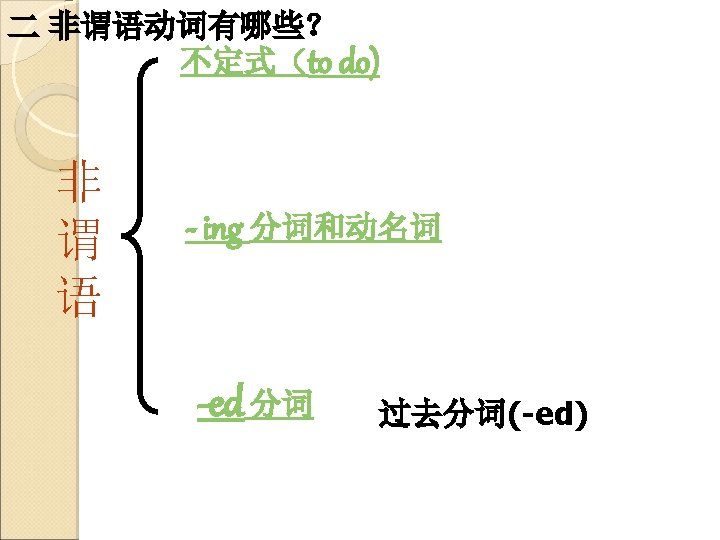
非谓语动词 Non-predicate Verbs
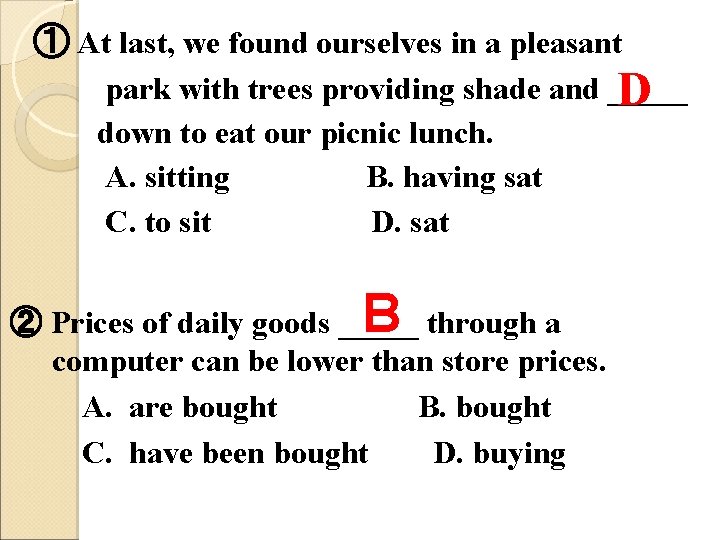
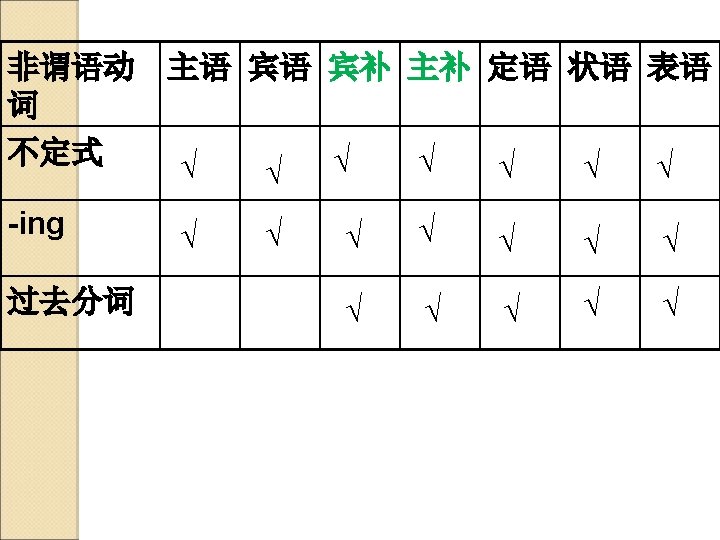
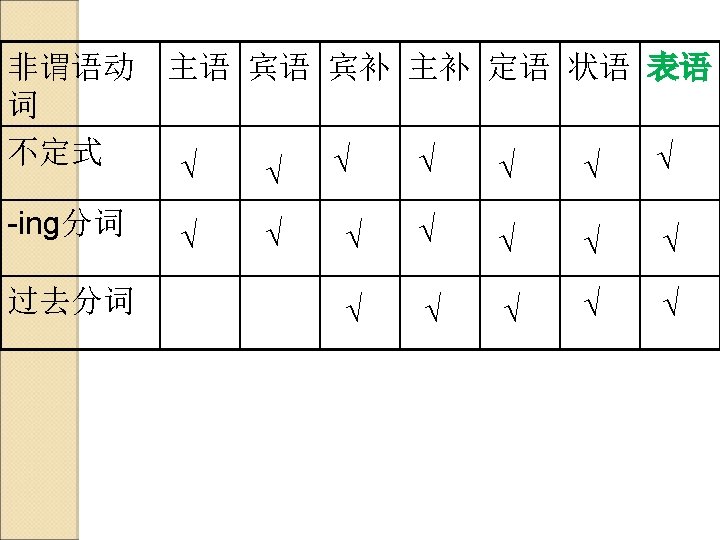
① At last, we found ourselves in a pleasant park with trees providing shade and _____ D down to eat our picnic lunch. A. sitting B. having sat C. to sit D. sat B ② Prices of daily goods _____ through a computer can be lower than store prices. A. are bought B. bought C. have been bought D. buying
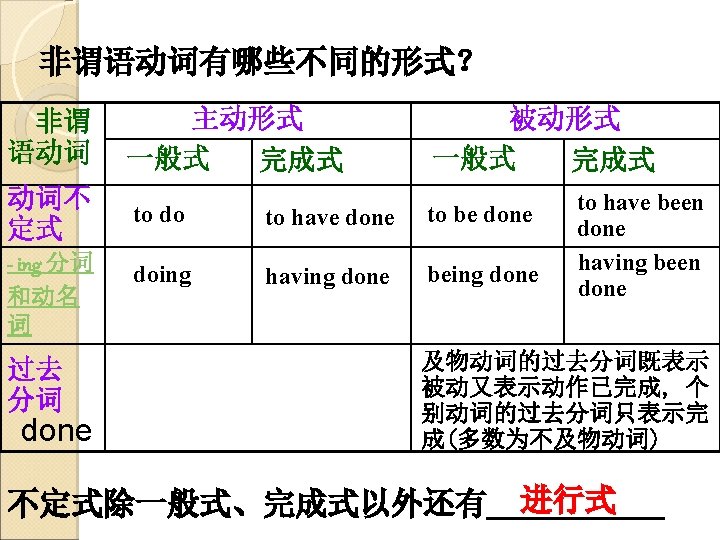
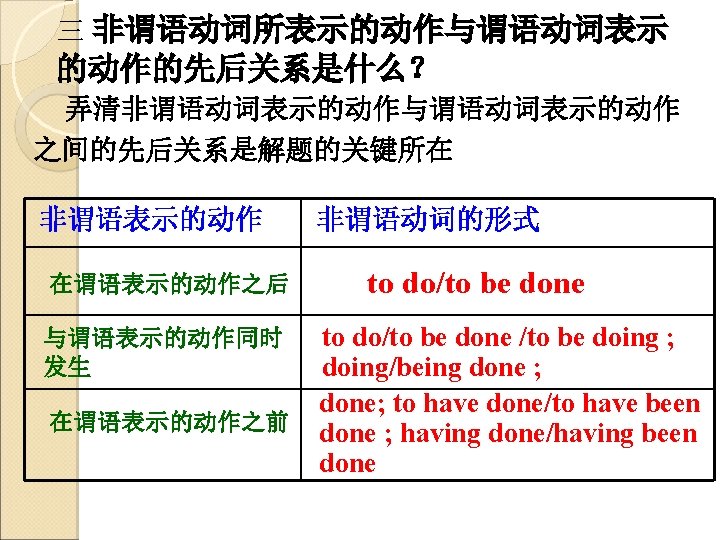
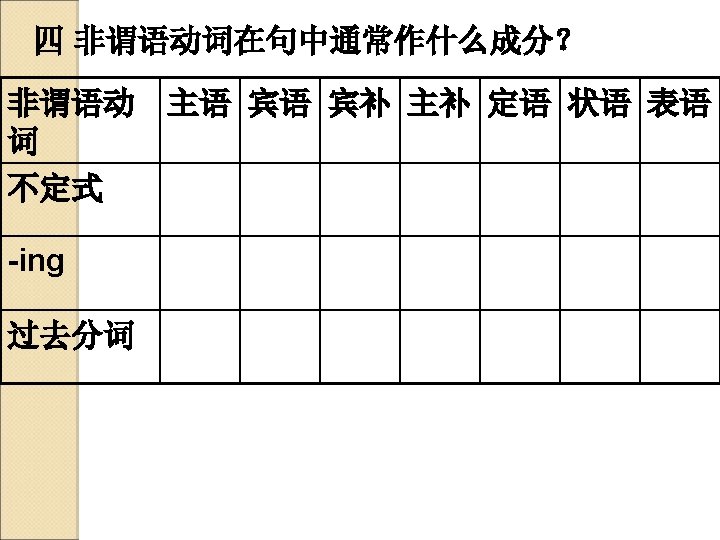
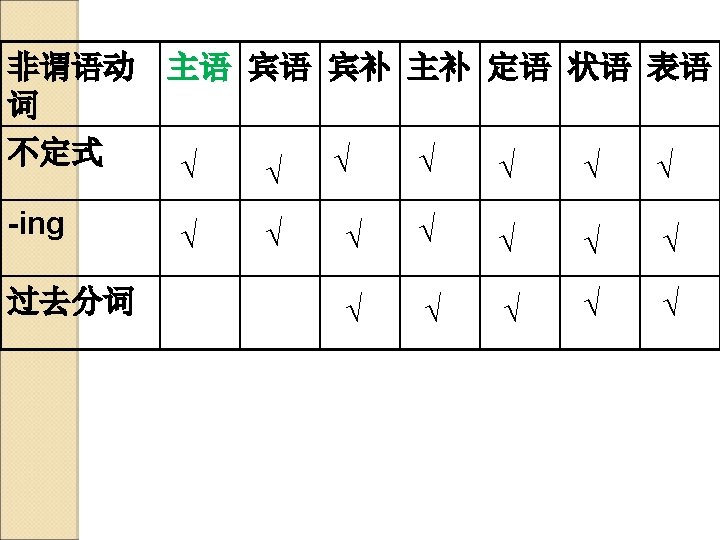
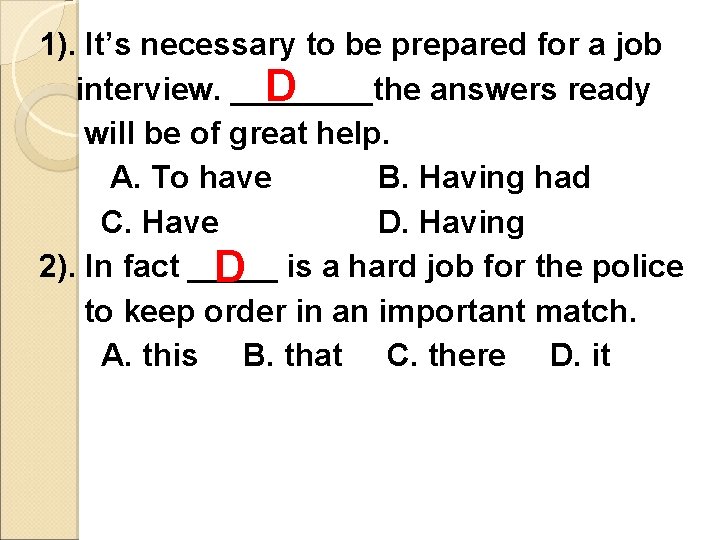
1). It’s necessary to be prepared for a job interview. ____the answers ready D will be of great help. A. To have B. Having had C. Have D. Having 2). In fact _____ D is a hard job for the police to keep order in an important match. A. this B. that C. there D. it
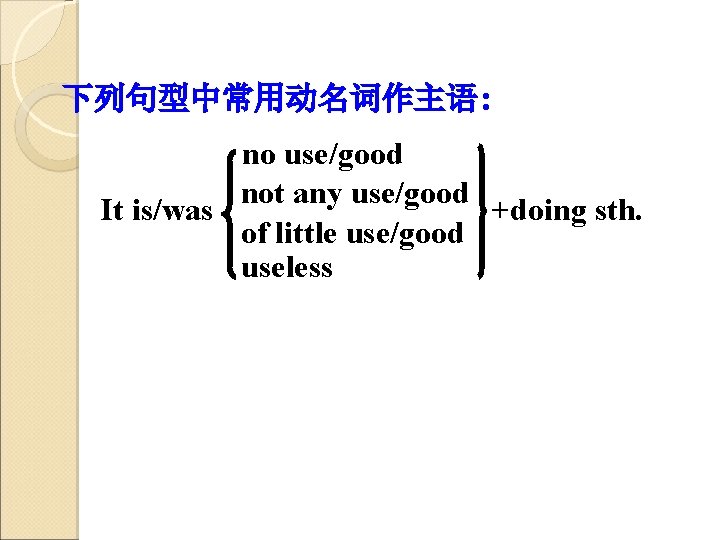
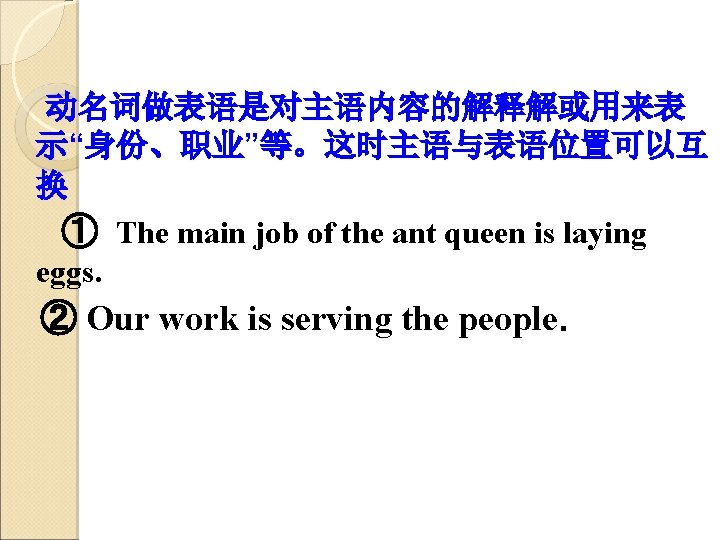
下列句型中常用动名词作主语: no use/good not any use/good It is/was +doing sth. of little use/good useless
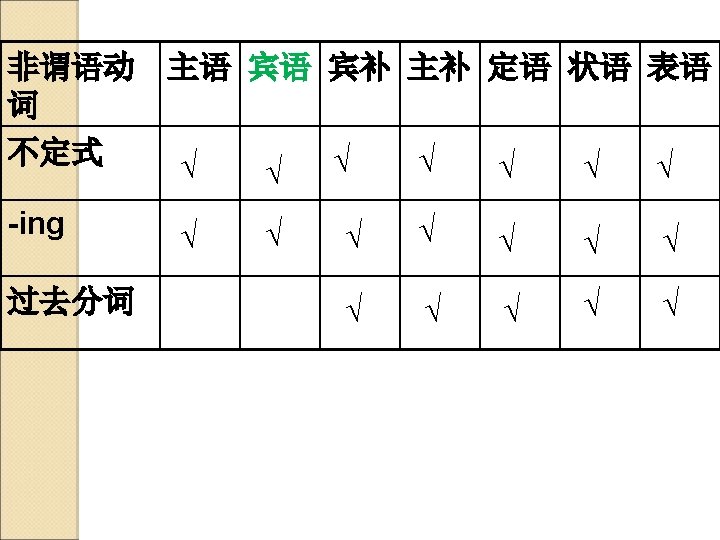

1. 有些动词后只跟不定式作宾语,如: …… manage, promise, pretend, plan, offer, agree, ask, dare, choose, fail, help(帮助), want(想要) , refuse等。 2. 有些动词后只跟动名词作宾语,如: ……practise, appreciate, dislike, excuse, forgive, keep, resist(抵抗、忍耐), risk, deny, advise, fancy, complete, forbid, permit, allow, stand, refer to(喜欢、想…) , give up, lead to, take to(喜欢、养成…习 惯), set about, get down to, object to, succeed in, have difficulty in. . .
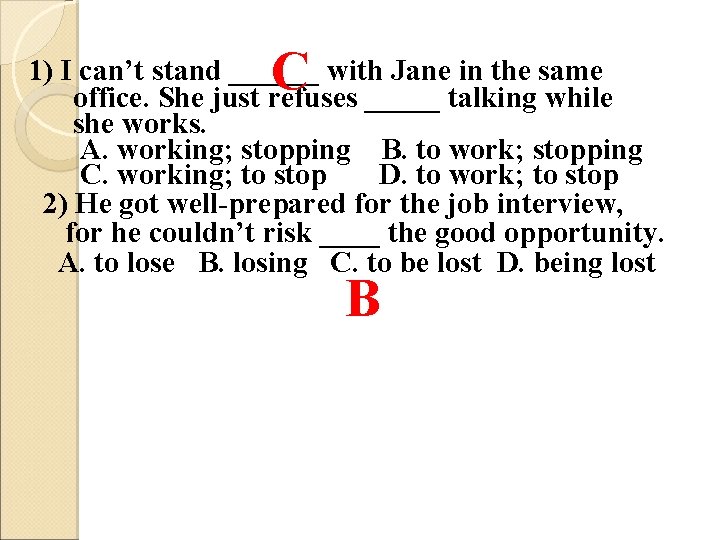
C 1) I can’t stand ______ with Jane in the same office. She just refuses _____ talking while she works. A. working; stopping B. to work; stopping C. working; to stop D. to work; to stop 2) He got well-prepared for the job interview, for he couldn’t risk ____ the good opportunity. A. to lose B. losing C. to be lost D. being lost B
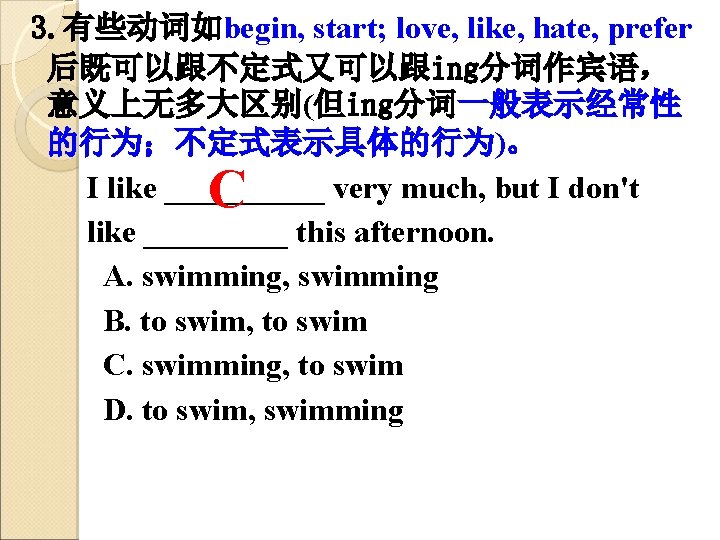
3. 有些动词如begin, start; love, like, hate, prefer 后既可以跟不定式又可以跟ing分词作宾语, 意义上无多大区别(但ing分词一般表示经常性 的行为;不定式表示具体的行为)。 I like _____ very much, but I don't like _____ this afternoon. A. swimming, swimming B. to swim, to swim C. swimming, to swim D. to swim, swimming C
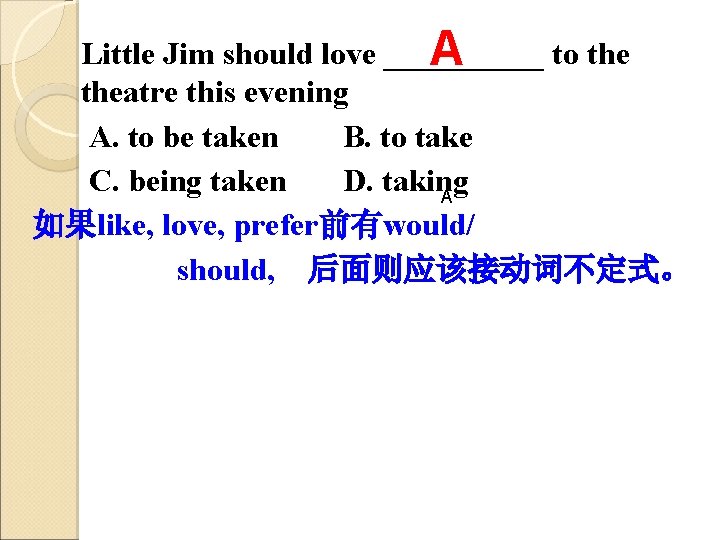
Little Jim should love _____ to the A theatre this evening A. to be taken B. to take C. being taken D. taking A 如果like, love, prefer前有would/ should, 后面则应该接动词不定式。

思考:下列情况中动词后接不定式还是接ing 分词作宾语呢? 1. Only then did I begin _________ (see) she was really good to me. 2. The moment he returned home, I was starting/beginning __________ (cook) supper. 3. The water began ________ (freeze).
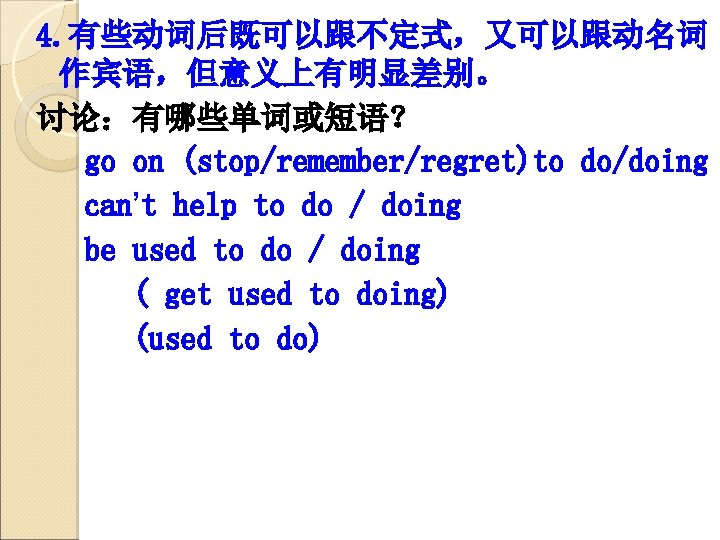
4. 有些动词后既可以跟不定式,又可以跟动名词 作宾语,但意义上有明显差别。 讨论:有哪些单词或短语? go on (stop/remember/regret)to do/doing can’t help to do / doing be used to do / doing ( get used to doing) (used to do)
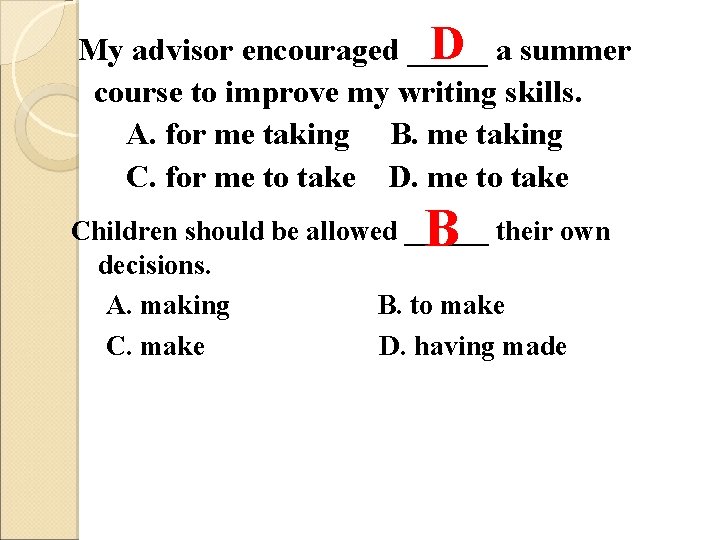
D a summer My advisor encouraged _____ course to improve my writing skills. A. for me taking B. me taking C. for me to take D. me to take B Children should be allowed ______ their own decisions. A. making B. to make C. make D. having made
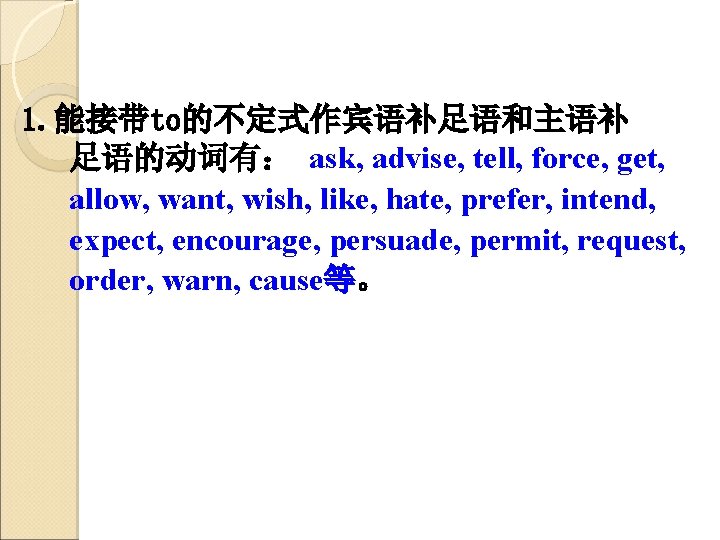
1. 能接带to的不定式作宾语补足语和主语补 足语的动词有: ask, advise, tell, force, get, allow, want, wish, like, hate, prefer, intend, expect, encourage, persuade, permit, request, order, warn, cause等。
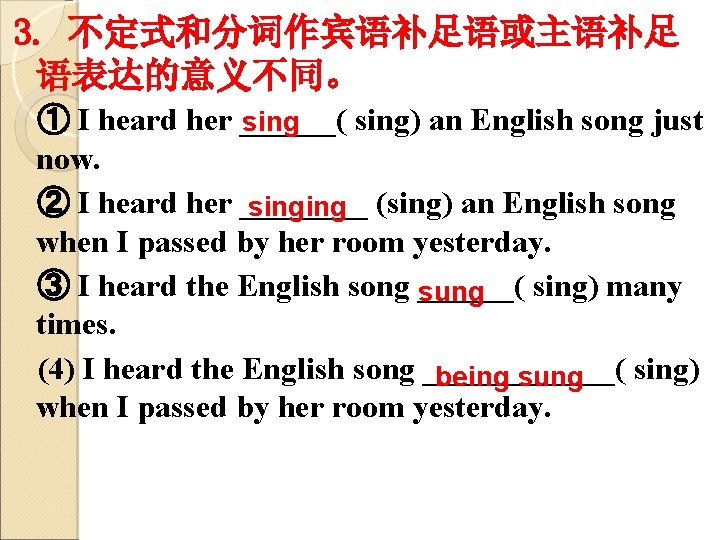
3. 不定式和分词作宾语补足语或主语补足 语表达的意义不同。 ① I heard her ______( sing) an English song just sing now. ② I heard her ____ singing (sing) an English song when I passed by her room yesterday. ③ I heard the English song ______( sing) many sung times. (4) I heard the English song ______( sing) being sung when I passed by her room yesterday.
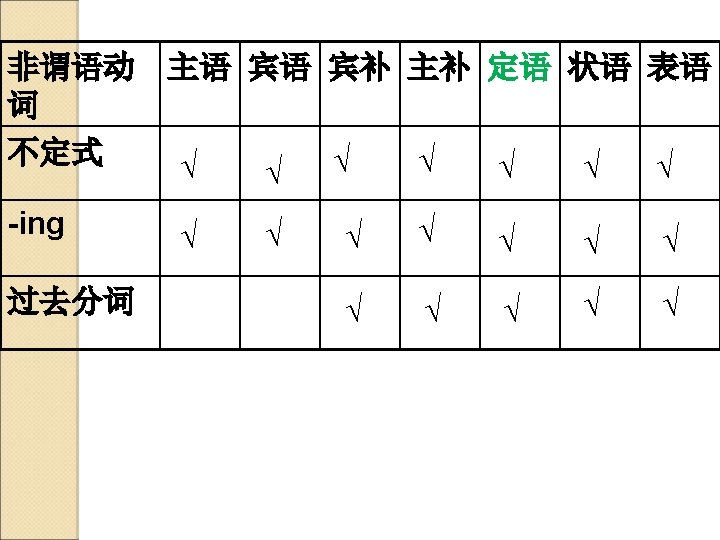
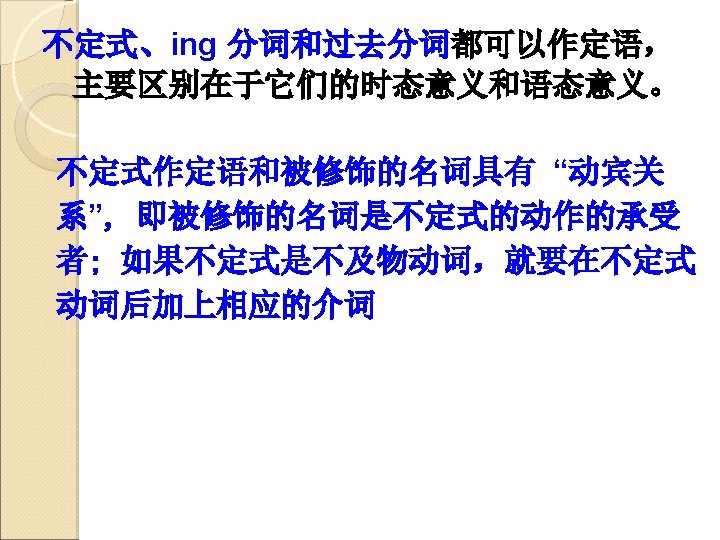
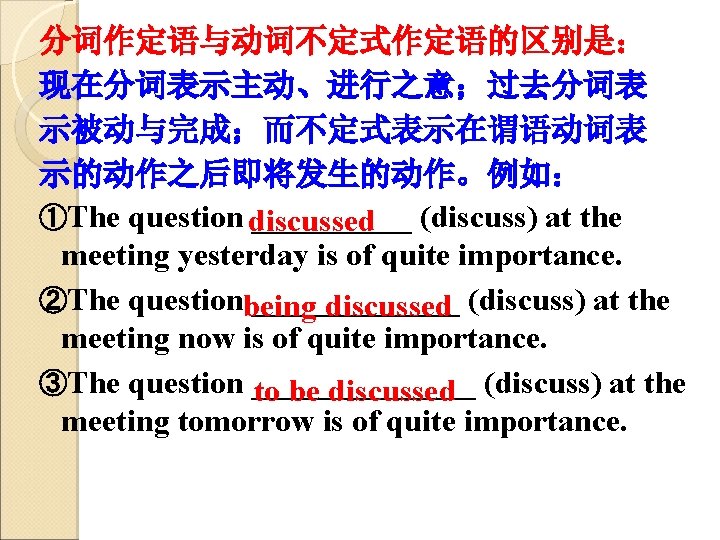
分词作定语与动词不定式作定语的区别是: 现在分词表示主动、进行之意;过去分词表 示被动与完成;而不定式表示在谓语动词表 示的动作之后即将发生的动作。例如: ①The question discussed _____ (discuss) at the meeting yesterday is of quite importance. ②The questionbeing _______ discussed (discuss) at the meeting now is of quite importance. ③The question _______ to be discussed (discuss) at the meeting tomorrow is of quite importance.
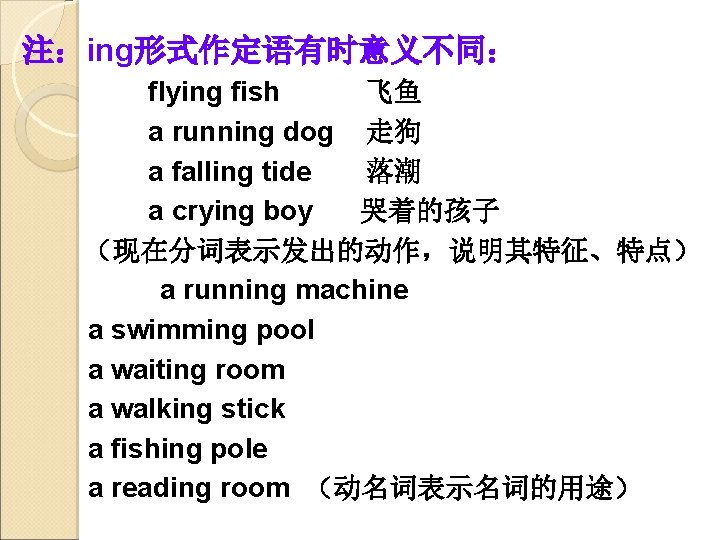
注:ing形式作定语有时意义不同: flying fish 飞鱼 a running dog 走狗 a falling tide 落潮 a crying boy 哭着的孩子 (现在分词表示发出的动作,说明其特征、特点) a running machine a swimming pool a waiting room a walking stick a fishing pole a reading room (动名词表示名词的用途)
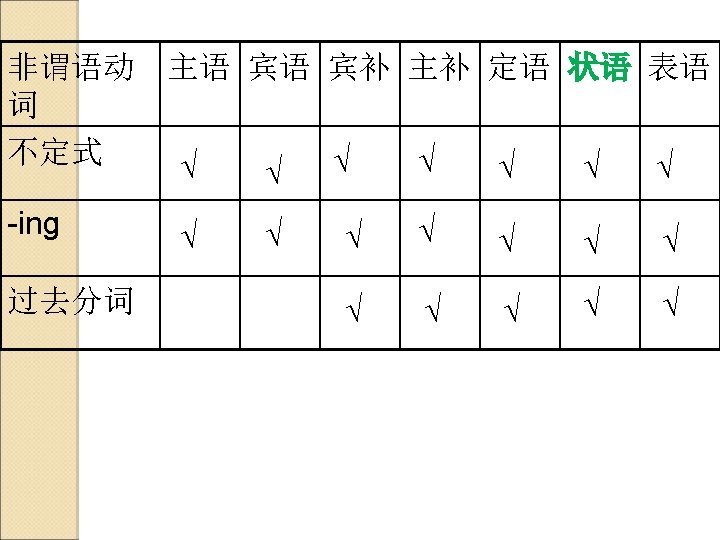
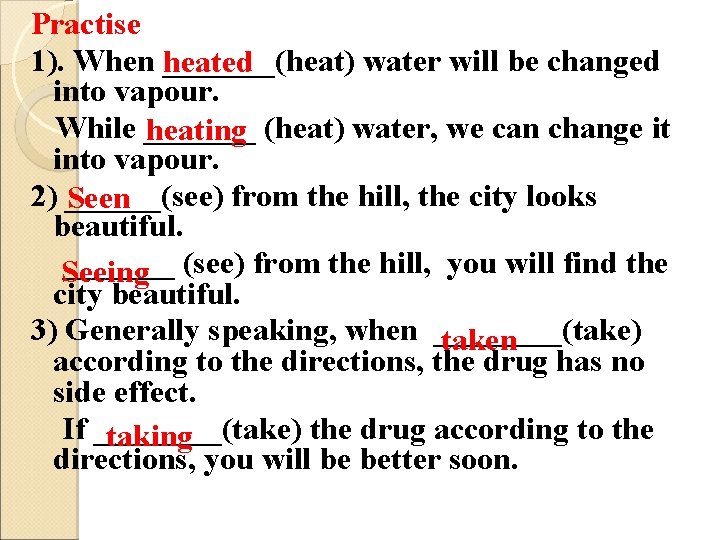
Practise 1). When heated _______(heat) water will be changed into vapour. While _______ heating (heat) water, we can change it into vapour. 2) ______(see) from the hill, the city looks Seen beautiful. _______ (see) from the hill, you will find the Seeing city beautiful. 3) Generally speaking, when ____(take) taken according to the directions, the drug has no side effect. If ____(take) the drug according to the taking directions, you will be better soon.

分词作状语时的逻辑主语问题 分词作状语时,其逻辑主语必须同句子的 主语一致;如果不一致,需在分词前加一个逻辑 主语,分词和它的逻辑主语合称独立主格结构或 用状语从句。(True or false) 1) Being an orphan, the nurse treated him kindly. F 2) He being an orphan, the nurse treated him kindly. T 3) As he was an orphan, the nurse treated him kindly. T
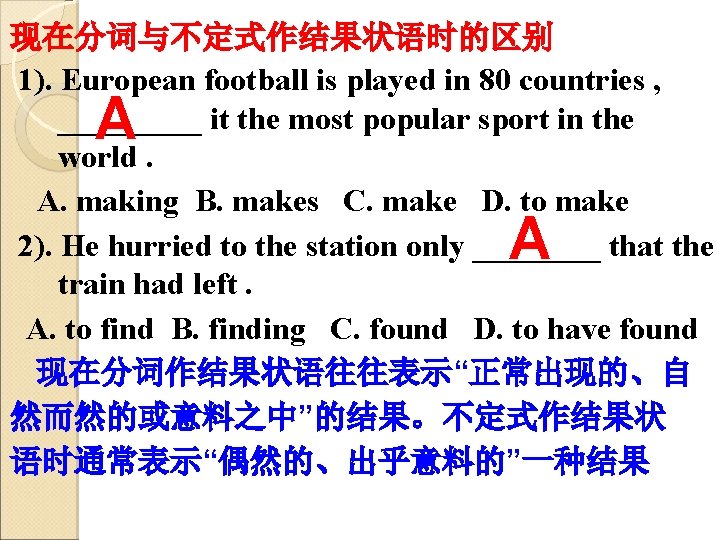
现在分词与不定式作结果状语时的区别 1). European football is played in 80 countries , _____ it the most popular sport in the world. A. making B. makes C. make D. to make 2). He hurried to the station only ____ that the train had left. A. to find B. finding C. found D. to have found 现在分词作结果状语往往表示“正常出现的、自 然而然的或意料之中”的结果。不定式作结果状 语时通常表示“偶然的、出乎意料的”一种结果 A A

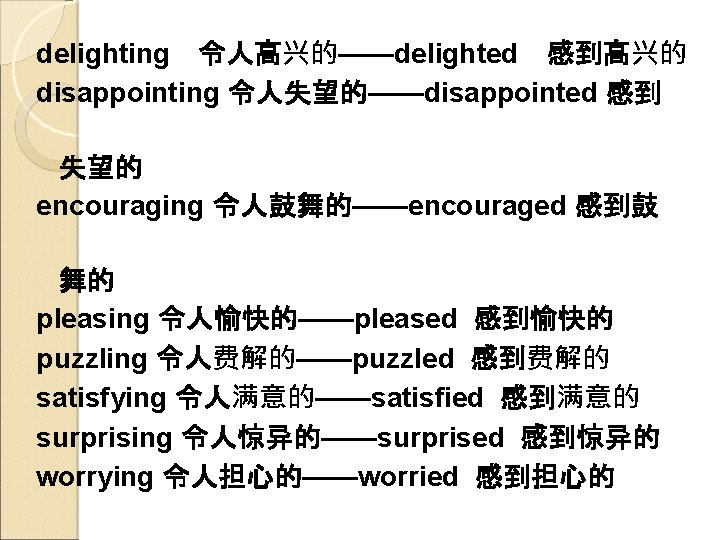
delighting 令人高兴的——delighted 感到高兴的 disappointing 令人失望的——disappointed 感到 失望的 encouraging 令人鼓舞的——encouraged 感到鼓 舞的 pleasing 令人愉快的——pleased 感到愉快的 puzzling 令人费解的——puzzled 感到费解的 satisfying 令人满意的——satisfied 感到满意的 surprising 令人惊异的——surprised 感到惊异的 worrying 令人担心的——worried 感到担心的

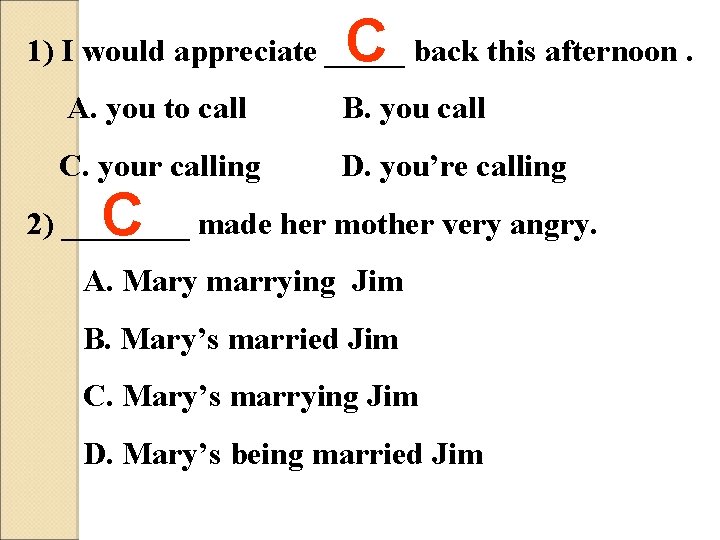
C 1) I would appreciate _____ back this afternoon. A. you to call B. you call C. your calling D. you’re calling C 2) ____ made her mother very angry. A. Mary marrying Jim B. Mary’s married Jim C. Mary’s marrying Jim D. Mary’s being married Jim
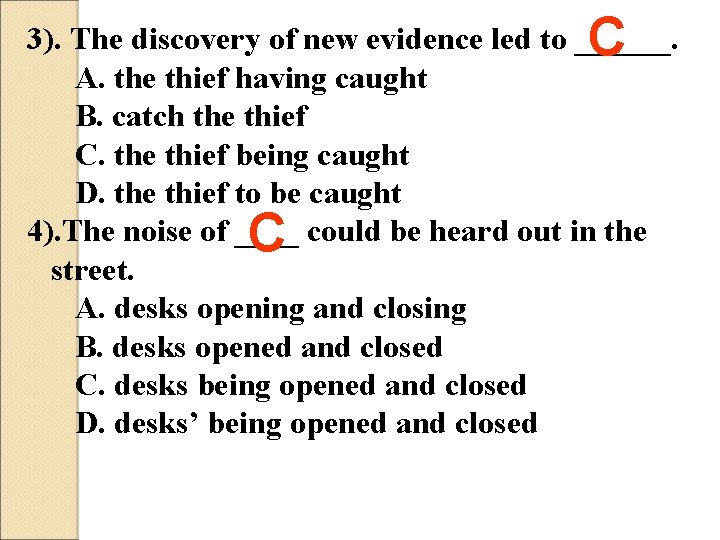
C 3). The discovery of new evidence led to ______. A. the thief having caught B. catch the thief C. the thief being caught D. the thief to be caught 4). The noise of ____ could be heard out in the street. A. desks opening and closing B. desks opened and closed C. desks being opened and closed D. desks’ being opened and closed C
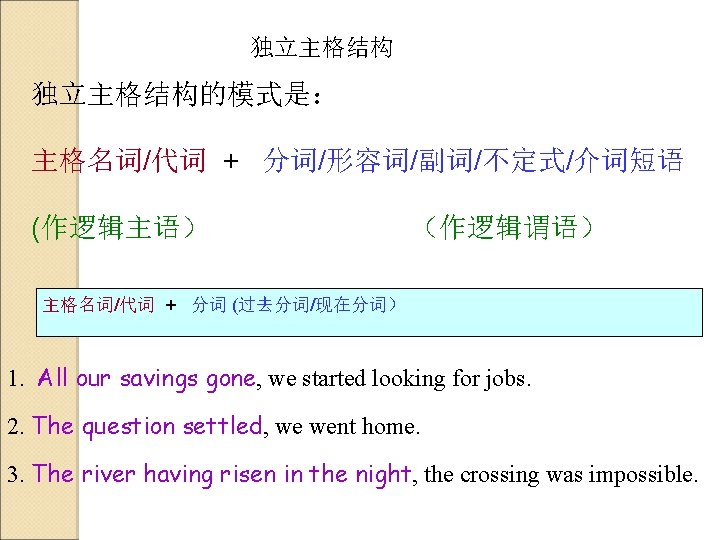
独立主格结构的模式是: 主格名词/代词 + 分词/形容词/副词/不定式/介词短语 (作逻辑主语) (作逻辑谓语) 主格名词/代词 + 分词 (过去分词/现在分词) 1. All our savings gone, we started looking for jobs. 2. The question settled, we went home. 3. The river having risen in the night, the crossing was impossible.
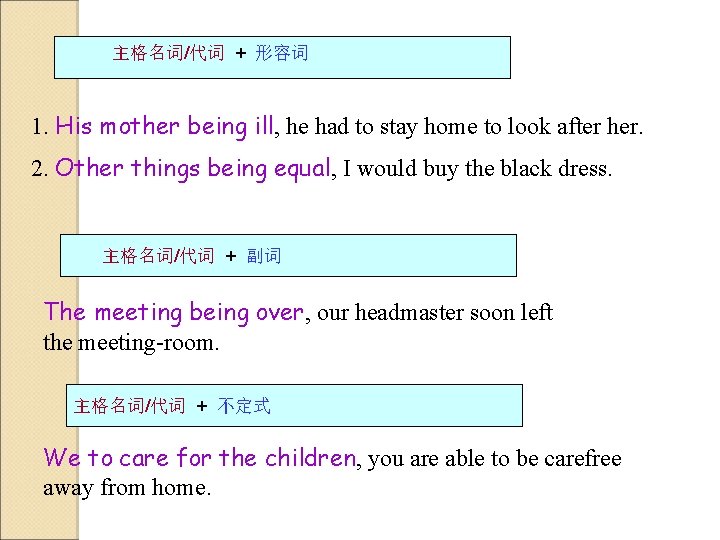
主格名词/代词 + 形容词 1. His mother being ill, he had to stay home to look after her. 2. Other things being equal, I would buy the black dress. 主格名词/代词 + 副词 The meeting being over, our headmaster soon left the meeting-room. 主格名词/代词 + 不定式 We to care for the children, you are able to be carefree away from home.
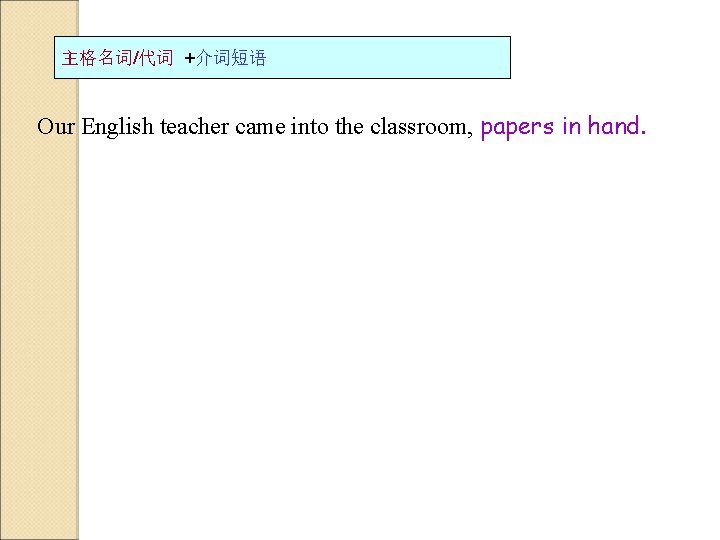
主格名词/代词 +介词短语 Our English teacher came into the classroom, papers in hand.
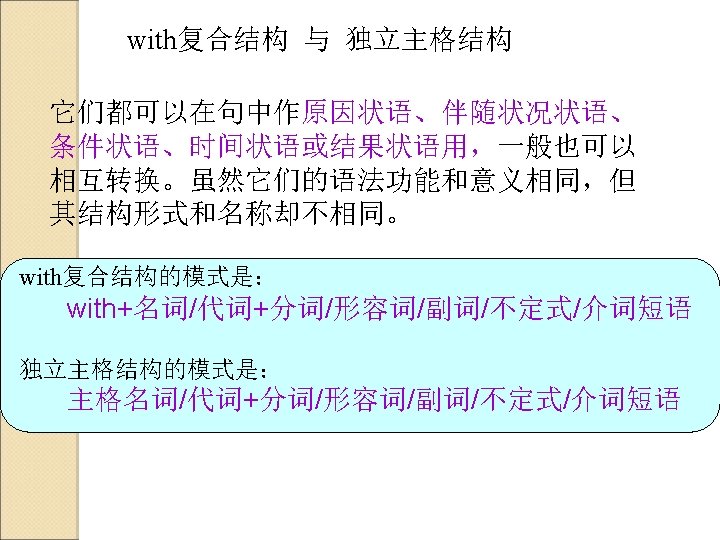
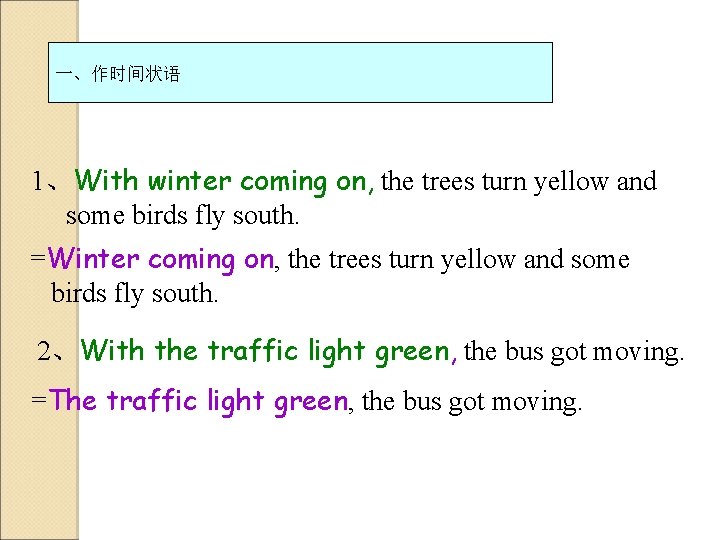
一、作时间状语 1、With winter coming on, the trees turn yellow and some birds fly south. =Winter coming on, the trees turn yellow and some birds fly south. 2、With the traffic light green, the bus got moving. =The traffic light green, the bus got moving.
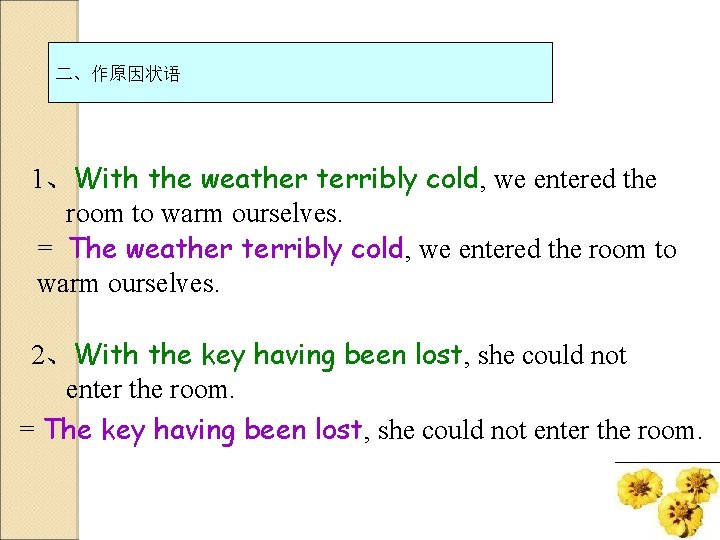
二、作原因状语 1、With the weather terribly cold, we entered the room to warm ourselves. = The weather terribly cold, we entered the room to warm ourselves. 2、With the key having been lost, she could not enter the room. = The key having been lost, she could not enter the room.
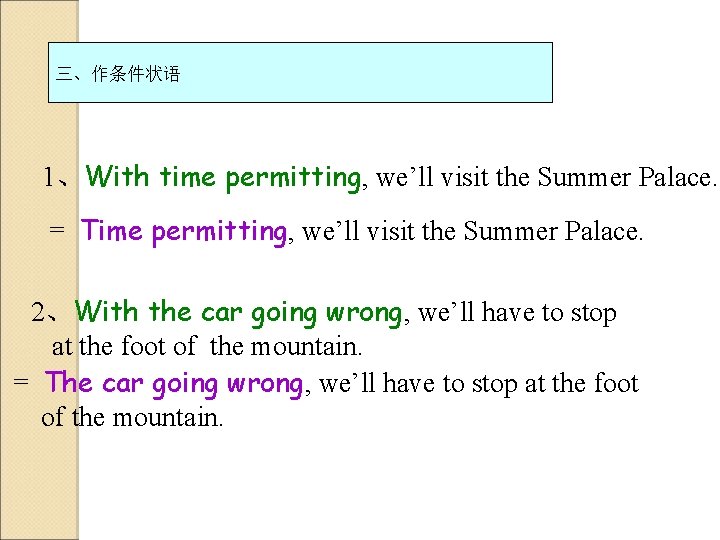
三、作条件状语 1、With time permitting, we’ll visit the Summer Palace. = Time permitting, we’ll visit the Summer Palace. 2、With the car going wrong, we’ll have to stop at the foot of the mountain. = The car going wrong, we’ll have to stop at the foot of the mountain.
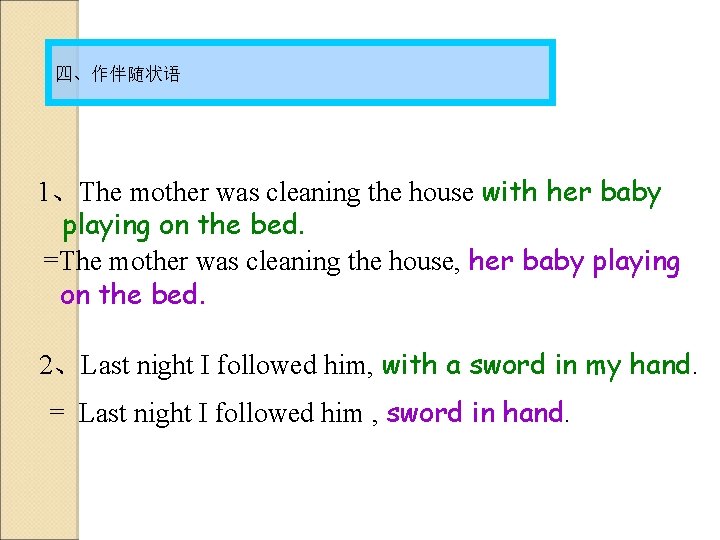
四、作伴随状语 1、The mother was cleaning the house with her baby playing on the bed. =The mother was cleaning the house, her baby playing on the bed. 2、Last night I followed him, with a sword in my hand. = Last night I followed him , sword in hand.
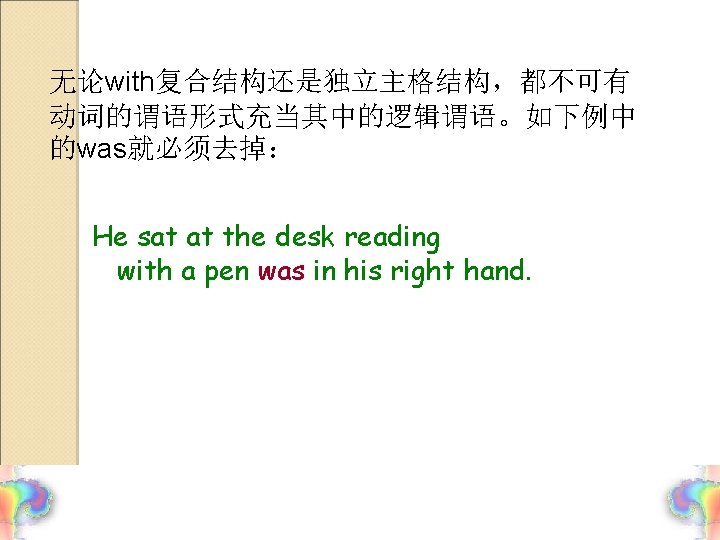
with复合结构可以作后置定语修饰名词,而 独立主格结构则不可作后置定语修饰名词. Soon she arrived at a park with grass green and flowers in blossom. = Soon she arrived at a park whose grass was green and whose flowers were in blossom.
1. All flights_____ D because of the snowstorm, we decided to take the train. A. were canceled B. had been canceled C. having canceled D. having been canceled 2. _____ D for a long time, most of the crops in this area died from lacking water. A. Being no rain B. There was no rain C. To be no rain D. There being no rain B into consideration, they 3. Everything _______ believed themselves more and returned to their positions. A. to take B. taken C. to be taken D. taking
- Slides: 53