
Nonpolar Covalent Bonds Electrons Produces nonpolar molecules such
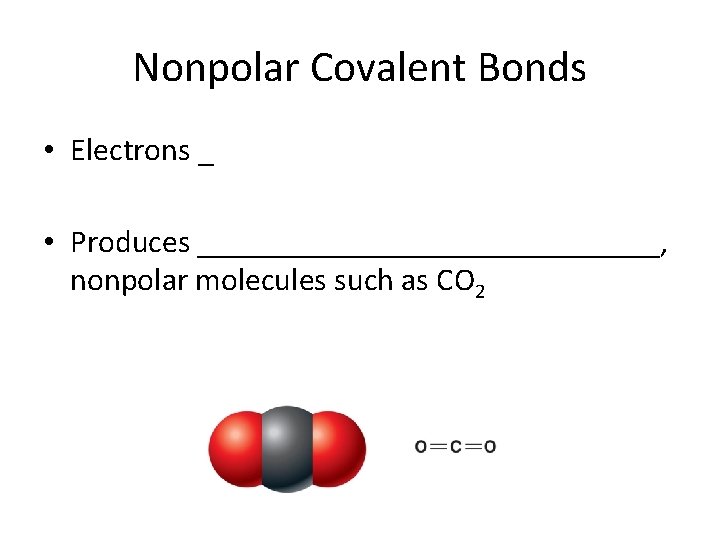
Nonpolar Covalent Bonds • Electrons _ • Produces _______________, nonpolar molecules such as CO 2
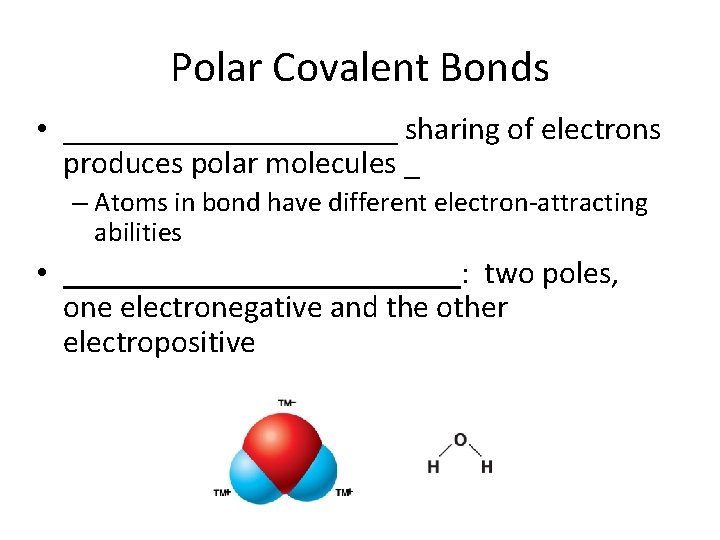
Polar Covalent Bonds • ___________ sharing of electrons produces polar molecules _ – Atoms in bond have different electron-attracting abilities • _____________: two poles, one electronegative and the other electropositive
Hydrogen Bonds ___________________ between electropositive hydrogen of one molecule and an electronegative atom of another molecule • • Common between dipoles such as water • • Maintains 3 -dimensional shape of large molecules •
Patterns of Chemical Reactions • __________________ (combination) reactions • • Exchange reactions
Synthesis Reactions • A + B AB – Atoms or molecules combine to form larger, more complex molecule – –
Decomposition Reactions • AB A + B – Molecule is broken down into smaller molecules or its constituent atoms • – Involve _ –
Exchange Reactions • AB + C AC + B – Also called _ – Involve both _ – Bonds are both made and broken
Oxidation-Reduction (Redox) Reactions • Are decomposition reactions – Reactions in which _ • Are also exchange reactions because _ – Electron donors lose electrons and _ – Electron acceptors receive electrons and _

Please note that due to differing operating systems, some animations will not appear until the presentation is viewed in Presentation Mode (Slide Show view). You may see blank slides in the “Normal” or “Slide Sorter” views. All animations will appear after viewing in Presentation Mode and playing each animation. Most animations will require the latest version of the Flash Player, which is available at http: //get. adobe. com/flashplayer.
Reversibility of Chemical Reactions • All chemical reactions are _ – A + B AB – AB A + B • ____________________ occurs if neither a forward nor reverse reaction is dominant • Many biological reactions are essentially irreversible – Due to _
Rate of Chemical Reactions • Affected by – – Concentration of reactant Rate – – _________________: Rate without being chemically changed or part of product •
Classes of Compounds • Inorganic compounds • Water, salts, and many acids and bases • Do not contain _ • Organic compounds • • Contain carbon, usually large, and are covalently bonded • Both equally essential for life
Water in Living Organisms • Most _ – 60%– 80% volume of living cells • Most important inorganic compound – Due to water’s properties
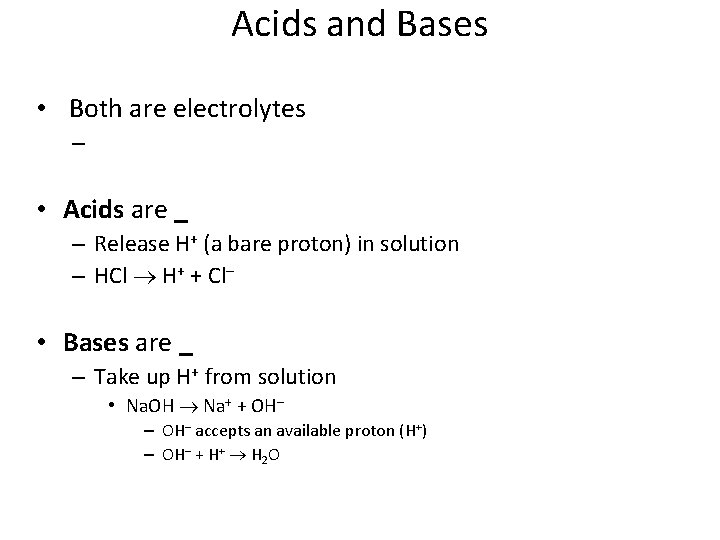
Acids and Bases • Both are electrolytes – • Acids are _ – Release H+ (a bare proton) in solution – HCl H+ + Cl– • Bases are _ – Take up H+ from solution • Na. OH Na+ + OH– – OH– accepts an available proton (H+) – OH– + H+ H 2 O
![p. H: Acid-base Concentration – Relative free [H+] of a solution measured on p.](http://slidetodoc.com/presentation_image_h2/ab6bae1b96301ea5abf8efff620068e1/image-15.jpg "p. H: Acid-base Concentration – Relative free [H+] of a solution measured on p.")
p. H: Acid-base Concentration – Relative free [H+] of a solution measured on p. H scale – As free [H+] increases, _ • [OH–] decreases as [H+] increases • – As free [H+] decreases _ • [OH–] increases as [H+] decreases •
![p. H: Acid-base Concentration • p. H = negative logarithm of [H+] in moles](http://slidetodoc.com/presentation_image_h2/ab6bae1b96301ea5abf8efff620068e1/image-16.jpg "p. H: Acid-base Concentration • p. H = negative logarithm of [H+] in moles")
p. H: Acid-base Concentration • p. H = negative logarithm of [H+] in moles per liter • p. H scale ranges from 0– 14 • Because p. H scale is logarithmic –
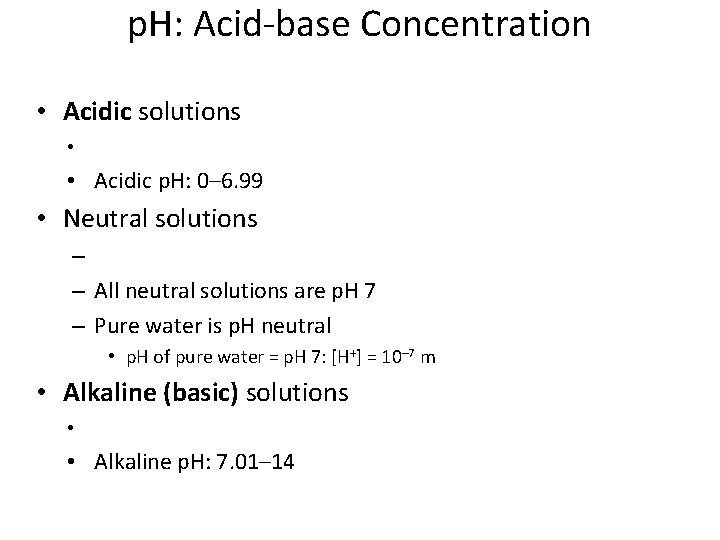
p. H: Acid-base Concentration • Acidic solutions • • Acidic p. H: 0– 6. 99 • Neutral solutions – – All neutral solutions are p. H 7 – Pure water is p. H neutral • p. H of pure water = p. H 7: [H+] = 10– 7 m • Alkaline (basic) solutions • • Alkaline p. H: 7. 01– 14
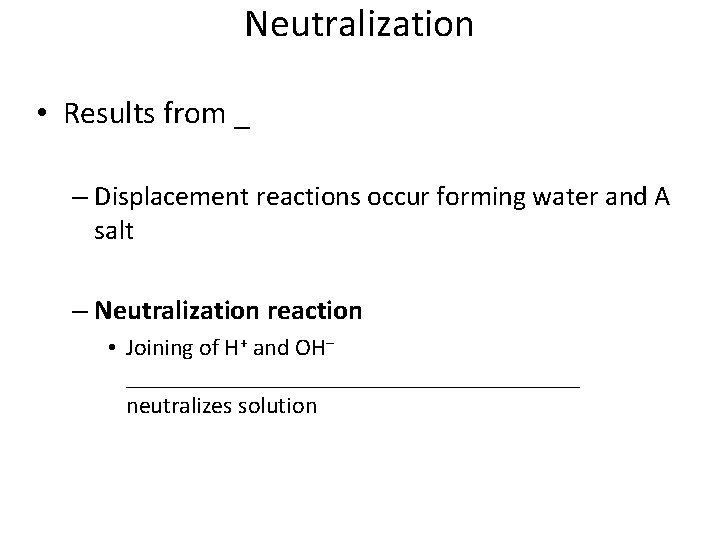
Neutralization • Results from _ – Displacement reactions occur forming water and A salt – Neutralization reaction • Joining of H+ and OH– ___________________ neutralizes solution
Acid-base Homeostasis • p. H change ___________________ and may damage living tissue • Even _ • p. H is regulated by kidneys, lungs, and chemical buffers
Buffers • Acidity reflects only _ – Not those bound to anions • ________________ resist abrupt and large swings in p. H – Release hydrogen ions if p. H rises – Bind hydrogen ions if p. H falls • Convert strong (completely dissociated) acids or bases _ • Carbonic acid-bicarbonate system (important buffer system of blood)
Organic Compounds • Molecules that contain carbon – Except ________________, which are considered inorganic – Carbon is electroneutral • • Forms four covalent bonds with other elements • Unique to living systems • Carbohydrates, lipids, proteins, and nucleic acids
Organic Compounds • Many are _ – Chains of ______________ called monomers (____________) • Synthesized by _ • Broken down by _
Carbohydrates • • Sugars and starches Polymers Contain C, H, and O Three classes – – one sugar – – two sugars – – many sugars
Carbohydrates • Functions of carbohydrates – Major source of _ – – Structural molecules –
Monosaccharides • Simple sugars containing three to seven C atoms • Monomers of carbohydrates • Important monosaccharides – • Glucose (blood sugar)
Disaccharides • Double sugars • _________________ to pass through cell membranes • Important disaccharides –
Polysaccharides • Polymers of monosaccharides • Important polysaccharides – • Not _
Lipids • Contain C, H, O (less than in carbohydrates), and sometimes P • • Main types: – Neutral fats or _ – – Steroids – Eicosanoids
Neutral Fats or Triglycerides • Called _____________ when solid and __________when liquid • Composed of _________________ bonded to _ • Main functions – Energy storage – Insulation – Protection
Saturation of Fatty Acids • Saturated fatty acids – ________________________ between C atoms • Maximum number of H atoms – • Unsaturated fatty acids – __________________________ between C atoms • Reduced number of H atoms – Plant oils, e. g. , olive oil – “Heart healthy” • Trans fats – _ • Omega-3 fatty acids – “heart healthy”
Phospholipids • Modified triglycerides: – Glycerol + two fatty acids and _ • “Head” and “tail” regions have different properties • Important in _
Steroids • interlocking four-ring structure • _______________, vitamin D, steroid hormones, and bile salts • Most important steroid – Cholesterol • Important in _________________, vitamin D synthesis, steroid hormones, and bile salts
Eicosanoids • Many different ones • Derived from a fatty acid (arachidonic acid) in cell membranes • Most important eicosanoid – • Role in __________________, control of blood pressure, __________________, and labor contractions
Other Lipids in the Body • Other fat-soluble vitamins – Vitamins A, D, E, and K • Lipoproteins – Transport fats in the blood
Proteins • Contain C, H, O, N, and sometimes S and P • • ________________________ (20 types) are the monomers in proteins – Joined by _ – Contain amine group and acid group – Can act as either _ – All identical except for “R group”
Primary Structure of Protein • The _________in which the amino acids are arranged
Secondary Structure of Protein • The shapes that the polypeptide chain takes –
Tertiary Structure of Protein • The _
Quaternary Protein • A combination of _ • Not all proteins will reach this stage. Some are fully _
Fibrous and Globular Proteins • __________________ proteins – Strandlike, _ – Most have tertiary or quaternary structure (3 -D) – Provide _ – Examples: keratin, elastin, collagen (single most abundant protein in body), and certain contractile fibers
Fibrous and Globular Proteins • – Compact, ______________, water -soluble and sensitive to environmental changes – Tertiary or quaternary structure (3 -D) – Specific _________________ (active sites) – Examples: antibodies, hormones, molecular chaperones, and enzymes
Protein Denaturation • – Globular proteins _ • Active sites destroyed – Can be cause by _ • Usually reversible if normal conditions restored • Irreversible if changes extreme – e. g. , cooking an egg
Enzymes • – Globular proteins that act as _ • Regulate and increase speed of chemical reactions – Lower the activation energy, increase the speed of a reaction – millions of reactions per minute
Characteristics of Enzymes • Enzymes are specific – Act on specific _ • Usually end in _ • Often named for the _ – Hydrolases, oxidases
Nucleic Acids • Deoxyribonucleic acid (DNA) and ribonucleic acid (RNA) – • Contain C, O, H, N, and P • Polymers – Monomer = • Composed of
Deoxyribonucleic Acid (DNA) • Utilizes four nitrogen bases: – ____________: Adenine (A), Guanine (G) – ____________: Cytosine (C), and Thymine (T) – Base-pair rule – each base pairs with its _ – A always pairs with T; G always pairs with C • Double-stranded helical molecule in the cell nucleus • Pentose sugar is _ • Provides _________________ for protein synthesis • ____________________ ensuring genetic continuity
Ribonucleic Acid (RNA) • Four bases: – Adenine (A), Guanine (G), Cytosine (C), and _ • Pentose sugar is _ • ____________________ molecule mostly active outside the nucleus • Three varieties of RNA carry out the DNA orders for protein synthesis – – –
Adenosine Triphosphate (ATP) • Chemical energy in glucose captured in this important molecule • Directly ___________________ in cells • Energy form immediately useable by all body cells • Structure of ATP – Adenine-containing RNA nucleotide with two additional phosphate groups
- Slides: 48