
Nonparametric Statistics Exact test Sign Test 2 test
- Slides: 43
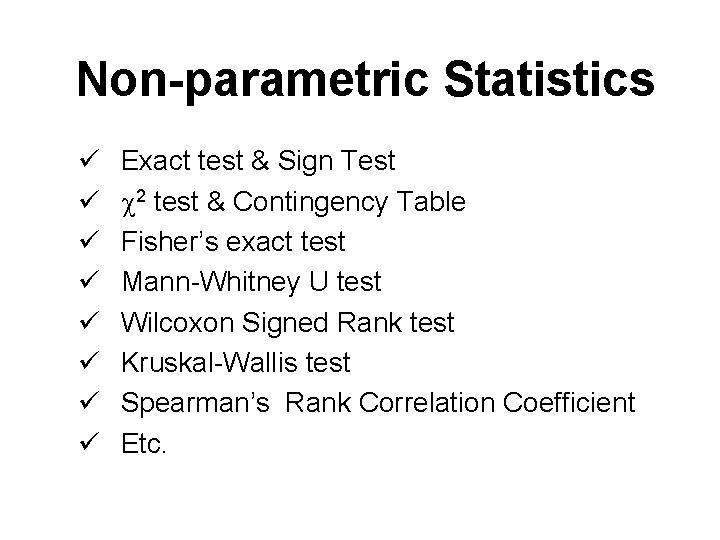
Non-parametric Statistics ü ü ü ü Exact test & Sign Test 2 test & Contingency Table Fisher’s exact test Mann-Whitney U test Wilcoxon Signed Rank test Kruskal-Wallis test Spearman’s Rank Correlation Coefficient Etc.
Why do we use nonparametric tests? Parametric tests <are robust and versatile; <are versatile to tests two or more variable & their interactions; <use in several experimental designs;
Why do we use nonparametric tests? Parametric tests = can’t use when data are extreme violation of = = assumptions; is inappropriate if scaling of data is not properly made so. can’t use when data are extreme violation of assumptions; Ø Skewed data or data are not in normal distribution = is inappropriate if scaling of data is not properly made so. Ø Data are measured in nominal or rank scales
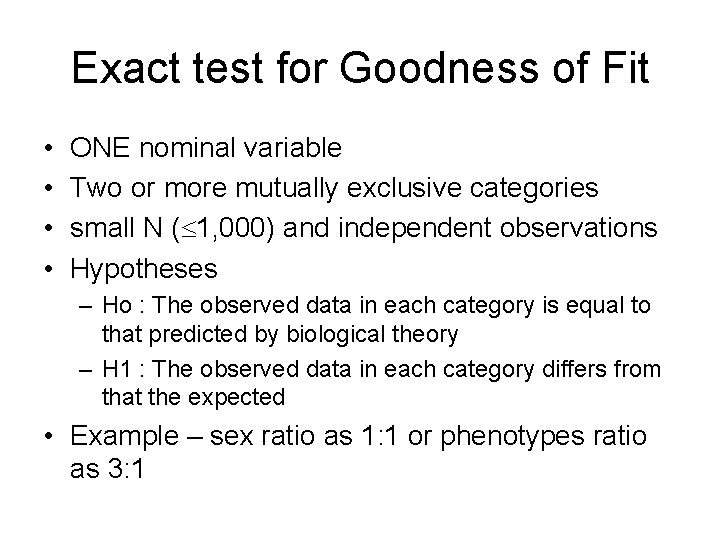
Exact test for Goodness of Fit • • ONE nominal variable Two or more mutually exclusive categories small N ( 1, 000) and independent observations Hypotheses – Ho : The observed data in each category is equal to that predicted by biological theory – H 1 : The observed data in each category differs from that the expected • Example – sex ratio as 1: 1 or phenotypes ratio as 3: 1
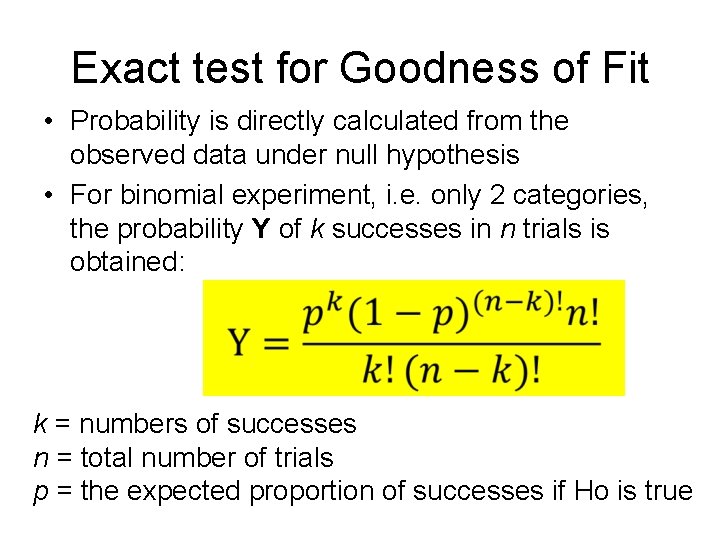
Exact test for Goodness of Fit • Probability is directly calculated from the observed data under null hypothesis • For binomial experiment, i. e. only 2 categories, the probability Y of k successes in n trials is obtained: k = numbers of successes n = total number of trials p = the expected proportion of successes if Ho is true
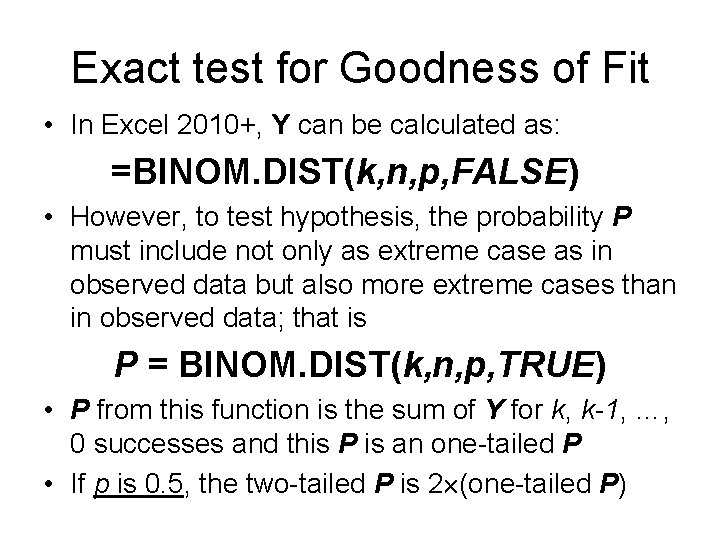
Exact test for Goodness of Fit • In Excel 2010+, Y can be calculated as: =BINOM. DIST(k, n, p, FALSE) • However, to test hypothesis, the probability P must include not only as extreme case as in observed data but also more extreme cases than in observed data; that is P = BINOM. DIST(k, n, p, TRUE) • P from this function is the sum of Y for k, k-1, …, 0 successes and this P is an one-tailed P • If p is 0. 5, the two-tailed P is 2 (one-tailed P)
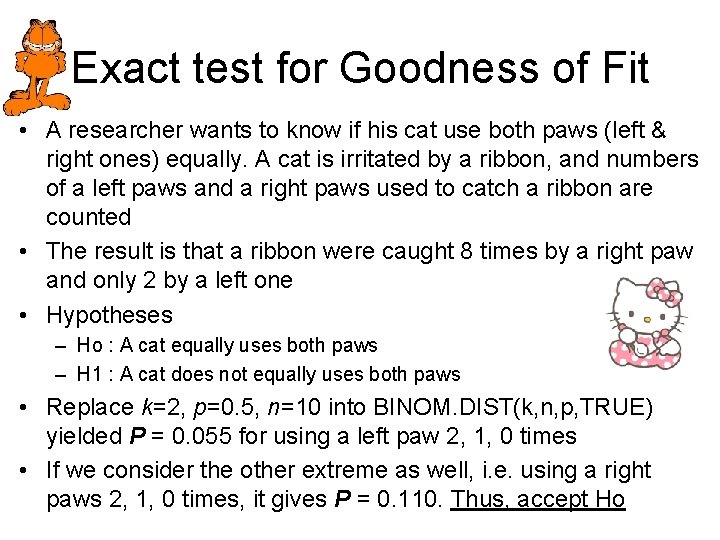
Exact test for Goodness of Fit • A researcher wants to know if his cat use both paws (left & right ones) equally. A cat is irritated by a ribbon, and numbers of a left paws and a right paws used to catch a ribbon are counted • The result is that a ribbon were caught 8 times by a right paw and only 2 by a left one • Hypotheses – Ho : A cat equally uses both paws – H 1 : A cat does not equally uses both paws • Replace k=2, p=0. 5, n=10 into BINOM. DIST(k, n, p, TRUE) yielded P = 0. 055 for using a left paw 2, 1, 0 times • If we consider the other extreme as well, i. e. using a right paws 2, 1, 0 times, it gives P = 0. 110. Thus, accept Ho
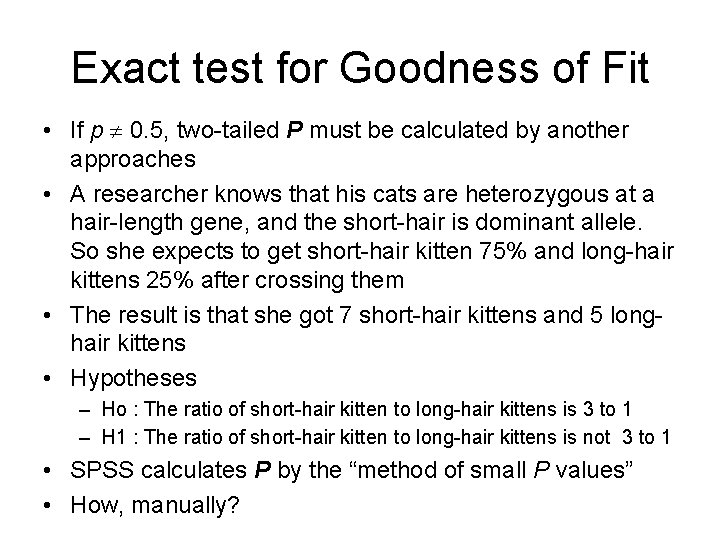
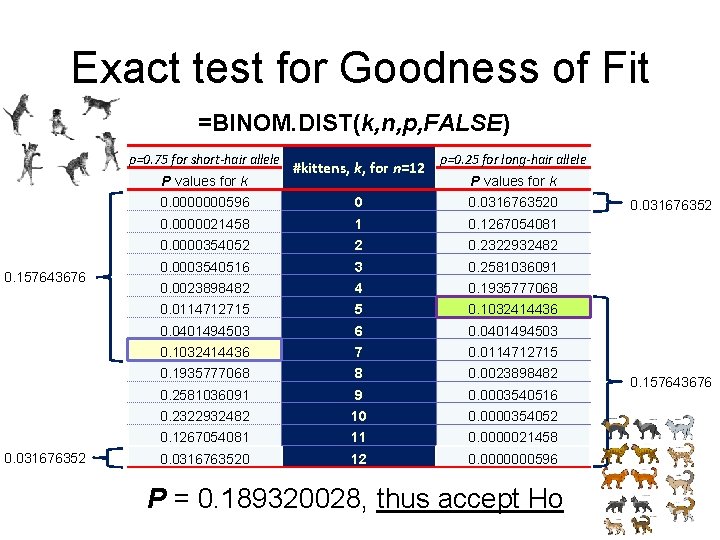
Exact test for Goodness of Fit • If p 0. 5, two-tailed P must be calculated by another approaches • A researcher knows that his cats are heterozygous at a hair-length gene, and the short-hair is dominant allele. So she expects to get short-hair kitten 75% and long-hair kittens 25% after crossing them • The result is that she got 7 short-hair kittens and 5 longhair kittens • Hypotheses – Ho : The ratio of short-hair kitten to long-hair kittens is 3 to 1 – H 1 : The ratio of short-hair kitten to long-hair kittens is not 3 to 1 • SPSS calculates P by the “method of small P values” • How, manually?
Exact test for Goodness of Fit =BINOM. DIST(k, n, p, FALSE) p=0. 75 for short-hair allele P values for k 0. 157643676 0. 031676352 #kittens, k, for n=12 p=0. 25 for long-hair allele P values for k 0. 0000000596 0 0. 0316763520 0. 0000021458 1 0. 1267054081 0. 0000354052 2 0. 2322932482 0. 0003540516 3 0. 2581036091 0. 0023898482 4 0. 1935777068 0. 0114712715 5 0. 1032414436 0. 0401494503 0. 1032414436 7 0. 0114712715 0. 1935777068 8 0. 0023898482 0. 2581036091 9 0. 0003540516 0. 2322932482 10 0. 0000354052 0. 1267054081 11 0. 0000021458 0. 0316763520 12 0. 0000000596 P = 0. 189320028, thus accept Ho 0. 031676352 0. 157643676
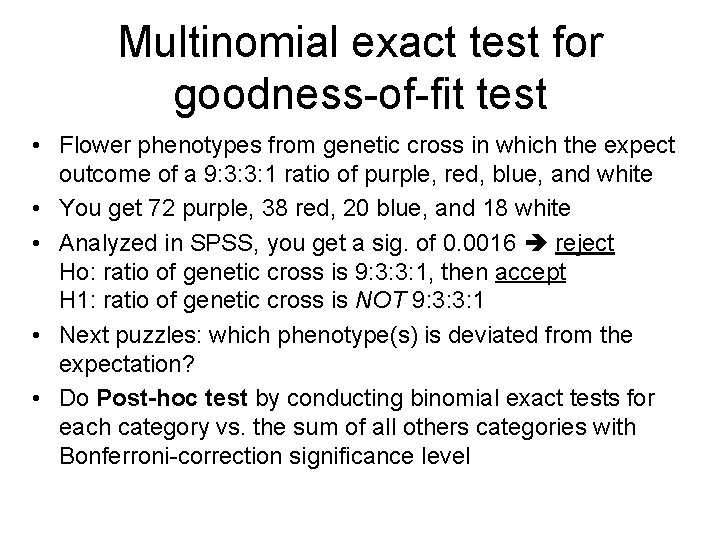
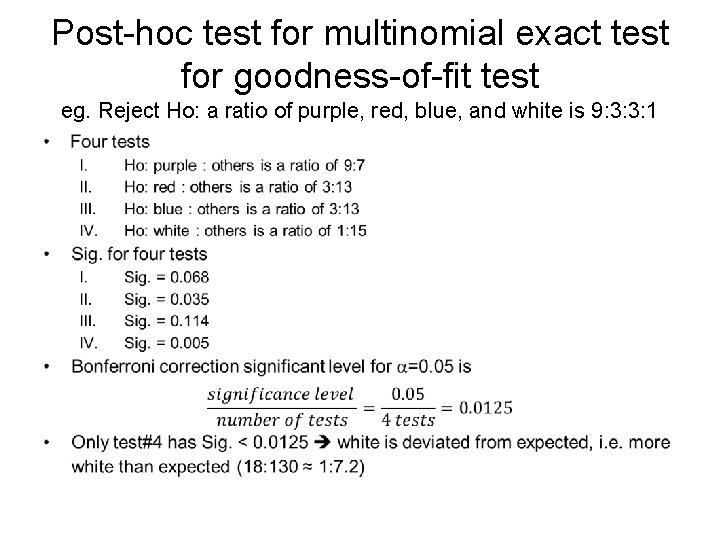
Multinomial exact test for goodness-of-fit test • Flower phenotypes from genetic cross in which the expect outcome of a 9: 3: 3: 1 ratio of purple, red, blue, and white • You get 72 purple, 38 red, 20 blue, and 18 white • Analyzed in SPSS, you get a sig. of 0. 0016 reject Ho: ratio of genetic cross is 9: 3: 3: 1, then accept H 1: ratio of genetic cross is NOT 9: 3: 3: 1 • Next puzzles: which phenotype(s) is deviated from the expectation? • Do Post-hoc test by conducting binomial exact tests for each category vs. the sum of all others categories with Bonferroni-correction significance level
Post-hoc test for multinomial exact test for goodness-of-fit test eg. Reject Ho: a ratio of purple, red, blue, and white is 9: 3: 3: 1 •
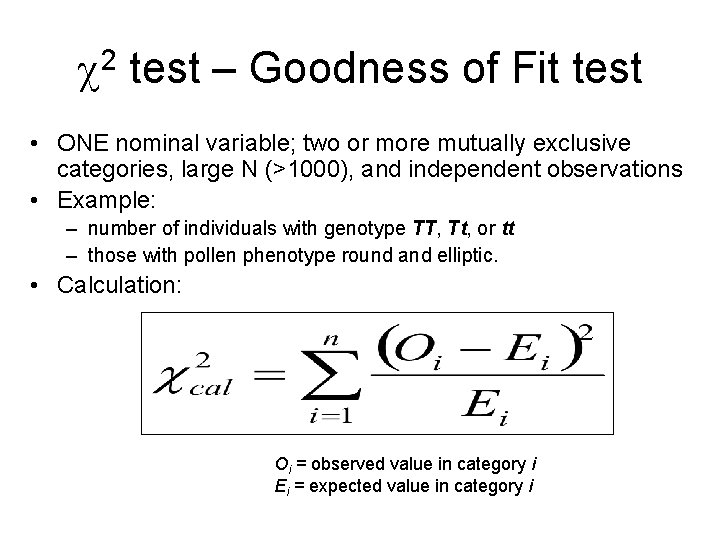
2 test – Goodness of Fit test • ONE nominal variable; two or more mutually exclusive categories, large N (>1000), and independent observations • Example: – number of individuals with genotype TT, Tt, or tt – those with pollen phenotype round and elliptic. • Calculation: Oi = observed value in category i Ei = expected value in category i
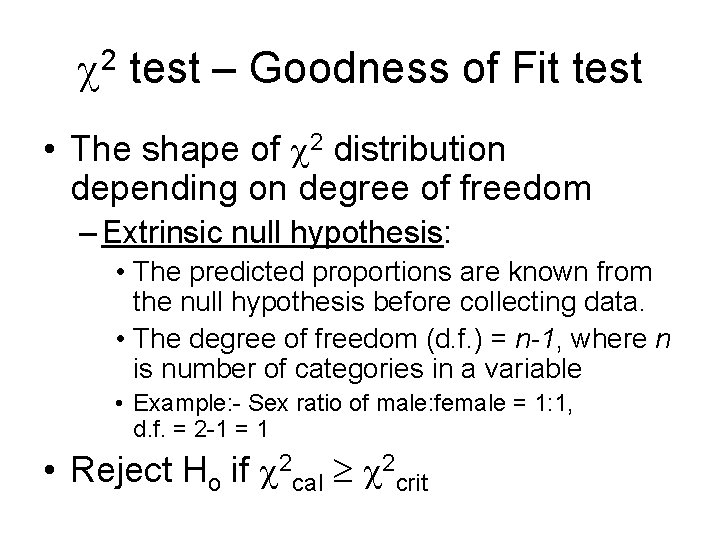
2 test – Goodness of Fit test • The shape of 2 distribution depending on degree of freedom – Extrinsic null hypothesis: • The predicted proportions are known from the null hypothesis before collecting data. • The degree of freedom (d. f. ) = n-1, where n is number of categories in a variable • • Example: - Sex ratio of male: female = 1: 1, d. f. = 2 -1 = 1 Reject Ho if 2 cal 2 crit
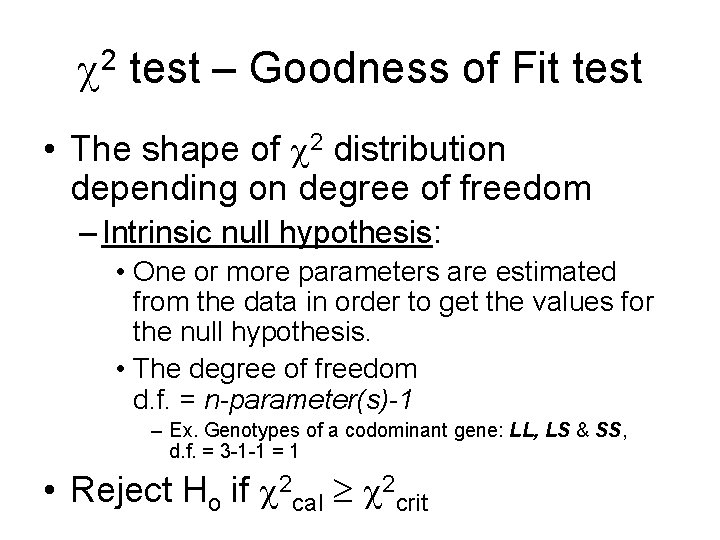
2 test – Goodness of Fit test • The shape of 2 distribution depending on degree of freedom – Intrinsic null hypothesis: • One or more parameters are estimated from the data in order to get the values for the null hypothesis. • The degree of freedom d. f. = n-parameter(s)-1 – Ex. Genotypes of a codominant gene: LL, LS & SS, d. f. = 3 -1 -1 = 1 • Reject Ho if 2 cal 2 crit
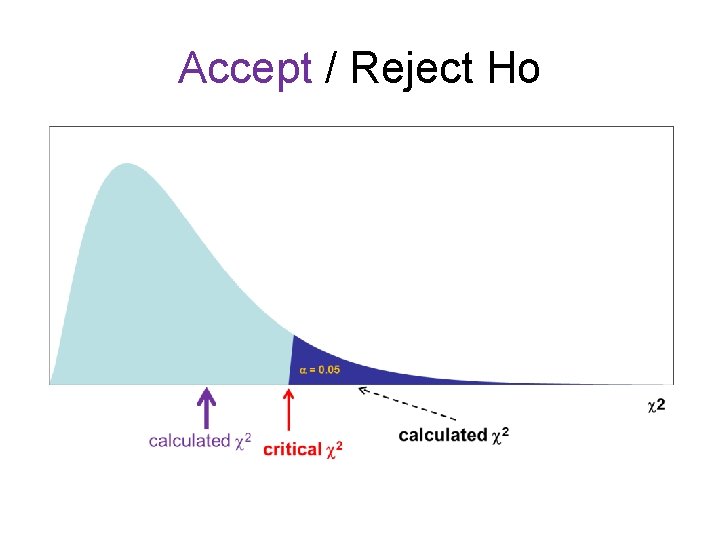
Accept / Reject Ho
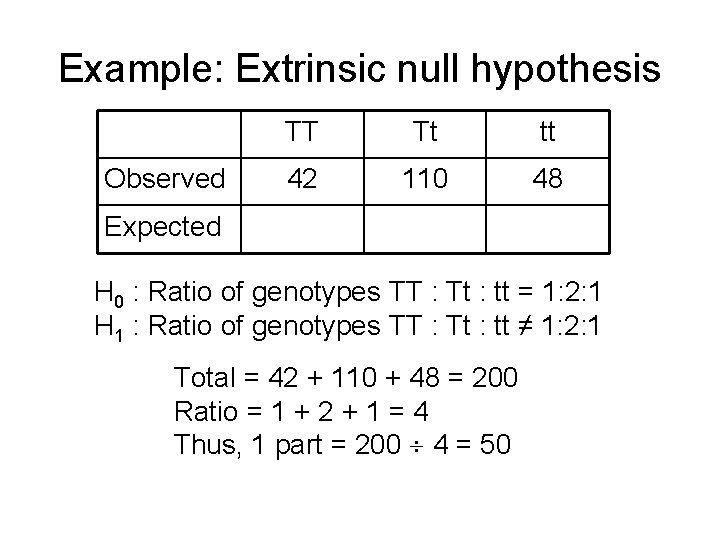
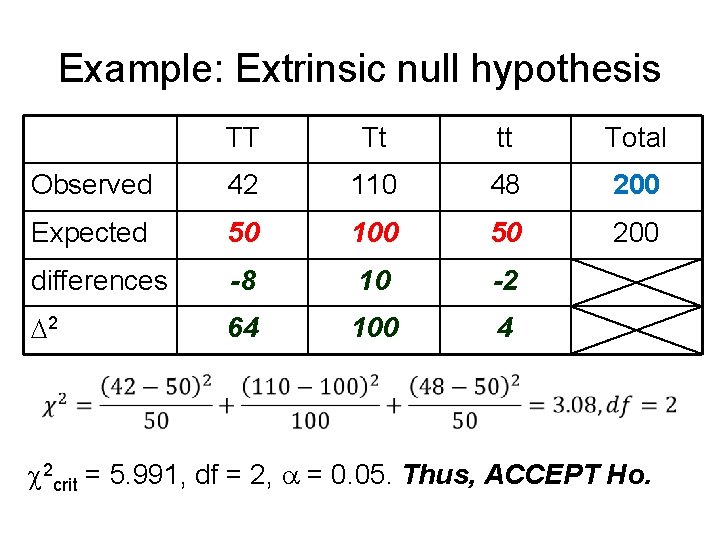
Example: Extrinsic null hypothesis Observed TT Tt tt 42 110 48 Expected H 0 : Ratio of genotypes TT : Tt : tt = 1: 2: 1 H 1 : Ratio of genotypes TT : Tt : tt ≠ 1: 2: 1 Total = 42 + 110 + 48 = 200 Ratio = 1 + 2 + 1 = 4 Thus, 1 part = 200 4 = 50
Example: Extrinsic null hypothesis TT Tt tt Total Observed 42 110 48 200 Expected 50 100 50 200 differences -8 10 -2 2 64 100 4 2 crit = 5. 991, df = 2, = 0. 05. Thus, ACCEPT Ho.
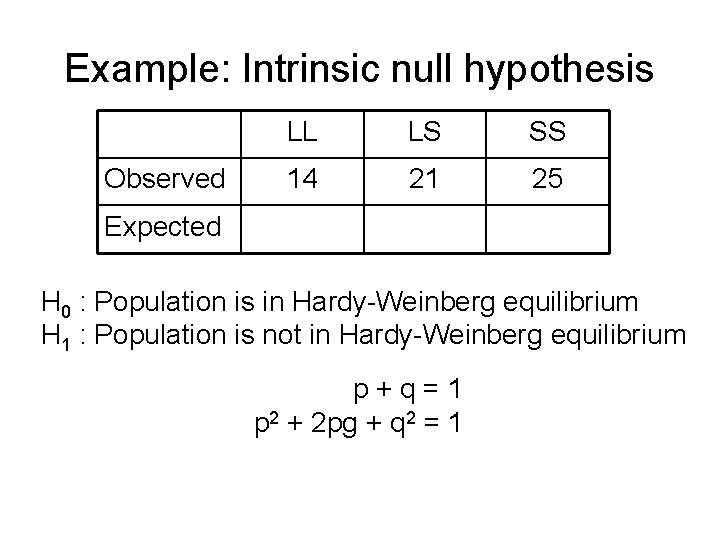
Example: Intrinsic null hypothesis Observed LL LS SS 14 21 25 Expected H 0 : Population is in Hardy-Weinberg equilibrium H 1 : Population is not in Hardy-Weinberg equilibrium p + q = 1 p 2 + 2 pg + q 2 = 1
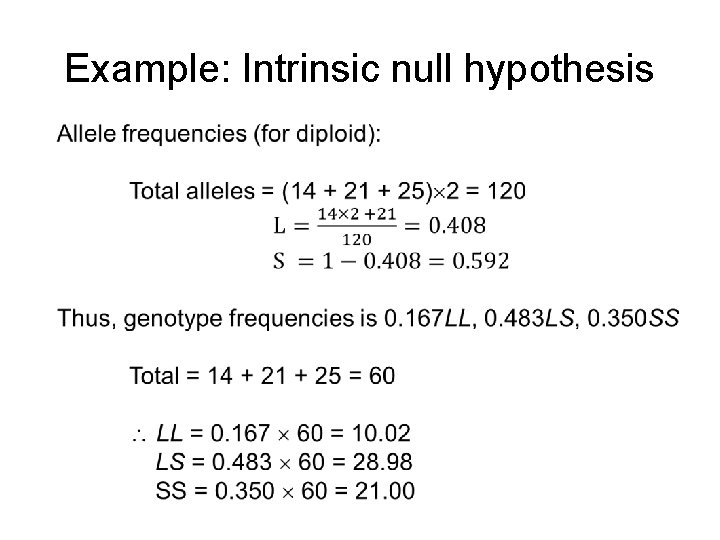
Example: Intrinsic null hypothesis
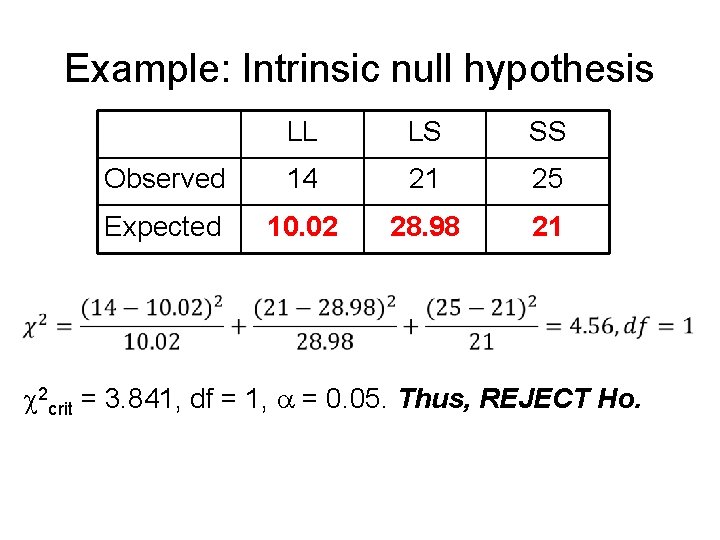
Example: Intrinsic null hypothesis LL LS SS Observed 14 21 25 Expected 10. 02 28. 98 21 2 crit = 3. 841, df = 1, = 0. 05. Thus, REJECT Ho.
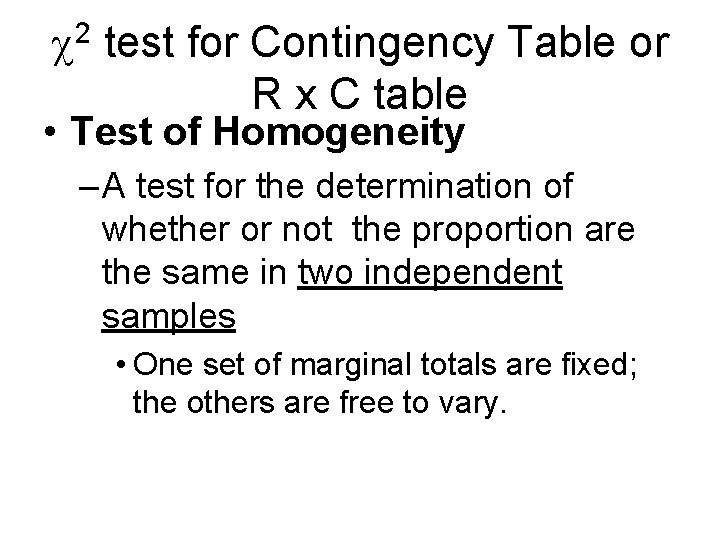
2 test for Contingency Table or R x C table • Test of Homogeneity – A test for the determination of whether or not the proportion are the same in two independent samples • One set of marginal totals are fixed; the others are free to vary.
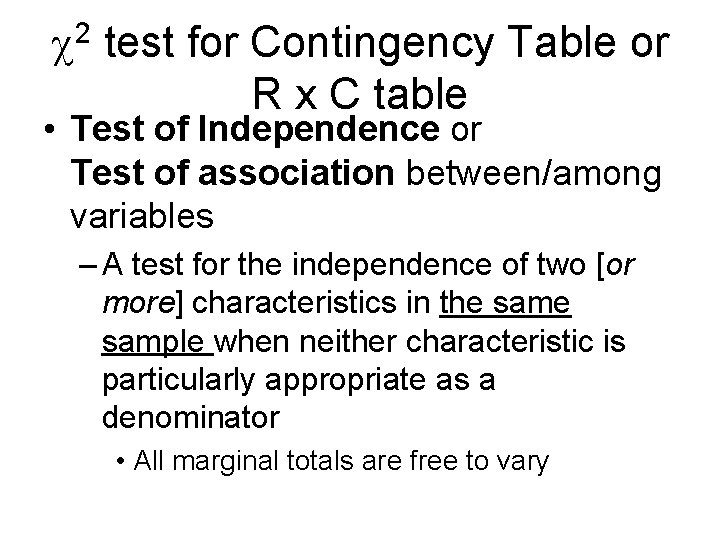
2 test for Contingency Table or R x C table • Test of Independence or Test of association between/among variables – A test for the independence of two [or more] characteristics in the sample when neither characteristic is particularly appropriate as a denominator • All marginal totals are free to vary
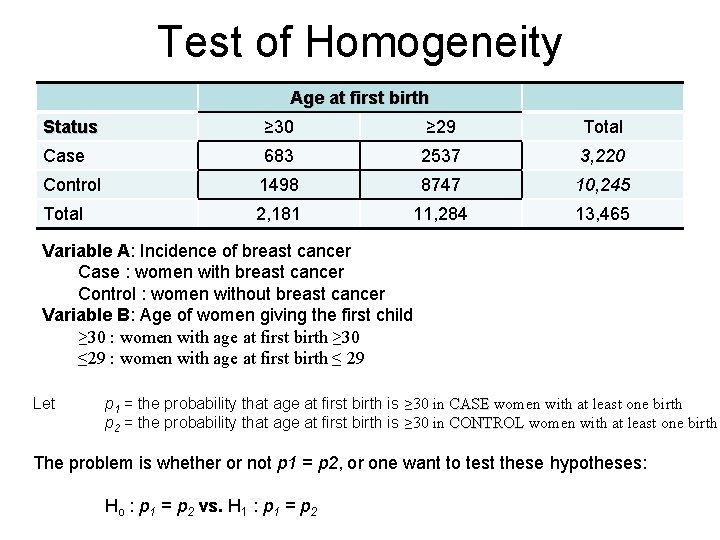
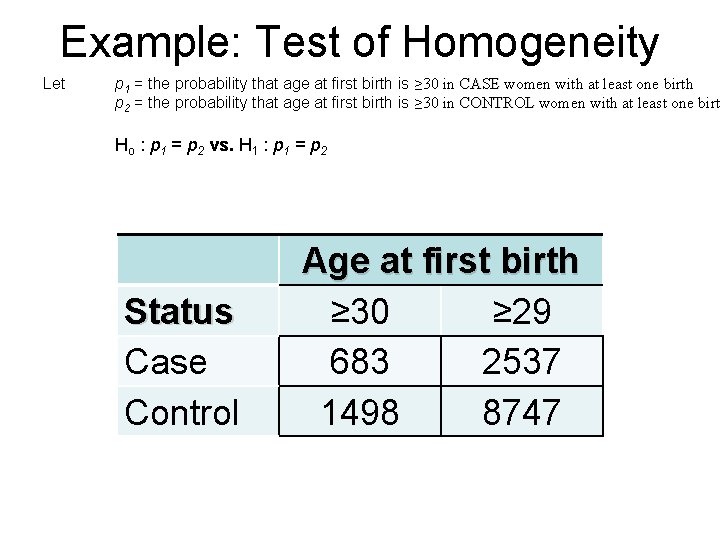
Test of Homogeneity Age at first birth Status ≥ 30 ≥ 29 Total Case 683 2537 3, 220 Control 1498 8747 10, 245 Total 2, 181 11, 284 13, 465 Variable A: Incidence of breast cancer Case : women with breast cancer Control : women without breast cancer Variable B: Age of women giving the first child ≥ 30 : women with age at first birth ≥ 30 ≤ 29 : women with age at first birth ≤ 29 Let p 1 = the probability that age at first birth is ≥ 30 in CASE women with at least one birth p 2 = the probability that age at first birth is ≥ 30 in CONTROL women with at least one birth The problem is whether or not p 1 = p 2, or one want to test these hypotheses: Ho : p 1 = p 2 vs. H 1 : p 1 = p 2
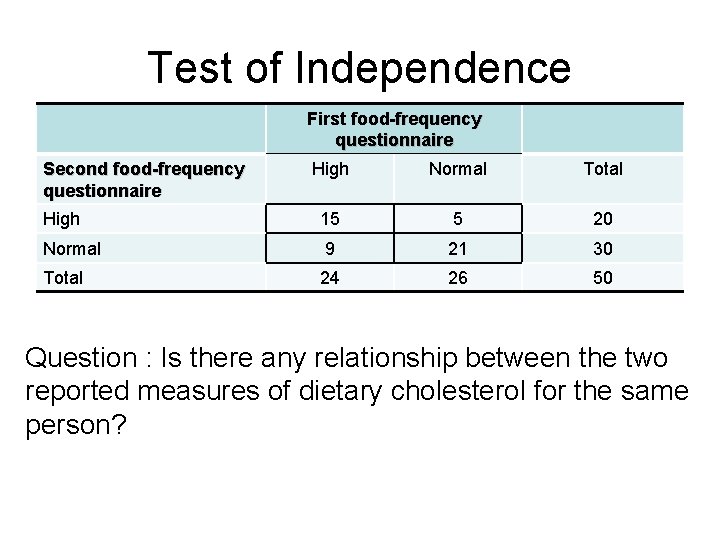
Test of Independence First food-frequency questionnaire Second food-frequency questionnaire High Normal Total High 15 5 20 Normal 9 21 30 Total 24 26 50 Question : Is there any relationship between the two reported measures of dietary cholesterol for the same person?
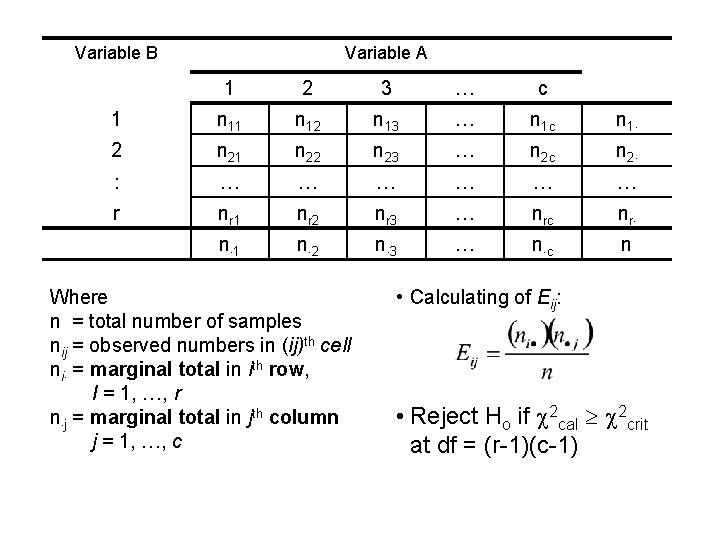
Variable B Variable A 1 2 3 … c 1 n 12 n 13 … n 1 c n 1 2 n 21 n 22 n 23 … n 2 c n 2 : … … … r nr 1 nr 2 nr 3 … nrc nr n 1 n 2 n 3 … n c n Where n = total number of samples nij = observed numbers in (ij)th cell ni = marginal total in ith row, I = 1, …, r n j = marginal total in jth column j = 1, …, c • Calculating of Eij: • Reject Ho if 2 cal 2 crit at df = (r-1)(c-1)
Example: Test of Homogeneity Let p 1 = the probability that age at first birth is ≥ 30 in CASE women with at least one birth p 2 = the probability that age at first birth is ≥ 30 in CONTROL women with at least one birt Ho : p 1 = p 2 vs. H 1 : p 1 = p 2 Status Case Control Age at first birth ≥ 30 ≥ 29 683 2537 1498 8747
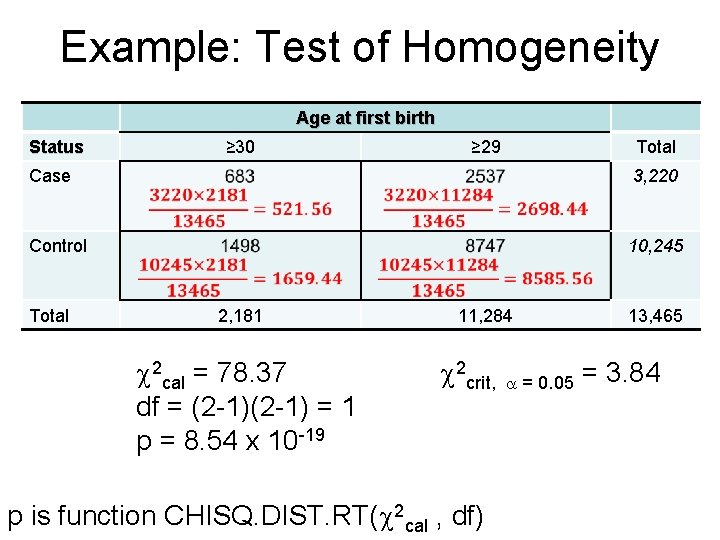
Example: Test of Homogeneity Age at first birth Status ≥ 30 ≥ 29 Total Case 3, 220 Control 10, 245 Total 2, 181 2 cal = 78. 37 df = (2 -1) = 1 p = 8. 54 x 10 -19 11, 284 13, 465 2 crit, = 0. 05 = 3. 84 p is function CHISQ. DIST. RT( 2 cal , df)
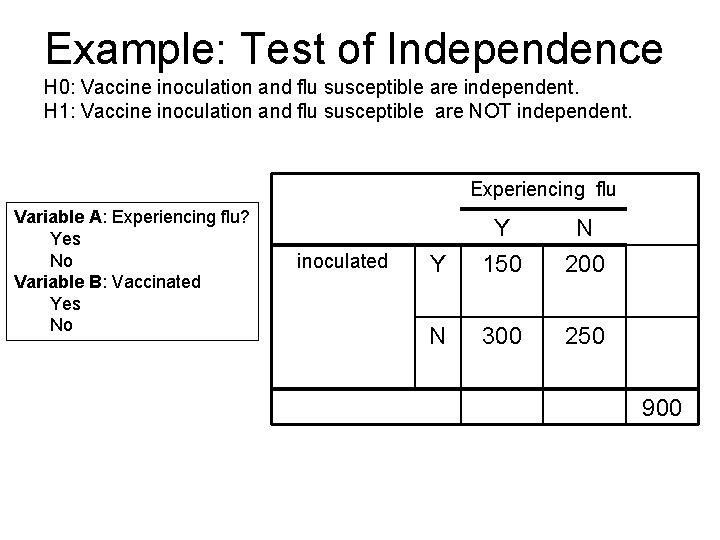
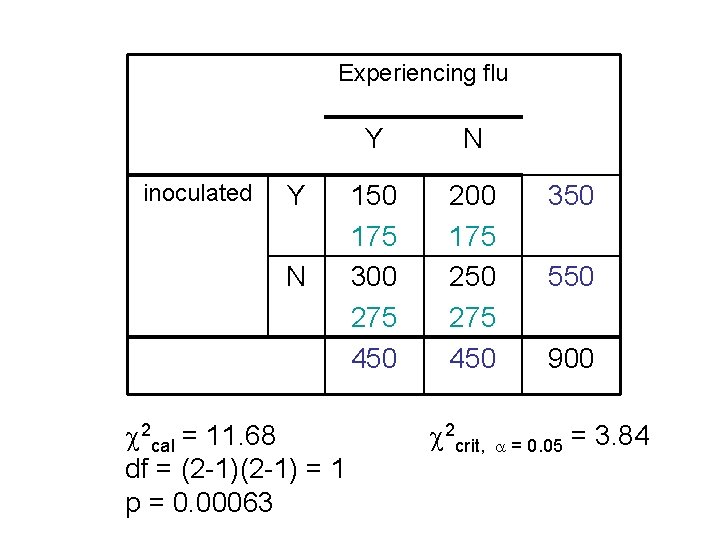
Example: Test of Independence H 0: Vaccine inoculation and flu susceptible are independent. H 1: Vaccine inoculation and flu susceptible are NOT independent. Experiencing flu Variable A: Experiencing flu? Yes No Variable B: Vaccinated Yes No inoculated Y Y 150 N 200 N 300 250 900
Experiencing flu inoculated Y N 2 cal = 11. 68 df = (2 -1) = 1 p = 0. 00063 Y N 150 175 300 275 450 200 175 250 275 450 350 550 900 2 crit, = 0. 05 = 3. 84
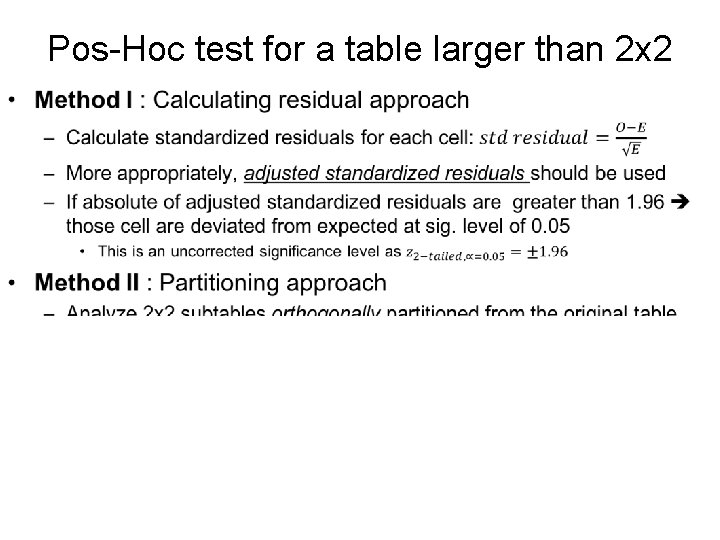
Pos-Hoc test for a table larger than 2 x 2 •
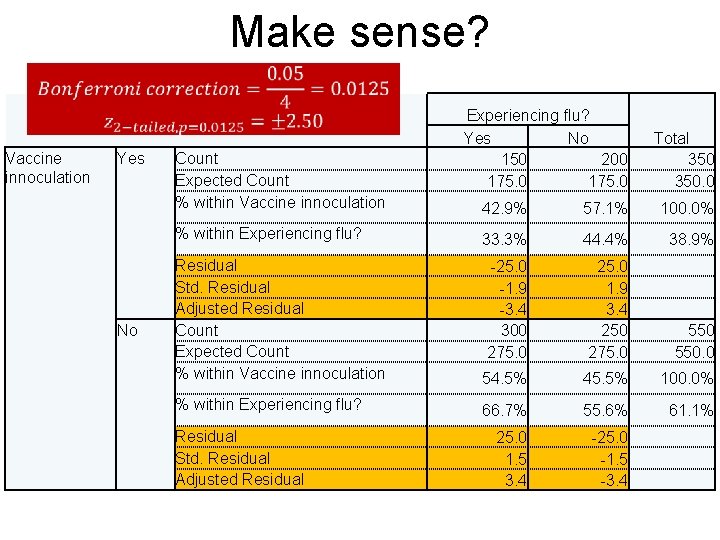
Make sense? Vaccine innoculation Yes Count Expected Count % within Vaccine innoculation % within Experiencing flu? No Experiencing flu? Yes No 150 200 175. 0 Total 350. 0 42. 9% 57. 1% 100. 0% 33. 3% 44. 4% 38. 9% Residual Std. Residual Adjusted Residual Count Expected Count % within Vaccine innoculation 54. 5% 45. 5% 100. 0% % within Experiencing flu? 66. 7% 55. 6% 61. 1% Residual Std. Residual Adjusted Residual -25. 0 -1. 9 -3. 4 300 275. 0 25. 0 1. 5 3. 4 25. 0 1. 9 3. 4 250 275. 0 -25. 0 -1. 5 -3. 4 550. 0
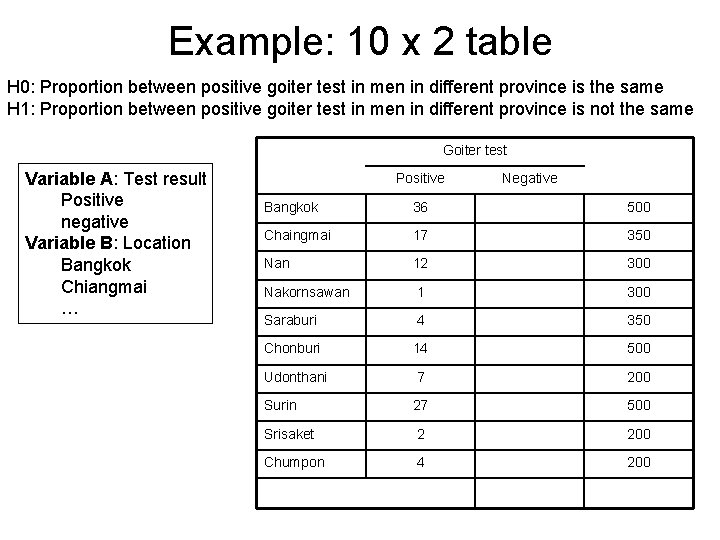
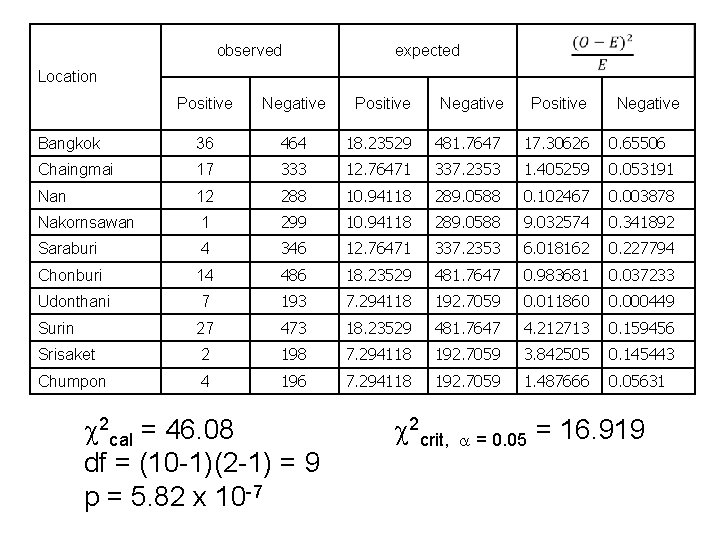
Example: 10 x 2 table H 0: Proportion between positive goiter test in men in different province is the same H 1: Proportion between positive goiter test in men in different province is not the same Goiter test Variable A: Test result Positive negative Variable B: Location Bangkok Chiangmai … Positive Negative Bangkok 36 500 Chaingmai 17 350 Nan 12 300 Nakornsawan 1 300 Saraburi 4 350 Chonburi 14 500 Udonthani 7 200 Surin 27 500 Srisaket 2 200 Chumpon 4 200
observed expected Location Positive Negative Positive Bangkok 36 464 18. 23529 481. 7647 17. 30626 0. 65506 Chaingmai 17 333 12. 76471 337. 2353 1. 405259 0. 053191 Nan 12 288 10. 94118 289. 0588 0. 102467 0. 003878 Nakornsawan 1 299 10. 94118 289. 0588 9. 032574 0. 341892 Saraburi 4 346 12. 76471 337. 2353 6. 018162 0. 227794 Chonburi 14 486 18. 23529 481. 7647 0. 983681 0. 037233 Udonthani 7 193 7. 294118 192. 7059 0. 011860 0. 000449 Surin 27 473 18. 23529 481. 7647 4. 212713 0. 159456 Srisaket 2 198 7. 294118 192. 7059 3. 842505 0. 145443 Chumpon 4 196 7. 294118 192. 7059 1. 487666 0. 05631 2 cal = 46. 08 df = (10 -1)(2 -1) = 9 p = 5. 82 x 10 -7 Negative 2 crit, = 0. 05 = 16. 919
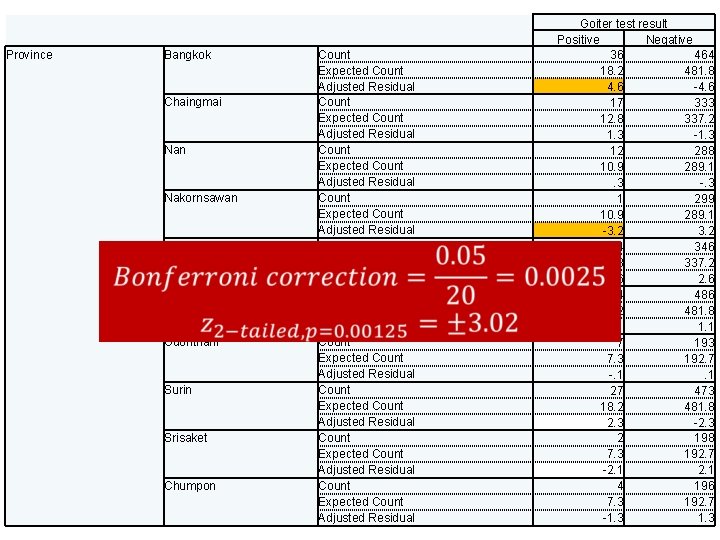
Province Bangkok Chaingmai Nan Nakornsawan Saraburi Chonburi Udonthani Surin Srisaket Chumpon Count Expected Count Adjusted Residual Count Expected Count Adjusted Residual Count Expected Count Adjusted Residual Goiter test result Positive Negative 36 464 18. 2 481. 8 4. 6 -4. 6 17 333 12. 8 337. 2 1. 3 -1. 3 12 288 10. 9 289. 1. 3 -. 3 1 299 10. 9 289. 1 -3. 2 4 346 12. 8 337. 2 -2. 6 14 486 18. 2 481. 8 -1. 1 7 193 7. 3 192. 7 -. 1. 1 27 473 18. 2 481. 8 2. 3 -2. 3 2 198 7. 3 192. 7 -2. 1 4 196 7. 3 192. 7 -1. 3
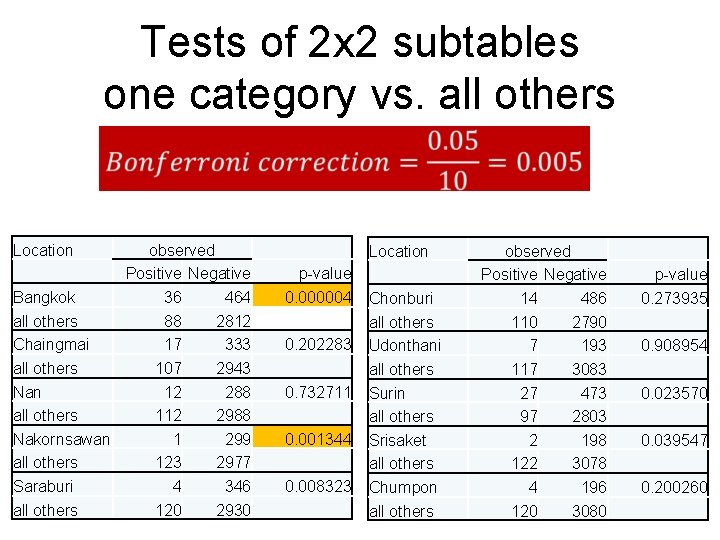
Tests of 2 x 2 subtables one category vs. all others Location observed Positive Negative Bangkok 36 464 all others 88 2812 Chaingmai 17 333 all others 107 2943 Nan 12 288 all others 112 2988 Nakornsawan 1 299 all others 123 2977 Saraburi 4 346 all others 120 2930 Location p-value 0. 000004 0. 202283 0. 732711 0. 001344 0. 008323 Chonburi all others Udonthani all others Surin all others Srisaket all others Chumpon all others observed Positive Negative 14 486 110 2790 7 193 117 3083 27 473 97 2803 2 198 122 3078 4 196 120 3080 p-value 0. 273935 0. 908954 0. 023570 0. 039547 0. 200260
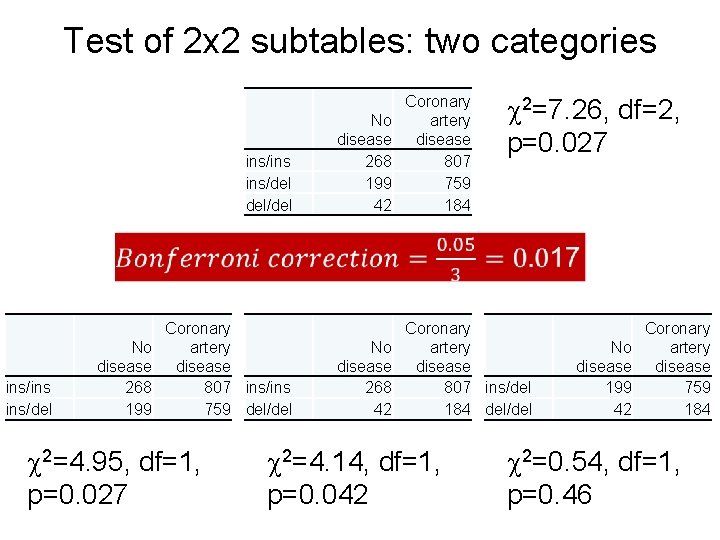
Test of 2 x 2 subtables: two categories ins/ins ins/del del/del 2=7. 26, df=2, p=0. 027 No disease 268 199 42 Coronary artery disease 807 759 184 No disease 268 42 Coronary artery disease 807 ins/del 184 del/del ins/ins ins/del No disease 268 199 Coronary artery disease 807 ins/ins 759 del/del 2=4. 95, df=1, p=0. 027 2=4. 14, df=1, p=0. 042 No disease 199 42 Coronary artery disease 759 184 2=0. 54, df=1, p=0. 46
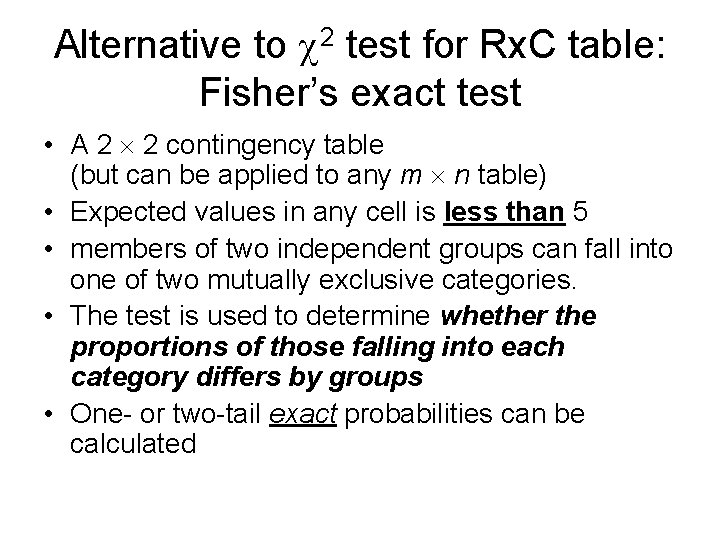
Alternative to 2 test for Rx. C table: Fisher’s exact test • A 2 2 contingency table (but can be applied to any m n table) • Expected values in any cell is less than 5 • members of two independent groups can fall into one of two mutually exclusive categories. • The test is used to determine whether the proportions of those falling into each category differs by groups • One- or two-tail exact probabilities can be calculated
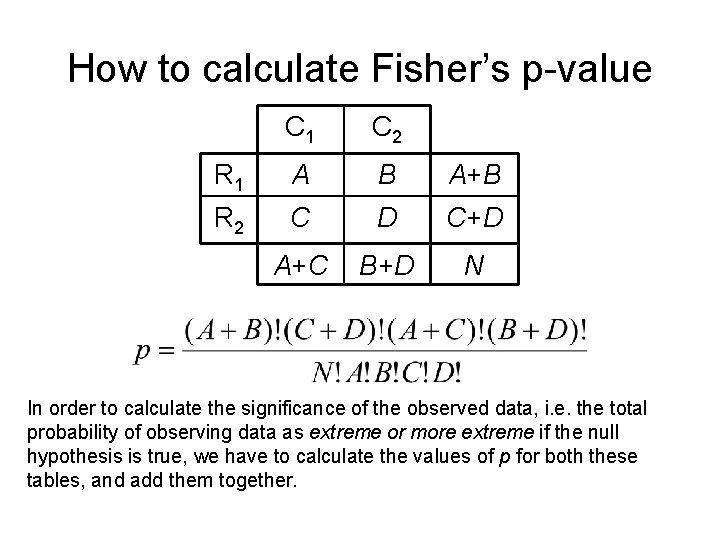
How to calculate Fisher’s p-value C 1 C 2 R 1 A B A+B R 2 C D C+D A+C B+D N In order to calculate the significance of the observed data, i. e. the total probability of observing data as extreme or more extreme if the null hypothesis is true, we have to calculate the values of p for both these tables, and add them together.
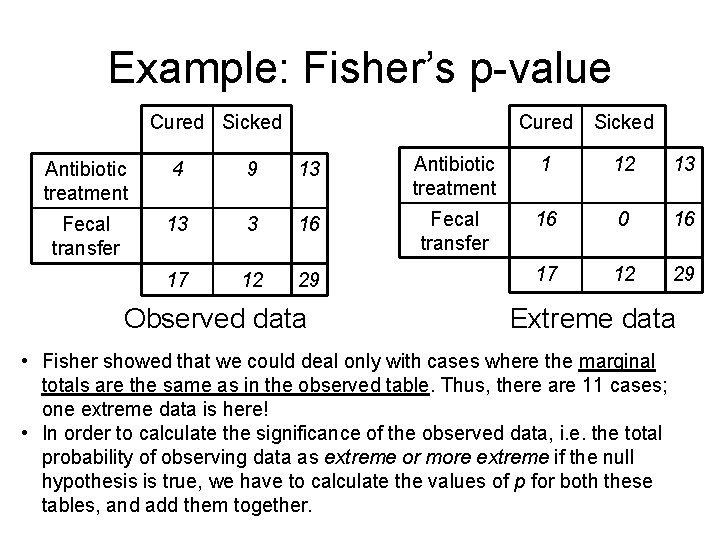
Example: Fisher’s p-value Cured Sicked Antibiotic treatment 4 9 13 Antibiotic treatment 1 12 13 Fecal transfer 13 3 16 Fecal transfer 16 0 16 17 12 29 Observed data Extreme data • Fisher showed that we could deal only with cases where the marginal totals are the same as in the observed table. Thus, there are 11 cases; one extreme data is here! • In order to calculate the significance of the observed data, i. e. the total probability of observing data as extreme or more extreme if the null hypothesis is true, we have to calculate the values of p for both these tables, and add them together.
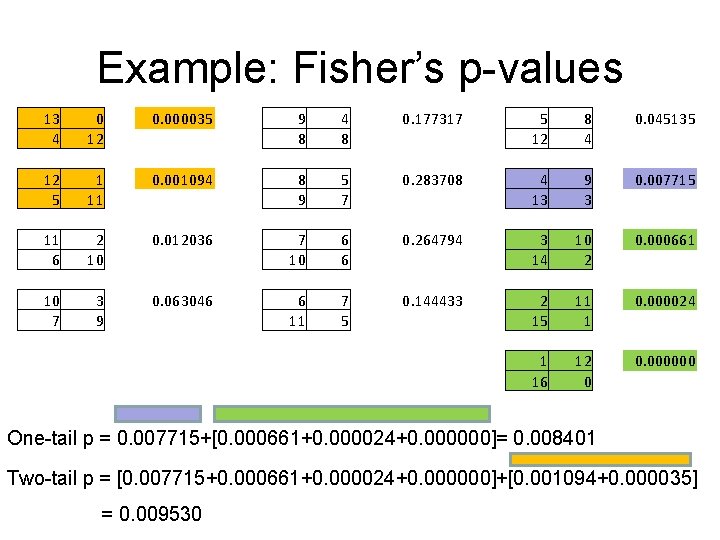
Example: Fisher’s p-values 13 4 0 12 0. 000035 9 8 4 8 0. 177317 5 12 8 4 0. 045135 12 5 1 11 0. 001094 8 9 5 7 0. 283708 4 13 9 3 0. 007715 11 6 2 10 0. 012036 7 10 6 6 0. 264794 3 14 10 2 0. 000661 10 7 3 9 0. 063046 6 11 7 5 0. 144433 2 15 11 1 0. 000024 1 16 12 0 0. 000000 One-tail p = 0. 007715+[0. 000661+0. 000024+0. 000000]= 0. 008401 Two-tail p = [0. 007715+0. 000661+0. 000024+0. 000000]+[0. 001094+0. 000035] = 0. 009530
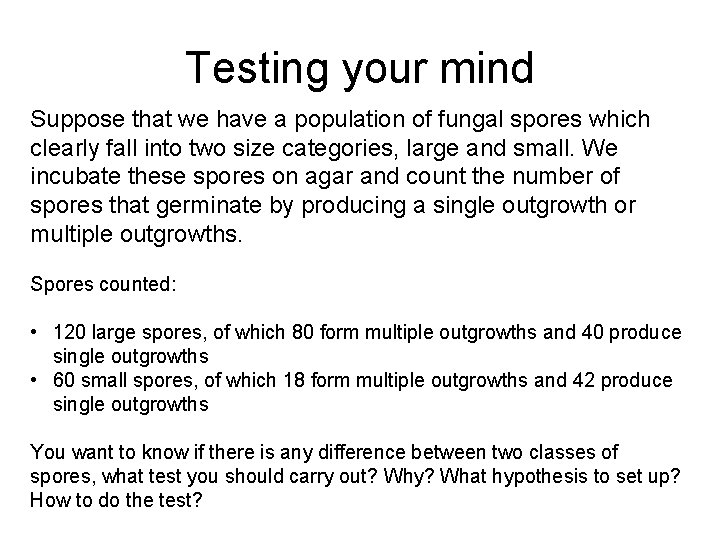
Testing your mind Suppose that we have a population of fungal spores which clearly fall into two size categories, large and small. We incubate these spores on agar and count the number of spores that germinate by producing a single outgrowth or multiple outgrowths. Spores counted: • 120 large spores, of which 80 form multiple outgrowths and 40 produce single outgrowths • 60 small spores, of which 18 form multiple outgrowths and 42 produce single outgrowths You want to know if there is any difference between two classes of spores, what test you should carry out? Why? What hypothesis to set up? How to do the test?
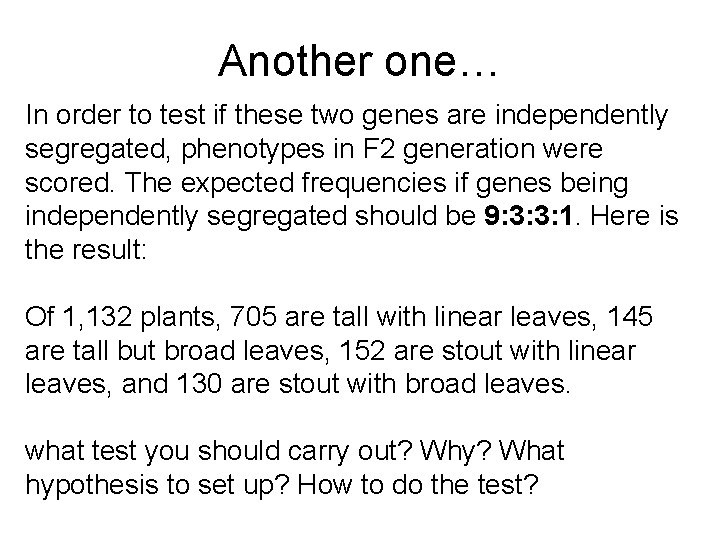
Another one… In order to test if these two genes are independently segregated, phenotypes in F 2 generation were scored. The expected frequencies if genes being independently segregated should be 9: 3: 3: 1. Here is the result: Of 1, 132 plants, 705 are tall with linear leaves, 145 are tall but broad leaves, 152 are stout with linear leaves, and 130 are stout with broad leaves. what test you should carry out? Why? What hypothesis to set up? How to do the test?
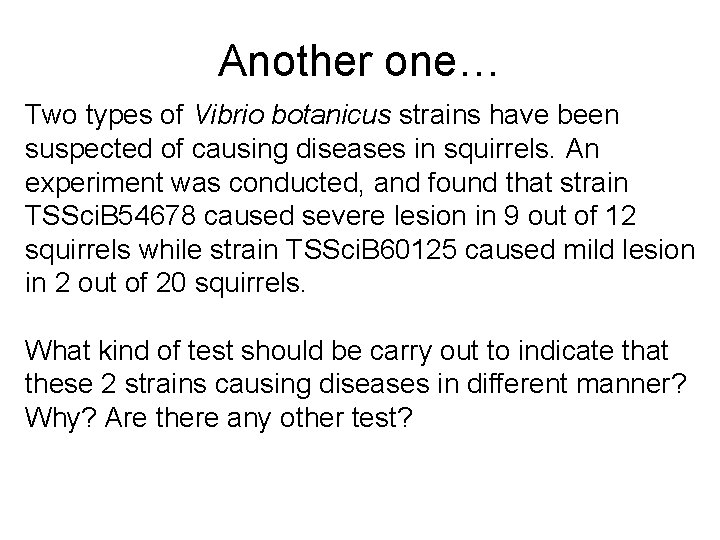
Another one… Two types of Vibrio botanicus strains have been suspected of causing diseases in squirrels. An experiment was conducted, and found that strain TSSci. B 54678 caused severe lesion in 9 out of 12 squirrels while strain TSSci. B 60125 caused mild lesion in 2 out of 20 squirrels. What kind of test should be carry out to indicate that these 2 strains causing diseases in different manner? Why? Are there any other test?