
NonModelBased Algorithm Portfolios for SAT Yuri 2 Malitsky
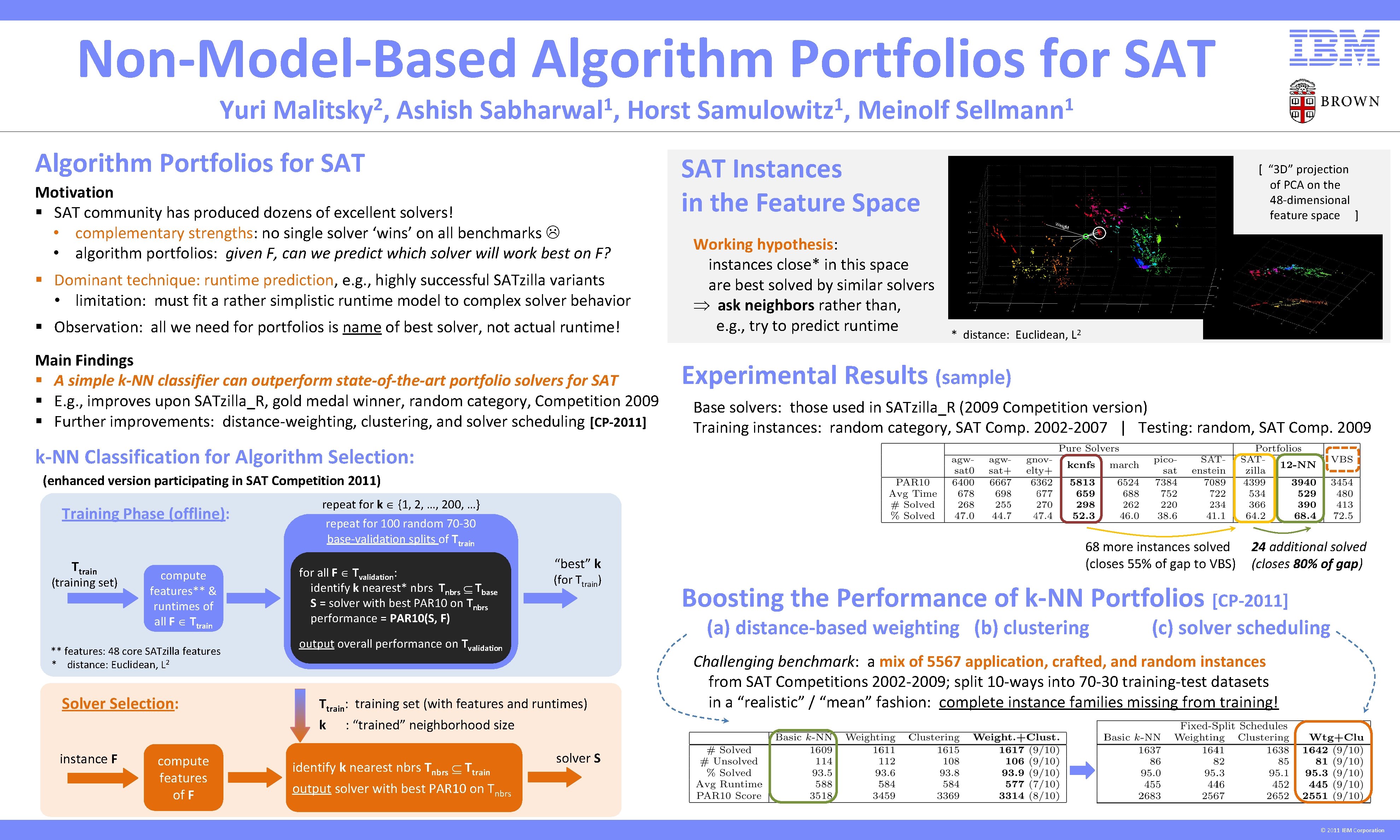
Non-Model-Based Algorithm Portfolios for SAT Yuri 2 Malitsky , Ashish 1 Sabharwal , Horst Algorithm Portfolios for SAT Motivation § SAT community has produced dozens of excellent solvers! • complementary strengths: no single solver ‘wins’ on all benchmarks • algorithm portfolios: given F, can we predict which solver will work best on F? § Dominant technique: runtime prediction, e. g. , highly successful SATzilla variants • limitation: must fit a rather simplistic runtime model to complex solver behavior § Observation: all we need for portfolios is name of best solver, not actual runtime! Main Findings § A simple k-NN classifier can outperform state-of-the-art portfolio solvers for SAT § E. g. , improves upon SATzilla_R, gold medal winner, random category, Competition 2009 § Further improvements: distance-weighting, clustering, and solver scheduling [CP-2011] 1 Samulowitz , Meinolf 1 Sellmann SAT Instances in the Feature Space [ “ 3 D” projection of PCA on the 48 -dimensional feature space ] Weig ht Working hypothesis: instances close* in this space are best solved by similar solvers ask neighbors rather than, e. g. , try to predict runtime * distance: Euclidean, L 2 Experimental Results (sample) Base solvers: those used in SATzilla_R (2009 Competition version) Training instances: random category, SAT Comp. 2002 -2007 | Testing: random, SAT Comp. 2009 k-NN Classification for Algorithm Selection: (enhanced version participating in SAT Competition 2011) Training Phase (offline): Ttrain (training set) compute features** & runtimes of all F Ttrain ** features: 48 core SATzilla features * distance: Euclidean, L 2 Solver Selection: repeat for k {1, 2, …, 200, …} repeat for 100 random 70 -30 base-validation splits of Ttrain for all F Tvalidation: identify k nearest* nbrs Tnbrs Tbase S = solver with best PAR 10 on Tnbrs performance = PAR 10(S, F) compute features of F (for Ttrain) Ttrain: training set (with features and runtimes) 24 additional solved (closes 80% of gap) Boosting the Performance of k-NN Portfolios [CP-2011] (a) distance-based weighting (b) clustering output overall performance on Tvalidation k instance F “best” k 68 more instances solved (closes 55% of gap to VBS) (c) solver scheduling Challenging benchmark: a mix of 5567 application, crafted, and random instances from SAT Competitions 2002 -2009; split 10 -ways into 70 -30 training-test datasets in a “realistic” / “mean” fashion: complete instance families missing from training! : “trained” neighborhood size identify k nearest nbrs Tnbrs Ttrain solver S output solver with best PAR 10 on Tnbrs © 2011 IBM Corporation
- Slides: 1