
NONMENDELIAN INHERITANCE Chapter 7 1 I Mendelian inheritance
- Slides: 13
NON-MENDELIAN INHERITANCE Chapter 7 1
I Mendelian inheritance patterns A. Involve genes directly influencing traits B. Obey Mendel’s laws 1. Law of segregation 2. Law of independent assortment C. Include 1. Dominant / recessive relationships 2. Gene interactions 3. Phenotype-influencing roles of sex and environment 2
II NON-MENDELIAN INHERITANCE A. Many genes do not follow a Mendelian inheritance pattern • Sex-linked traits • Incomplete Dominance • Codominance • Multiple alleles • We will discuss additional and more bizarre non-Mendelian inheritance patterns 3
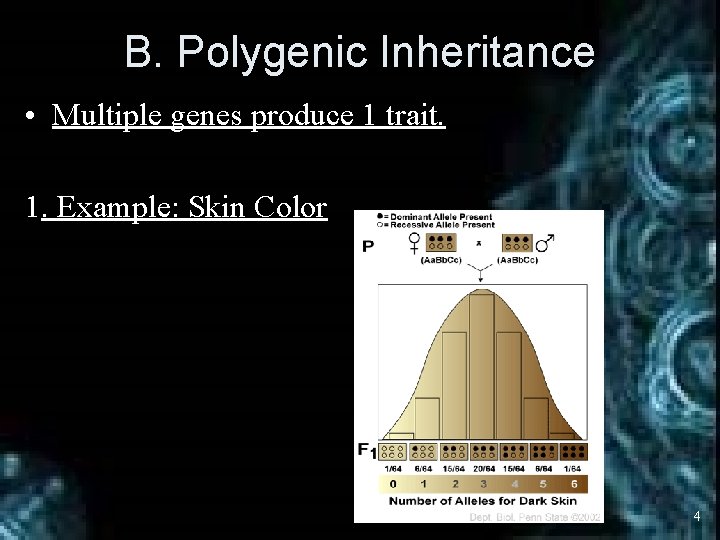
B. Polygenic Inheritance • Multiple genes produce 1 trait. 1. Example: Skin Color 4
C. Gene Linkage • Genes are located on the same chromosome 1. Alleles cannot separate randomly according to the law of Random Segregation 2. Unless…crossing over during meiosis I moves them to a different chromosome. – We measure the distance between genes by the frequency of crossing over moving one of them to a new chromosome, called gene linkage mapping – Distant genes are separated by crossing over more often than nearby genes.
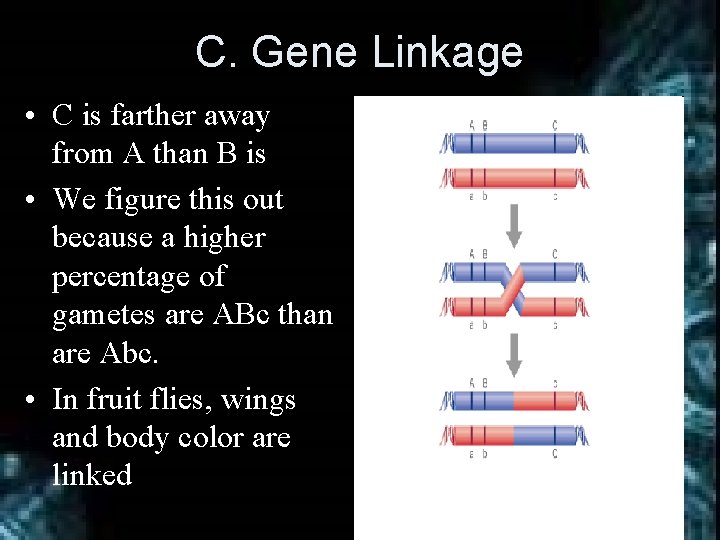
C. Gene Linkage • C is farther away from A than B is • We figure this out because a higher percentage of gametes are ABc than are Abc. • In fruit flies, wings and body color are linked
d. MATERNAL EFFECT – Genotype of mother directly determines phenotype of offspring • Genotype of father and offspring are irrelevant 1. Explained by the accumulation of gene products mother provides to developing eggs 7
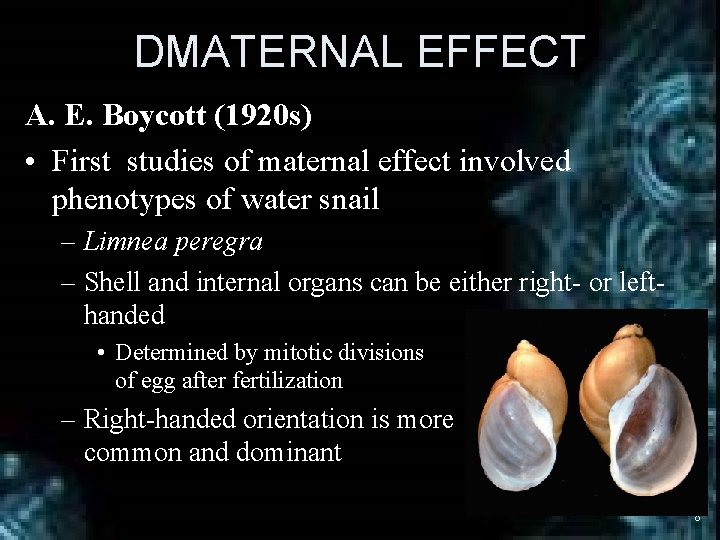
DMATERNAL EFFECT A. E. Boycott (1920 s) • First studies of maternal effect involved phenotypes of water snail – Limnea peregra – Shell and internal organs can be either right- or lefthanded • Determined by mitotic divisions of egg after fertilization – Right-handed orientation is more common and dominant 8
E. EPIGENETIC INHERITANCE – Gene expression is altered (1 gene affects another gene somewhere else) • May be fixed during an individual’s lifetime 1. Expression is not permanently changed over multiple generations • DNA sequence is not altered 9
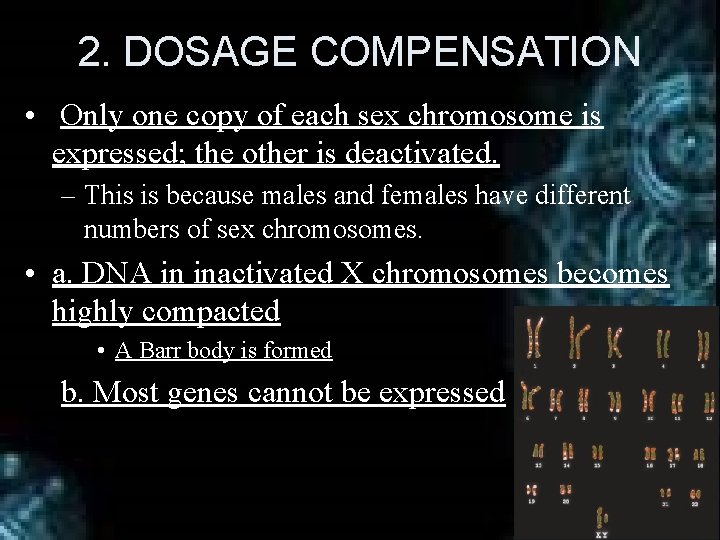
2. DOSAGE COMPENSATION • Only one copy of each sex chromosome is expressed; the other is deactivated. – This is because males and females have different numbers of sex chromosomes. • a. DNA in inactivated X chromosomes becomes highly compacted • A Barr body is formed b. Most genes cannot be expressed 10
2. DOSAGE COMPENSATION • Sex in birds is determined by Z and W sex chromosomes – Males are ZZ, females are ZW – The Z chromosome is large – So in birds, dosage compensation works by deactivating one of a males Z chromosomes. 11
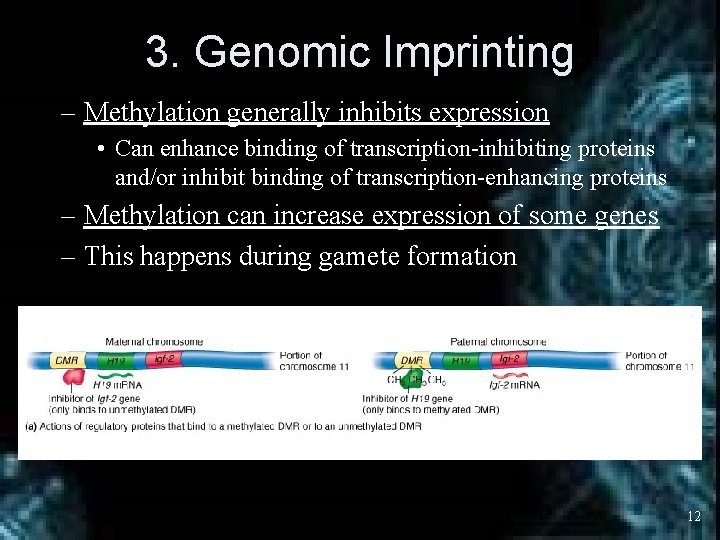
3. Genomic Imprinting – Methylation generally inhibits expression • Can enhance binding of transcription-inhibiting proteins and/or inhibit binding of transcription-enhancing proteins – Methylation can increase expression of some genes – This happens during gamete formation 12
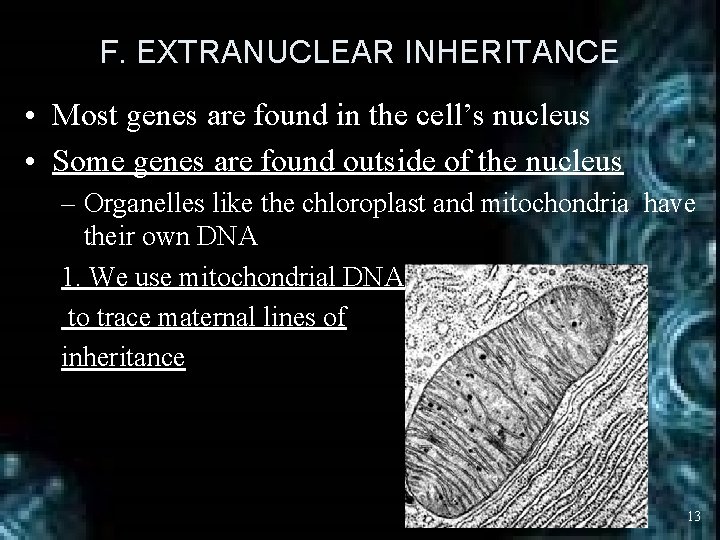
F. EXTRANUCLEAR INHERITANCE • Most genes are found in the cell’s nucleus • Some genes are found outside of the nucleus – Organelles like the chloroplast and mitochondria have their own DNA 1. We use mitochondrial DNA to trace maternal lines of inheritance 13