
NonManual Signals NMS What they mean and how
- Slides: 1
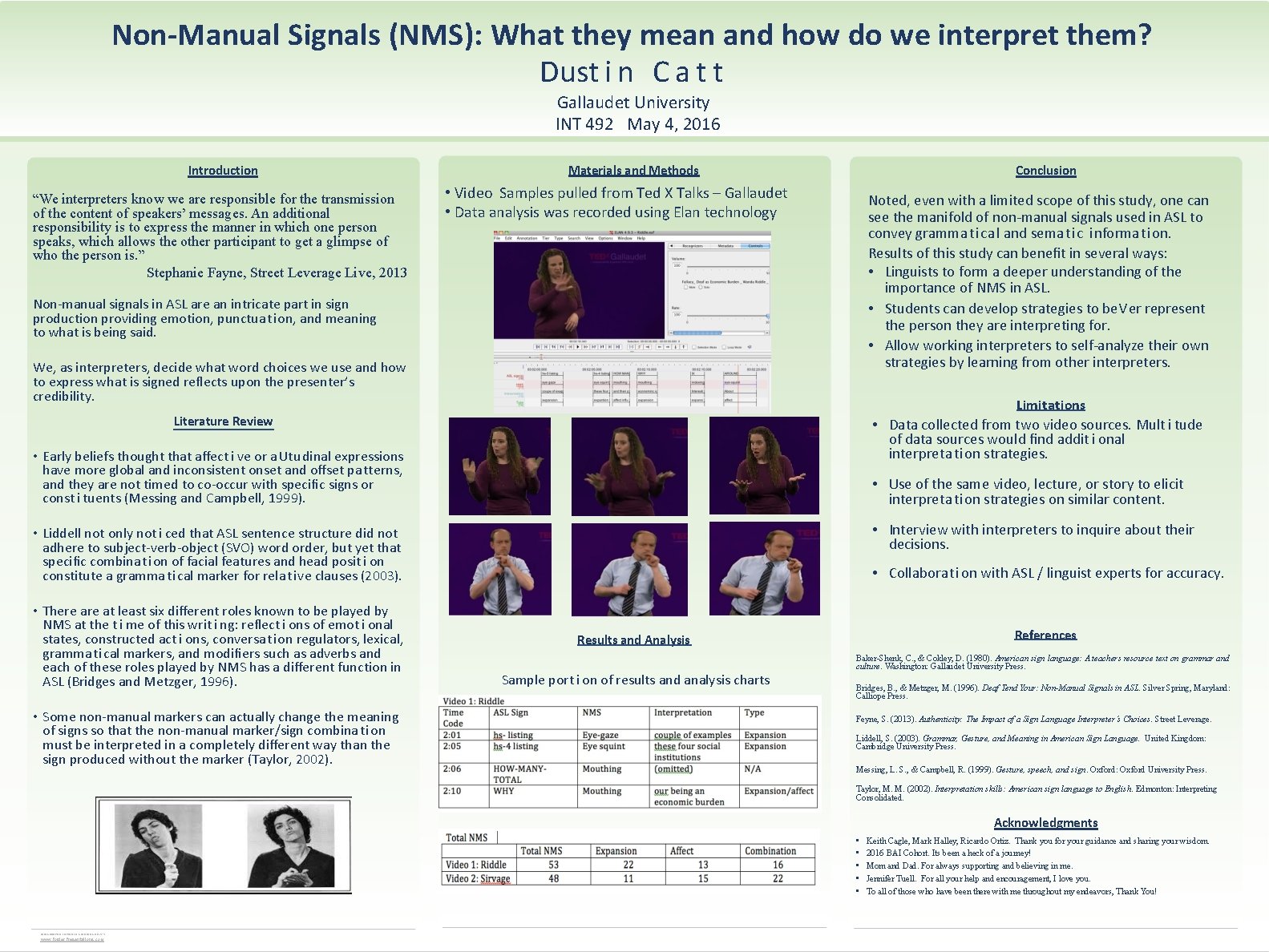
Non-Manual Signals (NMS): What they mean and how do we interpret them? Dust i n C a t t Gallaudet University INT 492 May 4, 2016 Introduction “We interpreters know we are responsible for the transmission of the content of speakers’ messages. An additional responsibility is to express the manner in which one person speaks, which allows the other participant to get a glimpse of who the person is. ” Stephanie Fayne, Street Leverage Live, 2013 Materials and Methods Conclusion • Video Samples pulled from Ted X Talks – Gallaudet • Data analysis was recorded using Elan technology Noted, even with a limited scope of this study, one can see the manifold of non-manual signals used in ASL to convey grammatical and sematic information. Results of this study can benefit in several ways: • Linguists to form a deeper understanding of the importance of NMS in ASL. • Students can develop strategies to be. Ver represent the person they are interpreting for. • Allow working interpreters to self-analyze their own strategies by learning from other interpreters. Non-manual signals in ASL are an intricate part in sign production providing emotion, punctuation, and meaning to what is being said. We, as interpreters, decide what word choices we use and how to express what is signed reflects upon the presenter’s credibility. Limitations Literature Review • Data collected from two video sources. Mult i tude of data sources would find addit i onal interpretation strategies. • Early beliefs thought that affect i ve or a. Utudinal expressions have more global and inconsistent onset and offset patterns, and they are not timed to co-occur with specific signs or const i tuents (Messing and Campbell, 1999). • Use of the same video, lecture, or story to elicit interpretation strategies on similar content. • Interview with interpreters to inquire about their decisions. • Liddell not only not i ced that ASL sentence structure did not adhere to subject-verb-object (SVO) word order, but yet that specific combination of facial features and head posit i on constitute a grammatical marker for relative clauses (2003). • There at least six different roles known to be played by NMS at the t i me of this writ i ng: reflect i ons of emot i onal states, constructed act i ons, conversation regulators, lexical, grammatical markers, and modifiers such as adverbs and each of these roles played by NMS has a different function in ASL (Bridges and Metzger, 1996). • Some non-manual markers can actually change the meaning of signs so that the non-manual marker/sign combination must be interpreted in a completely different way than the sign produced without the marker (Taylor, 2002). • Collaboration with ASL / linguist experts for accuracy. References Results and Analysis Sample port i on of results and analysis charts Baker-Shenk, C. , & Cokley, D. (1980). American sign language: A teachers resource text on grammar and culture. Washington: Gallaudet University Press. Bridges, B. , & Metzger, M. (1996). Deaf Tend Your: Non-Manual Signals in ASL. Silver Spring, Maryland: Calliope Press. Feyne, S. (2013). Authenticity: The Impact of a Sign Language Interpreter’s Choices. Street Leverage. Liddell, S. (2003). Grammar, Gesture, and Meaning in American Sign Language. United Kingdom: Cambridge University Press. Messing, L. S. , & Campbell, R. (1999). Gesture, speech, and sign. Oxford: Oxford University Press. Taylor, M. M. (2002). Interpretation skills: American sign language to English. Edmonton: Interpreting Consolidated. Acknowledgments • • • RESEARCH POSTER PRESENTATION DESIGN © 2015 www. Poster. Presentations. com Keith Cagle, Mark Halley, Ricardo Ortiz. Thank you for your guidance and sharing your wisdom. 2016 BAI Cohort. Its been a heck of a journey! Mom and Dad. For always supporting and believing in me. Jennifer Tuell. For all your help and encouragement, I love you. To all of those who have been there with me throughout my endeavors, Thank You!