
Nonlinguistic Representation ResearchBased Strategies for Increasing Student Achievement
Non-linguistic Representation Research-Based Strategies for Increasing Student Achievement Compiled from: Classroom Instruction That Works! By: Robert J. Marzano, Debra J. Pickering & Jane E. Pollock Curriculum & Staff Development Center
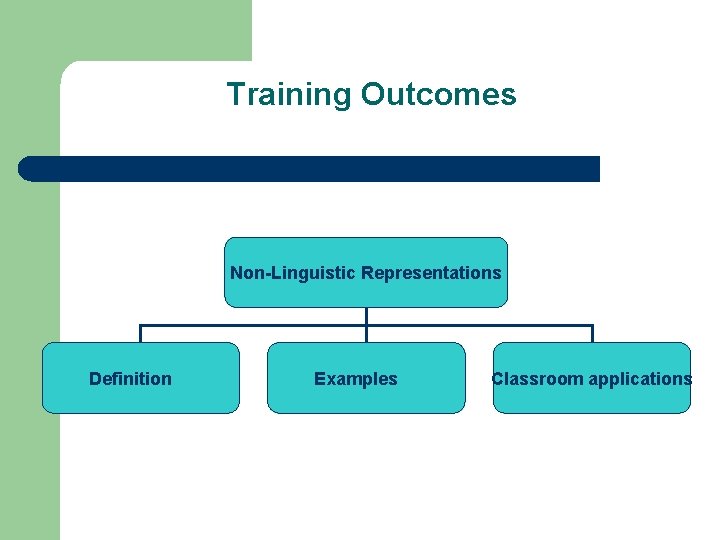
Training Outcomes Non-Linguistic Representations Definition Examples Classroom applications
Participant K-W-L What do I already Know about Non-Linguistic Representation? What I Want to Know? What I Learned.
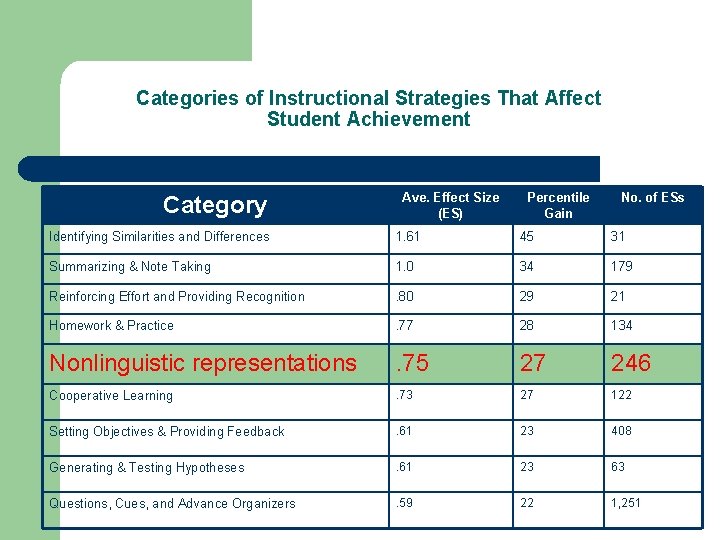
Categories of Instructional Strategies That Affect Student Achievement Category Ave. Effect Size (ES) Percentile Gain No. of ESs Identifying Similarities and Differences 1. 61 45 31 Summarizing & Note Taking 1. 0 34 179 Reinforcing Effort and Providing Recognition . 80 29 21 Homework & Practice . 77 28 134 Nonlinguistic representations . 75 27 246 Cooperative Learning . 73 27 122 Setting Objectives & Providing Feedback . 61 23 408 Generating & Testing Hypotheses . 61 23 63 Questions, Cues, and Advance Organizers . 59 22 1, 251
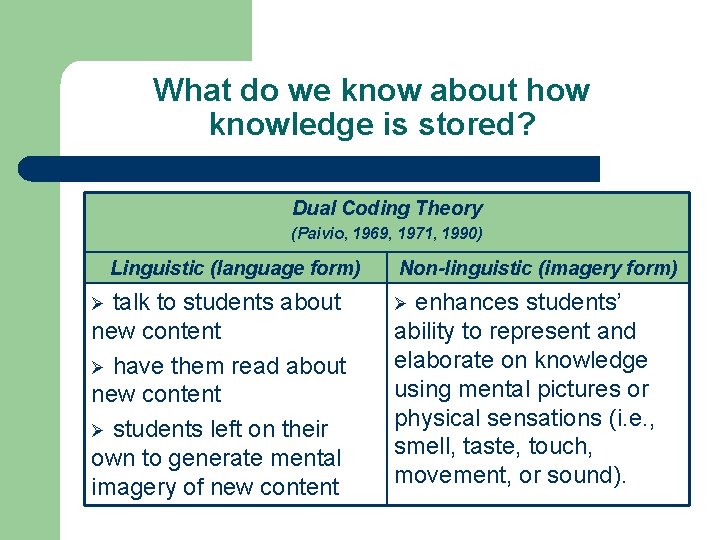
What do we know about how knowledge is stored? Dual Coding Theory (Paivio, 1969, 1971, 1990) Linguistic (language form) talk to students about new content Ø have them read about new content Ø students left on their own to generate mental imagery of new content Ø Non-linguistic (imagery form) enhances students’ ability to represent and elaborate on knowledge using mental pictures or physical sensations (i. e. , smell, taste, touch, movement, or sound). Ø
What is Non-Linguistic Representation? ~ Generating mental pictures or physical models of information and creating graphic representations for the information.
What does research tell us about nonlinguistic representations? Explicitly engaging students in the creation of nonlinguistic representations stimulates and increases activity in the brain. (Gerlic & Jausovec, 1999)
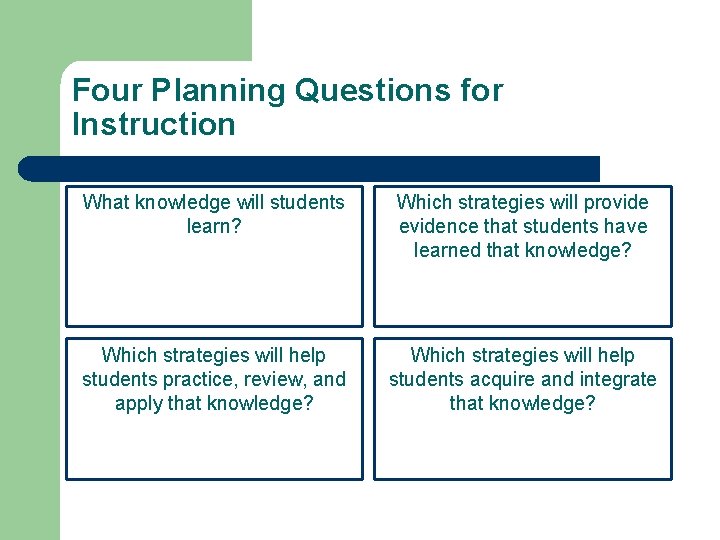
Four Planning Questions for Instruction What knowledge will students learn? Which strategies will provide evidence that students have learned that knowledge? Which strategies will help students practice, review, and apply that knowledge? Which strategies will help students acquire and integrate that knowledge?
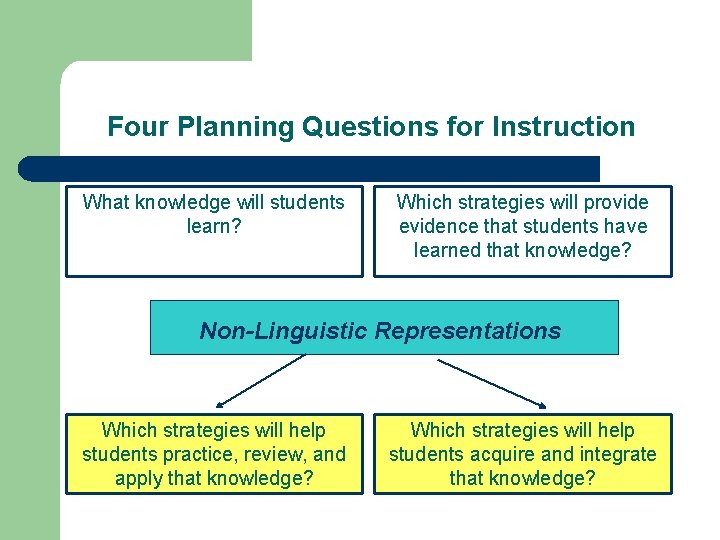
Four Planning Questions for Instruction What knowledge will students learn? Which strategies will provide evidence that students have learned that knowledge? Non-Linguistic Representations Which strategies will help students practice, review, and apply that knowledge? Which strategies will help students acquire and integrate that knowledge?
Two Generalizations from the Research on Non-Linguistic Representation 1. 2. A variety of activities produce nonlinguistic representations. Nonlinguistic representations should elaborate on knowledge.
“Elaborate On” l l l Simply means “add to” knowledge. Results in students not only understanding the knowledge in greater depth, but students also recalling it more easily. Asking students to explain and justify their elaborations enhances learning.
Recommendations for Classroom Practice: Nonlinguistic Representations F F F Use graphic organizers to represent knowledge. Have students generate physical models of the knowledge. Have students generate mental pictures of the knowledge they are learning. Use pictures or pictographs to represent knowledge. Have students engage in kinesthetic activities representing the knowledge.
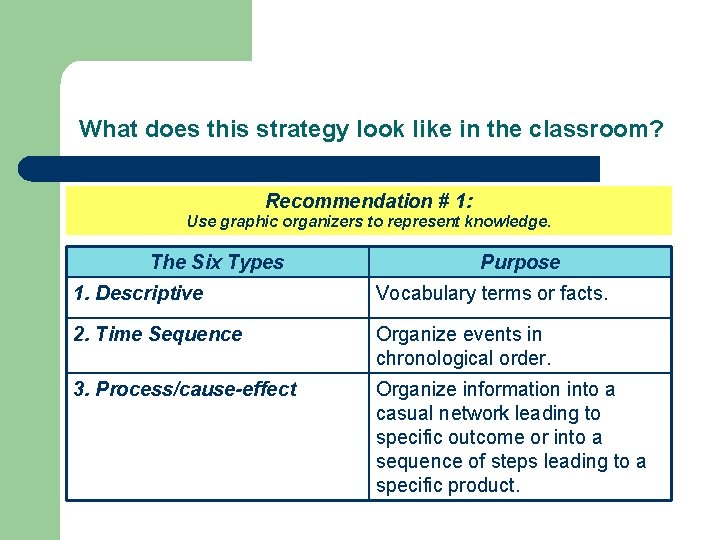
What does this strategy look like in the classroom? Recommendation # 1: Use graphic organizers to represent knowledge. The Six Types Purpose 1. Descriptive Vocabulary terms or facts. 2. Time Sequence Organize events in chronological order. 3. Process/cause-effect Organize information into a casual network leading to specific outcome or into a sequence of steps leading to a specific product.
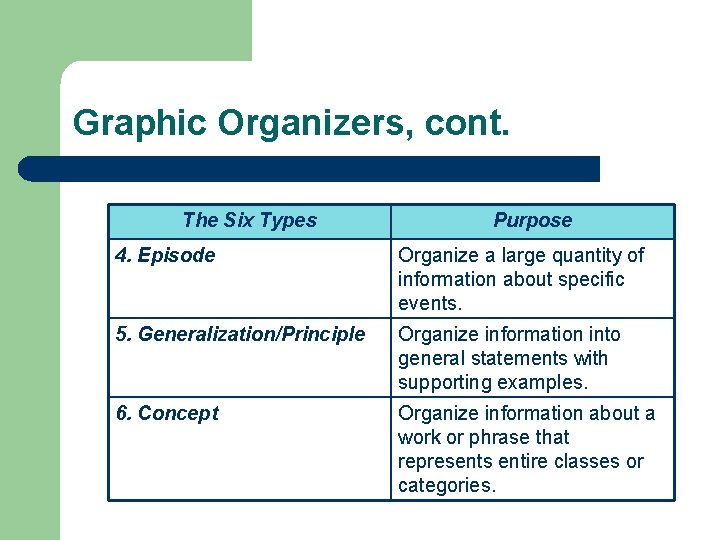
Graphic Organizers, cont. The Six Types Purpose 4. Episode Organize a large quantity of information about specific events. 5. Generalization/Principle Organize information into general statements with supporting examples. 6. Concept Organize information about a work or phrase that represents entire classes or categories.
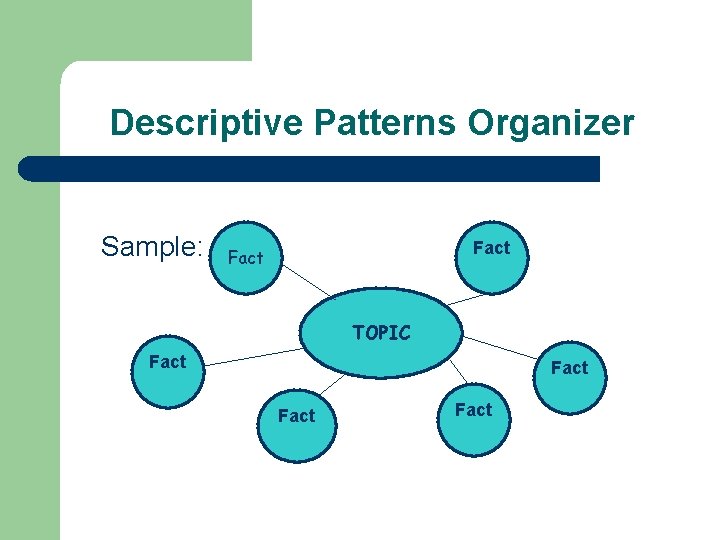
Descriptive Patterns Organizer Sample: Fact TOPIC Fact
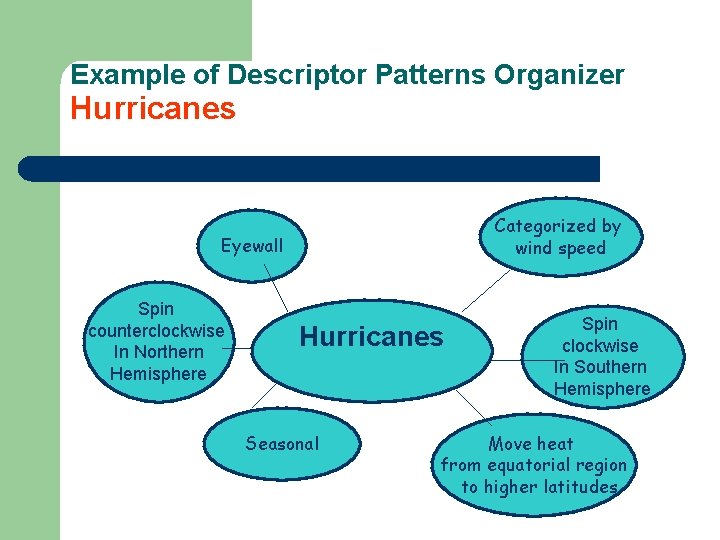
Example of Descriptor Patterns Organizer Hurricanes Categorized by wind speed Eyewall Spin counterclockwise In Northern Hemisphere Hurricanes Seasonal Spin clockwise In Southern Hemisphere Move heat from equatorial region to higher latitudes
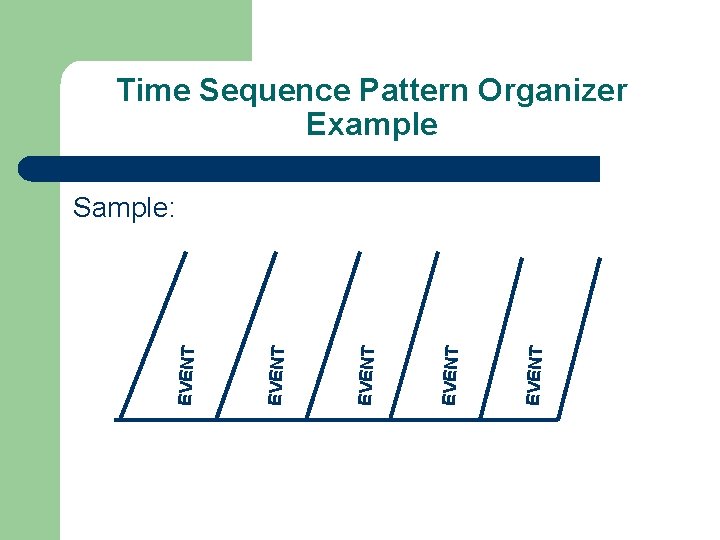
Time Sequence Pattern Organizer Example E V E NT E V E NT Sample:
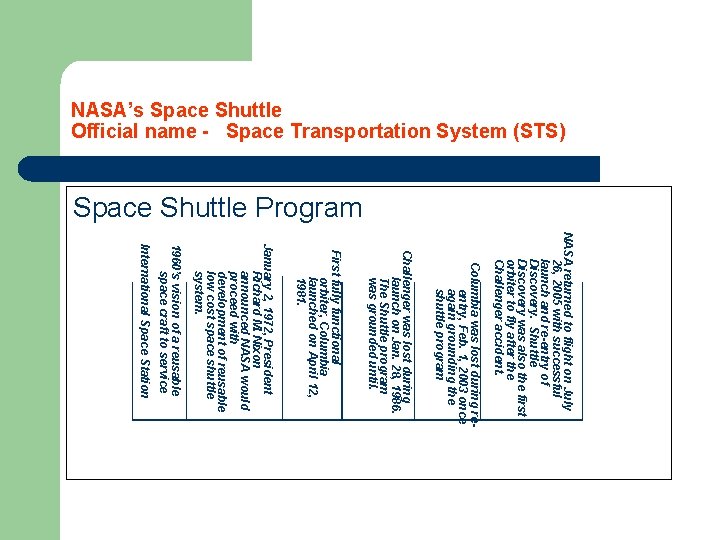
NASA’s Space Shuttle Official name - Space Transportation System (STS) Space Shuttle Program NASA returned to flight on July 26, 2005 with successful launch and re-entry of Discovery. Shuttle Discovery was also the first orbiter to fly after the Challenger accident. Columbia was lost during reentry, Feb. 1, 2003 once again grounding the shuttle program Challenger was lost during launch on Jan. 28, 1986. The Shuttle program was grounded until. First fully functional orbiter, Columbia launched on April 12, 1981. January 2, 1972, President Richard M. Nixon announced NASA would proceed with development of reusable low cost space shuttle system. 1960’s vision of a reusable space craft to service International Space Station
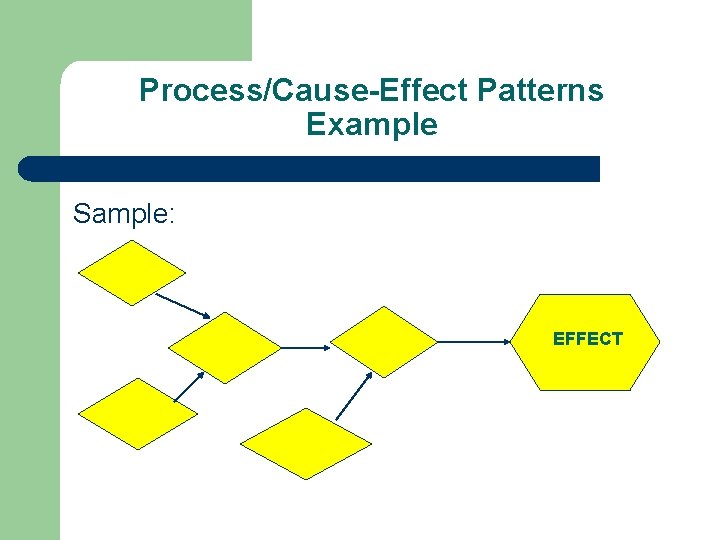
Process/Cause-Effect Patterns Example Sample: EFFECT
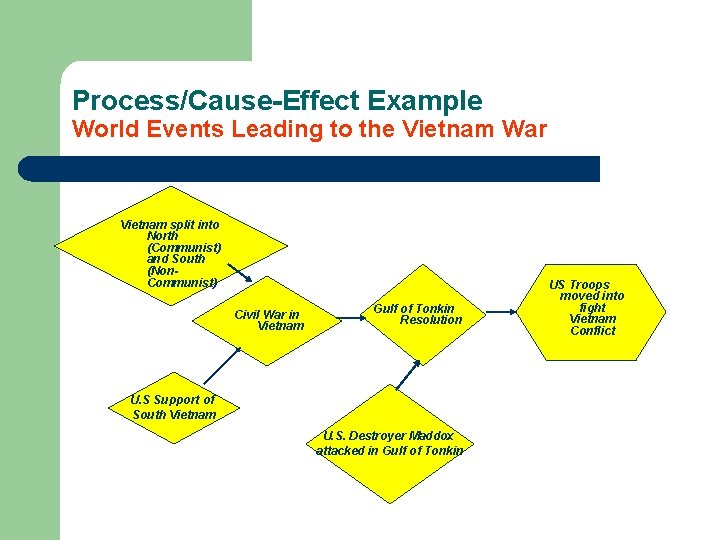
Process/Cause-Effect Example World Events Leading to the Vietnam War Vietnam split into North (Communist) and South (Non. Communist) Civil War in Vietnam Gulf of Tonkin Resolution U. S Support of South Vietnam U. S. Destroyer Maddox attacked in Gulf of Tonkin US Troops moved into fight Vietnam Conflict
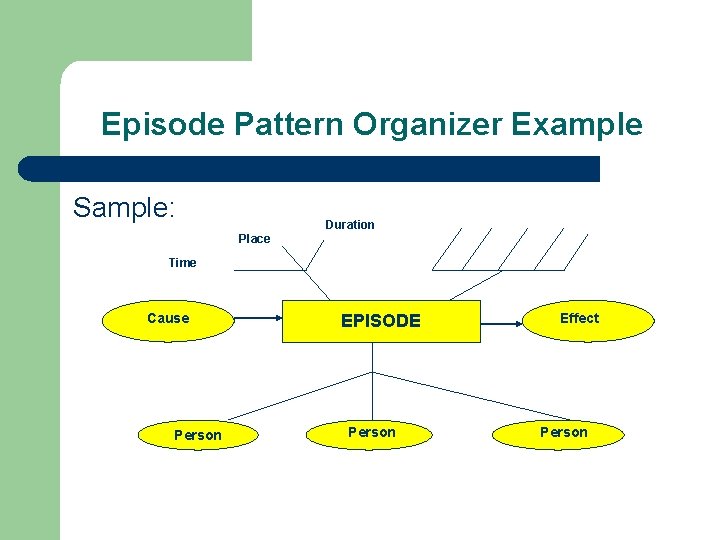
Episode Pattern Organizer Example Sample: Duration Place Time Cause Person EPISODE Person Effect Person
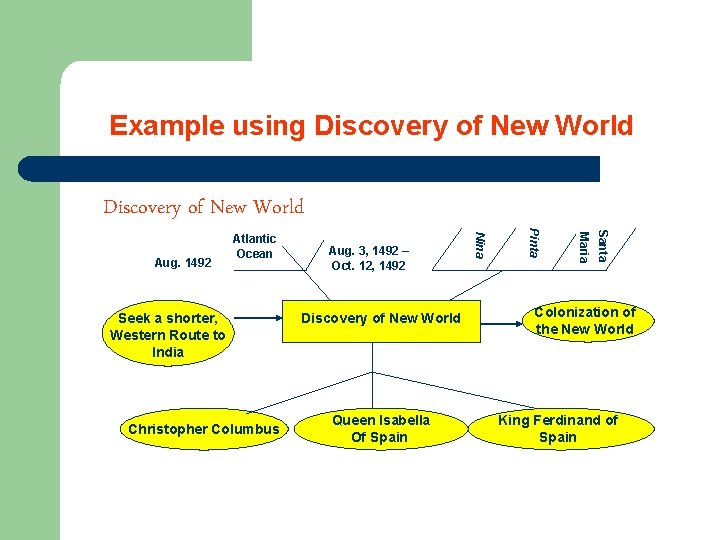
Example using Discovery of New World Queen Isabella Of Spain Santa Christopher Columbus Discovery of New World Maria Seek a shorter, Western Route to India Aug. 3, 1492 – Oct. 12, 1492 Nina Aug. 1492 Atlantic Ocean Pinta Discovery of New World Colonization of the New World King Ferdinand of Spain
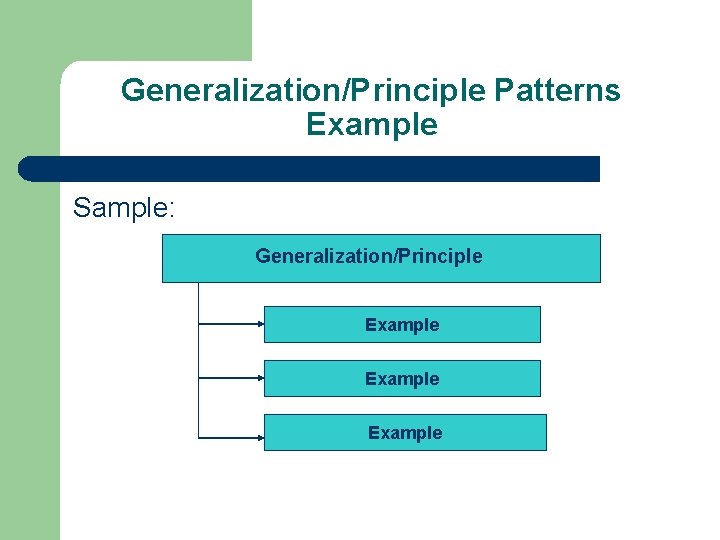
Generalization/Principle Patterns Example Sample: Generalization/Principle Example
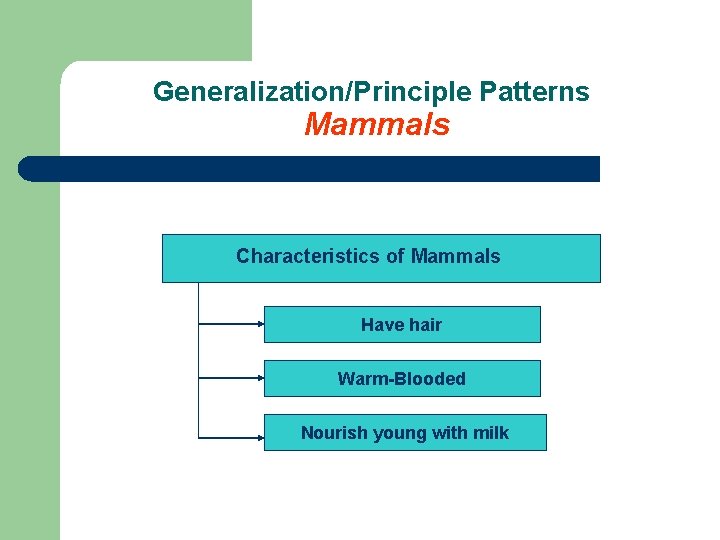
Generalization/Principle Patterns Mammals Characteristics of Mammals Have hair Warm-Blooded Nourish young with milk
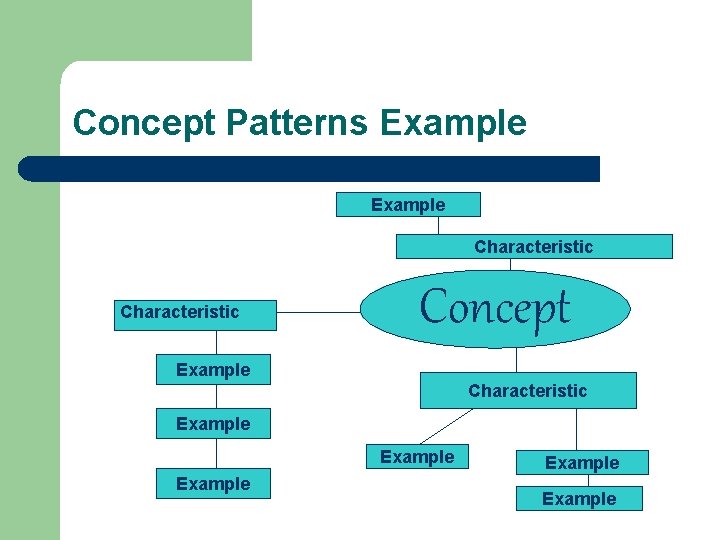
Concept Patterns Example Characteristic Concept Example Characteristic Example Example
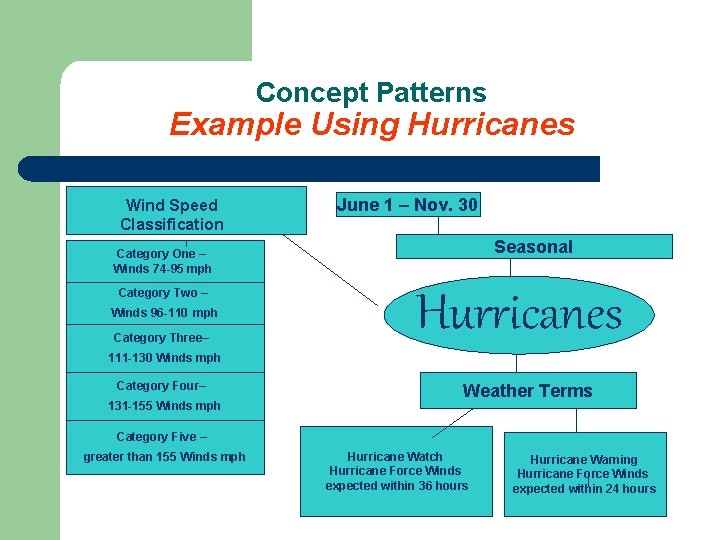
Concept Patterns Example Using Hurricanes Wind Speed Classification June 1 – Nov. 30 Seasonal Category One – Winds 74 -95 mph Category Two – Winds 96 -110 mph Category Three– Hurricanes 111 -130 Winds mph Category Four– 131 -155 Winds mph Weather Terms Category Five – greater than 155 Winds mph Hurricane Watch Hurricane Force Winds expected within 36 hours Hurricane Warning Hurricane Force Winds expected within 24 hours
Physical Models Recommendation # 2: Make Physical models to represent knowledge ~ Concrete representations of the knowledge learned ~ Think “Manipulatives” ~ Be sure the activity will extend students’ understanding of the knowledge
Example of Physical Model To extend student learning of the concepts of proportion and the relationships between two- and three-dimensional shapes, a teacher asked the students to build a three-dimensional model to scale. The assignment: Students were to choose any common object, identify a scale to use, draw a two-dimensional sketch, build the model and write two paragraphs explaining the proportional model and the process used. A student chose to build a model of her cylindrical lip balm container and chose a scale of 4: 1 for the model to the original. Some steps were easier than others in the process, but figuring out the circumference of the cylinder was a little harder. Working with construction paper, she was able to make the connection between the length of the rectangle she was rolling to create a cylinder and the circumference of the cylinder. This concrete representation solidified the connection between twodimensional and three-dimensional objects.
Mental Pictures Recommendation # 3: Have students generate mental pictures to represent knowledge they are learning. ~ Help students to create mental pictures by facilitating their thinking about the sounds, smells, tastes, and visual details associated with the knowledge. ~ The most direct way to generate nonlinguistic representations.
Example of Mental Pictures Help students create mental pictures by focusing them on the sounds, smells, tastes, and visual details associated with knowledge. If you are teaching a unit on tides, have them “feel” the breeze on the beach, feel the sand in their toes, the sun on their faces, smell the water and the seashells, hear the birds and the waves hitting the shore.
Pictures or Pictographs Recommendation # 4: Draw pictures or pictographs to represent knowledge. ~ Pictograph is a drawing that uses symbols or symbolic pictures to represent information.
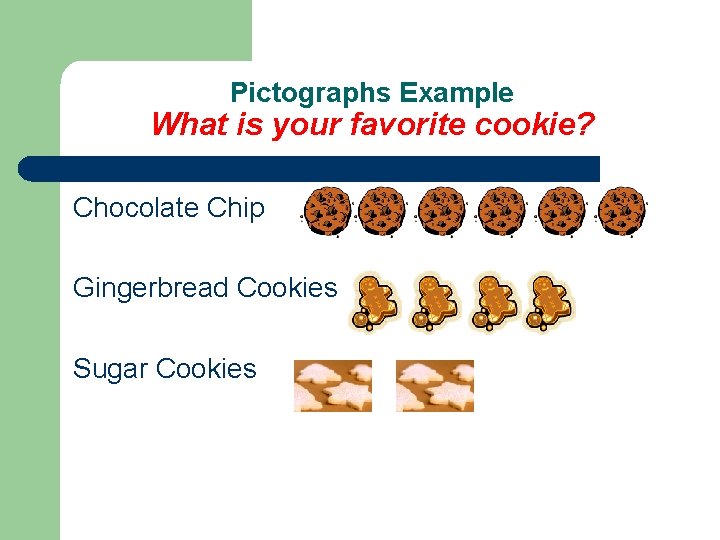
Pictographs Example What is your favorite cookie? Chocolate Chip Gingerbread Cookies Sugar Cookies
Engage in Kinesthetic Activities Recommendation # 5: Engage in kinesthetic activities that represent knowledge. ~ Physical movement activities that represent knowledge ~ how an electric circuit works, the way the planets move around the sun, the exchange of the oxygen and carbon dioxide in the body, adding and subtracting
Kinesthetic activities Modeling /Group activity: Example of kinesthetic activities…. Stand up and imagine that you are 4 th graders studying geometry topics. Use your arms to demonstrate the following: § Radius of a circle § Diameter of a circle § Circumference of a circle § Acute angle § Obtuse angle § Right angle
Three Key Points 1. We store what we know in a language form (linguistic) and an imagery form (nonlinguistic). The imagery mode is expressed as mental pictures or physical sensations.
Key Points, cont. 2. Teachers can take a variety of approaches to help students generate nonlinguistic representations of knowledge. These approaches have a strong positive effect on student achievement.
Key Points, cont. 3. Constructing nonlinguistic representations of knowledge helps students elaborate on their knowledge.
Reflection on Learning 1. 2. 3. 4. What have you learned about nonlinguistic representation? What questions do you have about nonlinguistic representations? What changes might you make in your practice related to nonlinguistic representation? What support might you need to make these changes?
- Slides: 38