
Nonlinear ResponseHistory Analysis for the Design of New
- Slides: 38
Nonlinear Response-History Analysis for the Design of New Buildings: A Fully Revised Chapter 16 Methodology for ASCE 7 -16 Project by: Large Issue Team Presented by: Curt B. Haselton, Ph. D, PE Professor of Civil Engineering @ CSU, Chico Co-Founder and CEO @ Seismic Performance Prediction Program (SP 3) [www. hbrisk. com] BSSC Webinar | April 28, 2015 Building Seismic Safety Council Issue Team 4 on Response History Analysis 1
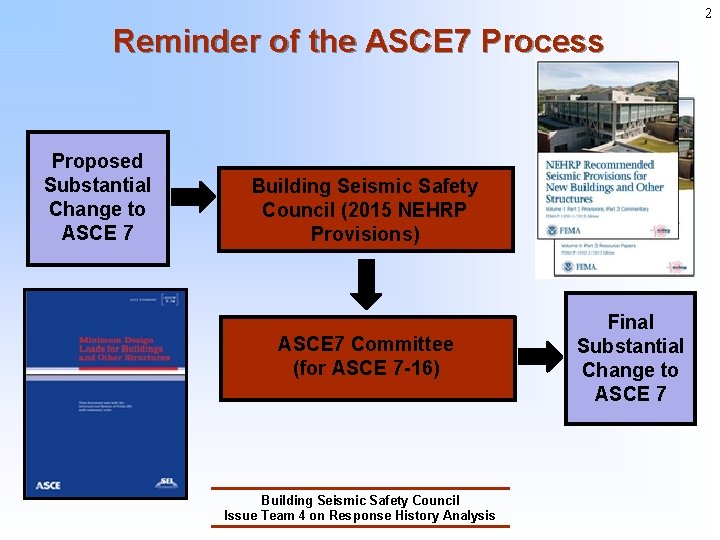
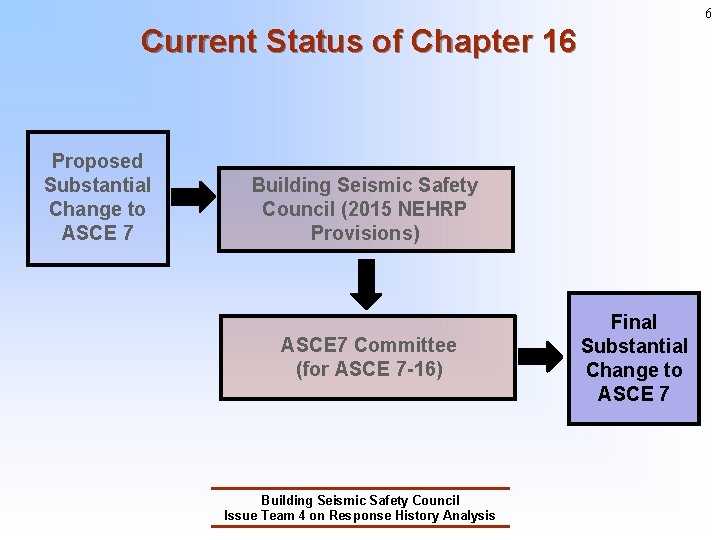
2 Reminder of the ASCE 7 Process Proposed Substantial Change to ASCE 7 Building Seismic Safety Council (2015 NEHRP Provisions) ASCE 7 Committee (for ASCE 7 -16) Building Seismic Safety Council Issue Team 4 on Response History Analysis Final Substantial Change to ASCE 7
3 Issue Team Charge and Deliverables § Issue Team Objective: Develop recommendations to the BSSC Committee regarding proposed improvements to Chapter 16 of ASCE 7. § Issue Team Deliverables: § Chapter 16 Code language (completely revised) § Chapter 16 Commentary language (completely revised) § Earthquake Spectra sister papers – (1&2) Development, (3) Example Applications, and (4) Evaluation Building Seismic Safety Council Issue Team 4 on Response History Analysis
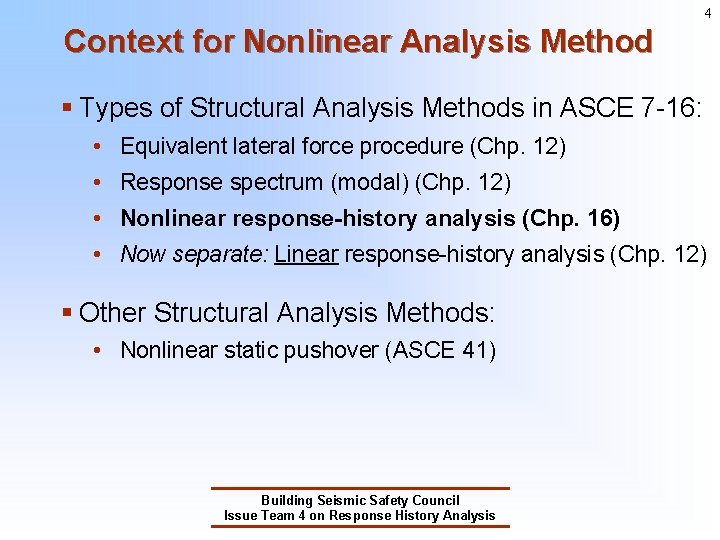
4 Context for Nonlinear Analysis Method § Types of Structural Analysis Methods in ASCE 7 -16: • Equivalent lateral force procedure (Chp. 12) • Response spectrum (modal) (Chp. 12) • Nonlinear response-history analysis (Chp. 16) • Now separate: Linear response-history analysis (Chp. 12) § Other Structural Analysis Methods: • Nonlinear static pushover (ASCE 41) Building Seismic Safety Council Issue Team 4 on Response History Analysis
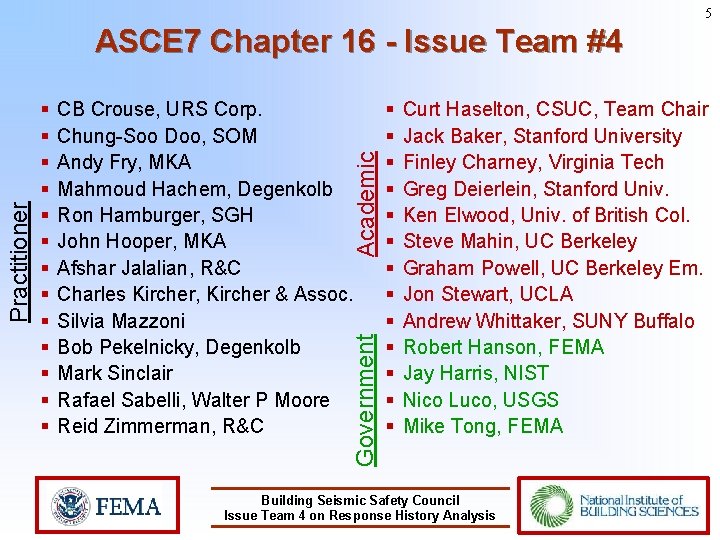
5 CB Crouse, URS Corp. Chung-Soo Doo, SOM Andy Fry, MKA Mahmoud Hachem, Degenkolb Ron Hamburger, SGH John Hooper, MKA Afshar Jalalian, R&C Charles Kircher, Kircher & Assoc. Silvia Mazzoni Bob Pekelnicky, Degenkolb Mark Sinclair Rafael Sabelli, Walter P Moore Reid Zimmerman, R&C Academic § § § § Government Practitioner ASCE 7 Chapter 16 - Issue Team #4 § § § § Curt Haselton, CSUC, Team Chair Jack Baker, Stanford University Finley Charney, Virginia Tech Greg Deierlein, Stanford Univ. Ken Elwood, Univ. of British Col. Steve Mahin, UC Berkeley Graham Powell, UC Berkeley Em. Jon Stewart, UCLA Andrew Whittaker, SUNY Buffalo Robert Hanson, FEMA Jay Harris, NIST Nico Luco, USGS Mike Tong, FEMA Building Seismic Safety Council Issue Team 4 on Response History Analysis
6 Current Status of Chapter 16 Proposed Substantial Change to ASCE 7 Building Seismic Safety Council (2015 NEHRP Provisions) ASCE 7 Committee (for ASCE 7 -16) Building Seismic Safety Council Issue Team 4 on Response History Analysis Final Substantial Change to ASCE 7
7 Literature Review § We had a lot to draw on (which was not the case only a few years ago)… • Requirements and Guidelines for the Seismic Design of New Tall Buildings using Non-Prescriptive Seismic-Design Procedures, 2010 San Francisco Building Code Administrative Bulletin 083 (AB-083, 2008). • Guidelines for Performance-Based Seismic Design of Tall Buildings, PEER Center, Tall Building Initiative (PEER, 2010). • An Alternative Procedure for Seismic Analysis and Design of Tall Buildings Located in the Los Angeles Region, 2008 Edition with Supplement #1 (LATBSDC, 2008). § NIST GCR 11 -917 -15: Selecting and Scaling Earthquake Ground Motions for Performing Response-History Analyses Building Seismic Safety Council Issue Team 4 on Response History Analysis
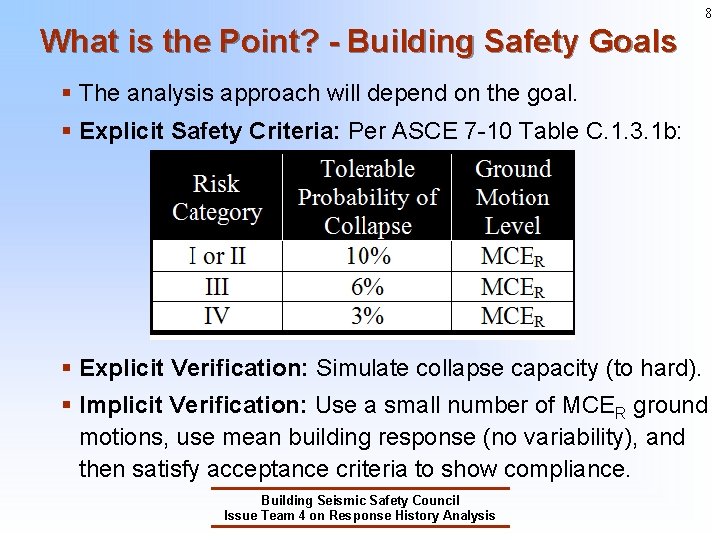
8 What is the Point? - Building Safety Goals § The analysis approach will depend on the goal. § Explicit Safety Criteria: Per ASCE 7 -10 Table C. 1. 3. 1 b: § Explicit Verification: Simulate collapse capacity (to hard). § Implicit Verification: Use a small number of MCER ground motions, use mean building response (no variability), and then satisfy acceptance criteria to show compliance. Building Seismic Safety Council Issue Team 4 on Response History Analysis
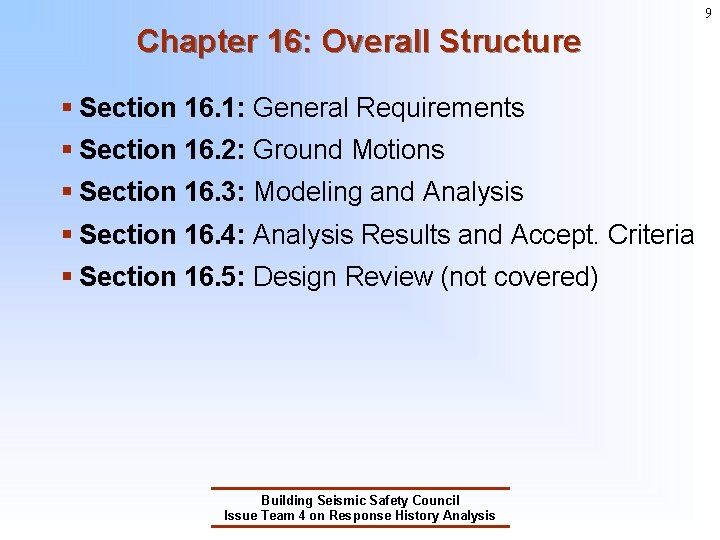
9 Chapter 16: Overall Structure § Section 16. 1: General Requirements § Section 16. 2: Ground Motions § Section 16. 3: Modeling and Analysis § Section 16. 4: Analysis Results and Accept. Criteria § Section 16. 5: Design Review (not covered) Building Seismic Safety Council Issue Team 4 on Response History Analysis
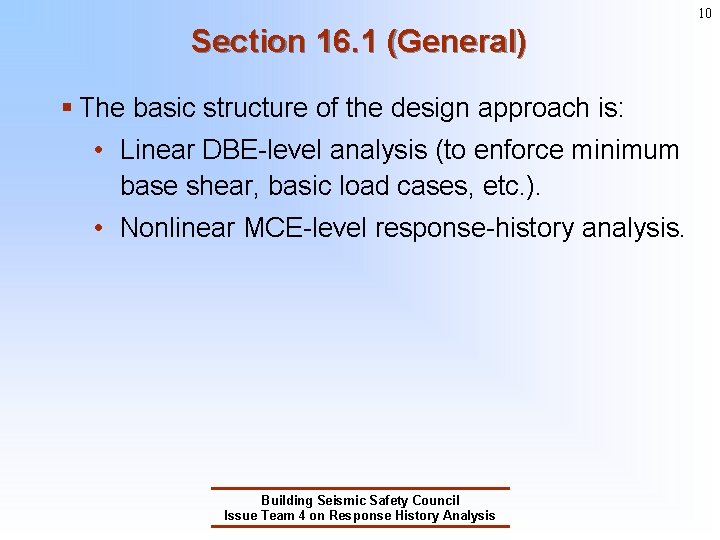
10 Section 16. 1 (General) § The basic structure of the design approach is: • Linear DBE-level analysis (to enforce minimum base shear, basic load cases, etc. ). • Nonlinear MCE-level response-history analysis. Building Seismic Safety Council Issue Team 4 on Response History Analysis
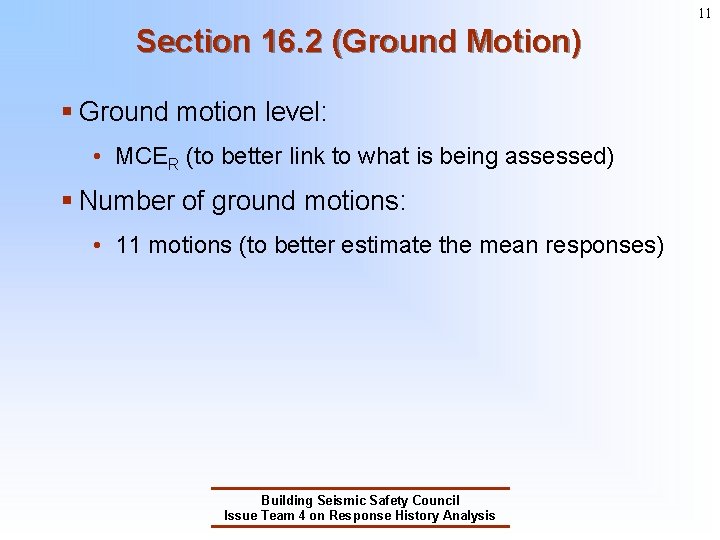
11 Section 16. 2 (Ground Motion) § Ground motion level: • MCER (to better link to what is being assessed) § Number of ground motions: • 11 motions (to better estimate the mean responses) Building Seismic Safety Council Issue Team 4 on Response History Analysis
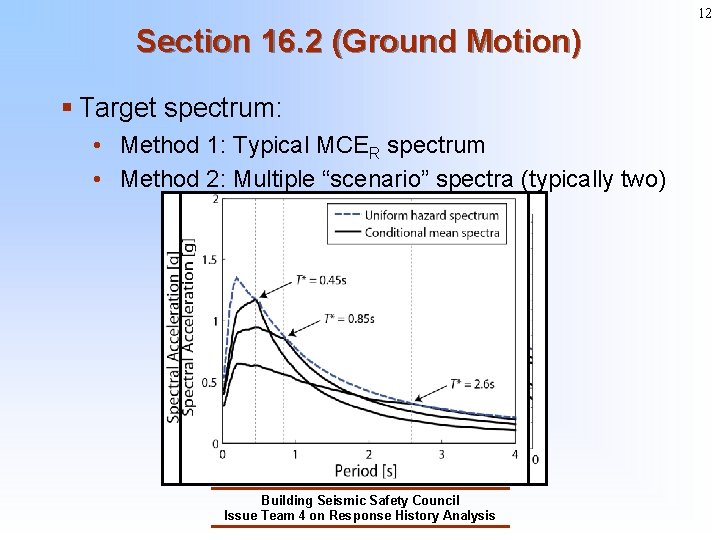
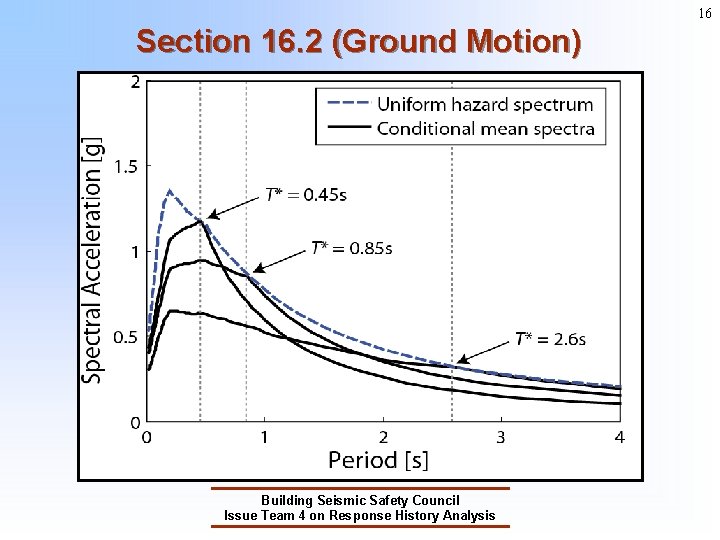
12 Section 16. 2 (Ground Motion) § Target spectrum: • Method 1: Typical MCER spectrum • Method 2: Multiple “scenario” spectra (typically two) Building Seismic Safety Council Issue Team 4 on Response History Analysis
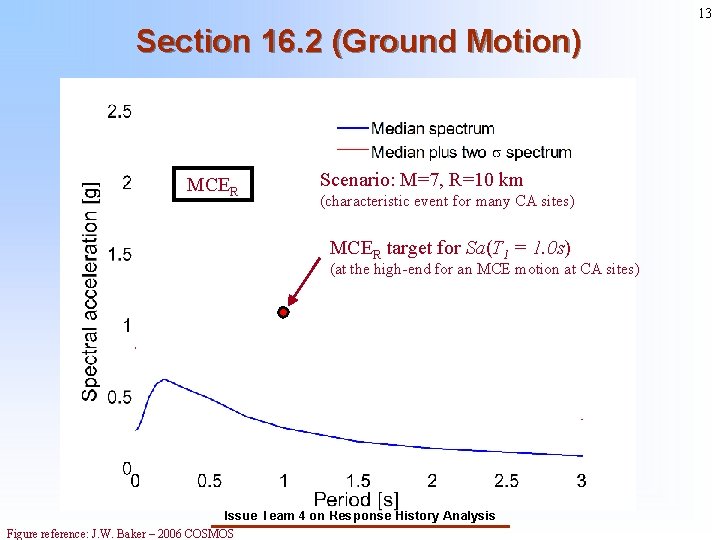
13 Section 16. 2 (Ground Motion) MCER Scenario: M=7, R=10 km (characteristic event for many CA sites) MCER target for Sa(T 1 = 1. 0 s) (at the high-end for an MCE motion at CA sites) Building Seismic Safety Council Issue Team 4 on Response History Analysis Figure reference: J. W. Baker – 2006 COSMOS
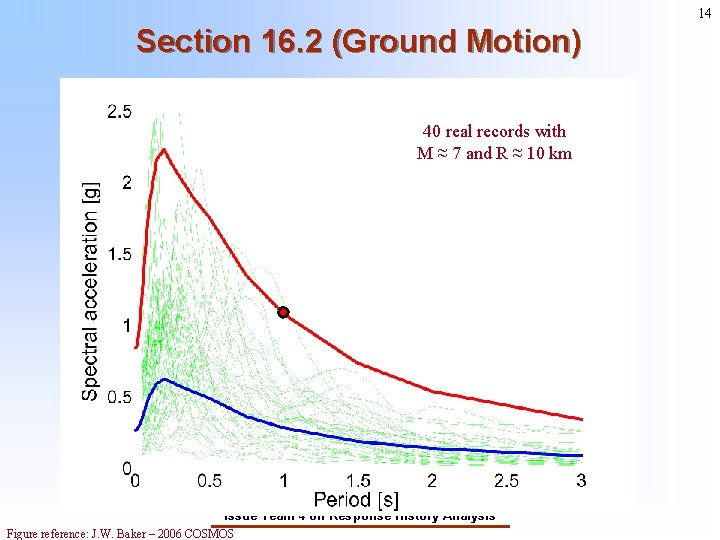
14 Section 16. 2 (Ground Motion) 40 real records with M ≈ 7 and R ≈ 10 km Building Seismic Safety Council Issue Team 4 on Response History Analysis Figure reference: J. W. Baker – 2006 COSMOS
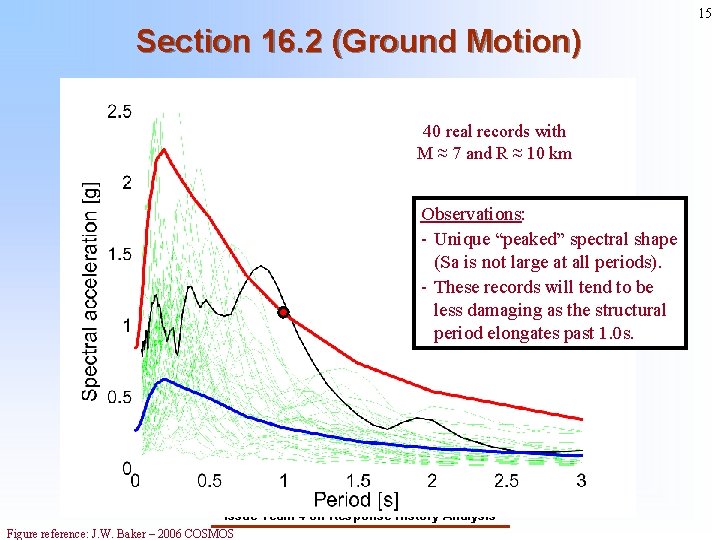
15 Section 16. 2 (Ground Motion) 40 real records with M ≈ 7 and R ≈ 10 km Observations: - Unique “peaked” spectral shape (Sa is not large at all periods). - These records will tend to be less damaging as the structural period elongates past 1. 0 s. Building Seismic Safety Council Issue Team 4 on Response History Analysis Figure reference: J. W. Baker – 2006 COSMOS
16 Section 16. 2 (Ground Motion) Building Seismic Safety Council Issue Team 4 on Response History Analysis
17 Section 16. 2 (Ground Motion) § Selection of motions: • Same general language. • Added: “It is also desirable for ground motion spectral shapes to be comparable to the target response spectrum of Section 16. 2. 2. ” • For near-fault: Include an appropriate ratio of pulse-type motions. Building Seismic Safety Council Issue Team 4 on Response History Analysis
18 Section 16. 2 (Ground Motion) § Scaling of motions: • Scale the maximum direction Sa to the target spectrum (which is maximum direction). [Contrast: Different from SRSS used in ASCE 7 and ASCE 41. ] § Period range for scaling: • Range from 0. 2 T 1 to 2. 0 T 1 (higher for MCER) • Also require 90% mass (which can control) Building Seismic Safety Council Issue Team 4 on Response History Analysis
19 Section 16. 2 (Ground Motion) § Near-Fault versus Far-Field • BSSC Issue Team left this fairly non-prescriptive. • ASCE 7 process added specificity (near-fault is R < 15 km if M > 7. 0 and R < 10 km if 7. 0 > M > 6. 5). As an aside/example, most of San Francisco is now “near-fault”. • [Contrast: Larger range than ASCE 41. ] § Orientation of Ground Motions: • Near-Fault: Apply pairs of records in FN/FP orientation • Far-Field: Apply pairs of records with “random orientation” (but ASCE 7 process added a more specific +/- 10% requirement) • No need to rotate pairs 90 degrees Building Seismic Safety Council Issue Team 4 on Response History Analysis
20 Section 16. 2 (Ground Motion) § Spectral matching: • Average matched spectra must meet a slightly higher threshold of 110% of the target spectrum. • This is an intentional penalty for the use of spectrum matching, because studies have shown that it can lead to conservatively biased results if not done correctly. • Only allowed for near-fault sites if it is shown that the pulse properties are maintained. Building Seismic Safety Council Issue Team 4 on Response History Analysis
21 Sec. 16. 3 (Modeling & Analysis) § This section says what to do but not how to do it. § This was intentionally not written to be a nonlinear analysis guideline. § One item to highlight – Torsion: • Interesting topic with lots of divergent opinions! • BSSC Issue Team: Leave this to the linear design step. • ASCE 7: Allow the above if no Type 1 a/1 b irregularity exists, otherwise require 5% mass offsets in the NL model. Building Seismic Safety Council Issue Team 4 on Response History Analysis
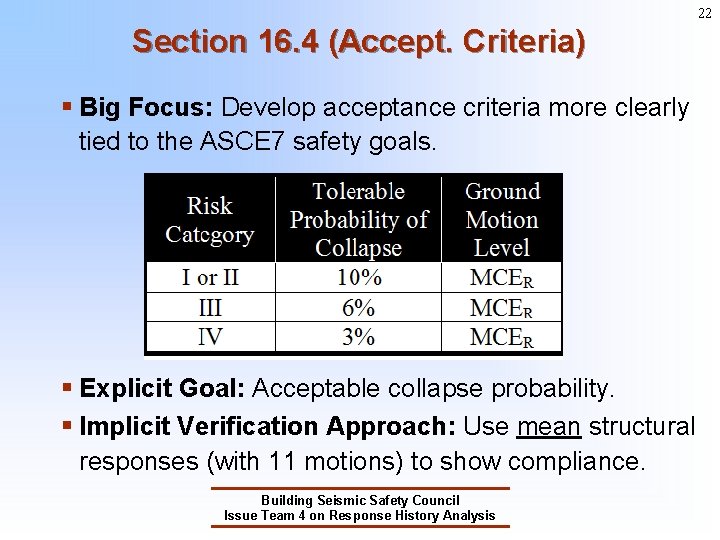
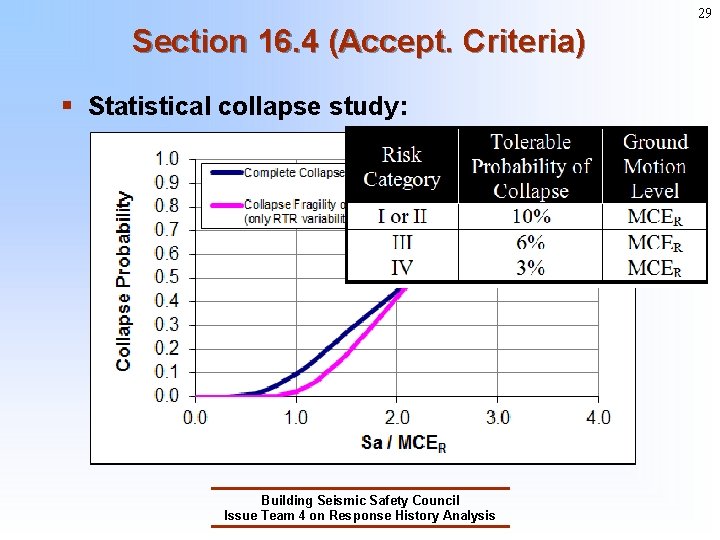
22 Section 16. 4 (Accept. Criteria) § Big Focus: Develop acceptance criteria more clearly tied to the ASCE 7 safety goals. § Explicit Goal: Acceptable collapse probability. § Implicit Verification Approach: Use mean structural responses (with 11 motions) to show compliance. Building Seismic Safety Council Issue Team 4 on Response History Analysis
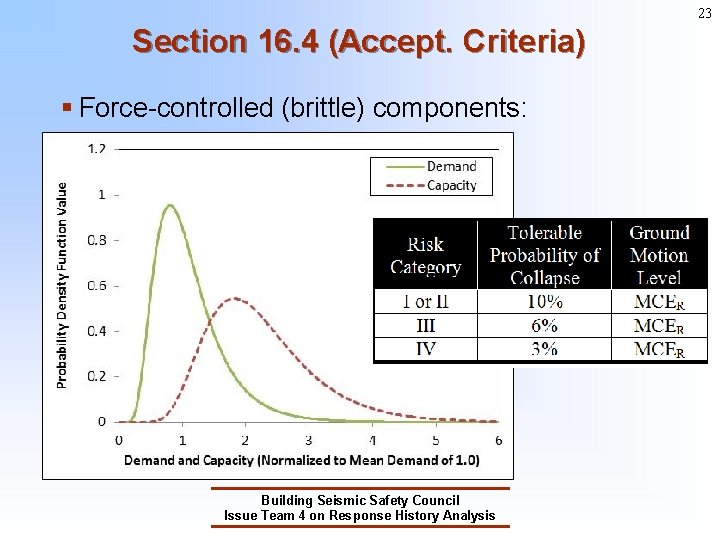
23 Section 16. 4 (Accept. Criteria) § Force-controlled (brittle) components: Building Seismic Safety Council Issue Team 4 on Response History Analysis
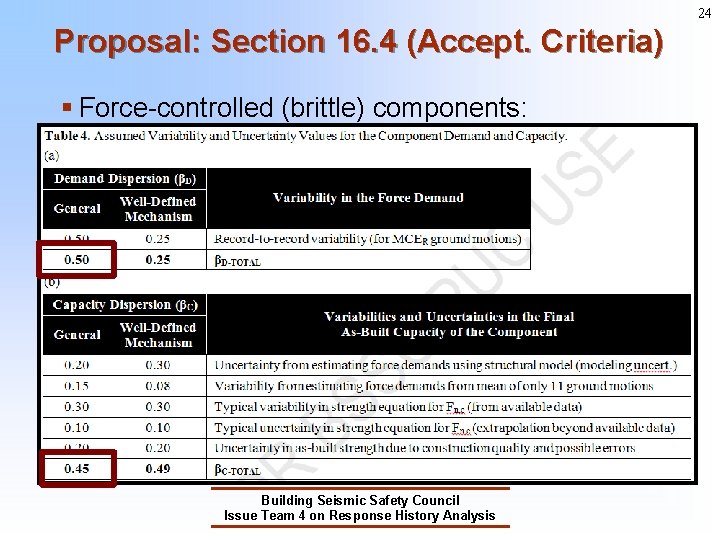
24 Proposal: Section 16. 4 (Accept. Criteria) § Force-controlled (brittle) components: Building Seismic Safety Council Issue Team 4 on Response History Analysis
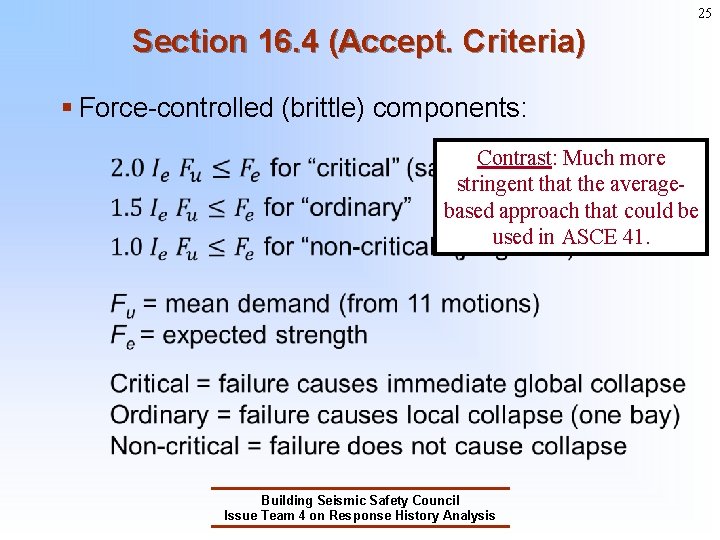
25 Section 16. 4 (Accept. Criteria) § Force-controlled (brittle) components: Contrast: Much more stringent that the averagebased approach that could be used in ASCE 41. Building Seismic Safety Council Issue Team 4 on Response History Analysis
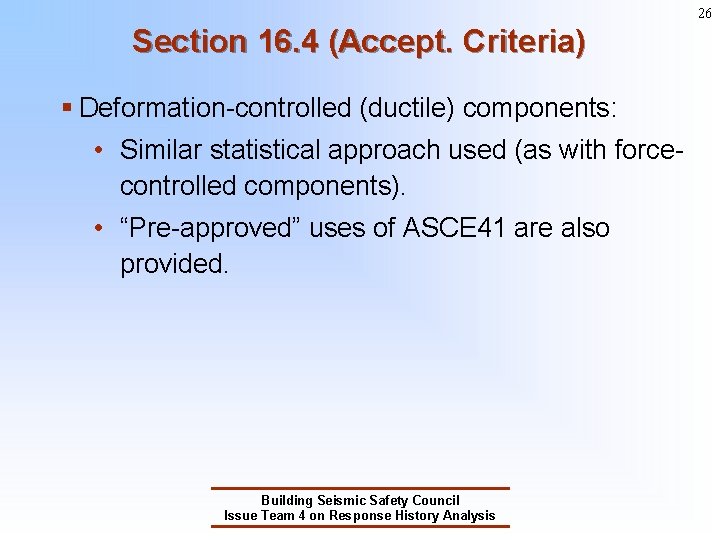
26 Section 16. 4 (Accept. Criteria) § Deformation-controlled (ductile) components: • Similar statistical approach used (as with forcecontrolled components). • “Pre-approved” uses of ASCE 41 are also provided. Building Seismic Safety Council Issue Team 4 on Response History Analysis
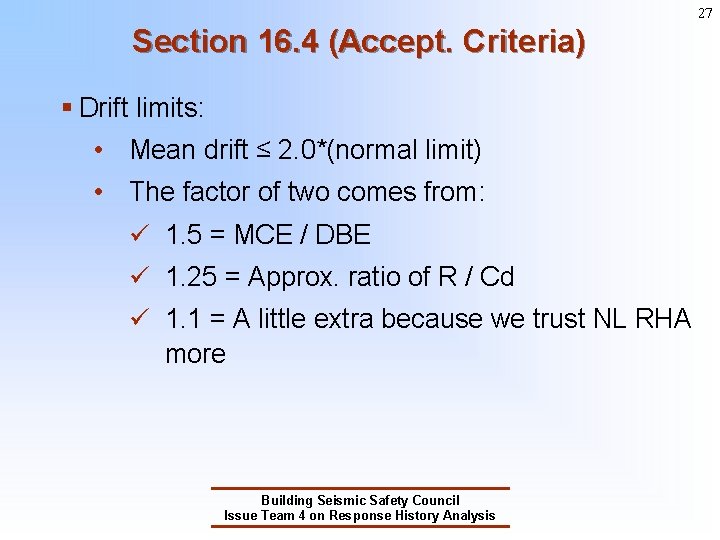
27 Section 16. 4 (Accept. Criteria) § Drift limits: • Mean drift ≤ 2. 0*(normal limit) • The factor of two comes from: ü 1. 5 = MCE / DBE ü 1. 25 = Approx. ratio of R / Cd ü 1. 1 = A little extra because we trust NL RHA more Building Seismic Safety Council Issue Team 4 on Response History Analysis
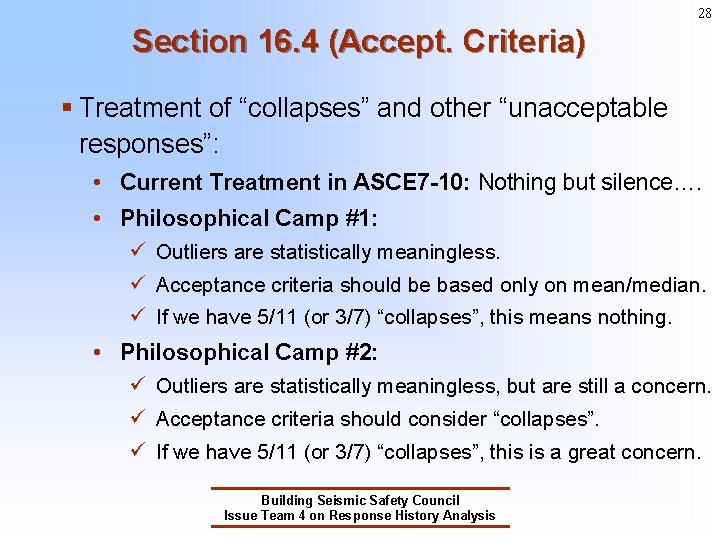
28 Section 16. 4 (Accept. Criteria) § Treatment of “collapses” and other “unacceptable responses”: • Current Treatment in ASCE 7 -10: Nothing but silence…. • Philosophical Camp #1: ü Outliers are statistically meaningless. ü Acceptance criteria should be based only on mean/median. ü If we have 5/11 (or 3/7) “collapses”, this means nothing. • Philosophical Camp #2: ü Outliers are statistically meaningless, but are still a concern. ü Acceptance criteria should consider “collapses”. ü If we have 5/11 (or 3/7) “collapses”, this is a great concern. Building Seismic Safety Council Issue Team 4 on Response History Analysis
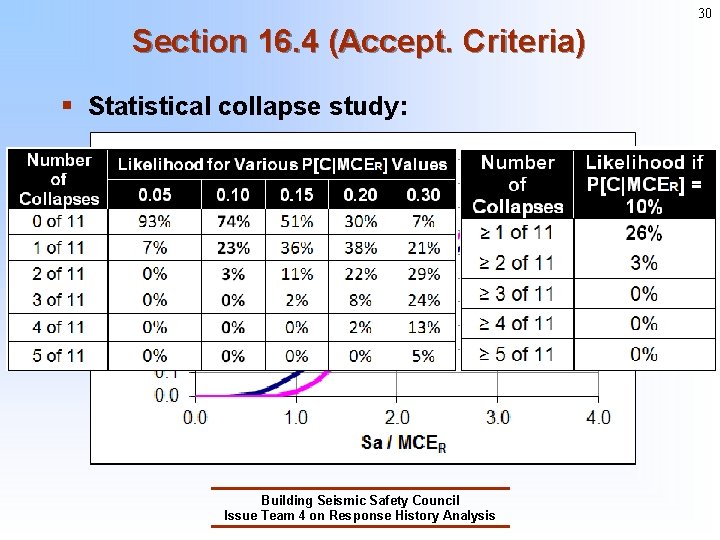
29 Section 16. 4 (Accept. Criteria) § Statistical collapse study: Building Seismic Safety Council Issue Team 4 on Response History Analysis
30 Section 16. 4 (Accept. Criteria) § Statistical collapse study: Building Seismic Safety Council Issue Team 4 on Response History Analysis
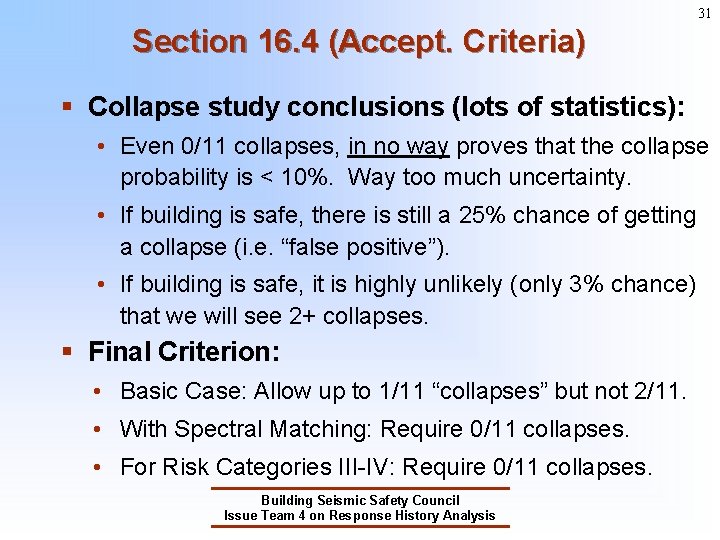
31 Section 16. 4 (Accept. Criteria) § Collapse study conclusions (lots of statistics): • Even 0/11 collapses, in no way proves that the collapse probability is < 10%. Way too much uncertainty. • If building is safe, there is still a 25% chance of getting a collapse (i. e. “false positive”). • If building is safe, it is highly unlikely (only 3% chance) that we will see 2+ collapses. § Final Criterion: • Basic Case: Allow up to 1/11 “collapses” but not 2/11. • With Spectral Matching: Require 0/11 collapses. • For Risk Categories III-IV: Require 0/11 collapses. Building Seismic Safety Council Issue Team 4 on Response History Analysis
32 Section 16. 4 (Accept. Criteria) § “Collapses” are more generally called “unacceptable responses” and include: 1. True dynamic instability, 2. Analytical solution fails to converge, 3. Predicted demands on deformation-controlled elements exceed the valid range of modeling, 4. Predicted demands on critical or ordinary force-controlled elements exceed the element capacity, or 5. Predicted deformation demands on elements not explicitly modeled exceed the deformation limits at which the members are no longer able to carry their gravity loads. Building Seismic Safety Council Issue Team 4 on Response History Analysis
33 Section 16. 5 (Design Review) § Typical requirements and language… § Design review is critical! Building Seismic Safety Council Issue Team 4 on Response History Analysis
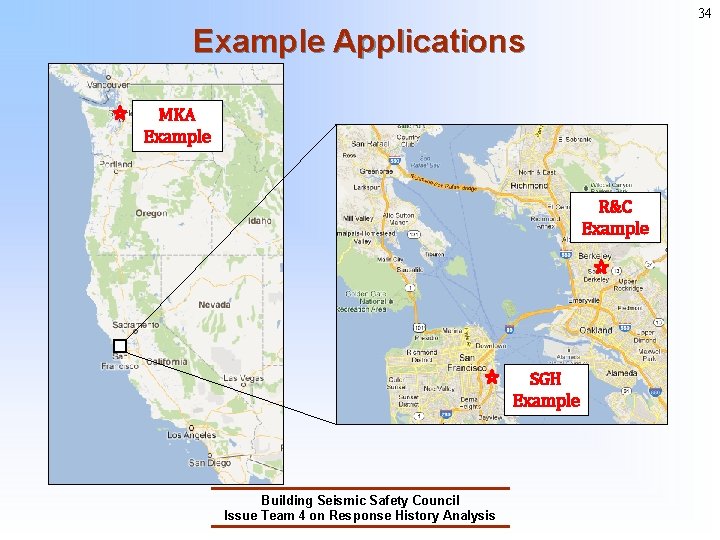
34 Example Applications MKA Example R&C Example SGH Example Building Seismic Safety Council Issue Team 4 on Response History Analysis
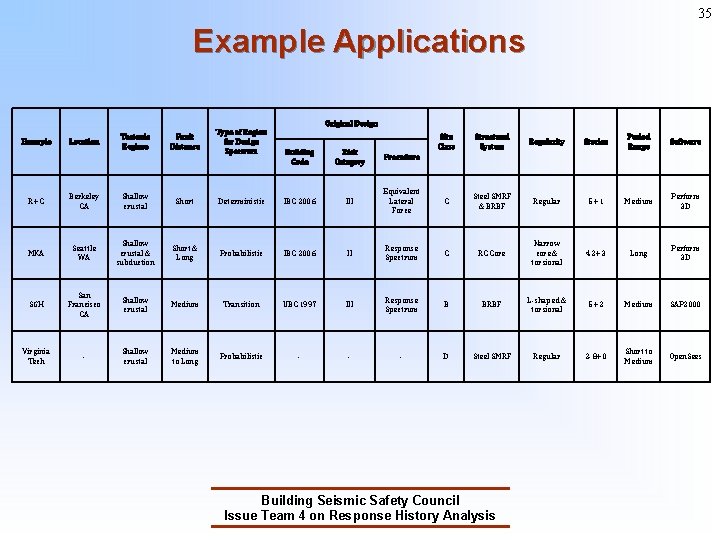
35 Example Applications Original Design Example Location Tectonic Regime Fault Distance Type of Region for Design Spectrum Building Code Risk Category Procedure Site Class Structural System Regularity Stories Period Range Software R+C Berkeley CA Shallow crustal Short Deterministic IBC 2006 III Equivalent Lateral Force C Steel SMRF & BRBF Regular 5+1 Medium Perform 3 D MKA Seattle WA Shallow crustal & subduction Short & Long Probabilistic IBC 2006 II Response Spectrum C RC Core Narrow core & torsional 42+3 Long Perform 3 D SGH San Francisco CA Shallow crustal Medium Transition UBC 1997 III Response Spectrum B BRBF L-shaped & torsional 5+2 Medium SAP 2000 Virginia Tech - Shallow crustal Medium to Long Probabilistic - - - D Steel SMRF Regular 2 -8+0 Short to Medium Open. Sees Building Seismic Safety Council Issue Team 4 on Response History Analysis
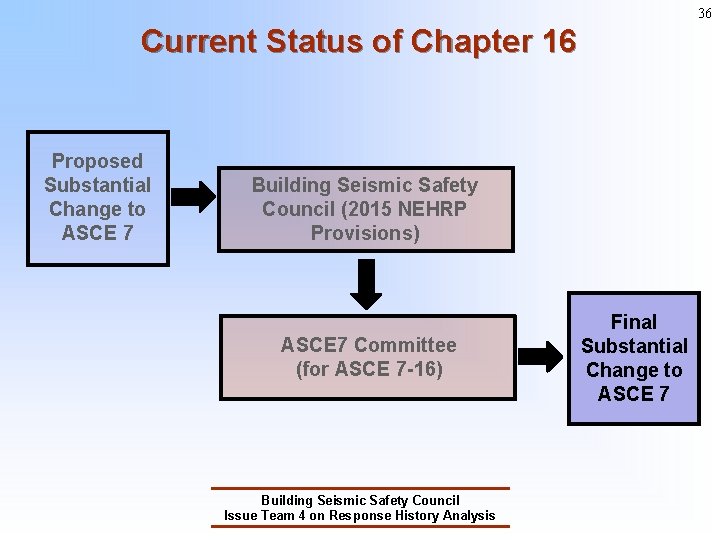
36 Current Status of Chapter 16 Proposed Substantial Change to ASCE 7 Building Seismic Safety Council (2015 NEHRP Provisions) ASCE 7 Committee (for ASCE 7 -16) Building Seismic Safety Council Issue Team 4 on Response History Analysis Final Substantial Change to ASCE 7
37 More Information: Publications ASCE 7 Chapter 16 Project Documentation: § Chapter 16 in the 2015 NEHRP Provisions (code and commentary) § Chapter 16 in the ASCE 7 -16 Standard (code and commentary) § Earthquake Spectra papers in progress/review: 1. Provisions Development (1 of 2) 2. Provisions Development (2 of 2) 3. Example Applications 4. Evaluation Studies Recent Advances in Ground Motion Selection and Scaling
38 Questions/Comments? § Thanks you for your time. § Please contact me if you would like more information/background because a short presentation is not enough! § Contact: • E-mail: curt@hbrisk. com • Website: www. hbrisk. com • Direct: (530) 514 -8980 Building Seismic Safety Council Issue Team 4 on Response History Analysis