
Nonlinear Neural Networks LAB CHAPTER 3 BOOLEAN ALGEBRA
Nonlinear & Neural Networks LAB. CHAPTER 3 BOOLEAN ALGEBRA (continued) 3. 1 3. 2 3. 3 3. 4 3. 5 Multiplying Out and Factoring Expressions Exclusive-OR and Equivalence Operations The Consensus Theorem Algebraic Simplification of Switching Expressions Proving the Validity of an Equation
Objectives Topics introduced in this chapter: • Apply Boolean laws and theorems to manipulation of expression - Simplifying - Finding the complement - Multiplying out and factoring • Exclusive-OR and Equivalence operation(Exclusive-NOR) • Consensus theorem Nonlinear & Neural Networks LAB.
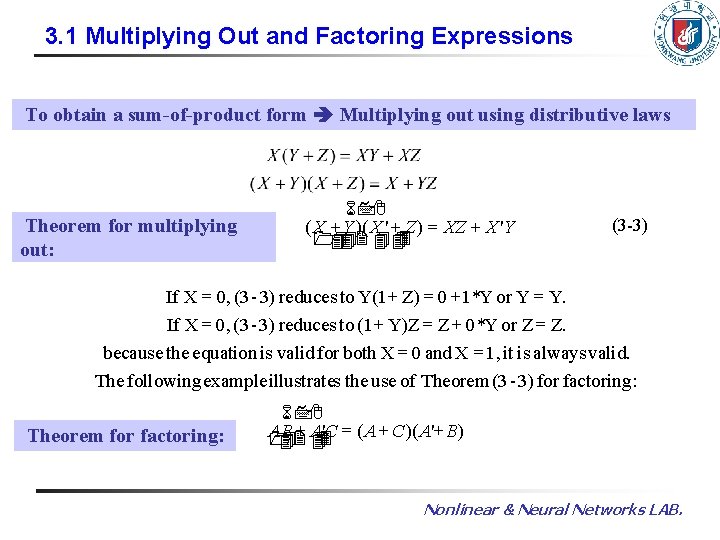
3. 1 Multiplying Out and Factoring Expressions To obtain a sum-of-product form Multiplying out using distributive laws Theorem for multiplying out: 678 ( X + Y )( X ' + Z ) = XZ + X ' Y 1442 4 4 3 (3 -3) If X = 0, (3 - 3) reduces to Y(1 + Z) = 0 + 1*Y or Y = Y. If X = 0, (3 - 3) reduces to (1 + Y)Z = Z + 0 *Y or Z = Z. because the equation is valid for both X = 0 and X = 1, it is always valid. The following example illustrates the use of Theorem (3 - 3) for factoring : Theorem for factoring: 6 78 A 42 B+ A 'C = ( A + C )( A'+ B) 1 43 Nonlinear & Neural Networks LAB.
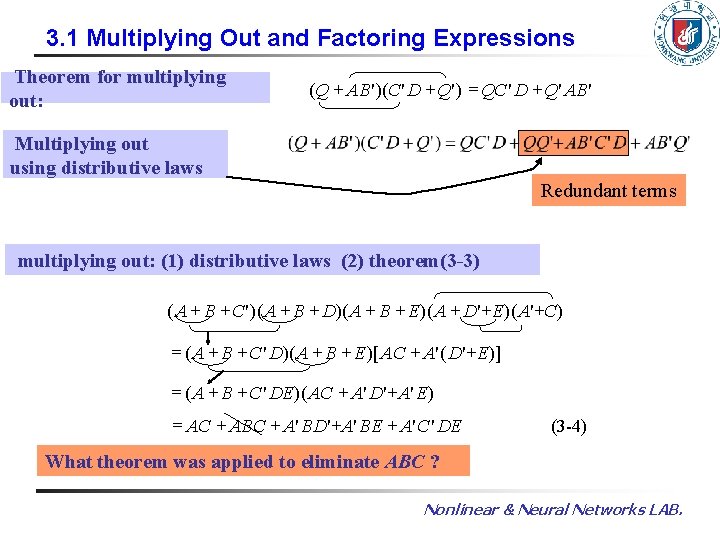
3. 1 Multiplying Out and Factoring Expressions Theorem for multiplying out: (Q + AB' )(C ' D + Q' ) = QC ' D + Q' AB' Multiplying out using distributive laws Redundant terms multiplying out: (1) distributive laws (2) theorem(3 -3) ( A + B + C ' )( A + B + D)( A + B + E )( A + D' +E )( A' +C ) = ( A + B + C ' D)( A + B + E )[ AC + A' ( D' +E )] = ( A + B + C ' DE )( AC + A' D' +A' E ) = AC + ABC + A' BD' +A' BE + A' C ' DE (3 -4) What theorem was applied to eliminate ABC ? Nonlinear & Neural Networks LAB.

3. 1 Multiplying Out and Factoring Expressions To obtain a product-of-sum form Factoring using distributive laws Theorem for factoring: 6 78 A 42 B+ A 'C = ( A + C )( A'+ B) 1 43 Example of factoring: AC + A' BD' +A' BE + A' C ' DE = AC + A' ( BD' +BE + C ' DE) XZ X ' Y = ( A + BD' +BE + C ' DE )( A' +C ) = [ A + C ' DE + B( D' +E )]( A' +C ) X Y Z = ( A + B + C ' DE )( A + C ' DE + D' +E )( A' +C ) = ( A + B + C ' )( A + B + D)( A + B + E )( A + D' +E )( A' +C ) (3 -5) Nonlinear & Neural Networks LAB.
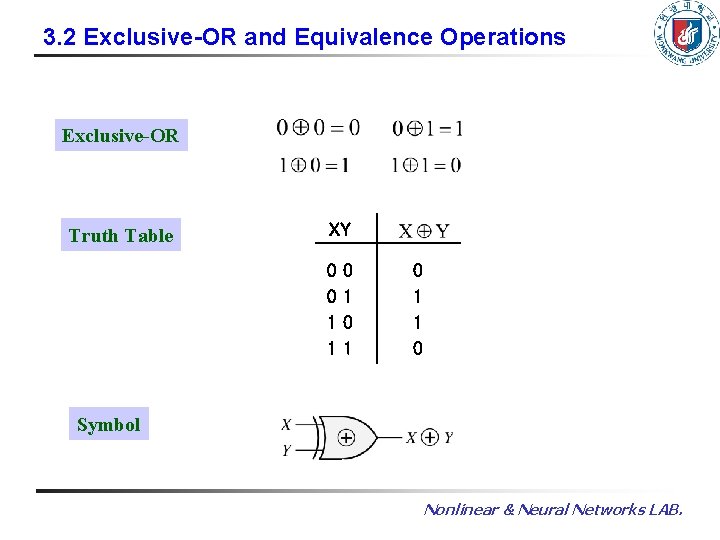
3. 2 Exclusive-OR and Equivalence Operations Exclusive-OR Truth Table XY 0 0 1 1 0 1 0 1 1 0 Symbol Nonlinear & Neural Networks LAB.
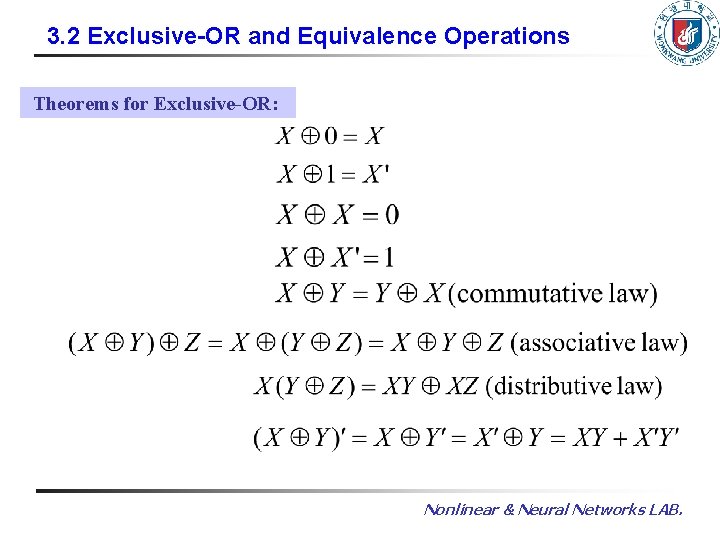
3. 2 Exclusive-OR and Equivalence Operations Theorems for Exclusive-OR: Nonlinear & Neural Networks LAB.
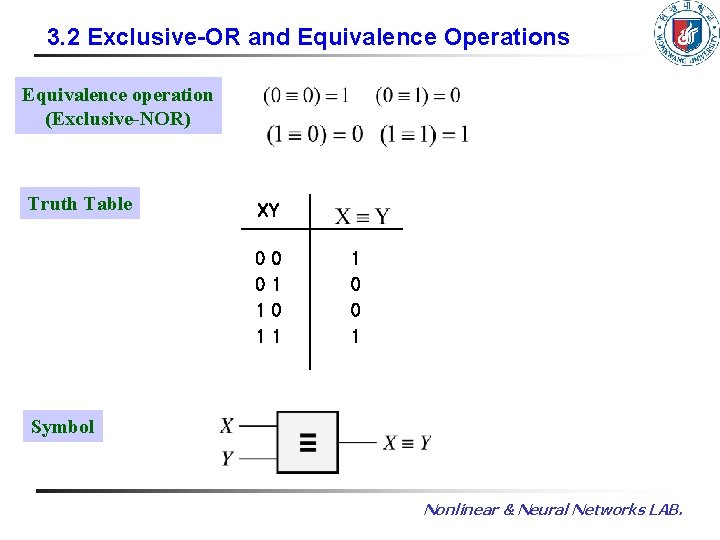
3. 2 Exclusive-OR and Equivalence Operations Equivalence operation (Exclusive-NOR) Truth Table XY 0 0 1 1 0 0 1 Symbol Nonlinear & Neural Networks LAB.
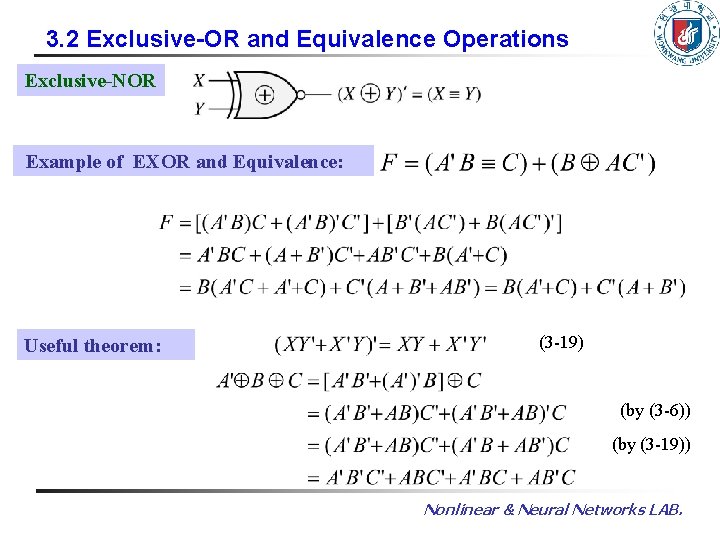
3. 2 Exclusive-OR and Equivalence Operations Exclusive-NOR Example of EXOR and Equivalence: Useful theorem: (3 -19) (by (3 -6)) (by (3 -19)) Nonlinear & Neural Networks LAB.
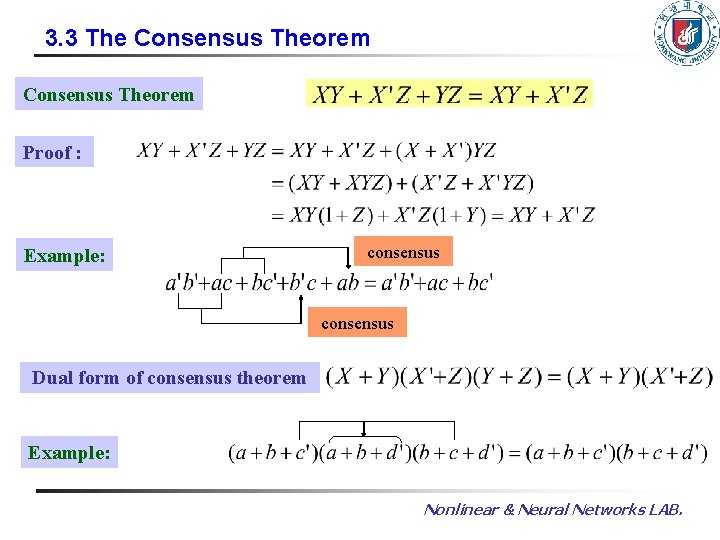
3. 3 The Consensus Theorem Proof : Example: consensus Dual form of consensus theorem Example: Nonlinear & Neural Networks LAB.
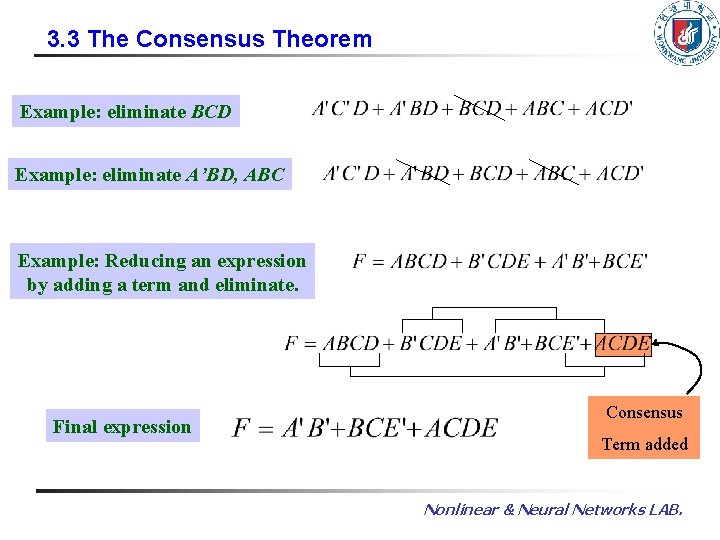
3. 3 The Consensus Theorem Example: eliminate BCD Example: eliminate A’BD, ABC Example: Reducing an expression by adding a term and eliminate. Final expression Consensus Term added Nonlinear & Neural Networks LAB.
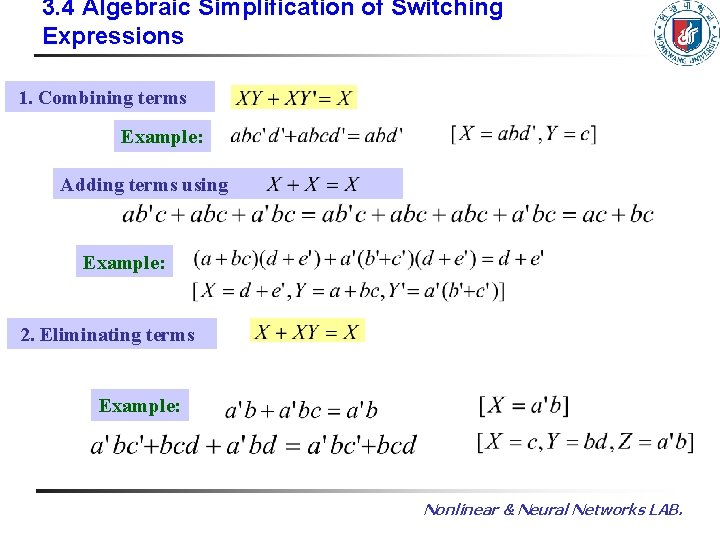
3. 4 Algebraic Simplification of Switching Expressions 1. Combining terms Example: Adding terms using Example: 2. Eliminating terms Example: Nonlinear & Neural Networks LAB.
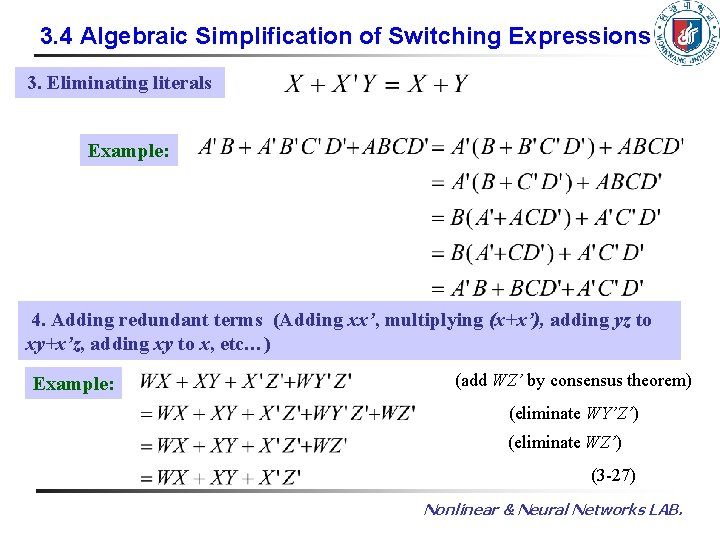
3. 4 Algebraic Simplification of Switching Expressions 3. Eliminating literals Example: 4. Adding redundant terms (Adding xx’, multiplying (x+x’), adding yz to xy+x’z, adding xy to x, etc…) Example: (add WZ’ by consensus theorem) (eliminate WY’Z’) (eliminate WZ’) (3 -27) Nonlinear & Neural Networks LAB.
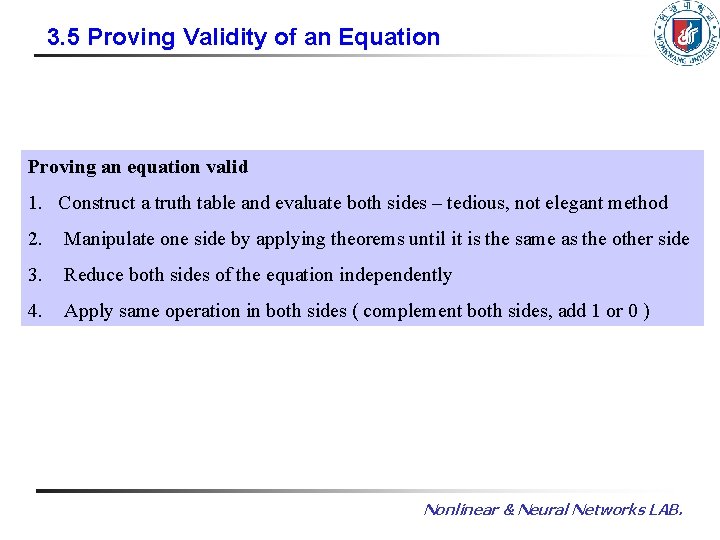
3. 5 Proving Validity of an Equation Proving an equation valid 1. Construct a truth table and evaluate both sides – tedious, not elegant method 2. Manipulate one side by applying theorems until it is the same as the other side 3. Reduce both sides of the equation independently 4. Apply same operation in both sides ( complement both sides, add 1 or 0 ) Nonlinear & Neural Networks LAB.
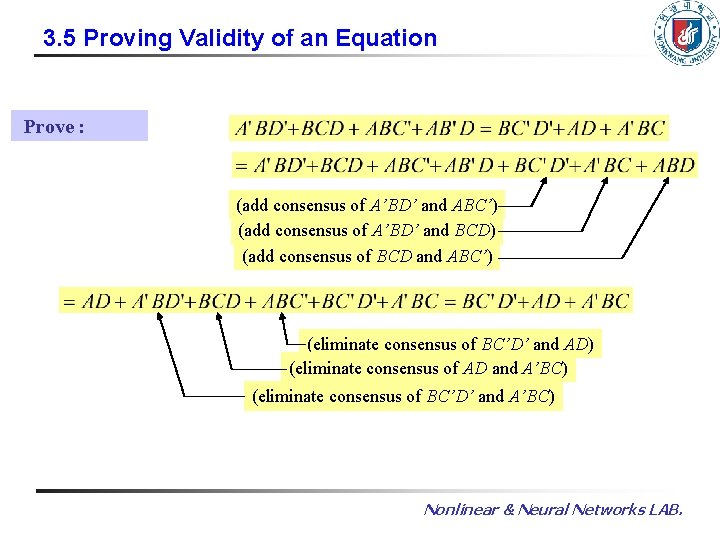
3. 5 Proving Validity of an Equation Prove : (add consensus of A’BD’ and ABC’) (add consensus of A’BD’ and BCD) (add consensus of BCD and ABC’) (eliminate consensus of BC’D’ and AD) (eliminate consensus of AD and A’BC) (eliminate consensus of BC’D’ and A’BC) Nonlinear & Neural Networks LAB.
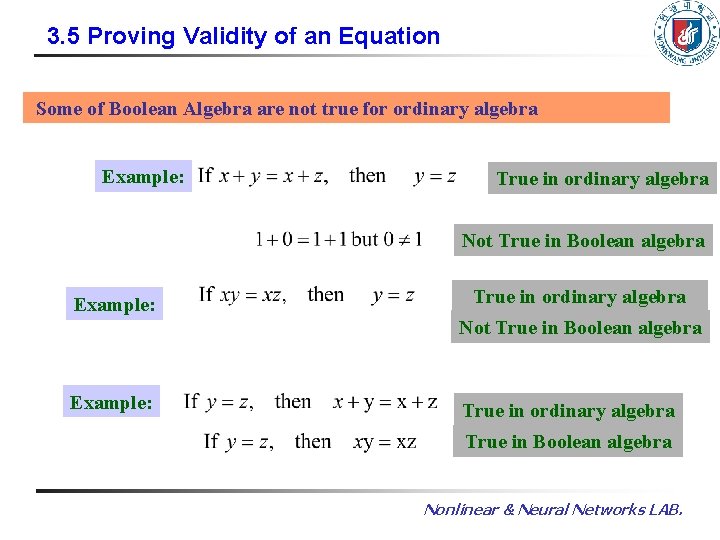
3. 5 Proving Validity of an Equation Some of Boolean Algebra are not true for ordinary algebra Example: True in ordinary algebra Not True in Boolean algebra Example: True in ordinary algebra True in Boolean algebra Nonlinear & Neural Networks LAB.
- Slides: 16