
Nonlinear behavior and intermodulation suppression in a TWT
Nonlinear behavior and intermodulation suppression in a TWT amplifier Aarti Singh University of Wisconsin - Madison Acknowledgments: J. Wöhlbier , J. Scharer and J. Booske
Outline Ø Characterization of Nonlinearity in terms of distortion products (Identify harmonics and intermods). Ø Nonlinear behavior description of a TWT amplifier. Ø Why suppress intermods? Ø Intermodulation suppression techniques and Experimental results.
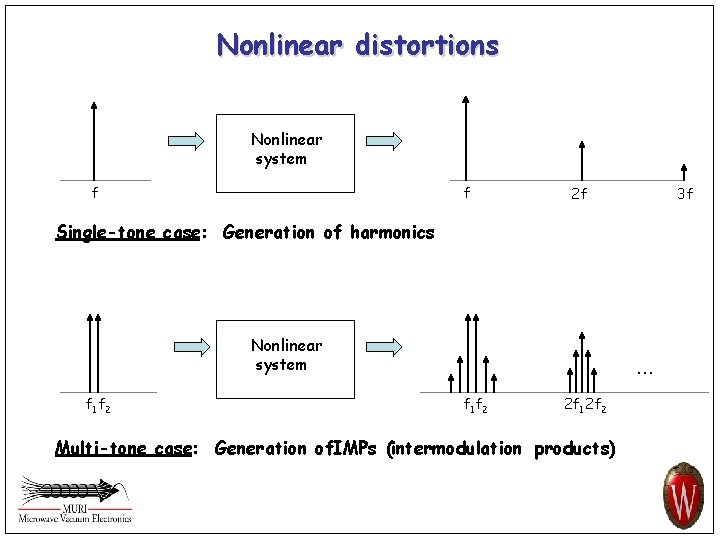
Nonlinear distortions Nonlinear system f f 2 f 3 f Single-tone case: Generation of harmonics Nonlinear system f 1 f 2 … f 1 f 2 2 f 1 2 f 2 Multi-tone case: Generation of. IMPs (intermodulation products)
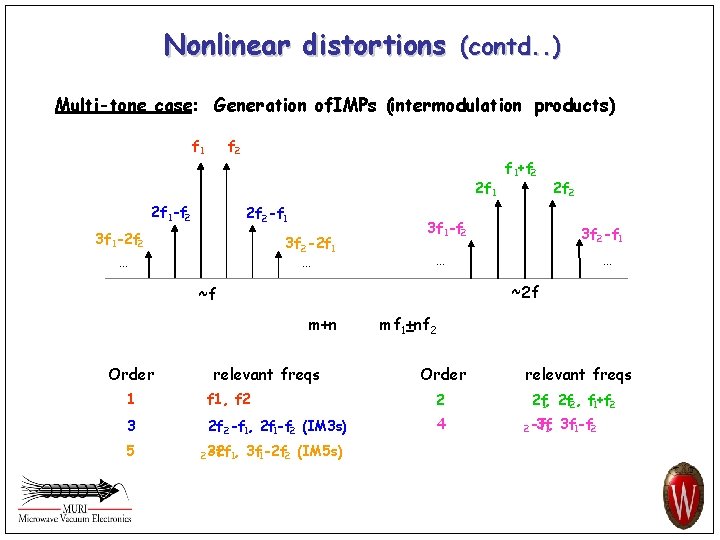
Nonlinear distortions (contd. . ) Multi-tone case: Generation of. IMPs (intermodulation products) f 1 f 2 2 f 1 -f 2 2 f 2 -f 1 3 f 1 -2 f 2 3 f 2 -2 f 1 … … relevant freqs … … mf 1±nf 2 Order 1 f 1, f 2 2 3 2 f 2 -f 1, 2 f 1 -f 2 (IM 3 s) 4 3 f 1, 2 -2 f 3 f 2 -f 1 ~2 f m+n 5 2 f 2 3 f 1 -f 2 ~f Order f 1+f 2 3 f 1 -2 f 2 (IM 5 s) relevant freqs 2 f 1, 2 f 2, f 1+f 2 3 f 2 -f 1, 3 f 1 -f 2
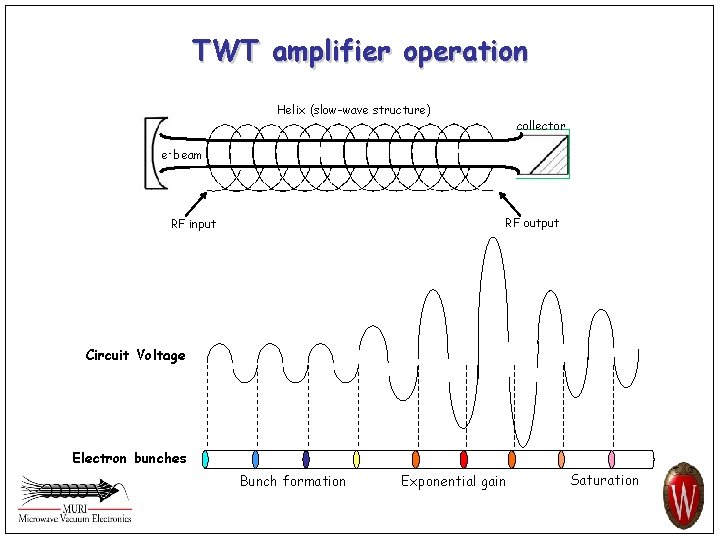
TWT amplifier operation Helix (slow-wave structure) collector e- beam RF output RF input Circuit Voltage Electron bunches Bunch formation Exponential gain Saturation
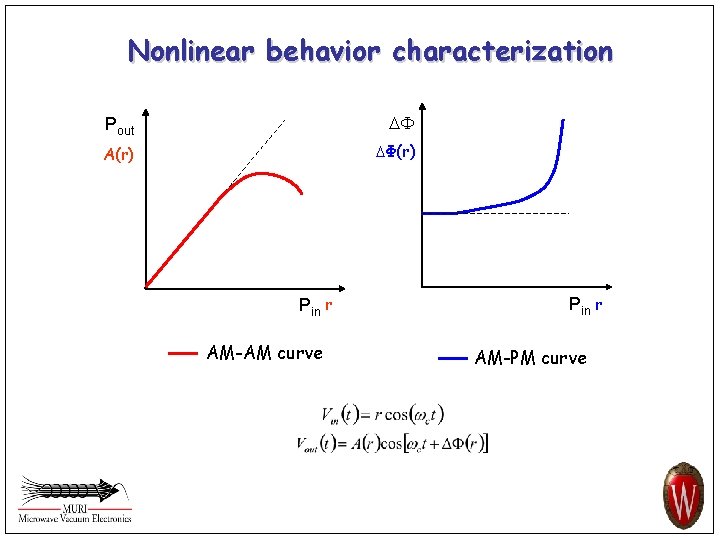
Nonlinear behavior characterization Pout DF A(r) DΦ(r) Pin r AM-AM curve Pin r AM-PM curve
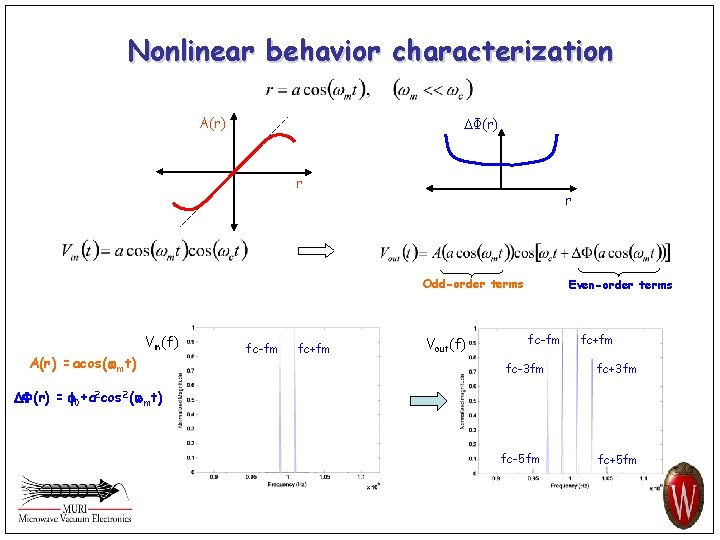
Nonlinear behavior characterization A(r) DΦ(r) r r Odd-order terms A(r) = acos( mt) Vin(f) fc-fm fc+fm Vout(f) Even-order terms fc-fm fc-3 fm fc+3 fm (r) = 0+a 2 cos 2( mt) fc-5 fm fc+5 fm
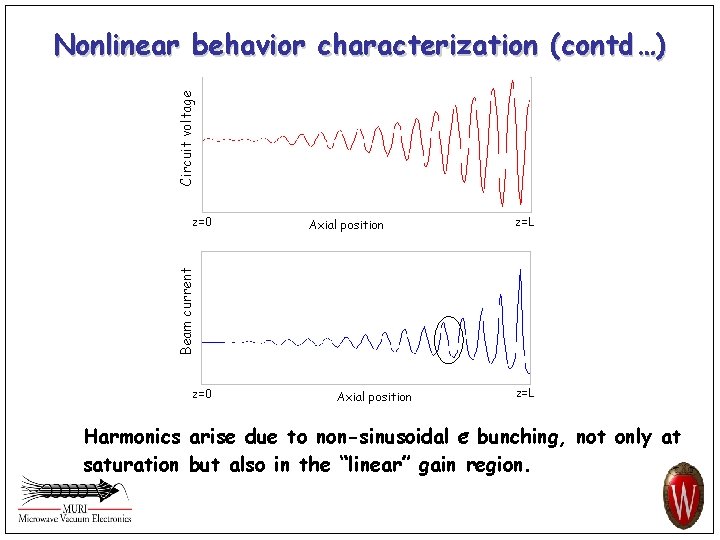
Circuit voltage Nonlinear behavior characterization (contd …) Axial position z=L Beam current z=0 Axial position z=L Harmonics arise due to non-sinusoidal e- bunching, not only at saturation but also in the “linear” gain region.
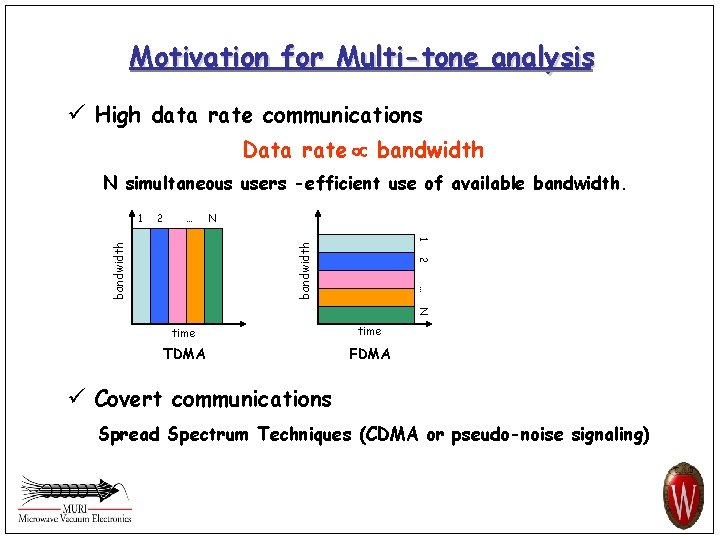
Motivation for Multi-tone analysis ü High data rate communications Data rate bandwidth N simultaneous users -efficient use of available bandwidth. 2 … N 2 bandwidth 1 … N time TDMA FDMA ü Covert communications Spread Spectrum Techniques (CDMA or pseudo-noise signaling)
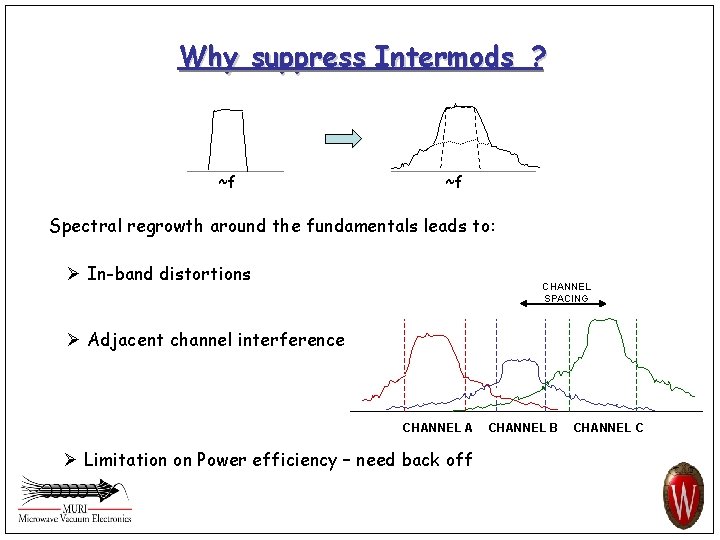
Why suppress Intermods ? ~f ~f Spectral regrowth around the fundamentals leads to: Ø In-band distortions CHANNEL SPACING Ø Adjacent channel interference CHANNEL A Ø Limitation on Power efficiency – need back off CHANNEL B CHANNEL C
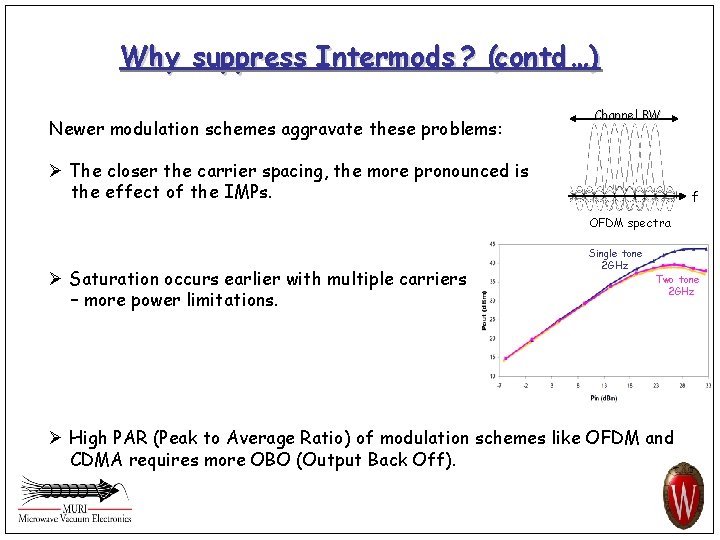
Why suppress Intermods ? (contd …) Newer modulation schemes aggravate these problems: Channel BW Ø The closer the carrier spacing, the more pronounced is the effect of the IMPs. f OFDM spectra Ø Saturation occurs earlier with multiple carriers – more power limitations. Single tone 2 GHz Two tone 2 GHz Ø High PAR (Peak to Average Ratio) of modulation schemes like OFDM and CDMA requires more OBO (Output Back Off).
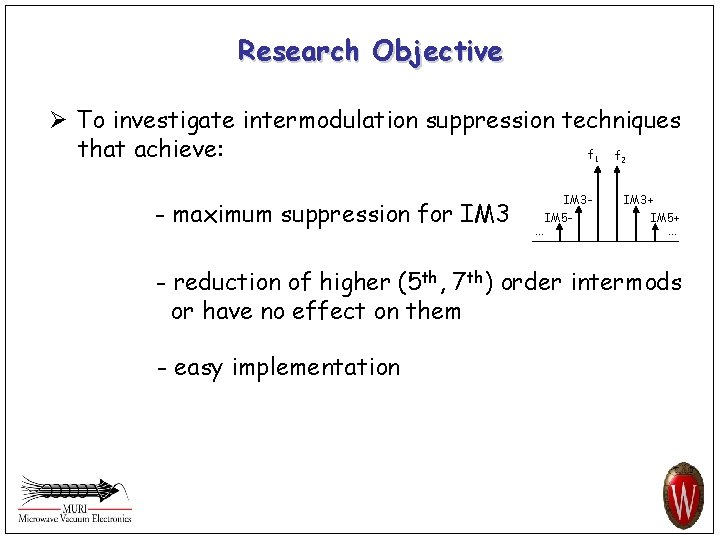
Research Objective Ø To investigate intermodulation suppression techniques that achieve: f f 1 - maximum suppression for IM 3 IM 5 - … 2 IM 3+ IM 5+ … - reduction of higher (5 th, 7 th) order intermods or have no effect on them - easy implementation
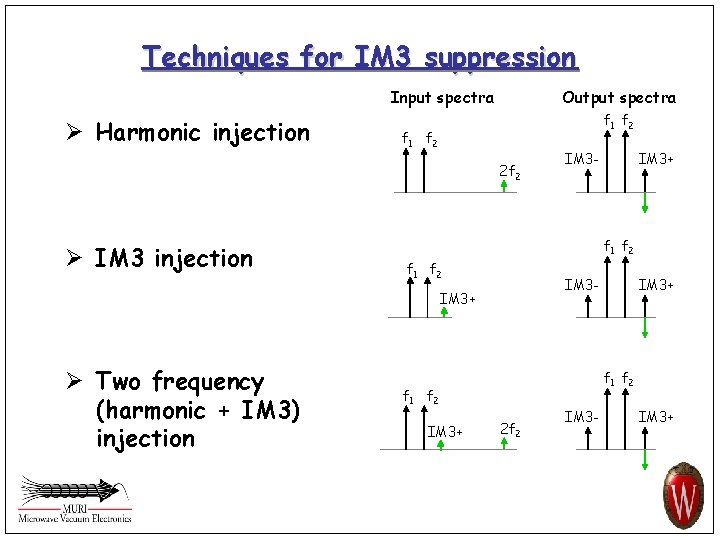
Techniques for IM 3 suppression Input spectra Ø Harmonic injection Output spectra f 1 f 2 2 f 2 Ø IM 3 injection f 1 f 2 IM 3+ IM 3 - IM 3+ Ø Two frequency (harmonic + IM 3) injection IM 3+ IM 3 - 2 f 2 IM 3 - IM 3+
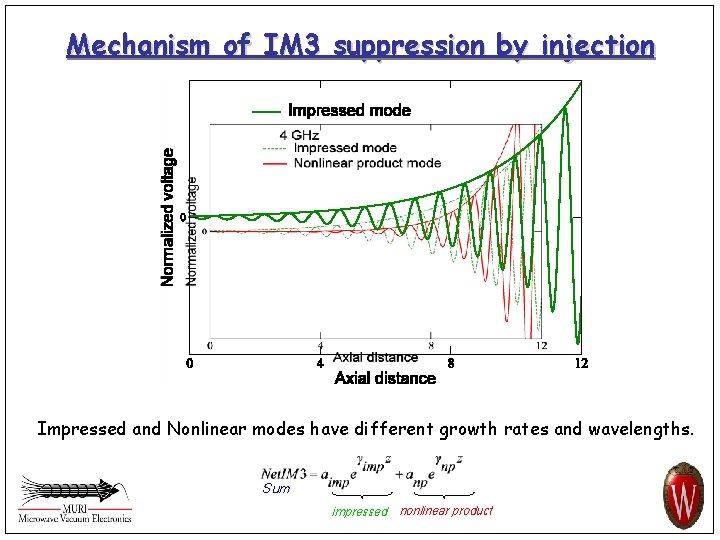
Mechanism of IM 3 suppression by injection Impressed and Nonlinear modes have different growth rates and wavelengths. Sum impressed nonlinear product
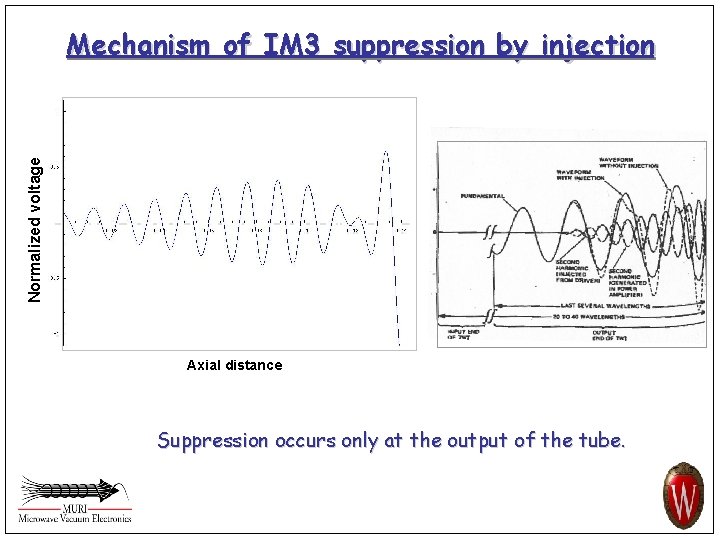
Normalized voltage Mechanism of IM 3 suppression by injection Axial distance Suppression occurs only at the output of the tube.
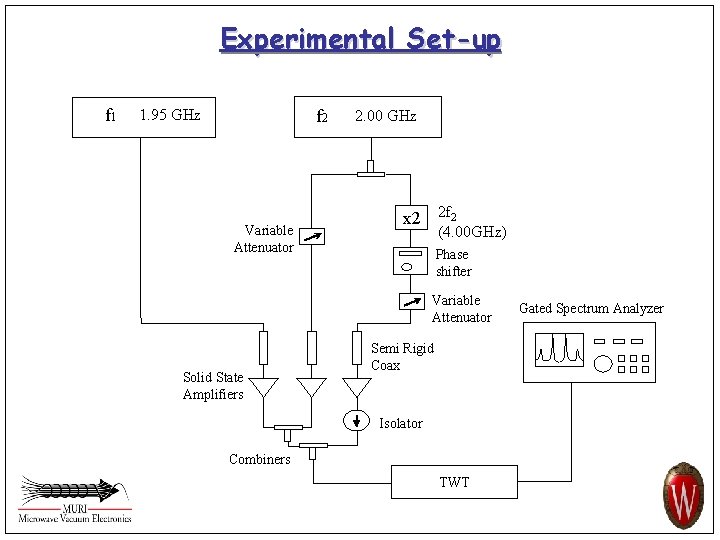
Experimental Set-up f 1 f 2 1. 95 GHz Variable Attenuator 2. 00 GHz x 2 2 f 2 (4. 00 GHz) Phase shifter Variable Attenuator Solid State Amplifiers Semi Rigid Coax Isolator Combiners TWT Gated Spectrum Analyzer
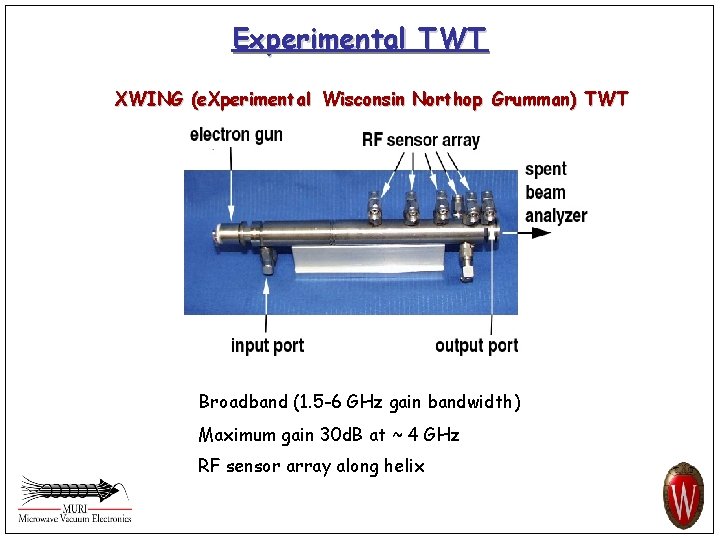
Experimental TWT XWING (e. Xperimental Wisconsin Northop Grumman) TWT Broadband (1. 5 -6 GHz gain bandwidth) Maximum gain 30 d. B at ~ 4 GHz RF sensor array along helix
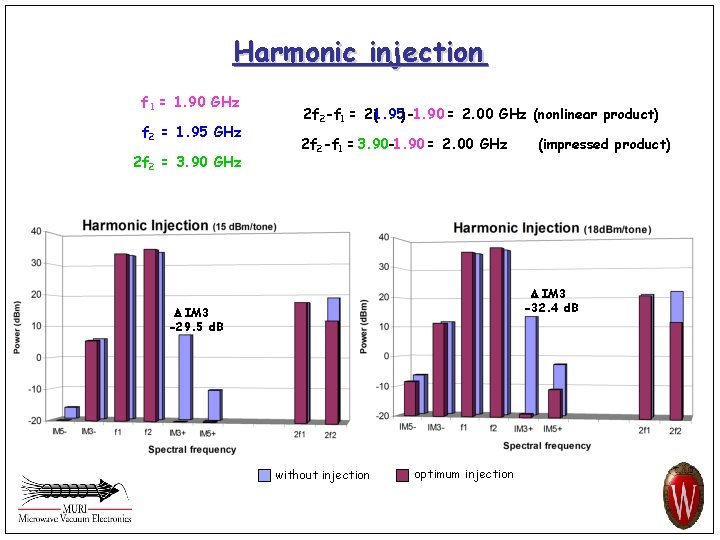
Harmonic injection f 1 = 1. 90 GHz f 2 = 1. 95 GHz 2 f 2 = 3. 90 GHz 2 f 2 -f 1 = 2(1. 95)-1. 90 = 2. 00 GHz (nonlinear product) 2 f 2 -f 1 = 3. 90 -1. 90 = 2. 00 GHz (impressed product) IM 3 -32. 4 d. B IM 3 -29. 5 d. B without injection optimum injection
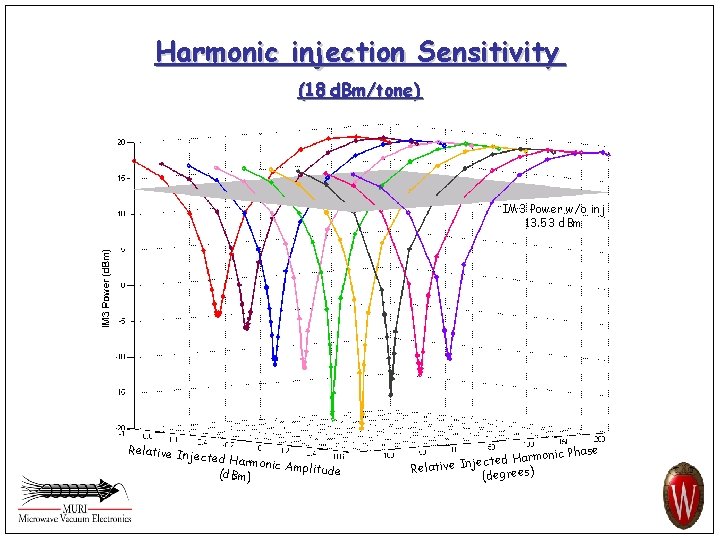
Harmonic injection Sensitivity (18 d. Bm /tone) IM 3 Power w/o inj 13. 53 d. Bm Relative In jected Har monic Amp litude (d. Bm) onic ected Harm j n I e iv t la Re (degrees) Phase
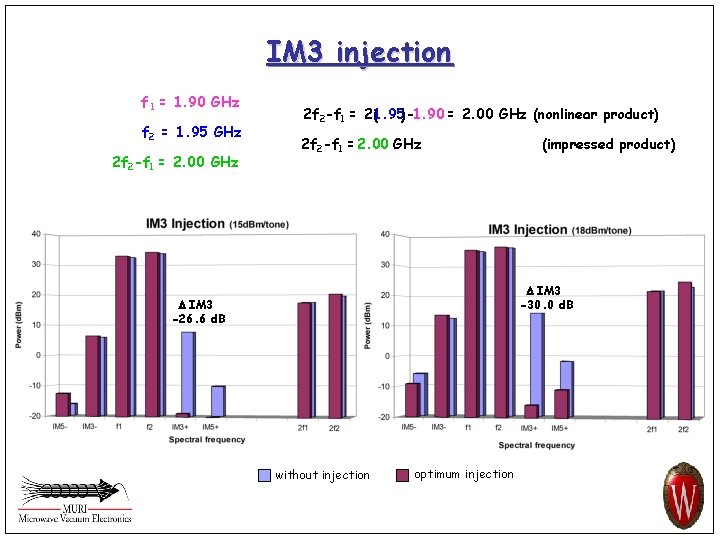
IM 3 injection f 1 = 1. 90 GHz f 2 = 1. 95 GHz 2 f 2 -f 1 = 2. 00 GHz 2 f 2 -f 1 = 2(1. 95)-1. 90 = 2. 00 GHz (nonlinear product) 2 f 2 -f 1 = 2. 00 GHz (impressed product) IM 3 -30. 0 d. B IM 3 -26. 6 d. B without injection optimum injection
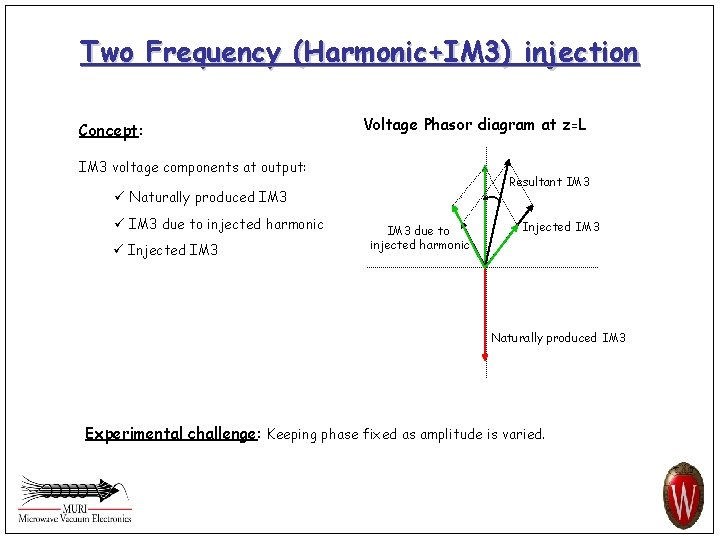
Two Frequency (Harmonic+IM 3) injection Concept: Voltage Phasor diagram at z=L IM 3 voltage components at output: Resultant IM 3 ü Naturally produced IM 3 ü IM 3 due to injected harmonic ü Injected IM 3 due to injected harmonic Injected IM 3 Naturally produced IM 3 Experimental challenge: Keeping phase fixed as amplitude is varied.
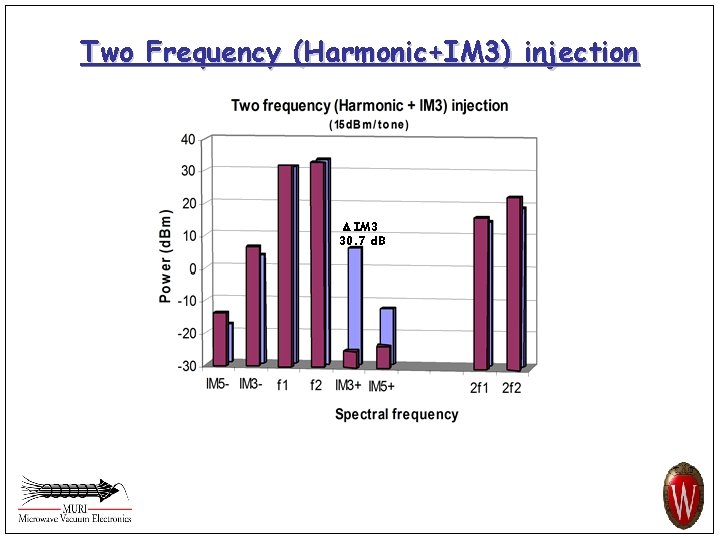
Two Frequency (Harmonic+IM 3) injection IM 3 30. 7 d. B
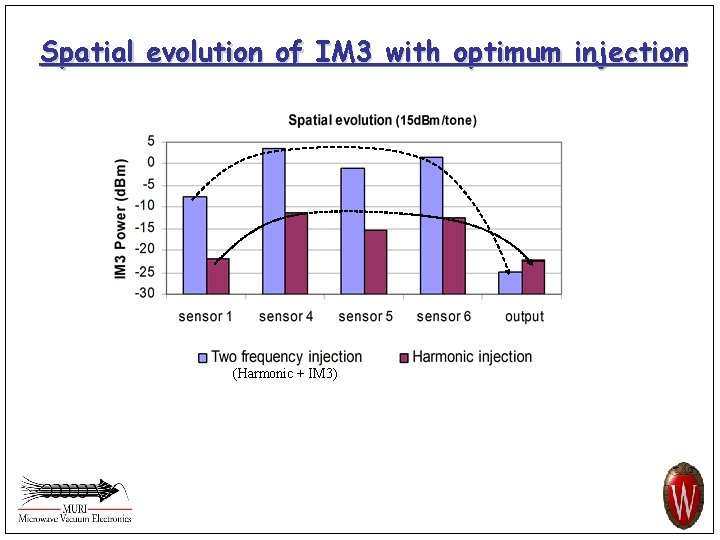
Spatial evolution of IM 3 with optimum injection (Harmonic + IM 3)
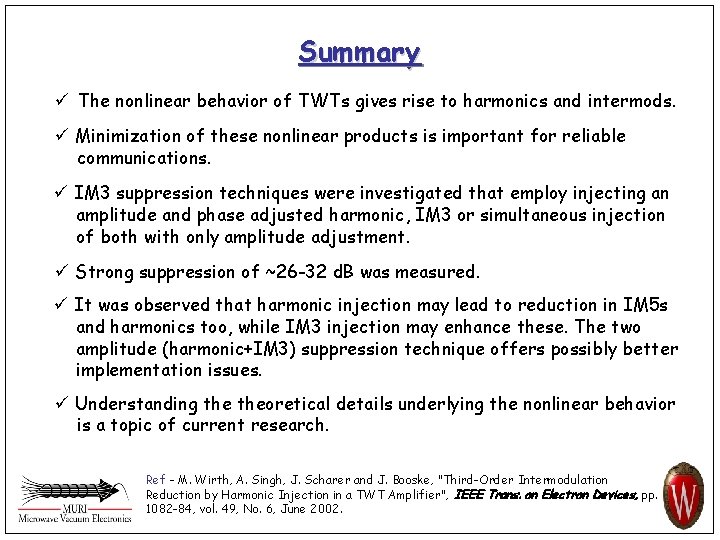
Summary ü The nonlinear behavior of TWTs gives rise to harmonics and intermods. ü Minimization of these nonlinear products is important for reliable communications. ü IM 3 suppression techniques were investigated that employ injecting an amplitude and phase adjusted harmonic, IM 3 or simultaneous injection of both with only amplitude adjustment. ü Strong suppression of ~26 -32 d. B was measured. ü It was observed that harmonic injection may lead to reduction in IM 5 s and harmonics too, while IM 3 injection may enhance these. The two amplitude (harmonic+IM 3) suppression technique offers possibly better implementation issues. ü Understanding theoretical details underlying the nonlinear behavior is a topic of current research. Ref - M. Wirth, A. Singh, J. Scharer and J. Booske, "Third-Order Intermodulation Reduction by Harmonic Injection in a TWT Amplifier", IEEE Trans. on Electron Devices, pp. 1082 -84, vol. 49, No. 6, June 2002.
- Slides: 24