
Noninverting Operational Amplifier The second basic configuration of
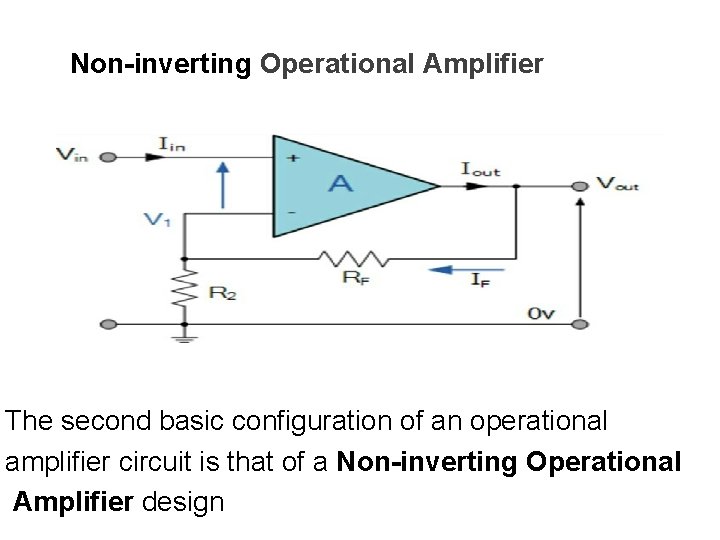
Non-inverting Operational Amplifier The second basic configuration of an operational amplifier circuit is that of a Non-inverting Operational Amplifier design
Non-inverting Operational Amplifier In this configuration, the input voltage signal, ( VIN ) is • applied directly to the non-inverting ( + ) input terminal which means that the output gain of the amplifier becomes “Positive” in value in contrast to the “Inverting Amplifier” circuit we saw in the last tutorial whose output gain is negative in value. The result of this is that the output signal is “in-phase” with the input signal. Feedback control of the non-inverting operational amplifier • is achieved by applying a small part of the output voltage signal back to the inverting ( – ) input terminal via a Rƒ – R 2 voltage divider network, again producing negative feedback. This closed-loop configuration produces a noninverting amplifier circuit with very good stability, a very high input impedance, Rin approaching infinity, as no current flows into the positive input terminal, (ideal conditions) and a low output impedance, Rout as shown below.
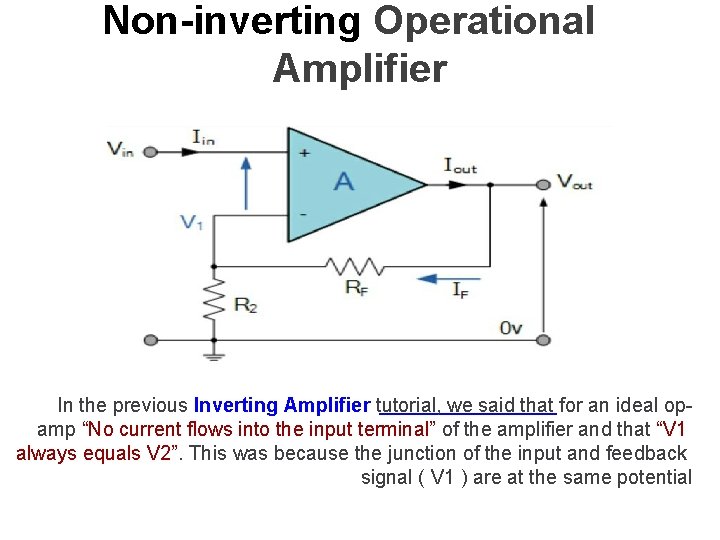
Non-inverting Operational Amplifier In the previous Inverting Amplifier tutorial, we said that for an ideal opamp “No current flows into the input terminal” of the amplifier and that “V 1 always equals V 2”. This was because the junction of the input and feedback signal ( V 1 ) are at the same potential
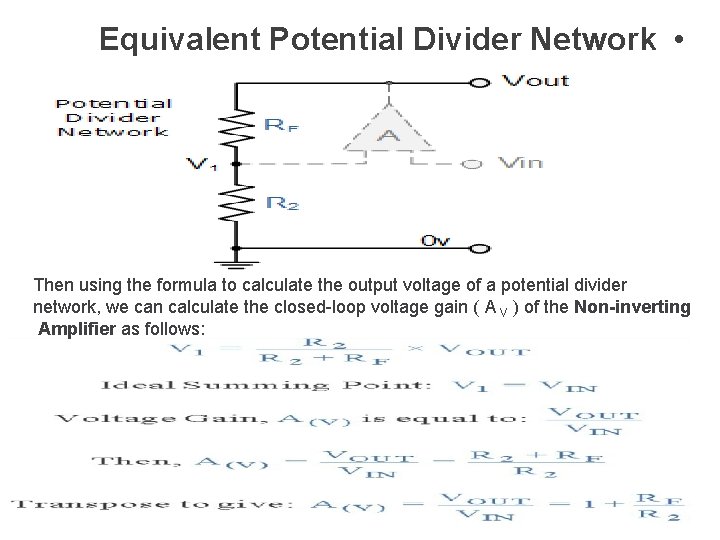
Equivalent Potential Divider Network • Then using the formula to calculate the output voltage of a potential divider network, we can calculate the closed-loop voltage gain ( A V ) of the Non-inverting Amplifier as follows:
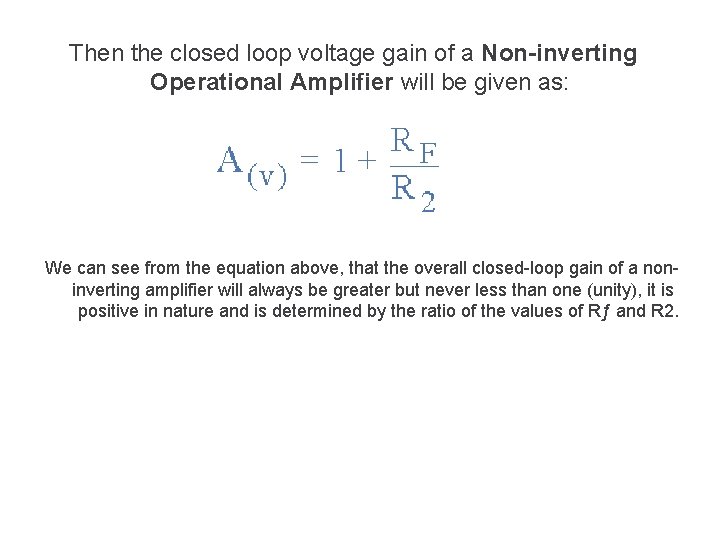
Then the closed loop voltage gain of a Non-inverting Operational Amplifier will be given as: We can see from the equation above, that the overall closed-loop gain of a noninverting amplifier will always be greater but never less than one (unity), it is positive in nature and is determined by the ratio of the values of Rƒ and R 2.
Voltage Follower (Unity Gain Buffer) • If we made the feedback resistor, Rƒ equal to zero, • (Rƒ = 0), and resistor R 2 equal to infinity, (R 2 = ∞), then the circuit would have a fixed gain of “ 1” as all the output voltage would be present on the inverting input terminal (negative feedback). This would then produce a special type of the non-inverting amplifier circuit called a Voltage Follower or also called a “unity gain buffer”. • The advantage of the unity gain voltage follower is that it can be used when impedance matching or circuit isolation is more important than amplification as it maintains the signal voltage.
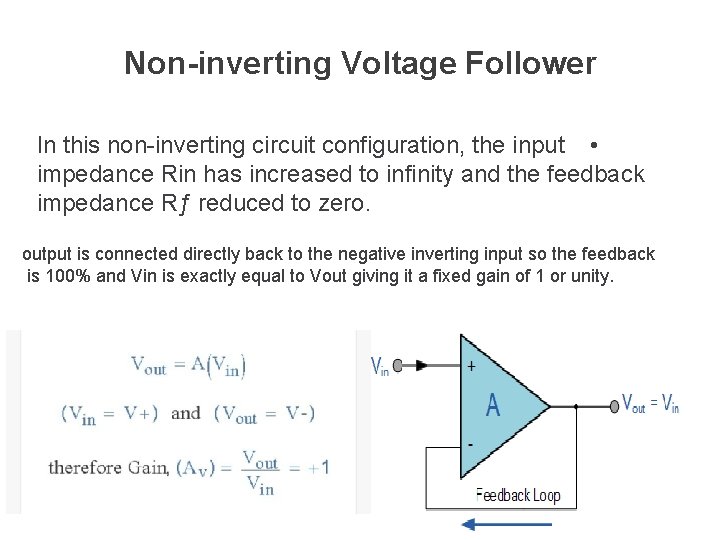
Non-inverting Voltage Follower In this non-inverting circuit configuration, the input • impedance Rin has increased to infinity and the feedback impedance Rƒ reduced to zero. output is connected directly back to the negative inverting input so the feedback is 100% and Vin is exactly equal to Vout giving it a fixed gain of 1 or unity.

- Slides: 8