
NonInvasive Ventilation from diagnosis to End of Life

![Motor Neurone Disease: Non-invasive ventilation Clinical guideline [CG 105] Published date: July 2010](https://slidetodoc.com/presentation_image/35df999fbf4cde9c6c471af40ed25320/image-7.jpg "Motor Neurone Disease: Non-invasive ventilation Clinical guideline [CG 105] Published date: July 2010")


- Slides: 30
Non-Invasive Ventilation from diagnosis to End of Life: hospice staff training in discussions, decisions and practical management Sr Jane Martin – Advanced Nurse Specialist and Ally Lycett – Senior Physiotherapist Specialist Palliative Care service, Macmillan Unit, Dorset, UK.
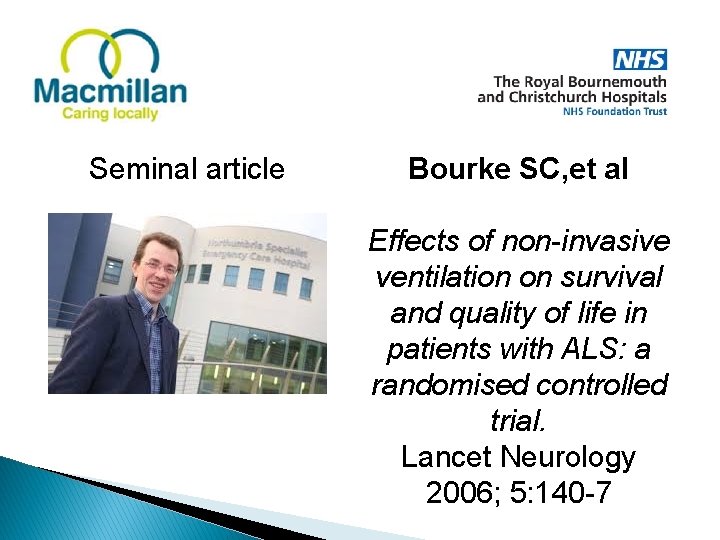
Seminal article Bourke SC, et al Effects of non-invasive ventilation on survival and quality of life in patients with ALS: a randomised controlled trial. Lancet Neurology 2006; 5: 140 -7
Motor Neurone Disease: Non-invasive ventilation Clinical guideline [CG 105] Published date: July 2010
Identifying the need for training for service improvement: • Staff feedback
Evidence • Baxter – (2013) unexpected terminal phase, advocated early ACP • Faull (2014) emphasised early decision making, risk of cognitive changes
Evidence • Harris (2015) – important to listen to person early before communication becomes difficult • Levi (2017) – suboptimal decision making during a crisis
Identifying the training need for service quality improvement: • Audit of patients on Macmillan Unit • Lack of confidence • Complexity • Unfamiliarity
• Discussions
• Respiratory assessment • Patient selection • Staff competencies • Equipment and care • Withdrawal of NIV
Aims - what did we want to achieve? • Early discussions and decisions • Ethical and legal foundation
Aims - what did we want to achieve? • Staff competent and confident practically • Planned ventilation and withdrawal • Support staff
• Nov 2013 - staff reflection
• 2014/5 - external training
• 2015 - literature searches/advice
Aims: What did we want to achieve? • Competencies • Training • Withdrawal Pathway
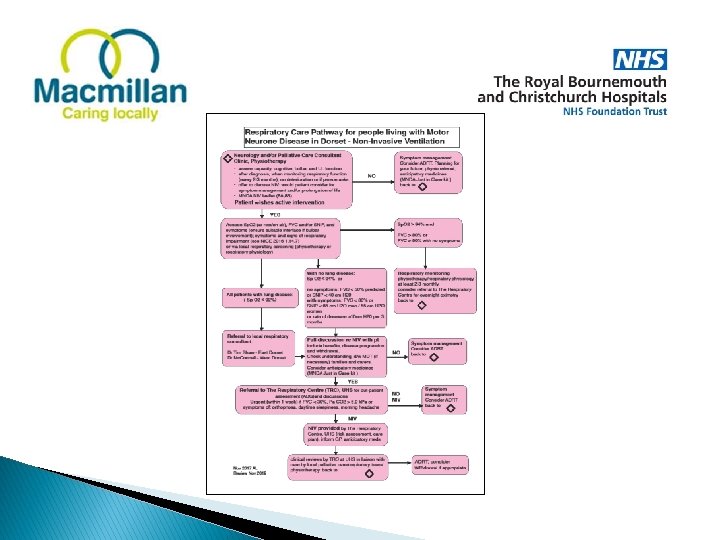
Aims: What did we want to achieve? • Respiratory Assessment • Dorset Respiratory Care Pathway • Nursing care plan
• NICE February 2016 Motor Neurone Disease: assessment and management • Withdrawal of assisted ventilation at the Request of a patient with Motor Neurone Disease – guidance for professionals. APM 2015
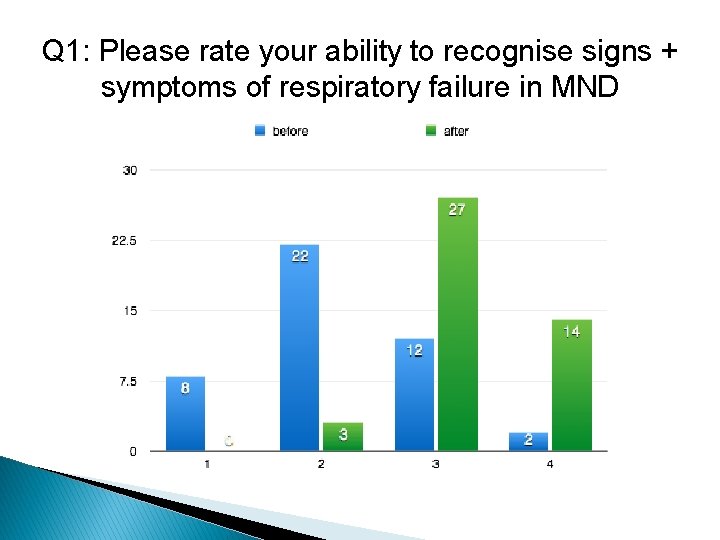
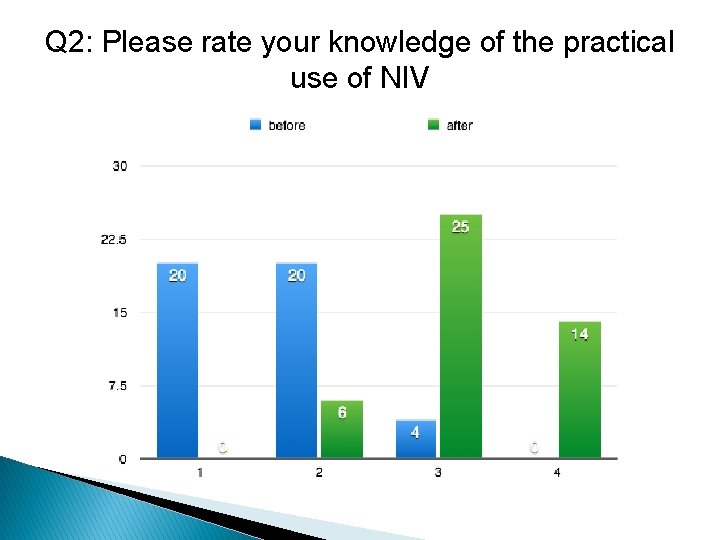
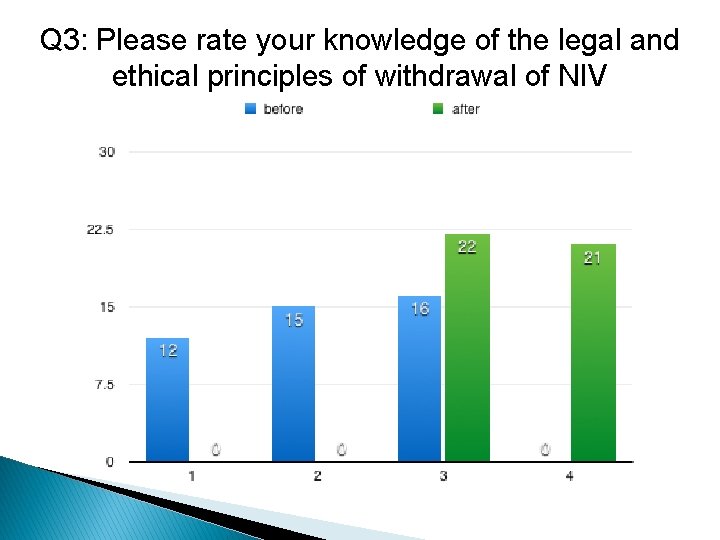
Training delivered • Sept 2015 - Feb 2018 • Feedback collected - asked staff to rate themselves 1 - 4
Q 1: Please rate your ability to recognise signs + symptoms of respiratory failure in MND
Q 2: Please rate your knowledge of the practical use of NIV
Q 3: Please rate your knowledge of the legal and ethical principles of withdrawal of NIV
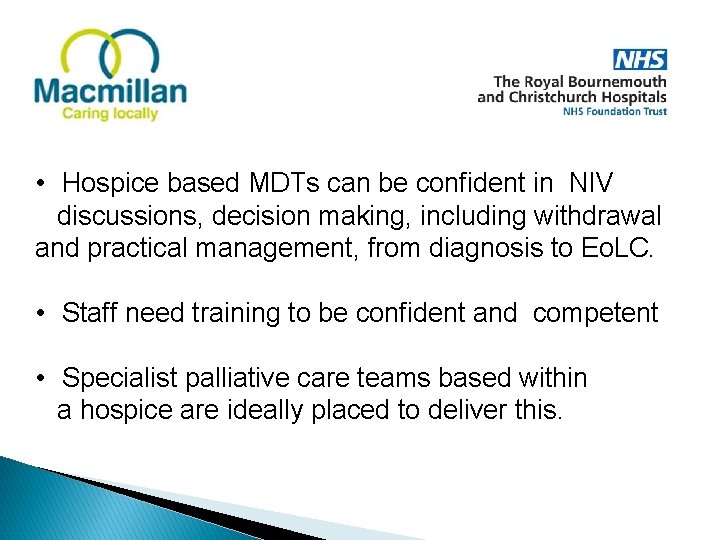
• Hospice based MDTs can be confident in NIV discussions, decision making, including withdrawal and practical management, from diagnosis to Eo. LC. • Staff need training to be confident and competent • Specialist palliative care teams based within a hospice are ideally placed to deliver this.
References BBC Inside the Ethics Committee (2011). Available at: https: //www. bbc. co. uk/programmes/b 012 r 7 j Baxter, S. (2013) ‘The use of NIV at end of life in patients with MND’. Palliative Medicine 27(6) 516 -52 Bourke, S. C. , Williams, T. L. , Bullock, R. E. , Gibson, G. J. , Shaw, P. J. , (2002) ‘Non-invasive ventilation in motor neuron disease: current UK practice'. Amyotrophic Lateral Sclerosis and Other Motor Neuron Disorders ; 3: 145 -149 Bourke, S. C. , Tomlinson, M. , Williams, T. L. , Bullock, R. E. , Shaw, P. J. , Gibson, G. J. , (2006) 'Effects of non-invasive ventilation on survival and quality of life in patients with amyotrophic lateral sclerosis: a randomised controlled trial'. Lancet Neurology ; 5: 140 -7 British Thoracic Society Standards of Care Committee (2002) BTS Guideline: Non-invasive ventilation in acute respiratory failure. Thorax; 57: 19221 Faull, C. , (2015) ‘Withdrawal of assisted ventilation at the Request of a Patient with Motor Neurone Disease’. Association for Palliative Medicine.
References Faull, C. , et al (2014). ‘Issues for Palliative Medicine doctors surrounding the withdrawal of NIV at the request of a patient with MND: a scoping study’. BMJ supportive and Palliative Care 4: 43 -39 Harris, D. A. , (2016). ‘Existential concerns for people with MND: who is listening to their needs, priorities and preferences? BJOT 79 (6) 391 -393 Levi. , et al (2017) Advance Care Planning for patients with ALS fronto-temporal Degen. August 18 (5 -6): 388 -396 NICE (2010) Motor Neurone Disease: non-invasive ventilation. Clinical guideline [CG 105] NICE (2016) Motor Neurone Disease: assessment and management O’Neill, C. L. , Williams, T. L. , Peel, E. T. , Mc. Dermott, C. J. , Shaw, P. J. , Gibson, G. J. , Bourke, S. C. , (2012) ‘Non-invasive Ventilation in Motor Neurone Disease: an update of current UK practice’ Journal of Neurology, Neurosurgery and Psychiatry 83: 371 -376 Simonds, A. , (2015) European Respiratory Society Practical Handbook: NIV. Sheffield The European Respiratory Society.
Contact information: Jane Martin, Advanced Nurse Specialist jane. martin@rbch. nhs. uk Ally Lycett, Senior Physiotherapist ally. lycett@rbch. nhs. uk Specialist Palliative Care, Macmillan Unit, Christchurch, Dorset. BH 23 2 JX.