
NonInvasive Positive Pressure Ventilation evidence base in preterm
Non-Invasive Positive Pressure Ventilation – evidence base in preterm infants
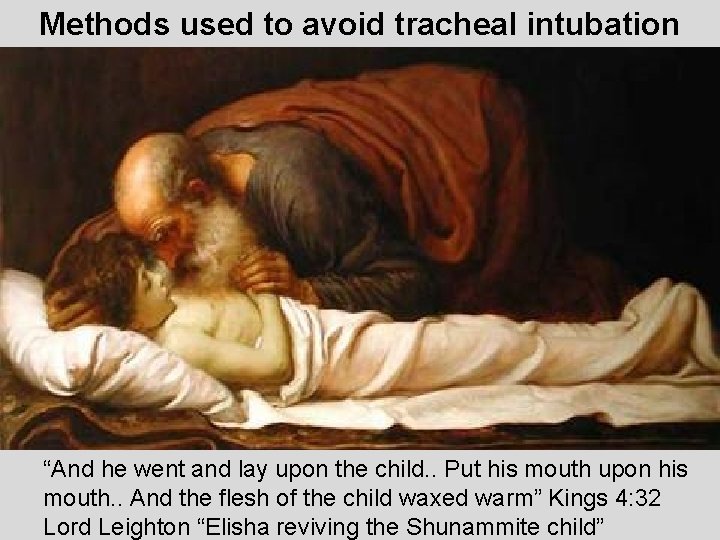
Methods used to avoid tracheal intubation “And he went and lay upon the child. . Put his mouth upon his mouth. . And the flesh of the child waxed warm” Kings 4: 32 Lord Leighton “Elisha reviving the Shunammite child”
OUTLINE 1. Why does non-invasive support matter? q endotracheal intubation damages airway mucosa from top to bottom q Long term adverse effects of BPD 2. Some relevant physiology 3. Methods to avoid intubation q NIPPV q Evidence from randomized trials
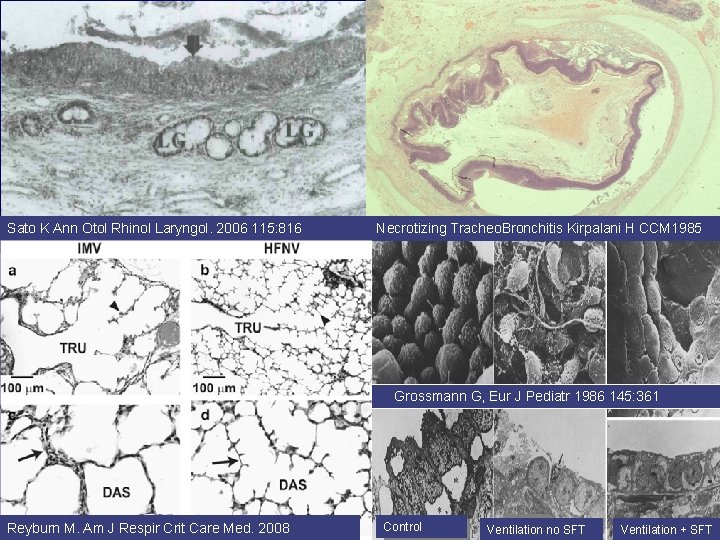
Sato K Ann Otol Rhinol Laryngol. 2006 115: 816 Necrotizing Tracheo. Bronchitis Kirpalani H CCM 1985 Grossmann G, Eur J Pediatr 1986 145: 361 Reyburn M. Am J Respir Crit Care Med. 2008 Control Ventilation no SFT Ventilation + SFT
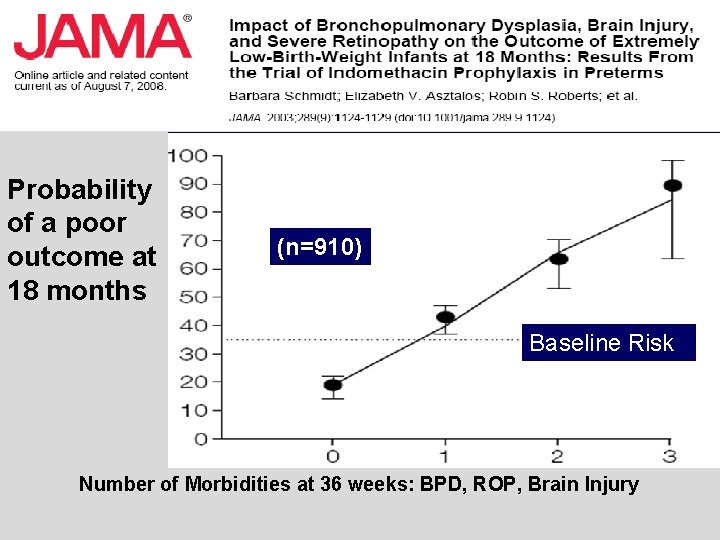
Probability of a poor outcome at 18 months (n=910) Baseline Risk Number of Morbidities at 36 weeks: BPD, ROP, Brain Injury
Objectives 1. Why does non-invasive support matter? q BPD and endotracheal intubation q Long term effects of BPD 2. Physiology 3. Methods to avoid intubation q CPAP, NIPPV q Evidence from randomized trials
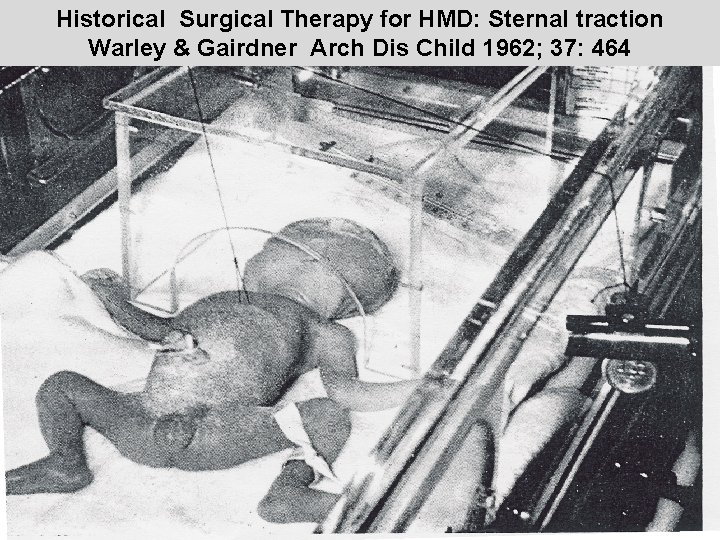
Historical Surgical Therapy for HMD: Sternal traction Warley & Gairdner Arch Dis Child 1962; 37: 464
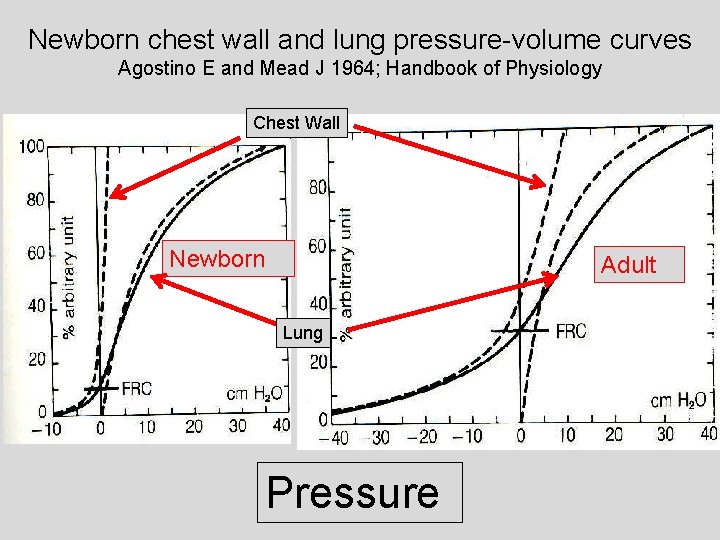
Newborn chest wall and lung pressure-volume curves Agostino E and Mead J 1964; Handbook of Physiology Chest Wall Newborn Adult Lung Pressure
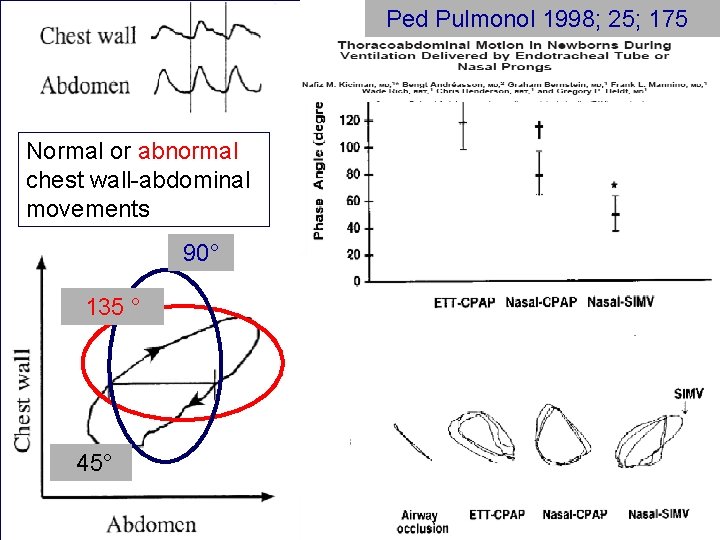
Ped Pulmonol 1998; 25; 175 Normal or abnormal chest wall-abdominal movements 90° 135 ° 45°
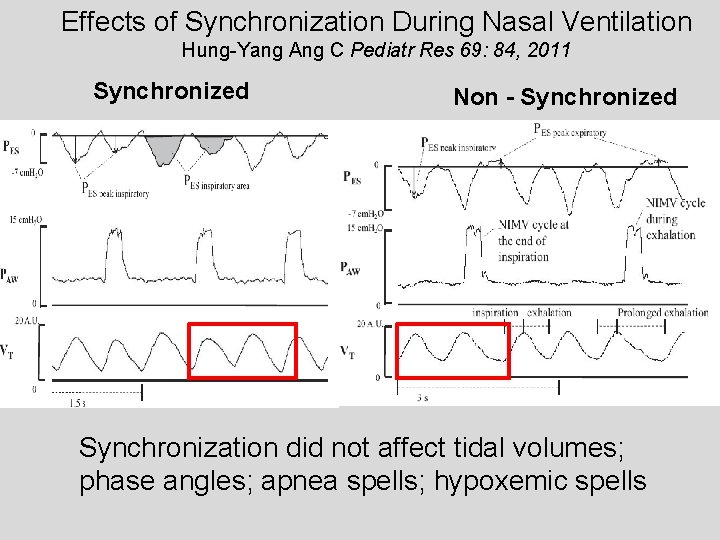
Effects of Synchronization During Nasal Ventilation Hung-Yang Ang C Pediatr Res 69: 84, 2011 Synchronized Non - Synchronized Synchronization did not affect tidal volumes; phase angles; apnea spells; hypoxemic spells
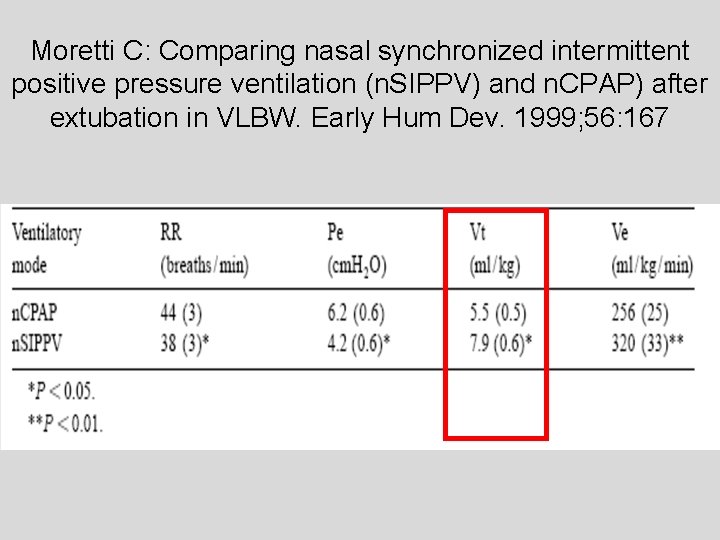
Moretti C: Comparing nasal synchronized intermittent positive pressure ventilation (n. SIPPV) and n. CPAP) after extubation in VLBW. Early Hum Dev. 1999; 56: 167
Objectives 1. Why does non-invasive support matter? q BPD and endotracheal intubation q Long term effects of BPD 2. Physiology of NIPPV 3. Methods to avoid intubation q CPAP, NIPPV q Evidence from randomized trials
Repetitive themes in ventilation Circular philosophy: “The thing that hath been, it is that which shall be; and that which is done is that which shall be done: and there is no new thing under the sun” Ch 1, v 9 Ecclesiastes Spiral philosophy: “The progress. . raises to each next stage of determination the whole content, and … enriches and concentrates itself. . . ” G. F. Hegel “Science of Logic”; ‘The Absolute Idea; 812’;
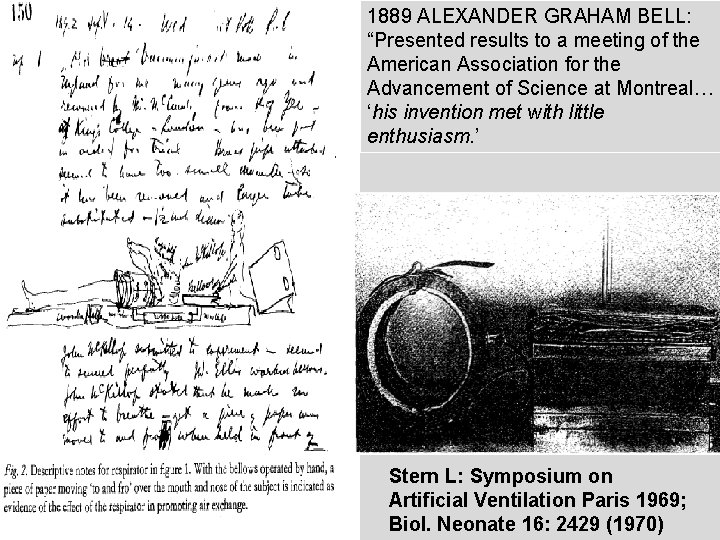
1889 ALEXANDER GRAHAM BELL: “Presented results to a meeting of the American Association for the Advancement of Science at Montreal… ‘his invention met with little enthusiasm. ’ Stern L: Symposium on Artificial Ventilation Paris 1969; Biol. Neonate 16: 2429 (1970)
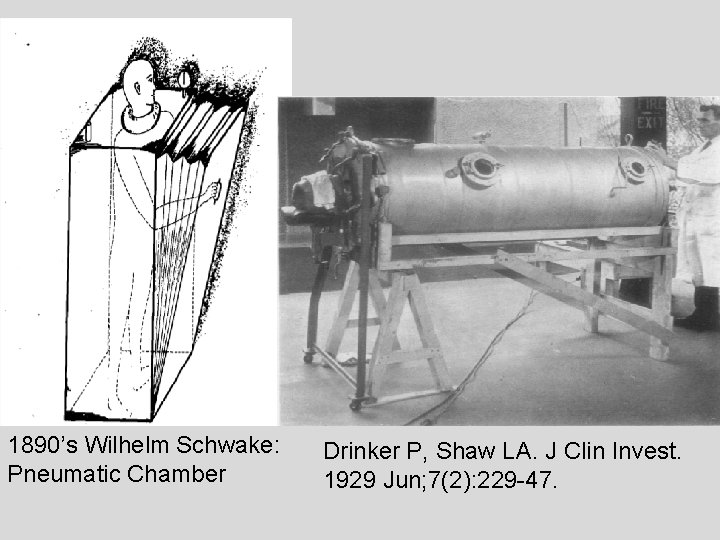
1890’s Wilhelm Schwake: Pneumatic Chamber Drinker P, Shaw LA. J Clin Invest. 1929 Jun; 7(2): 229 -47.
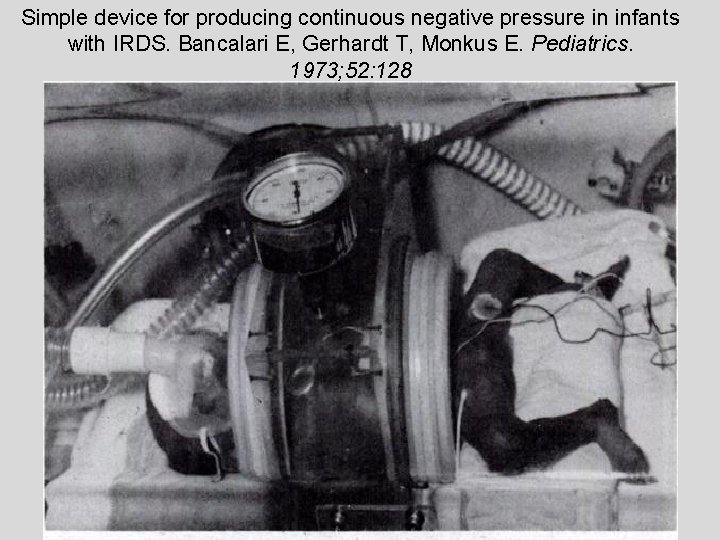
Simple device for producing continuous negative pressure in infants with IRDS. Bancalari E, Gerhardt T, Monkus E. Pediatrics. 1973; 52: 128
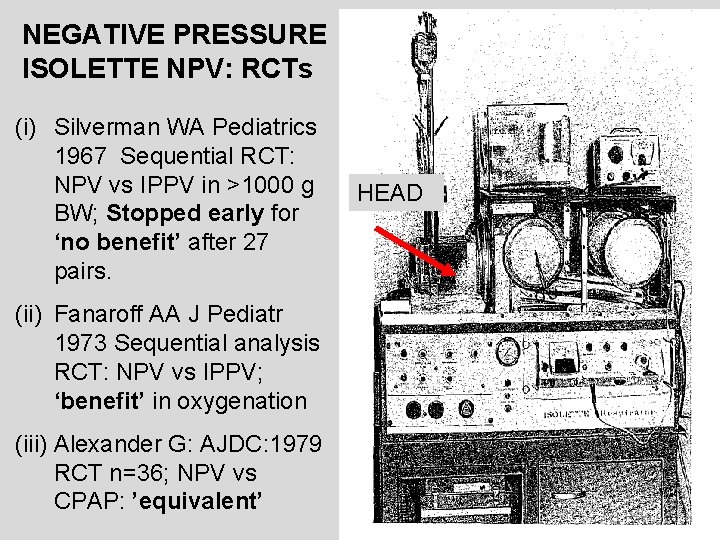
NEGATIVE PRESSURE ISOLETTE NPV: RCTs (i) Silverman WA Pediatrics 1967 Sequential RCT: NPV vs IPPV in >1000 g BW; Stopped early for ‘no benefit’ after 27 pairs. (ii) Fanaroff AA J Pediatr 1973 Sequential analysis RCT: NPV vs IPPV; ‘benefit’ in oxygenation (iii) Alexander G: AJDC: 1979 RCT n=36; NPV vs CPAP: ’equivalent’ HEAD
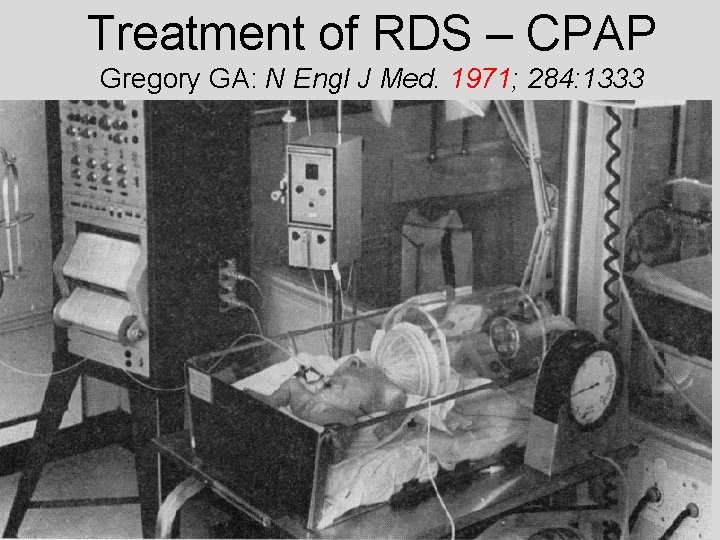
Treatment of RDS – CPAP Gregory GA: N Engl J Med. 1971; 284: 1333
PICOT CPAP P: In infants VLBW or ELBW in DR I: does randomization to n. CPAP C: compared to intubation IMV O: increase survival without BPD T: at 36 weeks PMA?
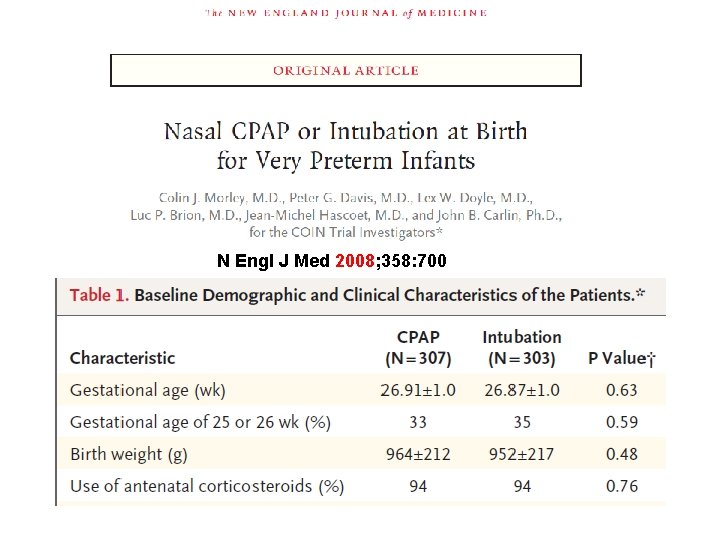
N Engl J Med 2008; 358: 700
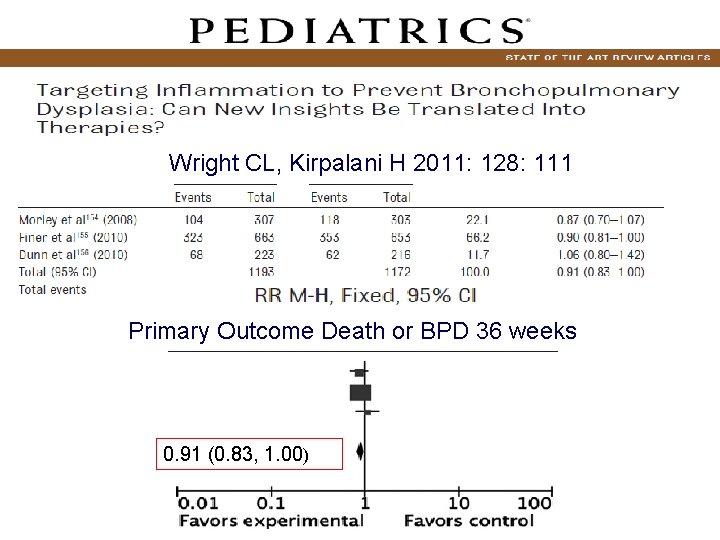
Wright CL, Kirpalani H 2011: 128: 111 Primary Outcome Death or BPD 36 weeks 0. 91 (0. 83, 1. 00)
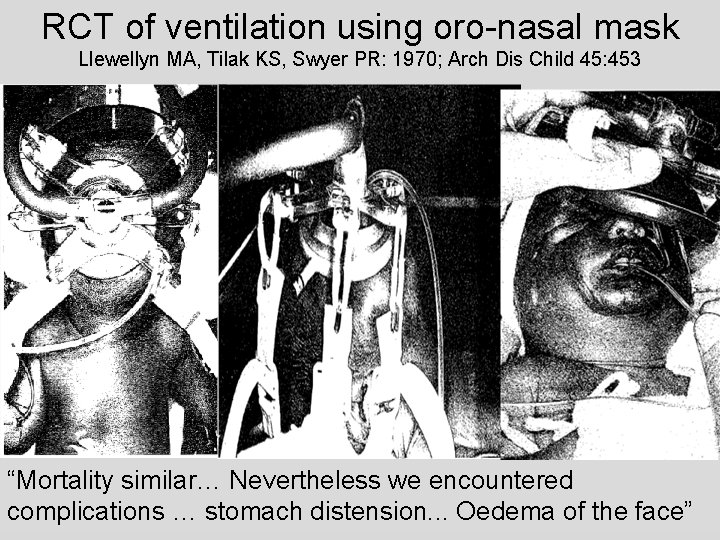
RCT of ventilation using oro-nasal mask Llewellyn MA, Tilak KS, Swyer PR: 1970; Arch Dis Child 45: 453 “Mortality similar… Nevertheless we encountered complications … stomach distension. . . Oedema of the face”
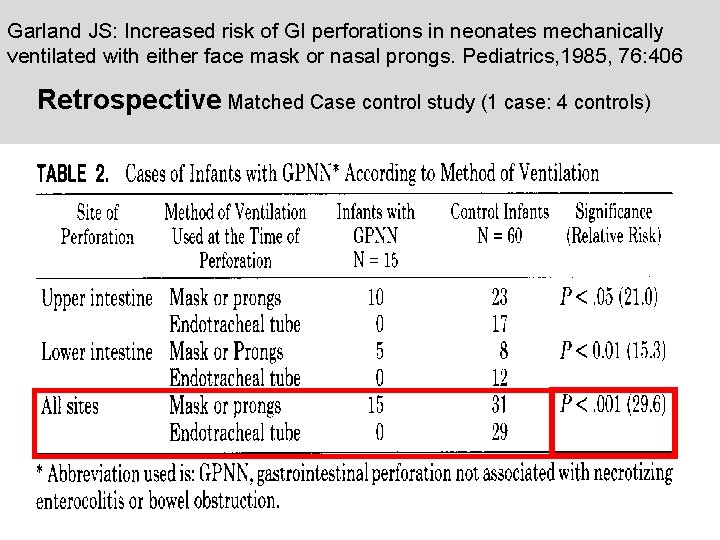
Garland JS: Increased risk of GI perforations in neonates mechanically ventilated with either face mask or nasal prongs. Pediatrics, 1985, 76: 406 Retrospective Matched Case control study (1 case: 4 controls)
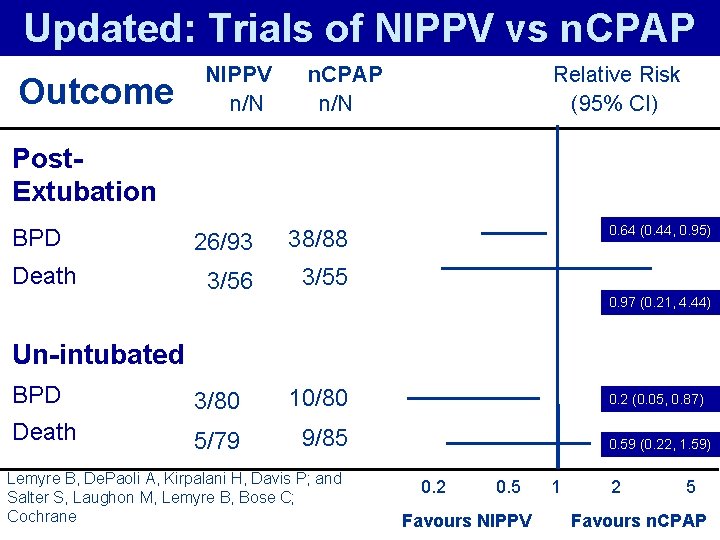
Updated: Trials of NIPPV vs n. CPAP Outcome NIPPV n/N n. CPAP n/N Relative Risk (95% CI) Post. Extubation BPD Death 26/93 38/88 3/56 3/55 0. 64 (0. 44, 0. 95) 0. 97 (0. 21, 4. 44) Un-intubated BPD 3/80 10/80 Death 5/79 9/85 Lemyre B, De. Paoli A, Kirpalani H, Davis P; and Salter S, Laughon M, Lemyre B, Bose C; Cochrane 0. 2 (0. 05, 0. 87) 0. 59 (0. 22, 1. 59) 0. 2 0. 5 Favours NIPPV 1 2 5 Favours n. CPAP
V Rajadurai B Urlesberger K Abubakar F Reiterer P Maton A Chaudhary G Dempsey M Roy D Millar R van Lingen E Boyle S Rahman J Frank K Sankaran P Srinivasan E Asztalos J Cairnie P Mc. Namara B Lemyre C O’Donnell NIPPV: The Nasal Intermittent Positive Ventilation for Prematures Trial R Whyte T Ibrahim L Costantini N Rashid W Marion I Herlihy C Thiel M Finelli P Dijk S Godambe I Frantz B Simma I Hand W Stelzl M Hyndman B Jonsson J Miletin P Gerhard S Ranu J Zupancic R Roberts A O ’Sullivan H Kirpalani R Kim L Legnevall
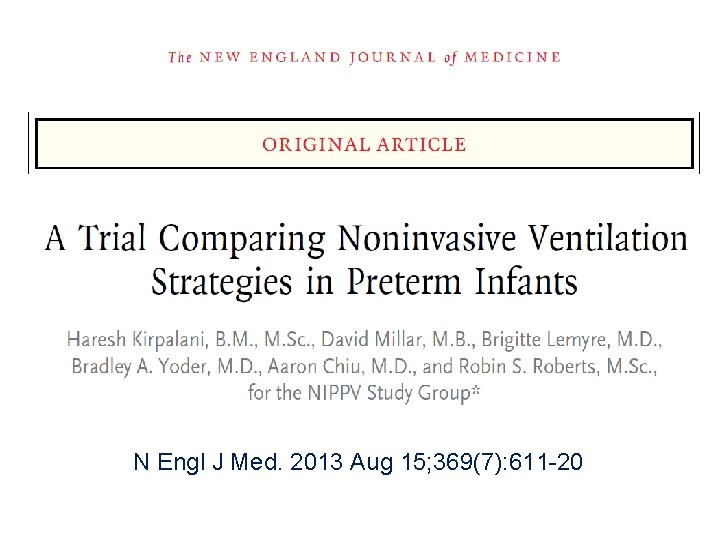
N Engl J Med. 2013 Aug 15; 369(7): 611 -20
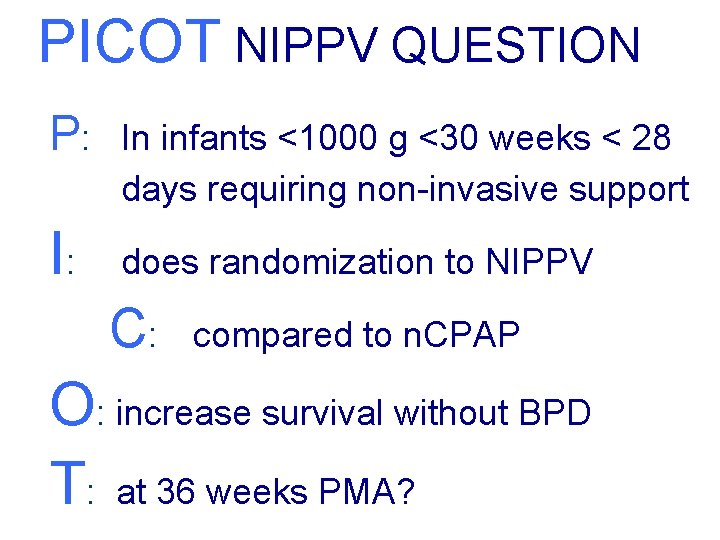
PICOT NIPPV QUESTION P: In infants <1000 g <30 weeks < 28 days requiring non-invasive support does randomization to NIPPV C: compared to n. CPAP O: increase survival without BPD T: at 36 weeks PMA?
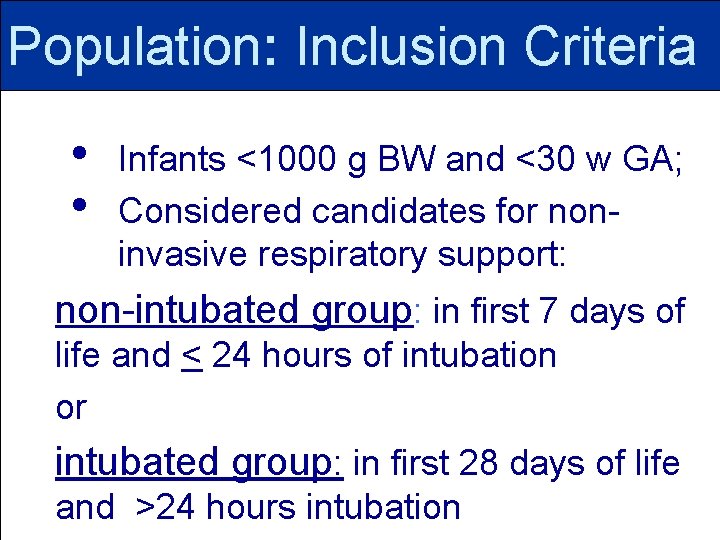
Population: Inclusion Criteria • • Infants <1000 g BW and <30 w GA; Considered candidates for noninvasive respiratory support: non-intubated group: in first 7 days of life and < 24 hours of intubation or intubated group: in first 28 days of life and >24 hours intubation
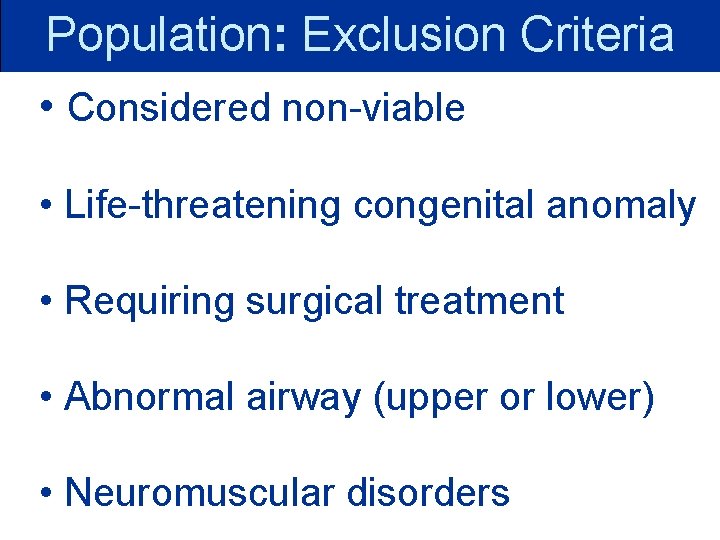
Population: Exclusion Criteria • Considered non-viable • Life-threatening congenital anomaly • Requiring surgical treatment • Abnormal airway (upper or lower) • Neuromuscular disorders
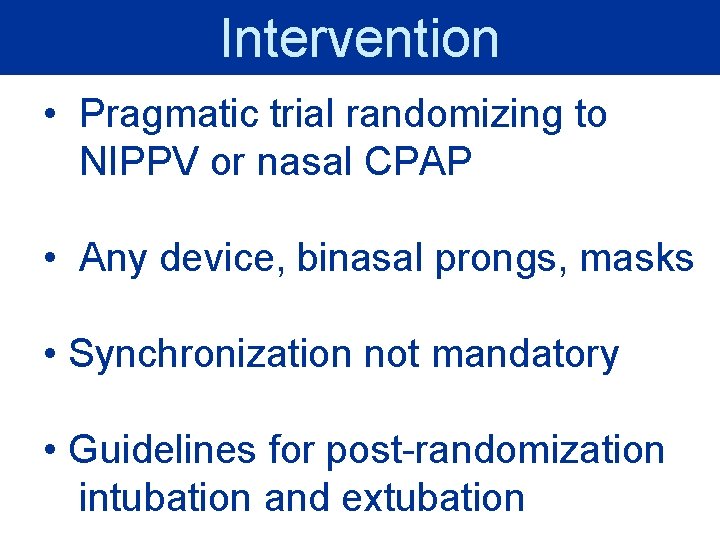
Intervention • Pragmatic trial randomizing to NIPPV or nasal CPAP • Any device, binasal prongs, masks • Synchronization not mandatory • Guidelines for post-randomization intubation and extubation
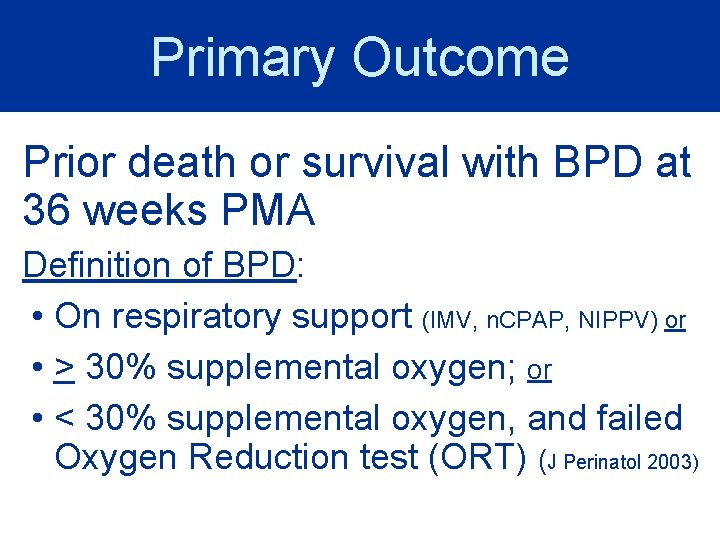
Primary Outcome Prior death or survival with BPD at 36 weeks PMA Definition of BPD: • On respiratory support (IMV, n. CPAP, NIPPV) or • > 30% supplemental oxygen; or • < 30% supplemental oxygen, and failed Oxygen Reduction test (ORT) (J Perinatol 2003)
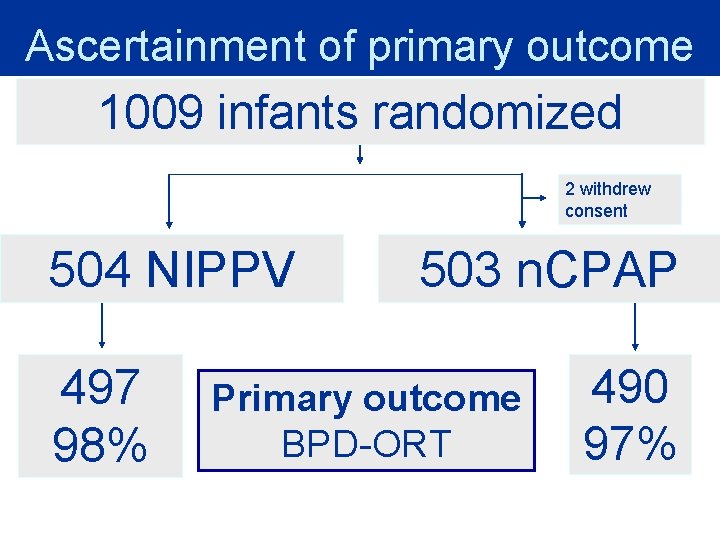
Ascertainment of primary outcome 1009 infants randomized 2 withdrew consent 504 NIPPV 497 98% 503 n. CPAP Primary outcome BPD-ORT 490 97%
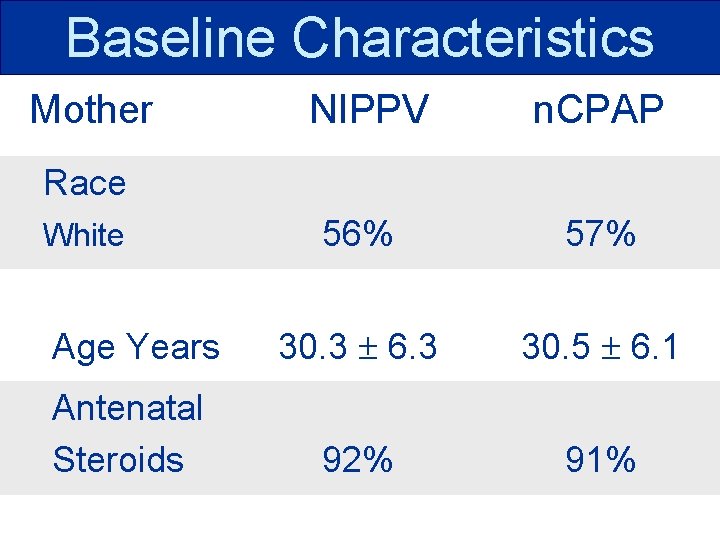
Baseline Characteristics Mother NIPPV n. CPAP Race 56% 57% Age Years 30. 3 6. 3 30. 5 6. 1 Antenatal Steroids 92% 91% White
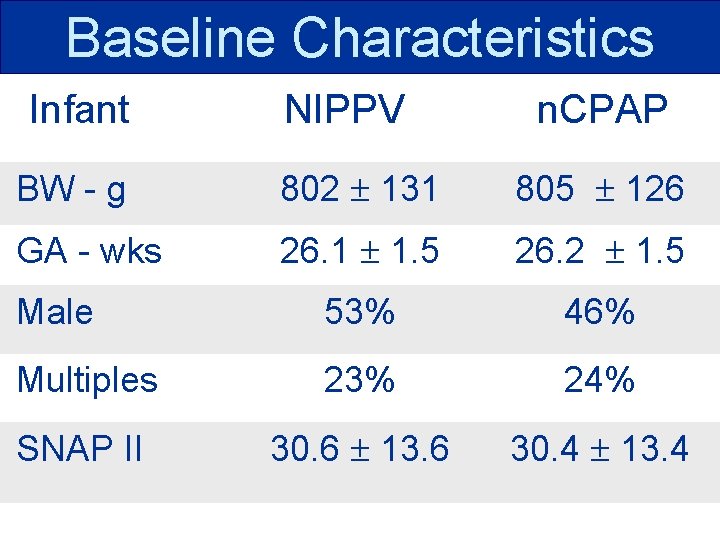
Baseline Characteristics Infant NIPPV n. CPAP BW - g 802 131 805 126 GA - wks 26. 1 1. 5 26. 2 1. 5 Male 53% 46% Multiples 23% 24% SNAP II 30. 6 13. 6 30. 4 13. 4
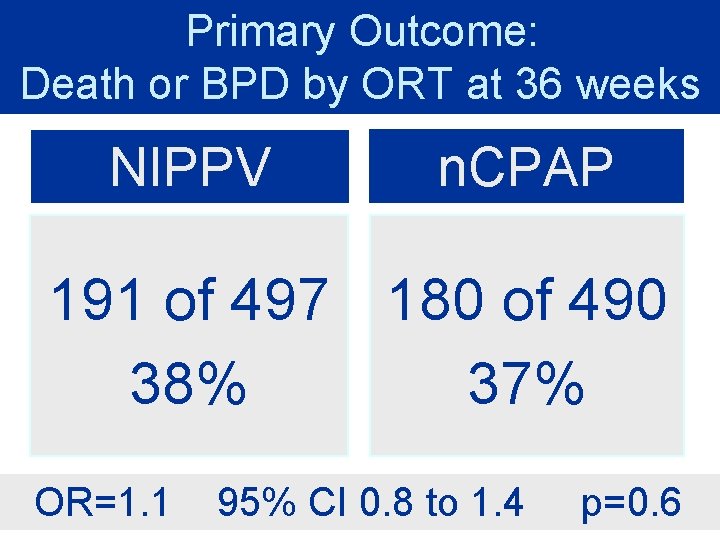
Primary Outcome: Death or BPD by ORT at 36 weeks NIPPV n. CPAP 191 of 497 180 of 490 38% 37% OR=1. 1 95% CI 0. 8 to 1. 4 p=0. 6
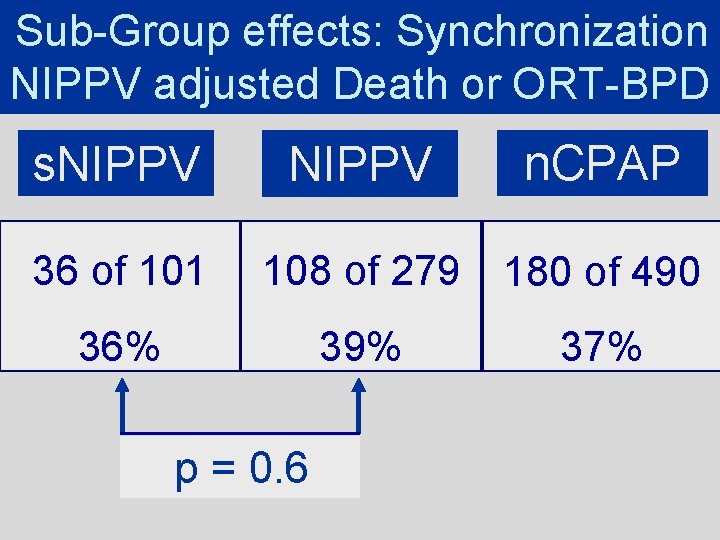
Sub-Group effects: Synchronization NIPPV adjusted Death or ORT-BPD s. NIPPV n. CPAP 36 of 101 108 of 279 180 of 490 36% 39% 37% p = 0. 6
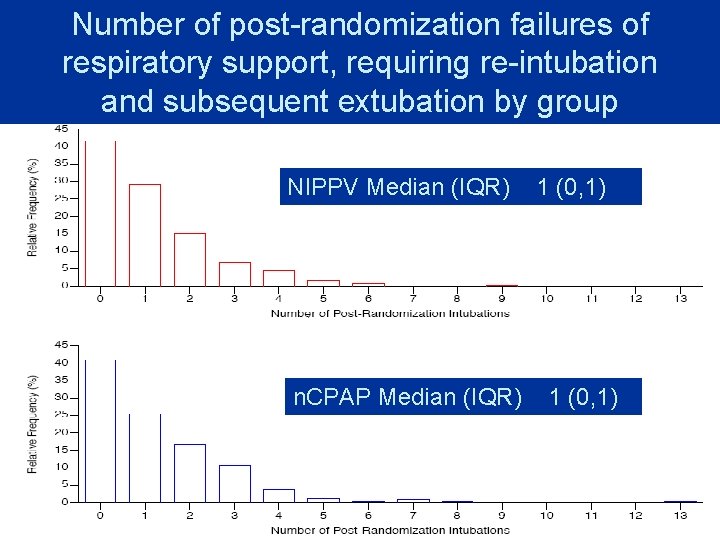
Number of post-randomization failures of respiratory support, requiring re-intubation and subsequent extubation by group NIPPV Median (IQR) n. CPAP Median (IQR) 1 (0, 1)
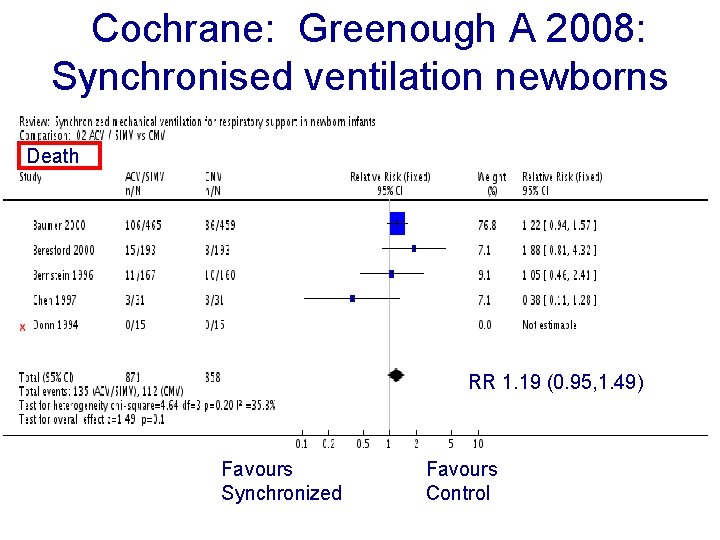
Cochrane: Greenough A 2008: Synchronised ventilation newborns Death RR 1. 19 (0. 95, 1. 49) Favours Synchronized Favours Control
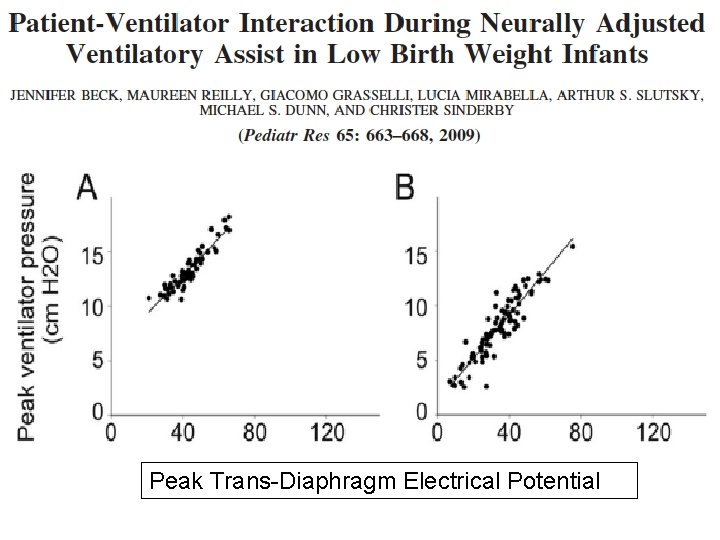
Peak Trans-Diaphragm Electrical Potential
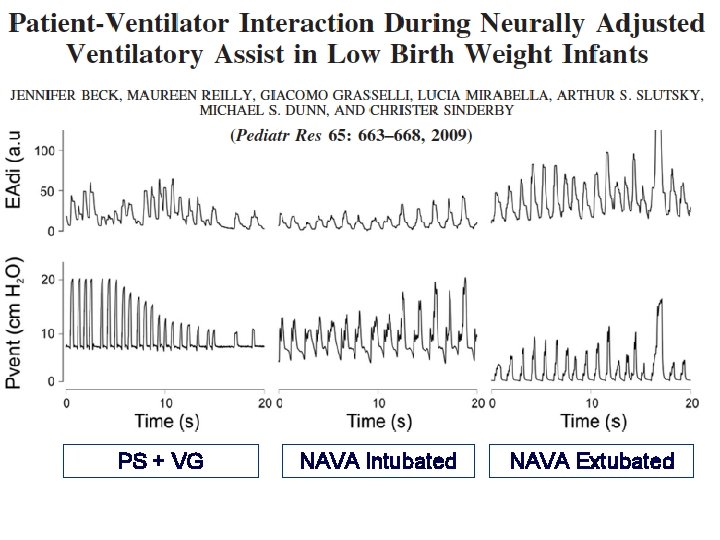
PS + VG NAVA Intubated NAVA Extubated
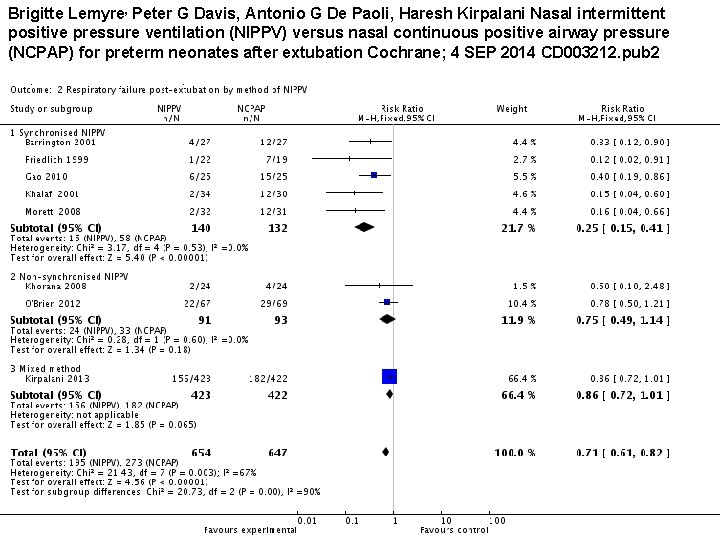
Brigitte Lemyre, Peter G Davis, Antonio G De Paoli, Haresh Kirpalani Nasal intermittent positive pressure ventilation (NIPPV) versus nasal continuous positive airway pressure (NCPAP) for preterm neonates after extubation Cochrane; 4 SEP 2014 CD 003212. pub 2
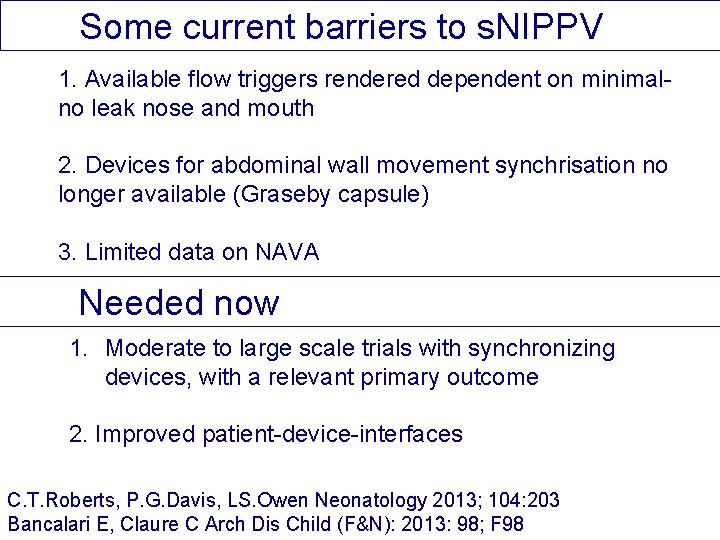
Some current barriers to s. NIPPV 1. Available flow triggers rendered dependent on minimalno leak nose and mouth 2. Devices for abdominal wall movement synchrisation no longer available (Graseby capsule) 3. Limited data on NAVA Needed now 1. Moderate to large scale trials with synchronizing devices, with a relevant primary outcome 2. Improved patient-device-interfaces C. T. Roberts, P. G. Davis, LS. Owen Neonatology 2013; 104: 203 Bancalari E, Claure C Arch Dis Child (F&N): 2013: 98; F 98
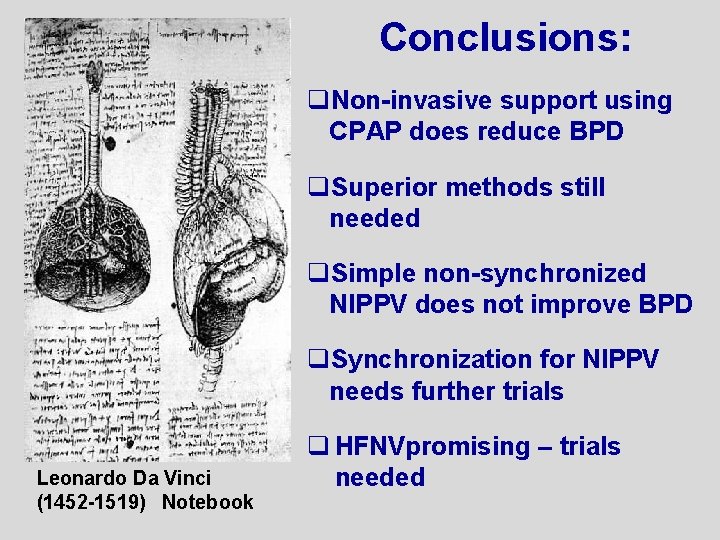
Conclusions: q. Non-invasive support using CPAP does reduce BPD q. Superior methods still needed q. Simple non-synchronized NIPPV does not improve BPD q. Synchronization for NIPPV needs further trials Leonardo Da Vinci (1452 -1519) Notebook q HFNVpromising – trials needed
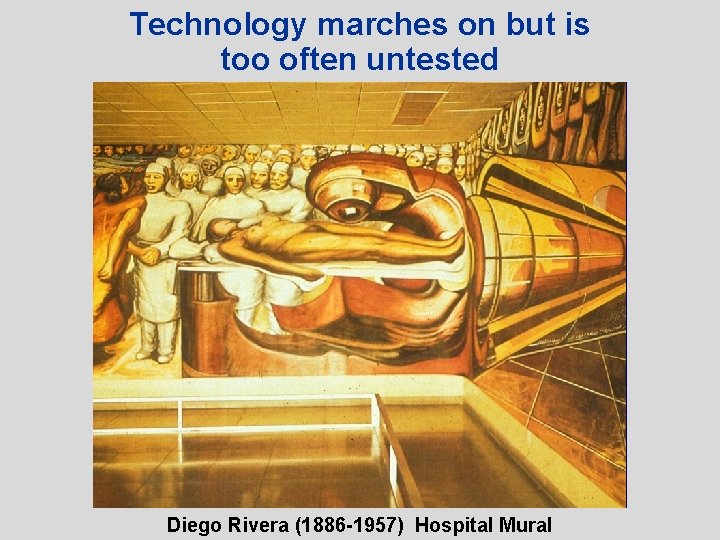
Technology marches on but is too often untested Diego Rivera (1886 -1957) Hospital Mural
- Slides: 45