
NonInfectious Complications of Total Hip Arthroplasty Khaled J
- Slides: 51
Non-Infectious Complications of Total Hip Arthroplasty Khaled J Saleh MD MSc FRCSC Assistant Professor University of Minnesota Department of Orthopedics & Clinical Outcome Research Center
Intraoperative Complications • • Nerve Injury Vascular Injury Cement Reaction/Fat Embolus Fracture/Canal Perforation
Post-Operative Complications • • Fracture Instability Heterotopic Ossification Aseptic Loosening Sepsis Venous Thrombosis Implant Wear and Failure
Neural Injury In Total Hip Arthroplasty
Nerve Injury: Central • Anoxia/Hypoxia • CVA Secondary to Clot • Fat/Marrow Embolus
Peripheral Nerve Injury After THA • Location • Severity • Etiology
Peripheral Nerve Injury • Upper Extremity – Downside Brachial Plexus palsy – Positional (rare) 0. 15% , usually RA (Nercessian et al. J. Arthroplasty 1994) – Usually transient.
Peripheral Nerve Injury: Downside Extremity • Contralateral Lower Extremity (Smith, Pellicci et al. JBJS 1989). • Occurred in 5/919 hip arthroplasties. • Positional, pressure at groin. • Transient paresthesias, motor dysfunction.
Peripheral Nerve Injury: Treated Lower Extremity • Incidence (clinically evident): – 0. 6 -1. 3% primary THA (Johanson, Pellicci et al. CORR 1983) – Up to 7. 5% in revision THA (Navarro et al. J. Arthroplasty, 1995). • EMG evidence of some degree of nerve injury in 70% (Weber et al. JBJS A 1976).
Peripheral Nerve Injury Risk Factors • • Prior Surgery or Altered Anatomy Surgical Approach: n. b. Obesity Hematoma Formation – Gluteals--sciatic nerve – Iliacus--femoral n. ®r/o acetab. fx. • Females >Males: ¯Bulk, size, vasc. diff. ? – 80% in 3 studies!
Peripheral Nerve Injury: • • • Cause often unclear Glut. Max. tendon Retraction Internal Rotation Bony impingement Entrapment by cables wires or sutures. • Screws • Lengthening • Cuts by scalpel or cautery • Hematoma • Extruded Cement • Abduction pillow • Post-op positioning • Dislocation
Vascular Complications of Total Hip Arthroplasty
Vascular Injury In THA: Arterial • Direct: Laceration/puncture – Hemorrhage – Pseudoaneurysm – A-V fistula. • Indirect: – Thrombosis – Embolization – Avulsion.
Vascular Injury In THA: Venous • Direct: – Laceration/puncture ® hemorrhage. • Indirect: – Thrombosis (DVT, PE) – Avulsion.
Vascular Injury in THA • Incidence – ~0. 24% THA – Higher risk in distorted anatomy, prior surgery, left side (? ) vascular disease.
Schoenfeld et al. J. Vasc. Surgery 1990 • 68 THA complicated by vascular injury requiring operative treatment. • 7% mortality. • 15% subsequent amputation. • RISK FACTORS: REVISION/LEFT SIDE/INTRAPELVIC MIGRATION
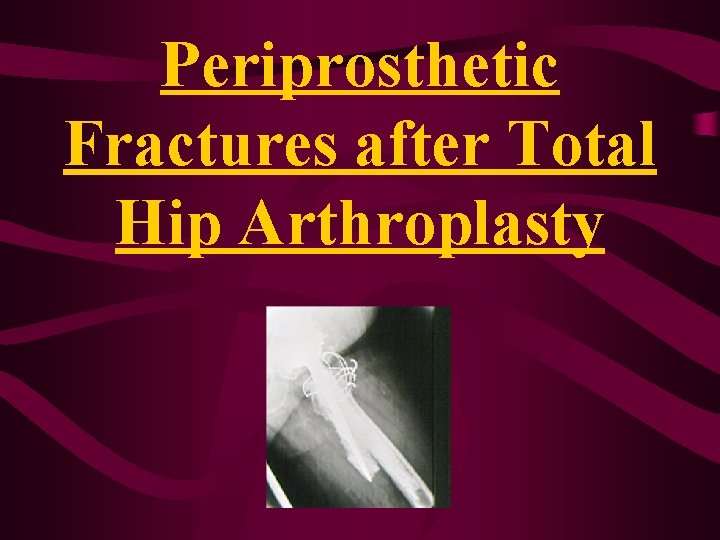
Periprosthetic Fractures after Total Hip Arthroplasty
PERIPROSTHETIC FRACTURES: INCIDENCE • Intra-operative: – Cemented 0. 1 -1. 0% – Uncemented 3 -17. 6% – Revision 6. 3% (Christiansen et al. CORR 1989). • Post-Operative: – <1% after primary – Up to 4% after revision (Kavanaugh OCNA 1992).
Causes for Revision Mayo 1989 -93 1. Loosening 2. Fracture 3. Dislocation 4. Infection
Periprosthetic Fracture • >170, 000 primary THA/year • Indications now include pts. who are younger, heavier and have more bone loss. • More revisions – 2° particle debris & osteolysis.
Periprosthetic Fractures: Risk Factors • Intraoperative: – RA – Uncemented implant – Metabolic bone disease – Paget’s – previous Fracture – Complex deformity (e. g. DDH) – Revision – Forceful Dislocation Manuever
Cortical Perforation Risk Factors Pellicci et al. , JBJS 1980 • • Female Osteoporosis Previous Surgery Previous Fracture
Periprosthetic Fractures: Classification • Johanson et al. , JBJS 1981 – Type I: Proximal to Tip – Type II: Around Tip – Type III: Distal to Tip
Duncan & Masri, I. C. L. XLIV Vancouver Classification System • Type A: Trochanteric fractures • Type B: Fx about stem or tip of stem – B 1: Well-fixed stem – B 2: Loose stem – B 3: Marked osseous deficiency or destruction • Type C: Fx well distal to the tip of the stem
Periprosthetic Fractures: Treatment Options • Non-surgical management (protected weight-bearing, traction, cast). • Revision arthroplasty, longstem, cables. • Revision arthroplasty with proximal femoral replacement. • Revision arthroplasty with allograft. • ORIF (plates, screws, wires, cables, cortical onlay grafts).
Dislocation Following Total Hip Arthroplasty
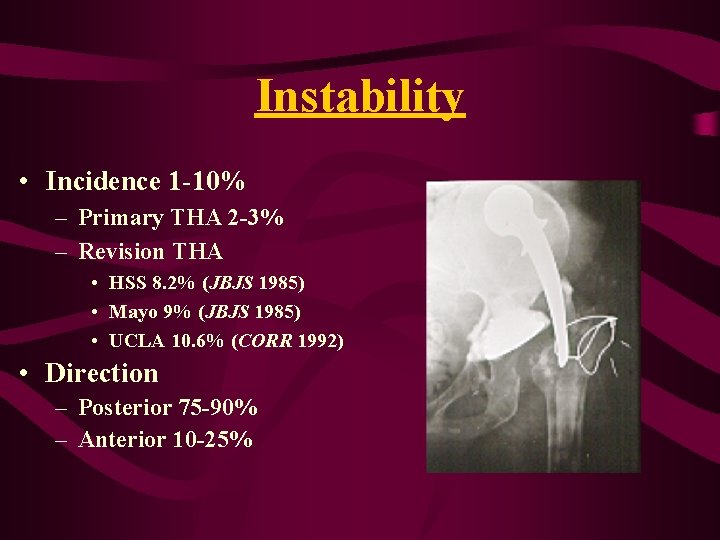
Instability • Incidence 1 -10% – Primary THA 2 -3% – Revision THA • HSS 8. 2% (JBJS 1985) • Mayo 9% (JBJS 1985) • UCLA 10. 6% (CORR 1992) • Direction – Posterior 75 -90% – Anterior 10 -25%
The majority of dislocations occur with minimal trauma.
Dislocation: Mechanisms • Posterior Dislocation: – Flexion, Adduction, Internal Rotation • Anterior Dislocation – Extension, Adduction and External Rotation
Dislocation: Risk Factors: Pre-Op • • • Age/Sex Height/Weight Underlying Hip Pathology Previous Hip Surgery Medical History
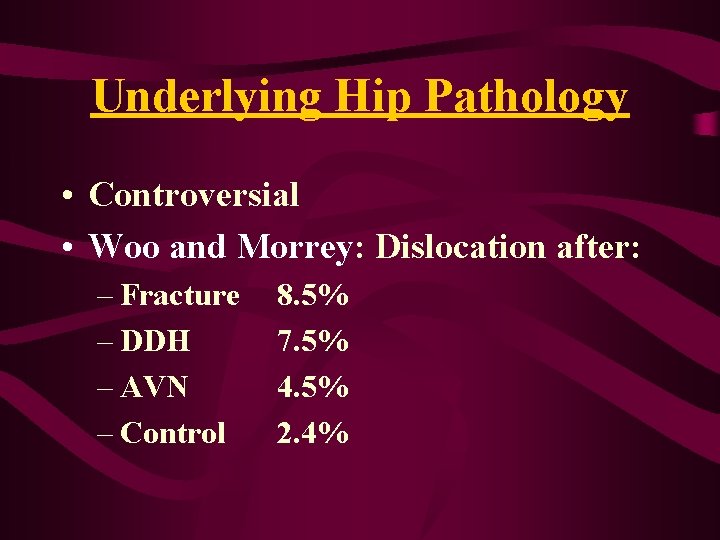
Underlying Hip Pathology • Controversial • Woo and Morrey: Dislocation after: – Fracture – DDH – AVN – Control 8. 5% 7. 5% 4. 5% 2. 4%
Instability: Treatment • Non-Operative – Closed reduction with I. V. sedation or regional anesthesia. – Aspirate to r/o infection if recurrent dislocation. – Brace or Spica cast (6 -12 weeks) • 20 degrees flexion, 15 -20 degrees Abd. , ext. rot. if posterior, int. rot. if anterior
Non-Operative Treatment • Successful at least 2/3 of the time. • Spica Cast or Brace – Shown to be effective (Ritter CORR 1976, Dorr CORR 1983) – Some patients cannot/will not tolerate • Knee immobilizer in post. dislocation.
Instability: Surgical Options • Advance/Lateralize Greater Trochanter – Fraser and Wroblewski JBJS 1981 – Kaplan et al. , J. Arthroplasty 1987 • Both studies had 80% success or 20% recurrent dislocators.
Instability: Operative Armamentarium • Pseudocapsule • Address Trochanter • Component Orientation • Elevated. Liner/ Head. Neck/ Offset • Eliminate Any Impingement • Constrained Cup • Close Pseudocapsule--bone holes • Post-op brace
Constrained Cup • Different systems. • Cemented or non. • Internal bipolar locking mechanism at femoral head articulation. • Little functional limitation of motion • ? Increased loosening
Constrained Cup • Constrained cup for recurrent dislocators, inadequate myofascial envelope. • 70 some-odd pts, up to 9 year f/u. • 1 failure requiring re-operation.
Heterotopic Ossification after THA
Heterotopic Ossification • Calcified osteoid. • Histology more mature peripherally. • Mechanism: Inflammation causes differentiation of mesenchymal tissue to osteoblasts.
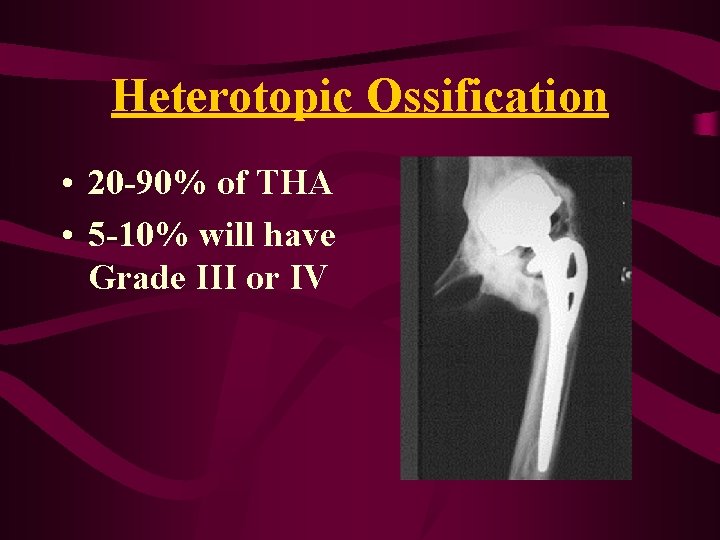
Heterotopic Ossification • 20 -90% of THA • 5 -10% will have Grade III or IV
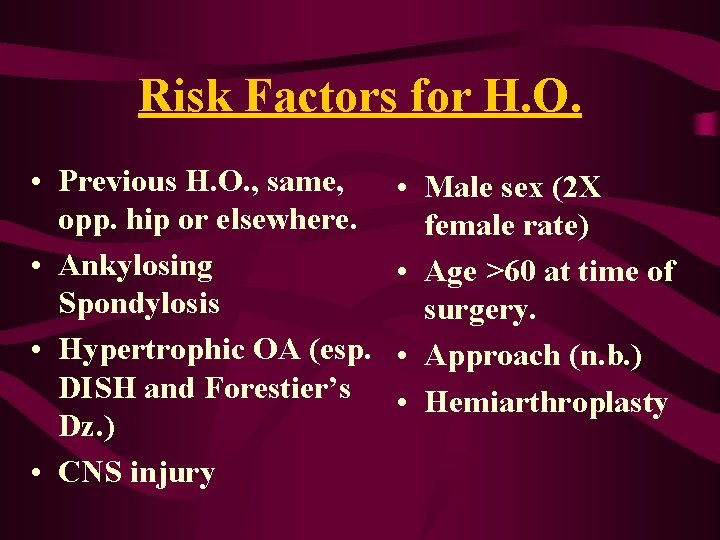
Risk Factors for H. O. • Previous H. O. , same, opp. hip or elsewhere. • Ankylosing Spondylosis • Hypertrophic OA (esp. DISH and Forestier’s Dz. ) • CNS injury • Male sex (2 X female rate) • Age >60 at time of surgery. • Approach (n. b. ) • Hemiarthroplasty
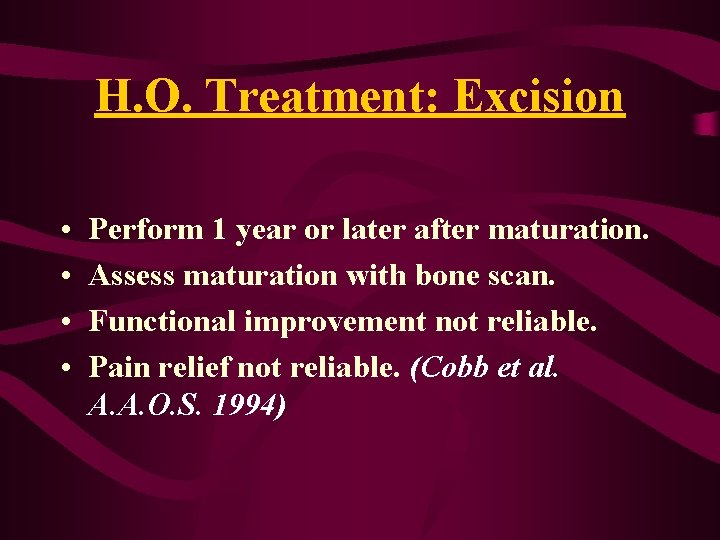
H. O. Treatment: Excision • • Perform 1 year or later after maturation. Assess maturation with bone scan. Functional improvement not reliable. Pain relief not reliable. (Cobb et al. A. A. O. S. 1994)
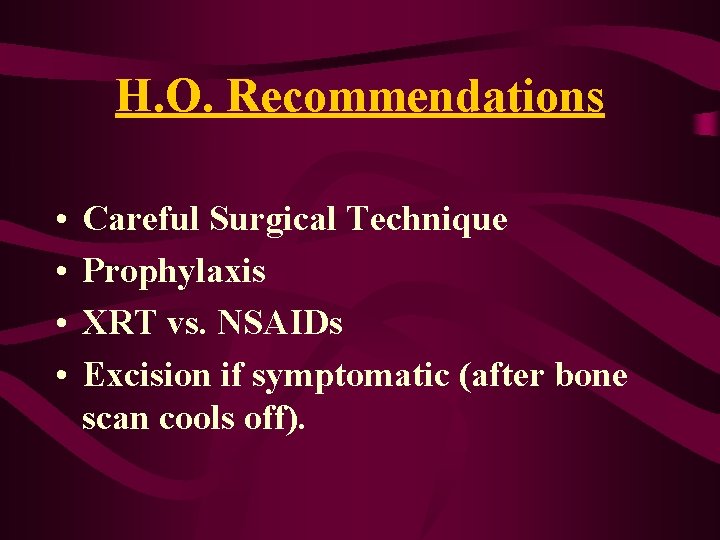
H. O. Recommendations • • Careful Surgical Technique Prophylaxis XRT vs. NSAIDs Excision if symptomatic (after bone scan cools off).
Leg Length Discrepancy
Wound Problems • • High Risk Patients Painting with betadyne? Bilateral Procedures Nutrition
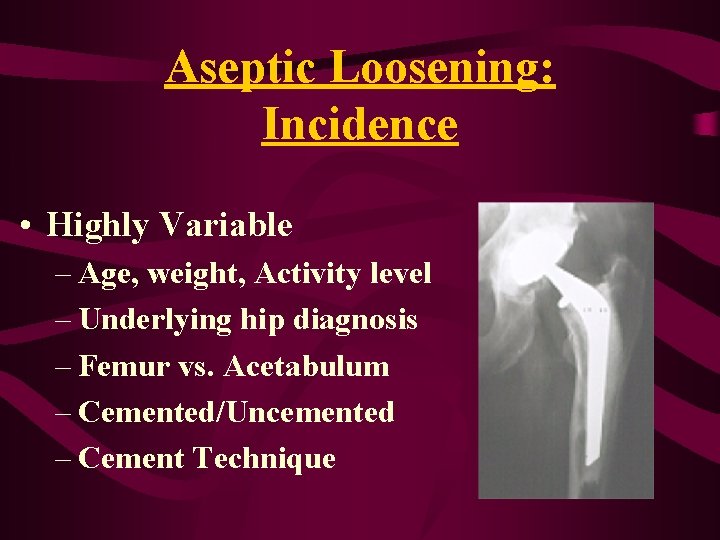
Aseptic Loosening: Incidence • Highly Variable – Age, weight, Activity level – Underlying hip diagnosis – Femur vs. Acetabulum – Cemented/Uncemented – Cement Technique
Thromboembolic Disease in Total Hip Arthroplasty
Virchow’s Triad (1856) • Stasis • Activation of coagulation • Damage to vascular endothelium
Prophylaxis • Mechanical – Exercises – Elastic stockings – Pneumatic compression – IVC filter
Pharmacologic Prophylaxis • • • ASA Warfarin Heparin Low Molecular Weight Heparin Other – Dextran – Mini-Heparin, Adjusted dose
Diagnosis • Clinical • Radiologic studies – U/S – Venogram – V/Q