
Nonenzymatic Browning Maillard reaction INTRODUCTION n Reducing sugars
Non-enzymatic Browning Maillard reaction

INTRODUCTION n Reducing sugars Brown colors Desirable n Reducing sugars + Amino Acids MAILLARD REACTION Undesirable Free amino acid or Free amino group of a protein
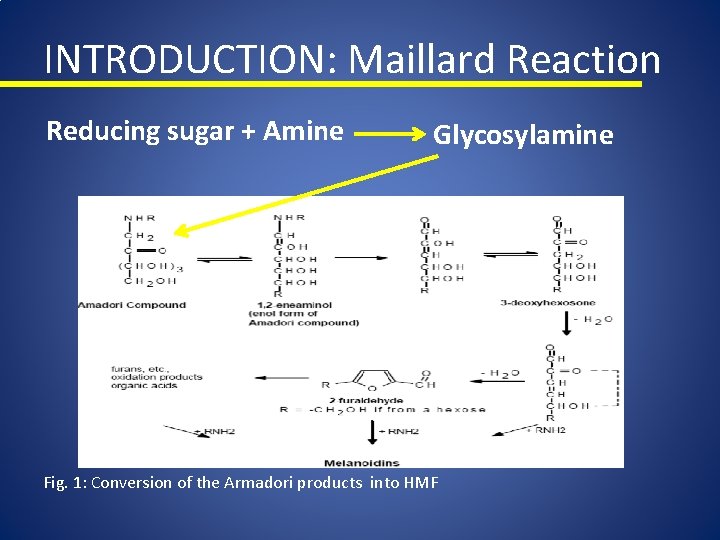
INTRODUCTION: Maillard Reaction Reducing sugar + Amine Glycosylamine Fig. 1: Conversion of the Armadori products into HMF
INTRODUCTION Keep in mind: • The type of amino acid will determine the resulting flavor • Heat is usually required Flavors: • Meat roasting • Bread crusts • Chocolate, coffee, cocoa • Caramels
OBJECTIVES • To gain a better understanding of non-enzymatic browning reactions and their role in food products. • To investigate the influence of substrate type on the rate of the Maillard reaction and establish the effect of p. H on Maillard browning reaction rates.
Lab 1: MATERIALS AND METHODS – Volumetric flasks (50, and 100 m. L) – Pipettes (10 m. L) – Beakers (100 and 50 m. L) – Spectrophotometer – Water bath – Screw-cap test tubes with caps – Phosphate buffers: p. H: 4. 5 (low) and p. H 8. 5 (high) by mixing 66. 7 m. M KH 2 PO 4 and 66. 7 m. M Na 2 HPO 4 - PREPARED
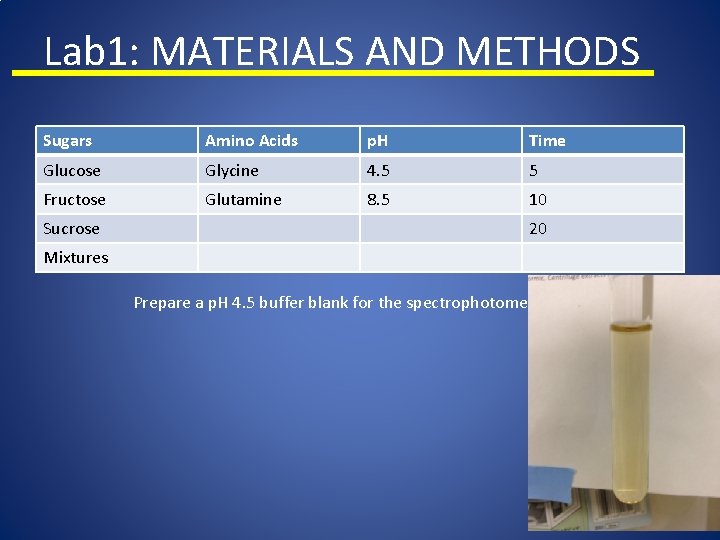
Lab 1: MATERIALS AND METHODS Sugars Amino Acids p. H Time Glucose Glycine 4. 5 5 Fructose Glutamine 8. 5 10 Sucrose 20 Mixtures Prepare a p. H 4. 5 buffer blank for the spectrophotometer
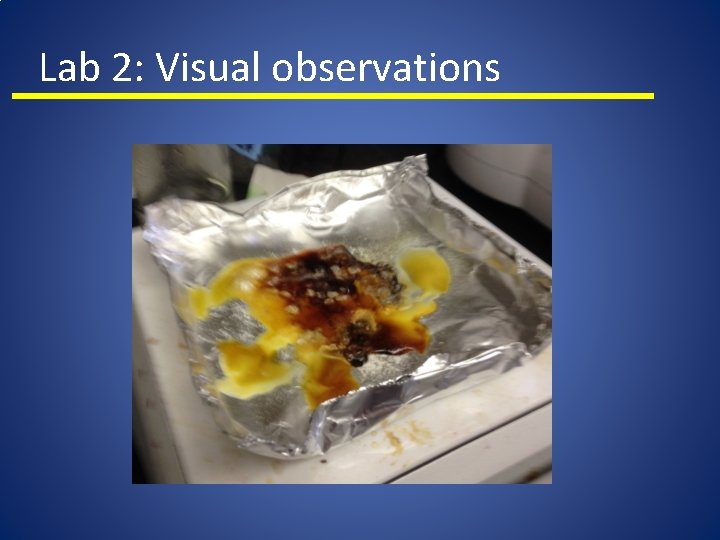
Lab 2: Visual observations • Time to play: • Select any type a sugar and amino-acid combos. • Try to create your own flavors! • Try to create: – A desirable flavor – A nasty flavor – Which AA would lead to that? – Reversing or inhibiting the reaction
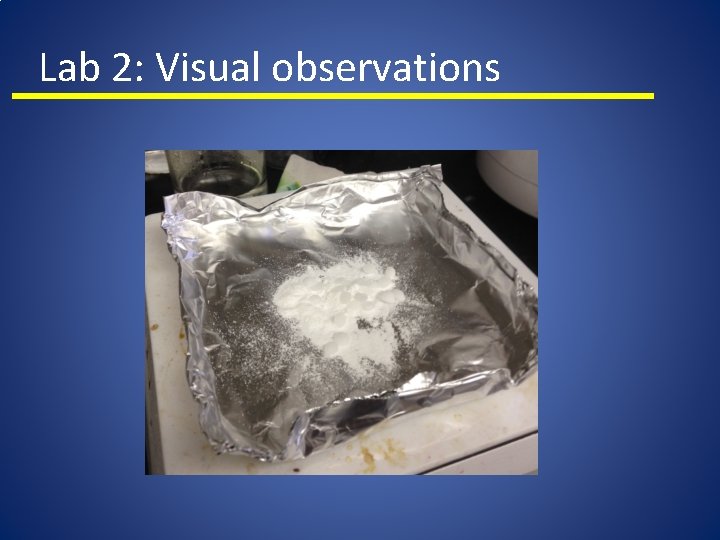
Lab 2: Visual observations
Lab 2: Visual observations
- Slides: 10