
NONE OF US IS AS SMART AS ALL

- Slides: 19
“NONE OF US IS AS SMART AS ALL OF US” THE ROLE OF MENTORING IN THE DEVELOPMENT OF ORGANIZATIONAL LEADERSHIP Bill Fiala, Ph. D Reina Juarez, Ph. D Azusa Pacific University UC San Diego Don Graham, Ed. D Sheri Richards, MS, MFT Cal State, Chico Saint Mary’s College OCCDHE Spring Conference April 29, 2006
Introduction “Make your friends your teachers and mingle the pleasures of conversation with the advantages of instruction. ” (Gracián, as quoted in Peddy, 1998)
Organizational Membership “Interaction with colleagues is a vital component of professional development. Professional organizations offer an excellent opportunity for emerging psychologists to associate with other psychologists and to develop their own professional identity. Through that interaction, graduate students and early-career psychologists gain access to content experts and potential mentors while developing a sense of belonging within their discipline. ” (Dodgen, Fowler, & Williams-Nickelson, 2003)
Organizational Membership n Why OCCDHE? Tell us about your first experience, what made you decide to become a member, what keeps you coming back…
Definitions and Experiences “Mentoring is a personal relationship in which a more experienced professional acts as a guide, role model, teacher, and sponsor of a less experienced or junior professional. A mentor provides the protégé with knowledge, advice, challenge, counsel, and support in the protégé’s pursuit of becoming a full member of a particular profession. ” (Johnson, 2002)
Definitions and Experiences Mentoring Functions (Kram, 1988) n Career functions: Those aspects of the relationship that enhance learning the ropes and preparing for advancement in an organization (e. g. , sponsorship, exposure and visibility, coaching, protection, provision of challenging assignments). n Psychosocial functions: Those aspects of the relationship that enhance a sense of competence, clarity of identity, and effectiveness in a professional role (e. g. , role modeling, acceptance and confirmation, counseling, friendship).
Definitions and Experiences “Mentees are likely to have many mentors over the course of a lifetime, based on their individual needs at a specific point in time. ” (Zachary, 2000)
Definitions and Experiences n What has been your experience of being “mentored” in this organization? What about this relationship(s) was important to you? How does this compare or contrast with your experiences elsewhere?
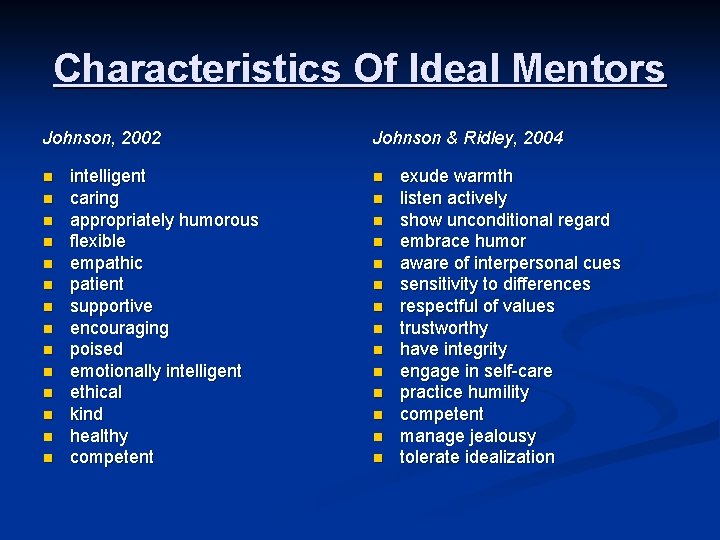
Characteristics Of Ideal Mentors Johnson, 2002 n n n n intelligent caring appropriately humorous flexible empathic patient supportive encouraging poised emotionally intelligent ethical kind healthy competent Johnson & Ridley, 2004 n n n n exude warmth listen actively show unconditional regard embrace humor aware of interpersonal cues sensitivity to differences respectful of values trustworthy have integrity engage in self-care practice humility competent manage jealousy tolerate idealization
Mentoring Experience “Mentoring plays a very important role in leadership… pleasure comes from seeing people one has mentored grow, blossom, and fulfill their potential. To be satisfied with the knowledge that one has played a part in making it happen, I think, takes maturity, integrity, the wisdom of experience, and the valuing of both the goals and the people who are working toward them…I have always made it a point, if at all possible, never to be too busy to mentor a student or colleague, because unless we psychologists give a hand up to those who come behind us, we do not increase our ranks, we do not nurture talent, we do not prepare for the future…To me, mentoring is an intrinsic part of life. I truly feel that psychologists have an obligation to help each other, and that in the process, we gain, ourselves. ” (Canter, 2000)
Mentoring Experience “Mentors are also likely to benefit substantially from mentoring. Mentors describe reaping extrinsic rewards, such as accelerated research productivity, greater networking, and enhanced professional recognition, when protégés perform well. Important intrinsic benefits include enhanced career satisfaction, rejuvenation of creative energy from collaboration with protégés, and a sense of generativity. ” (Johnson, 2002)
Mentoring Experience “Today’s mentor is a facilitative partner in an evolving learning relationship…today’s mentor enjoys the benefits of rich learning opportunities that mentoring provides for mentors as well as mentees. A mentor’s own growth and development are nurtured through reflection, renewal, and regeneration. ” (Zachary, 2000)
Mentoring Experience n Has OCCDHE given you the opportunity to mentor others? Have you pursued this? If not, why not? If so, how has this experience(s) been for you?
Future Directions “In general, informal mentorships (those that develop spontaneously, without formal assignment by a third party) are evaluated by both mentors and protégés as being more effective and meaningful than formal (assigned) mentorships. Protégés in informal relationships receive more career and psychosocial function from mentors and report greater effect from, and satisfaction with, the mentorship. It appears that formally assigned mentorships result in less identification, less relational comfort, less motivation for mentoring, and ultimately less communication and interaction. Most agree that mentorships…should be facilitated rather than assigned. ” (Johnson, 2002)
Future Directions “I have thought about the many instances of very successful mentoring of which I have been aware over the years, and I think that most of them were the result of informal rather than formal mentoring relationships. It occurs to me that perhaps our energies might most productively be put into trying to arrange situations in which people can come together to talk or to work but, most importantly, to share something of themselves. The spontaneous relationships that spring up and result in mentoring in those instances appear to me to be among the most successful, perhaps because they allow for some mutual selection in terms of compatibility…I am not suggesting that formal programs be abandoned, just that they be supplemented. It is important to keep remembering what it was like to be new and to reach out a friendly hand. ” (Canter, 2000)
Future Directions n What are your suggestions for future directions for OCCDHE? Do you like what we do already? Can we make improvements? Are there other models or organizations you are aware of that we can learn from?
Discussion
Trivia: Word History The word mentor is an example of the way in which the great works of literature live on without our knowing it. The word has recently gained currency in the professional world, where it is thought to be a good idea to have a mentor, a wise and trusted counselor, guiding one's career, preferably in the upper reaches of the organization. We owe this word to the more heroic age of Homer, in whose Odyssey Mentor is the trusted friend of Odysseus left in charge of the household during Odysseus's absence. More important for our usage of the word mentor, Athena disguised as Mentor guides Odysseus's son Telemachus in his search for his father. Fénelon in his romance Télémaque (1699) emphasized Mentor as a character, and so it was that in French (1749) and English (1750) mentor, going back through Latin to a Greek name, became a common noun meaning “wise counselor, ” first recorded in 1750. Mentor is an appropriate name for such a person because it probably meant “adviser” in Greek and comes from the Indo-European root men-, meaning “to think. ” (The American Heritage® Dictionary of the English Language, 1992)
Selected References Bogat, G. A. , & Redner, R. L. (1985). How mentoring affects the professional development of women in psychology. Professional Psychology: Research and Practice, 16, 851 -859. Canter, M. (2000). Reflections on receiving an award. American Psychologist, 55, 1304 -1311. Clark, R. A. , Harden, S. L. , & Johnson, W. B. (2000). Mentor relationships in clinical psychology doctoral training: Results of a national survey. Teaching of Psychology, 27, 262 -268. Dodgen, D. , Fowler, R. D. , & Williams-Nickelson, C. (2003). Getting involved in professional organizations: A gateway to career advancement. In Prinstein, M. J. , & Patterson, M. (eds. ). The portable mentor: Expert guide to a successful career in psychology. New York: Springer Publishing. Gilbert, L. A. , & Rossman, K. M. (1992). Gender and the mentoring process for women: Implications for professional development. Professional Psychology: Research and Practice, 233 -238. Johnson, W. B. , & Ridley, C. R. (2004). The elements of mentoring. New York: Palgrave Macmillan. Johnson, W. B. (2002). The intentional mentor: Strategies and guidelines for the practice of mentoring. Professional Psychology: Research and Practice, 33, 88 -96. Kram, K. E. (1988). Mentoring at work: Developmental relationships in organizational life. Lanham, MD: University Press of America. Peddy, S. (2001). The art of mentoring: Lead, follow and get out of the way. Corpus Christi, TX: Bullion Books. Zachary, L. J. (2000). The mentor’s guide: Facilitating effective learning relationships. San Francisco: Jossey-Bass.