
NONCOGNITIVE ASSESSMENT COGNITIVE DOMAIN Emphasizes measurements of reasoning
- Slides: 72
NON-COGNITIVE ASSESSMENT
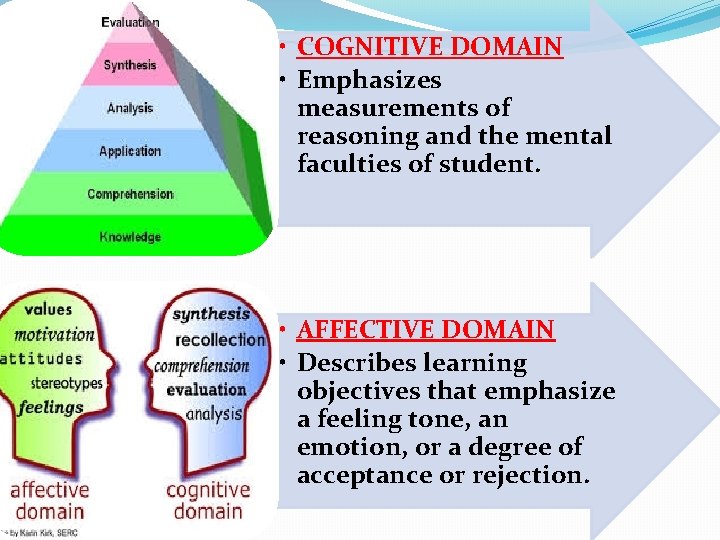
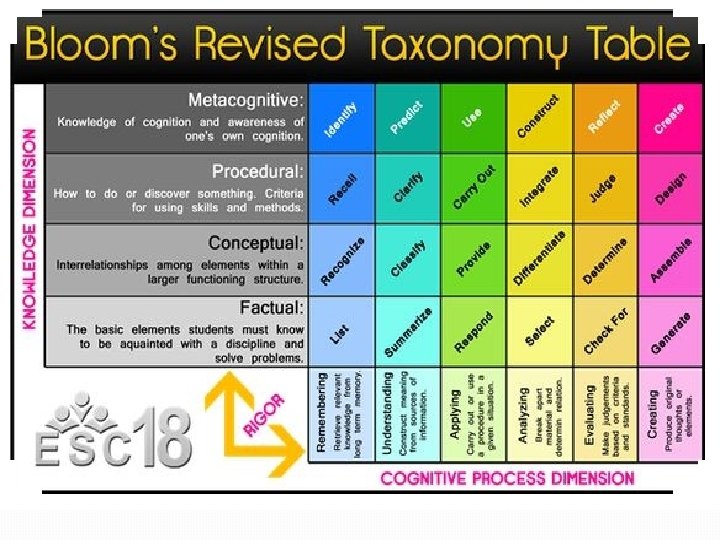
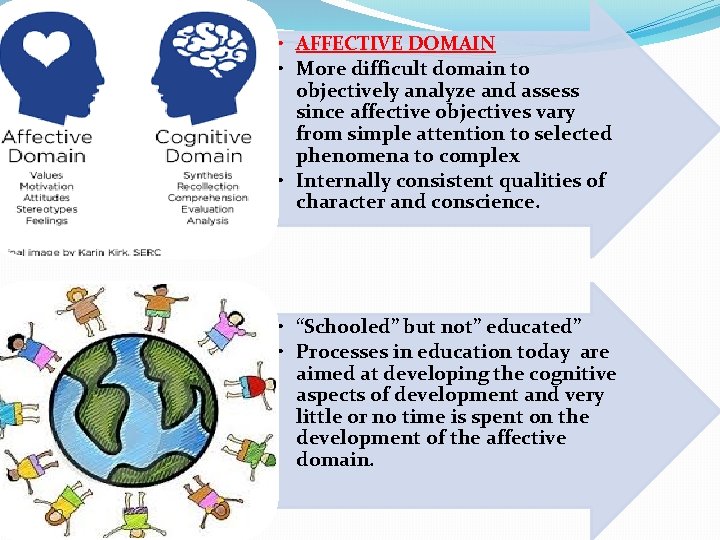
• COGNITIVE DOMAIN • Emphasizes measurements of reasoning and the mental faculties of student. • AFFECTIVE DOMAIN • Describes learning objectives that emphasize a feeling tone, an emotion, or a degree of acceptance or rejection.
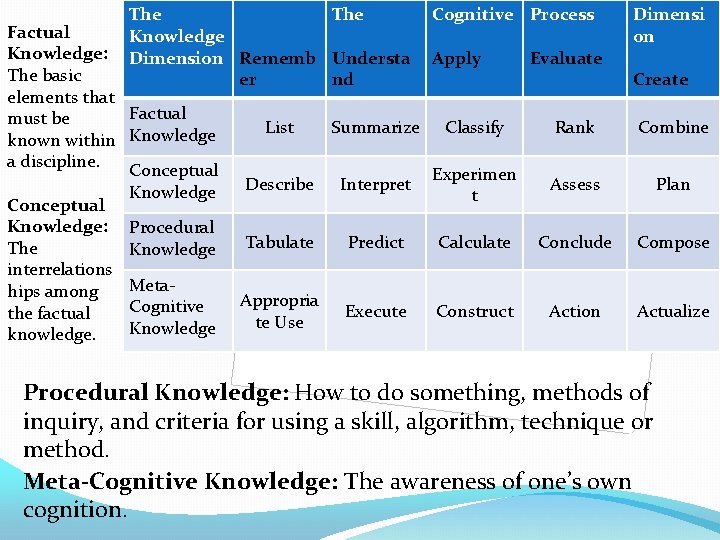
The Knowledge Dimension Rememb Understa er nd Factual Knowledge: The basic elements that Factual must be known within Knowledge a discipline. Conceptual Knowledge: Procedural The Knowledge interrelations Metahips among Cognitive the factual Knowledge knowledge. Cognitive Process Apply Evaluate Dimensi on Create List Summarize Classify Rank Combine Describe Interpret Experimen t Assess Plan Tabulate Predict Calculate Conclude Compose Appropria te Use Execute Construct Action Actualize Procedural Knowledge: How to do something, methods of inquiry, and criteria for using a skill, algorithm, technique or method. Meta-Cognitive Knowledge: The awareness of one’s own cognition.
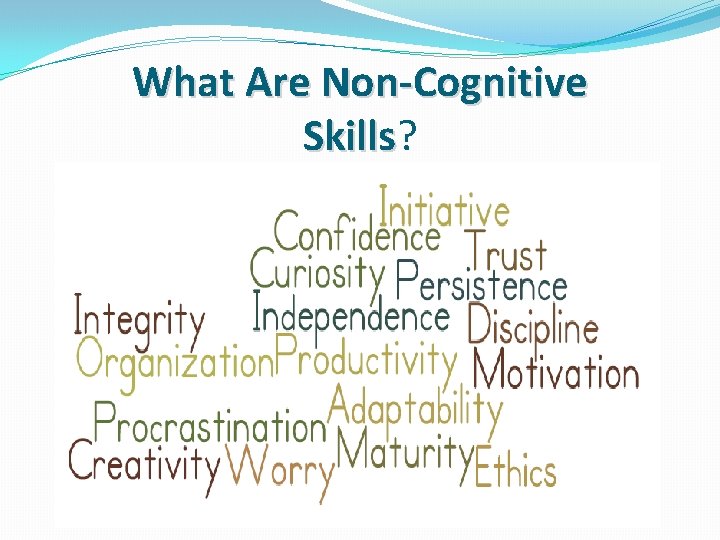
What Are Non-Cognitive Skills? Skills
• AFFECTIVE DOMAIN • More difficult domain to objectively analyze and assess since affective objectives vary from simple attention to selected phenomena to complex • Internally consistent qualities of character and conscience. • “Schooled” but not” educated” • Processes in education today are aimed at developing the cognitive aspects of development and very little or no time is spent on the development of the affective domain.
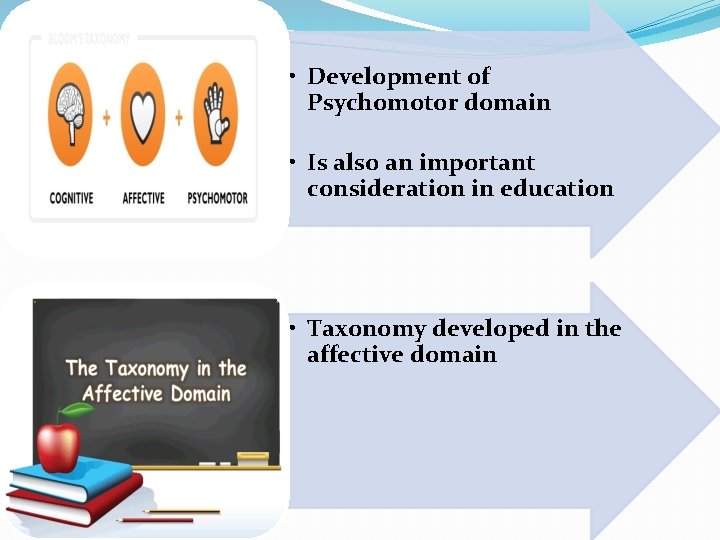
• Development of Psychomotor domain • Is also an important consideration in education • Taxonomy developed in the affective domain
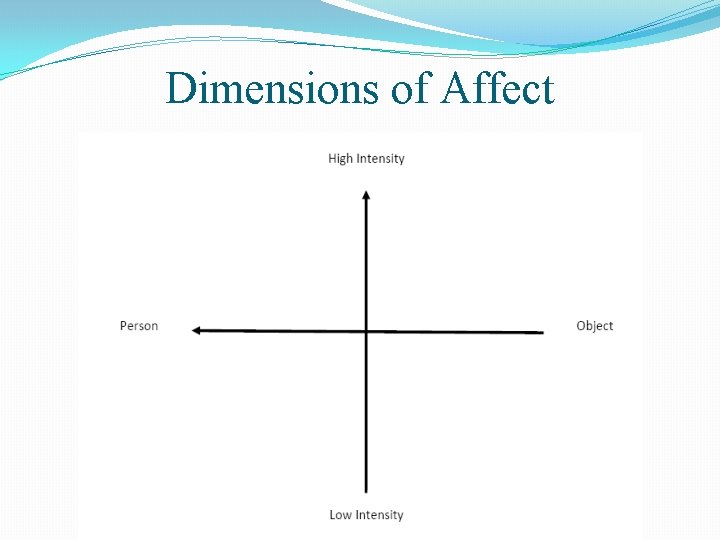
Affective Characteristics �Anderson (1981) explained affective characteristics as “qualities which presents people’s typical ways of feeling, or expressing their emotions” (p. 3). �Sta. Maria and Magno (2007) found that affective characteristics run on two dimensions: Intensity and direction.
Affective Characteristics �Intensity refers to the strength of the characteristic expressed. �Direction of affect refers to the cause of the affect from object external factors to person factors.
Dimensions of Affect
Can Non-Cognitive Skills Be Taught? You can’t change a tiger’s stripes, but you can teach that tiger to hunt in a different environment.
THE TAXONOMY IN THE AFFECTIVE DOMAIN Contain a large numer of objectives in the literature expressed as interests, attitudes, appreciations, values, and emotional sets or biases (Krathwohl et al, 1964) The Description of each steps culled from Krathwol’s Taxonomy of Affective Domain (1964)
1. RECEIVING �Being aware of or sensitive to the existence of certain ideas, material, or phenomena and being willing to tolerate them. The learners are willing to listen. Ex. Listens to the ideas of others with respect. Sample verbs: to differentiate, to accept, to listen(for), to respond to, points to
2. RESPONDING �Committed in some small measure to the ideas, materials, or phenomena involved by actively responding to them. The learners are willing to participate. Ex. Participates in class discussion actively. Sample verbs: To comply, to follow, to commend, to volunteer, to spend leisure time in, to acclaim, practices
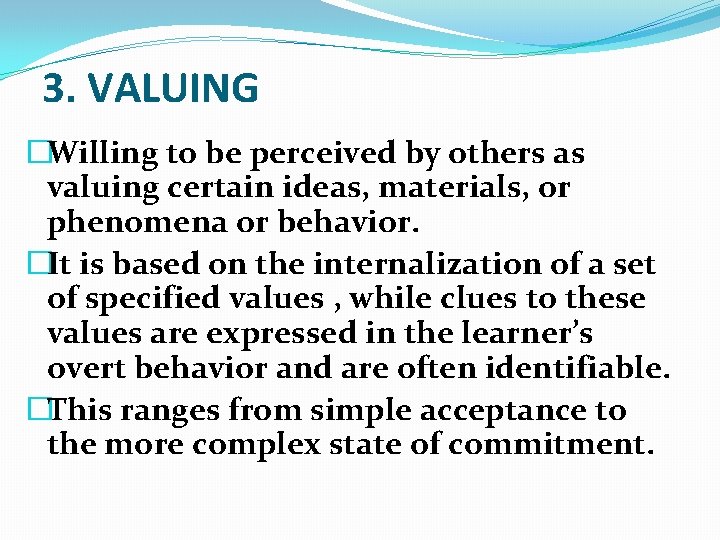
3. VALUING �Willing to be perceived by others as valuing certain ideas, materials, or phenomena or behavior. �It is based on the internalization of a set of specified values , while clues to these values are expressed in the learner’s overt behavior and are often identifiable. �This ranges from simple acceptance to the more complex state of commitment.
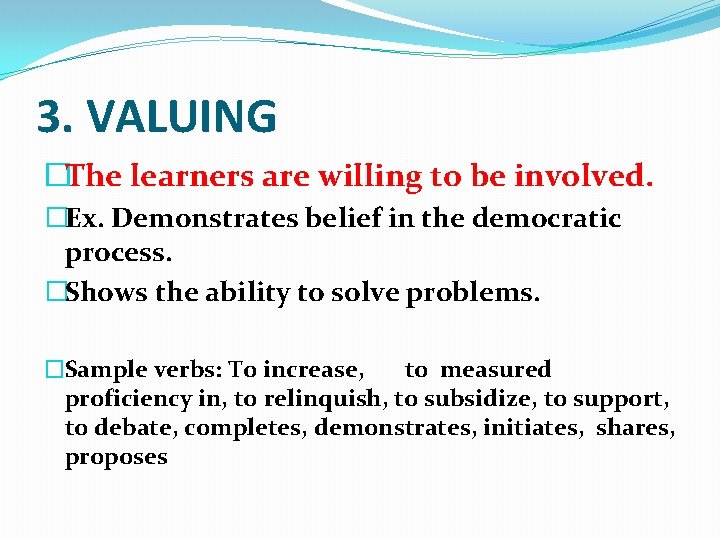
3. VALUING �The learners are willing to be involved. �Ex. Demonstrates belief in the democratic process. �Shows the ability to solve problems. �Sample verbs: To increase, to measured proficiency in, to relinquish, to subsidize, to support, to debate, completes, demonstrates, initiates, shares, proposes
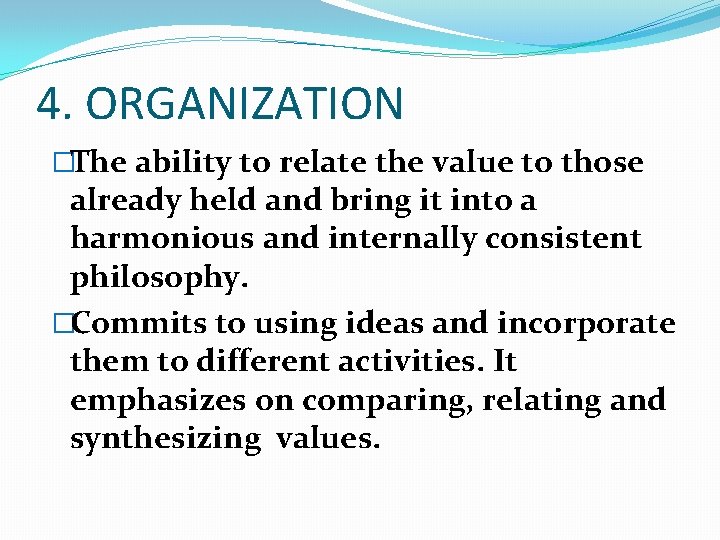
4. ORGANIZATION �The ability to relate the value to those already held and bring it into a harmonious and internally consistent philosophy. �Commits to using ideas and incorporate them to different activities. It emphasizes on comparing, relating and synthesizing values.
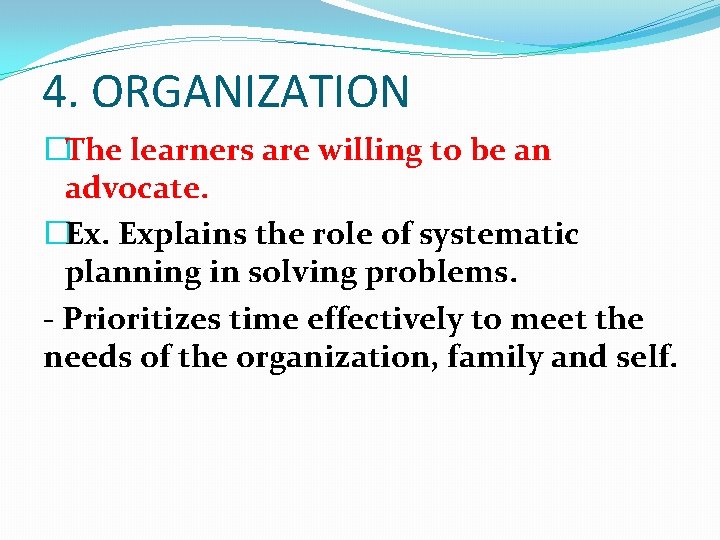
4. ORGANIZATION �The learners are willing to be an advocate. �Ex. Explains the role of systematic planning in solving problems. - Prioritizes time effectively to meet the needs of the organization, family and self.
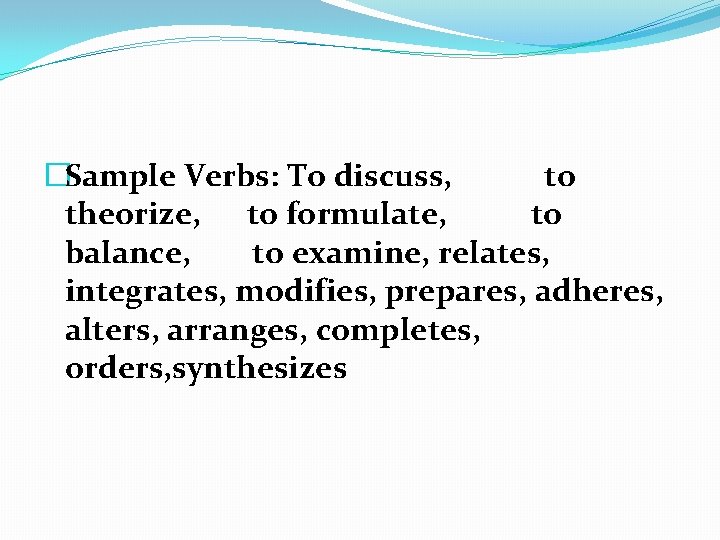
�Sample Verbs: To discuss, to theorize, to formulate, to balance, to examine, relates, integrates, modifies, prepares, adheres, alters, arranges, completes, orders, synthesizes
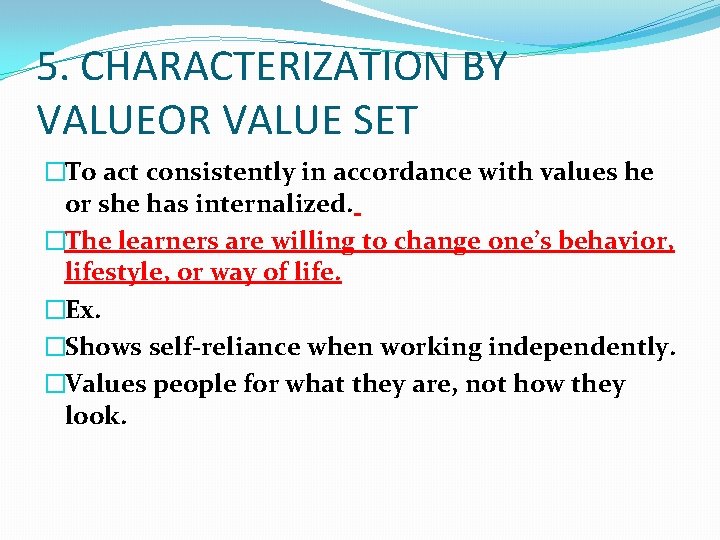
5. CHARACTERIZATION BY VALUEOR VALUE SET �To act consistently in accordance with values he or she has internalized. �The learners are willing to change one’s behavior, lifestyle, or way of life. �Ex. �Shows self-reliance when working independently. �Values people for what they are, not how they look.
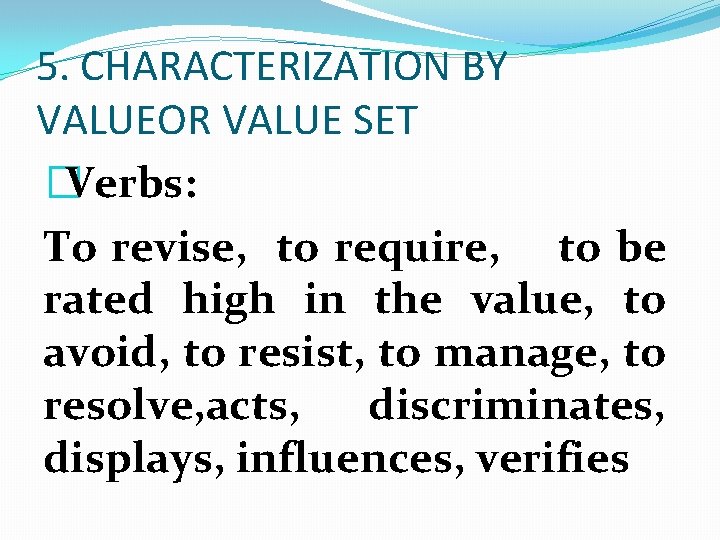
5. CHARACTERIZATION BY VALUEOR VALUE SET �Verbs: To revise, to require, to be rated high in the value, to avoid, to resist, to manage, to resolve, acts, discriminates, displays, influences, verifies
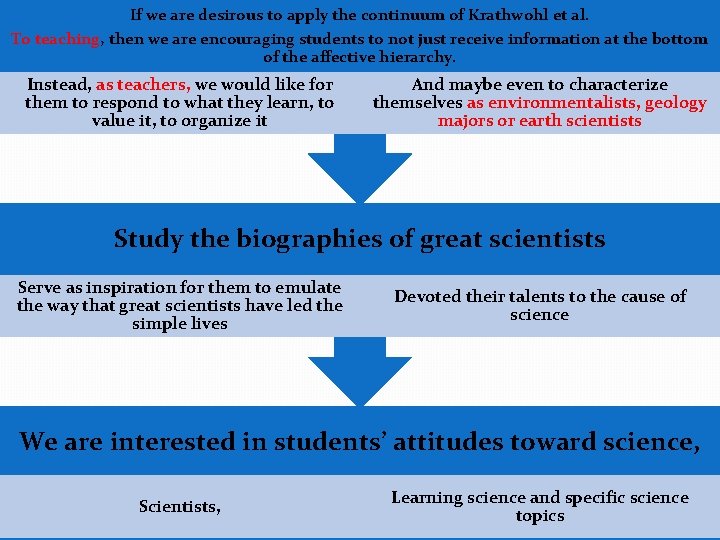
If we are desirous to apply the continuum of Krathwohl et al. To teaching, then we are encouraging students to not just receive information at the bottom of the affective hierarchy. Instead, as teachers, we would like for them to respond to what they learn, to value it, to organize it And maybe even to characterize themselves as environmentalists, geology majors or earth scientists Study the biographies of great scientists Serve as inspiration for them to emulate the way that great scientists have led the simple lives Devoted their talents to the cause of science We are interested in students’ attitudes toward science, Scientists, Learning science and specific science topics
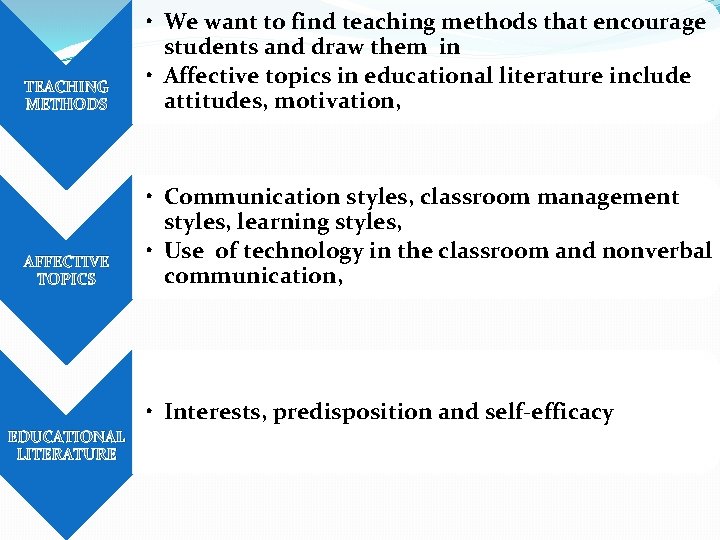
TEACHING METHODS • We want to find teaching methods that encourage students and draw them in • Affective topics in educational literature include attitudes, motivation, AFFECTIVE TOPICS • Communication styles, classroom management styles, learning styles, • Use of technology in the classroom and nonverbal communication, • Interests, predisposition and self-efficacy EDUCATIONAL LITERATURE
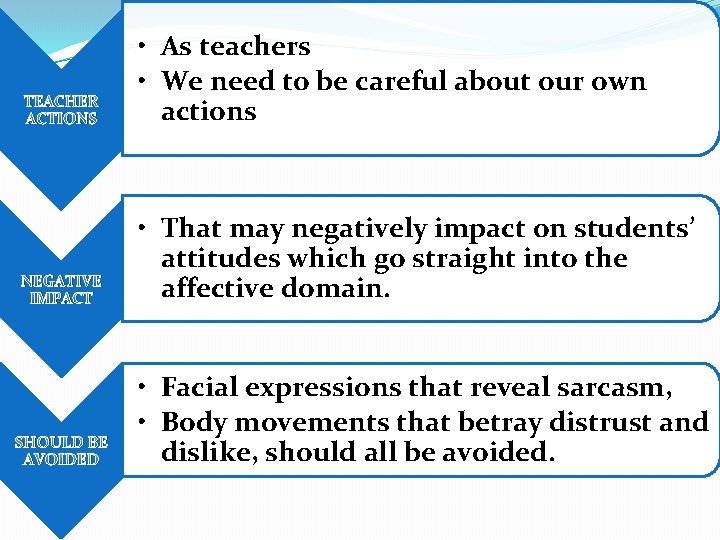
TEACHER ACTIONS • As teachers • We need to be careful about our own actions NEGATIVE IMPACT • That may negatively impact on students’ attitudes which go straight into the affective domain. SHOULD BE AVOIDED • Facial expressions that reveal sarcasm, • Body movements that betray distrust and dislike, should all be avoided.
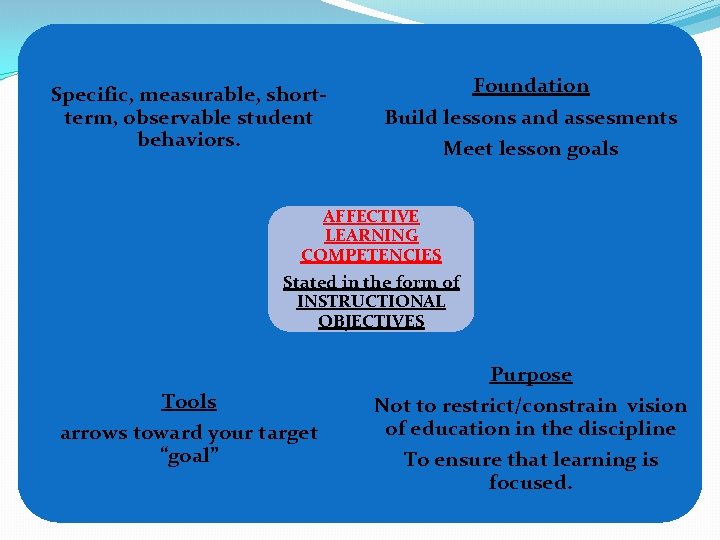
Specific, measurable, shortterm, observable student behaviors. Foundation Build lessons and assesments Meet lesson goals AFFECTIVE LEARNING COMPETENCIES Stated in the form of INSTRUCTIONAL OBJECTIVES Tools arrows toward your target “goal” Purpose Not to restrict/constrain vision of education in the discipline To ensure that learning is focused.
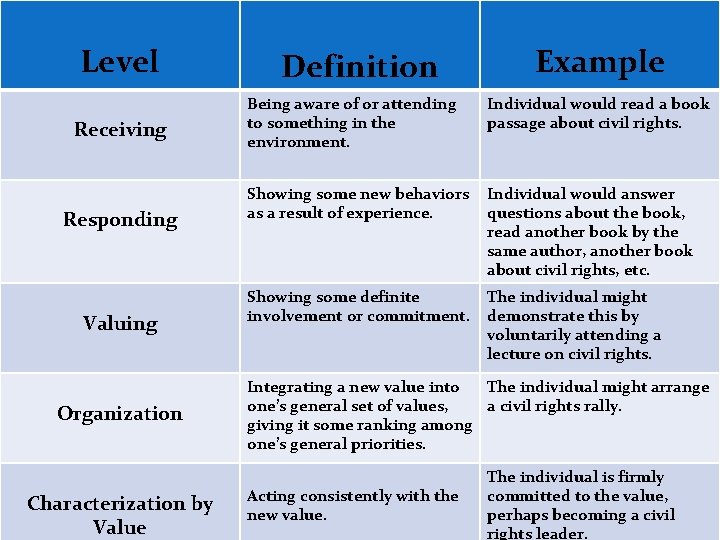
Level Receiving Responding Valuing Organization Characterization by Value Definition Example Being aware of or attending to something in the environment. Individual would read a book passage about civil rights. Showing some new behaviors as a result of experience. Individual would answer questions about the book, read another book by the same author, another book about civil rights, etc. Showing some definite involvement or commitment. The individual might demonstrate this by voluntarily attending a lecture on civil rights. Integrating a new value into The individual might arrange one’s general set of values, a civil rights rally. giving it some ranking among one’s general priorities. Acting consistently with the new value. The individual is firmly committed to the value, perhaps becoming a civil rights leader.
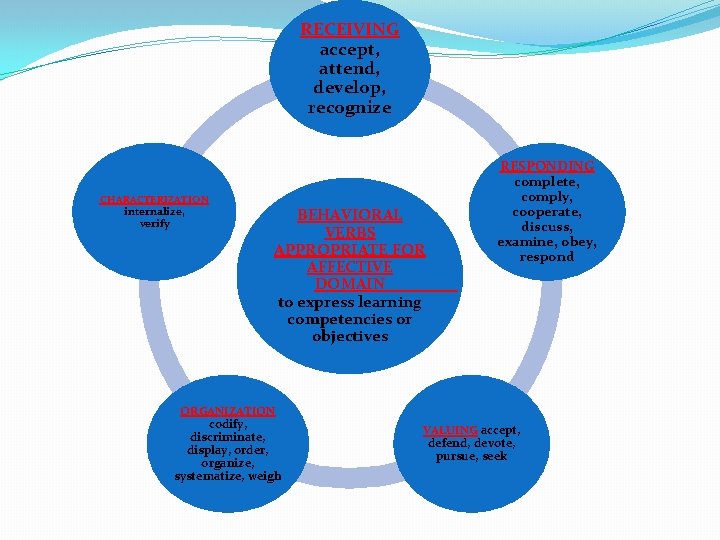
RECEIVING accept, attend, develop, recognize CHARACTERIZATION internalize, verify BEHAVIORAL VERBS APPROPRIATE FOR AFFECTIVE DOMAIN to express learning competencies or objectives ORGANIZATION codify, discriminate, display, order, organize, systematize, weigh RESPONDING complete, comply, cooperate, discuss, examine, obey, respond VALUING accept, defend, devote, pursue, seek
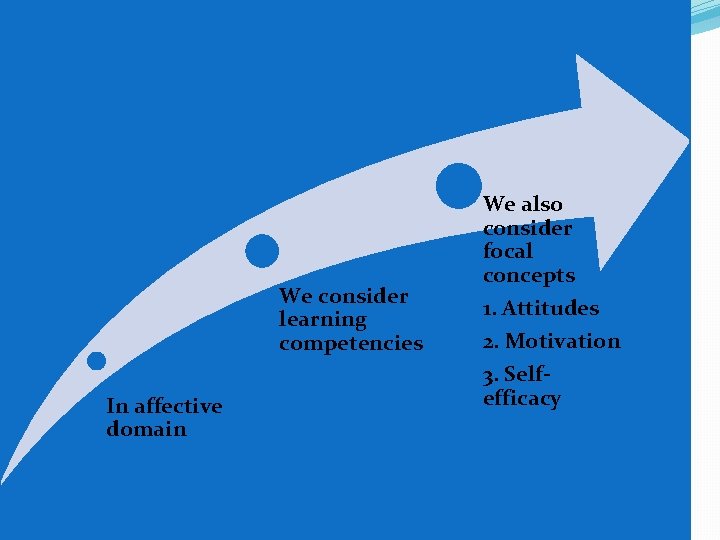
We consider learning competencies In affective domain We also consider focal concepts 1. Attitudes 2. Motivation 3. Selfefficacy
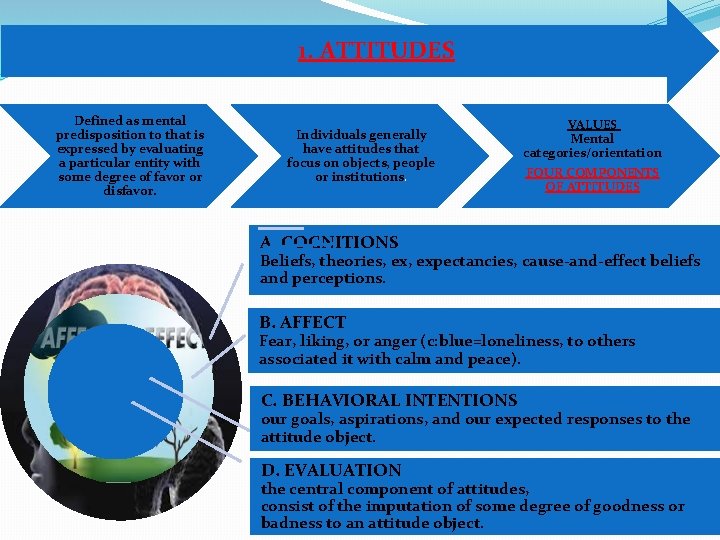
1. ATTITUDES Defined as mental predisposition to that is expressed by evaluating a particular entity with some degree of favor or disfavor. Individuals generally have attitudes that focus on objects, people or institutions. VALUES Mental categories/orientation FOUR COMPONENTS OF ATTITUDES A. COGNITIONS Beliefs, theories, expectancies, cause-and-effect beliefs and perceptions. B. AFFECT Fear, liking, or anger (c: blue=loneliness, to others associated it with calm and peace). C. BEHAVIORAL INTENTIONS our goals, aspirations, and our expected responses to the attitude object. D. EVALUATION the central component of attitudes, consist of the imputation of some degree of goodness or badness to an attitude object.
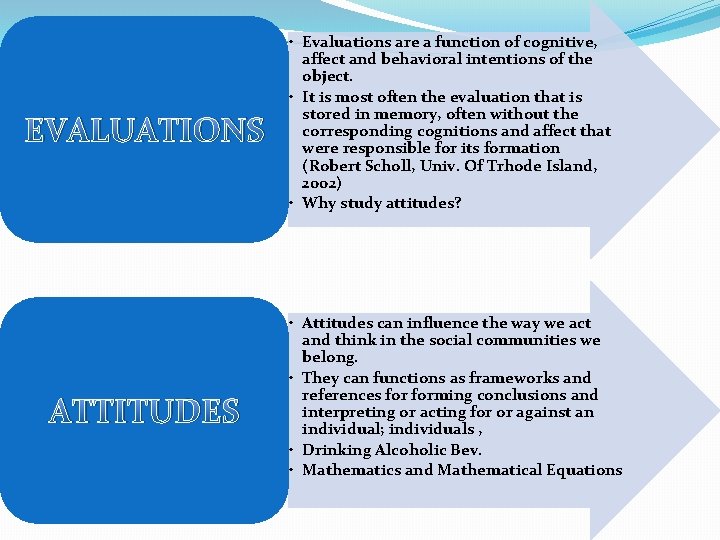
EVALUATIONS ATTITUDES • Evaluations are a function of cognitive, affect and behavioral intentions of the object. • It is most often the evaluation that is stored in memory, often without the corresponding cognitions and affect that were responsible for its formation (Robert Scholl, Univ. Of Trhode Island, 2002) • Why study attitudes? • Attitudes can influence the way we act and think in the social communities we belong. • They can functions as frameworks and references forming conclusions and interpreting or acting for or against an individual; individuals , • Drinking Alcoholic Bev. • Mathematics and Mathematical Equations
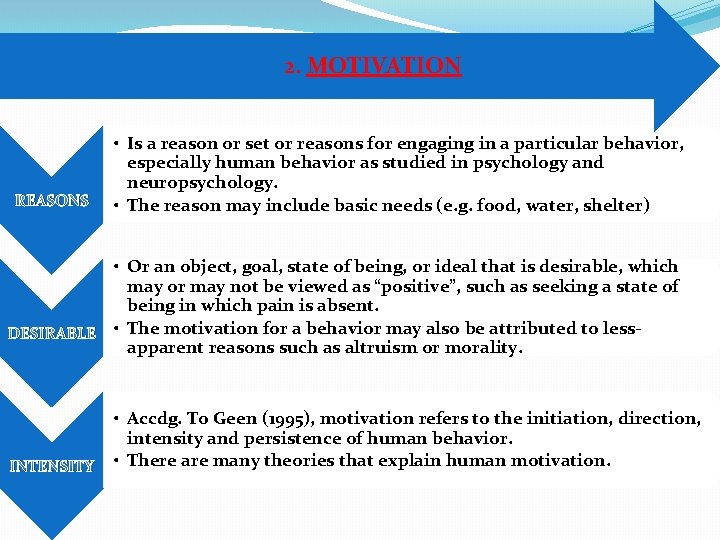
2. MOTIVATION REASONS • Is a reason or set or reasons for engaging in a particular behavior, especially human behavior as studied in psychology and neuropsychology. • The reason may include basic needs (e. g. food, water, shelter) • Or an object, goal, state of being, or ideal that is desirable, which may or may not be viewed as “positive”, such as seeking a state of being in which pain is absent. DESIRABLE • The motivation for a behavior may also be attributed to lessapparent reasons such as altruism or morality. INTENSITY • Accdg. To Geen (1995), motivation refers to the initiation, direction, intensity and persistence of human behavior. • There are many theories that explain human motivation.
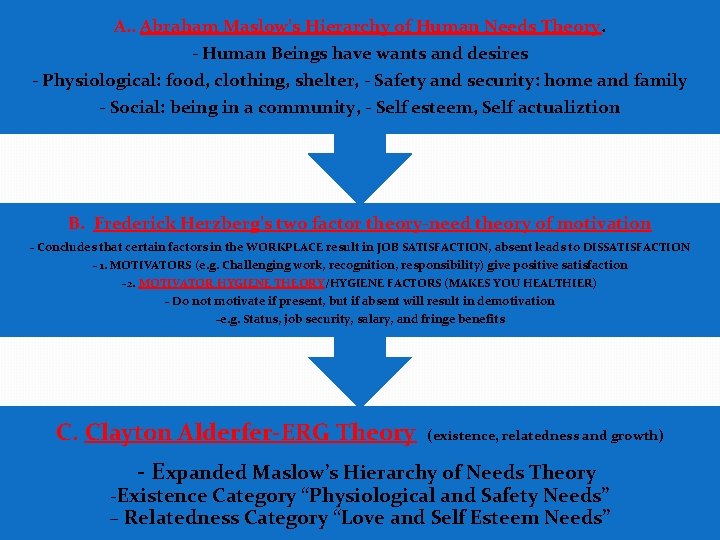
A. . Abraham Maslow’s Hierarchy of Human Needs Theory. - Human Beings have wants and desires - Physiological: food, clothing, shelter, - Safety and security: home and family - Social: being in a community, - Self esteem, Self actualiztion B. Frederick Herzberg’s two factor theory-need theory of motivation - Concludes that certain factors in the WORKPLACE result in JOB SATISFACTION, absent leads to DISSATISFACTION - 1. MOTIVATORS (e. g. Challenging work, recognition, responsibility) give positive satisfaction -2. MOTIVATOR HYGIENE THEORY/HYGIENE FACTORS (MAKES YOU HEALTHIER) - Do not motivate if present, but if absent will result in demotivation -e. g. Status, job security, salary, and fringe benefits C. Clayton Alderfer-ERG Theory (existence, relatedness and growth) - Expanded Maslow’s Hierarchy of Needs Theory -Existence Category “Physiological and Safety Needs” – Relatedness Category “Love and Self Esteem Needs”
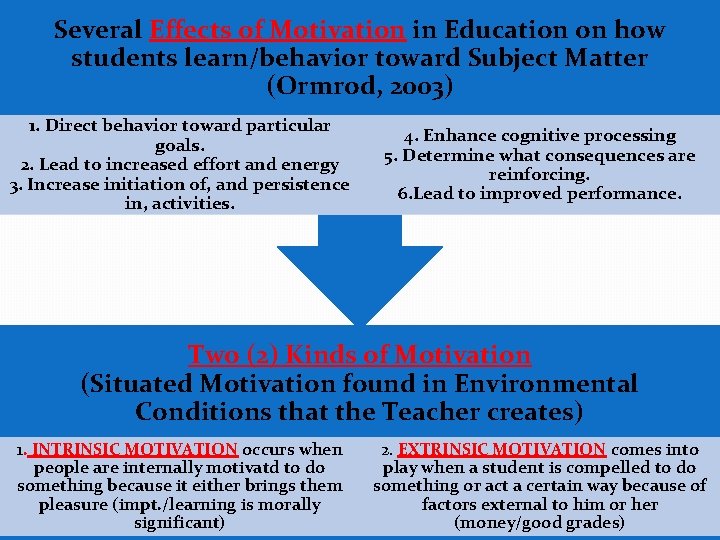
Several Effects of Motivation in Education on how students learn/behavior toward Subject Matter (Ormrod, 2003) 1. Direct behavior toward particular goals. 2. Lead to increased effort and energy 3. Increase initiation of, and persistence in, activities. 4. Enhance cognitive processing 5. Determine what consequences are reinforcing. 6. Lead to improved performance. Two (2) Kinds of Motivation (Situated Motivation found in Environmental Conditions that the Teacher creates) 1. INTRINSIC MOTIVATION occurs when people are internally motivatd to do something because it either brings them pleasure (impt. /learning is morally significant) 2. EXTRINSIC MOTIVATION comes into play when a student is compelled to do something or act a certain way because of factors external to him or her (money/good grades)
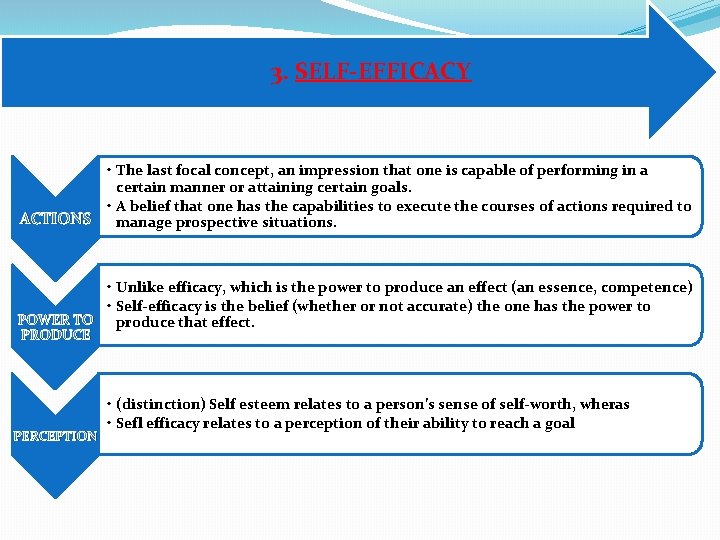
3. SELF-EFFICACY ACTIONS • The last focal concept, an impression that one is capable of performing in a certain manner or attaining certain goals. • A belief that one has the capabilities to execute the courses of actions required to manage prospective situations. • Unlike efficacy, which is the power to produce an effect (an essence, competence) • Self-efficacy is the belief (whether or not accurate) the one has the power to POWER TO produce that effect. PRODUCE PERCEPTION • (distinction) Self esteem relates to a person’s sense of self-worth, wheras • Sefl efficacy relates to a perception of their ability to reach a goal
Steps in Constructing Non-Cognitive Measures �Decide what information should be sought (1) No scales are available to measure such construct (2) All scales are foreign and it is not suitable for the stakeholders or sample that will take the measure (3) Existing measures are not appropriate for the purpose of assessment
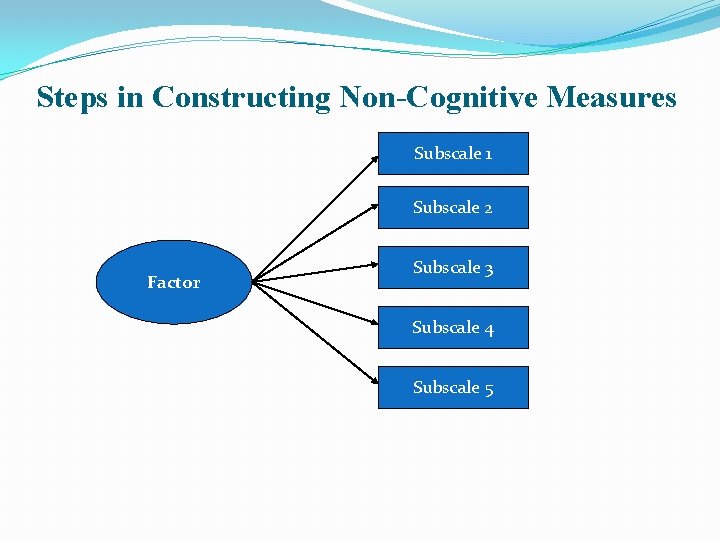
(4) The test developer intends to explore the underlying factors of a construct and eventually confirm it �Search for Content Domain: �Search for relevant literature reviews �Look for the appropriate definition �Explain theory �Specify the underlying variables (deconstruction)
Steps in Constructing Non-Cognitive Measures Subscale 1 Subscale 2 Factor Subscale 3 Subscale 4 Subscale 5
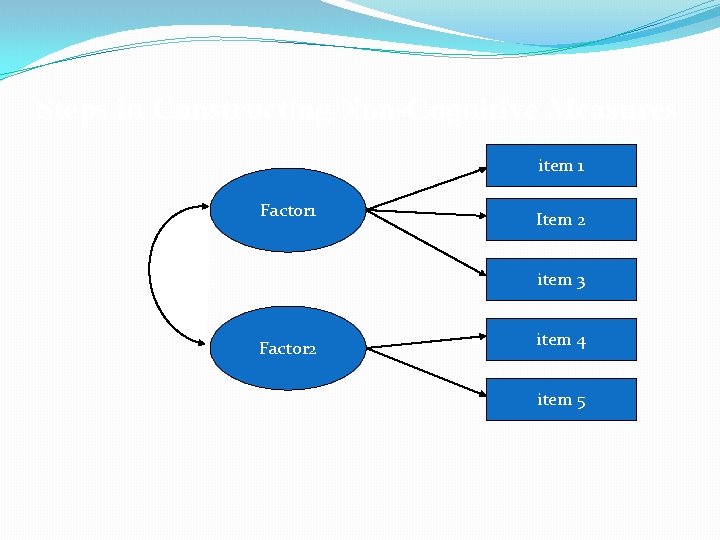
Steps in Constructing Non-Cognitive Measures item 1 Factor 1 Item 2 item 3 Factor 2 item 4 item 5
�Write the first draft of items: �Items are created for each subscale as guided by the conceptual definition. �The number of items as planned in the Table of Specifications is also considered. �As much as possible, a large number of items are written to represent well the behavior being measured.
�How to write Items: �Items are based on the definition of the subscales �Provide the manifestation of the construct �Descriptions from references �Conduct an open ended surveys, interview, FGD’s
Steps in Constructing Non-Cognitive Measures Good questionnaire items should: 1. Include a vocabulary that is simple, direct, and familiar to all respondents 2. Be clear and specific 3. Not involve leading, loaded or double barreled questions 4. Be as short as possible 5. Include all conditional information prior to the key ideas 6. Be edited for readability 7. Generalizable for a large sample. 8. Avoid time-bound situations.
Steps in Constructing Non-Cognitive Measures Example of bad items: �I am satisfied with my wages and hours at the place where I work. (Double Barreled) �I not in favor congress passing a law not allowing any employer to force any employee to retire at any age. (Double Negative) �Most people favor death penalty. What do you think? (Leading Question)
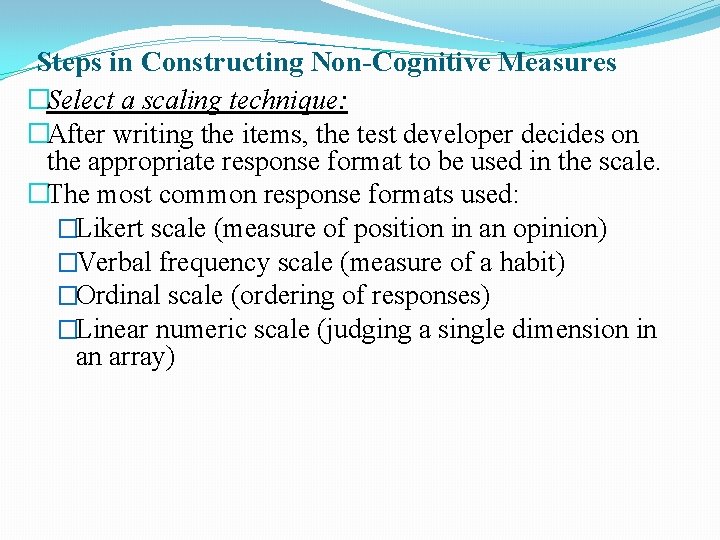
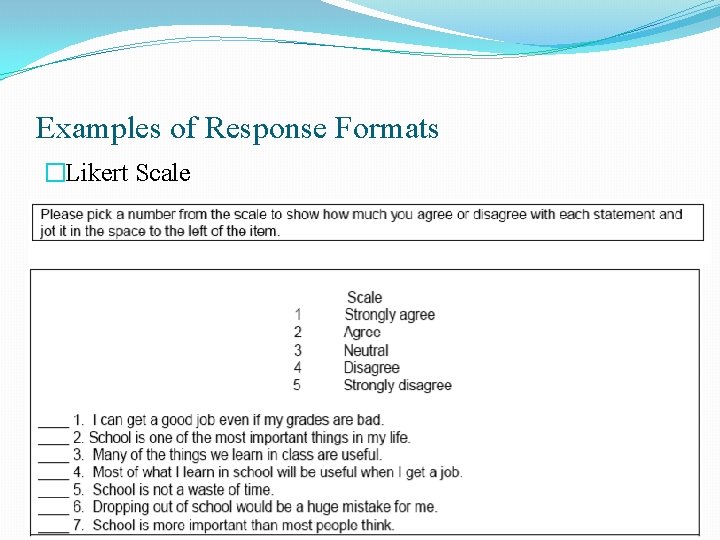
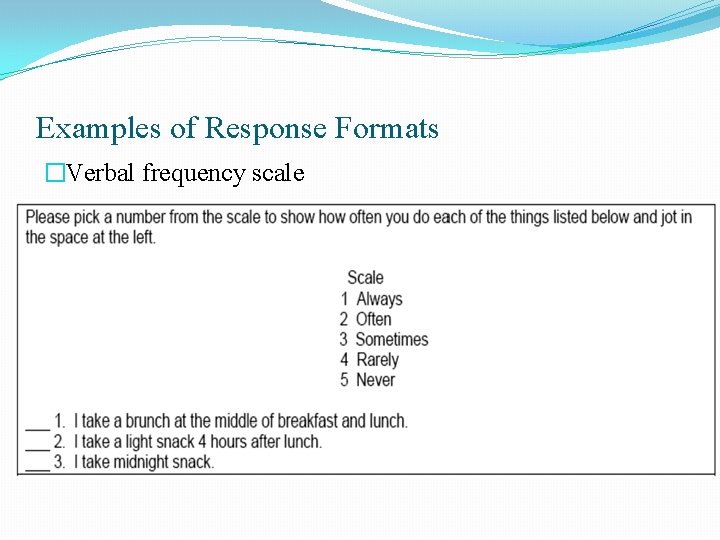
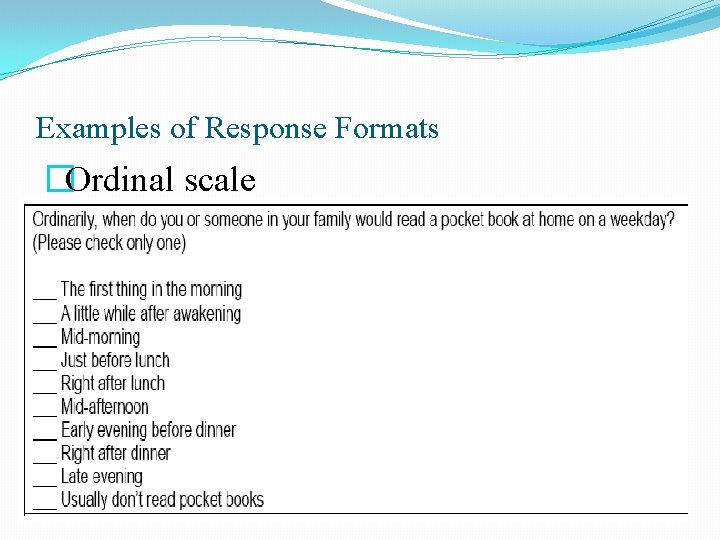
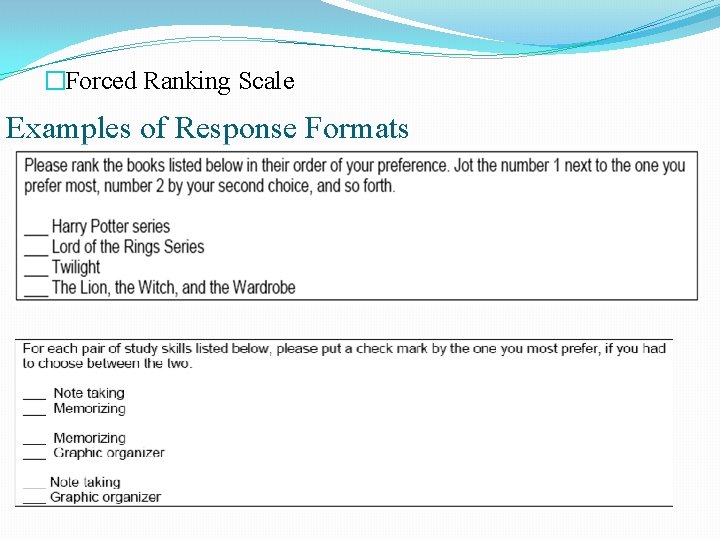
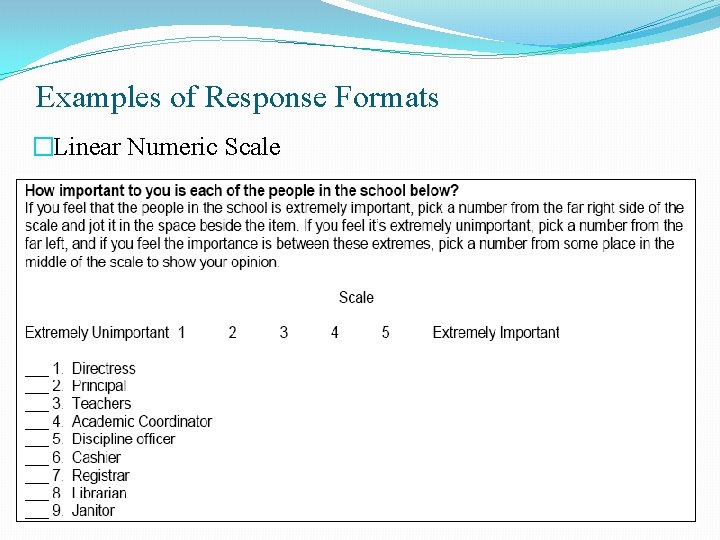
Steps in Constructing Non-Cognitive Measures �Select a scaling technique: �After writing the items, the test developer decides on the appropriate response format to be used in the scale. �The most common response formats used: �Likert scale (measure of position in an opinion) �Verbal frequency scale (measure of a habit) �Ordinal scale (ordering of responses) �Linear numeric scale (judging a single dimension in an array)
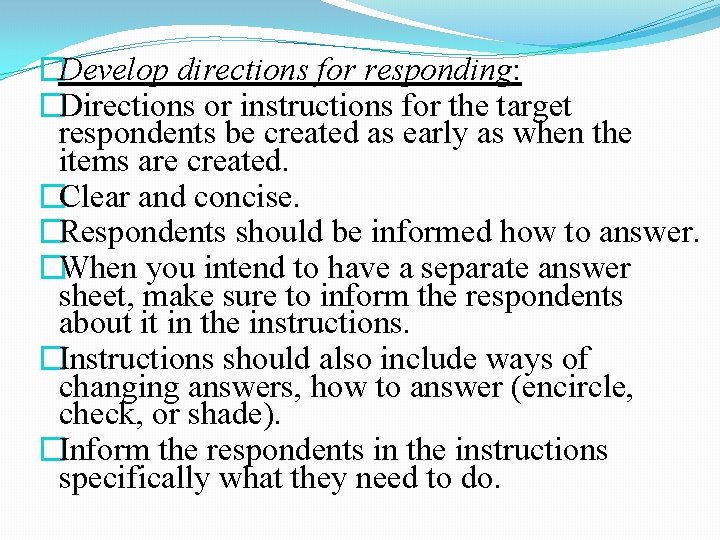
�Develop directions for responding: �Directions or instructions for the target respondents be created as early as when the items are created. �Clear and concise. �Respondents should be informed how to answer. �When you intend to have a separate answer sheet, make sure to inform the respondents about it in the instructions. �Instructions should also include ways of changing answers, how to answer (encircle, check, or shade). �Inform the respondents in the instructions specifically what they need to do.
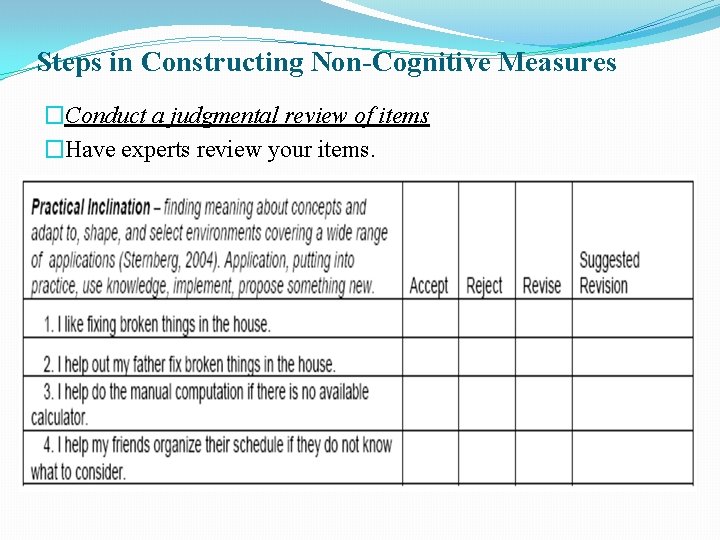
Steps in Constructing Non-Cognitive Measures �Conduct a judgmental review of items �Have experts review your items.
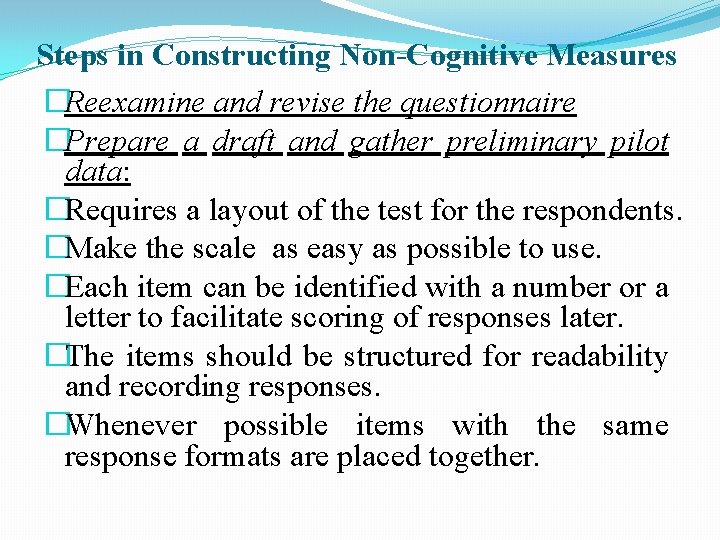
Steps in Constructing Non-Cognitive Measures �Reexamine and revise the questionnaire �Prepare a draft and gather preliminary pilot data: �Requires a layout of the test for the respondents. �Make the scale as easy as possible to use. �Each item can be identified with a number or a letter to facilitate scoring of responses later. �The items should be structured for readability and recording responses. �Whenever possible items with the same response formats are placed together.
�In designing self-administered scales, it is suggested to make it visually appealing to increase response rate. �Self-explanatory and the respondents can complete it in a short time. �Ordering of items: The first few questions set the tone for the rest of the items and determine how willingly and conscientiously respondents will work on subsequent questions.
Steps in Constructing Non-Cognitive Measures �Analyze Pilot data: �The responses in the scale should be recorded using a spreadsheet. �The numerical responses are then analyzed. �The analysis consists of determining whether the test is reliable or valid. �Revise the Instrument: �The instrument is then revised because items with low factor loadings are removed �Items when removed will increase Cronbach’s alpha.
Steps in Constructing Non-Cognitive Measures �Gather final pilot data �A large sample is again selected which is three times the number of items. �Conduct Additional Validity and Reliability Analysis �The validity and reliability is again analyzed using the new pilot data. �Edit the questionnaire and specify the procedures for its use �Items with low factor loadings are again removed resulting to less items. �A new form of the test with reduced items will be formed. �Prepare the Test Manual �The test manual indicates the purpose of the test, instructions in administering, procedure for scoring, interpreting the scores including the norms.
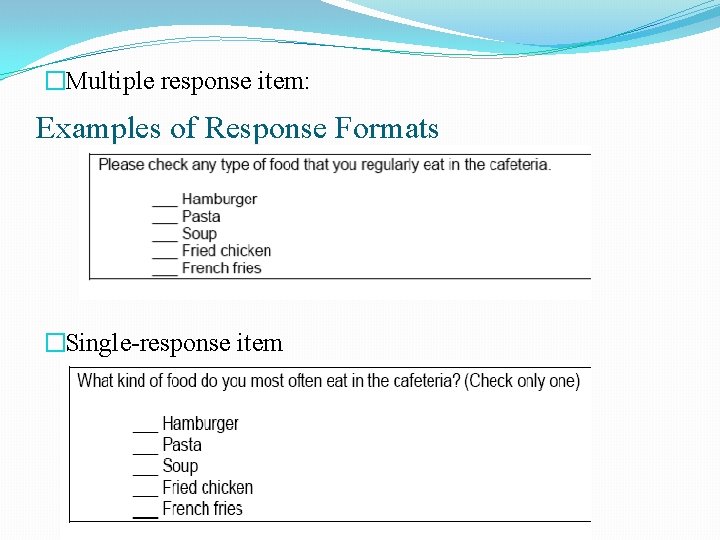
�Multiple response item: Examples of Response Formats �Single-response item
Examples of Response Formats �Likert Scale
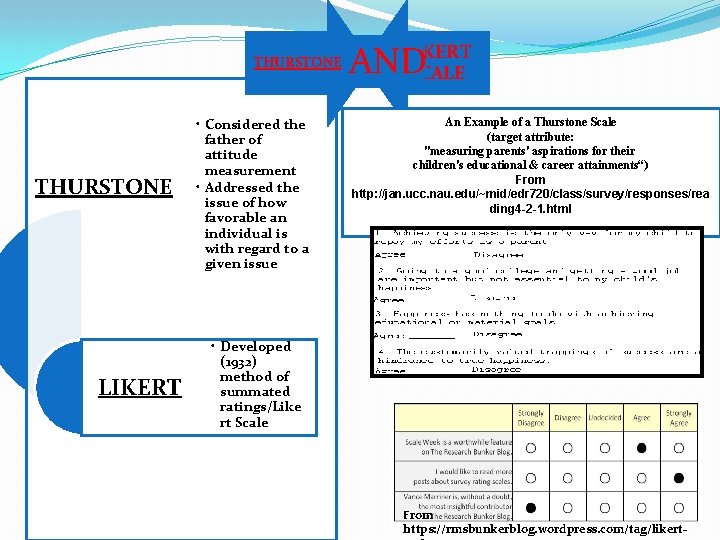
THURSTONE LIKERT • Considered the father of attitude measurement • Addressed the issue of how favorable an individual is with regard to a given issue AND LIKERT SCALE An Example of a Thurstone Scale (target attribute: "measuring parents' aspirations for their children's educational & career attainments“) From http: //jan. ucc. nau. edu/~mid/edr 720/class/survey/responses/rea ding 4 -2 -1. html • Developed (1932) method of summated ratings/Like rt Scale From https: //rmsbunkerblog. wordpress. com/tag/likert-
Examples of Response Formats �Verbal frequency scale
Examples of Response Formats �Ordinal scale
�Forced Ranking Scale Examples of Response Formats �Paired Comparison Scale
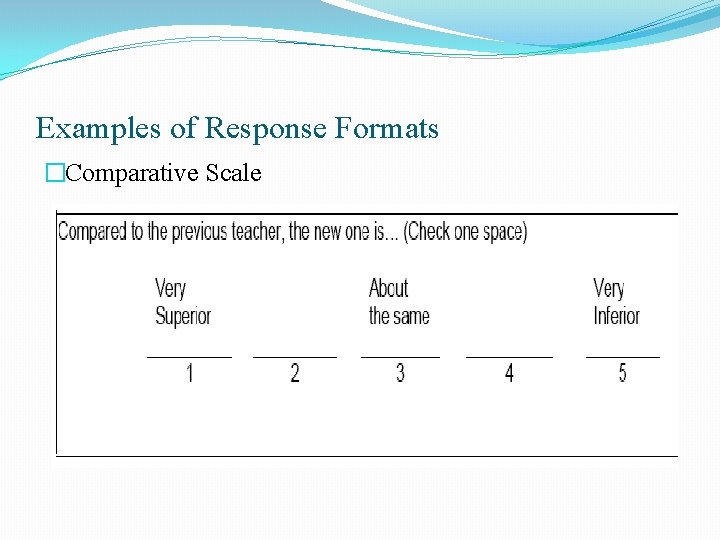
Examples of Response Formats �Comparative Scale
Examples of Response Formats �Linear Numeric Scale
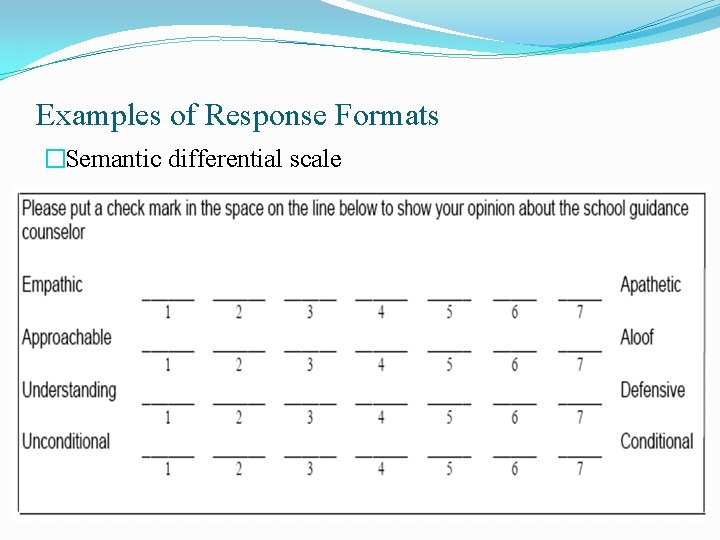
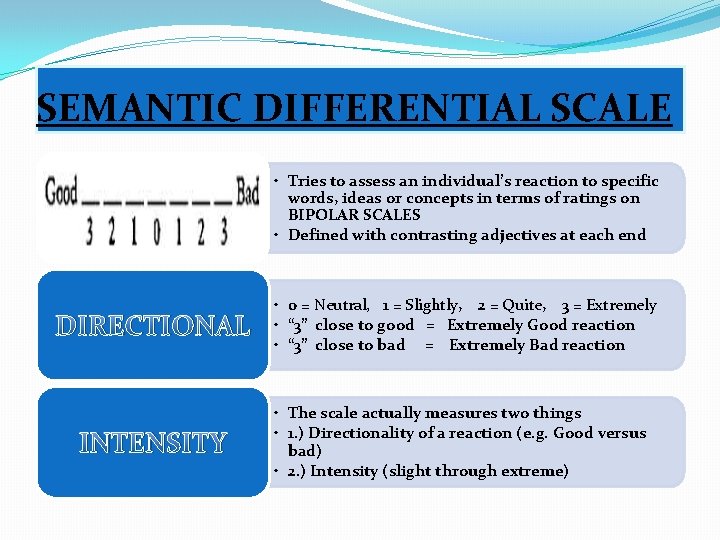
Examples of Response Formats �Semantic differential scale
SEMANTIC DIFFERENTIAL SCALE • Tries to assess an individual’s reaction to specific words, ideas or concepts in terms of ratings on BIPOLAR SCALES • Defined with contrasting adjectives at each end DIRECTIONAL INTENSITY • 0 = Neutral, 1 = Slightly, 2 = Quite, 3 = Extremely • “ 3” close to good = Extremely Good reaction • “ 3” close to bad = Extremely Bad reaction • The scale actually measures two things • 1. ) Directionality of a reaction (e. g. Good versus bad) • 2. ) Intensity (slight through extreme)
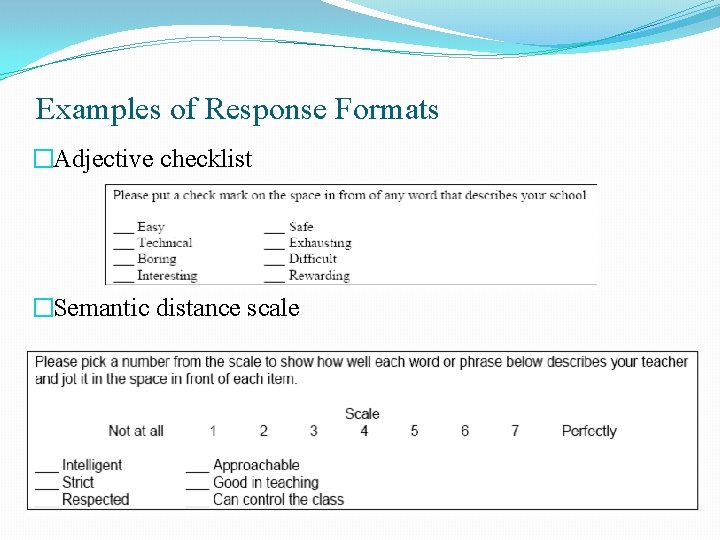
Examples of Response Formats �Adjective checklist �Semantic distance scale
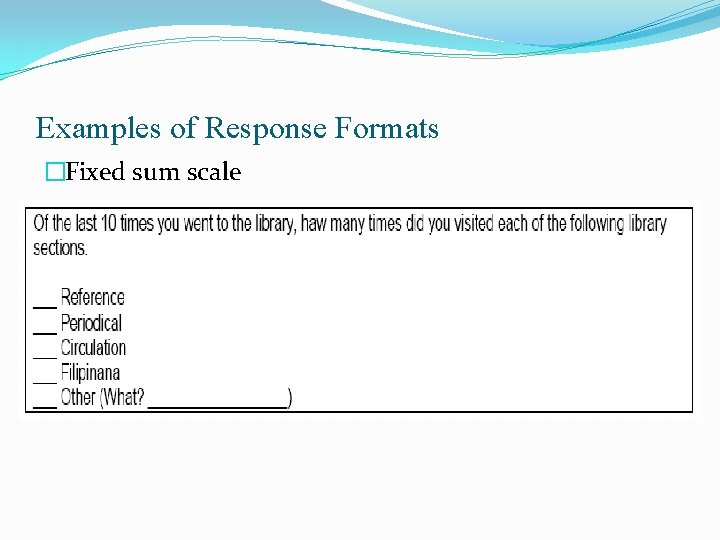
Examples of Response Formats �Fixed sum scale
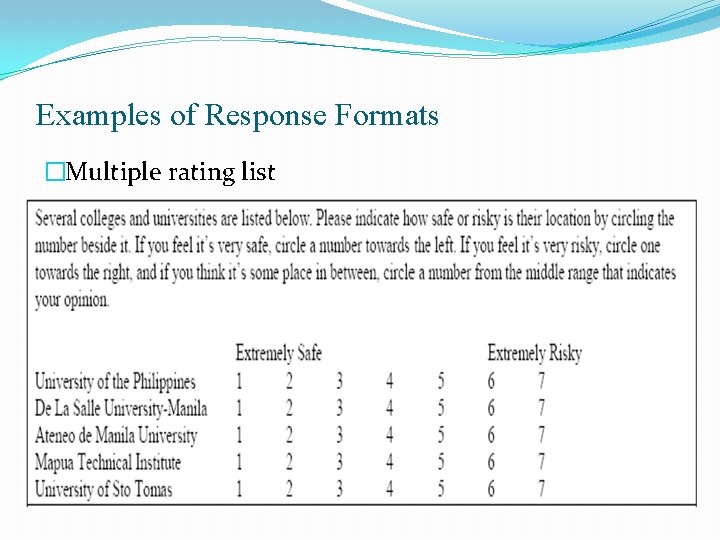
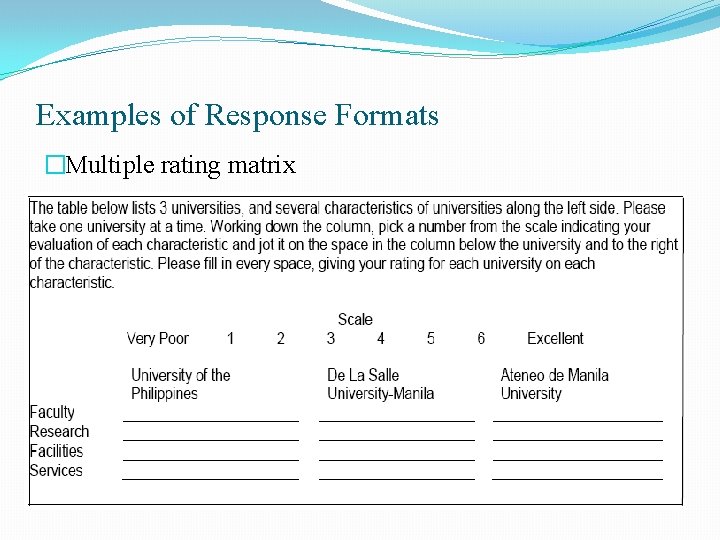
Examples of Response Formats �Multiple rating list
Examples of Response Formats �Multiple rating matrix
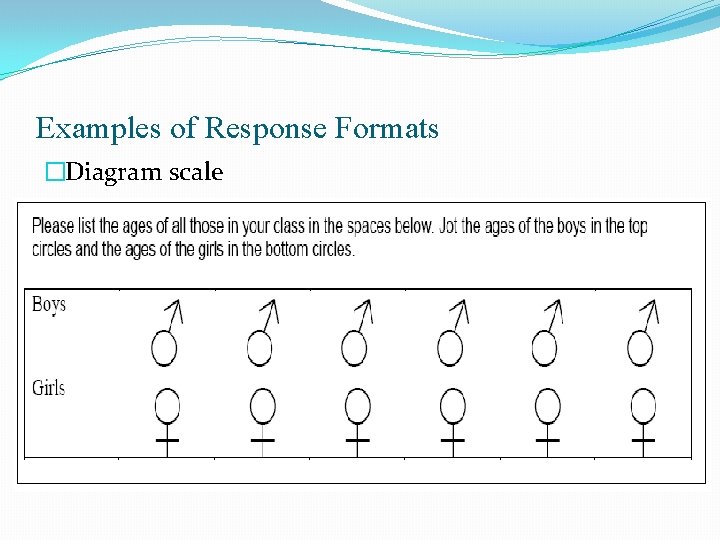
Examples of Response Formats �Diagram scale
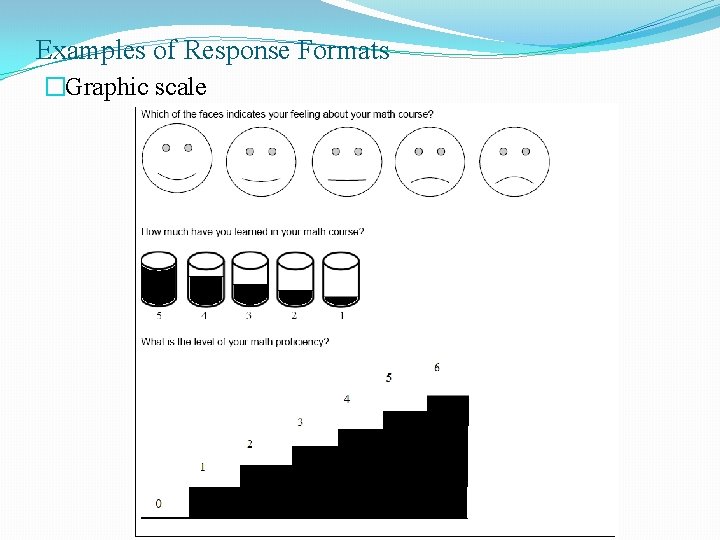
Examples of Response Formats �Graphic scale
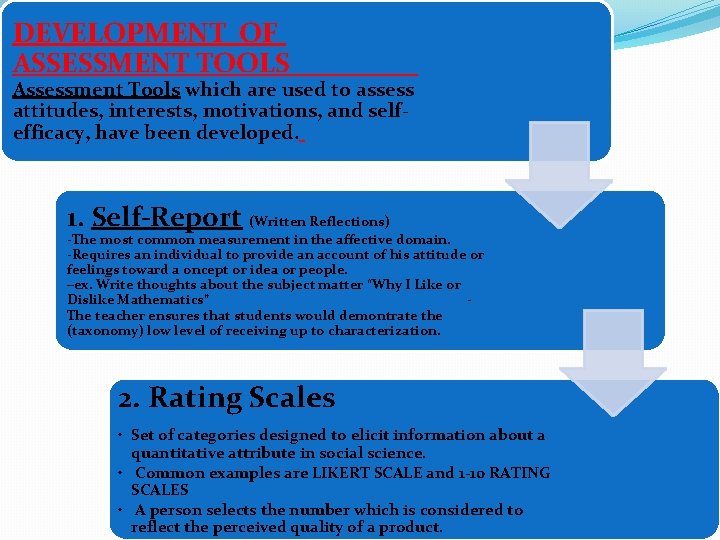
DEVELOPMENT OF ASSESSMENT TOOLS Assessment Tools which are used to assess attitudes, interests, motivations, and selfefficacy, have been developed. 1. Self-Report (Written Reflections) -The most common measurement in the affective domain. -Requires an individual to provide an account of his attitude or feelings toward a oncept or idea or people. –ex. Write thoughts about the subject matter “Why I Like or Dislike Mathematics” The teacher ensures that students would demontrate the (taxonomy) low level of receiving up to characterization. 2. Rating Scales • Set of categories designed to elicit information about a quantitative attribute in social science. • Common examples are LIKERT SCALE and 1 -10 RATING SCALES • A person selects the number which is considered to reflect the perceived quality of a product.
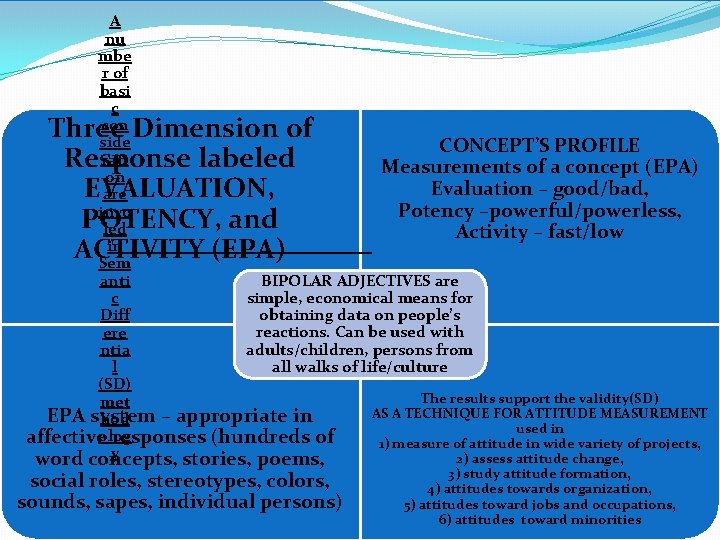
A nu mbe r of basi c con side CONCEPT’S PROFILE rati Measurements of a concept (EPA) on Evaluation – good/bad, are invo Potency –powerful/powerless, led Activity – fast/low in Sem BIPOLAR ADJECTIVES are anti simple, economical means for c obtaining data on people’s Diff reactions. Can be used with ere adults/children, persons from ntia all walks of life/culture l (SD) The results support the validity(SD) met AS A TECHNIQUE FOR ATTITUDE MEASUREMENT EPA system – appropriate in hod used in affectiveolog responses (hundreds of 1) measure of attitude in wide variety of projects, y 2) assess attitude change, word concepts, stories, poems, Three Dimension of Response labeled EVALUATION, POTENCY, and ACTIVITY (EPA) social roles, stereotypes, colors, sounds, sapes, individual persons) 3) study attitude formation, 4) attitudes towards organization, 5) attitudes toward jobs and occupations, 6) attitudes toward minorities
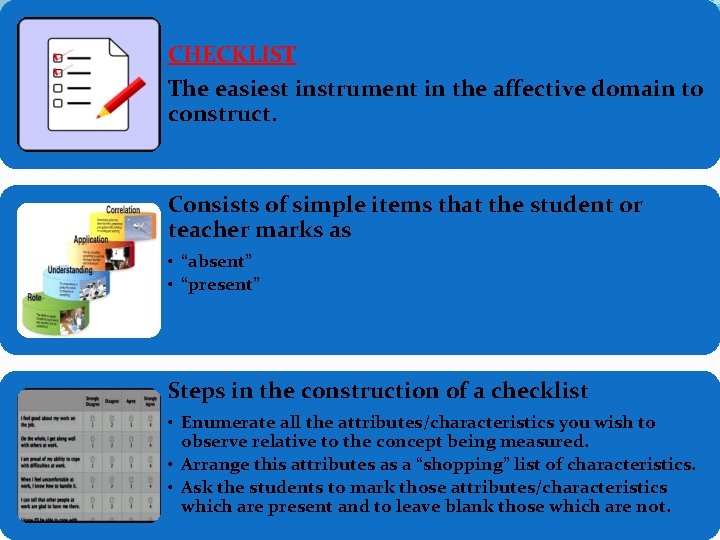
CHECKLIST The easiest instrument in the affective domain to construct. Consists of simple items that the student or teacher marks as • “absent” • “present” Steps in the construction of a checklist • Enumerate all the attributes/characteristics you wish to observe relative to the concept being measured. • Arrange this attributes as a “shopping” list of characteristics. • Ask the students to mark those attributes/characteristics which are present and to leave blank those which are not.
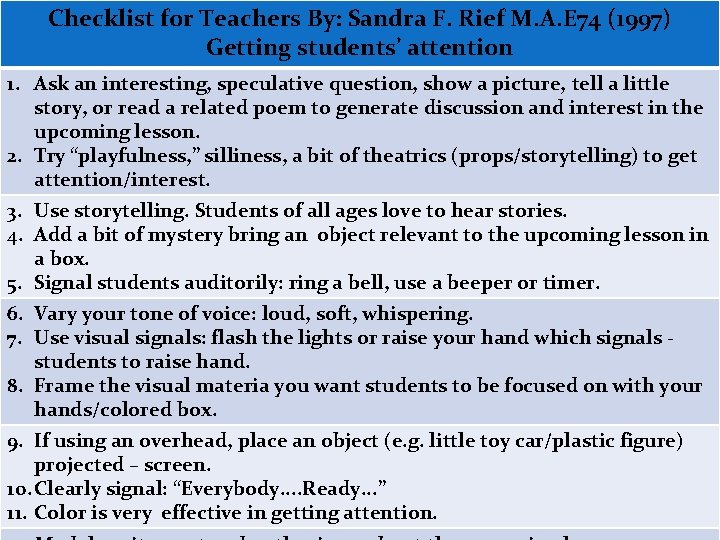
Checklist for Teachers By: Sandra F. Rief M. A. E 74 (1997) Getting students’ attention 1. Ask an interesting, speculative question, show a picture, tell a little story, or read a related poem to generate discussion and interest in the upcoming lesson. 2. Try “playfulness, ” silliness, a bit of theatrics (props/storytelling) to get attention/interest. 3. Use storytelling. Students of all ages love to hear stories. 4. Add a bit of mystery bring an object relevant to the upcoming lesson in a box. 5. Signal students auditorily: ring a bell, use a beeper or timer. 6. Vary your tone of voice: loud, soft, whispering. 7. Use visual signals: flash the lights or raise your hand which signals students to raise hand. 8. Frame the visual materia you want students to be focused on with your hands/colored box. 9. If using an overhead, place an object (e. g. little toy car/plastic figure) projected – screen. 10. Clearly signal: “Everybody. . Ready. . . ” 11. Color is very effective in getting attention.
References � Santos, Rosita De Guzman Ph. D. 2007. Advanced Methods in Educational Assessment and Evaluation Assessment of Learning 2 � PICTURES � Retrieved October 14 2014 http: //leanlearning. wikispaces. com/instructional_design � Retrieved October 14, 2014 http: //serc. carleton. edu/NAGTWorkshops/affective/index. html � Retrieved October 14, 2014 http: //www. theknowledgeguru. com/serious-games-work-large-enterprise/ � Retrieved October 14, 2014 http: //educatingpreschool. blogspot. com/2011/03/affective-domain. html � Retrieved October 14, 2014 http: //www. slideshare. net/gabriellavillafranca 3/assessment-in-affective-domain � Retrieved October 18, 2014 http: //norahcolvin. com/tag/maslow/ � Retrieved October 18, 2014 http: //aviationmentor. blogspot. com/2011_03_01_archive. html � Retrieved October 18, 2014 http: //logcero. blogspot. com/2014/01/assessment-tools-in-affective-domain. html