
Non Specific Binding NSB in AntigenAntibody Assays Chem
Non Specific Binding (NSB) in Antigen-Antibody Assays Chem 395 Spring 2007 Instructor : Dr. James Rusling Presenter : Bhaskara V. Chikkaveeraiah
OUTLINE • Immunoassays Introduction • Factors contributing to Non-specific binding (NSB) • NSB Blocking agents • Minimizing NSB • NSB in Immunoassay.
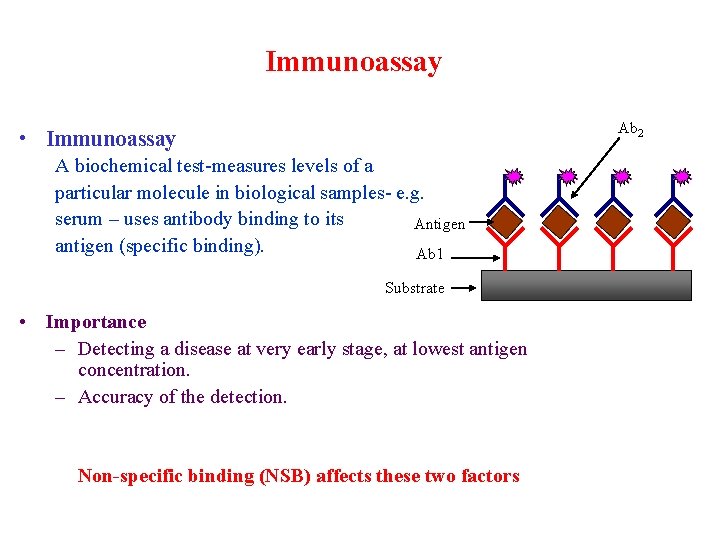
Immunoassay Ab 2 • Immunoassay A biochemical test-measures levels of a particular molecule in biological samples- e. g. serum – uses antibody binding to its Antigen antigen (specific binding). Ab 1 Substrate • Importance – Detecting a disease at very early stage, at lowest antigen concentration. – Accuracy of the detection. Non-specific binding (NSB) affects these two factors
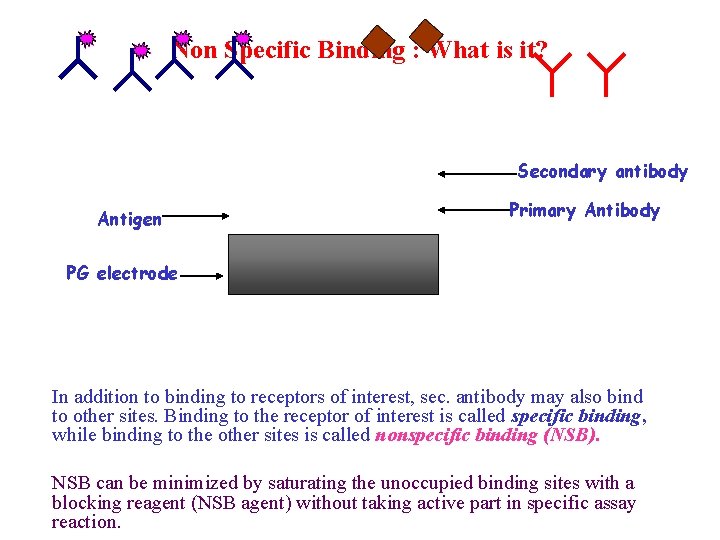
Non Specific Binding : What is it? Secondary antibody Antigen Primary Antibody PG electrode In addition to binding to receptors of interest, sec. antibody may also bind to other sites. Binding to the receptor of interest is called specific binding, while binding to the other sites is called nonspecific binding (NSB). NSB can be minimized by saturating the unoccupied binding sites with a blocking reagent (NSB agent) without taking active part in specific assay reaction.

Immunoassay without NSB blocking agent Enzyme labelled Secondary antibody Primary Antibody Antigen PG electrode I Voltage+H 2 O 2 Signal t
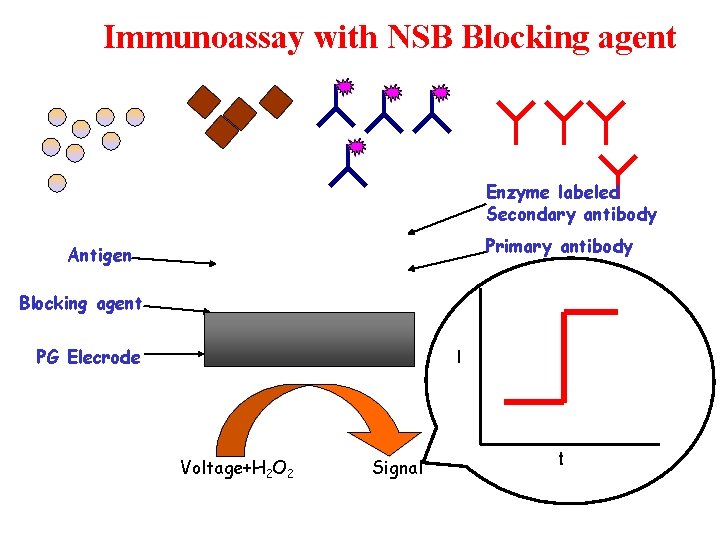
Immunoassay with NSB Blocking agent Enzyme labeled Secondary antibody Primary antibody Antigen Blocking agent PG Elecrode I Voltage+H 2 O 2 Signal t
Properties of the blocking agent. • Inhibit NSB (passive or covalent) of assay components to the surface, • Inhibit non-specific protein - protein interaction. • Exhibit no cross reactivity with subsequent assay components antibodies, protein ) • Not disrupt the bonds that immobilize the specific protein or biomolecule to the surface. • Exhibit consistent, reproducible performance with every lot. (
Blocking agents – Detergent Blockers • Tween-20, Triton X-100 – Protein Blockers • Bovine serum albumin, Casein, Fish Gelatin, Whole Sera, – Polymer based Blockers • Polyethylene glycol (PEG), Polyvinyl alcohol (PVA), Polyvinylpyrrolidone (PVP), Polyacrylic acid (PAA), Polyacrylic maleic acid (PAMA).
Detergent Blockers – Disrupt ionic and hydrophobic biomolecule-surface bonds. – Inhibits enzyme-substrate reactions. – Inexpensive, – stable, can be stored at room temperature ( wash buffers) – strips off loosely bound molecules in wash steps. – 0. 01 – 0. 10% is commonly used.
Protein Blockers • Blocks the non occupied sites on the surface. • Space out and stabilize biomolecules bound to the surface to reduce the steric hindrance. • Bovine serum albumin (BSA) – Widely used, Inexpensive, blocks non specific protein-surface binding. ~1 – 3% ic commonly used. • Fish Gelatin – Mainly blocks protein-protein(Ab 1 -Ab 2) interactions • Whole sera – Blocks biomolecule-surface passive, covalent interactions, protein interactions, and acts as protein stabilizer.
Factors affecting NSB • Ab 1 / Ab 2 ratio ( ~ 500: 1) • Type of blocking agent used. – Bovine serum albumin, Casein, etc. • Washing steps – Consistent and vigorous.

PSMA Immunoassay (Prostate Specific Membrane Antigen) HRP labeled anti-PSMA 1 anti-PSMA 2 PSMA Blocking agent I SWCNT PG Electrode t Voltage+H 2 O 2 Signal
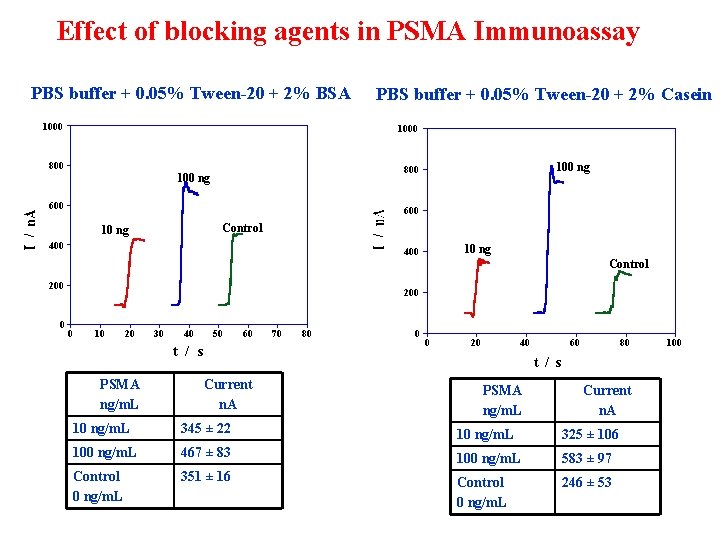
Effect of blocking agents in PSMA Immunoassay PBS buffer + 0. 05% Tween-20 + 2% BSA 1000 PBS buffer + 0. 05% Tween-20 + 2% Casein 1000 800 100 ng 600 Control 10 ng 400 Control 200 0 10 20 30 40 50 60 t / s PSMA ng/m. L 70 80 0 0 20 40 60 80 t / s Current n. A PSMA ng/m. L Current n. A 10 ng/m. L 345 ± 22 10 ng/m. L 325 ± 106 100 ng/m. L 467 ± 83 100 ng/m. L 583 ± 97 Control 0 ng/m. L 351 ± 16 Control 0 ng/m. L 246 ± 53 100
Reduction of the Nonspecific Binding of a Target Antibody and of Its Enzyme-Labeled Detection Probe Enabling Electrochemical Immunoassay of Antibody through the 7 pg/m. L – 100 ng/m. L (40 f. M - 400 p. M) Range Yongchao Zhang and Adam Heller* Department of Chemical Engineering and Texas Materials Institute University of Texas at Austin. Anal. Chem. 2005, 7758 - 7762
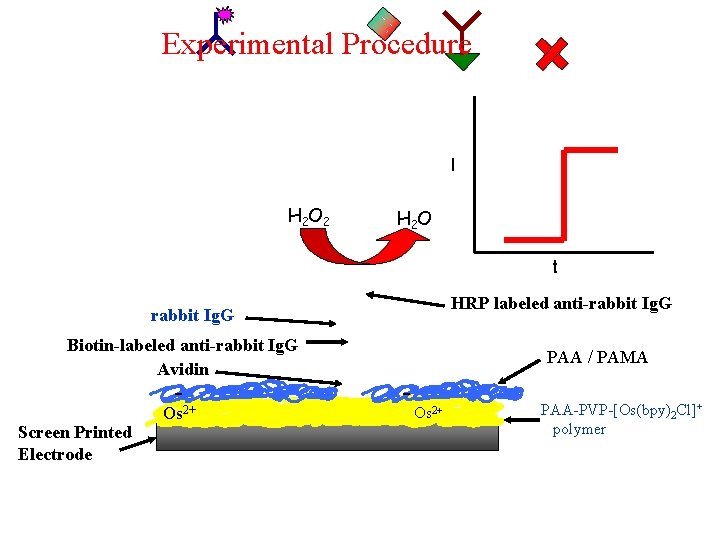
Experimental Procedure I H 2 O 2 H 2 O t HRP labeled anti-rabbit Ig. G Biotin-labeled anti-rabbit Ig. G Avidin - Screen Printed Electrode Os 2+ PAA / PAMA Os 2+ PAA-PVP-[Os(bpy)2 Cl]+ polymer
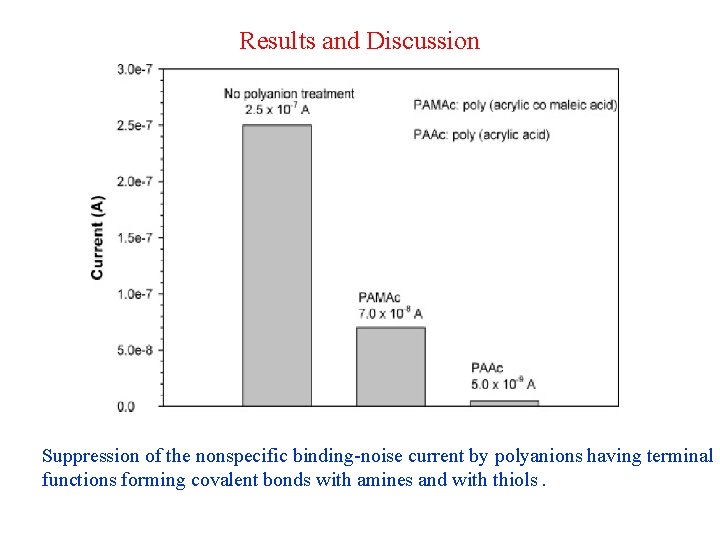
Results and Discussion Suppression of the nonspecific binding-noise current by polyanions having terminal functions forming covalent bonds with amines and with thiols.
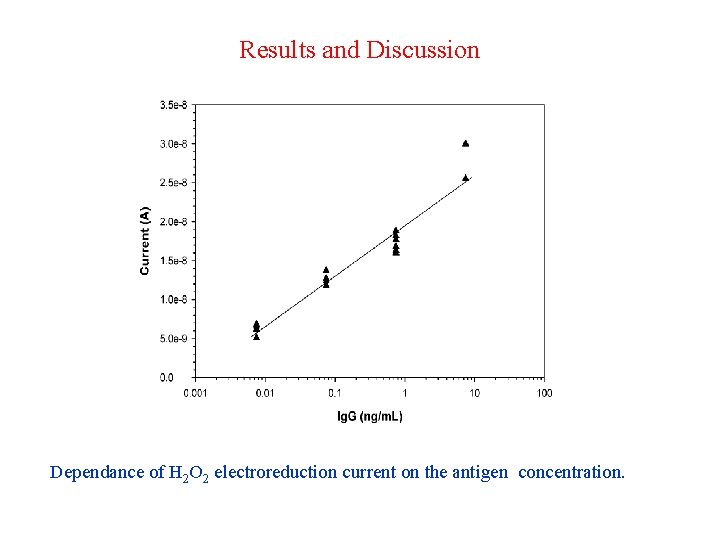
Results and Discussion Dependance of H 2 O 2 electroreduction current on the antigen concentration.
Summary • Selection of appropriate blocking system is essential for the development of a specific and sensitive assay. • Empirical testing is required to both choose and optimize the blocking procedure and is influenced by the surface chemistry.
Acknowledgements • Dr. Rusling • Chem 395 Class
- Slides: 19