
NON LINEAR NONLINEAR OPTICS Presented By Gaurav C
NON LINEAR NON-LINEAR OPTICS Presented By: Gaurav C Josan Department - EE Department-EE
TOPICS n n n n Linear optics vs. Non-linear optics Importance of Non-linear optics Linear & Non-linear polarization. Phenomenon associated with NLO Materials applied in NLO Applications Future
MILESTONES n n n 1961 – Discovery of Optical second harmonic generation. 1962 – Discovery of Stimulated Raman scattering. 1964 – Stimulated Brilloium scattering. It is now an efficient technique to generate or amplify coherent optical radiation with small frequency shift.
Linear Optics vs Non Linear Optics n Linear optics- ‘Optics of weak light’: Light is deflected or delayed but its frequency is unchanged. n Non-Linear optics-‘Optics of intense light’: We are concerned with the effects that light itself induces as it propagates through the medium.
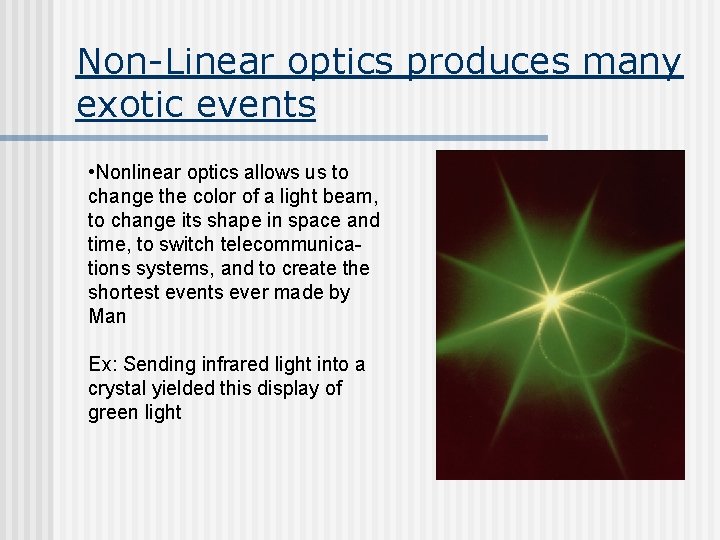
Non-Linear optics produces many exotic events • Nonlinear optics allows us to change the color of a light beam, to change its shape in space and time, to switch telecommunications systems, and to create the shortest events ever made by Man Ex: Sending infrared light into a crystal yielded this display of green light
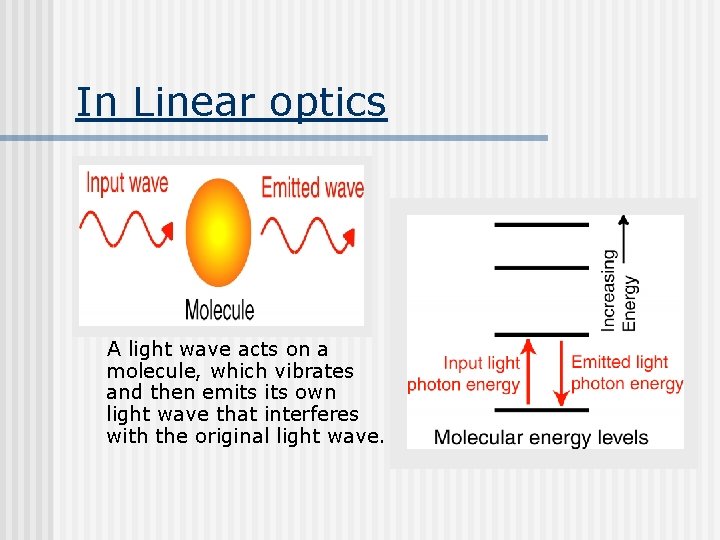
In Linear optics A light wave acts on a molecule, which vibrates and then emits own light wave that interferes with the original light wave.
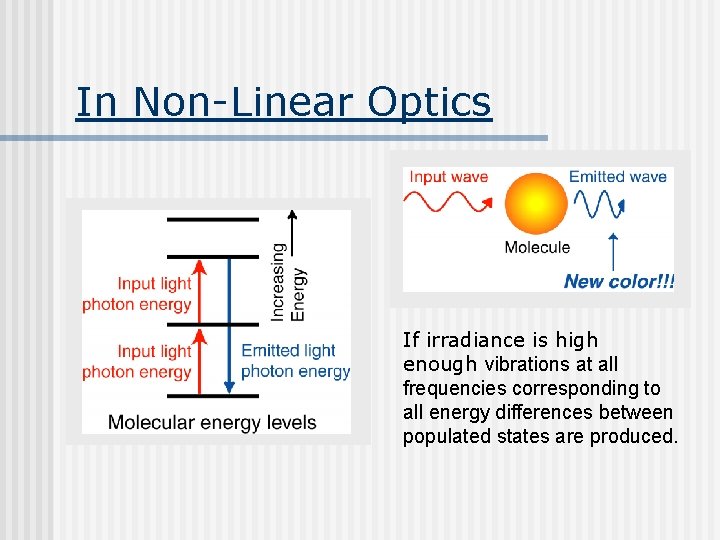
In Non-Linear Optics If irradiance is high enough vibrations at all frequencies corresponding to all energy differences between populated states are produced.
Importance of ‘NLO’ n n Optical wave manipulation is one of the future technologies for optical processing. It has various applications in fiber-optic communications and optoelectronics which makes it an increasingly important topic among electrical engineers.

Polarization n Linear n n Non-linear P: induced polarization of medium e 0: dielectric constant of vacuum E: electric field c(i): succeptibilities of ‘i’ order.
Phenomenon Associated With Non -linear Optics n n n Second harmonic generation. Sum frequency generation. Difference frequency generation. Optical parameter amplification. ‘N’ wave mixing.
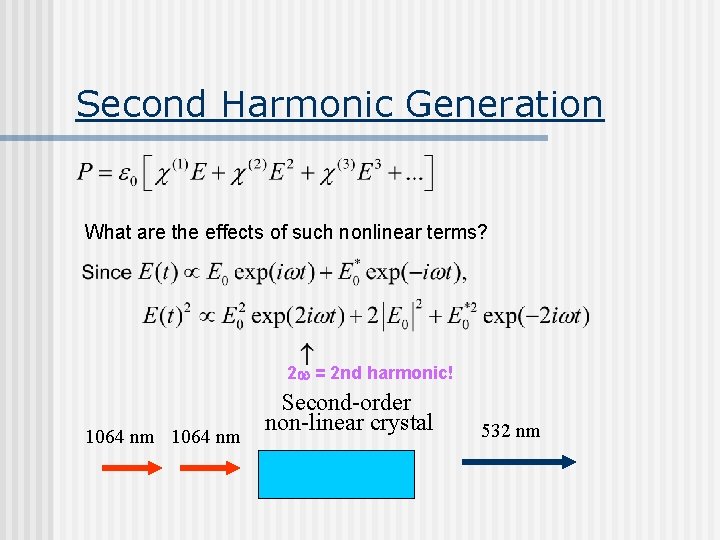
Second Harmonic Generation What are the effects of such nonlinear terms? 2 w = 2 nd harmonic! 1064 nm Second-order non-linear crystal 532 nm
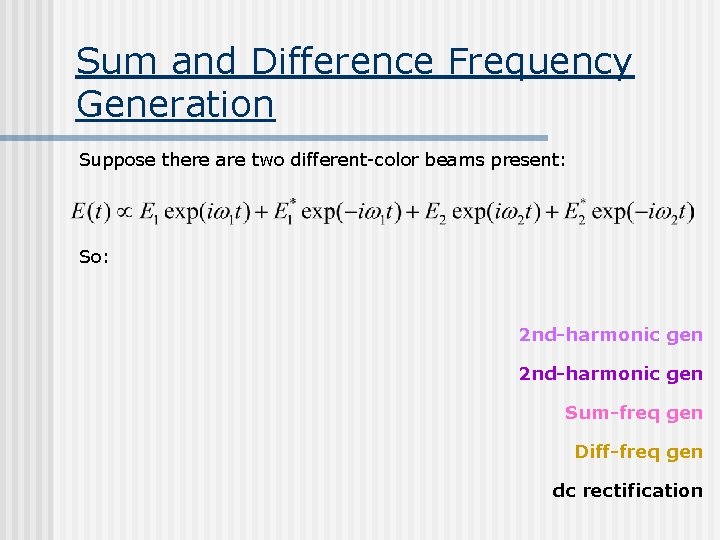
Sum and Difference Frequency Generation Suppose there are two different-color beams present: So: 2 nd-harmonic gen Sum-freq gen Diff-freq gen dc rectification
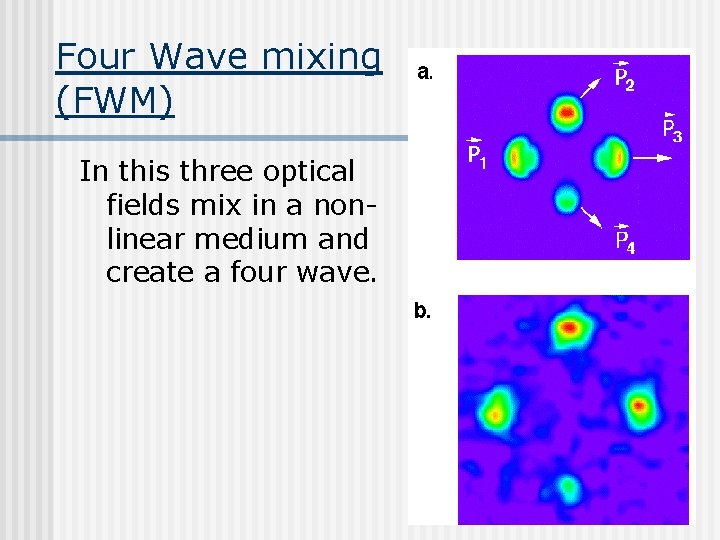
Four Wave mixing (FWM) In this three optical fields mix in a nonlinear medium and create a four wave.
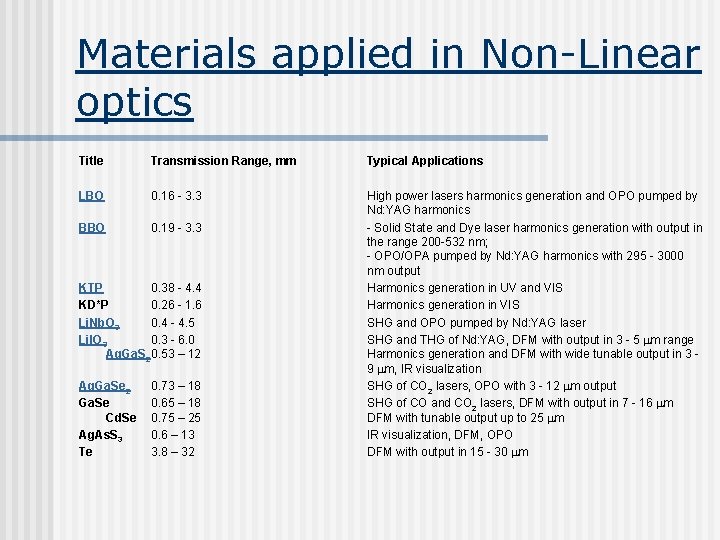
Materials applied in Non-Linear optics Title Transmission Range, mm Typical Applications LBO 0. 16 - 3. 3 BBO 0. 19 - 3. 3 High power lasers harmonics generation and OPO pumped by Nd: YAG harmonics - Solid State and Dye laser harmonics generation with output in the range 200 -532 nm; - OPO/OPA pumped by Nd: YAG harmonics with 295 - 3000 nm output Harmonics generation in UV and VIS Harmonics generation in VIS SHG and OPO pumped by Nd: YAG laser SHG and THG of Nd: YAG, DFM with output in 3 - 5 mm range Harmonics generation and DFM with wide tunable output in 3 9 mm, IR visualization SHG of CO 2 lasers, OPO with 3 - 12 mm output SHG of CO and CO 2 lasers, DFM with output in 7 - 16 mm DFM with tunable output up to 25 mm IR visualization, DFM, OPO DFM with output in 15 - 30 mm KTP 0. 38 - 4. 4 KD*P 0. 26 - 1. 6 Li. Nb. O 3 0. 4 - 4. 5 Li. IO 3 0. 3 - 6. 0 Ag. Ga. S 2 0. 53 – 12 Ag. Ga. Se 2 Ga. Se Cd. Se Ag. As. S 3 Te 0. 73 – 18 0. 65 – 18 0. 75 – 25 0. 6 – 13 3. 8 – 32
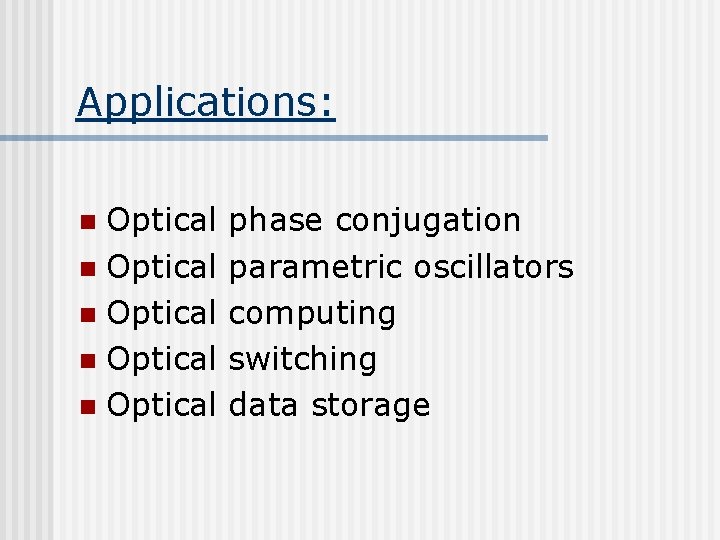
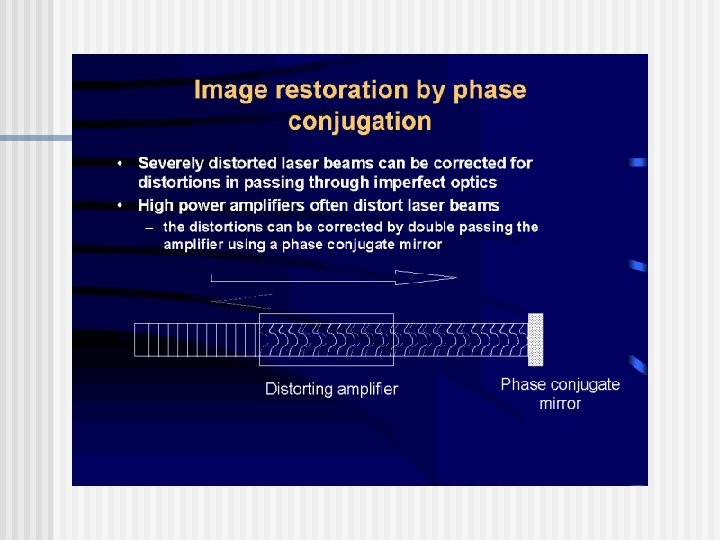
Applications: Optical n Optical n phase conjugation parametric oscillators computing switching data storage
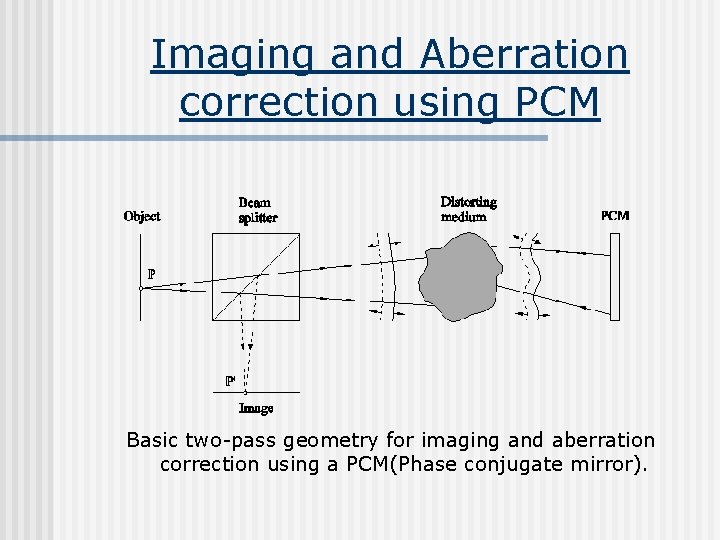
Imaging and Aberration correction using PCM Basic two-pass geometry for imaging and aberration correction using a PCM(Phase conjugate mirror).
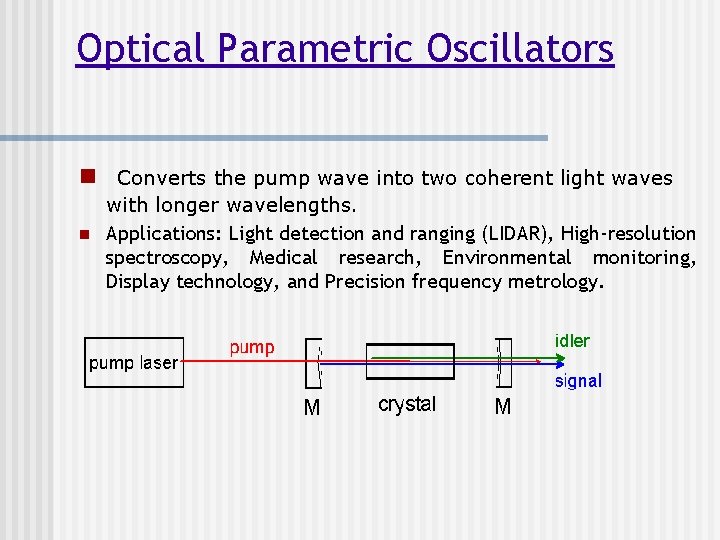
Optical Parametric Oscillators n Converts the pump wave into two coherent light waves n with longer wavelengths. Applications: Light detection and ranging (LIDAR), High-resolution spectroscopy, Medical research, Environmental monitoring, Display technology, and Precision frequency metrology.
Optical Computing n n Optical Techniques can provide a number of ways of extending the information processing capability of electronics. Large quantities of data can be generated from different resources and powerful computer is required to process them. Just electronics are not enough for this and therefore OPTICS can provide some solutions. Digital Optical computer requires the use of nonlinear optics.
Future Scope n n n The field of Nonlinear Optics today has grown into a vast enterprise with a considerable potential for technological applications. The nonlinear optical (NLO) materials needed for optimized components , however, have not yet been realized. New nonlinear optical materials and devices are in various stages of development. Organic nonlinear optical materials are thought to play a key role in the future of NLO. “Purely optical information processing looms on the horizon”.
References n n n n http: //phys. strath. ac. uk http: //www. buscom. com http: //web. archive. org/web http: //www. tn. utwente. nl http: //www. ulb. ac. be/sciences/ont/En. Publi. html http: //www. nat. vu. nl/~wimu/NLO-2001. pdf http: //www. istoptimist. org/PDF/trends/ENST_nois_oct 2000. pdf http: //www. maths. soton. ac. uk/applied/research/gd_Two. W aves. BAMC. pd

Thank you for your patience
- Slides: 23