
Non Isolated Power Supply Layout Design for EMI






- Slides: 59
Non Isolated Power Supply Layout Design for EMI Mitigation Yang Zhang Denislav Petkov Silicon Valley Analog
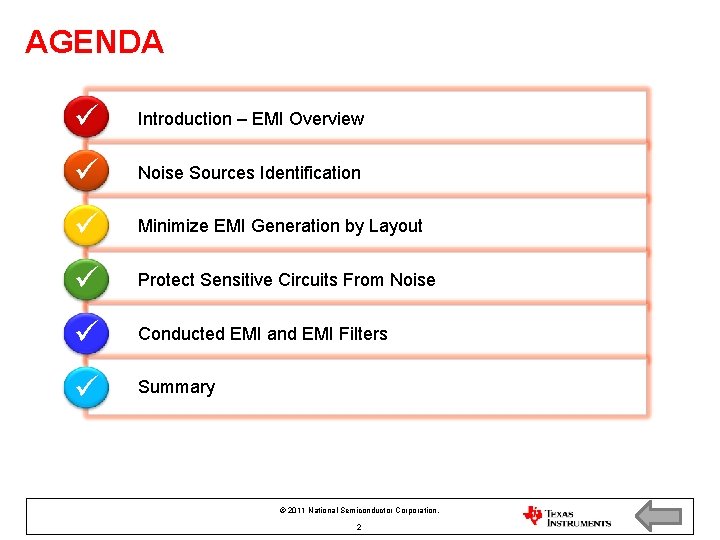
AGENDA Introduction – EMI Overview Noise Sources Identification Minimize EMI Generation by Layout Protect Sensitive Circuits From Noise Conducted EMI and EMI Filters Summary © 2011 National Semiconductor Corporation. 2
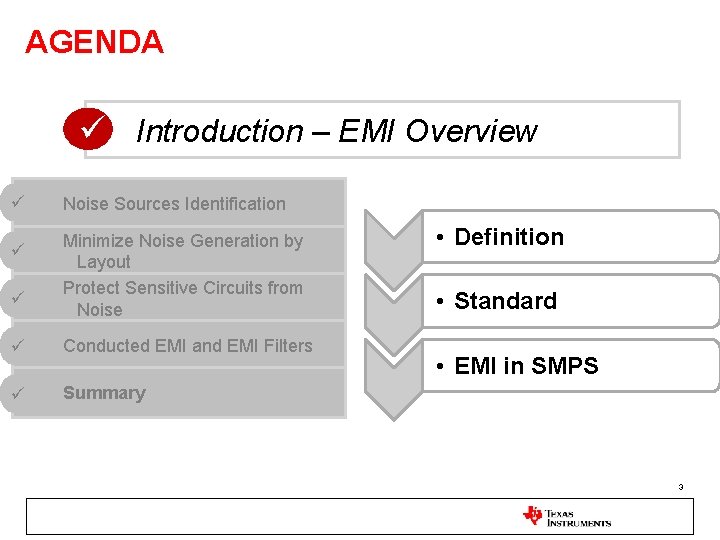
AGENDA Introduction – EMI Overview Noise Sources Identification Minimize Noise Generation by Layout Protect Sensitive Circuits from Noise Conducted EMI and EMI Filters Summary • Definition • Standard • EMI in SMPS 3
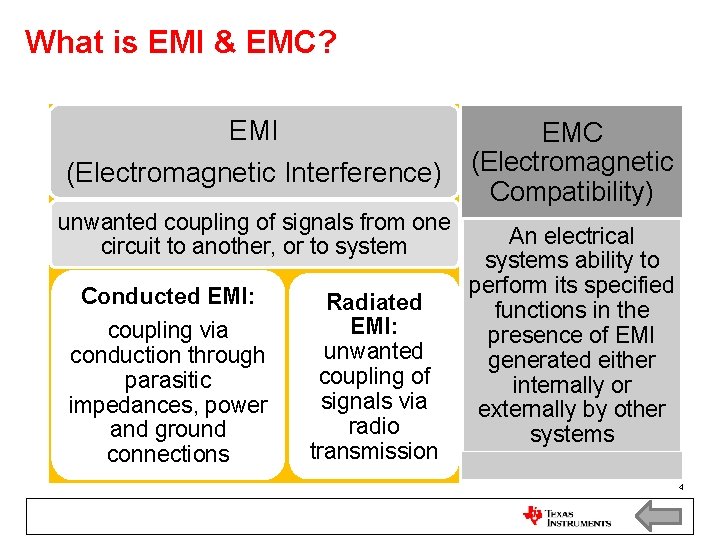
What is EMI & EMC? EMI (Electromagnetic Interference) unwanted coupling of signals from one circuit to another, or to system Conducted EMI: coupling via conduction through parasitic impedances, power and ground connections Radiated EMI: unwanted coupling of signals via radio transmission EMC (Electromagnetic Compatibility) An electrical systems ability to perform its specified functions in the presence of EMI generated either internally or externally by other systems 4
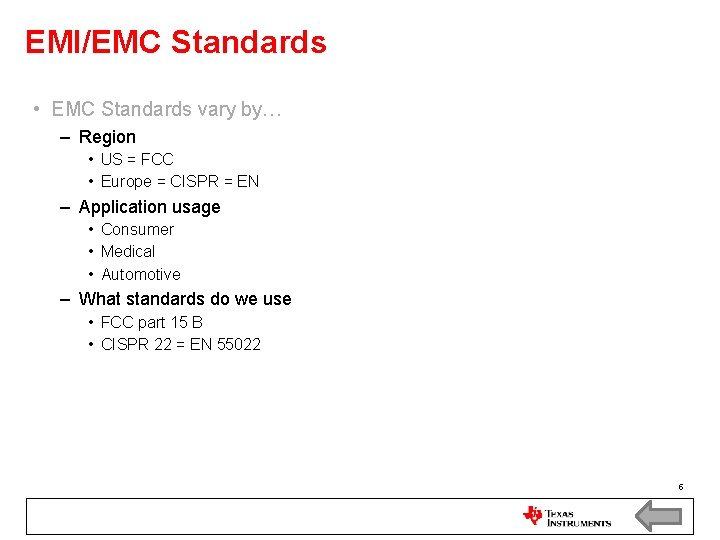
EMI/EMC Standards • EMC Standards vary by… – Region • US = FCC • Europe = CISPR = EN – Application usage • Consumer • Medical • Automotive – What standards do we use • FCC part 15 B • CISPR 22 = EN 55022 5
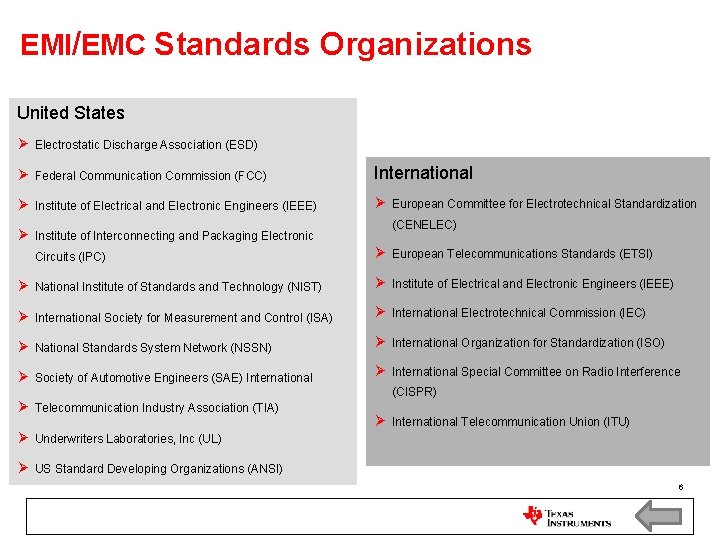
EMI/EMC Standards Organizations United States Ø Electrostatic Discharge Association (ESD) Ø Federal Communication Commission (FCC) International Ø Institute of Electrical and Electronic Engineers (IEEE) Ø European Committee for Electrotechnical Standardization Ø Institute of Interconnecting and Packaging Electronic Circuits (IPC) (CENELEC) Ø European Telecommunications Standards (ETSI) Ø National Institute of Standards and Technology (NIST) Ø Institute of Electrical and Electronic Engineers (IEEE) Ø International Society for Measurement and Control (ISA) Ø International Electrotechnical Commission (IEC) Ø National Standards System Network (NSSN) Ø International Organization for Standardization (ISO) Ø Society of Automotive Engineers (SAE) International Ø International Special Committee on Radio Interference (CISPR) Ø Telecommunication Industry Association (TIA) Ø International Telecommunication Union (ITU) Ø Underwriters Laboratories, Inc (UL) Ø US Standard Developing Organizations (ANSI) 6
Links • EU EMC Directives: http: //ec. europa. eu/enterprise/sectors/electrical/documents/emc/legislation/index_en. htm • EU EMC Standards List (24 Feb 2011): http: //eur-lex. europa. eu/Lex. Uri. Serv. do? uri=OJ: C: 2011: 059: 0001: 0019: EN: PDF • FCC Rules (Title 47 Telecommunications, Part 2): http: //www. access. gpo. gov/nara/cfr/waisidx_10/47 cfr 2_10. html • FCC Rules (Title 47 Telecommunications, Part 15) Information Technology Equipment (ITE): http: //www. access. gpo. gov/nara/cfr/waisidx_10/47 cfr 15_10. html • FCC Rules (Title 47 Telecommunications, Part 18) Industrial, Scientific, & Medical Equipment (ISM): http: //www. access. gpo. gov/nara/cfr/waisidx_10/47 cfr 18_10. html • FDA Inspection and Compliance (Medical devices are exempt from FCC regulations): http: //www. fda. gov/ICECI/Inspections/Inspection. Guides/ucm 090621. htm 7
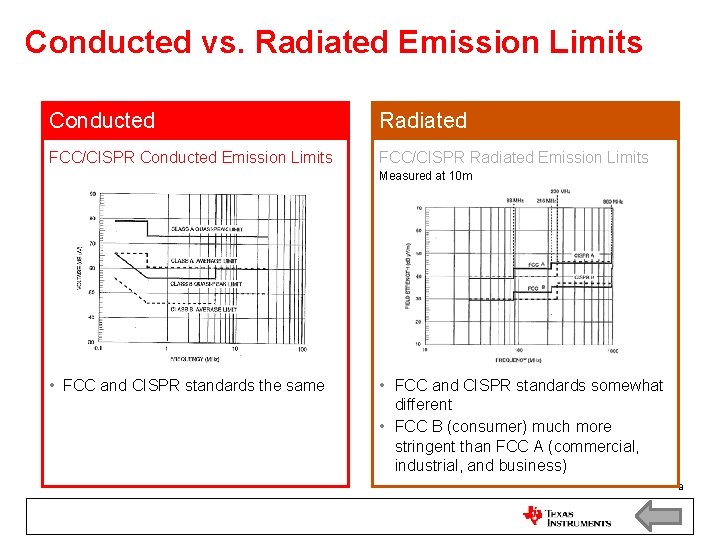
Conducted vs. Radiated Emission Limits Conducted Radiated FCC/CISPR Conducted Emission Limits FCC/CISPR Radiated Emission Limits Measured at 10 m • FCC and CISPR standards the same • FCC and CISPR standards somewhat different • FCC B (consumer) much more stringent than FCC A (commercial, industrial, and business) 8
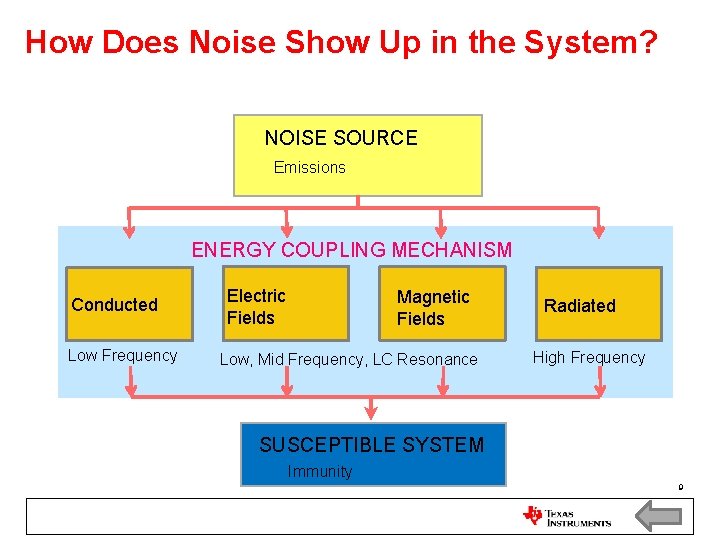
How Does Noise Show Up in the System? NOISE SOURCE Emissions ENERGY COUPLING MECHANISM Conducted Low Frequency Electric Fields Magnetic Fields Low, Mid Frequency, LC Resonance Radiated High Frequency SUSCEPTIBLE SYSTEM Immunity 9
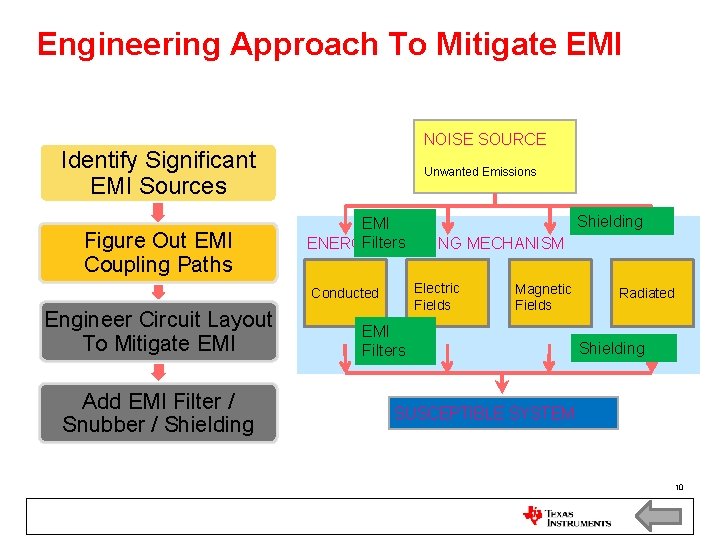
Engineering Approach To Mitigate EMI NOISE SOURCE Identify Significant EMI Sources Figure Out EMI Coupling Paths Unwanted Emissions Shielding EMI Filters ENERGY COUPLING MECHANISM Electric Fields Conducted Engineer Circuit Layout To Mitigate EMI Add EMI Filter / Snubber / Shielding Magnetic Fields EMI Filters Radiated Shielding SUSCEPTIBLE SYSTEM 10
SMPSs Are Big Generators Of Radiated And Conducted Emissions Supply Switch Mode Power Supply • Due to – – – High power High di/dt on the switches and diodes Fast transients (voltage and current) Not generally enclosed (not shielded) Parasitic inductance and capacitance in current paths LOAD • Causing – Noise Conducted to Supply and / or Load – Interfere with circuits in the same system – Interfere with other systems 11
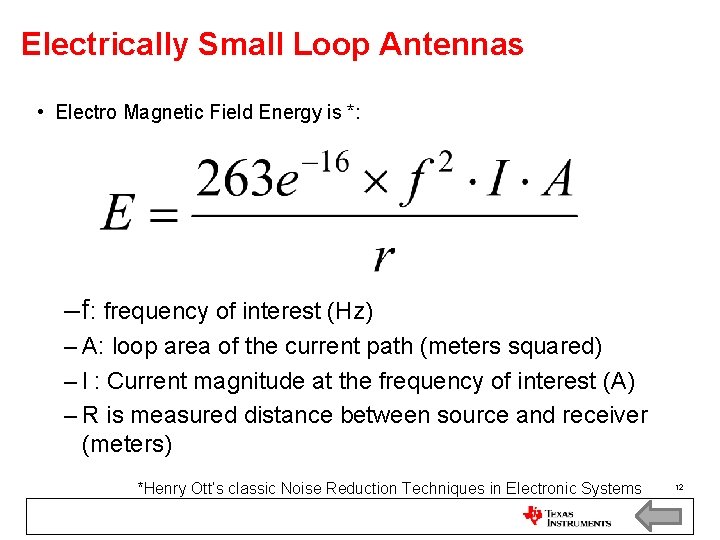
Electrically Small Loop Antennas • Electro Magnetic Field Energy is *: – f: frequency of interest (Hz) – A: loop area of the current path (meters squared) – I : Current magnitude at the frequency of interest (A) – R is measured distance between source and receiver (meters) *Henry Ott’s classic Noise Reduction Techniques in Electronic Systems 12
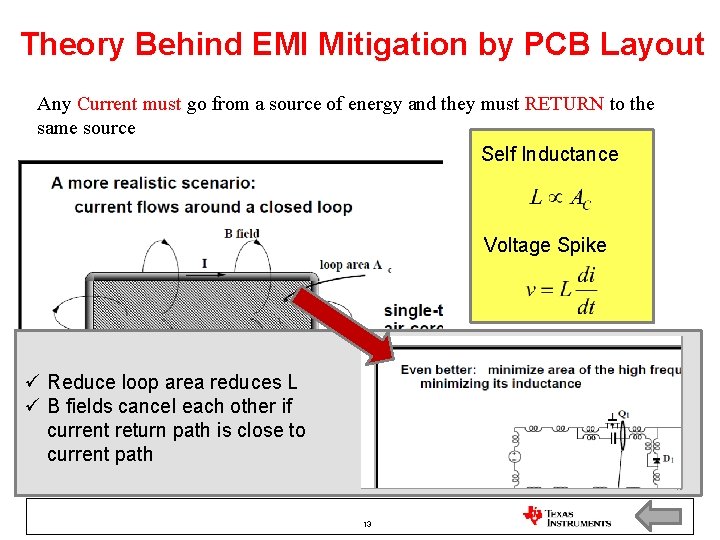
Theory Behind EMI Mitigation by PCB Layout Any Current must go from a source of energy and they must RETURN to the same source Self Inductance Voltage Spike Reduce loop area reduces L B fields cancel each other if current return path is close to current path 13 13
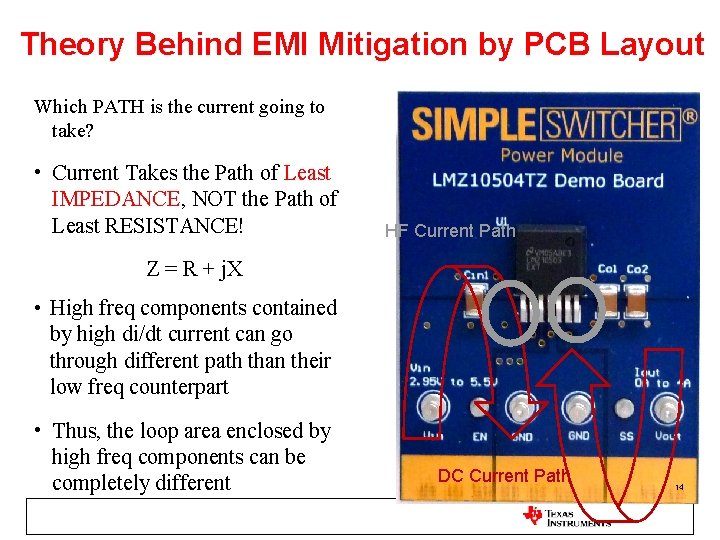
Theory Behind EMI Mitigation by PCB Layout Which PATH is the current going to take? • Current Takes the Path of Least IMPEDANCE, NOT the Path of Least RESISTANCE! HF Current Path Z = R + j. X • High freq components contained by high di/dt current can go through different path than their low freq counterpart • Thus, the loop area enclosed by high freq components can be completely different DC Current Path 14
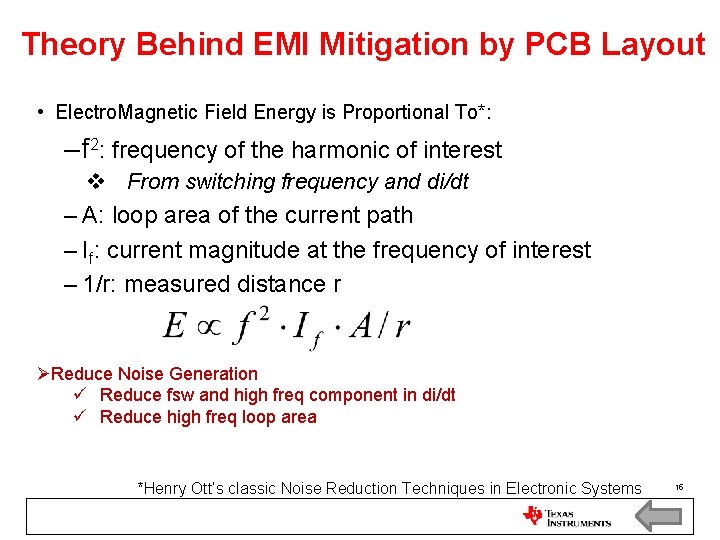
Theory Behind EMI Mitigation by PCB Layout • Electro. Magnetic Field Energy is Proportional To*: – f 2: frequency of the harmonic of interest v From switching frequency and di/dt – A: loop area of the current path – If: current magnitude at the frequency of interest – 1/r: measured distance r ØReduce Noise Generation Reduce fsw and high freq component in di/dt Reduce high freq loop area *Henry Ott’s classic Noise Reduction Techniques in Electronic Systems 15
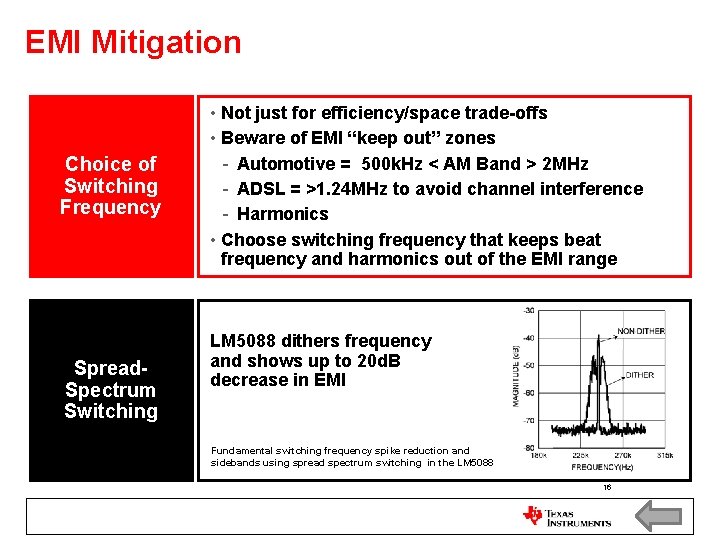
EMI Mitigation Choice of Switching Frequency Spread. Spectrum Switching • Not just for efficiency/space trade-offs • Beware of EMI “keep out” zones - Automotive = 500 k. Hz < AM Band > 2 MHz - ADSL = >1. 24 MHz to avoid channel interference - Harmonics • Choose switching frequency that keeps beat frequency and harmonics out of the EMI range LM 5088 dithers frequency and shows up to 20 d. B decrease in EMI Fundamental switching frequency spike reduction and sidebands using spread spectrum switching in the LM 5088 16
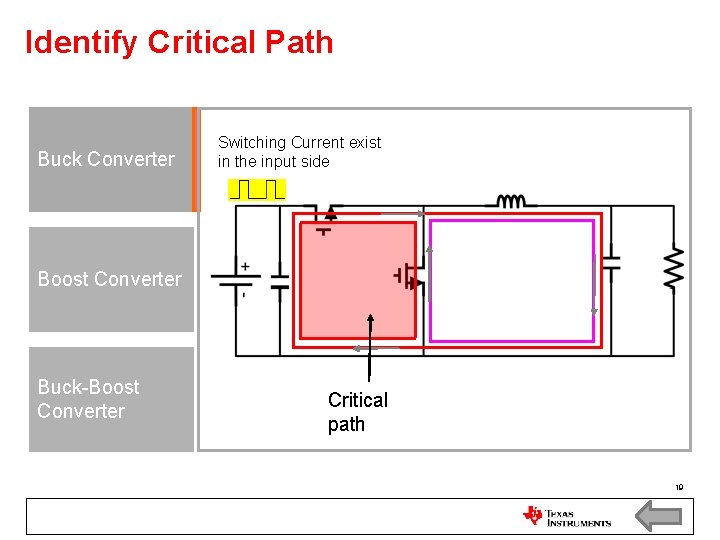
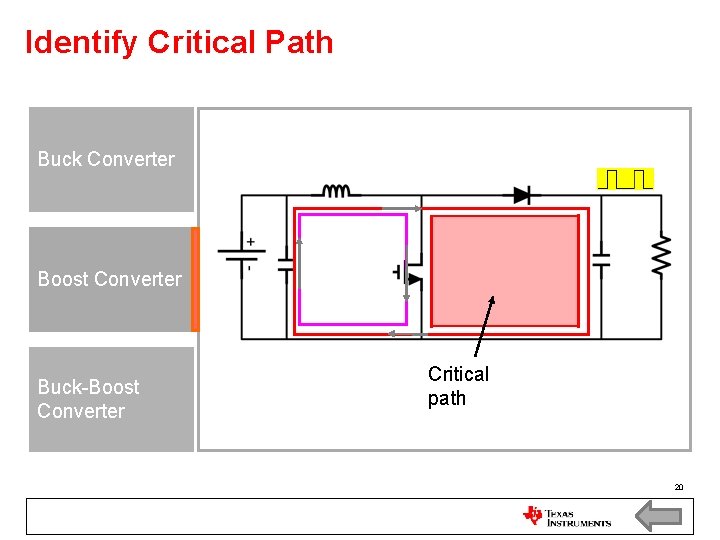
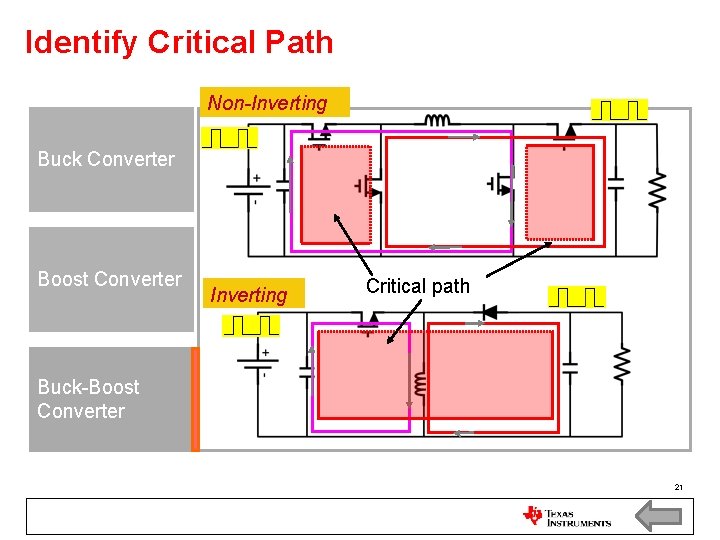
Steps To Mitigate EMI In PCB Where is high di/dt? Where is the Critical PATH? How to reduce di/dt and LOOP area? Switching components generate high di/dt current where is the return path? Loop Contains high di/dt current is CRITICAL PATH. Slow down switching action Reduce high freq path enclosed area 17
AGENDA EMI Overview – definition and standards Noise Sources Identification Minimize EMI Generation by Layout Protect Sensitive Circuits from Noise Conducted EMI and EMI Filters Summary Isolated and High Power Density Power Supply Board • Buck • Boost • Buck Boost 18
Identify Critical Path Buck Converter Switching Current exist in the input side Boost Converter Buck-Boost Converter Critical path 19
Identify Critical Path Buck Converter Boost Converter Buck-Boost Converter Critical path 20
Identify Critical Path Non-Inverting Buck Converter Boost Converter Inverting Critical path Buck-Boost Converter 21
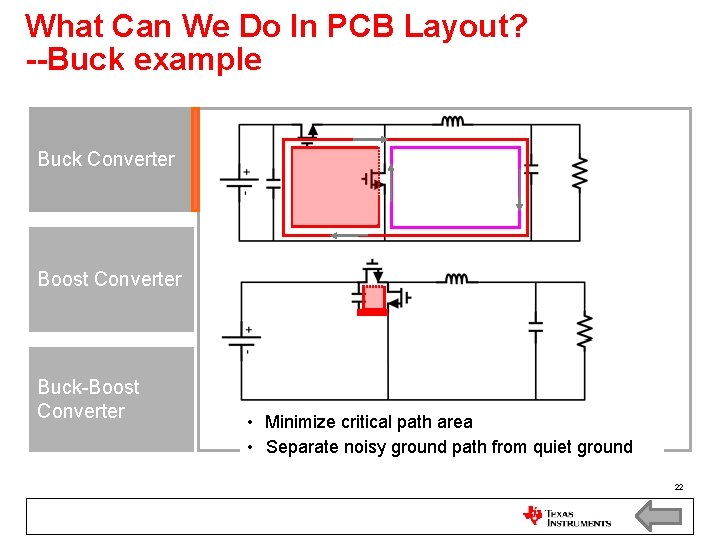
What Can We Do In PCB Layout? --Buck example Buck Converter Boost Converter Buck-Boost Converter • Minimize critical path area • Separate noisy ground path from quiet ground 22
What Can We Do In PCB Layout? --Buck-Boost example Non-Inverting Buck Converter Boost Converter Buck-Boost Converter 23
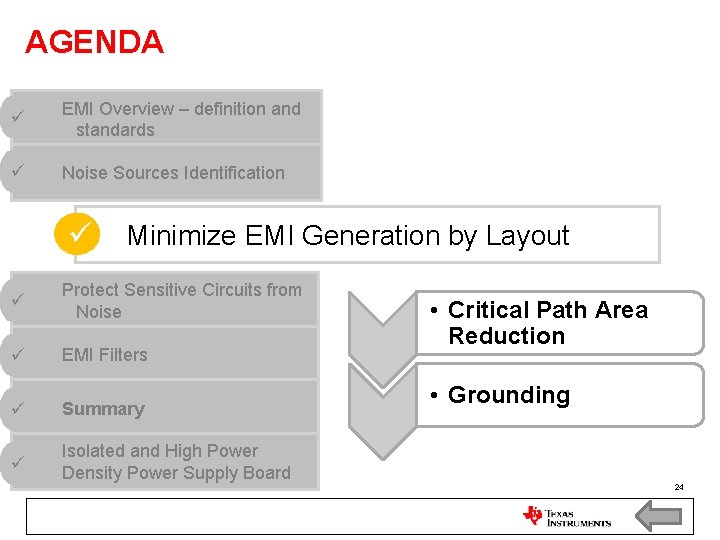
AGENDA EMI Overview – definition and standards Noise Sources Identification Minimize EMI Generation by Layout Protect Sensitive Circuits from Noise EMI Filters Summary Isolated and High Power Density Power Supply Board • Critical Path Area Reduction • Grounding 24
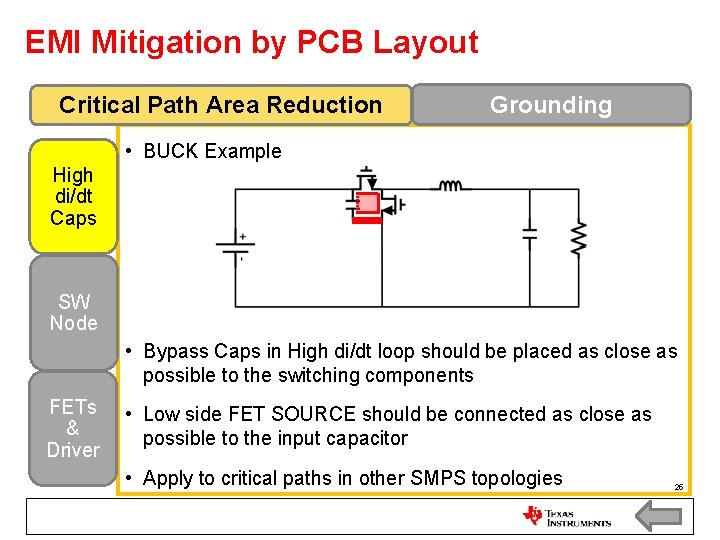
EMI Mitigation by PCB Layout Critical Path Area Reduction Grounding • BUCK Example High di/dt Caps SW Node • Bypass Caps in High di/dt loop should be placed as close as possible to the switching components FETs & Driver • Low side FET SOURCE should be connected as close as possible to the input capacitor • Apply to critical paths in other SMPS topologies 25
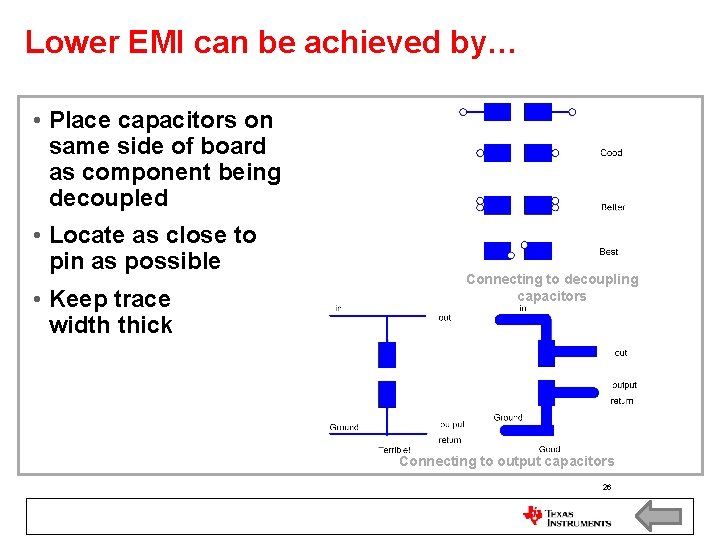
Lower EMI can be achieved by… • Place capacitors on same side of board as component being decoupled • Locate as close to pin as possible • Keep trace width thick Connecting to decoupling capacitors Connecting to output capacitors 26
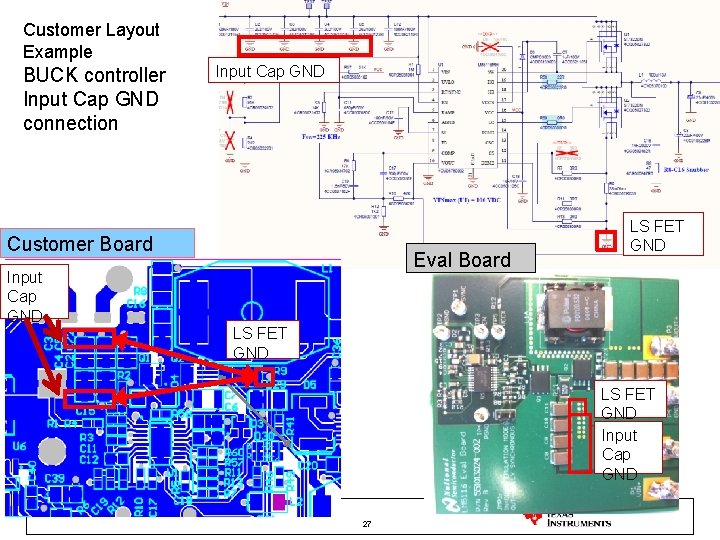
Customer Layout Example BUCK controller Input Cap GND connection Input Cap GND Customer Board Input Cap GND Eval Board LS FET GND Input Cap GND 27
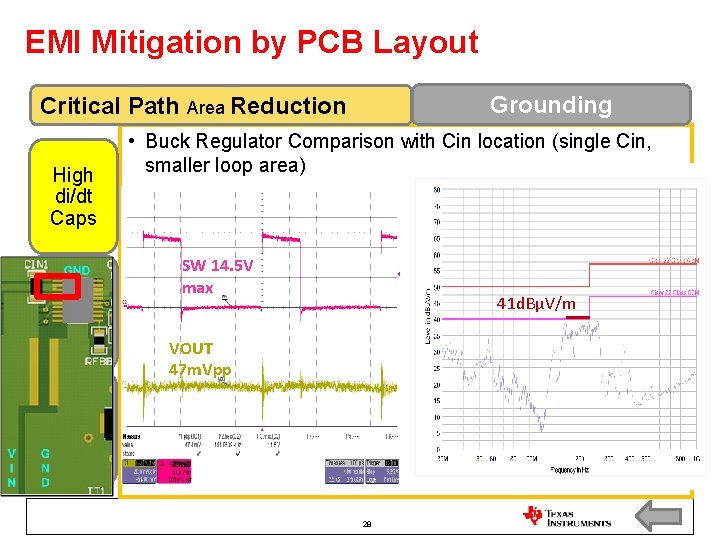
EMI Mitigation by PCB Layout Grounding Critical Path Area Reduction High di/dt Caps SW Node • Buck Regulator Comparison with Cin location (single Cin, smaller loop area) SW 14. 5 V max 41 d. BµV/m VOUT 47 m. Vpp FETs & Driver VIN VOUT 28 28
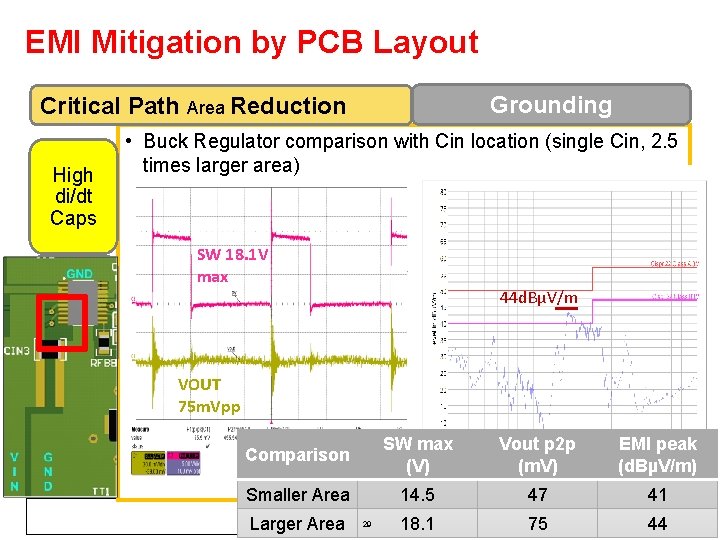
EMI Mitigation by PCB Layout Grounding Critical Path Area Reduction High di/dt Caps • Buck Regulator comparison with Cin location (single Cin, 2. 5 times larger area) SW 18. 1 V max 44 d. BµV/m SW Node FETs & Driver VOUT 75 m. Vpp Comparison SW max (V) Vout p 2 p (m. V) EMI peak (d. BµV/m) Smaller Area 14. 5 47 41 18. 1 75 44 Larger Area 29 29
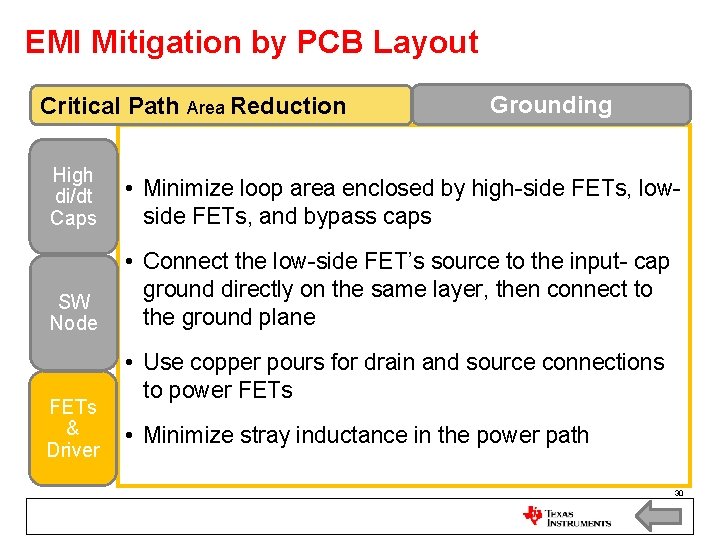
EMI Mitigation by PCB Layout Critical Path Area Reduction Grounding High di/dt Caps • Minimize loop area enclosed by high-side FETs, lowside FETs, and bypass caps SW Node • Connect the low-side FET’s source to the input- cap ground directly on the same layer, then connect to the ground plane FETs & Driver • Use copper pours for drain and source connections to power FETs • Minimize stray inductance in the power path 30
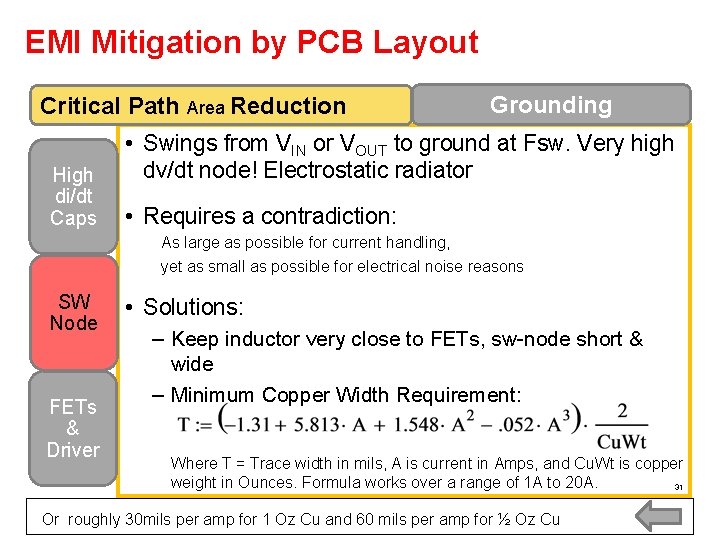
EMI Mitigation by PCB Layout Critical Path Area Reduction High di/dt Caps Grounding • Swings from VIN or VOUT to ground at Fsw. Very high dv/dt node! Electrostatic radiator • Requires a contradiction: As large as possible for current handling, yet as small as possible for electrical noise reasons SW Node FETs & Driver • Solutions: – Keep inductor very close to FETs, sw-node short & wide – Minimum Copper Width Requirement: Where T = Trace width in mils, A is current in Amps, and Cu. Wt is copper weight in Ounces. Formula works over a range of 1 A to 20 A. 31 Or roughly 30 mils per amp for 1 Oz Cu and 60 mils per amp for ½ Oz Cu
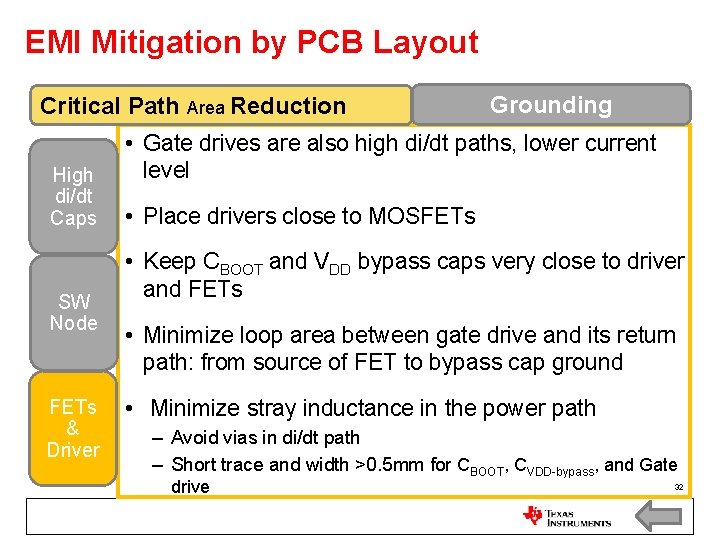
EMI Mitigation by PCB Layout Critical Path Area Reduction High di/dt Caps SW Node FETs & Driver Grounding • Gate drives are also high di/dt paths, lower current level • Place drivers close to MOSFETs • Keep CBOOT and VDD bypass caps very close to driver and FETs • Minimize loop area between gate drive and its return path: from source of FET to bypass cap ground • Minimize stray inductance in the power path – Avoid vias in di/dt path – Short trace and width >0. 5 mm for CBOOT, CVDD-bypass, and Gate drive 32
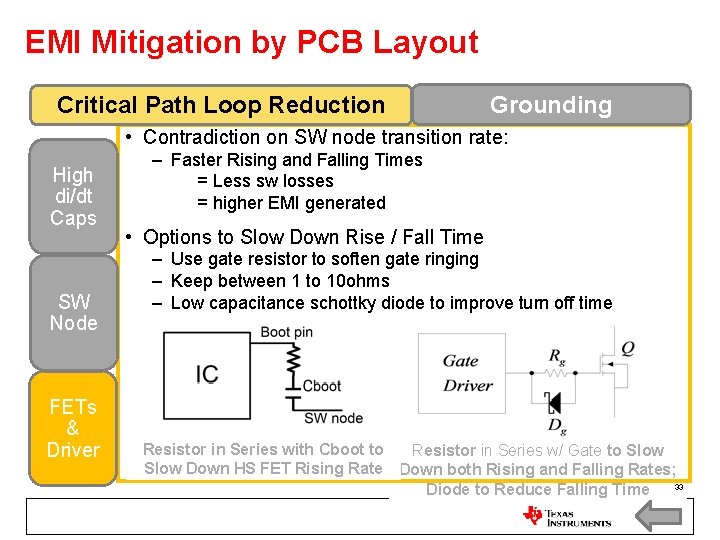
EMI Mitigation by PCB Layout Critical Path Loop Reduction Grounding • Contradiction on SW node transition rate: High di/dt Caps SW Node FETs & Driver – Faster Rising and Falling Times = Less sw losses = higher EMI generated • Options to Slow Down Rise / Fall Time – Use gate resistor to soften gate ringing – Keep between 1 to 10 ohms – Low capacitance schottky diode to improve turn off time Resistor in Series with Cboot to Resistor in Series w/ Gate to Slow Down HS FET Rising Rate Down both Rising and Falling Rates; 33 Diode to Reduce Falling Time
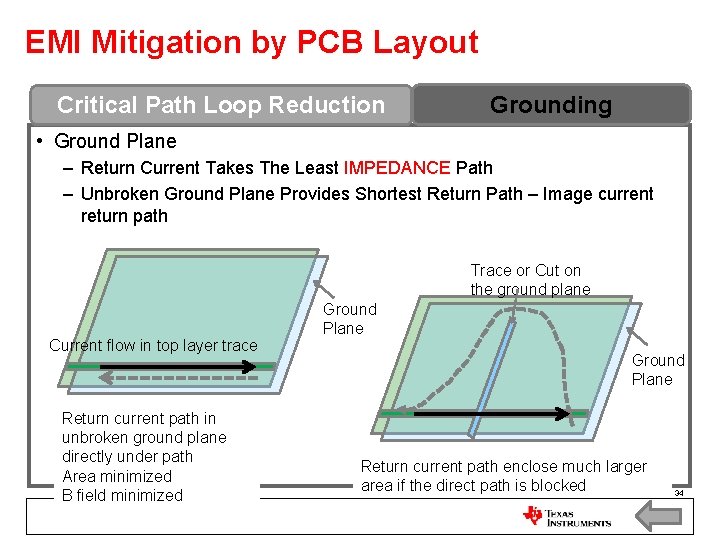
EMI Mitigation by PCB Layout Critical Path Loop Reduction Grounding • Ground Plane – Return Current Takes The Least IMPEDANCE Path – Unbroken Ground Plane Provides Shortest Return Path – Image current return path Trace or Cut on the ground plane Current flow in top layer trace Return current path in unbroken ground plane directly under path Area minimized B field minimized Ground Plane Return current path enclose much larger area if the direct path is blocked 34
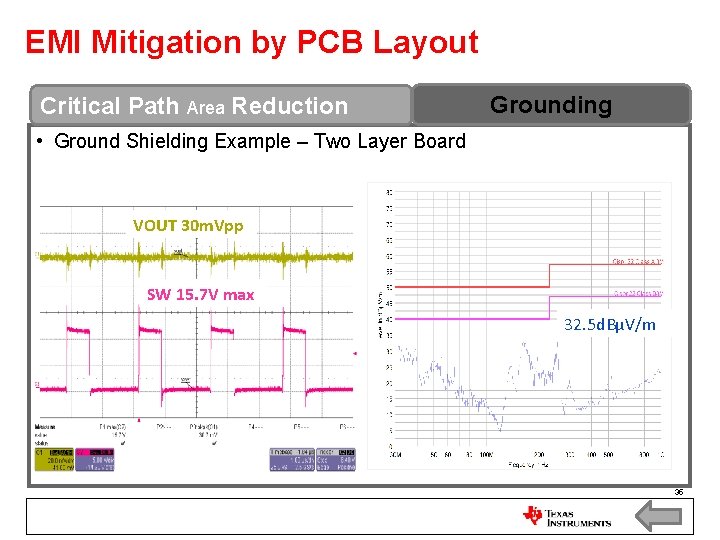
EMI Mitigation by PCB Layout Critical Path Area Reduction Grounding • Ground Shielding Example – Two Layer Board VOUT 30 m. Vpp SW 15. 7 V max 32. 5 d. BμV/m 35
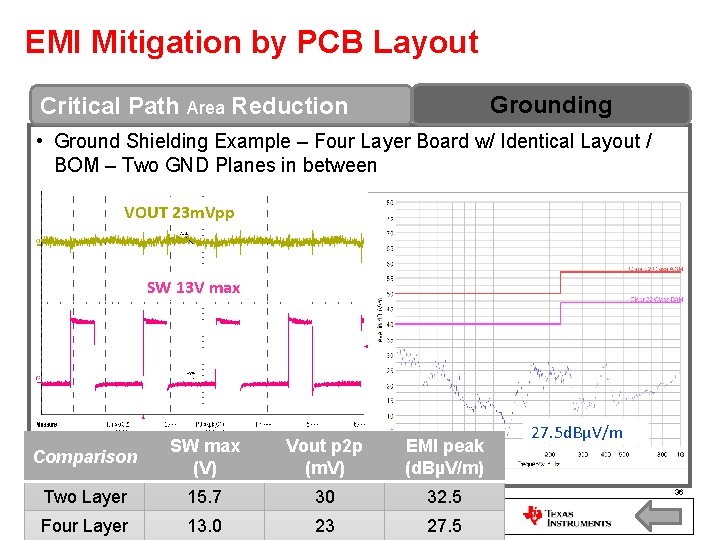
EMI Mitigation by PCB Layout Grounding Critical Path Area Reduction • Ground Shielding Example – Four Layer Board w/ Identical Layout / BOM – Two GND Planes in between VOUT 23 m. Vpp SW 13 V max Comparison SW max (V) Vout p 2 p (m. V) EMI peak (d. BµV/m) Two Layer 15. 7 30 32. 5 Four Layer 13. 0 23 27. 5 d. BμV/m 36
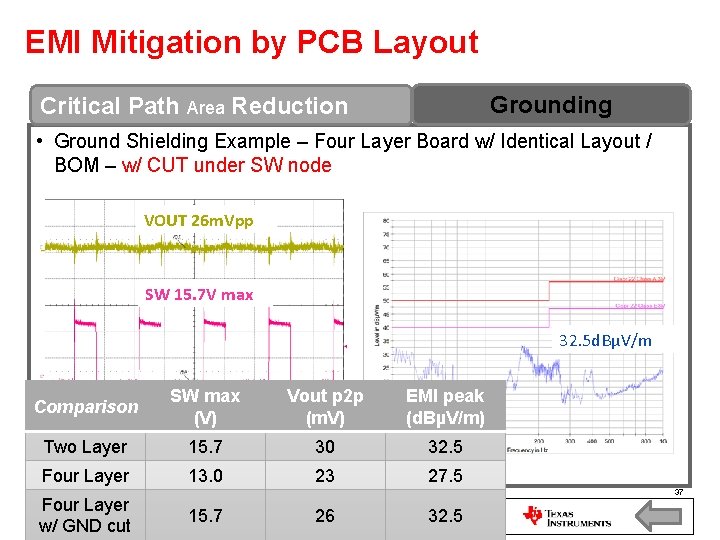
EMI Mitigation by PCB Layout Grounding Critical Path Area Reduction • Ground Shielding Example – Four Layer Board w/ Identical Layout / BOM – w/ CUT under SW node VOUT 26 m. Vpp SW 15. 7 V max 32. 5 d. BμV/m Comparison SW max (V) Vout p 2 p (m. V) EMI peak (d. BµV/m) Two Layer 15. 7 30 32. 5 Four Layer 13. 0 23 27. 5 Four Layer w/ GND cut 37 15. 7 26 32. 5
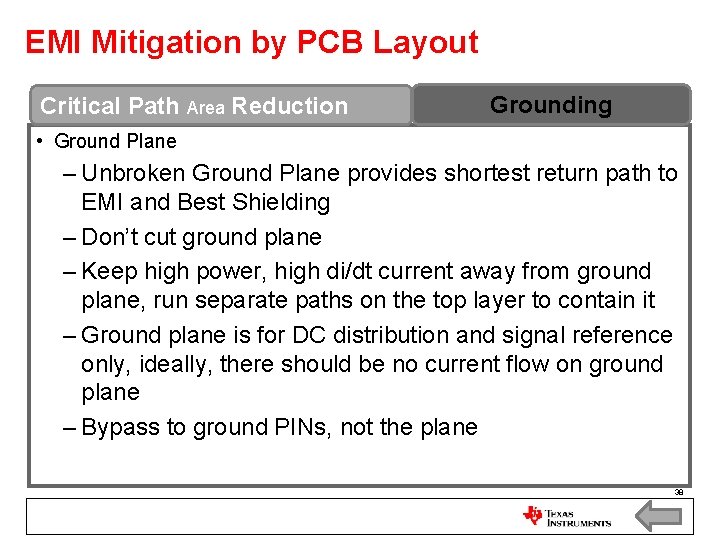
EMI Mitigation by PCB Layout Critical Path Area Reduction Grounding • Ground Plane – Unbroken Ground Plane provides shortest return path to EMI and Best Shielding – Don’t cut ground plane – Keep high power, high di/dt current away from ground plane, run separate paths on the top layer to contain it – Ground plane is for DC distribution and signal reference only, ideally, there should be no current flow on ground plane – Bypass to ground PINs, not the plane 38
Switcher Power Modules (LMZ 23610) • Ease of Use 15 mm 5. 9 mm 15 mm – Webench, Ease to mount & rework 2. 8 mm – Internal Comp • Dual Lead frame • Built in Vin Capacitors to solve EMI issue, & shielded inductor 10 Amp Current Sharing Eval board CISPR 22 Measurements EMI Configuration 39
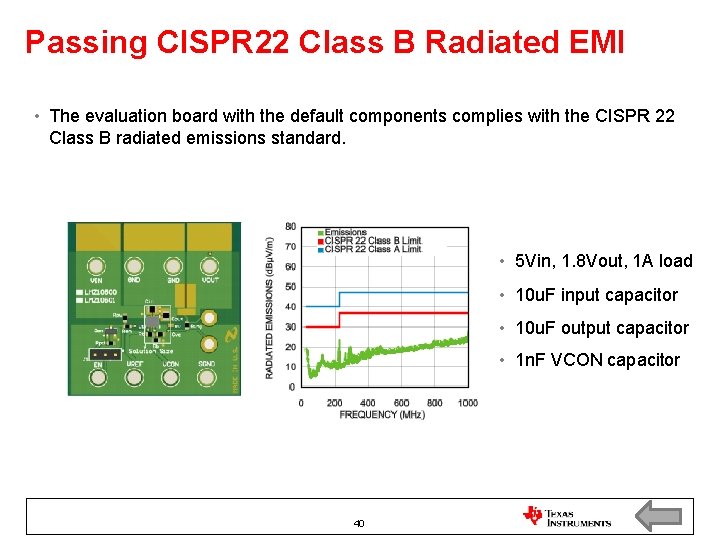
Passing CISPR 22 Class B Radiated EMI • The evaluation board with the default components complies with the CISPR 22 Class B radiated emissions standard. • 5 Vin, 1. 8 Vout, 1 A load • 10 u. F input capacitor • 10 u. F output capacitor • 1 n. F VCON capacitor 40
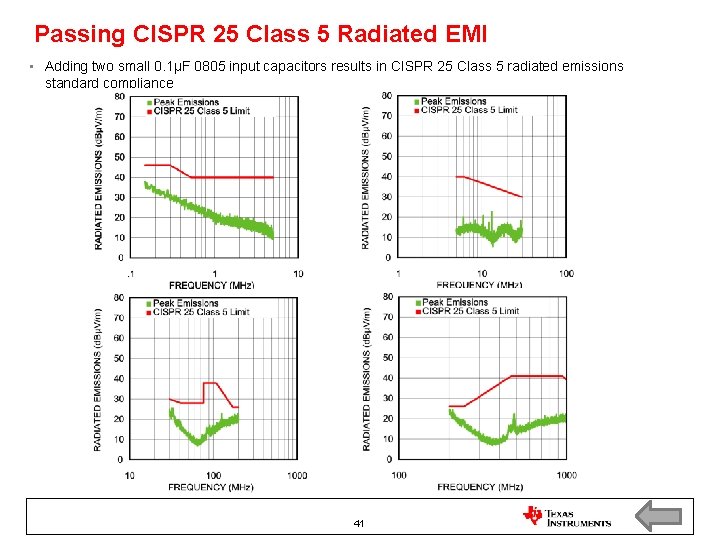
Passing CISPR 25 Class 5 Radiated EMI • Adding two small 0. 1μF 0805 input capacitors results in CISPR 25 Class 5 radiated emissions standard compliance 41
AGENDA EMI Overview – definition and standards Noise Sources Identification Minimize EMI Generation by Layout Protect Sensitive Circuits from Noise Conducted EMI and EMI Filters Summary 42
Protect EMI Sensitive Nodes from Noise Noisy Nodes: Any Nodes in High di/dt Loop SW node Inductor High di/dt bypass caps MOSFETs Power Diodes …… Ø Sensitive Nodes: Control and Sensing Circuits Vout sensing path and feedback node Compensation network Current sensing path Frequency setting Monitoring and Protecting Circuits …… Shielded by Ground / Power Planes Ø Away from EMI source 43
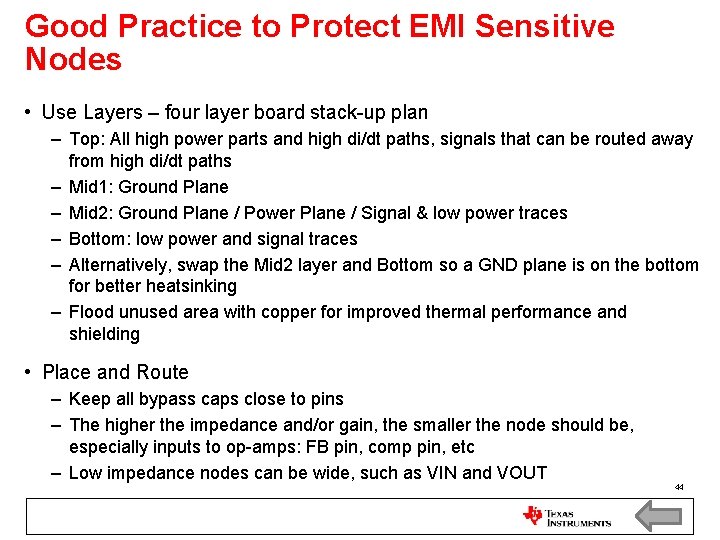
Good Practice to Protect EMI Sensitive Nodes • Use Layers – four layer board stack-up plan – Top: All high power parts and high di/dt paths, signals that can be routed away from high di/dt paths – Mid 1: Ground Plane – Mid 2: Ground Plane / Power Plane / Signal & low power traces – Bottom: low power and signal traces – Alternatively, swap the Mid 2 layer and Bottom so a GND plane is on the bottom for better heatsinking – Flood unused area with copper for improved thermal performance and shielding • Place and Route – Keep all bypass caps close to pins – The higher the impedance and/or gain, the smaller the node should be, especially inputs to op-amps: FB pin, comp pin, etc – Low impedance nodes can be wide, such as VIN and VOUT 44
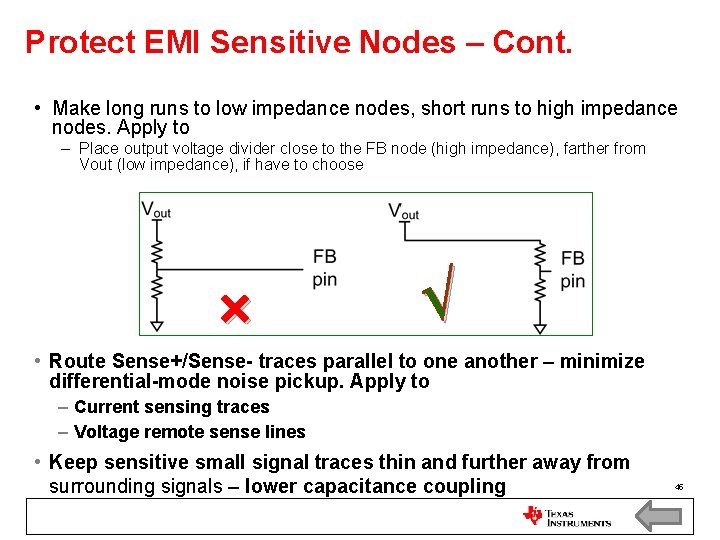
Protect EMI Sensitive Nodes – Cont. • Make long runs to low impedance nodes, short runs to high impedance nodes. Apply to – Place output voltage divider close to the FB node (high impedance), farther from Vout (low impedance), if have to choose × √ • Route Sense+/Sense- traces parallel to one another – minimize differential-mode noise pickup. Apply to – Current sensing traces – Voltage remote sense lines • Keep sensitive small signal traces thin and further away from surrounding signals – lower capacitance coupling 45
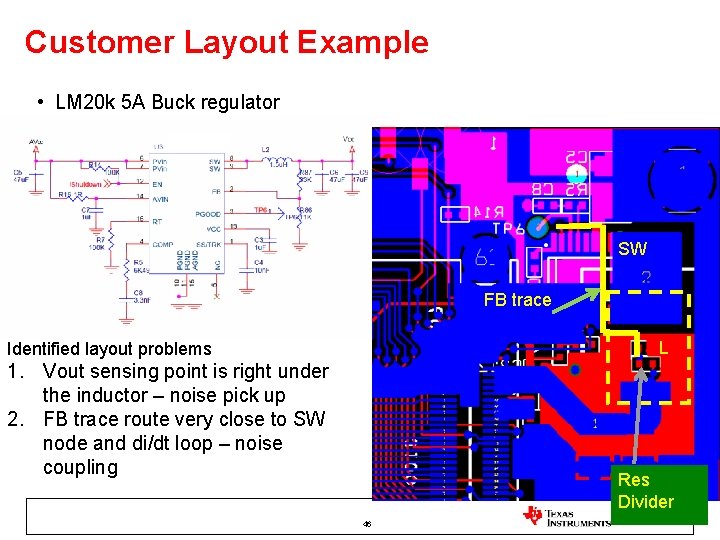
Customer Layout Example • LM 20 k 5 A Buck regulator SW FB trace L Identified layout problems 1. Vout sensing point is right under the inductor – noise pick up 2. FB trace route very close to SW node and di/dt loop – noise coupling Res 46 Divider 46
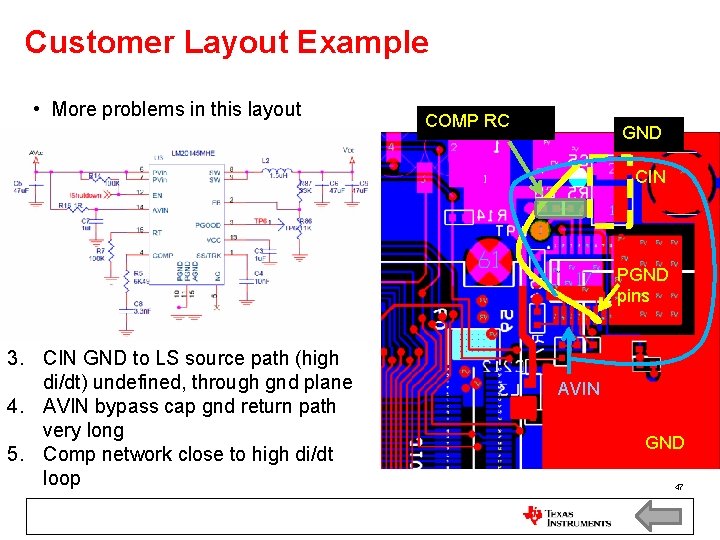
Customer Layout Example • More problems in this layout COMP RC GND CIN PGND pins 3. CIN GND to LS source path (high di/dt) undefined, through gnd plane 4. AVIN bypass cap gnd return path very long 5. Comp network close to high di/dt loop AVIN GND 47
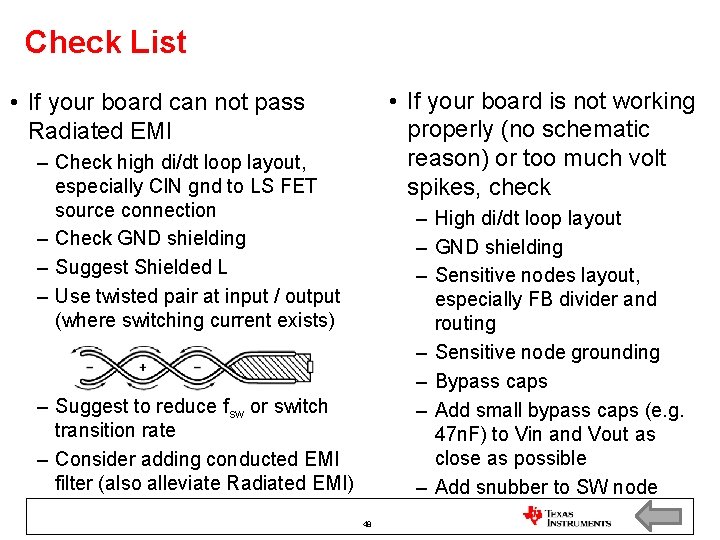
Check List • If your board is not working properly (no schematic reason) or too much volt spikes, check • If your board can not pass Radiated EMI – Check high di/dt loop layout, especially CIN gnd to LS FET source connection – Check GND shielding – Suggest Shielded L – Use twisted pair at input / output (where switching current exists) – High di/dt loop layout – GND shielding – Sensitive nodes layout, especially FB divider and routing – Sensitive node grounding – Bypass caps – Add small bypass caps (e. g. 47 n. F) to Vin and Vout as close as possible – Add snubber to SW node – Suggest to reduce fsw or switch transition rate – Consider adding conducted EMI filter (also alleviate Radiated EMI) 48
AGENDA EMI Overview – definition and standards Noise Sources Identification Minimize Noise Generation by Layout Protect Sensitive Circuits from Noise Conducted EMI and EMI Filters Summary 49
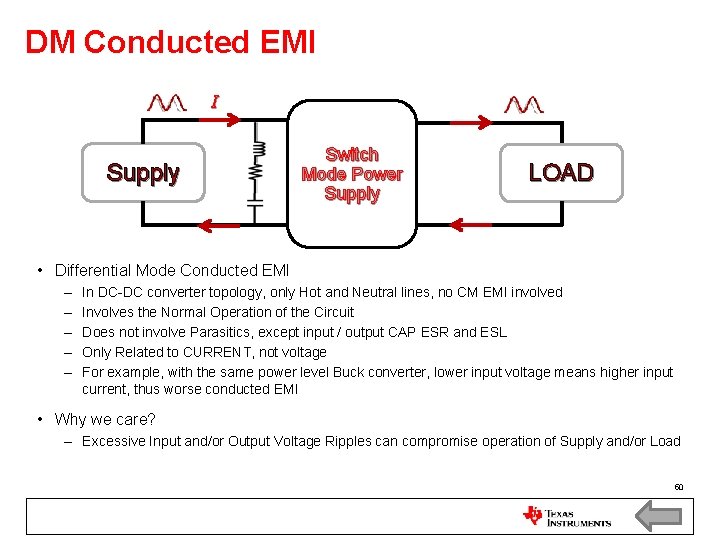
DM Conducted EMI I Supply Switch Mode Power Supply LOAD • Differential Mode Conducted EMI – – – In DC-DC converter topology, only Hot and Neutral lines, no CM EMI involved Involves the Normal Operation of the Circuit Does not involve Parasitics, except input / output CAP ESR and ESL Only Related to CURRENT, not voltage For example, with the same power level Buck converter, lower input voltage means higher input current, thus worse conducted EMI • Why we care? – Excessive Input and/or Output Voltage Ripples can compromise operation of Supply and/or Load 50
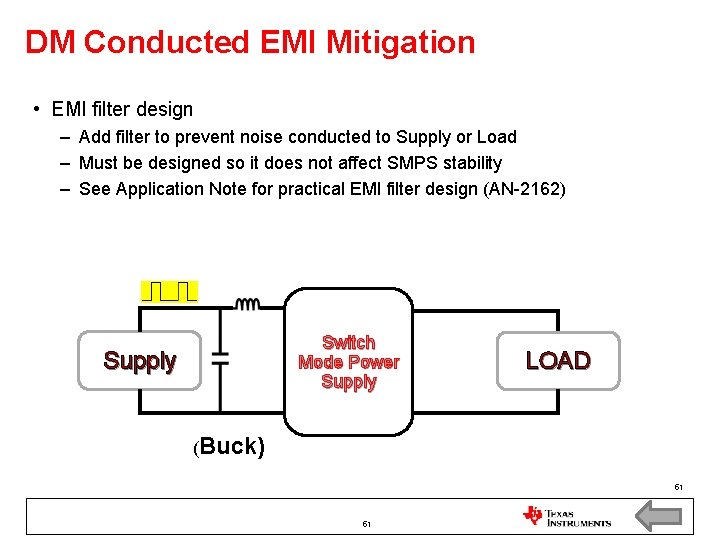
DM Conducted EMI Mitigation • EMI filter design – Add filter to prevent noise conducted to Supply or Load – Must be designed so it does not affect SMPS stability – See Application Note for practical EMI filter design (AN-2162) Switch Mode Power Supply LOAD (Buck) 51 51
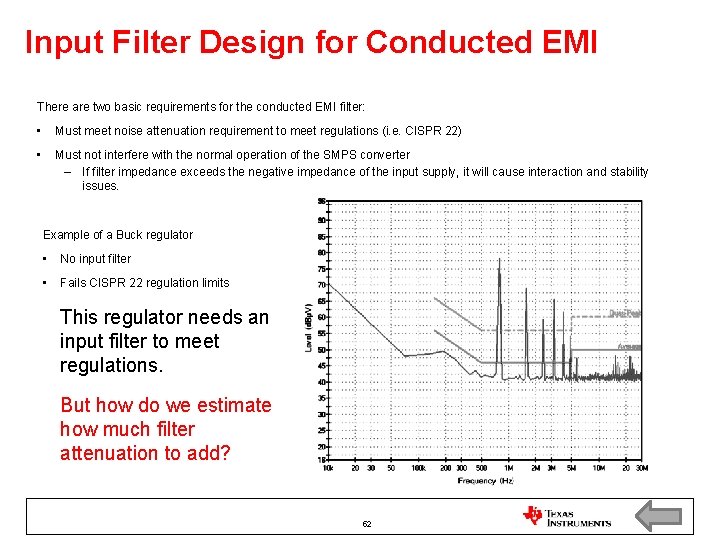
Input Filter Design for Conducted EMI There are two basic requirements for the conducted EMI filter: • Must meet noise attenuation requirement to meet regulations (i. e. CISPR 22) • Must not interfere with the normal operation of the SMPS converter – If filter impedance exceeds the negative impedance of the input supply, it will cause interaction and stability issues. Example of a Buck regulator • No input filter • Fails CISPR 22 regulation limits This regulator needs an input filter to meet regulations. But how do we estimate how much filter attenuation to add? 52
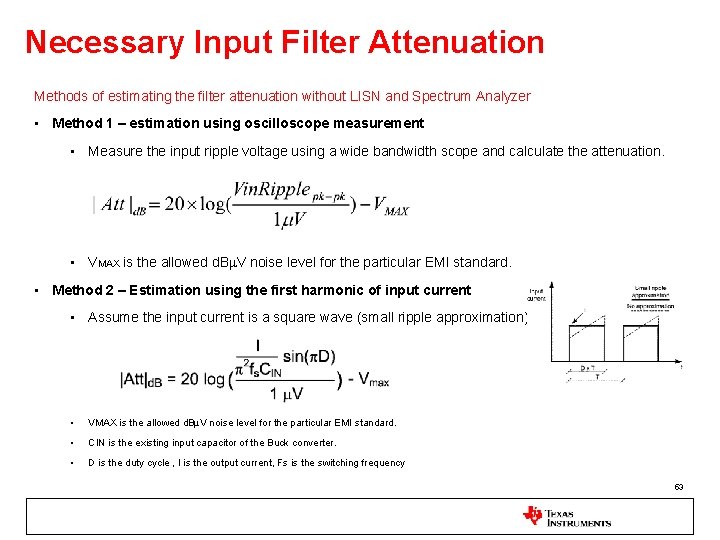
Necessary Input Filter Attenuation Methods of estimating the filter attenuation without LISN and Spectrum Analyzer • Method 1 – estimation using oscilloscope measurement • Measure the input ripple voltage using a wide bandwidth scope and calculate the attenuation. • VMAX is the allowed d. BμV noise level for the particular EMI standard. • Method 2 – Estimation using the first harmonic of input current • Assume the input current is a square wave (small ripple approximation) • VMAX is the allowed d. BμV noise level for the particular EMI standard. • CIN is the existing input capacitor of the Buck converter. • D is the duty cycle , I is the output current, Fs is the switching frequency 53
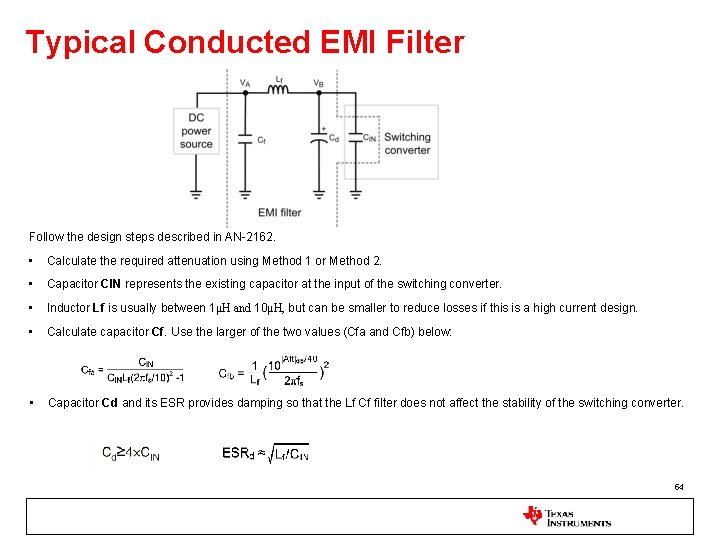
Typical Conducted EMI Filter Follow the design steps described in AN-2162. • Calculate the required attenuation using Method 1 or Method 2. • Capacitor CIN represents the existing capacitor at the input of the switching converter. • Inductor Lf is usually between 1μH and 10μH, but can be smaller to reduce losses if this is a high current design. • Calculate capacitor Cf. Use the larger of the two values (Cfa and Cfb) below: • Capacitor Cd and its ESR provides damping so that the Lf Cf filter does not affect the stability of the switching converter. 54
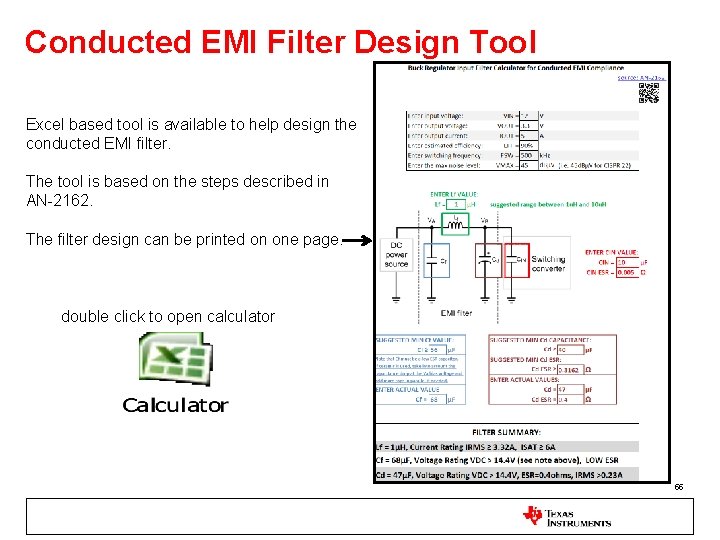
Conducted EMI Filter Design Tool Excel based tool is available to help design the conducted EMI filter. The tool is based on the steps described in AN-2162. The filter design can be printed on one page. double click to open calculator 55
Conducted EMI Before and After Filter VIN = 30 V, VOUT=3. 3 V, IOUT = 1. 6 A, CIN = 10μF + 1μF, Fs = 370 k. Hz Results with the following filter: Results before installing filter: Lf = 3. 9 μH, Cf = 10 μF, Cd = 100 μF 56 56
AGENDA EMI Overview – definition and standards Noise Sources Identification Minimize EMI Generation by Layout Protect Sensitive Circuits from Noise Conducted EMI and EMI Filters Summary 57
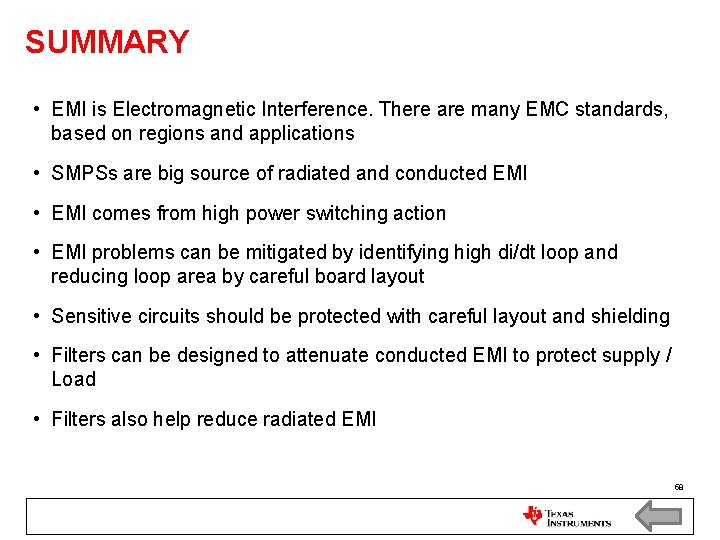
SUMMARY • EMI is Electromagnetic Interference. There are many EMC standards, based on regions and applications • SMPSs are big source of radiated and conducted EMI • EMI comes from high power switching action • EMI problems can be mitigated by identifying high di/dt loop and reducing loop area by careful board layout • Sensitive circuits should be protected with careful layout and shielding • Filters can be designed to attenuate conducted EMI to protect supply / Load • Filters also help reduce radiated EMI 58
AGENDA EMI Overview – definition and standards Noise Sources Identification Minimize EMI Generation by Layout Protect Sensitive Circuits from Noise Conducted EMI and EMI Filters Summary Questions 59