
Nomenclature Naming of Chemical Compounds Ionic Compounds All
- Slides: 30
Nomenclature Naming of Chemical Compounds
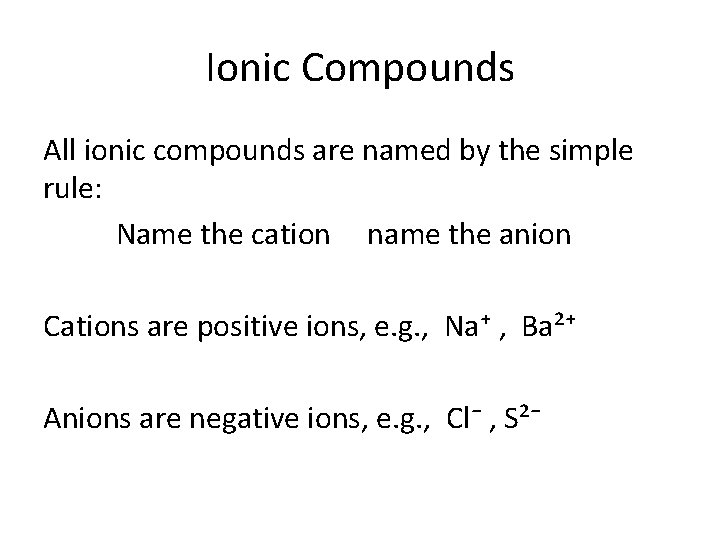
Ionic Compounds All ionic compounds are named by the simple rule: Name the cation name the anion Cations are positive ions, e. g. , Na⁺ , Ba²⁺ Anions are negative ions, e. g. , Cl⁻ , S²⁻
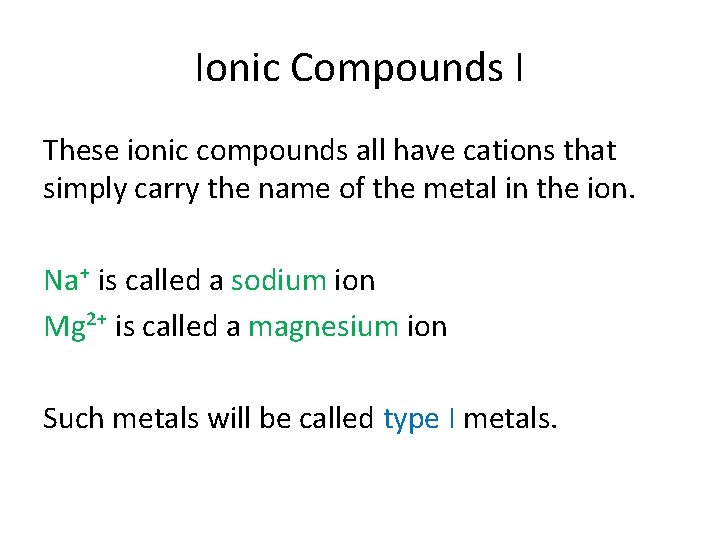
Ionic Compounds I These ionic compounds all have cations that simply carry the name of the metal in the ion. Na⁺ is called a sodium ion Mg²⁺ is called a magnesium ion Such metals will be called type I metals.
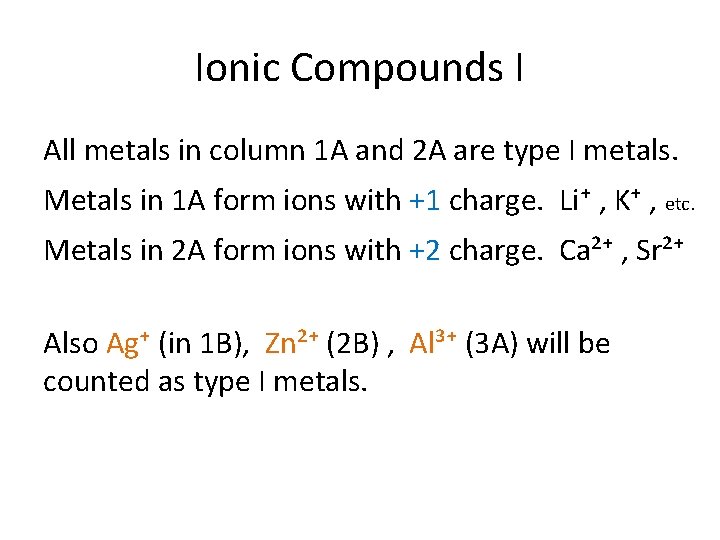
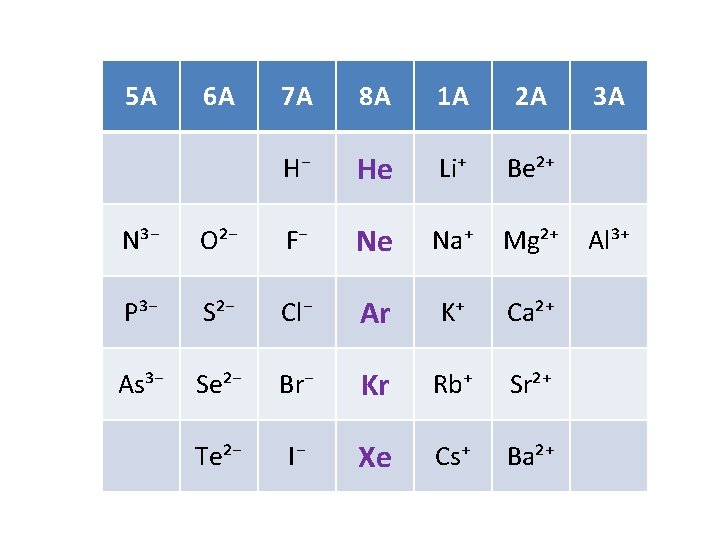
Ionic Compounds I All metals in column 1 A and 2 A are type I metals. Metals in 1 A form ions with +1 charge. Li⁺ , K⁺ , etc. Metals in 2 A form ions with +2 charge. Ca²⁺ , Sr²⁺ Also Ag⁺ (in 1 B), Zn²⁺ (2 B) , Al³⁺ (3 A) will be counted as type I metals.
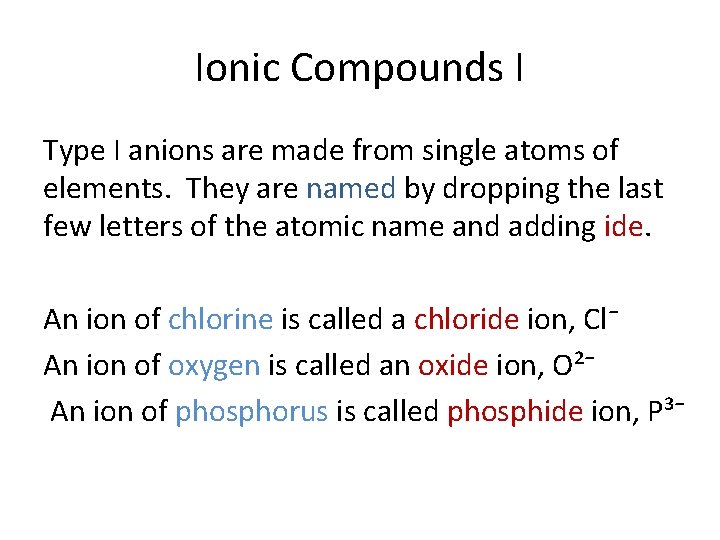
Ionic Compounds I Type I anions are made from single atoms of elements. They are named by dropping the last few letters of the atomic name and adding ide. An ion of chlorine is called a chloride ion, Cl⁻ An ion of oxygen is called an oxide ion, O²⁻ An ion of phosphorus is called phosphide ion, P³⁻
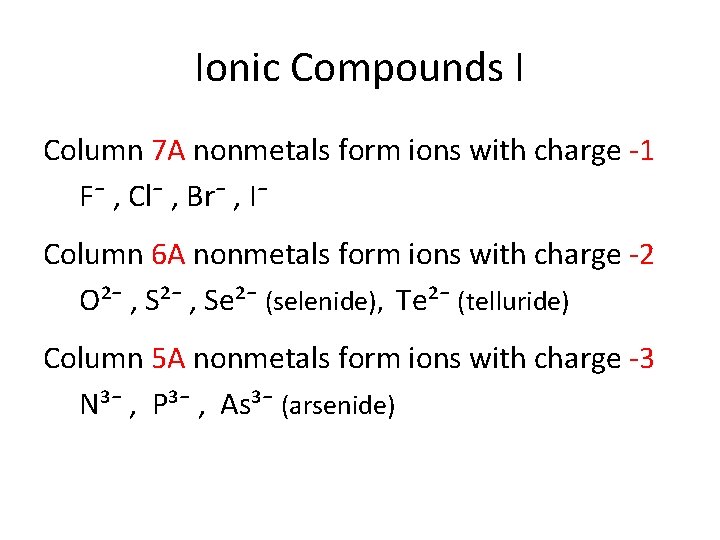
Ionic Compounds I Column 7 A nonmetals form ions with charge -1 F⁻ , Cl⁻ , Br⁻ , I⁻ Column 6 A nonmetals form ions with charge -2 O²⁻ , Se²⁻ (selenide), Te²⁻ (telluride) Column 5 A nonmetals form ions with charge -3 N³⁻ , P³⁻ , As³⁻ (arsenide)
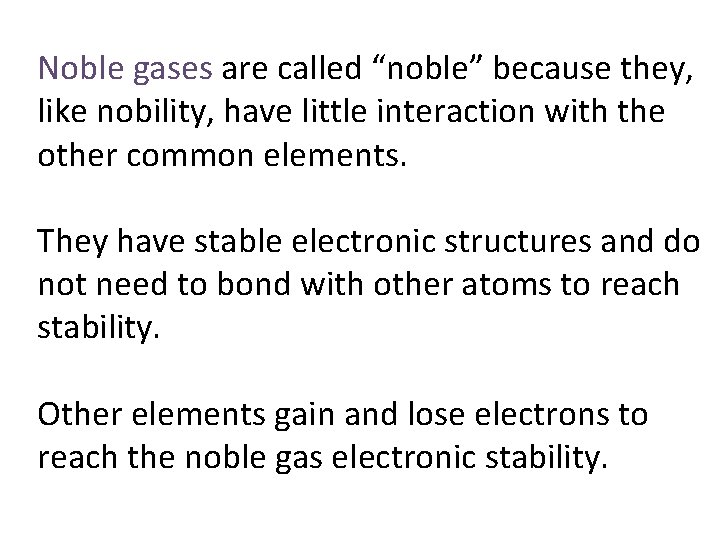
Noble gases are called “noble” because they, like nobility, have little interaction with the other common elements. They have stable electronic structures and do not need to bond with other atoms to reach stability. Other elements gain and lose electrons to reach the noble gas electronic stability.
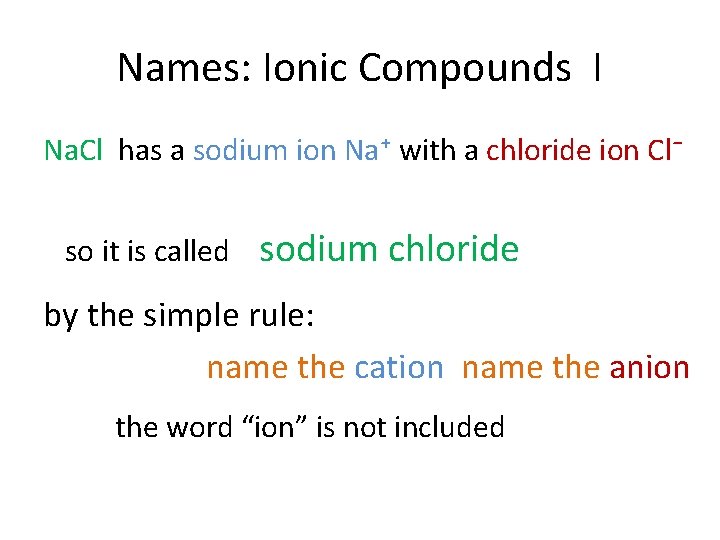
Names: Ionic Compounds I Na. Cl has a sodium ion Na⁺ with a chloride ion Cl⁻ so it is called sodium chloride by the simple rule: name the cation name the anion the word “ion” is not included
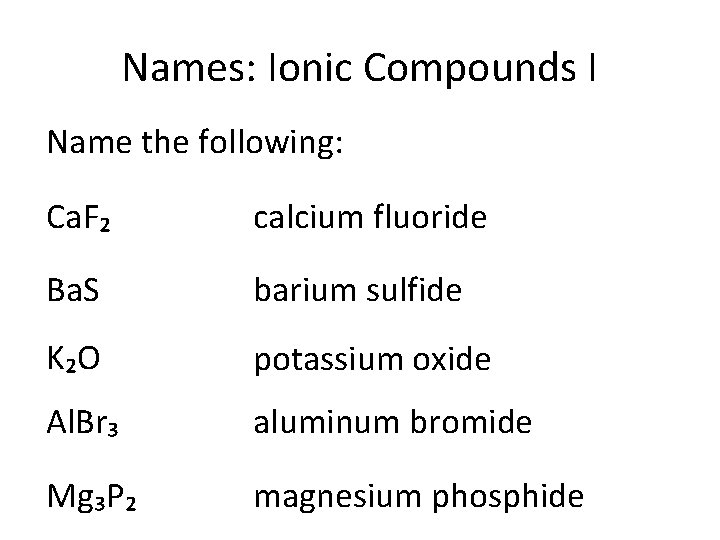
Names: Ionic Compounds I Name the following: Ca. F₂ calcium fluoride Ba. S barium sulfide K₂O potassium oxide Al. Br₃ aluminum bromide Mg₃P₂ magnesium phosphide
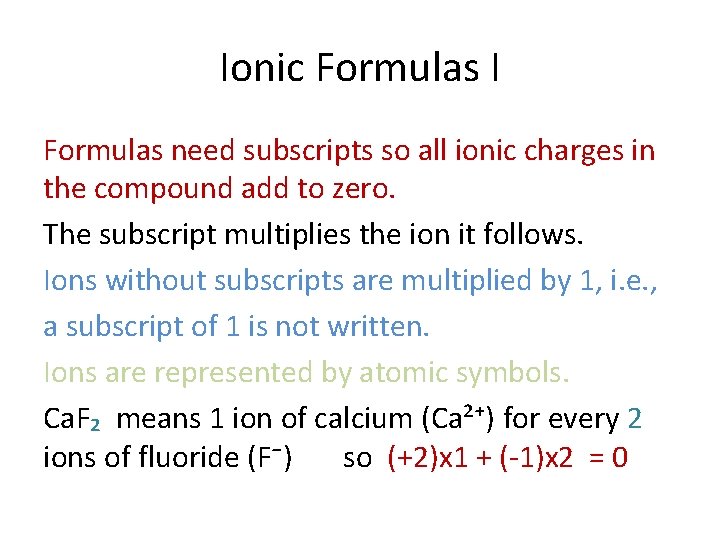
Ionic Formulas I Formulas need subscripts so all ionic charges in the compound add to zero. The subscript multiplies the ion it follows. Ions without subscripts are multiplied by 1, i. e. , a subscript of 1 is not written. Ions are represented by atomic symbols. Ca. F₂ means 1 ion of calcium (Ca²⁺) for every 2 ions of fluoride (F⁻) so (+2)x 1 + (-1)x 2 = 0
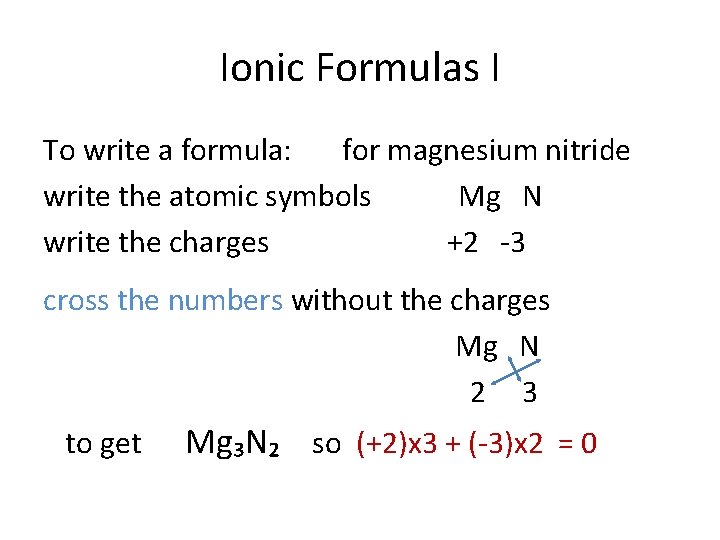
Ionic Formulas I To write a formula: for magnesium nitride write the atomic symbols Mg N write the charges +2 -3 cross the numbers without the charges Mg N 2 3 to get Mg₃N₂ so (+2)x 3 + (-3)x 2 = 0
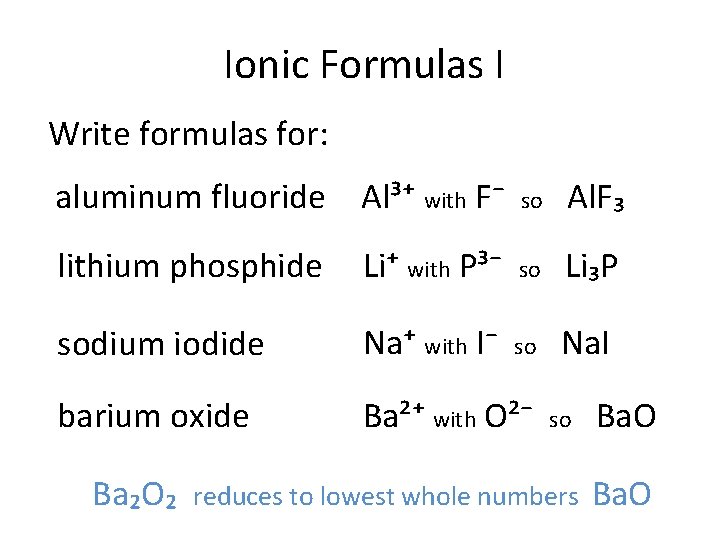
Ionic Formulas I Write formulas for: aluminum fluoride Al³⁺ with F⁻ so Al. F₃ lithium phosphide Li⁺ with P³⁻ so Li₃P sodium iodide Na⁺ with I⁻ so Na. I barium oxide Ba²⁺ with O²⁻ Ba₂O₂ so Ba. O reduces to lowest whole numbers Ba. O
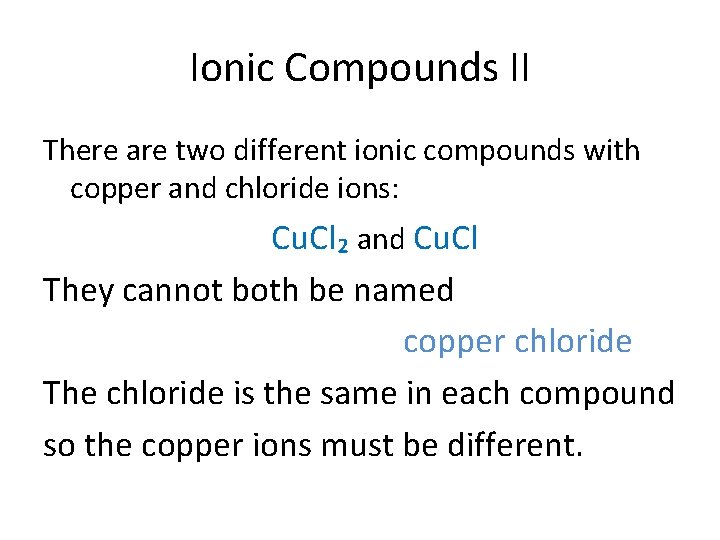
Ionic Compounds II There are two different ionic compounds with copper and chloride ions: Cu. Cl₂ and Cu. Cl They cannot both be named copper chloride The chloride is the same in each compound so the copper ions must be different.
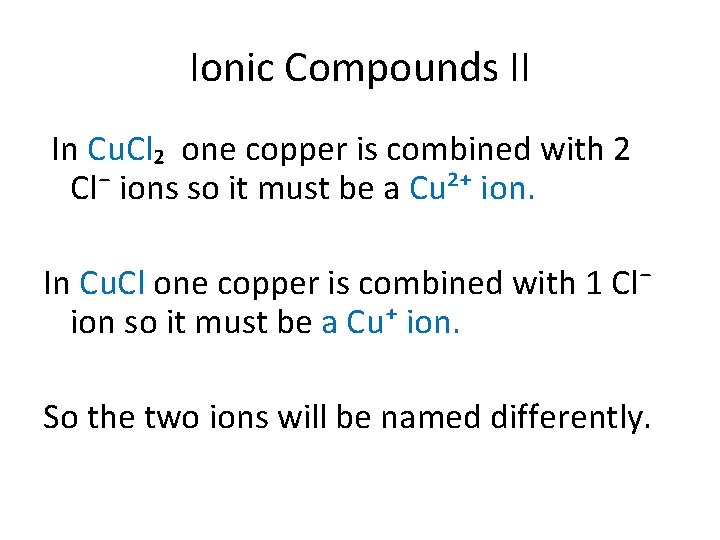
Ionic Compounds II In Cu. Cl₂ one copper is combined with 2 Cl⁻ ions so it must be a Cu²⁺ ion. In Cu. Cl one copper is combined with 1 Cl⁻ ion so it must be a Cu⁺ ion. So the two ions will be named differently.
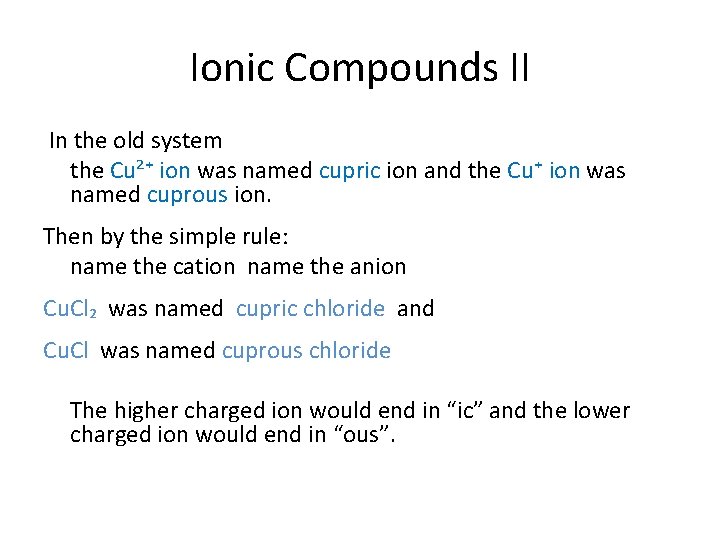
Ionic Compounds II In the old system the Cu²⁺ ion was named cupric ion and the Cu⁺ ion was named cuprous ion. Then by the simple rule: name the cation name the anion Cu. Cl₂ was named cupric chloride and Cu. Cl was named cuprous chloride The higher charged ion would end in “ic” and the lower charged ion would end in “ous”.
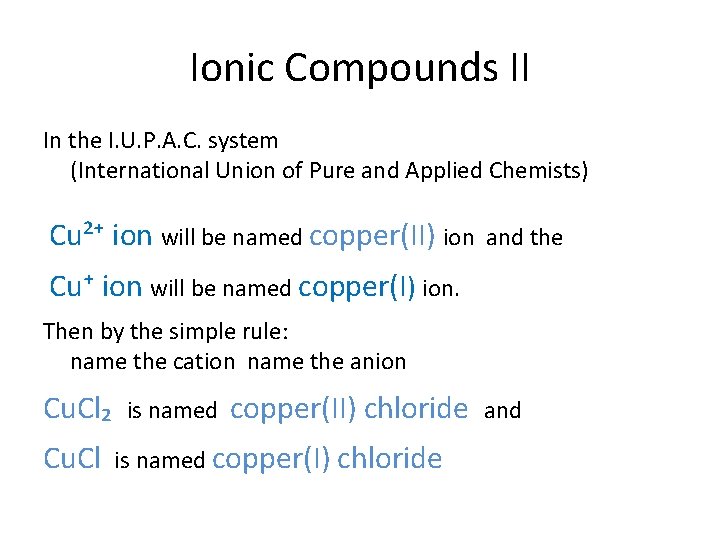
Ionic Compounds II In the I. U. P. A. C. system (International Union of Pure and Applied Chemists) Cu²⁺ ion will be named copper(II) ion and the Cu⁺ ion will be named copper(I) ion. Then by the simple rule: name the cation name the anion Cu. Cl₂ Cu. Cl is named copper(II) chloride is named copper(I) chloride and
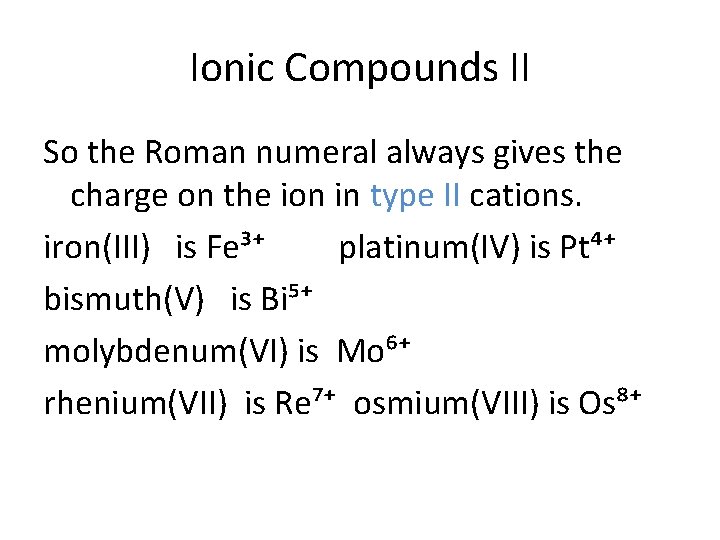
Ionic Compounds II So the Roman numeral always gives the charge on the ion in type II cations. iron(III) is Fe³⁺ platinum(IV) is Pt⁴⁺ bismuth(V) is Bi⁵⁺ molybdenum(VI) is Mo⁶⁺ rhenium(VII) is Re⁷⁺ osmium(VIII) is Os⁸⁺
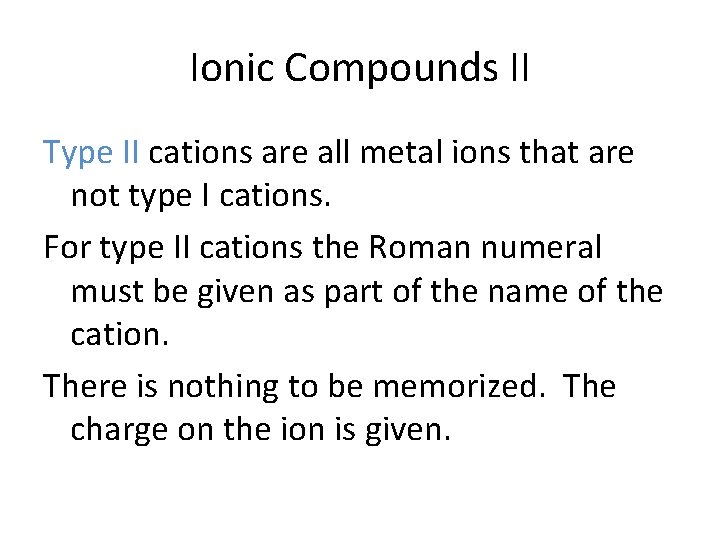
Ionic Compounds II Type II cations are all metal ions that are not type I cations. For type II cations the Roman numeral must be given as part of the name of the cation. There is nothing to be memorized. The charge on the ion is given.
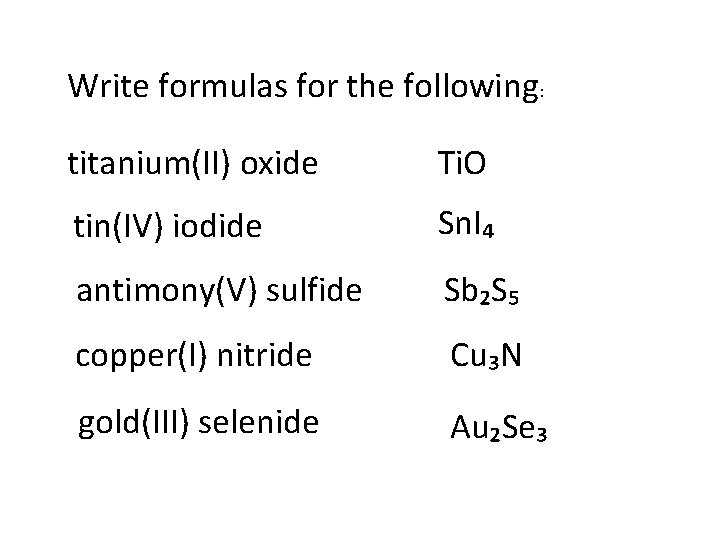
Write formulas for the following: titanium(II) oxide Ti. O tin(IV) iodide Sn. I₄ antimony(V) sulfide Sb₂S₅ copper(I) nitride Cu₃N gold(III) selenide Au₂Se₃
Names: Ionic Compounds II Since type II cations need Roman numerals in the name, the charge must be determined from the formula. The charge on the anion will be known. Then since all charges add to zero, the charge on the cation can be determined.
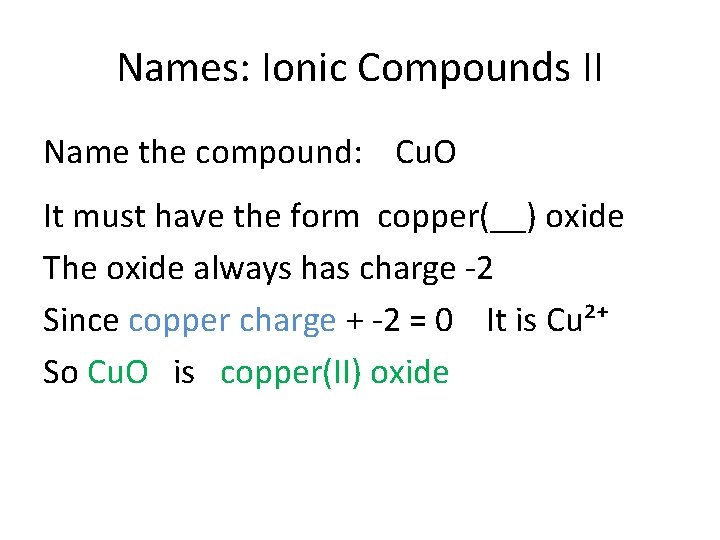
Names: Ionic Compounds II Name the compound: Cu. O It must have the form copper(__) oxide The oxide always has charge -2 Since copper charge + -2 = 0 It is Cu²⁺ So Cu. O is copper(II) oxide
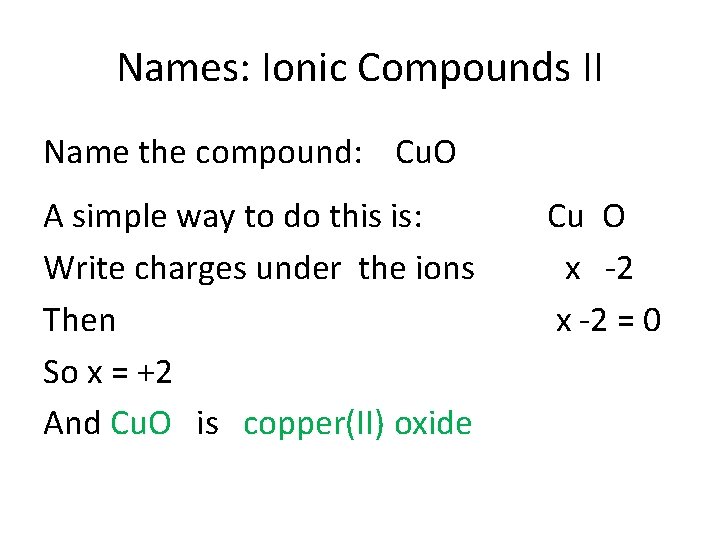
Names: Ionic Compounds II Name the compound: Cu. O A simple way to do this is: Write charges under the ions Then So x = +2 And Cu. O is copper(II) oxide Cu O x -2 = 0
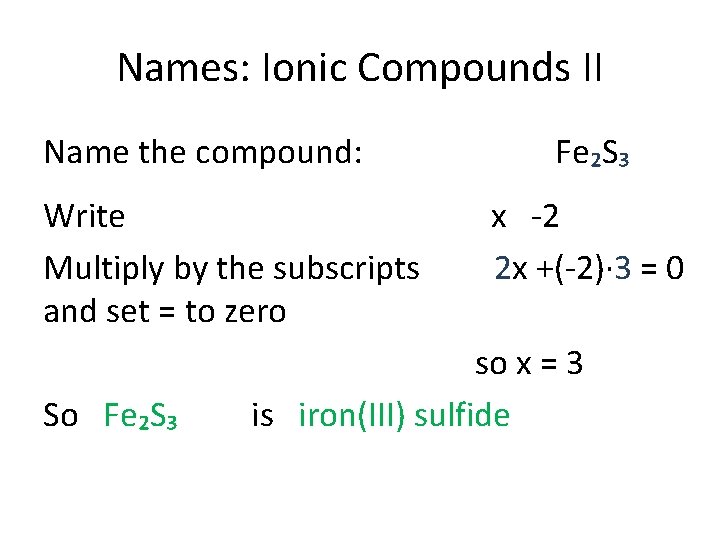
Names: Ionic Compounds II Name the compound: Write Multiply by the subscripts and set = to zero So Fe₂S₃ x -2 2 x +(-2)· 3 = 0 so x = 3 is iron(III) sulfide
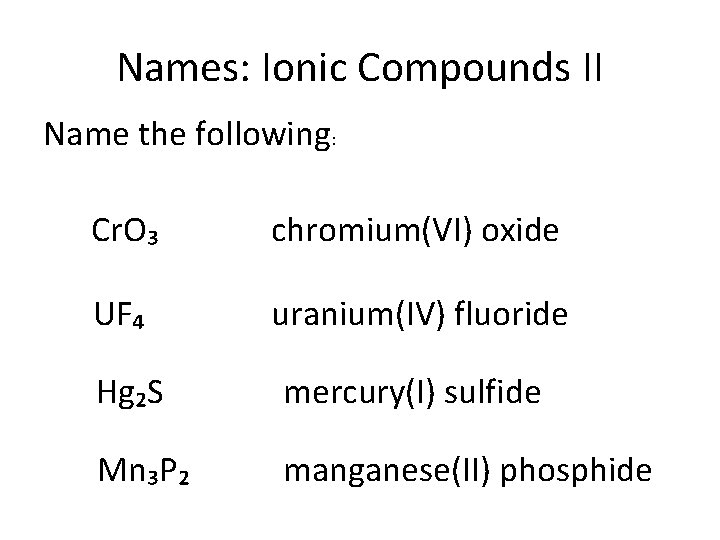
Names: Ionic Compounds II Name the following: Cr. O₃ chromium(VI) oxide UF₄ uranium(IV) fluoride Hg₂S mercury(I) sulfide Mn₃P₂ manganese(II) phosphide
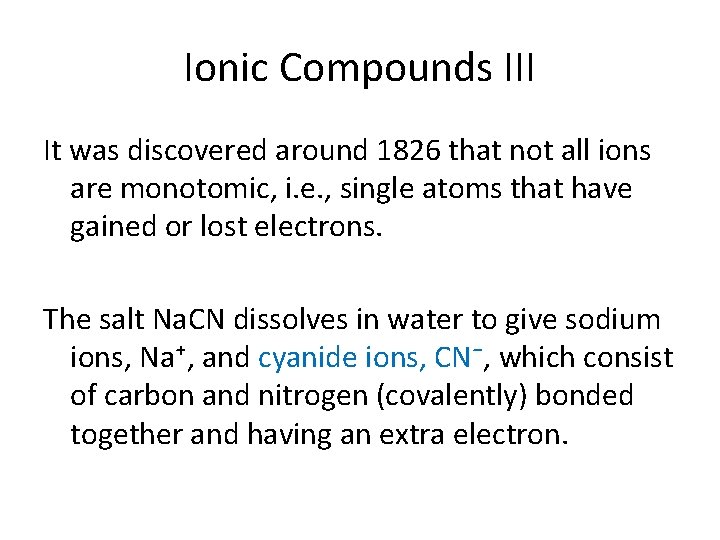
Ionic Compounds III It was discovered around 1826 that not all ions are monotomic, i. e. , single atoms that have gained or lost electrons. The salt Na. CN dissolves in water to give sodium ions, Na⁺, and cyanide ions, CN⁻, which consist of carbon and nitrogen (covalently) bonded together and having an extra electron.
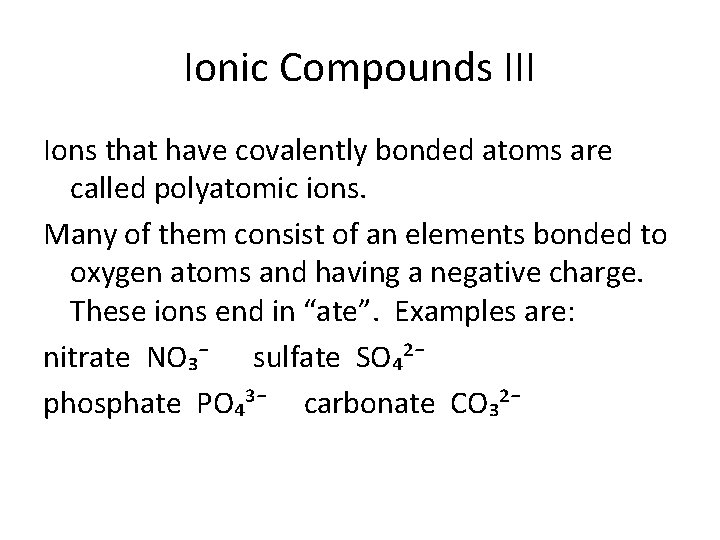
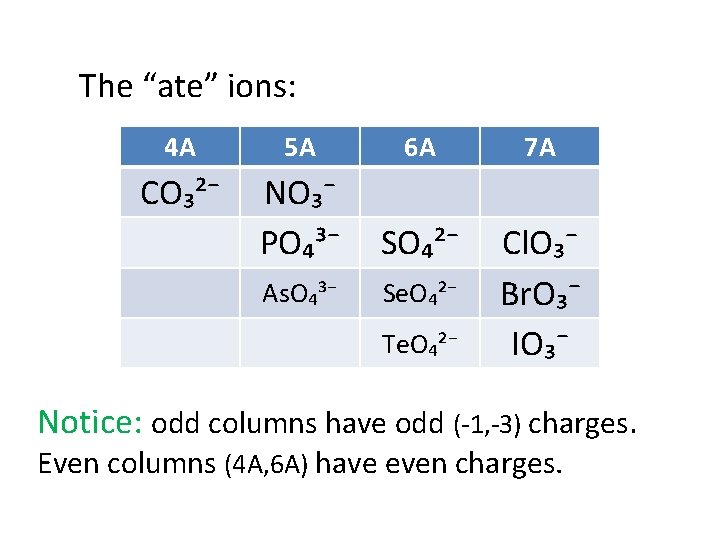
Ionic Compounds III Ions that have covalently bonded atoms are called polyatomic ions. Many of them consist of an elements bonded to oxygen atoms and having a negative charge. These ions end in “ate”. Examples are: nitrate NO₃⁻ sulfate SO₄²⁻ phosphate PO₄³⁻ carbonate CO₃²⁻
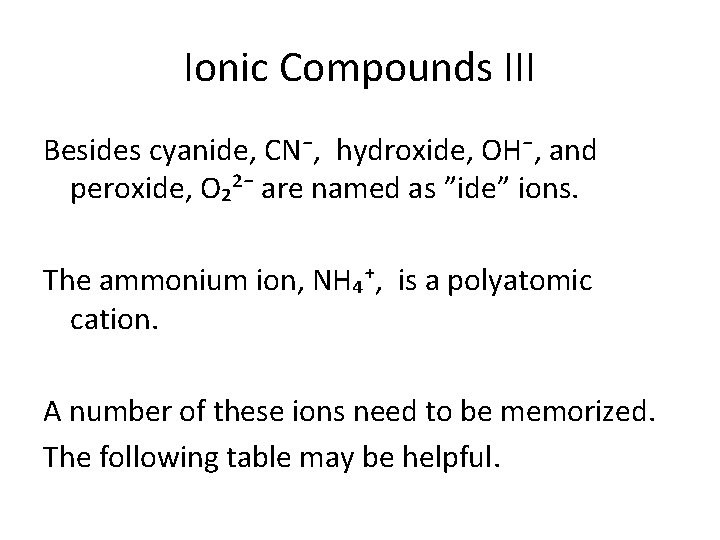
Ionic Compounds III Besides cyanide, CN⁻, hydroxide, OH⁻, and peroxide, O₂²⁻ are named as ”ide” ions. The ammonium ion, NH₄⁺, is a polyatomic cation. A number of these ions need to be memorized. The following table may be helpful.
The “ate” ions: 4 A 5 A 6 A 7 A CO₃²⁻ NO₃⁻ PO₄³⁻ SO₄²⁻ As. O₄³⁻ Se. O₄²⁻ Cl. O₃⁻ Br. O₃⁻ IO₃⁻ Te. O₄²⁻ Notice: odd columns have odd (-1, -3) charges. Even columns (4 A, 6 A) have even charges.
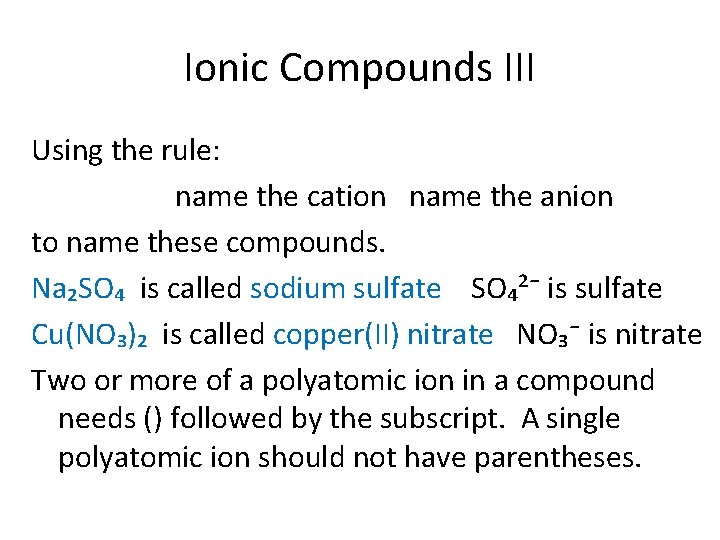
Ionic Compounds III Using the rule: name the cation name the anion to name these compounds. Na₂SO₄ is called sodium sulfate SO₄²⁻ is sulfate Cu(NO₃)₂ is called copper(II) nitrate NO₃⁻ is nitrate Two or more of a polyatomic ion in a compound needs () followed by the subscript. A single polyatomic ion should not have parentheses.