
Nomenclature Formula Writing Rules for Writing Formulas Each
- Slides: 16
Nomenclature
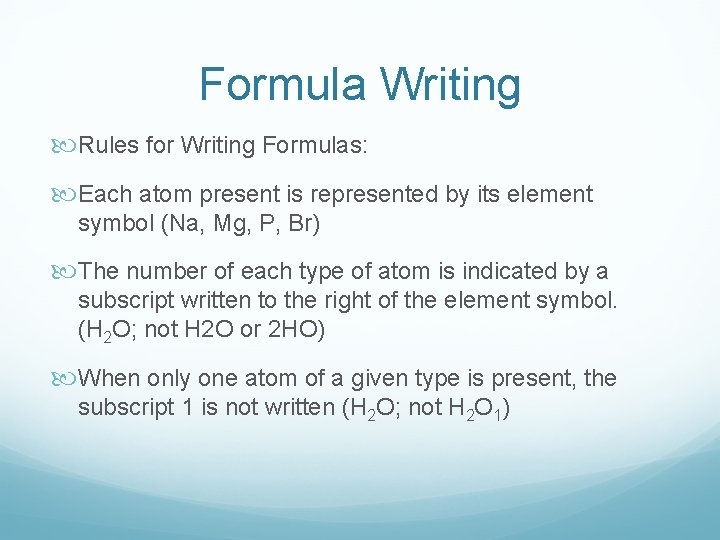
Formula Writing Rules for Writing Formulas: Each atom present is represented by its element symbol (Na, Mg, P, Br) The number of each type of atom is indicated by a subscript written to the right of the element symbol. (H 2 O; not H 2 O or 2 HO) When only one atom of a given type is present, the subscript 1 is not written (H 2 O; not H 2 O 1)
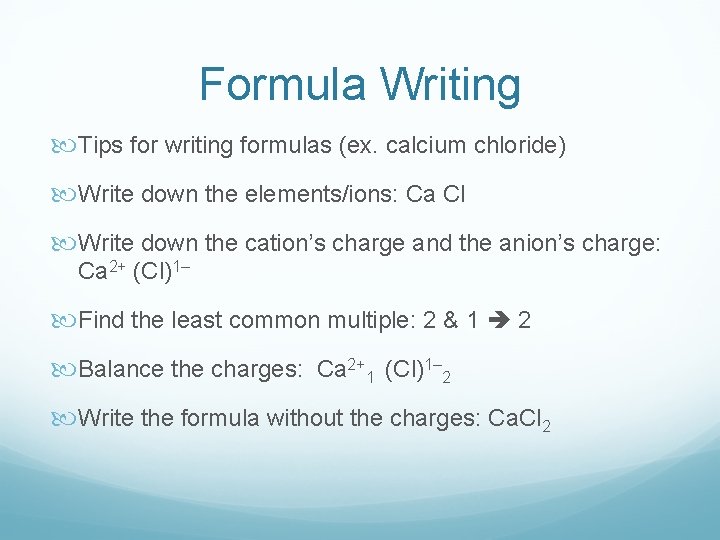
Formula Writing Tips for writing formulas (ex. calcium chloride) Write down the elements/ions: Ca Cl Write down the cation’s charge and the anion’s charge: Ca 2+ (Cl)1– Find the least common multiple: 2 & 1 2 Balance the charges: Ca 2+1 (Cl)1– 2 Write the formula without the charges: Ca. Cl 2
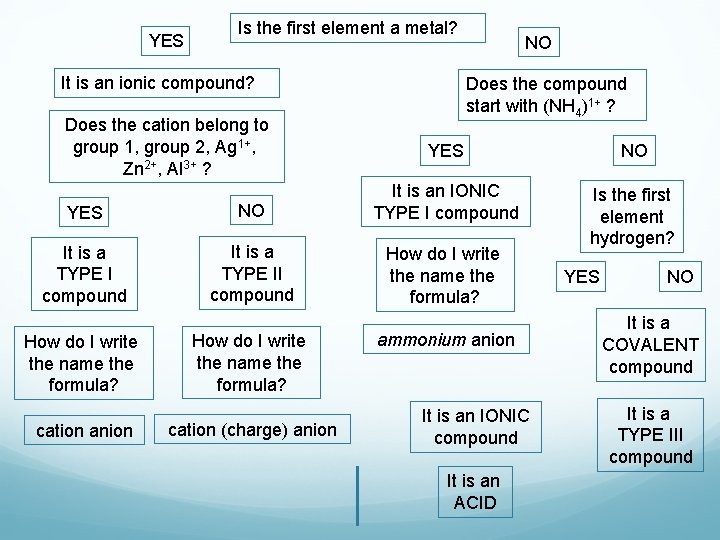
YES Is the first element a metal? It is an ionic compound? Does the cation belong to group 1, group 2, Ag 1+, Zn 2+, Al 3+ ? NO Does the compound start with (NH 4)1+ ? YES NO Is the first element hydrogen? YES NO It is an IONIC TYPE I compound It is a TYPE II compound How do I write the name the formula? cation anion How do I write the name the formula? cation (charge) anion ammonium anion It is an IONIC compound It is an ACID YES NO It is a COVALENT compound It is a TYPE III compound
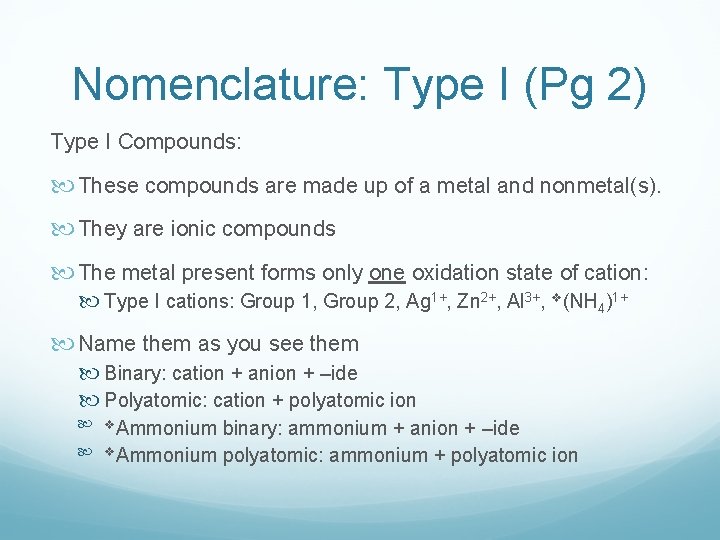
Nomenclature: Type I (Pg 2) Type I Compounds: These compounds are made up of a metal and nonmetal(s). They are ionic compounds The metal present forms only one oxidation state of cation: Type I cations: Group 1, Group 2, Ag 1+, Zn 2+, Al 3+, (NH 4)1+ Name them as you see them Binary: cation + anion + –ide Polyatomic: cation + polyatomic ion Ammonium binary: ammonium + anion + –ide Ammonium polyatomic: ammonium + polyatomic ion
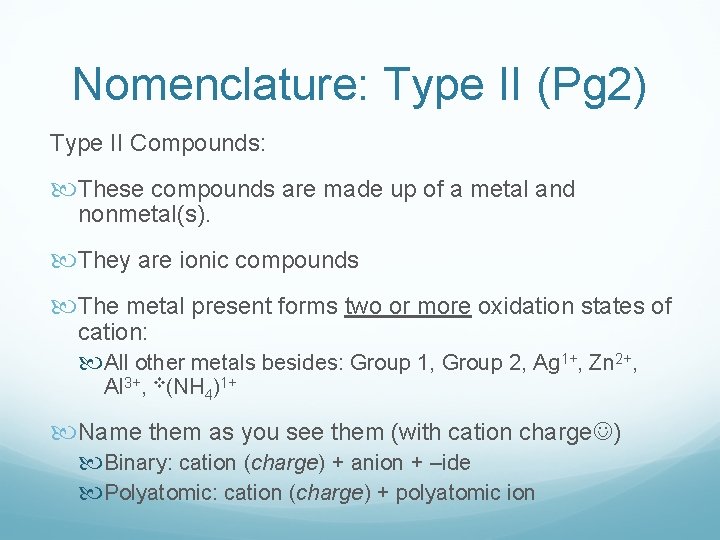
Nomenclature: Type II (Pg 2) Type II Compounds: These compounds are made up of a metal and nonmetal(s). They are ionic compounds The metal present forms two or more oxidation states of cation: All other metals besides: Group 1, Group 2, Ag 1+, Zn 2+, Al 3+, (NH 4)1+ Name them as you see them (with cation charge ) Binary: cation (charge) + anion + –ide Polyatomic: cation (charge) + polyatomic ion
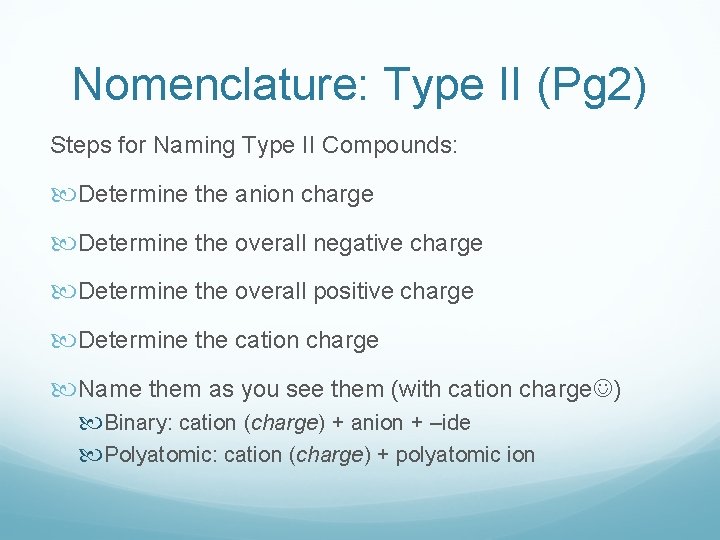
Nomenclature: Type II (Pg 2) Steps for Naming Type II Compounds: Determine the anion charge Determine the overall negative charge Determine the overall positive charge Determine the cation charge Name them as you see them (with cation charge ) Binary: cation (charge) + anion + –ide Polyatomic: cation (charge) + polyatomic ion
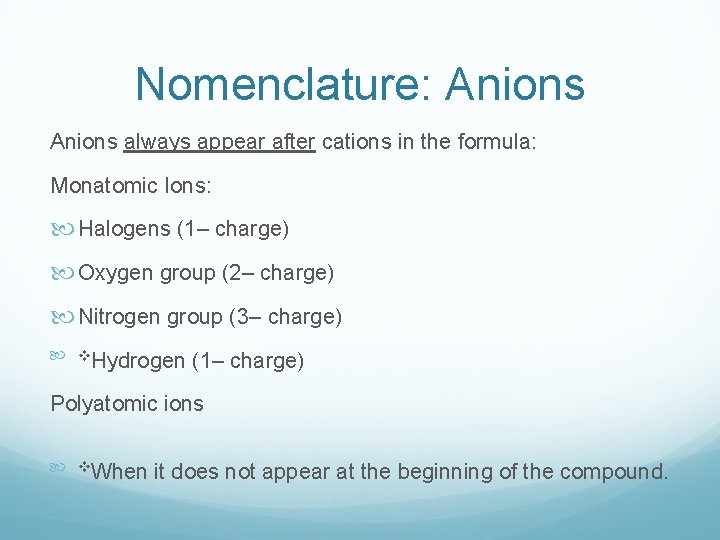
Nomenclature: Anions always appear after cations in the formula: Monatomic Ions: Halogens (1– charge) Oxygen group (2– charge) Nitrogen group (3– charge) Hydrogen (1– charge) Polyatomic ions When it does not appear at the beginning of the compound.
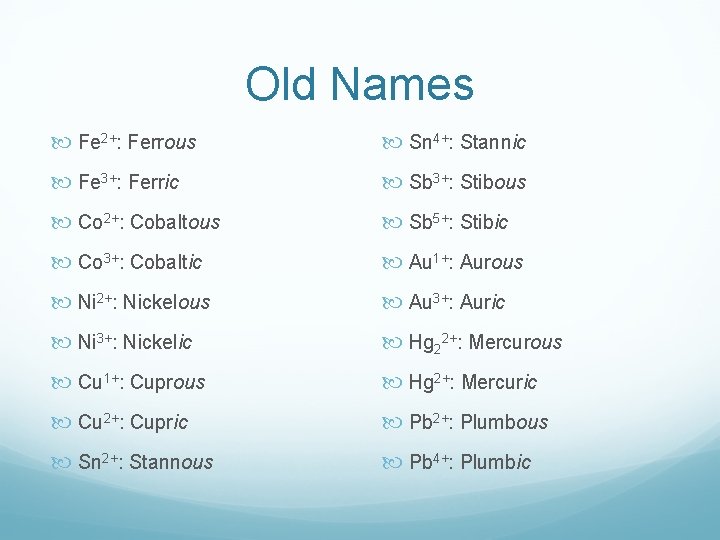
Old Names Fe 2+: Ferrous Sn 4+: Stannic Fe 3+: Ferric Sb 3+: Stibous Co 2+: Cobaltous Sb 5+: Stibic Co 3+: Cobaltic Au 1+: Aurous Ni 2+: Nickelous Au 3+: Auric Ni 3+: Nickelic Hg 22+: Mercurous Cu 1+: Cuprous Hg 2+: Mercuric Cu 2+: Cupric Pb 2+: Plumbous Sn 2+: Stannous Pb 4+: Plumbic
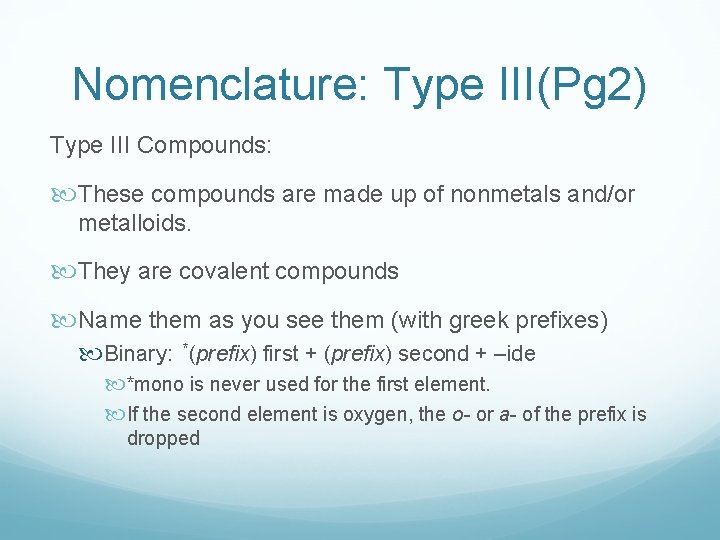
Nomenclature: Type III(Pg 2) Type III Compounds: These compounds are made up of nonmetals and/or metalloids. They are covalent compounds Name them as you see them (with greek prefixes) Binary: *(prefix) first + (prefix) second + –ide *mono is never used for the first element. If the second element is oxygen, the o- or a- of the prefix is dropped
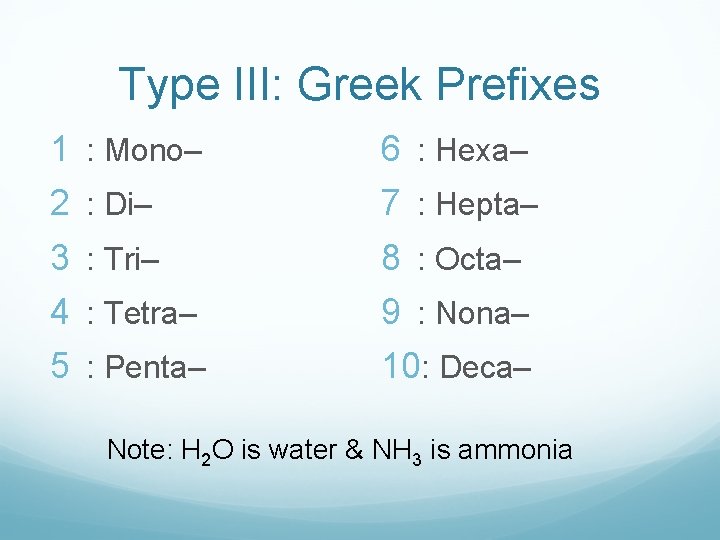
Type III: Greek Prefixes 1 : Mono– 6 : Hexa– 2 : Di– 7 : Hepta– 3 : Tri– 8 : Octa– 4 : Tetra– 9 : Nona– 5 : Penta– 10: Deca– Note: H 2 O is water & NH 3 is ammonia
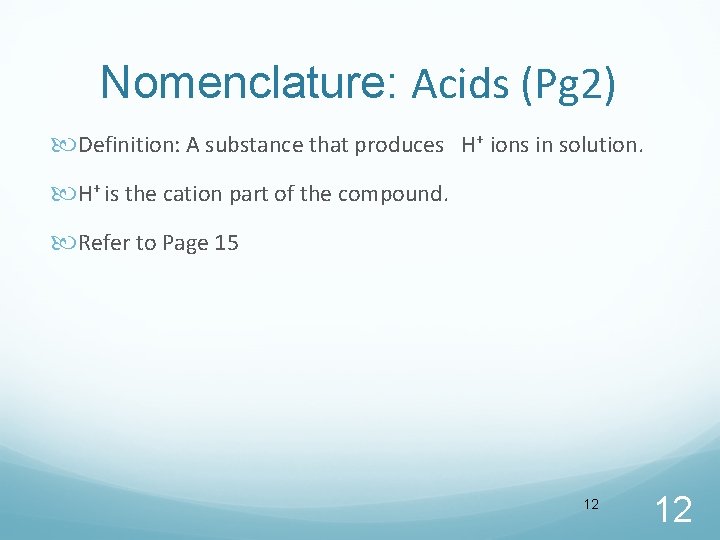
Nomenclature: Acids (Pg 2) Definition: A substance that produces H+ ions in solution. H+ is the cation part of the compound. Refer to Page 15 12 12
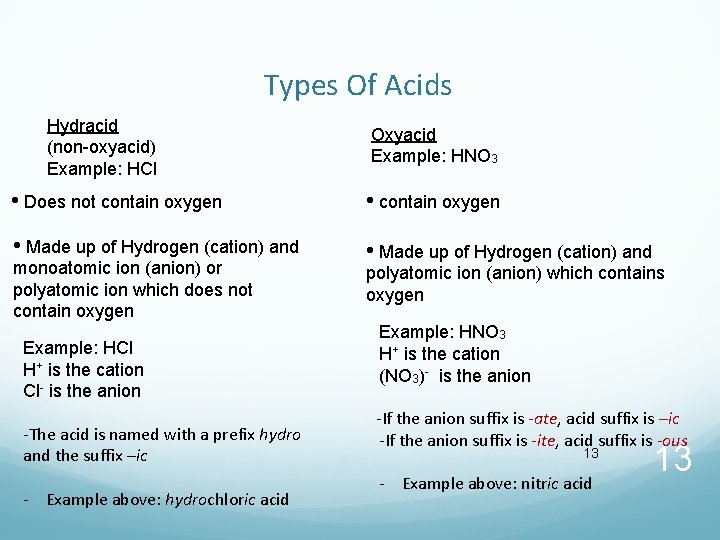
Types Of Acids Hydracid (non-oxyacid) Example: HCl Oxyacid Example: HNO 3 • Does not contain oxygen • Made up of Hydrogen (cation) and monoatomic ion (anion) or polyatomic ion which does not contain oxygen Example: HCl H+ is the cation Cl- is the anion -The acid is named with a prefix hydro and the suffix –ic - Example above: hydrochloric acid polyatomic ion (anion) which contains oxygen Example: HNO 3 H+ is the cation (NO 3)- is the anion -If the anion suffix is -ate, acid suffix is –ic -If the anion suffix is -ite, acid suffix is -ous 13 - Example above: nitric acid 13
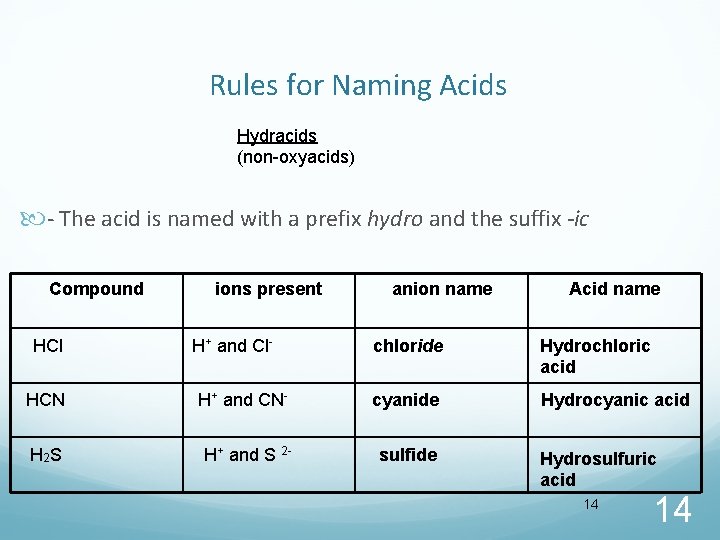
Rules for Naming Acids Hydracids (non-oxyacids) - The acid is named with a prefix hydro and the suffix -ic Compound HCl ions present H+ and Cl- anion name Acid name chloride Hydrochloric acid Hydrocyanic acid HCN H+ and CN- cyanide H 2 S H+ and S 2 - sulfide Hydrosulfuric acid 14 14
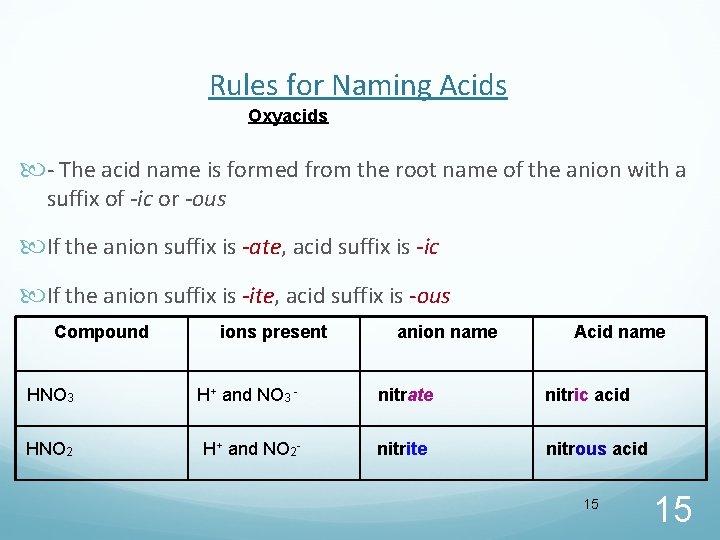
Rules for Naming Acids Oxyacids - The acid name is formed from the root name of the anion with a suffix of -ic or -ous If the anion suffix is -ate, acid suffix is -ic If the anion suffix is -ite, acid suffix is -ous Compound ions present anion name Acid name HNO 3 H+ and NO 3 - nitrate nitric acid HNO 2 H+ and NO 2 - nitrite nitrous acid 15 15
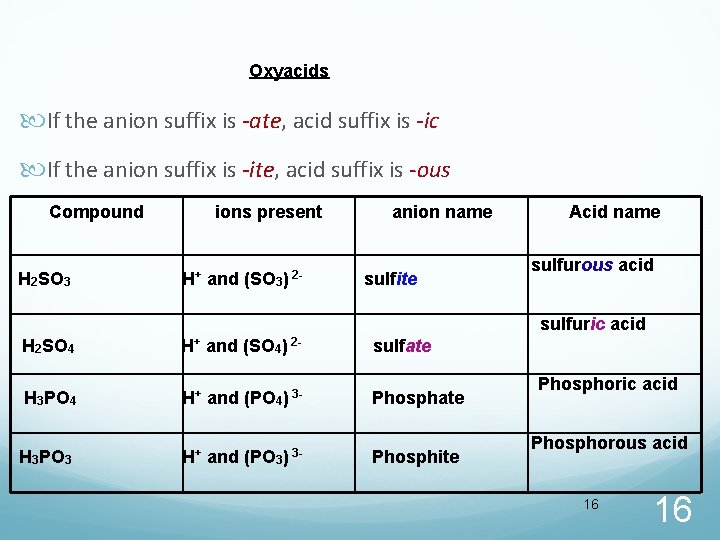
Oxyacids If the anion suffix is -ate, acid suffix is -ic If the anion suffix is -ite, acid suffix is -ous Compound H 2 SO 3 ions present H+ and (SO 3 ) 2 - anion name sulfite Acid name sulfurous acid sulfuric acid H 2 SO 4 H+ and (SO 4) 2 - sulfate H 3 PO 4 H+ and (PO 4) 3 - Phosphate H 3 PO 3 H+ and (PO 3) 3 - Phosphite Phosphoric acid Phosphorous acid 16 16