
Noise Susceptibility Measurement of Front End Electronics Systems
Noise Susceptibility Measurement of Front. End Electronics Systems B. Allongue a, F. Anghinolfi a, G. Blanchot a, F. Faccio a, C. Fuentes a, b, S. Michelis a, c, S. Orlandi a, A. Toro b a CERN, 1211 Geneva 23, Switzerland Valparaiso, Chile c EPFL, Lausanne, Switzerland b UTFSM, Topic Workshop on Electronics for Particle Physics September 2008, Naxos, Greece G. Blanchot CERN, CH-1211 Geneva 23, Switzerland Georges. Blanchot@cern. ch
Outline Exposing systems to controlled EMI sources to evaluate their impact on the output data in a quantifiable manner. § Noise coupling into front-end systems. q q § Susceptibility to conducted noise. q q q § Measurement method. Susceptibility of the ATLAS Roman Pots prototype. System tests with DC/DC converters on TOTEM. Susceptibility to electric fields. q q § Conducted noise. Radiated noise. Evaluation method. Susceptibility of the TOTEM front-end against electric field. Susceptibility to magnetic couplings. q q Evaluation method. Susceptibility of the TOTEM front-end against inductor field. TWEPP 2008 G. Blanchot, CERN 2
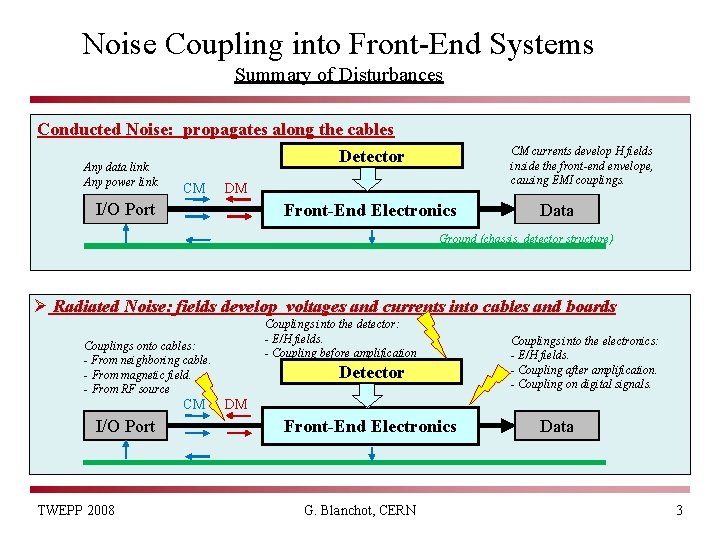
Noise Coupling into Front-End Systems Summary of Disturbances Conducted Noise: propagates along the cables Detector Any data link. Any power link. CM CM currents develop H fields inside the front-end envelope, causing EMI couplings. DM I/O Port Front-End Electronics Data Ground (chassis, detector structure) Ø Radiated Noise: fields develop voltages and currents into cables and boards Couplings into the detector: - E/H fields. - Coupling before amplification Couplings onto cables: - From neighboring cable. - From magnetic field. - From RF source CM I/O Port TWEPP 2008 Detector Couplings into the electronics: - E/H fields. - Coupling after amplification. - Coupling on digital signals. DM Front-End Electronics G. Blanchot, CERN Data 3
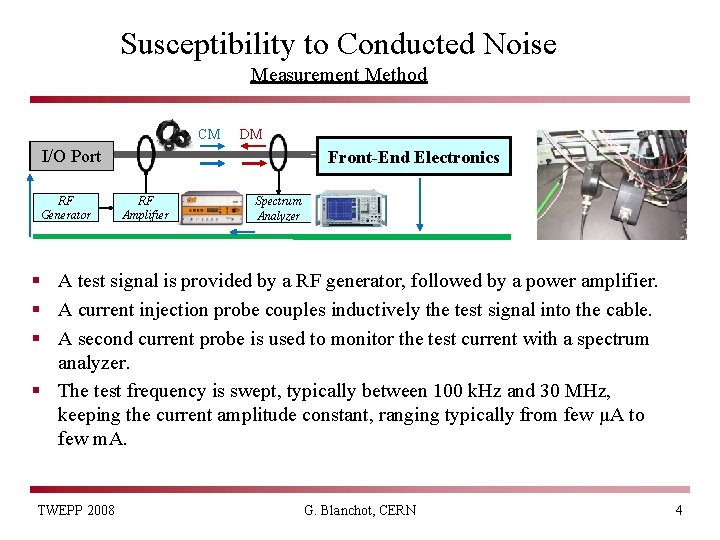
Susceptibility to Conducted Noise Measurement Method CM DM I/O Port RF Generator Front-End Electronics RF Amplifier Spectrum Analyzer § A test signal is provided by a RF generator, followed by a power amplifier. § A current injection probe couples inductively the test signal into the cable. § A second current probe is used to monitor the test current with a spectrum analyzer. § The test frequency is swept, typically between 100 k. Hz and 30 MHz, keeping the current amplitude constant, ranging typically from few μA to few m. A. TWEPP 2008 G. Blanchot, CERN 4
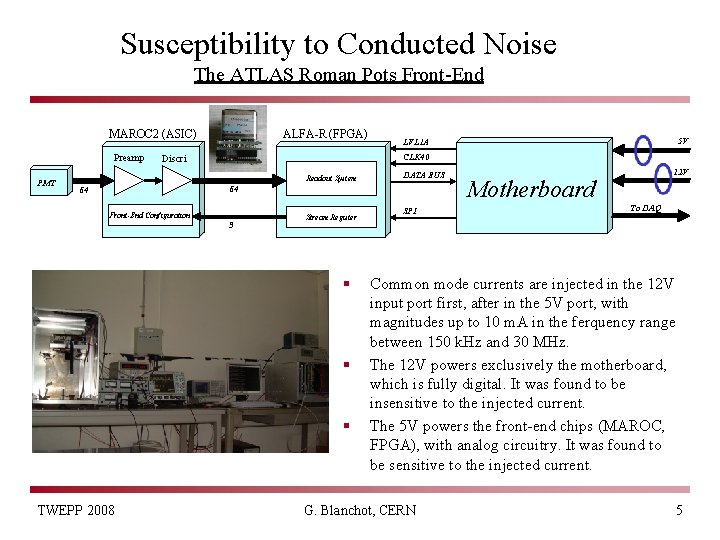
Susceptibility to Conducted Noise The ATLAS Roman Pots Front-End MAROC 2 (ASIC) Preamp PMT ALFA-R (FPGA) CLK 40 Discri Readout System DATA BUS 64 64 Front-End Configuration 3 Stream Register § § § TWEPP 2008 5 V LVL 1 A SPI 12 V Motherboard To DAQ Common mode currents are injected in the 12 V input port first, after in the 5 V port, with magnitudes up to 10 m. A in the ferquency range between 150 k. Hz and 30 MHz. The 12 V powers exclusively the motherboard, which is fully digital. It was found to be insensitive to the injected current. The 5 V powers the front-end chips (MAROC, FPGA), with analog circuitry. It was found to be sensitive to the injected current. G. Blanchot, CERN 5
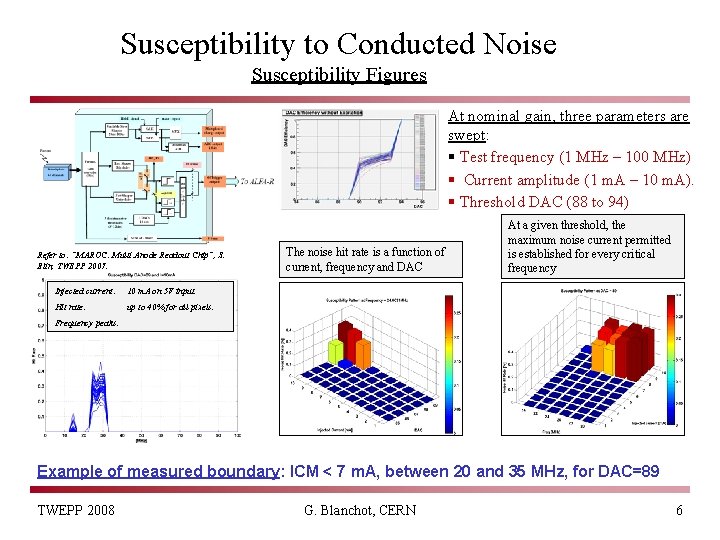
Susceptibility to Conducted Noise Susceptibility Figures At nominal gain, three parameters are swept: § Test frequency (1 MHz – 100 MHz) § Current amplitude (1 m. A – 10 m. A). § Threshold DAC (88 to 94) Refer to: “MAROC: Multi Anode Readout Chip”, S. Blin, TWEPP 2007. Injected current: 10 m. A on 5 V input. Hit rate: up to 40% for all pixels. The noise hit rate is a function of current, frequency and DAC At a given threshold, the maximum noise current permitted is established for every critical frequency Frequency peaks: Example of measured boundary: ICM < 7 m. A, between 20 and 35 MHz, for DAC=89 TWEPP 2008 G. Blanchot, CERN 6
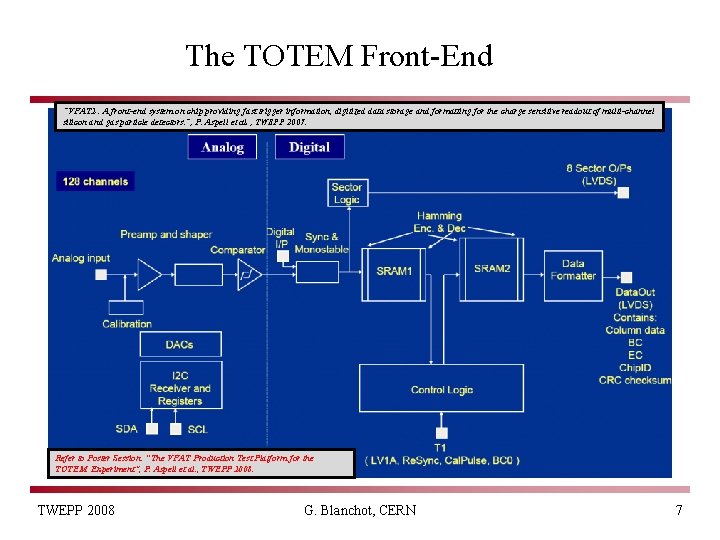
The TOTEM Front-End “VFAT 2 : A front-end system on chip providing fast trigger information, digitized data storage and formatting for the charge sensitive readout of multi-channel silicon and gas particle detectors. ”, P. Aspell et al. , TWEPP 2007. Refer to Poster Session: “The VFAT Production Test Platform for the TOTEM Experiment”, P. Aspell et al. , TWEPP 2008 G. Blanchot, CERN 7
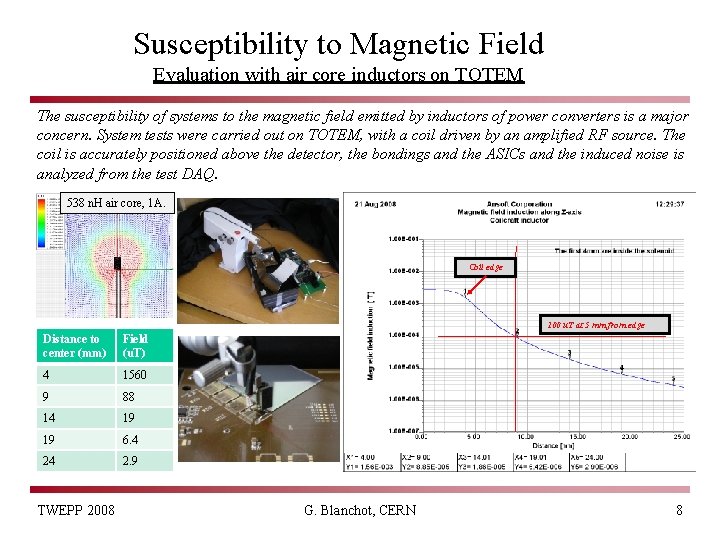
Susceptibility to Magnetic Field Evaluation with air core inductors on TOTEM The susceptibility of systems to the magnetic field emitted by inductors of power converters is a major concern. System tests were carried out on TOTEM, with a coil driven by an amplified RF source. The coil is accurately positioned above the detector, the bondings and the ASICs and the induced noise is analyzed from the test DAQ. 538 n. H air core, 1 A. Coil edge 100 u. T at 5 mm from edge Distance to center (mm) Field (u. T) 4 1560 9 88 14 19 19 6. 4 24 2. 9 TWEPP 2008 G. Blanchot, CERN 8
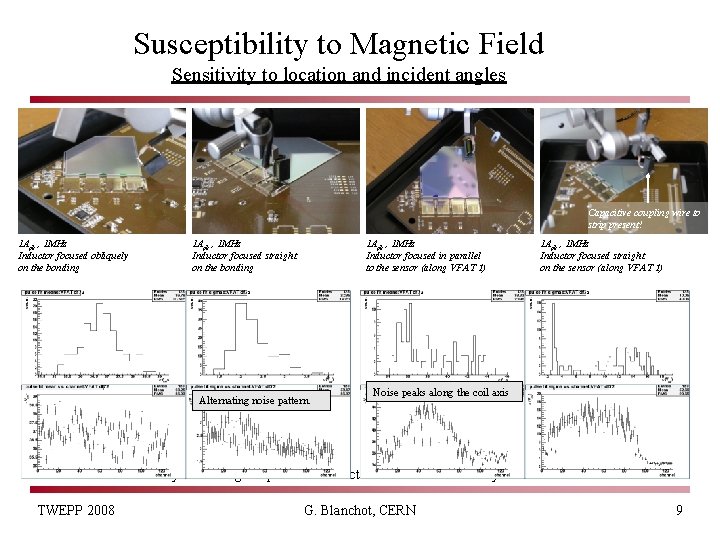
Susceptibility to Magnetic Field Sensitivity to location and incident angles Capacitive coupling wire to strip present! 1 Apk , 1 MHz Inductor focused obliquely on the bonding 1 Apk , 1 MHz Inductor focused straight on the bonding 1 Apk , 1 MHz Inductor focused in parallel to the sensor (along VFAT 1) Alternating noise pattern. 1 Apk , 1 MHz Inductor focused straight on the sensor (along VFAT 1) Noise peaks along the coil axis The noise is estimated by the average slope of the characterized S curves for every VFAT channel. TWEPP 2008 G. Blanchot, CERN 9
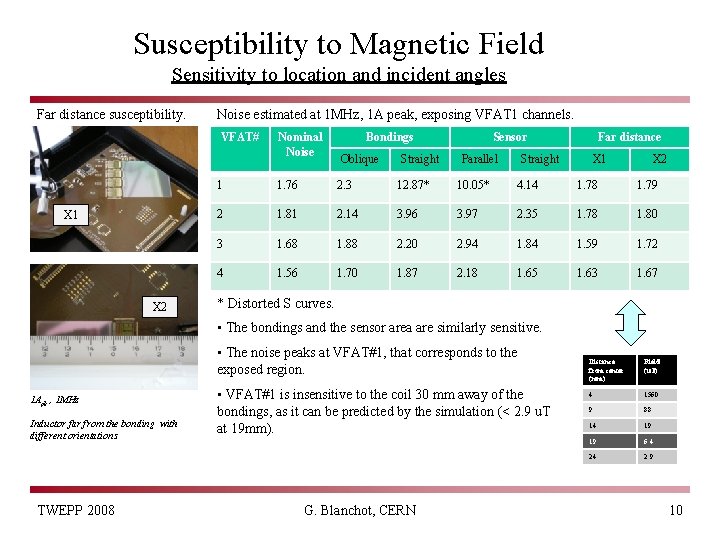
Susceptibility to Magnetic Field Sensitivity to location and incident angles Far distance susceptibility. Noise estimated at 1 MHz, 1 A peak, exposing VFAT 1 channels. VFAT# X 1 X 2 Nominal Noise Bondings Oblique Straight Sensor Parallel Straight Far distance X 1 X 2 1 1. 76 2. 3 12. 87* 10. 05* 4. 14 1. 78 1. 79 2 1. 81 2. 14 3. 96 3. 97 2. 35 1. 78 1. 80 3 1. 68 1. 88 2. 20 2. 94 1. 84 1. 59 1. 72 4 1. 56 1. 70 1. 87 2. 18 1. 65 1. 63 1. 67 * Distorted S curves. • The bondings and the sensor area are similarly sensitive. • The noise peaks at VFAT#1, that corresponds to the exposed region. 1 Apk , 1 MHz Inductor far from the bonding with different orientations TWEPP 2008 • VFAT#1 is insensitive to the coil 30 mm away of the bondings, as it can be predicted by the simulation (< 2. 9 u. T at 19 mm). G. Blanchot, CERN Distance from center (mm) Field (u. T) 4 1560 9 88 14 19 19 6. 4 24 2. 9 10
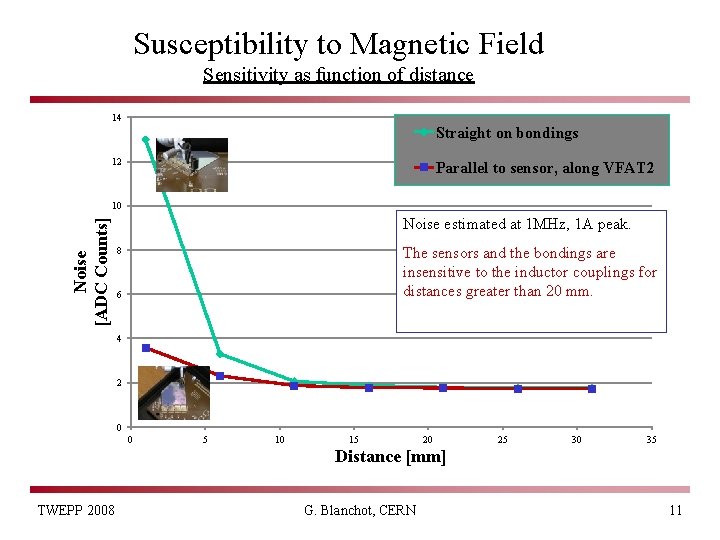
Susceptibility to Magnetic Field Sensitivity as function of distance 14 Straight on bondings 12 Parallel to sensor, along VFAT 2 Noise [ADC Counts] 10 Noise estimated at 1 MHz, 1 A peak. The sensors and the bondings are insensitive to the inductor couplings for distances greater than 20 mm. 8 6 4 2 0 0 5 10 15 20 25 30 35 Distance [mm] TWEPP 2008 G. Blanchot, CERN 11
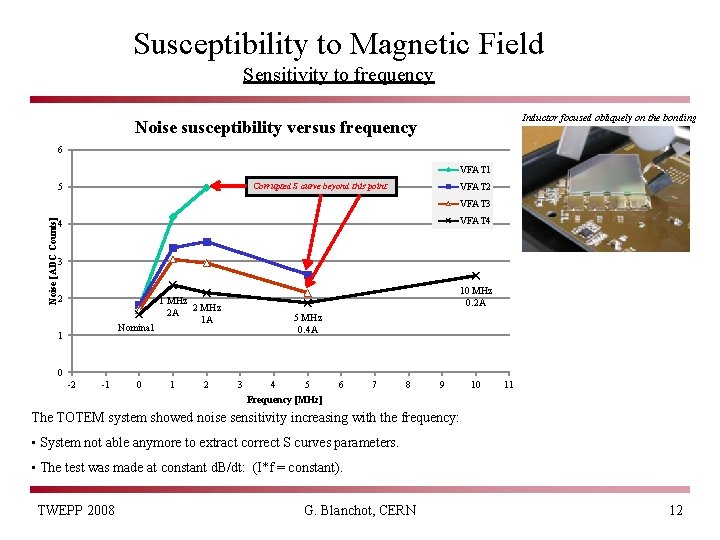
Susceptibility to Magnetic Field Sensitivity to frequency Inductor focused obliquely on the bonding Noise susceptibility versus frequency 6 VFAT 1 Corrupted S curve beyond this point 5 VFAT 2 Noise [ADC Counts] VFAT 3 VFAT 4 4 3 2 Nominal 1 10 MHz 0. 2 A 1 MHz 2 A 2 MHz 1 A 5 MHz 0. 4 A 0 -2 -1 0 1 2 3 4 5 6 7 8 9 10 11 Frequency [MHz] The TOTEM system showed noise sensitivity increasing with the frequency: • System not able anymore to extract correct S curves parameters. • The test was made at constant d. B/dt: (I*f = constant). TWEPP 2008 G. Blanchot, CERN 12
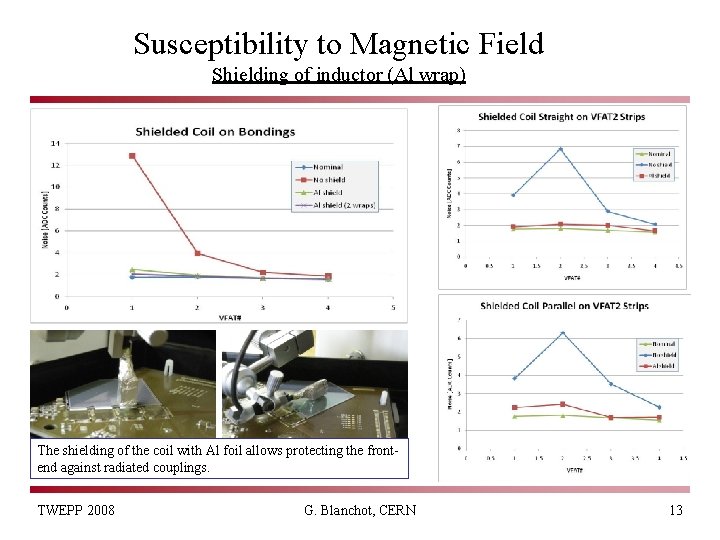
Susceptibility to Magnetic Field Shielding of inductor (Al wrap) The shielding of the coil with Al foil allows protecting the frontend against radiated couplings. TWEPP 2008 G. Blanchot, CERN 13
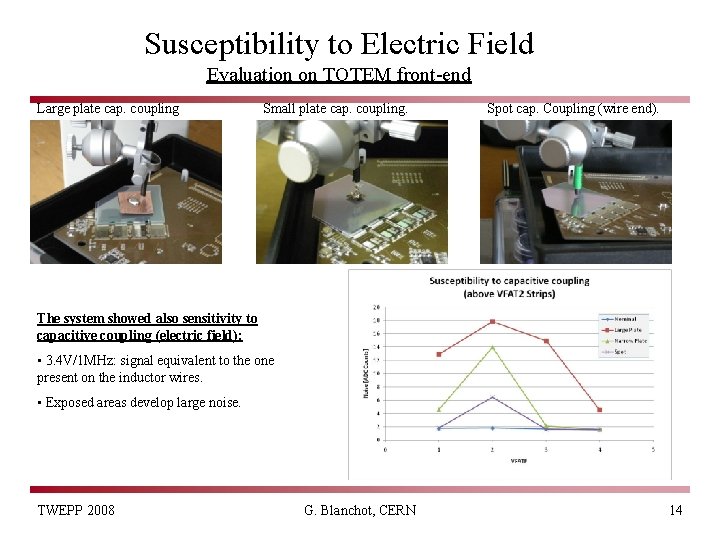
Susceptibility to Electric Field Evaluation on TOTEM front-end Large plate cap. coupling Small plate cap. coupling. Spot cap. Coupling (wire end). The system showed also sensitivity to capacitive coupling (electric field): • 3. 4 V/1 MHz: signal equivalent to the one present on the inductor wires. • Exposed areas develop large noise. TWEPP 2008 G. Blanchot, CERN 14
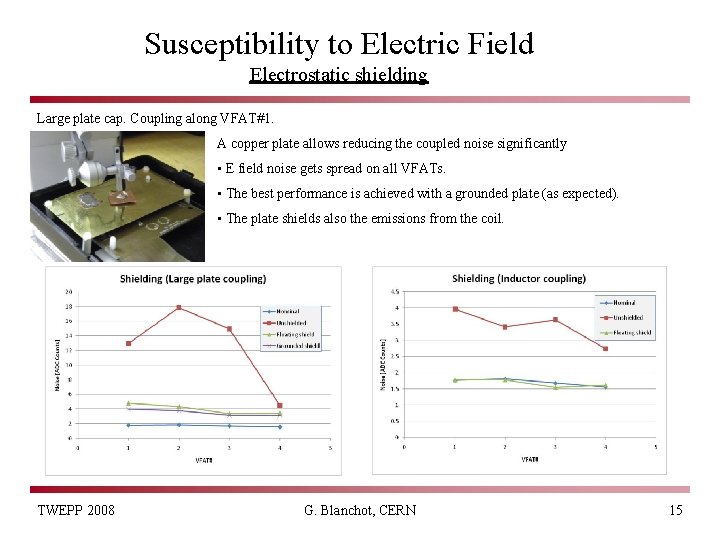
Susceptibility to Electric Field Electrostatic shielding Large plate cap. Coupling along VFAT#1. A copper plate allows reducing the coupled noise significantly • E field noise gets spread on all VFATs. • The best performance is achieved with a grounded plate (as expected). • The plate shields also the emissions from the coil. TWEPP 2008 G. Blanchot, CERN 15
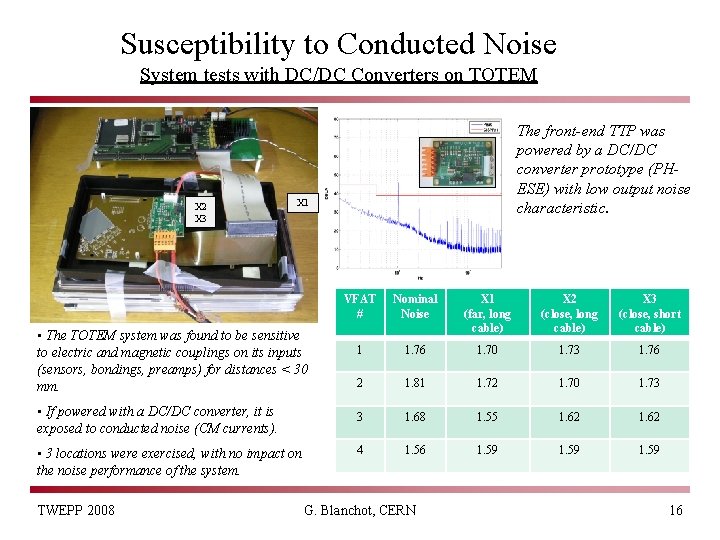
Susceptibility to Conducted Noise System tests with DC/DC Converters on TOTEM X 2 X 3 X 1 • The TOTEM system was found to be sensitive to electric and magnetic couplings on its inputs (sensors, bondings, preamps) for distances < 30 mm. • If powered with a DC/DC converter, it is exposed to conducted noise (CM currents). • 3 locations were exercised, with no impact on the noise performance of the system. TWEPP 2008 The front-end TTP was powered by a DC/DC converter prototype (PHESE) with low output noise characteristic. VFAT # Nominal Noise X 1 (far, long cable) X 2 (close, long cable) X 3 (close, short cable) 1 1. 76 1. 70 1. 73 1. 76 2 1. 81 1. 72 1. 70 1. 73 3 1. 68 1. 55 1. 62 4 1. 56 1. 59 G. Blanchot, CERN 16
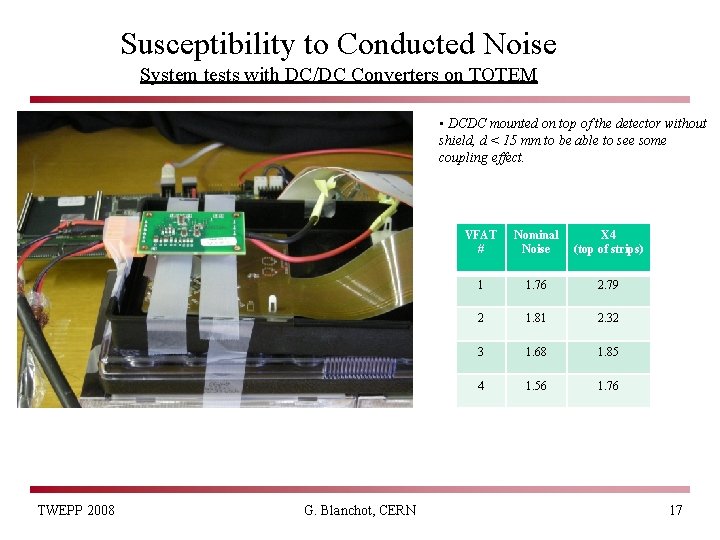
Susceptibility to Conducted Noise System tests with DC/DC Converters on TOTEM • DCDC mounted on top of the detector without shield, d < 15 mm to be able to see some coupling effect. X 2 X 3 TWEPP 2008 G. Blanchot, CERN VFAT # Nominal Noise X 4 (top of strips) 1 1. 76 2. 79 2 1. 81 2. 32 3 1. 68 1. 85 4 1. 56 1. 76 17
Conclusions § § § Systems are exposed to conducted noise, electric fields and magnetic fields. Simple test methods to evaluate their susceptibility were proposed, but it remains difficult to disentangle the radiated components. The characterization of the conducted noise susceptibility can be carried out accurately, allowing to set precise requirements for the power supplies. The susceptibility to radiated fields can be easily evaluated: q q q § § It is possible to discriminate between electric and magnetic couplings. Geometrical bondaries can be defined. Shielding methods can be evaluated. The evaluation on the TOTEM front-end predicted susceptibility to both electric and magnetic couplings that are typically found in power converters, for distances of less than 20 mm. The susceptibility could be strongly reduced using shields. The TOTEM front-end was successfully operated, powering it with a low noise DC to DC converter, without increasing the system noise, without the addition of any shield, down to distances of 15 mm of the most critical location (bonding and strips). TWEPP 2008 G. Blanchot, CERN 18
- Slides: 18