
Noise Source Channel Message Context Feedback Model of

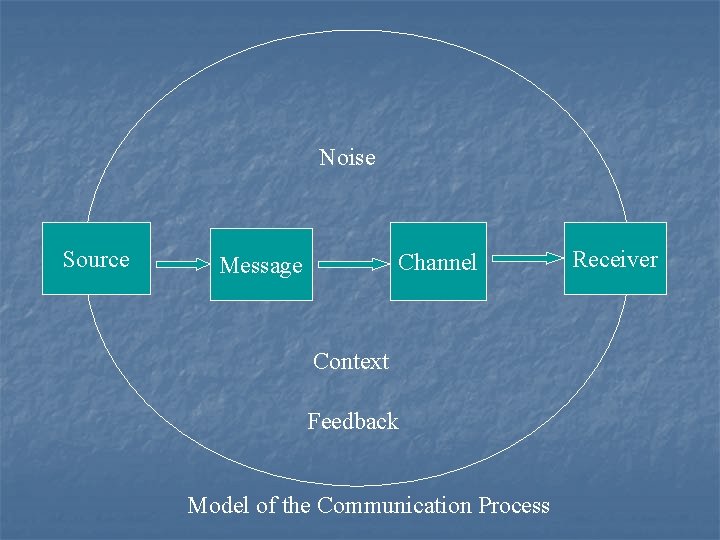
Noise Source Channel Message Context Feedback Model of the Communication Process Receiver
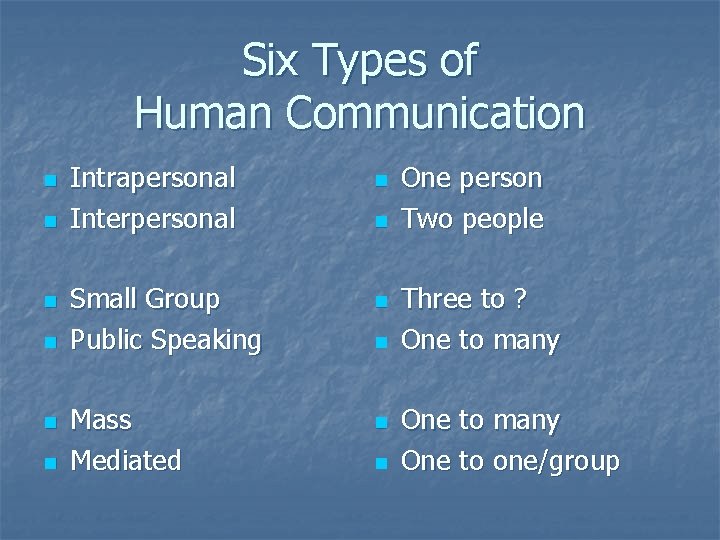
Six Types of Human Communication n n n Intrapersonal Interpersonal Small Group Public Speaking Mass Mediated n n n One person Two people Three to ? One to many One to one/group
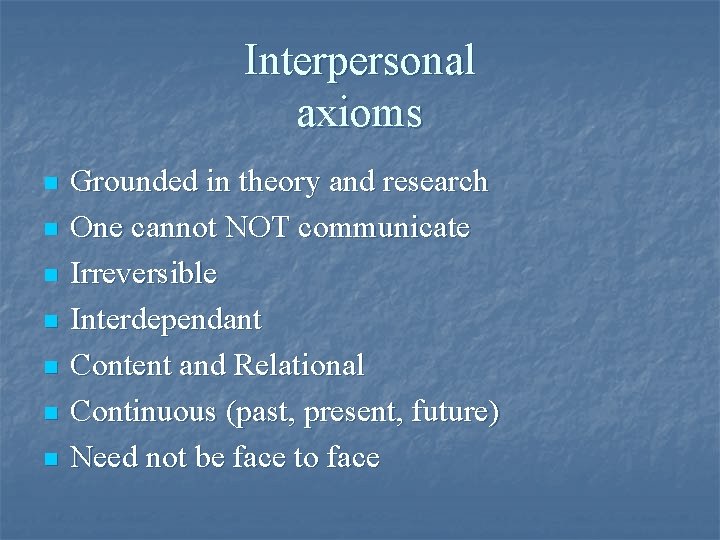
Interpersonal axioms n n n n Grounded in theory and research One cannot NOT communicate Irreversible Interdependant Content and Relational Continuous (past, present, future) Need not be face to face
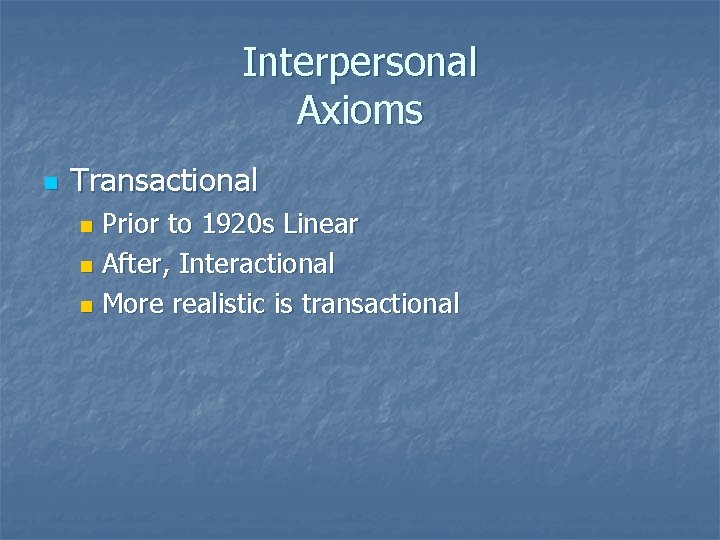
Interpersonal Axioms n Transactional Prior to 1920 s Linear n After, Interactional n More realistic is transactional n
Culture n A group’s specialized values, beliefs, artifacts, ways of behaving and communicating passed through communication, not genetics
Learning Cultures n n Enculturation learning the culture into which you were born (through parents, peers, schools, religion, government, media, internet, etc. ) Acculturation learning a culture different from your native culture (mutual influence occurs) Ethnocentrism the belief one’s culture is superior to that of other’s cultures Stereotypes a fixed impression of a person or group of people based mainly on physical characteristics
Communication Styles n Low Context n n n majority of information carried in explicit verbal messages, with less focus on the situational context. Self-expression valued. Communicators state opinions and desires directly and strive to persuade others to accept their own viewpoint. Clear, eloquent speech considered praiseworthy. Verbal fluency admired. n High Context n n n Important information carried in contextual cues time, place relationship, situation. Less reliance on explicit verbal messages. Communicators abstain from saying “no” directly Communicators talk “around” the point allowing others to fill in the missing pieces. Ambiguity and use of silence is admired.
Individualistic and Collectivist Cultures n Individualistic Cultures n n Self is separate, unique individual; independent, self-sufficient. Individual take care of themselves/family many flexible group memberships; friends based on shared interests & activities. Reward individual achievement & initiative; individual decision encouraged, credit/ blame assigned individually n Collectivist Cultures n n People belong to extended families; “we” or group orientation. Cares for extended family before self. Emphasis on belonging to a very few permanent ingroups with strong influence over person. Rewards contribution to group goals & well-being; cooperation with in-group members; group decisions valued; credit/ blame shared.
Perception Process n Select n Factors Physical characteristics n Education n Religion n Media n n Organize n Identify n Classify n Infer/interpret
Communication and the Self Concept A relatively stable set of perceptions one holds about oneself.
Different Aspects of Self Concept n n n n Self-esteem Self-awareness Self-actualization Ideal Self Reflected Appraisal Social Comparison
Self-Disclosure n n Revealing information about one’s self to others that they could not know otherwise. Factors influencing: n n n n Time of Age Gender Ethnicity Topic Relationship Valence
Reasons for Self-Awareness n Self-awareness is imperative to maintain because it directly affects personal and professional development Those that feel socially excluded try to dodge self awareness by not looking into a mirror. (Gail Williams) n (Jean M. Twenge; Kathleen R. Catanese; Roy F. Baumeister. )
Increase Your Self-Awareness 1. Who am I? test
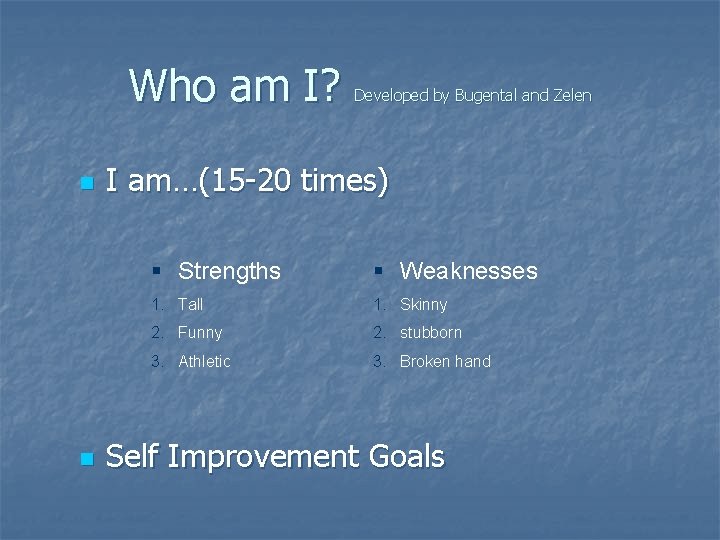
Who am I? n n Developed by Bugental and Zelen I am…(15 -20 times) § Strengths § Weaknesses 1. Tall 1. Skinny 2. Funny 2. stubborn 3. Athletic 3. Broken hand Self Improvement Goals
Increase Your Self-Awareness 1. Who am I? test 2. Listen to Others 3. Seek Information
Listen to Others n n Listen & Learn from feedback “Those struggling to define themselves crave others' feedback to help enhance their self-awareness, whereas those with a strong identity rely less on feedback: They can reinterpret, reject or accept information based on their own coherent sense of self. " ( Le Tourneau ) Seek Information n Actively engage in asking about what others think…in moderation
Increase Your Self-Awareness 1. Who am I? test 2. Listen to Others 3. Seek Information 4. Realize your Self dimensions 5. Try to expand your Open Self
Increase Open Self n n Self disclosure Blind and Hidden self will reduce, resulting in overall better communication.
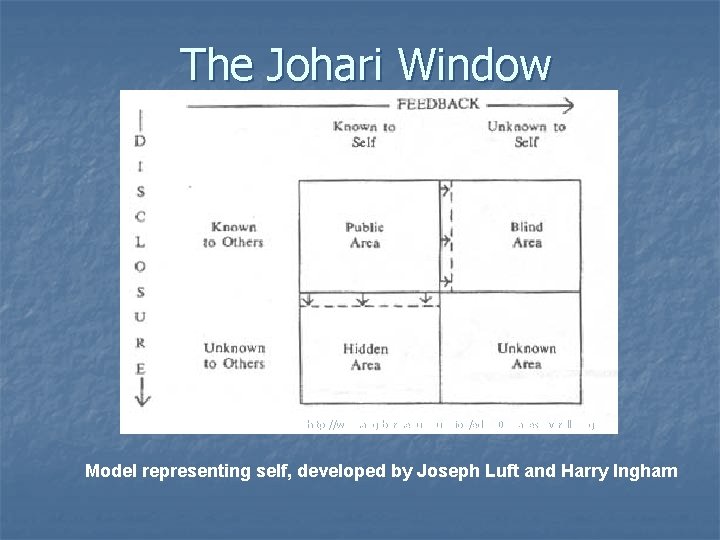
The Johari Window http: //www. augsburg. edu/education/edc 210/images/overall. jpeg Model representing self, developed by Joseph Luft and Harry Ingham
Self-Esteem How much do you like yourself ? How much would you say you are worth? How capable do you think you are ?
Self-Esteem is. . . w Your self evaluation w The value you place on yourself
Strategies to Build Self-Esteem w w Attack you Self-Destructive Beliefs Engage in Self-Affirmation Seek Out Nourishing People Work on Goals That Will Result in Success
Self-Destructive Beliefs w Beliefs that damage your self-esteem and prevent you from forming positive relationships. Steps towards elimination: w Recognize your internalized selfdestructive beliefs w Realize that these beliefs are unrealistic and selfdefeating (Ellis)
Self-Affirmation Remind yourself that you have succeeded (Aronson, Cohen, and Nail 1998) Examples of self-affirming phrases: I can live a nurturing, exciting, and creative life. I can accept imperfection. My world is safe and friendly. (From Gathering Through Insight and Love by Keyes)
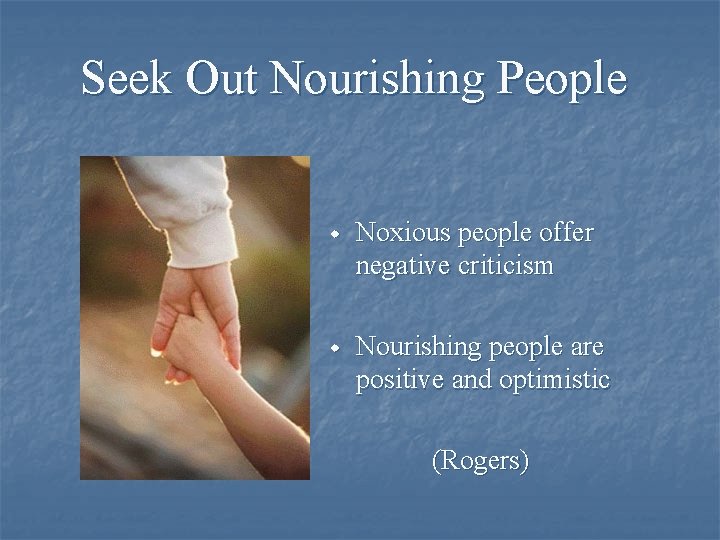
Seek Out Nourishing People w Noxious people offer negative criticism w Nourishing people are positive and optimistic (Rogers)
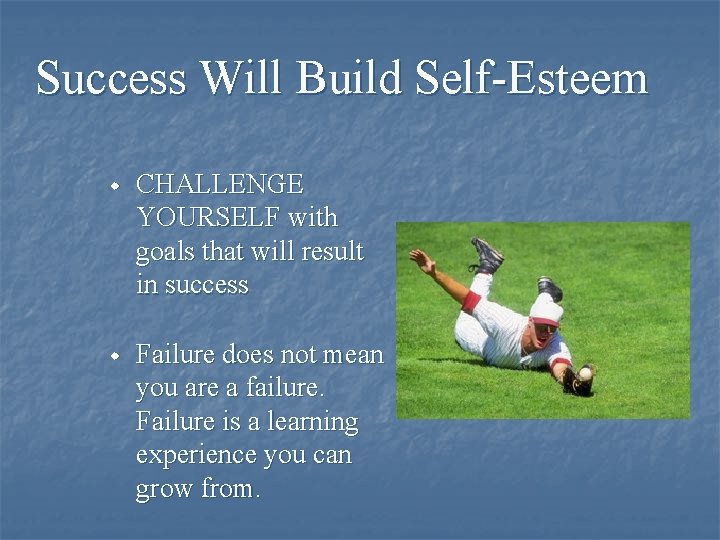
Success Will Build Self-Esteem w CHALLENGE YOURSELF with goals that will result in success w Failure does not mean you are a failure. Failure is a learning experience you can grow from.
Benefits of High Self-Esteem w w w better performance more likely to succeed will develop lasting and meaningful relationships learn from mistakes build solid foundations (Devito)
Listening
Nonverbal Communication n Kinesics n n n n Emblems Illustrators Regulators Adaptors Affect displays Proxemics Chronemics Haptics
Nonverbal Communication n n n n Silence Clothing Jewelry Body adornments Eye contact Color Artifacts Paralanguage
Nonverbal Communication
What is nonverbal communication?
Nonverbal Communication n Communication without words; communication by means of space, gestures, facial expressions, touching, vocal variation, and silence for example (De. Vito)
Why do we have nonverbal communication?
- Slides: 36