
Noise reduction technique in APD time resolution measurement

- Slides: 10
Noise reduction technique in APD time resolution measurement C. Lu Princeton University (5/15/2012)
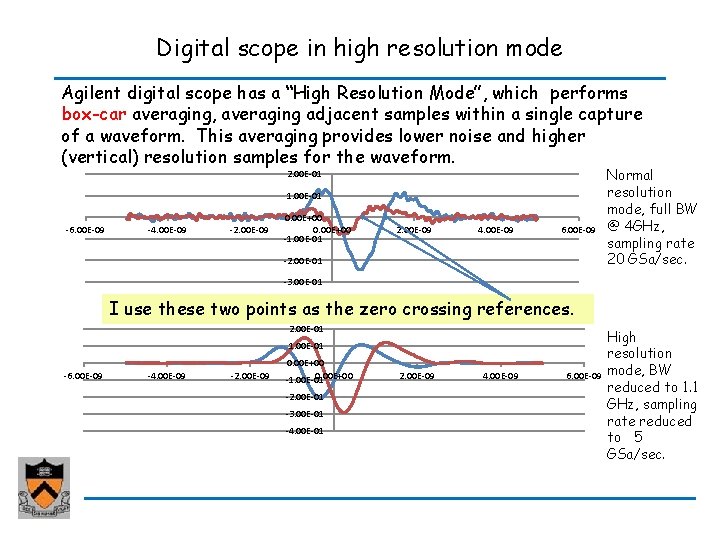
Digital scope in high resolution mode Agilent digital scope has a “High Resolution Mode”, which performs box-car averaging, averaging adjacent samples within a single capture of a waveform. This averaging provides lower noise and higher (vertical) resolution samples for the waveform. 2. 00 E-01 1. 00 E-01 -6. 00 E-09 -4. 00 E-09 -2. 00 E-09 0. 00 E+00 -1. 00 E-01 2. 00 E-09 4. 00 E-09 6. 00 E-09 -2. 00 E-01 Normal resolution mode, full BW @ 4 GHz, sampling rate 20 GSa/sec. -3. 00 E-01 I use these two points as the zero crossing references. 2. 00 E-01 1. 00 E-01 -6. 00 E-09 -4. 00 E-09 -2. 00 E-09 0. 00 E+00 -1. 00 E-01 -2. 00 E-01 -3. 00 E-01 -4. 00 E-01 2. 00 E-09 4. 00 E-09 6. 00 E-09 High resolution mode, BW reduced to 1. 1 GHz, sampling rate reduced to 5 GSa/sec.
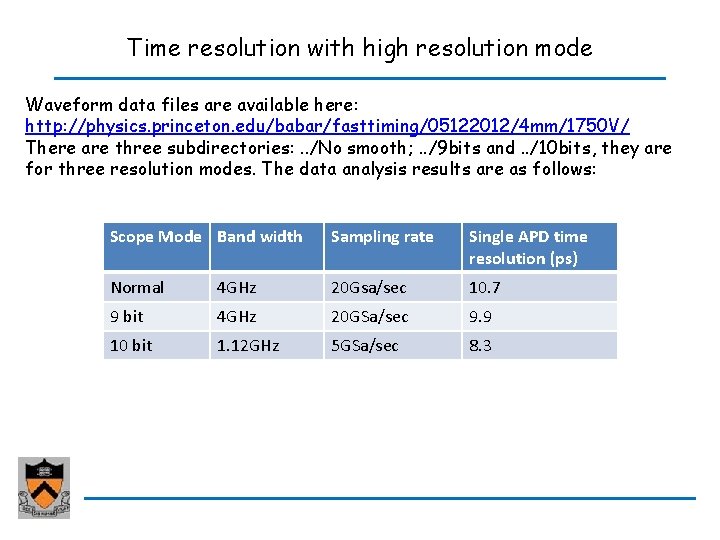
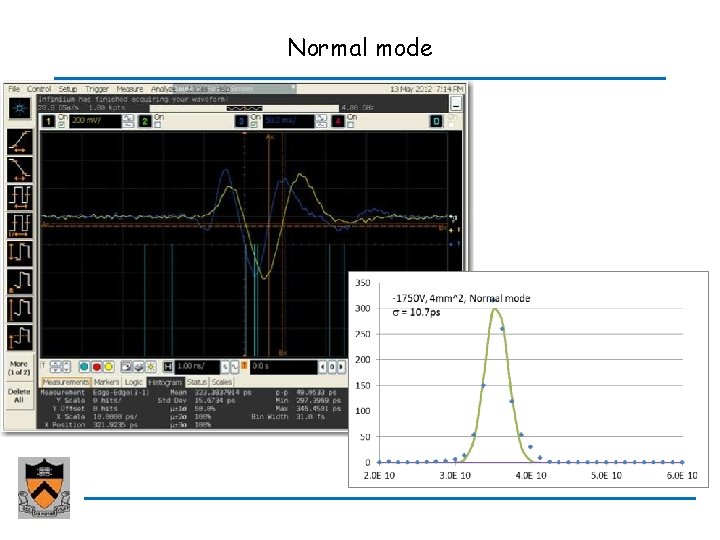
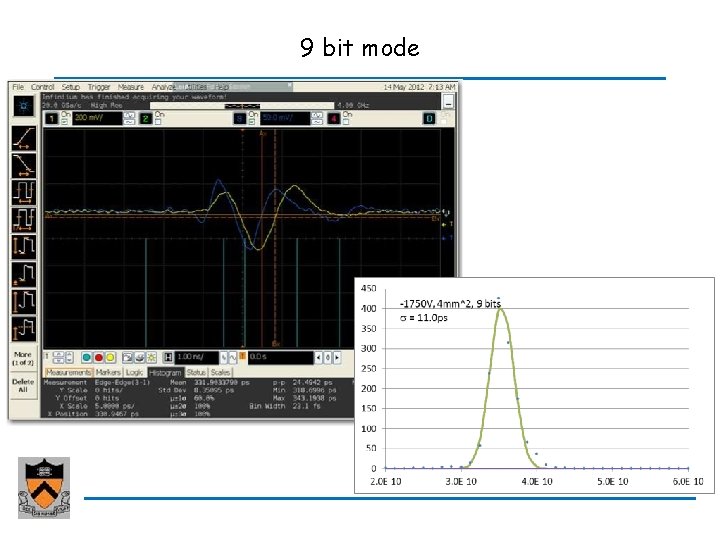
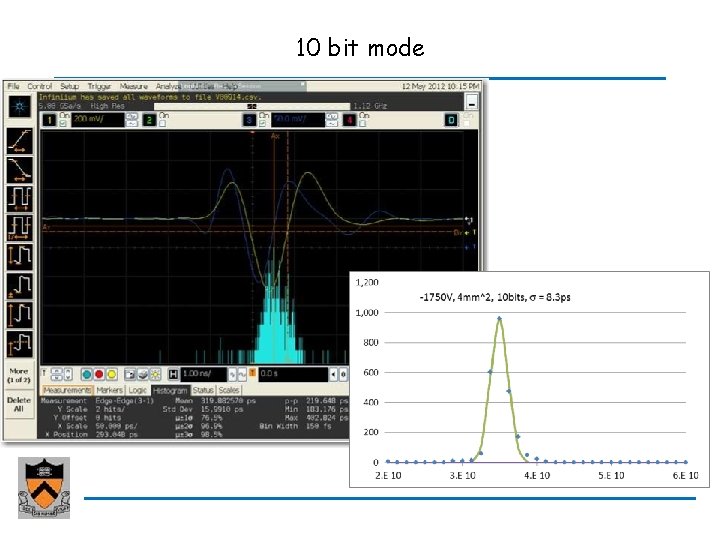
Time resolution with high resolution mode Waveform data files are available here: http: //physics. princeton. edu/babar/fasttiming/05122012/4 mm/1750 V/ There are three subdirectories: . . /No smooth; . . /9 bits and. . /10 bits, they are for three resolution modes. The data analysis results are as follows: Scope Mode Band width Sampling rate Single APD time resolution (ps) Normal 4 GHz 20 Gsa/sec 10. 7 9 bit 4 GHz 20 GSa/sec 9. 9 10 bit 1. 12 GHz 5 GSa/sec 8. 3
Normal mode
9 bit mode
10 bit mode
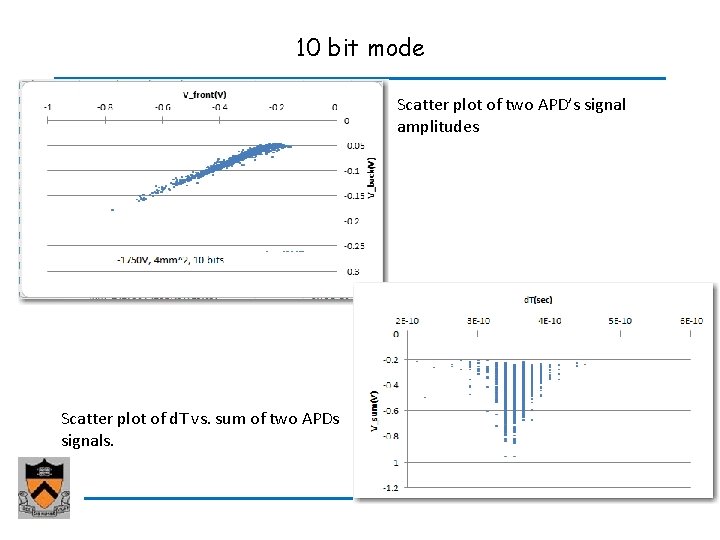
10 bit mode Scatter plot of two APD’s signal amplitudes Scatter plot of d. T vs. sum of two APDs signals.
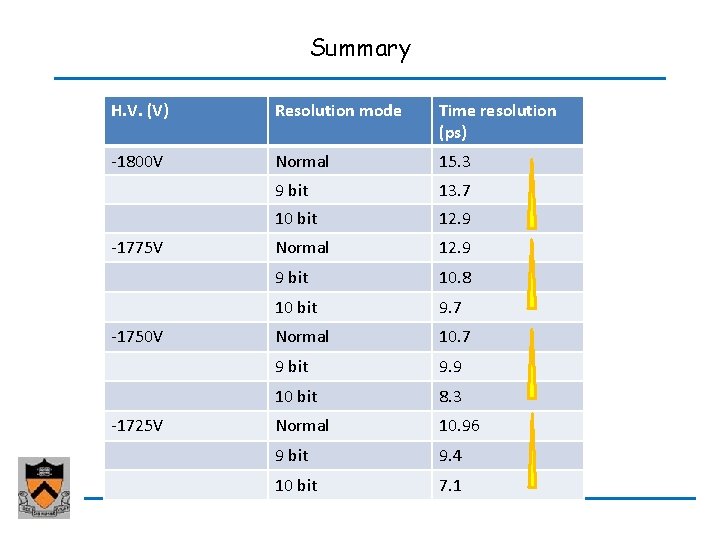
Summary H. V. (V) Resolution mode Time resolution (ps) -1800 V Normal 15. 3 9 bit 13. 7 10 bit 12. 9 Normal 12. 9 9 bit 10. 8 10 bit 9. 7 Normal 10. 7 9 bit 9. 9 10 bit 8. 3 Normal 10. 96 9 bit 9. 4 10 bit 7. 1 -1775 V -1750 V -1725 V
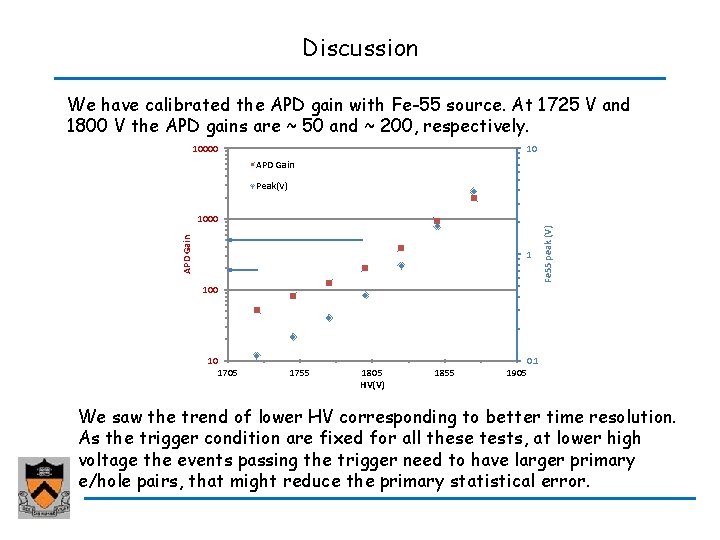
Discussion We have calibrated the APD gain with Fe-55 source. At 1725 V and 1800 V the APD gains are ~ 50 and ~ 200, respectively. 10000 10 APD Gain Peak(V) 1 Fe 55 peak (V) APD Gain 1000 10 1705 1755 1805 HV(V) 1855 0. 1 1905 We saw the trend of lower HV corresponding to better time resolution. As the trigger condition are fixed for all these tests, at lower high voltage the events passing the trigger need to have larger primary e/hole pairs, that might reduce the primary statistical error.
Discussion (cont’d) Charged particle Typical electron mobility in silicon at room temperature is 1400 cm 2 /(V*s). At ~ 1800 V, the P-depletion region is ~ 30 m. The APD avalanche multiplication starts at electric field strength ~ 2 x 10⁵ V/cm, if we assume the E-field in the depletion region is 1/3 of this number, it would be ~7 x 10⁴ V/cm. The total drift time range across the P-depletion region would be 30 x 10 -4 cm/ (1400 x 7 x 104 cm/s) = ~ 30 ps. This will contribute to the intrinsic time resolution of the APD. Statistics of the primary ionization in this layer will dominate the time resolution.