
NOISE Noise pollution What is noise pollution Any

- Slides: 37
NOISE
Noise pollution
What is noise pollution? Any unwanted sound that penetrates the environment is noise pollution. In general noise pollution refers to any noise irritating to one's ear which comes from an external source.
WHAT IS NOISE POLLUTION? Sound becomes undesirable when it disturbs the normal activities such as working, sleeping, and during conversations. It is an under rated environmental problem because of the fact that we can’t see, smell, or taste it. World Health Organization stated that “Noise must be recognized as a major threat to human well-being”
Loudness of sound => The level of sound. - measuring unit: decibel written as d. B - The higher the decibel, the louder is the sound. - Can be measured with a decibel meter
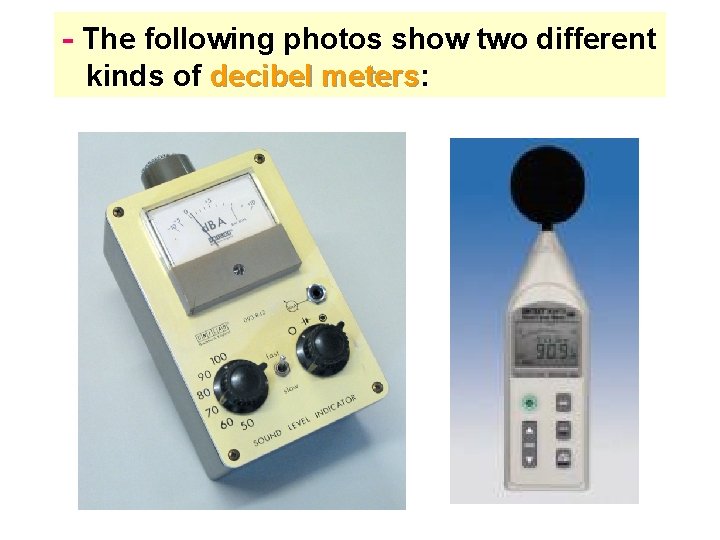
- The following photos show two different kinds of decibel meters:
Level of tolerance • Normal level of tolerance is 80 db. • Recommended level is 85 db • Sound level above this is considered to be as noise pollution.
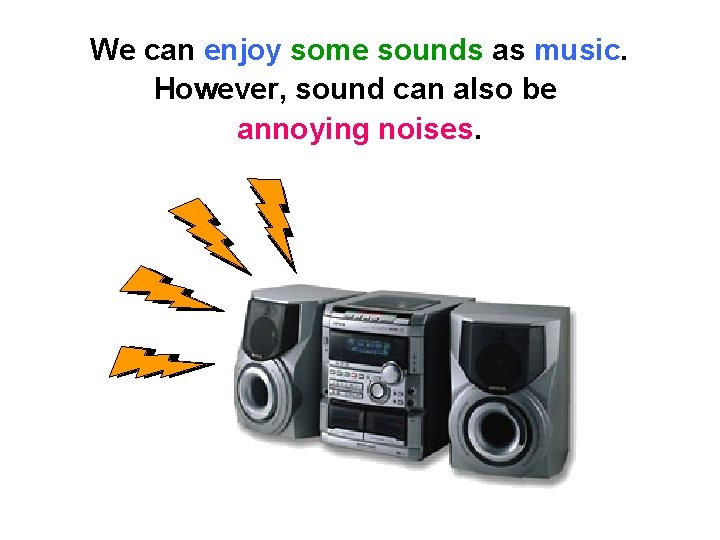
We can enjoy some sounds as music. However, sound can also be annoying noises.
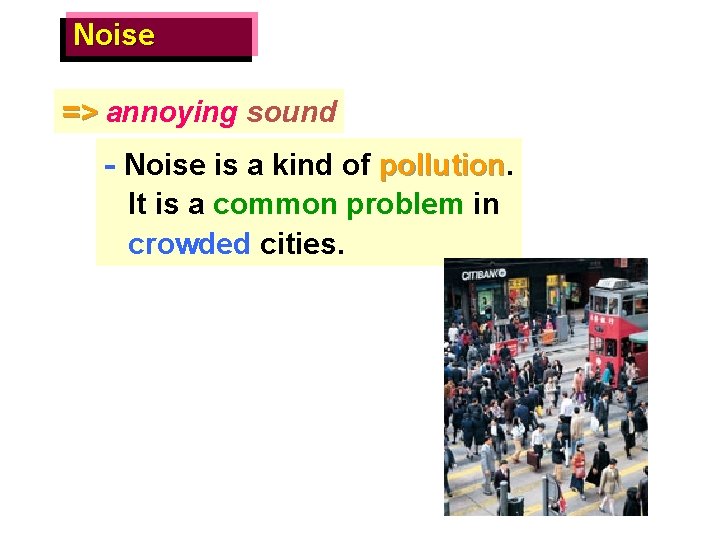
Noise => annoying sound - Noise is a kind of pollution It is a common problem in crowded cities.
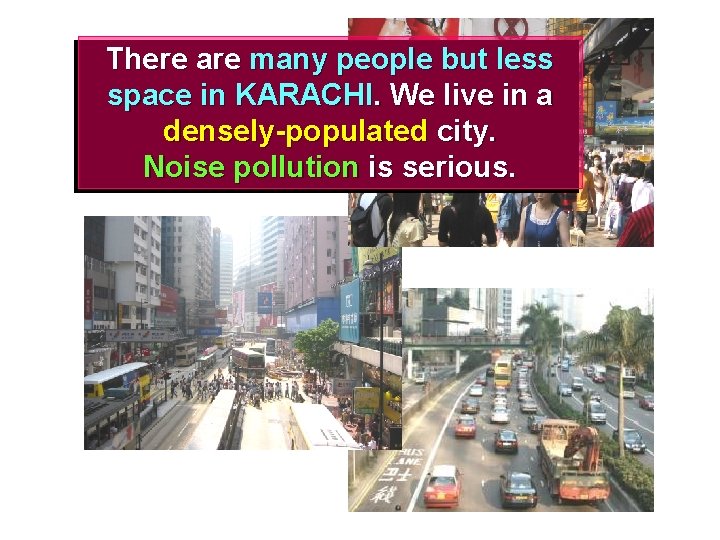
There are many people but less space in KARACHI. We live in a densely-populated city. Noise pollution is serious.
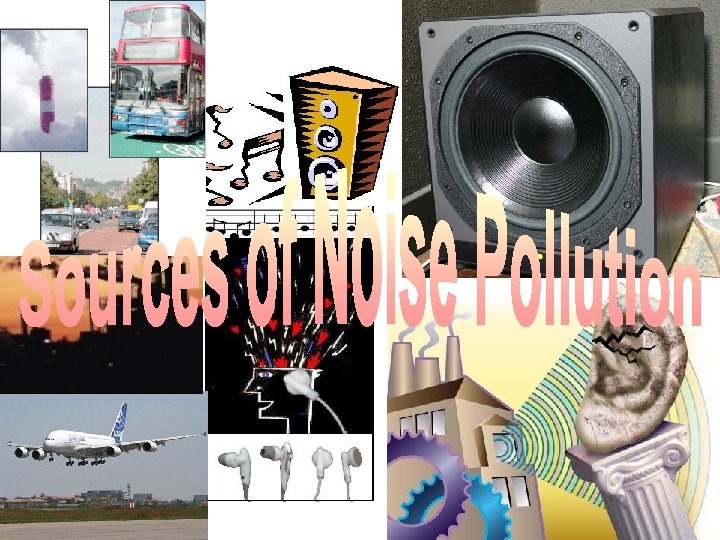
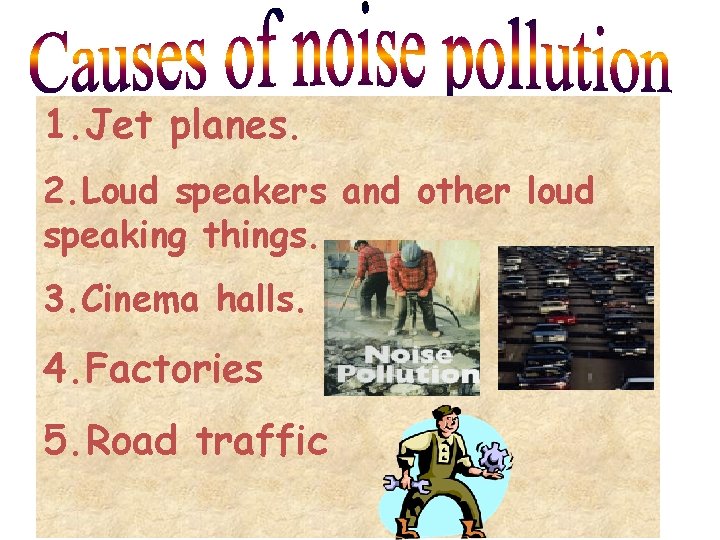
1. Jet planes. 2. Loud speakers and other loud speaking things. 3. Cinema halls. 4. Factories 5. Road traffic
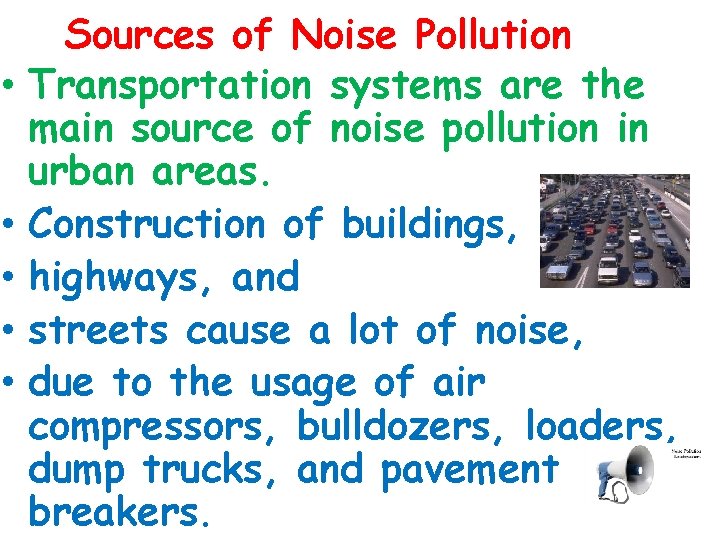
• • • Sources of Noise Pollution Transportation systems are the main source of noise pollution in urban areas. Construction of buildings, highways, and streets cause a lot of noise, due to the usage of air compressors, bulldozers, loaders, dump trucks, and pavement breakers.
• Industrial noise also adds to the already unfavorable state of noise pollution. • Loud speakers, plumbing, boilers, generators, air conditioners, fans, and vacuum cleaners add to the existing noise pollution.
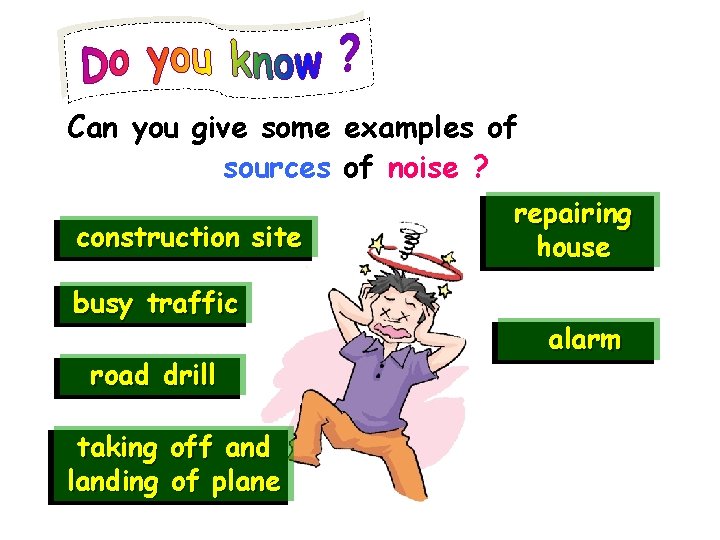
Can you give some examples of sources of noise ? construction site busy traffic road drill taking off and landing of plane repairing house alarm
Effects of noise pollution • There about 25000 hair cells in our ear which create wave in our ear, responding to different levels of frequencies. • With increasing levels of sound the cells get destroyed decreasing our ability to hear the high frequency sound.
Health Effects • There are direct links between noise and health. Also, noise pollution adversely affects the lives of millions of people.
Noise pollution can damage physiological and psychological health. • • High blood pressure, stress related illness, sleep disruption, hearing loss, and productivity loss are the problems related to noise pollution.
psychological health. It can also cause memory loss, severe depression, and panic attacks.
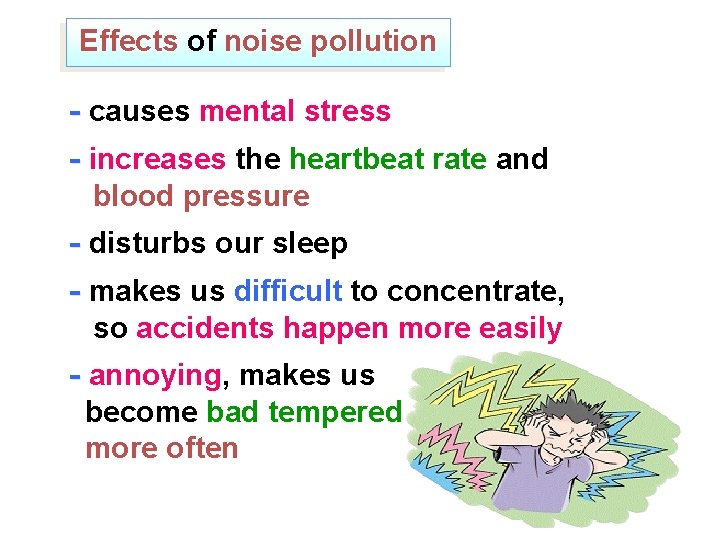
Effects of noise pollution - causes mental stress - increases the heartbeat rate and blood pressure - disturbs our sleep - makes us difficult to concentrate, so accidents happen more easily - annoying, makes us become bad tempered more often
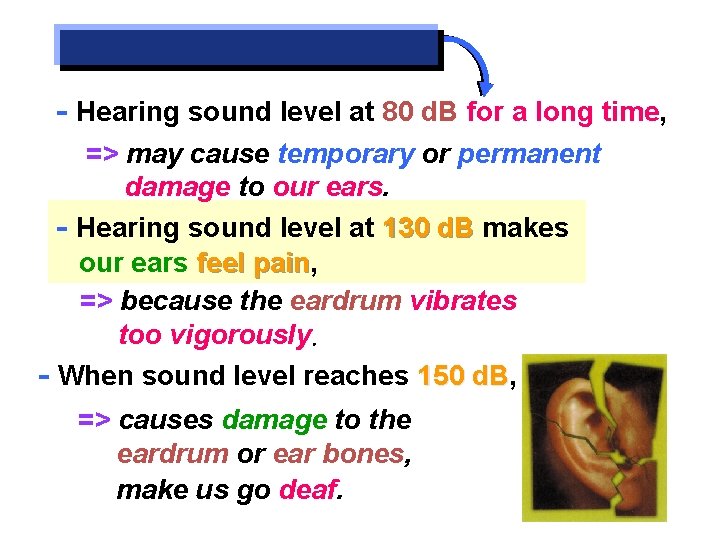
- Hearing sound level at 80 d. B for a long time, => may cause temporary or permanent damage to our ears. - Hearing sound level at 130 d. B makes our ears feel pain, pain => because the eardrum vibrates too vigorously. - When sound level reaches 150 d. B, d. B => causes damage to the eardrum or ear bones, make us go deaf.
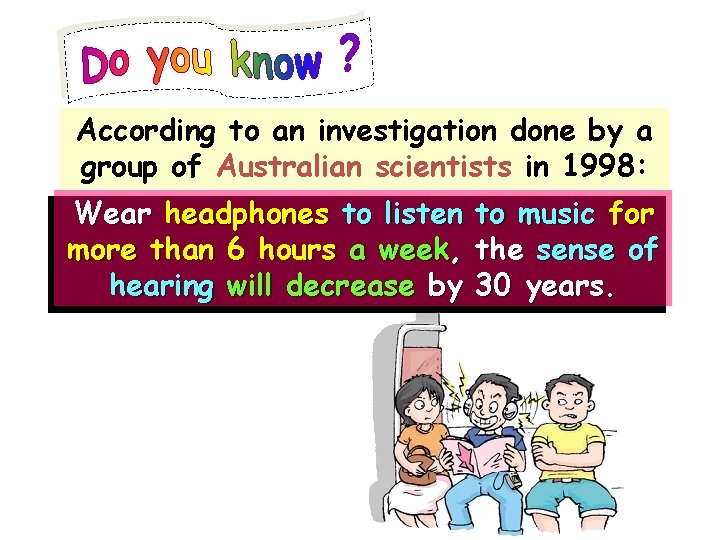
According to an investigation done by a group of Australian scientists in 1998: Wear headphones to listen more than 6 hours a week, hearing will decrease by to music for the sense of 30 years.
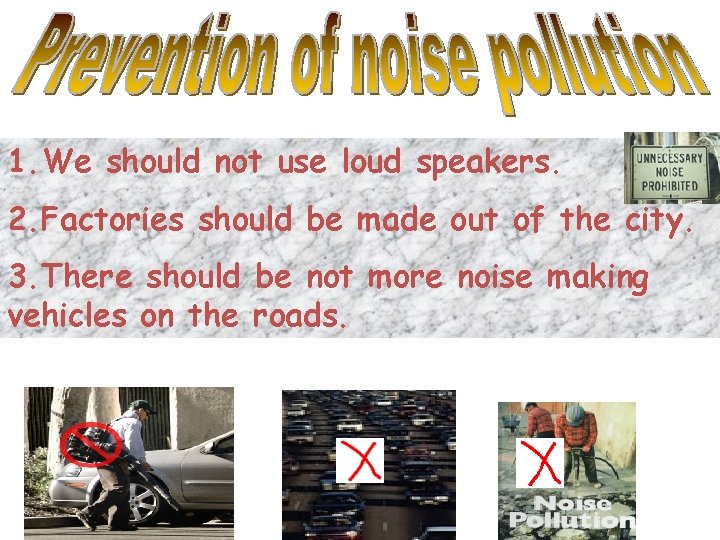
1. We should not use loud speakers. 2. Factories should be made out of the city. 3. There should be not more noise making vehicles on the roads.
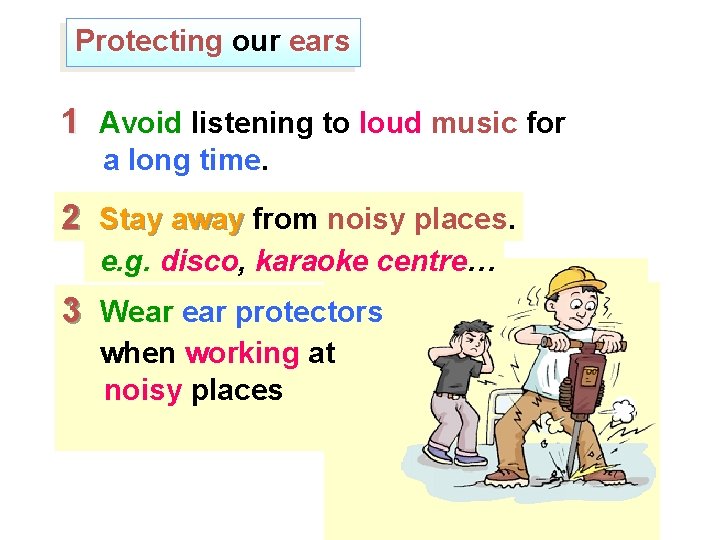
Protecting our ears 1 Avoid listening to loud music for a long time. 2 Stay away from noisy places. e. g. disco, karaoke centre… 3 Wear protectors when working at noisy places
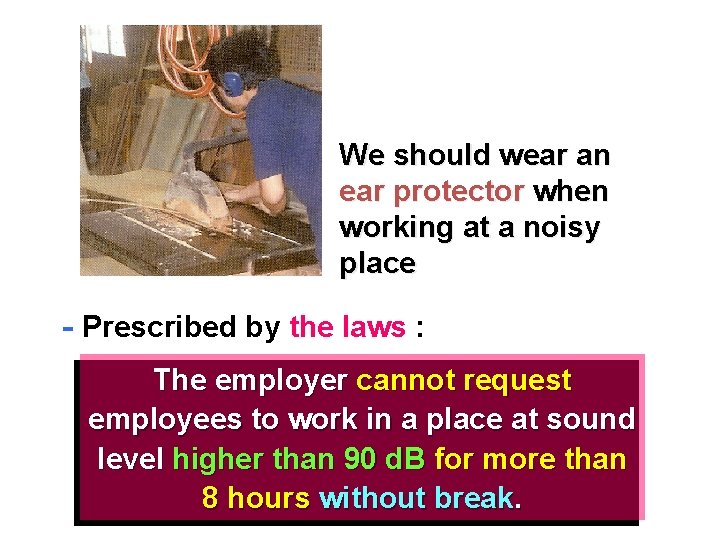
We should wear an ear protector when working at a noisy place - Prescribed by the laws : The employer cannot request employees to work in a place at sound level higher than 90 d. B for more than 8 hours without break.
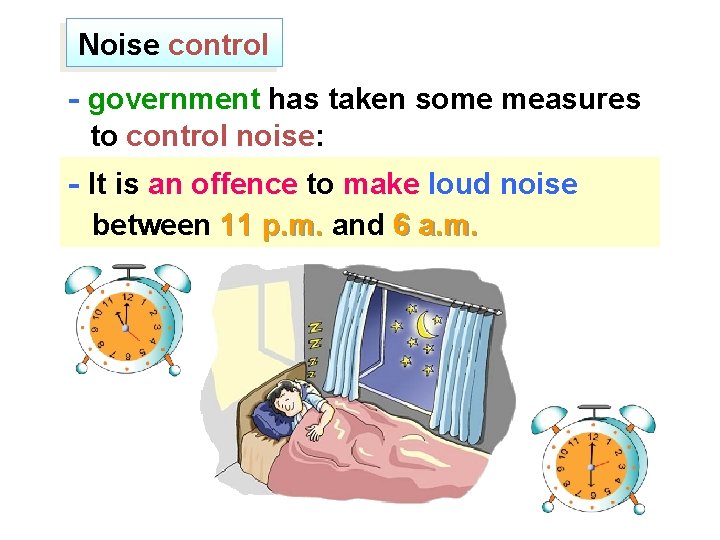
Noise control - government has taken some measures to control noise: - It is an offence to make loud noise between 11 p. m. and 6 a. m.
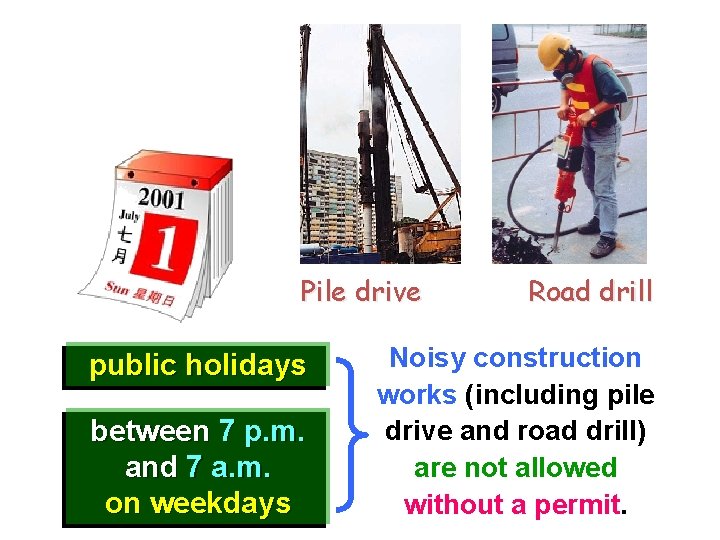
Pile drive public holidays between 7 p. m. and 7 a. m. on weekdays Road drill Noisy construction works (including pile drive and road drill) are not allowed without a permit.
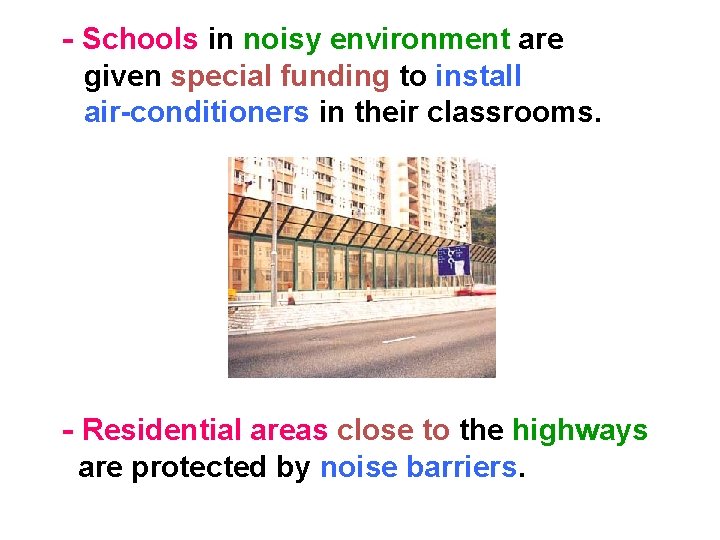
- Schools in noisy environment are given special funding to install air-conditioners in their classrooms. - Residential areas close to the highways are protected by noise barriers.
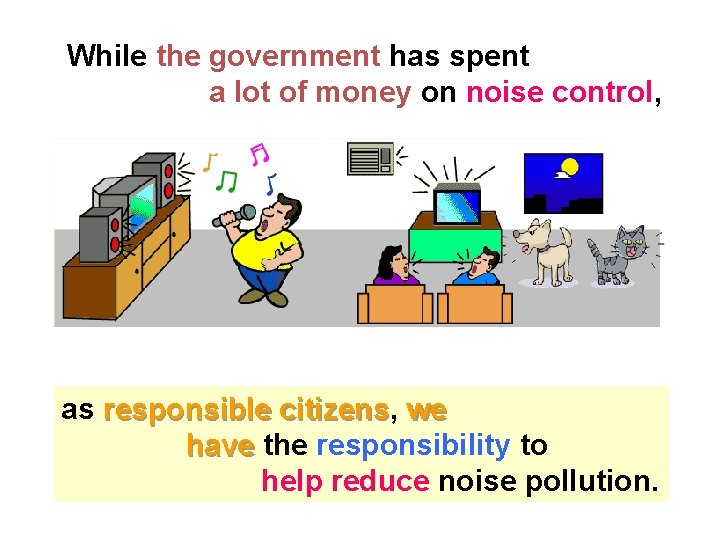
While the government has spent a lot of money on noise control, as responsible citizens, we have the responsibility to help reduce noise pollution.
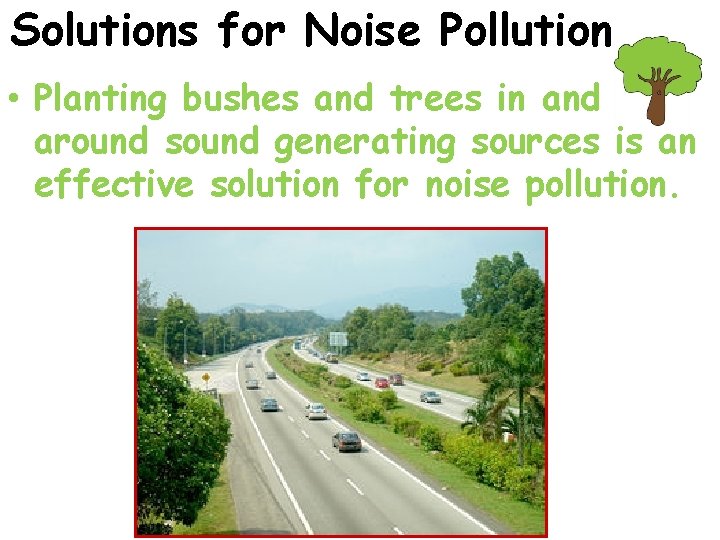
Solutions for Noise Pollution • Planting bushes and trees in and around sound generating sources is an effective solution for noise pollution.
• Regular servicing and tuning of automobiles can effectively reduce the noise pollution. • Buildings can be designed with suitable noise absorbing material for the walls, windows, and ceilings. • Workers should be provided with equipments such as ear plugs and earmuffs for hearing protection.
Solutions for Noise Pollution • Similar to automobiles, lubrication of the machinery and servicing should be done to minimize noise generation. • Soundproof doors and windows can be installed to block unwanted noise from outside. • Regulations should be imposed to restrict the usage of play loudspeakers in crowded areas and public places. • Factories and industries should be located far from the residential areas.
Solutions for Noise Pollution • Community development or urban management should be done with long-term planning, along with an aim to reduce noise pollution. • Social awareness programs should be taken up to educate the public about the causes and effects of noise pollution.
Symptoms of occupational hearing loss Feeling of fullness in the ear. Sounds may seem muffled. Cannot hear high frequency sounds. Ringing in the ears while listening to the high frequency sounds. • Loud noise for a long period of time, or sudden burst of sound can cause occupational hearing loss. • Hearing that does not return after an acute noise injury is called a permanent threshold shift. • •