
Noise mechanisms in electronic devices physical origin and

- Slides: 31
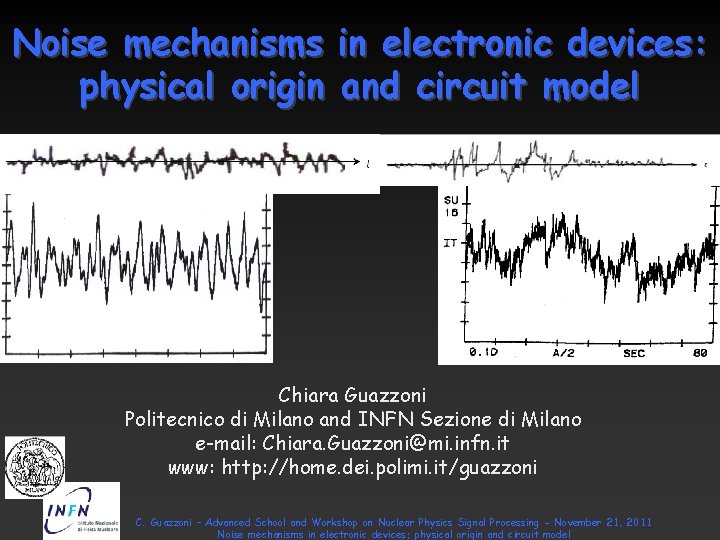
Noise mechanisms in electronic devices: physical origin and circuit model Chiara Guazzoni Politecnico di Milano and INFN Sezione di Milano e-mail: Chiara. Guazzoni@mi. infn. it www: http: //home. dei. polimi. it/guazzoni C. Guazzoni – Advanced School and Workshop on Nuclear Physics Signal Processing - November 21, 2011 Noise mechanisms in electronic devices: physical origin and circuit model
Table of contents ~Noise definitions, noise analysis and theorems ~Noise physical sources ~Noise modeling in electronic devices ~Equivalent Noise Charge Definition and Calculation C. Guazzoni – Advanced School and Workshop on Nuclear Physics Signal Processing - November 21, 2011 Noise mechanisms in electronic devices: physical origin and circuit model
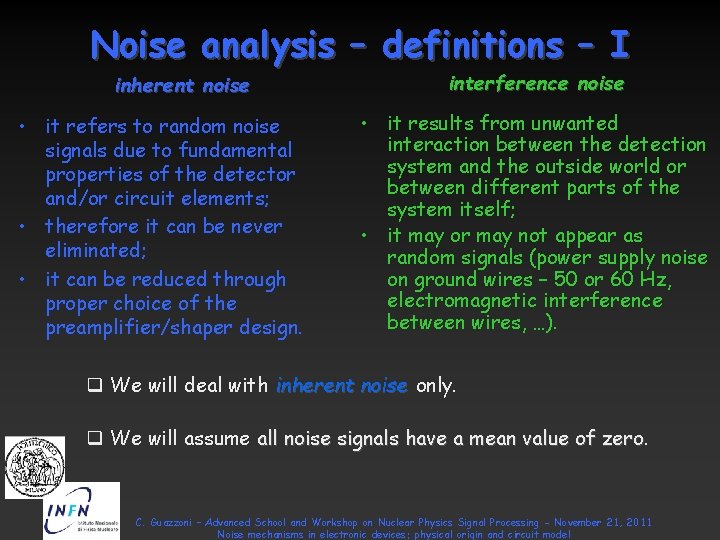
Noise analysis – definitions – I inherent noise • it refers to random noise signals due to fundamental properties of the detector and/or circuit elements; • therefore it can be never eliminated; • it can be reduced through proper choice of the preamplifier/shaper design. interference noise • it results from unwanted interaction between the detection system and the outside world or between different parts of the system itself; • it may or may not appear as random signals (power supply noise on ground wires – 50 or 60 Hz, electromagnetic interference between wires, …). q We will deal with inherent noise only. q We will assume all noise signals have a mean value of zero C. Guazzoni – Advanced School and Workshop on Nuclear Physics Signal Processing - November 21, 2011 Noise mechanisms in electronic devices: physical origin and circuit model
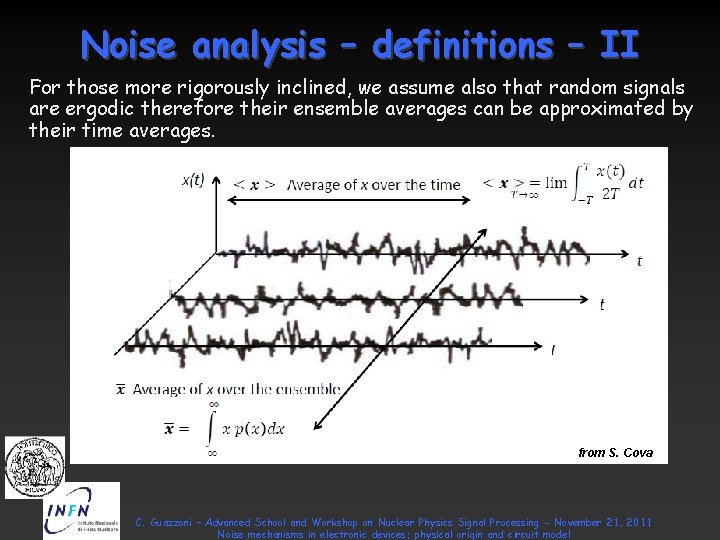
Noise analysis – definitions – II For those more rigorously inclined, we assume also that random signals are ergodic therefore their ensemble averages can be approximated by their time averages. from S. Cova C. Guazzoni – Advanced School and Workshop on Nuclear Physics Signal Processing - November 21, 2011 Noise mechanisms in electronic devices: physical origin and circuit model
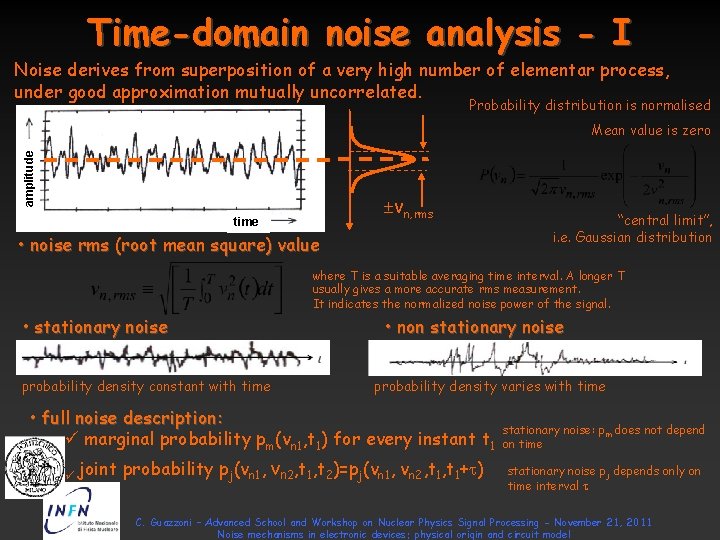
Time-domain noise analysis - I Noise derives from superposition of a very high number of elementar process, under good approximation mutually uncorrelated. Probability distribution is normalised amplitude Mean value is zero vn, rms time • noise rms (root mean square) value “central limit”, i. e. Gaussian distribution where T is a suitable averaging time interval. A longer T usually gives a more accurate rms measurement. It indicates the normalized noise power of the signal. • stationary noise probability density constant with time • non stationary noise probability density varies with time • full noise description: ü marginal probability pm(vn 1, t 1) for every instant t 1 ü joint probability pj(vn 1, vn 2, t 1, t 2)=pj(vn 1, vn 2, t 1+ ) stationary noise: pm does not depend on time stationary noise pj depends only on time interval C. Guazzoni – Advanced School and Workshop on Nuclear Physics Signal Processing - November 21, 2011 Noise mechanisms in electronic devices: physical origin and circuit model
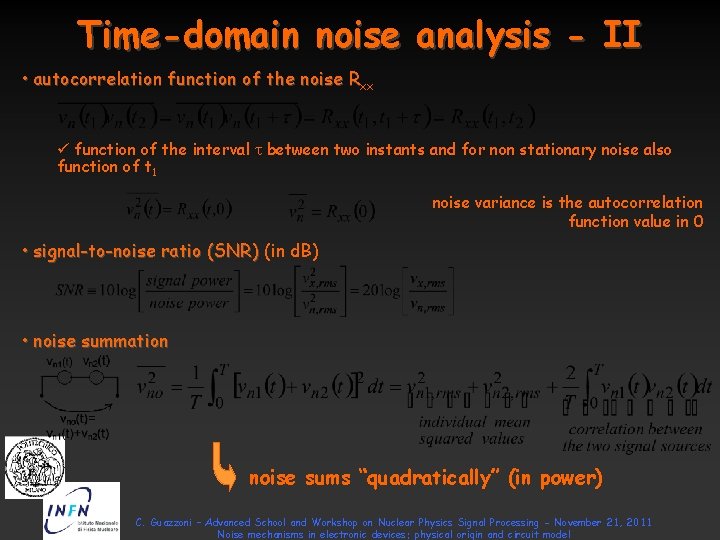
Time-domain noise analysis - II • autocorrelation function of the noise Rxx ü function of the interval between two instants and for non stationary noise also function of t 1 noise variance is the autocorrelation function value in 0 • signal-to-noise ratio (SNR) (in d. B) • noise summation noise sums “quadratically” (in power) C. Guazzoni – Advanced School and Workshop on Nuclear Physics Signal Processing - November 21, 2011 Noise mechanisms in electronic devices: physical origin and circuit model
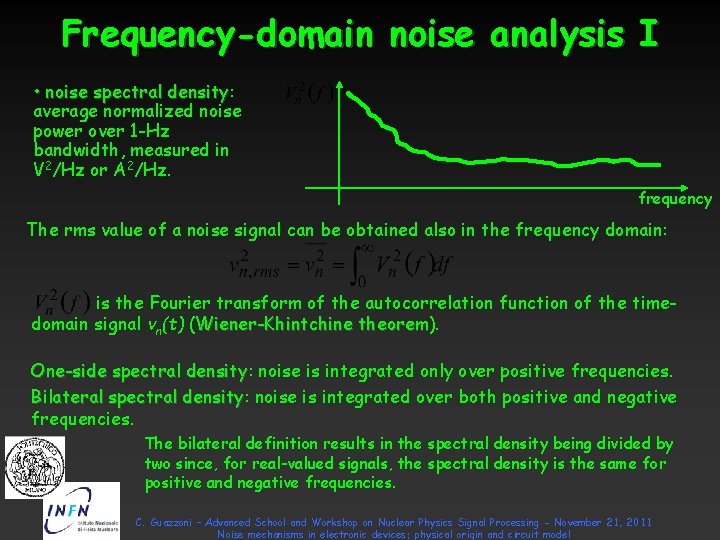
Frequency-domain noise analysis I • noise spectral density: density average normalized noise power over 1 -Hz bandwidth, measured in V 2/Hz or A 2/Hz. frequency The rms value of a noise signal can be obtained also in the frequency domain: is the Fourier transform of the autocorrelation function of the timedomain signal vn(t) (Wiener-Khintchine theorem). theorem One-side spectral density: density noise is integrated only over positive frequencies. Bilateral spectral density: density noise is integrated over both positive and negative frequencies. The bilateral definition results in the spectral density being divided by two since, for real-valued signals, the spectral density is the same for positive and negative frequencies. C. Guazzoni – Advanced School and Workshop on Nuclear Physics Signal Processing - November 21, 2011 Noise mechanisms in electronic devices: physical origin and circuit model
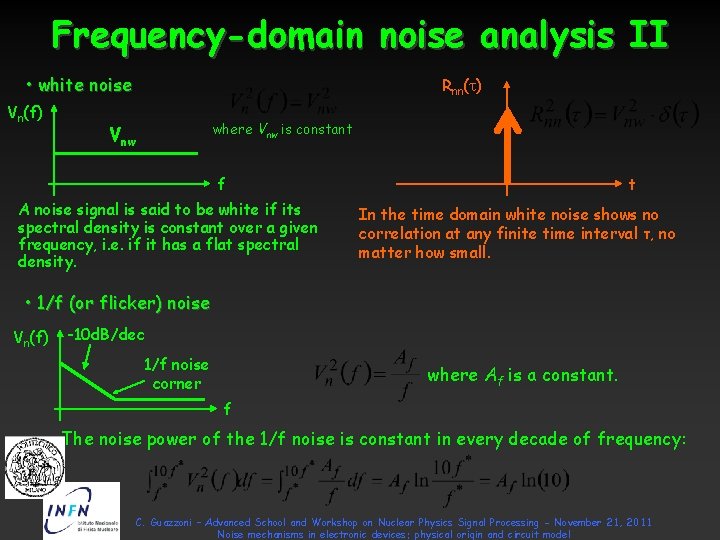
Frequency-domain noise analysis II • white noise Vn(f) Rnn( ) where Vnw is constant Vnw f A noise signal is said to be white if its spectral density is constant over a given frequency, i. e. if it has a flat spectral density. t In the time domain white noise shows no correlation at any finite time interval τ, no matter how small. • 1/f (or flicker) noise Vn(f) -10 d. B/dec 1/f noise corner where Af is a constant. f The noise power of the 1/f noise is constant in every decade of frequency: C. Guazzoni – Advanced School and Workshop on Nuclear Physics Signal Processing - November 21, 2011 Noise mechanisms in electronic devices: physical origin and circuit model
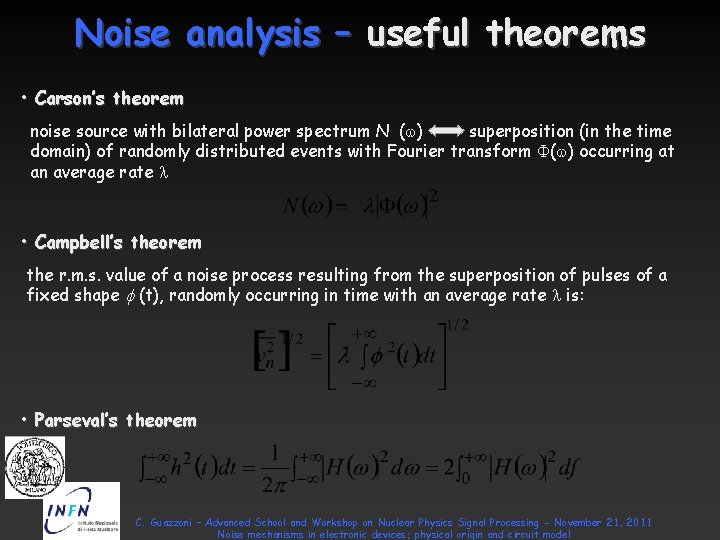
Noise analysis – useful theorems • Carson’s theorem noise source with bilateral power spectrum N (w) superposition (in the time domain) of randomly distributed events with Fourier transform F(w) occurring at an average rate l • Campbell’s theorem the r. m. s. value of a noise process resulting from the superposition of pulses of a fixed shape f (t), randomly occurring in time with an average rate l is: • Parseval’s theorem C. Guazzoni – Advanced School and Workshop on Nuclear Physics Signal Processing - November 21, 2011 Noise mechanisms in electronic devices: physical origin and circuit model
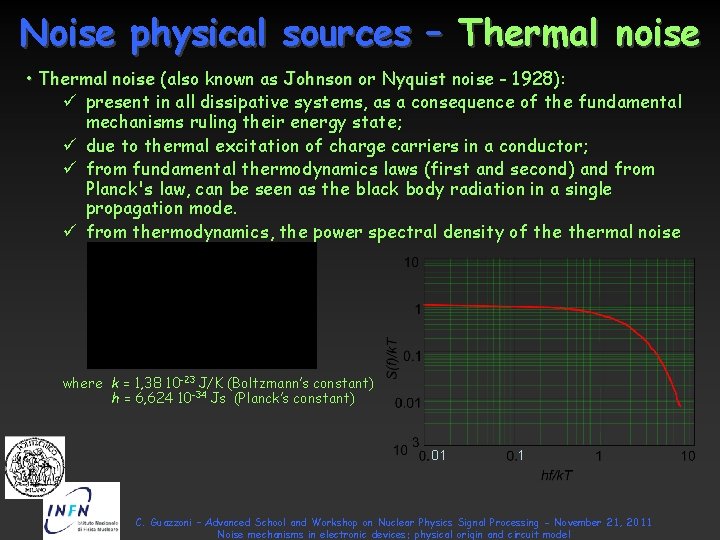
Noise physical sources – Thermal noise • Thermal noise (also known as Johnson or Nyquist noise - 1928): ü present in all dissipative systems, as a consequence of the fundamental mechanisms ruling their energy state; ü due to thermal excitation of charge carriers in a conductor; ü from fundamental thermodynamics laws (first and second) and from Planck's law, can be seen as the black body radiation in a single propagation mode. ü from thermodynamics, the power spectral density of thermal noise is where k = 1, 38 10 -23 J/K (Boltzmann’s constant) h = 6, 624 10 -34 Js (Planck’s constant) 01 1 C. Guazzoni – Advanced School and Workshop on Nuclear Physics Signal Processing - November 21, 2011 Noise mechanisms in electronic devices: physical origin and circuit model
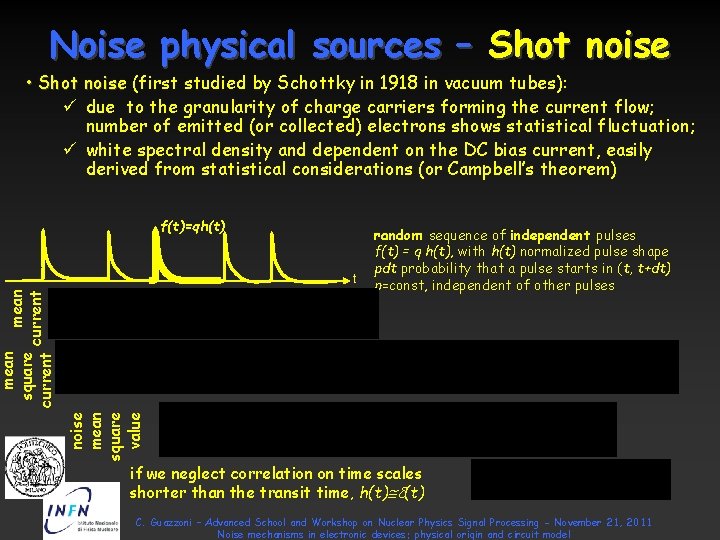
Noise physical sources – Shot noise • Shot noise (first studied by Schottky in 1918 in vacuum tubes): ü due to the granularity of charge carriers forming the current flow; number of emitted (or collected) electrons shows statistical fluctuation; ü white spectral density and dependent on the DC bias current, easily derived from statistical considerations (or Campbell’s theorem) f(t)=qh(t) noise mean square value mean square current t random sequence of independent pulses f(t) = q h(t), with h(t) normalized pulse shape pdt probability that a pulse starts in (t, t+dt) p=const, independent of other pulses if we neglect correlation on time scales shorter than the transit time, h(t) C. Guazzoni – Advanced School and Workshop on Nuclear Physics Signal Processing - November 21, 2011 Noise mechanisms in electronic devices: physical origin and circuit model
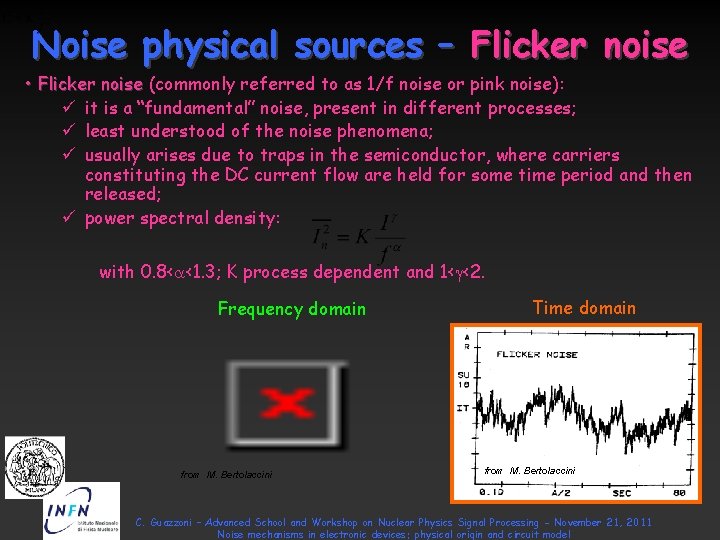
Noise physical sources – Flicker noise • Flicker noise (commonly referred to as 1/f noise or pink noise): ü it is a “fundamental” noise, present in different processes; ü least understood of the noise phenomena; ü usually arises due to traps in the semiconductor, where carriers constituting the DC current flow are held for some time period and then released; ü power spectral density: with 0. 8< <1. 3; K process dependent and 1<g<2. Frequency domain from M. Bertolaccini Time domain from M. Bertolaccini C. Guazzoni – Advanced School and Workshop on Nuclear Physics Signal Processing - November 21, 2011 Noise mechanisms in electronic devices: physical origin and circuit model
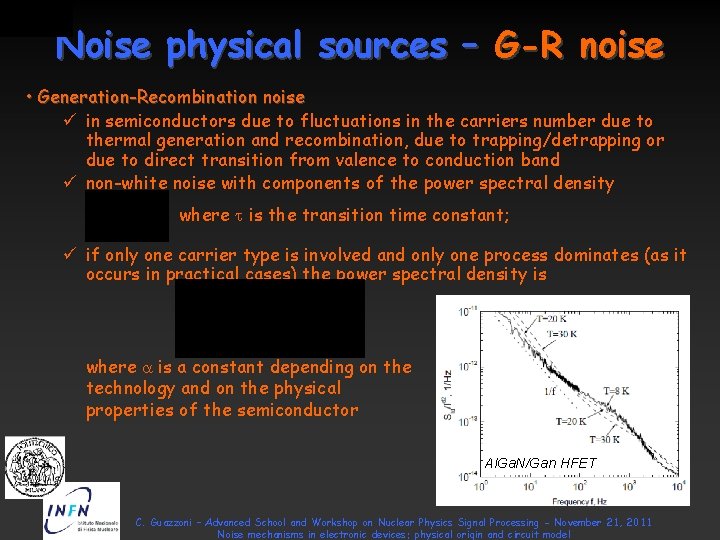
Noise physical sources – G-R noise • Generation-Recombination noise ü in semiconductors due to fluctuations in the carriers number due to thermal generation and recombination, due to trapping/detrapping or due to direct transition from valence to conduction band ü non-white noise with components of the power spectral density where is the transition time constant; ü if only one carrier type is involved and only one process dominates (as it occurs in practical cases) the power spectral density is where is a constant depending on the technology and on the physical properties of the semiconductor Al. Ga. N/Gan HFET C. Guazzoni – Advanced School and Workshop on Nuclear Physics Signal Processing - November 21, 2011 Noise mechanisms in electronic devices: physical origin and circuit model
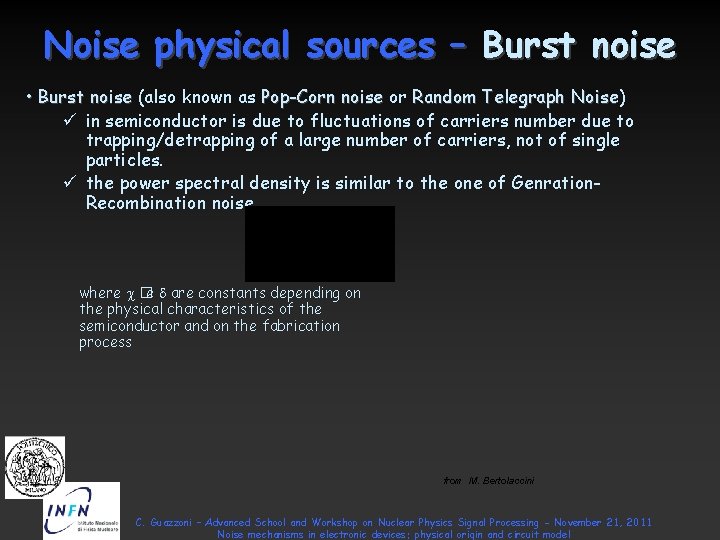
Noise physical sources – Burst noise • Burst noise (also known as Pop-Corn noise or Random Telegraph Noise) Noise ü in semiconductor is due to fluctuations of carriers number due to trapping/detrapping of a large number of carriers, not of single particles. ü the power spectral density is similar to the one of Genration. Recombination noise where c �e d are constants depending on the physical characteristics of the semiconductor and on the fabrication process from M. Bertolaccini C. Guazzoni – Advanced School and Workshop on Nuclear Physics Signal Processing - November 21, 2011 Noise mechanisms in electronic devices: physical origin and circuit model
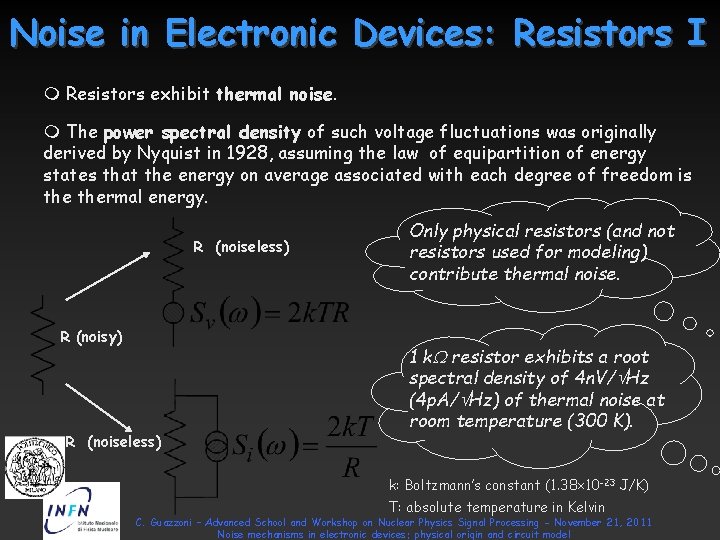
Noise in Electronic Devices: Resistors I m Resistors exhibit thermal noise. m The power spectral density of such voltage fluctuations was originally derived by Nyquist in 1928, assuming the law of equipartition of energy states that the energy on average associated with each degree of freedom is thermal energy. R (noiseless) R (noisy) R (noiseless) Only physical resistors (and not resistors used for modeling) contribute thermal noise. 1 k. W resistor exhibits a root spectral density of 4 n. V/ Hz (4 p. A/ Hz) of thermal noise at room temperature (300 K). k: Boltzmann’s constant (1. 38 10 -23 J/K) T: absolute temperature in Kelvin C. Guazzoni – Advanced School and Workshop on Nuclear Physics Signal Processing - November 21, 2011 Noise mechanisms in electronic devices: physical origin and circuit model
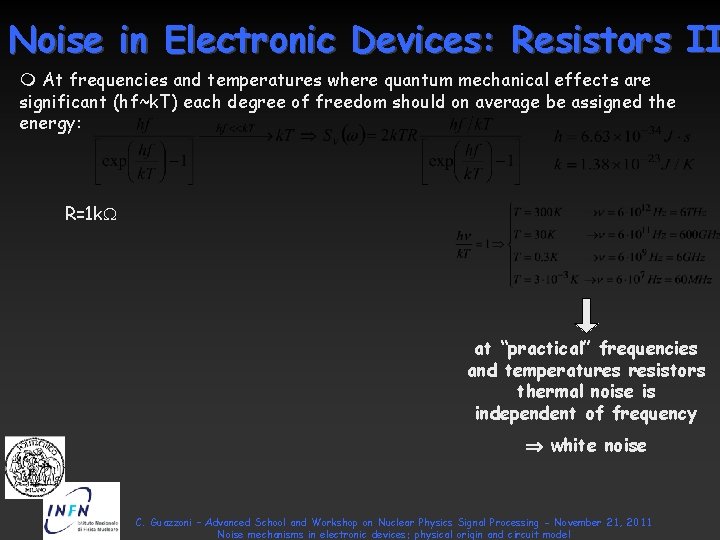
Noise in Electronic Devices: Resistors II m At frequencies and temperatures where quantum mechanical effects are significant (hf~k. T) each degree of freedom should on average be assigned the energy: R=1 k. W at “practical” frequencies and temperatures resistors thermal noise is independent of frequency white noise C. Guazzoni – Advanced School and Workshop on Nuclear Physics Signal Processing - November 21, 2011 Noise mechanisms in electronic devices: physical origin and circuit model
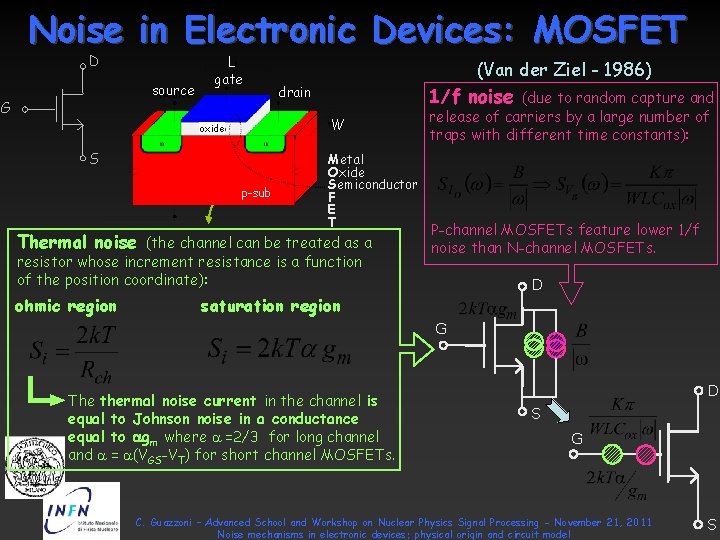
Noise in Electronic Devices: MOSFET D source G L gate (Van der Ziel - 1986) drain 1/f noise W oxide S p-sub Metal Oxide Semiconductor F E T Thermal noise (the channel can be treated as a resistor whose increment resistance is a function of the position coordinate): ohmic region (due to random capture and release of carriers by a large number of traps with different time constants): P-channel MOSFETs feature lower 1/f noise than N-channel MOSFETs. D saturation region G The thermal noise current in the channel is equal to Johnson noise in a conductance equal to agm where =2/3 for long channel and = (VGS-VT) for short channel MOSFETs. D S G C. Guazzoni – Advanced School and Workshop on Nuclear Physics Signal Processing - November 21, 2011 Noise mechanisms in electronic devices: physical origin and circuit model S
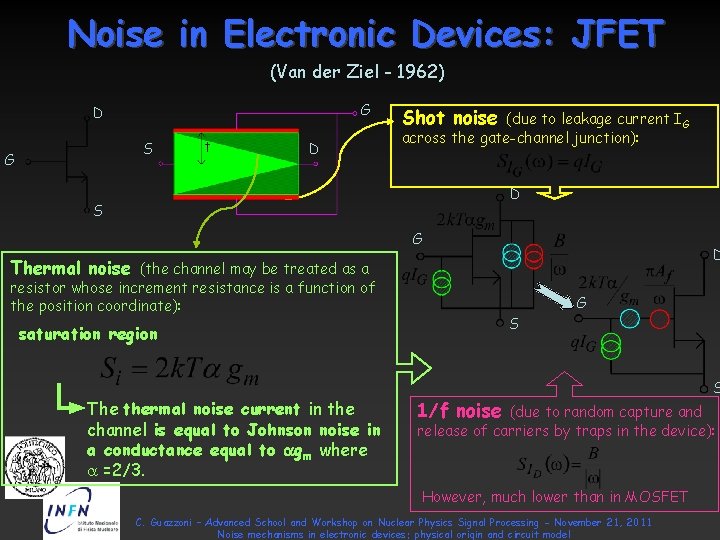
Noise in Electronic Devices: JFET (Van der Ziel - 1962) G D S G t D Shot noise (due to leakage current IG across the gate-channel junction): D S G D Thermal noise (the channel may be treated as a resistor whose increment resistance is a function of the position coordinate): G S saturation region The thermal noise current in the channel is equal to Johnson noise in a conductance equal to agm where =2/3. 1/f noise S (due to random capture and release of carriers by traps in the device): However, much lower than in MOSFET C. Guazzoni – Advanced School and Workshop on Nuclear Physics Signal Processing - November 21, 2011 Noise mechanisms in electronic devices: physical origin and circuit model
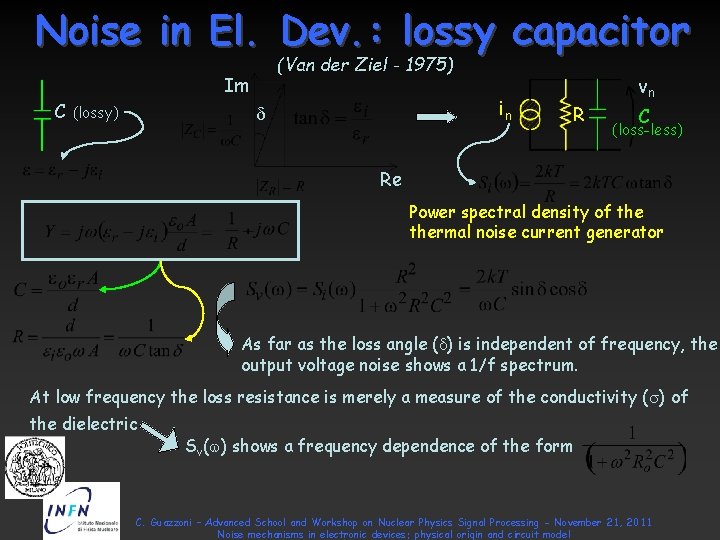
Noise in El. Dev. : lossy capacitor (Van der Ziel - 1975) Im C (lossy) in d R vn C (loss-less) Re Power spectral density of thermal noise current generator As far as the loss angle (d) is independent of frequency, the output voltage noise shows a 1/f spectrum. At low frequency the loss resistance is merely a measure of the conductivity (s) of the dielectric Sv(w) shows a frequency dependence of the form C. Guazzoni – Advanced School and Workshop on Nuclear Physics Signal Processing - November 21, 2011 Noise mechanisms in electronic devices: physical origin and circuit model
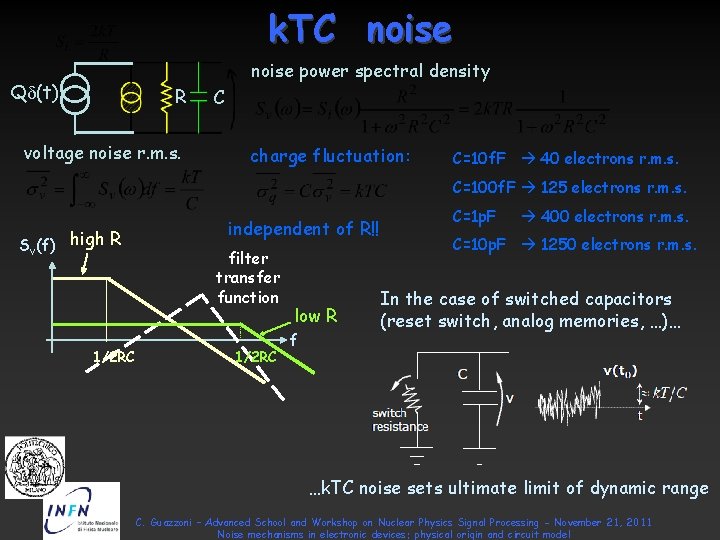
k. TC noise Qd(t) R voltage noise r. m. s. noise power spectral density C charge fluctuation: C=10 f. F 40 electrons r. m. s. C=100 f. F 125 electrons r. m. s. Sv(f) high R 1/2 RC independent of R!! filter transfer function 1/2 RC low R f C=1 p. F 400 electrons r. m. s. C=10 p. F 1250 electrons r. m. s. In the case of switched capacitors (reset switch, analog memories, …)… …k. TC noise sets ultimate limit of dynamic range C. Guazzoni – Advanced School and Workshop on Nuclear Physics Signal Processing - November 21, 2011 Noise mechanisms in electronic devices: physical origin and circuit model
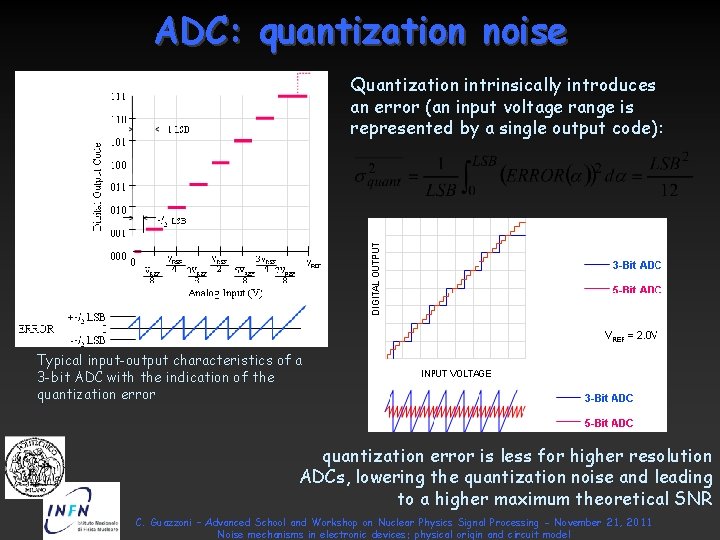
ADC: quantization noise Quantization intrinsically introduces an error (an input voltage range is represented by a single output code): Typical input-output characteristics of a 3 -bit ADC with the indication of the quantization error is less for higher resolution ADCs, lowering the quantization noise and leading to a higher maximum theoretical SNR C. Guazzoni – Advanced School and Workshop on Nuclear Physics Signal Processing - November 21, 2011 Noise mechanisms in electronic devices: physical origin and circuit model
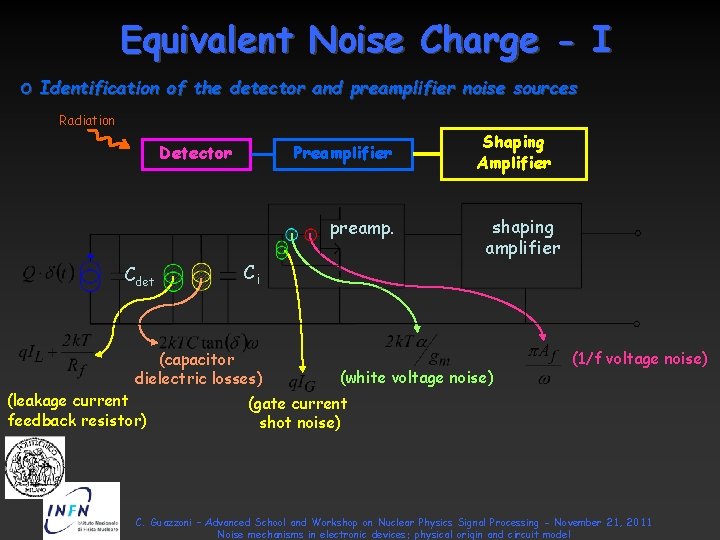
Equivalent Noise Charge - I o Identification of the detector and preamplifier noise sources Radiation Preamplifier Detector preamp. Cdet Ci (capacitor dielectric losses) (leakage current feedback resistor) Shaping Amplifier shaping amplifier (white voltage noise) (1/f voltage noise) (gate current shot noise) C. Guazzoni – Advanced School and Workshop on Nuclear Physics Signal Processing - November 21, 2011 Noise mechanisms in electronic devices: physical origin and circuit model
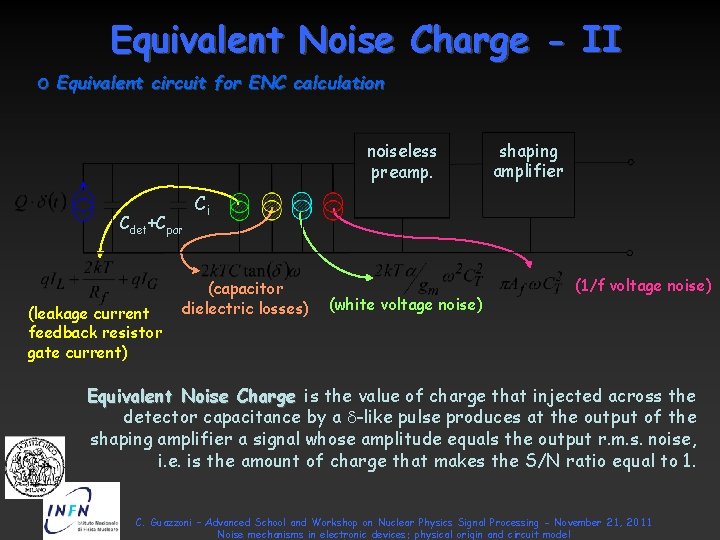
Equivalent Noise Charge - II o Equivalent circuit for ENC calculation noiseless preamp. Cdet+Cpar (leakage current feedback resistor gate current) shaping amplifier Ci (capacitor dielectric losses) (white voltage noise) (1/f voltage noise) Equivalent Noise Charge is the value of charge that injected across the detector capacitance by a d-like pulse produces at the output of the shaping amplifier a signal whose amplitude equals the output r. m. s. noise, i. e. is the amount of charge that makes the S/N ratio equal to 1. C. Guazzoni – Advanced School and Workshop on Nuclear Physics Signal Processing - November 21, 2011 Noise mechanisms in electronic devices: physical origin and circuit model
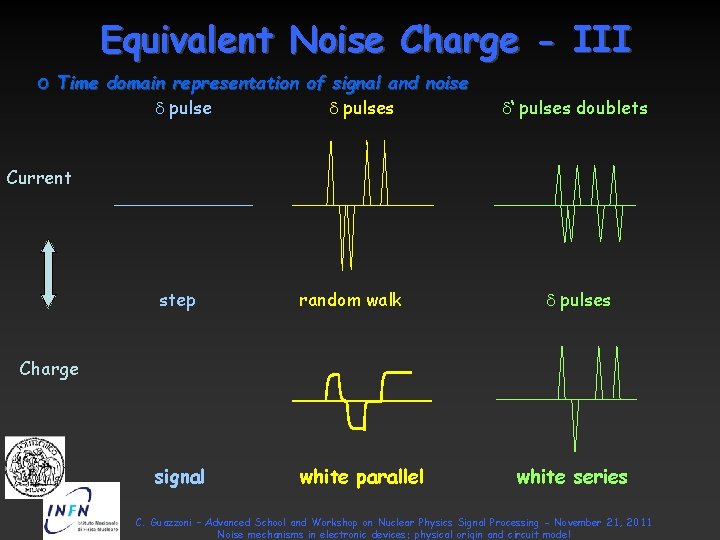
Equivalent Noise Charge - III o Time domain representation of signal and noise d pulses d‘ pulses doublets Current step random walk signal white parallel d pulses Charge white series C. Guazzoni – Advanced School and Workshop on Nuclear Physics Signal Processing - November 21, 2011 Noise mechanisms in electronic devices: physical origin and circuit model
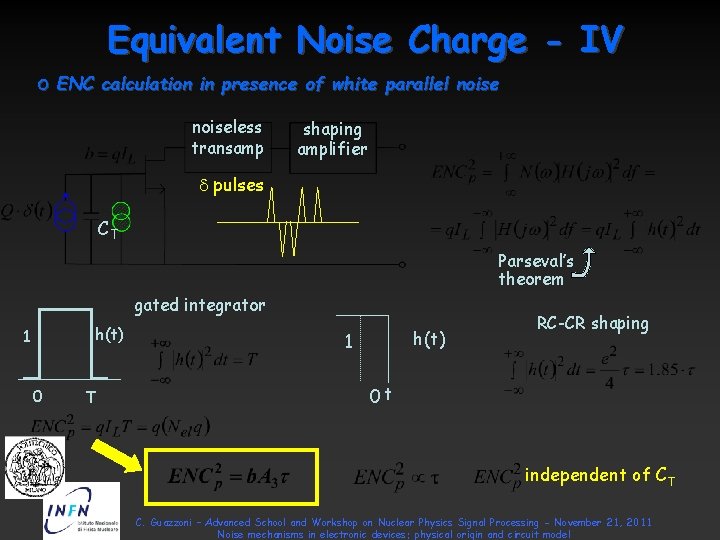
Equivalent Noise Charge - IV o ENC calculation in presence of white parallel noiseless transamp shaping amplifier d pulses CT Parseval’s theorem gated integrator h(t) 1 0 T h(t) 1 RC-CR shaping 0 t independent of CT C. Guazzoni – Advanced School and Workshop on Nuclear Physics Signal Processing - November 21, 2011 Noise mechanisms in electronic devices: physical origin and circuit model
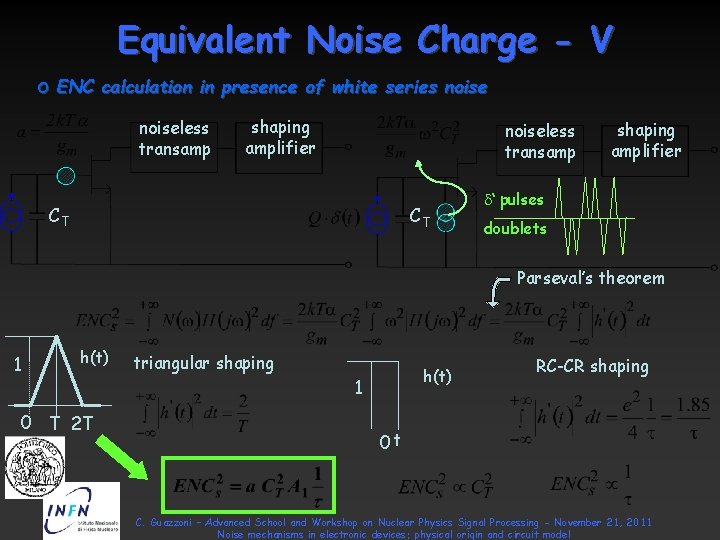
Equivalent Noise Charge - V o ENC calculation in presence of white series noiseless transamp shaping amplifier noiseless transamp CT CT shaping amplifier d‘ pulses doublets Parseval’s theorem 1 h(t) 0 T 2 T triangular shaping h(t) 1 RC-CR shaping 0 t C. Guazzoni – Advanced School and Workshop on Nuclear Physics Signal Processing - November 21, 2011 Noise mechanisms in electronic devices: physical origin and circuit model
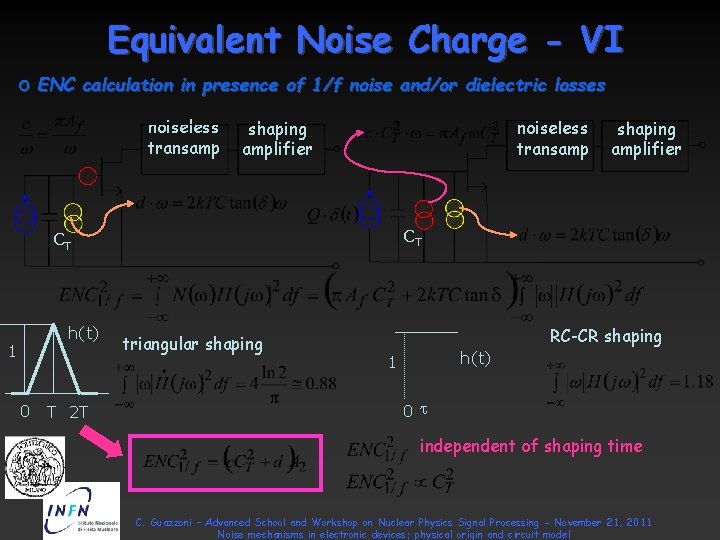
Equivalent Noise Charge - VI o ENC calculation in presence of 1/f noise and/or dielectric losses noiseless transamp shaping amplifier CT CT h(t) 1 0 T 2 T shaping amplifier triangular shaping RC-CR shaping h(t) 1 0 independent of shaping time C. Guazzoni – Advanced School and Workshop on Nuclear Physics Signal Processing - November 21, 2011 Noise mechanisms in electronic devices: physical origin and circuit model
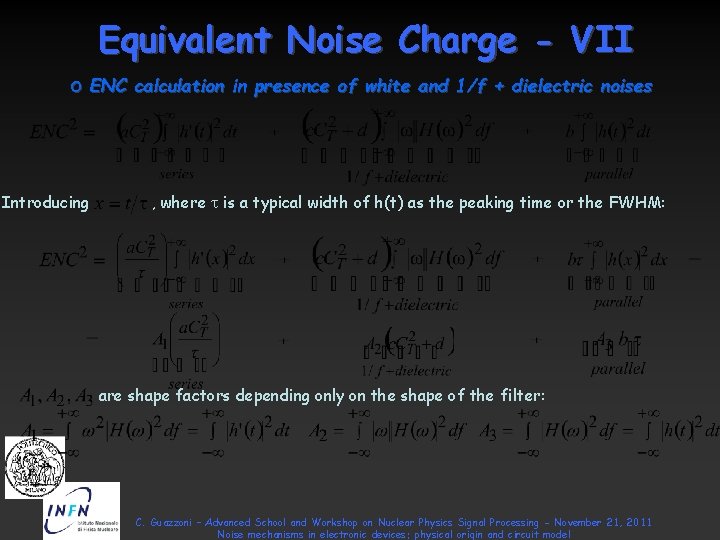
Equivalent Noise Charge - VII o ENC calculation in presence of white and 1/f + dielectric noises Introducing , where is a typical width of h(t) as the peaking time or the FWHM: are shape factors depending only on the shape of the filter: C. Guazzoni – Advanced School and Workshop on Nuclear Physics Signal Processing - November 21, 2011 Noise mechanisms in electronic devices: physical origin and circuit model
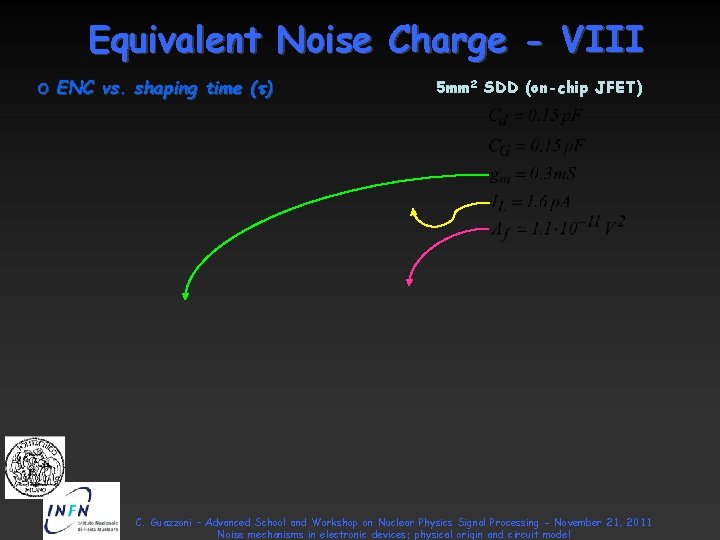
Equivalent Noise Charge - VIII o ENC vs. shaping time (t) 5 mm 2 SDD (on-chip JFET) C. Guazzoni – Advanced School and Workshop on Nuclear Physics Signal Processing - November 21, 2011 Noise mechanisms in electronic devices: physical origin and circuit model
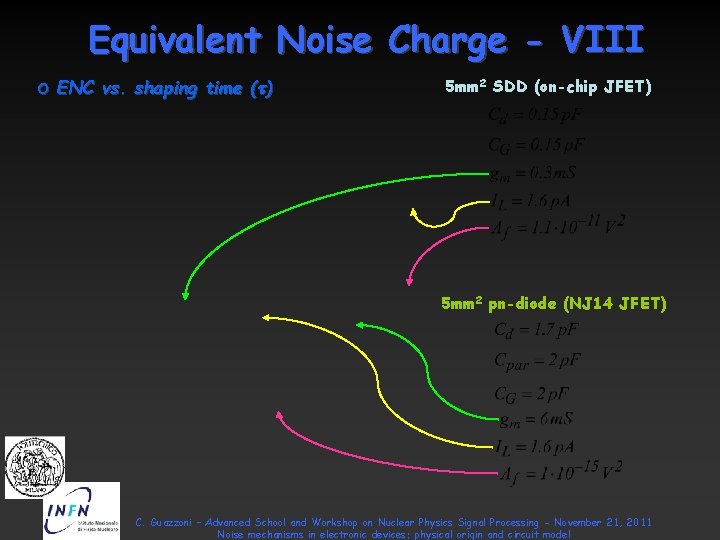
Equivalent Noise Charge - VIII o ENC vs. shaping time (t) 5 mm 2 SDD (on-chip JFET) 5 mm 2 pn-diode (NJ 14 JFET) C. Guazzoni – Advanced School and Workshop on Nuclear Physics Signal Processing - November 21, 2011 Noise mechanisms in electronic devices: physical origin and circuit model
C. Guazzoni – Advanced School and Workshop on Nuclear Physics Signal Processing - November 21, 2011 Noise mechanisms in electronic devices: physical origin and circuit model