
Noise in Road Construction Developed by the Division

Noise in Road Construction Developed by the Division of Occupational Safety and Health (DOSH) August, 2009
What this presentation covers § Hearing loss rates and claims facts § Noise levels of construction equipment § Control methods to reduce harmful noise exposures § Resources
Hearing loss is expensive! In Washington State, Hearing loss is 1/3 of all costs of permanent impairments. Hearing loss is the most expensive occupational disease for road construction workers. Incidence rate is 10 times higher for “Road Construction” risk class than for all other risk classes. Hearing loss claims rate is highest of all construction risk classes. The result is higher industrial insurance premiums paid by road construction contractors.
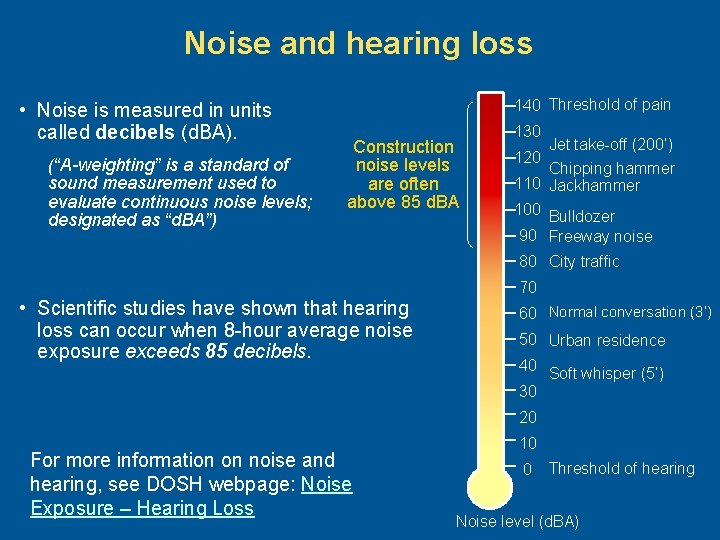
Noise and hearing loss • Noise is measured in units called decibels (d. BA). (“A-weighting” is a standard of sound measurement used to evaluate continuous noise levels; designated as “d. BA”) 140 Threshold of pain Construction noise levels are often above 85 d. BA 130 Jet take-off (200’) Chipping hammer 110 Jackhammer 120 100 Bulldozer 90 Freeway noise 80 City traffic 70 • Scientific studies have shown that hearing loss can occur when 8 -hour average noise exposure exceeds 85 decibels. 60 Normal conversation (3’) 50 Urban residence 40 Soft whisper (5’) 30 20 For more information on noise and hearing, see DOSH webpage: Noise Exposure – Hearing Loss 10 0 Threshold of hearing Noise level (d. BA)

Some Common Noise Levels in Construction Source: Center to Protect Worker’s Rights Decibels (d. BA) 60 70 80 85 90 100 110 -113 Pneumatic chipping hammer Jackhammer 102 -111 Concrete joint cutter 99 -102 Skilsaw 88 -102 Bulldozer 93 -96 Earth Tamper 90 -96 Crane 90 -96 Hammer 87 -95 Gradeall 87 -94 Front end loader 86 -94 Backhoe 110 84 -93 120
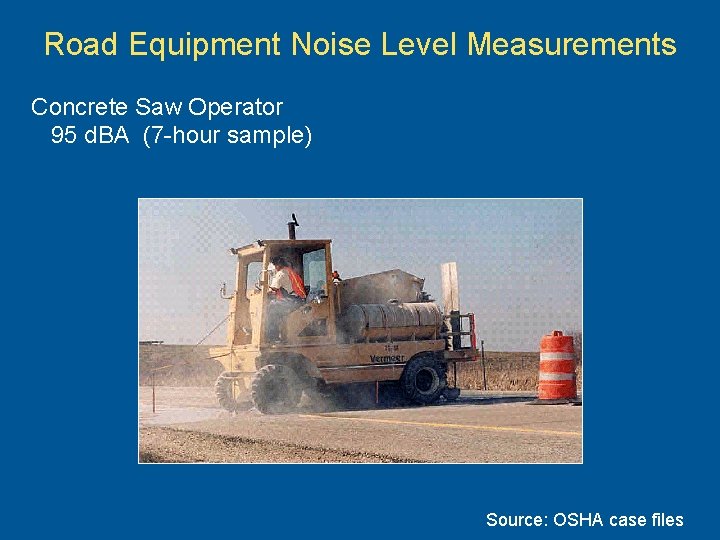
Road Equipment Noise Level Measurements Concrete Saw Operator 95 d. BA (7 -hour sample) Source: OSHA case files
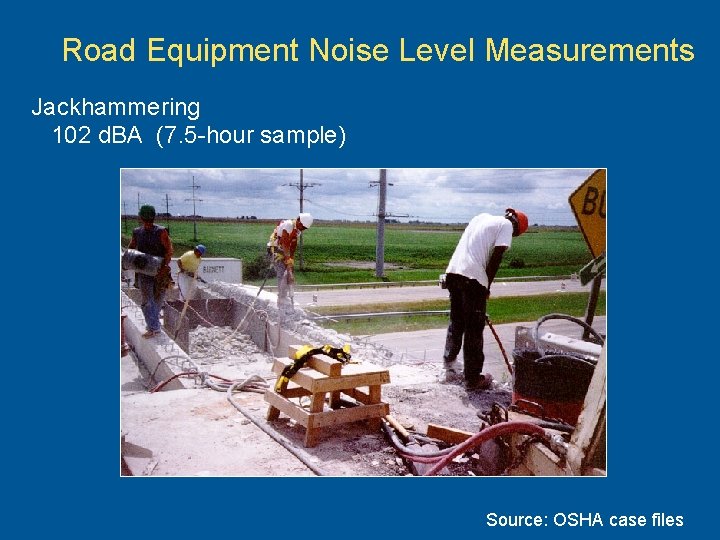
Road Equipment Noise Level Measurements Jackhammering 102 d. BA (7. 5 -hour sample) Source: OSHA case files

Road Equipment Noise Level Measurements Breaking pavement 112 d. BA (7 -hour sample) Source: OSHA case files
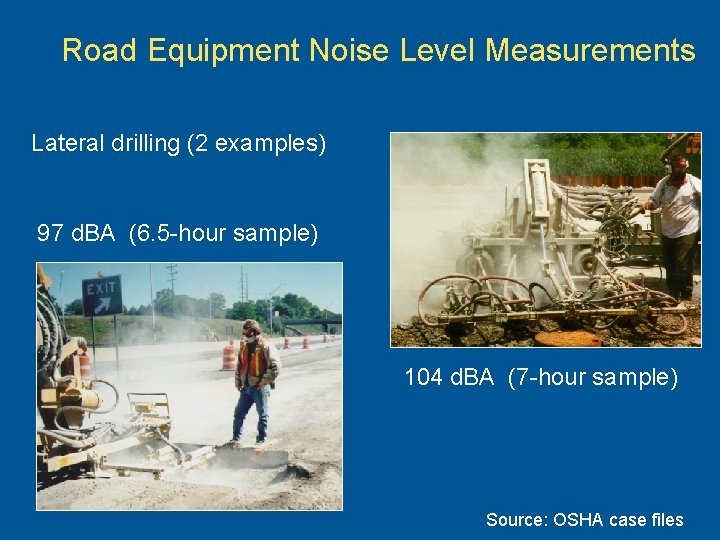
Road Equipment Noise Level Measurements Lateral drilling (2 examples) 97 d. BA (6. 5 -hour sample) 104 d. BA (7 -hour sample) Source: OSHA case files
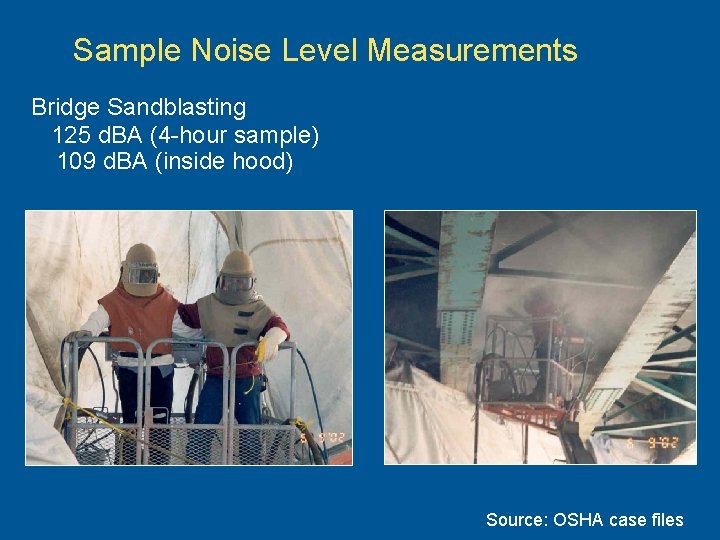
Sample Noise Level Measurements Bridge Sandblasting 125 d. BA (4 -hour sample) 109 d. BA (inside hood) Source: OSHA case files
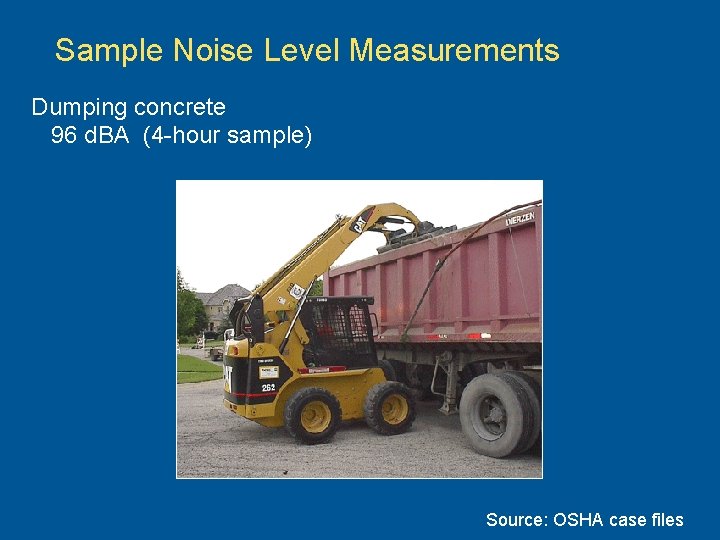
Sample Noise Level Measurements Dumping concrete 96 d. BA (4 -hour sample) Source: OSHA case files
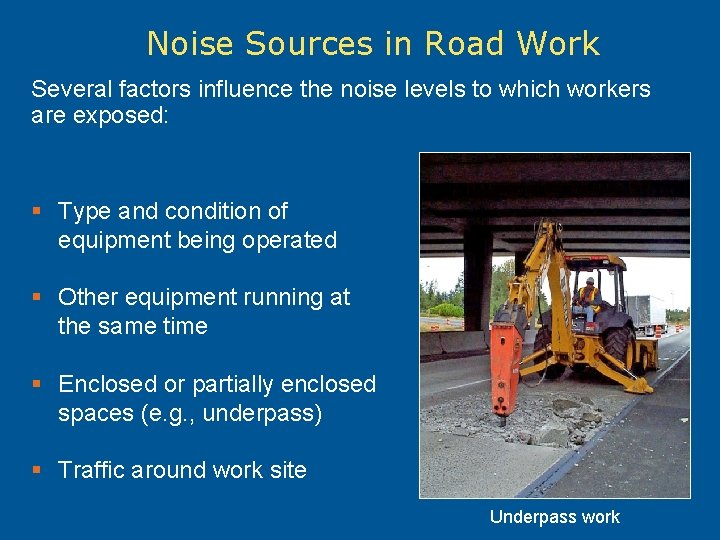
Noise Sources in Road Work Several factors influence the noise levels to which workers are exposed: § Type and condition of equipment being operated § Other equipment running at the same time Underpass § Enclosed or partially enclosed spaces (e. g. , underpass) § Traffic around work site Underpass work
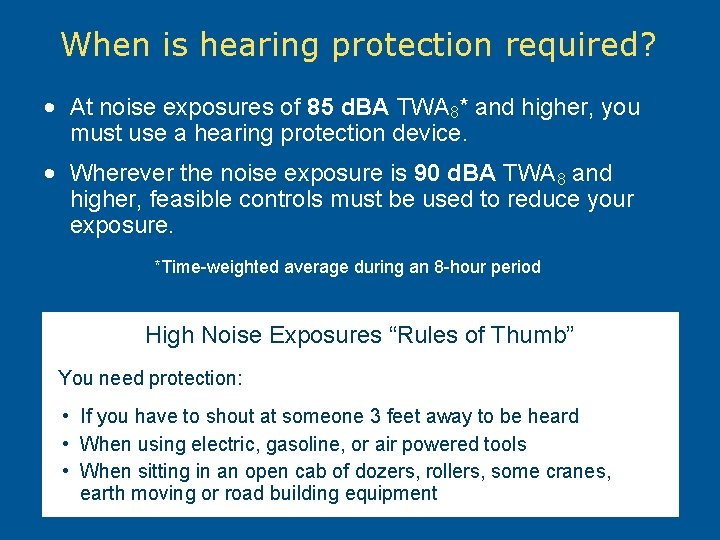
When is hearing protection required? • At noise exposures of 85 d. BA TWA 8* and higher, you must use a hearing protection device. • Wherever the noise exposure is 90 d. BA TWA 8 and higher, feasible controls must be used to reduce your exposure. *Time-weighted average during an 8 -hour period High Noise Exposures “Rules of Thumb” You need protection: • If you have to shout at someone 3 feet away to be heard • When using electric, gasoline, or air powered tools • When sitting in an open cab of dozers, rollers, some cranes, earth moving or road building equipment
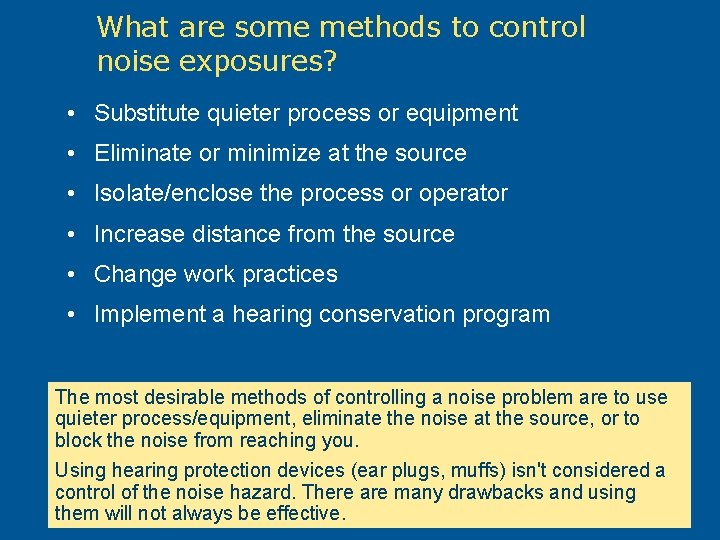
What are some methods to control noise exposures? • Substitute quieter process or equipment • Eliminate or minimize at the source • Isolate/enclose the process or operator • Increase distance from the source • Change work practices • Implement a hearing conservation program The most desirable methods of controlling a noise problem are to use quieter process/equipment, eliminate the noise at the source, or to block the noise from reaching you. Using hearing protection devices (ear plugs, muffs) isn't considered a control of the noise hazard. There are many drawbacks and using them will not always be effective.
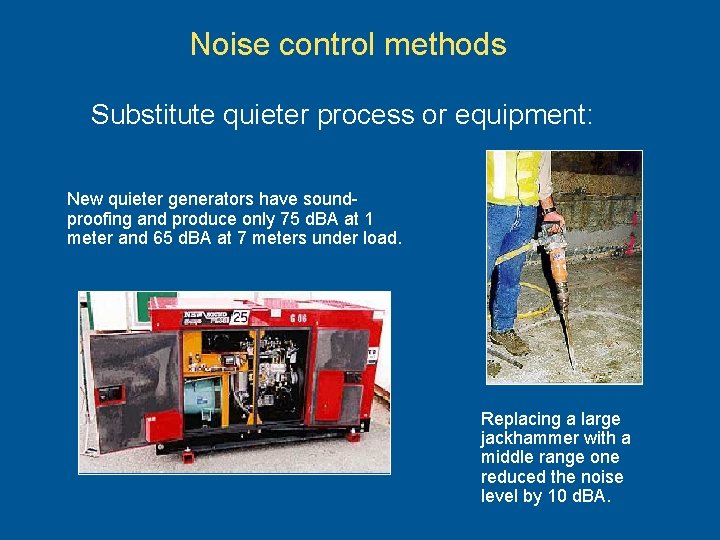
Noise control methods Substitute quieter process or equipment: New quieter generators have soundproofing and produce only 75 d. BA at 1 meter and 65 d. BA at 7 meters under load. Replacing a large jackhammer with a middle range one reduced the noise level by 10 d. BA.
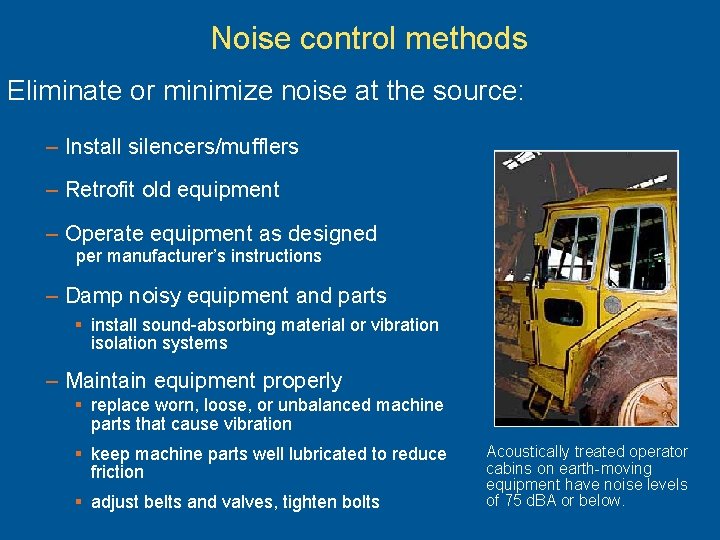
Noise control methods Eliminate or minimize noise at the source: – Install silencers/mufflers – Retrofit old equipment – Operate equipment as designed per manufacturer’s instructions – Damp noisy equipment and parts § install sound-absorbing material or vibration isolation systems – Maintain equipment properly § replace worn, loose, or unbalanced machine parts that cause vibration § keep machine parts well lubricated to reduce friction § adjust belts and valves, tighten bolts Acoustically treated operator cabins on earth-moving equipment have noise levels of 75 d. BA or below.
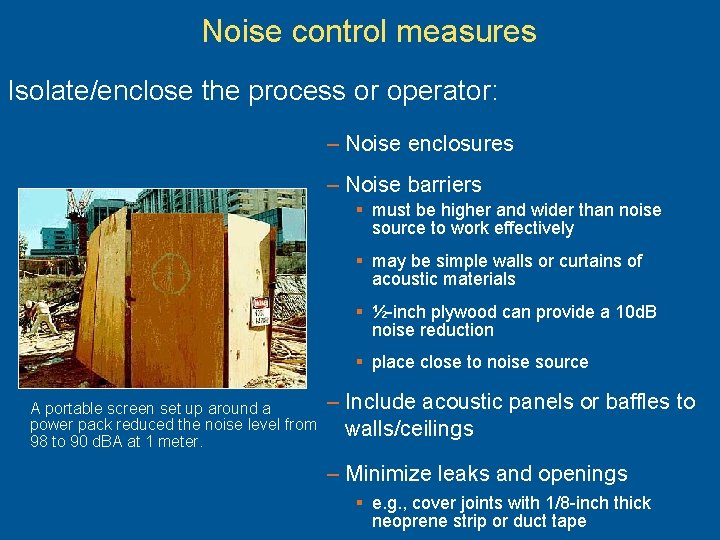
Noise control measures Isolate/enclose the process or operator: – Noise enclosures – Noise barriers § must be higher and wider than noise source to work effectively § may be simple walls or curtains of acoustic materials § ½-inch plywood can provide a 10 d. B noise reduction § place close to noise source A portable screen set up around a power pack reduced the noise level from 98 to 90 d. BA at 1 meter. – Include acoustic panels or baffles to walls/ceilings – Minimize leaks and openings § e. g. , cover joints with 1/8 -inch thick neoprene strip or duct tape
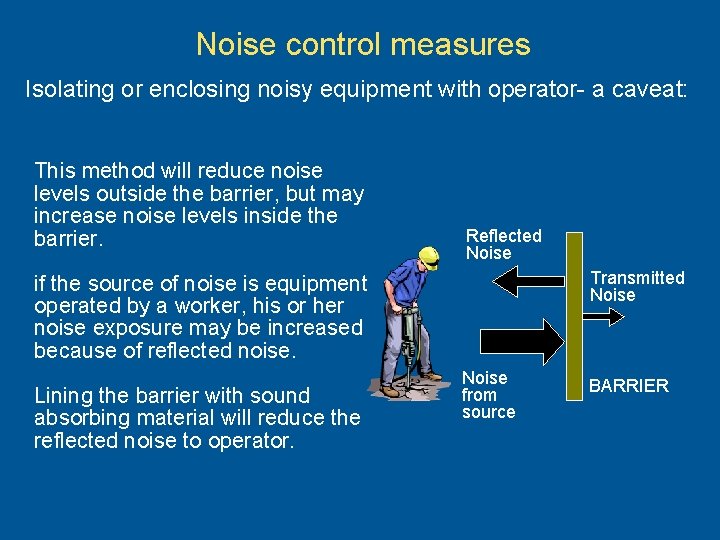
Noise control measures Isolating or enclosing noisy equipment with operator- a caveat: This method will reduce noise levels outside the barrier, but may increase noise levels inside the barrier. Reflected Noise Transmitted Noise if the source of noise is equipment operated by a worker, his or her noise exposure may be increased because of reflected noise. Lining the barrier with sound absorbing material will reduce the reflected noise to operator. Noise from source BARRIER
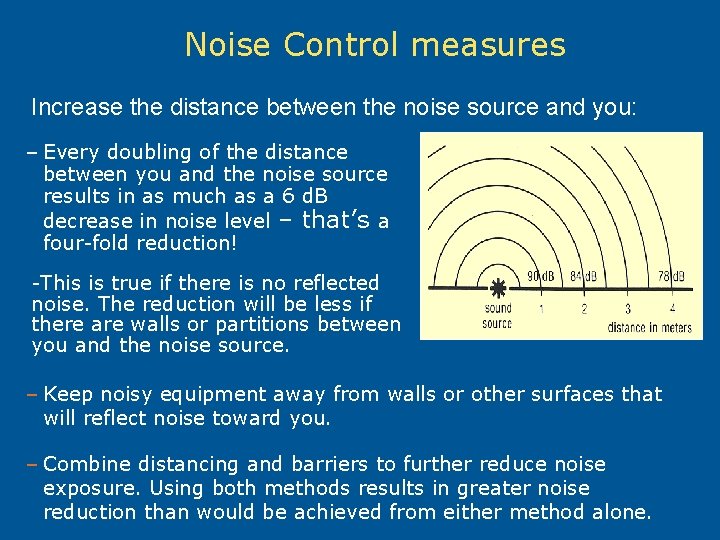
Noise Control measures Increase the distance between the noise source and you: – Every doubling of the distance between you and the noise source results in as much as a 6 d. B decrease in noise level – that’s a four-fold reduction! -This is true if there is no reflected noise. The reduction will be less if there are walls or partitions between you and the noise source. – Keep noisy equipment away from walls or other surfaces that will reflect noise toward you. – Combine distancing and barriers to further reduce noise exposure. Using both methods results in greater noise reduction than would be achieved from either method alone.
Other Noise Control Measures Change employee work practices: – limit time exposed: job rotation, rescheduling work – limit use of noisy equipment – provide breaks away from the noisy area – turn off equipment not in use
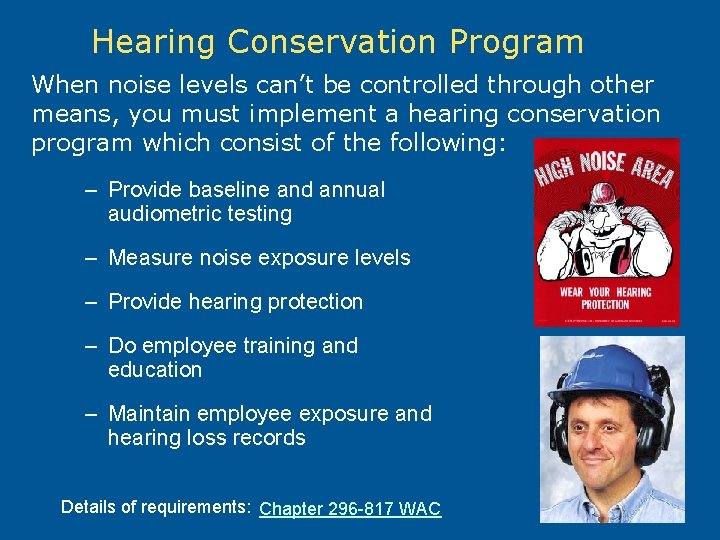
Hearing Conservation Program When noise levels can’t be controlled through other means, you must implement a hearing conservation program which consist of the following: – Provide baseline and annual audiometric testing – Measure noise exposure levels – Provide hearing protection – Do employee training and education – Maintain employee exposure and hearing loss records Details of requirements: Chapter 296 -817 WAC
Summary Hearing loss is expensive! Many construction noise levels are high and require controls to reduce workers’ exposures. Control methods: • • • Substitute quieter process or equipment Eliminate or minimize at the source Isolate/enclose the process or operator Increase distance from the source Change work practices Implement hearing conservation program
DOSH Consultation Services Safety & Health program review and worksite evaluation • • • By employer invitation only Free Confidential No citations or penalties Letter explains findings Follow-up all serious hazards For additional assistance, you can call one of our consultants. Click below for local L & I office locations: http: //www. lni. wa. gov/wisha/consultation/regional_consultants. htm
More Information § DOSH: Noise Exposure – Hearing Loss § NIOSH: Noise and Hearing Loss Prevention § OSHA: Noise and Hearing Conservation § National Hearing Conservation Association § MSHA Noise Control Manual: Surface Mining Equipment § Institute of Noise Control Engineering of the USA
- Slides: 24