
Nodals Impact on IT EMS User Group Ron
- Slides: 22
Nodal’s Impact on IT EMS User Group Ron Hinsley ERCOT Chief Information Officer Information Technology September 24, 2007
Agenda • • • Overview – ERCOT Primer – Nodal Primer – Bringing Strategy to Life What the RUP? !? – View from the Top – A Pattern for Everything – Better Living with Standards How it All Comes Together – Tracing the Requirements – Measuring Success – Right People, Right Place, Right Time Q&A Important Sources August 21, 2007 2 Enterprise Architecture
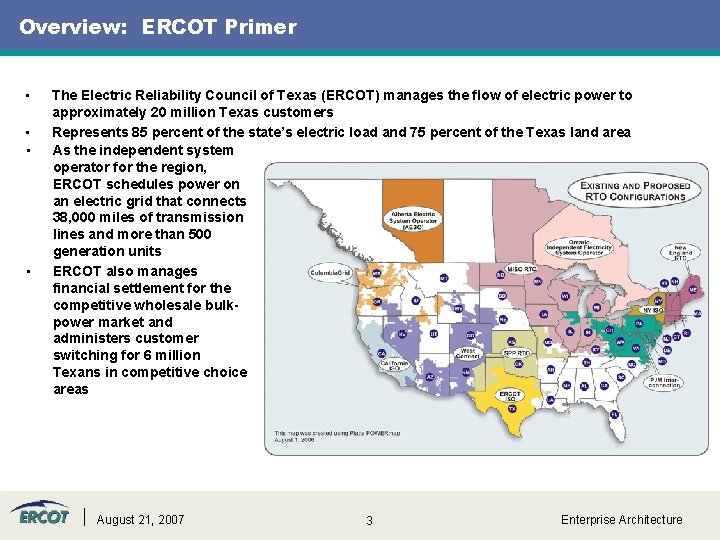
Overview: ERCOT Primer • • The Electric Reliability Council of Texas (ERCOT) manages the flow of electric power to approximately 20 million Texas customers Represents 85 percent of the state’s electric load and 75 percent of the Texas land area As the independent system operator for the region, ERCOT schedules power on an electric grid that connects 38, 000 miles of transmission lines and more than 500 generation units ERCOT also manages financial settlement for the competitive wholesale bulkpower market and administers customer switching for 6 million Texans in competitive choice areas August 21, 2007 3 Enterprise Architecture
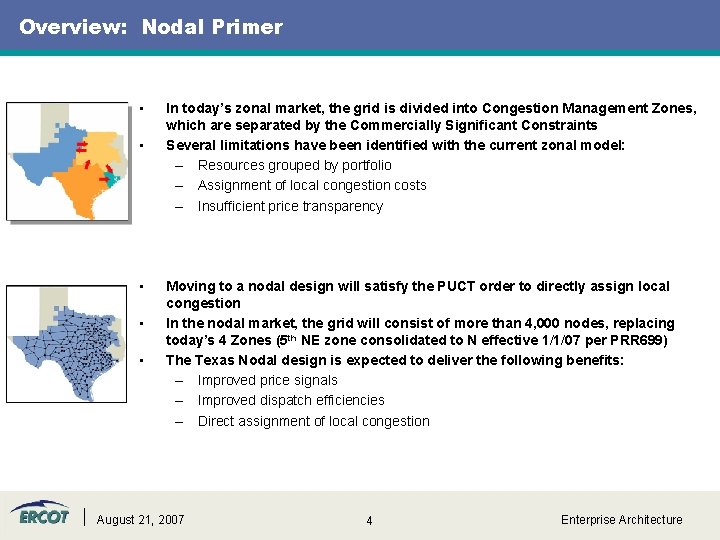
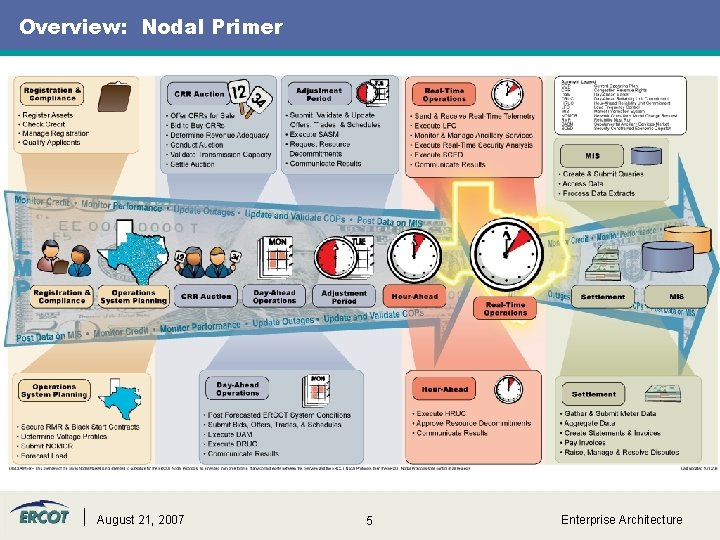
Overview: Nodal Primer • • • In today’s zonal market, the grid is divided into Congestion Management Zones, which are separated by the Commercially Significant Constraints Several limitations have been identified with the current zonal model: – Resources grouped by portfolio – Assignment of local congestion costs – Insufficient price transparency Moving to a nodal design will satisfy the PUCT order to directly assign local congestion In the nodal market, the grid will consist of more than 4, 000 nodes, replacing today’s 4 Zones (5 th NE zone consolidated to N effective 1/1/07 per PRR 699) The Texas Nodal design is expected to deliver the following benefits: – Improved price signals – Improved dispatch efficiencies – Direct assignment of local congestion August 21, 2007 4 Enterprise Architecture
Overview: Nodal Primer August 21, 2007 5 Enterprise Architecture
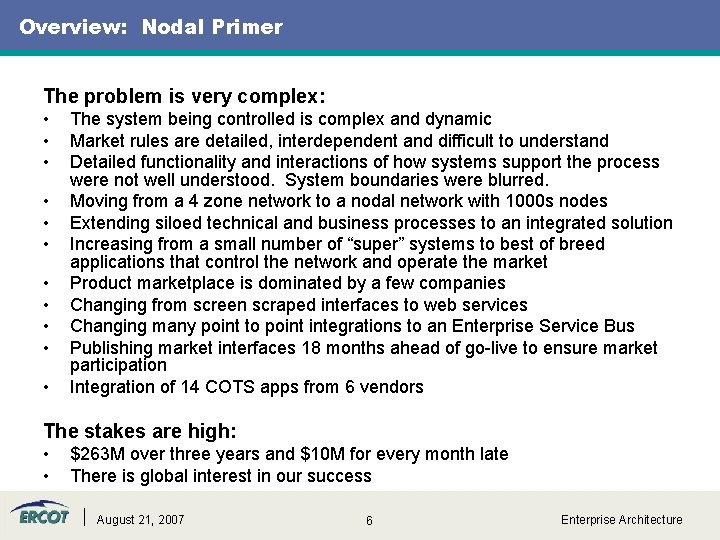
Overview: Nodal Primer The problem is very complex: • • • The system being controlled is complex and dynamic Market rules are detailed, interdependent and difficult to understand Detailed functionality and interactions of how systems support the process were not well understood. System boundaries were blurred. Moving from a 4 zone network to a nodal network with 1000 s nodes Extending siloed technical and business processes to an integrated solution Increasing from a small number of “super” systems to best of breed applications that control the network and operate the market Product marketplace is dominated by a few companies Changing from screen scraped interfaces to web services Changing many point to point integrations to an Enterprise Service Bus Publishing market interfaces 18 months ahead of go-live to ensure market participation Integration of 14 COTS apps from 6 vendors The stakes are high: • • $263 M over three years and $10 M for every month late There is global interest in our success August 21, 2007 6 Enterprise Architecture
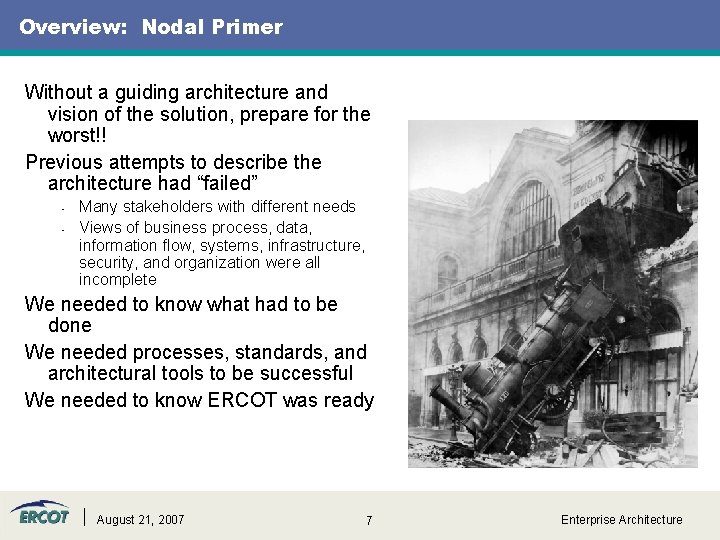
Overview: Nodal Primer Building a complex system in a dynamic environment Without a guiding architecture and vision of the solution, prepare for the worst!! Previous attempts to describe the architecture had “failed” • • Many stakeholders with different needs Views of business process, data, information flow, systems, infrastructure, security, and organization were all incomplete We needed to know what had to be done We needed processes, standards, and architectural tools to be successful We needed to know ERCOT was ready August 21, 2007 7 Enterprise Architecture
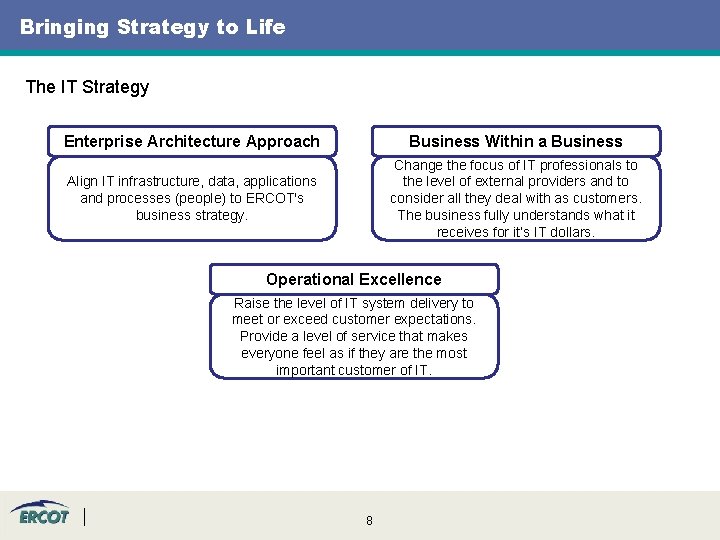
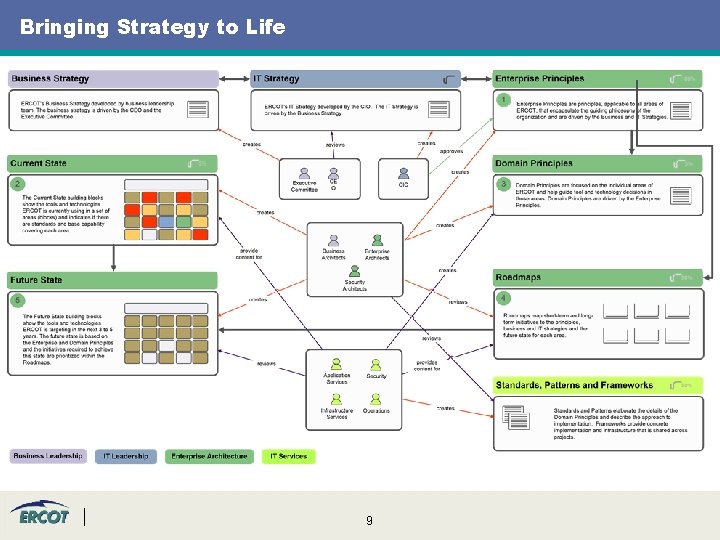
Bringing Strategy to Life The IT Strategy Enterprise Architecture Approach Business Within a Business Align IT infrastructure, data, applications and processes (people) to ERCOT's business strategy. Change the focus of IT professionals to the level of external providers and to consider all they deal with as customers. The business fully understands what it receives for it’s IT dollars. Operational Excellence Raise the level of IT system delivery to meet or exceed customer expectations. Provide a level of service that makes everyone feel as if they are the most important customer of IT. 8
Bringing Strategy to Life 9
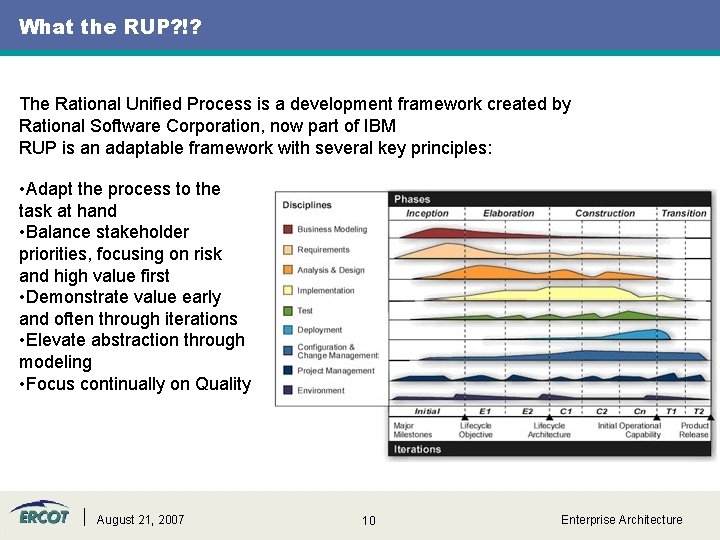
What the RUP? !? The Rational Unified Process is a development framework created by Rational Software Corporation, now part of IBM RUP is an adaptable framework with several key principles: • Adapt the process to the task at hand • Balance stakeholder priorities, focusing on risk and high value first • Demonstrate value early and often through iterations • Elevate abstraction through modeling • Focus continually on Quality August 21, 2007 10 Enterprise Architecture
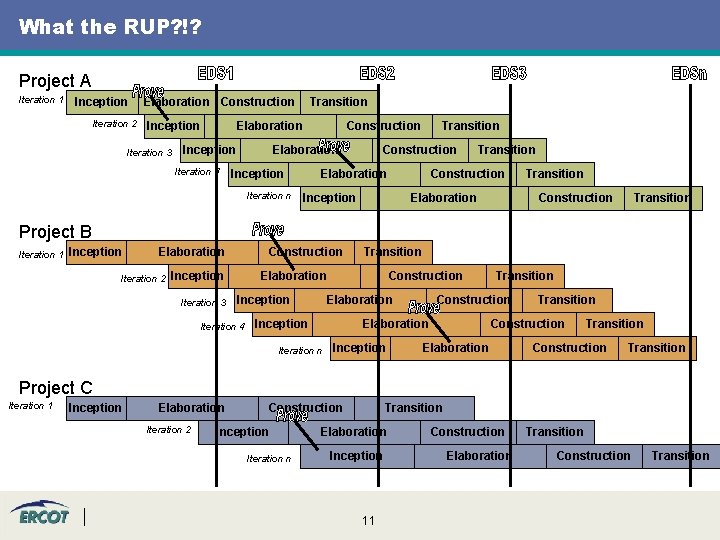
What the RUP? !? Project A Iteration 1 Inception Iteration 2 Elaboration Construction Inception Iteration 3 Transition Elaboration Inception Iteration 4 Construction Elaboration Inception Iteration n Transition Construction Elaboration Transition Construction Inception Elaboration Transition Construction Transition Project B Iteration 1 Inception Elaboration Iteration 2 Construction Inception Iteration 3 Transition Elaboration Inception Iteration 4 Construction Elaboration Inception Construction Elaboration Iteration n Inception Transition Construction Elaboration Transition Construction Transition Project C Iteration 1 Inception Elaboration Iteration 2 Construction Inception Iteration n Transition Elaboration Inception 11 Construction Elaboration Transition Construction Transition
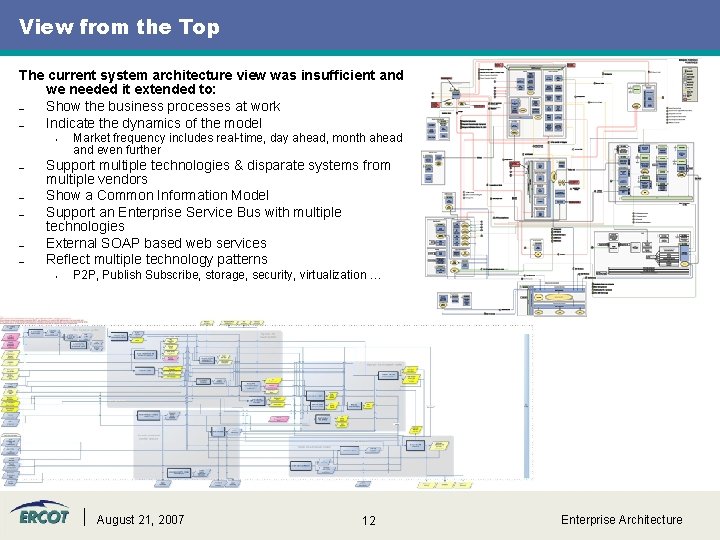
View from the Top The current system architecture view was insufficient and we needed it extended to: – Show the business processes at work – Indicate the dynamics of the model • – – – Market frequency includes real-time, day ahead, month ahead and even further Support multiple technologies & disparate systems from multiple vendors Show a Common Information Model Support an Enterprise Service Bus with multiple technologies External SOAP based web services Reflect multiple technology patterns • P 2 P, Publish Subscribe, storage, security, virtualization … August 21, 2007 12 Enterprise Architecture
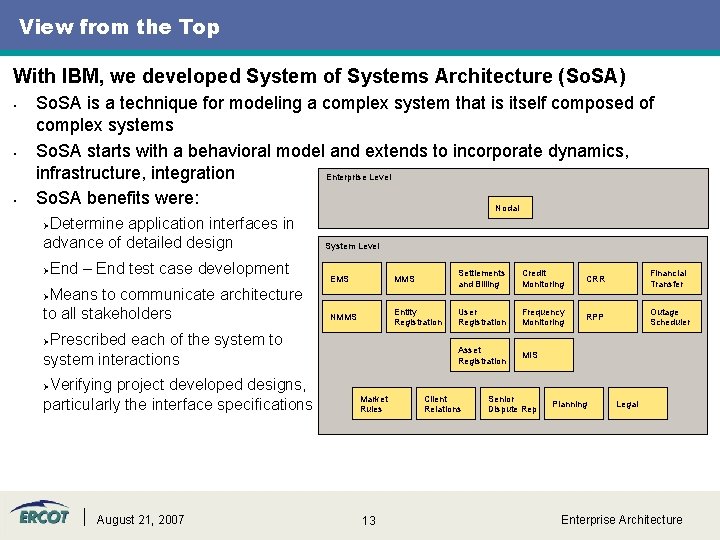
View from the Top With IBM, we developed System of Systems Architecture (So. SA) • • • So. SA is a technique for modeling a complex system that is itself composed of complex systems So. SA starts with a behavioral model and extends to incorporate dynamics, infrastructure, integration Enterprise Level So. SA benefits were: Nodal Determine application interfaces in advance of detailed design Ø Ø End – End test case development Means to communicate architecture to all stakeholders System Level EMS MMS Settlements and Billing Credit Monitoring CRR Financial Transfer NMMS Entity Registration User Registration Frequency Monitoring RPP Outage Scheduler Asset Registration MIS Ø Prescribed each of the system to system interactions Ø Verifying project developed designs, particularly the interface specifications Ø August 21, 2007 Market Rules 13 Client Relations Senior Dispute Rep Planning Legal Enterprise Architecture
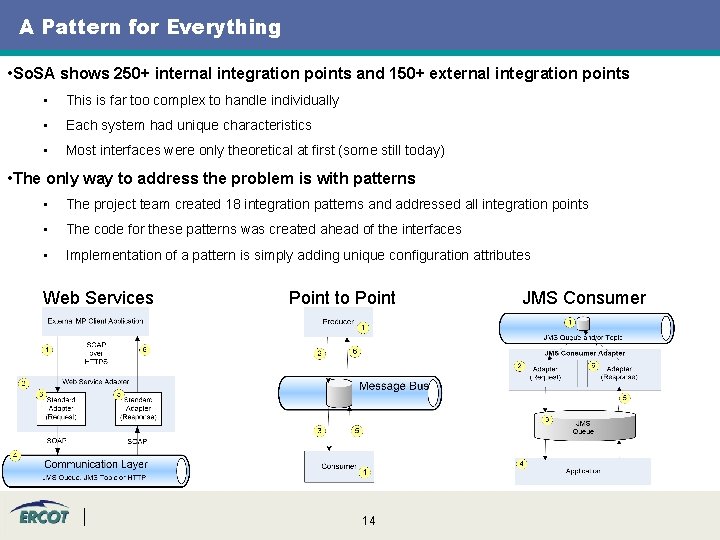
A Pattern for Everything • So. SA shows 250+ internal integration points and 150+ external integration points • This is far too complex to handle individually • Each system had unique characteristics • Most interfaces were only theoretical at first (some still today) • The only way to address the problem is with patterns • The project team created 18 integration patterns and addressed all integration points • The code for these patterns was created ahead of the interfaces • Implementation of a pattern is simply adding unique configuration attributes Web Services Point to Point 14 JMS Consumer
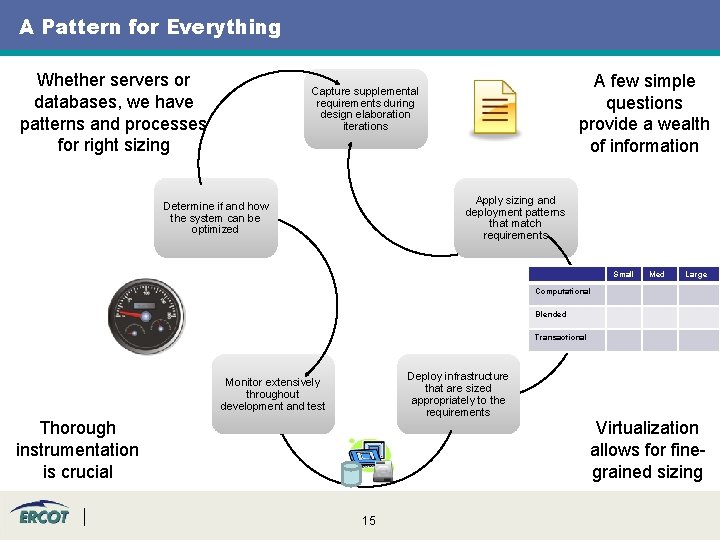
A Pattern for Everything Whether servers or databases, we have patterns and processes for right sizing A few simple questions provide a wealth of information Capture supplemental requirements during design elaboration iterations Apply sizing and deployment patterns that match requirements Determine if and how the system can be optimized Small Med Large Computational Blended Transactional Deploy infrastructure that are sized appropriately to the requirements Monitor extensively throughout development and test Thorough instrumentation is crucial Virtualization allows for finegrained sizing 15
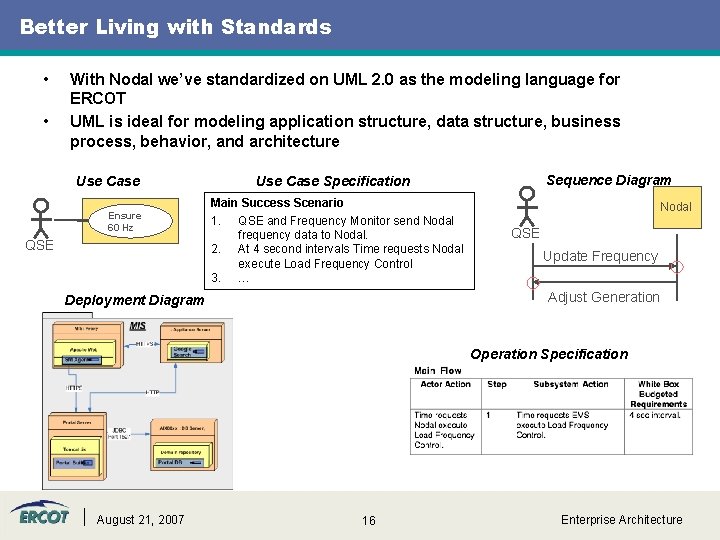
Better Living with Standards • • With Nodal we’ve standardized on UML 2. 0 as the modeling language for ERCOT UML is ideal for modeling application structure, data structure, business process, behavior, and architecture Use Case … Ensure 60 Hz QSE Sequence Diagram Use Case Specification Main Success Scenario 1. QSE and Frequency Monitor send Nodal frequency data to Nodal. 2. At 4 second intervals Time requests Nodal execute Load Frequency Control 3. … Nodal QSE Update Frequency Adjust Generation Deployment Diagram Operation Specification August 21, 2007 16 Enterprise Architecture
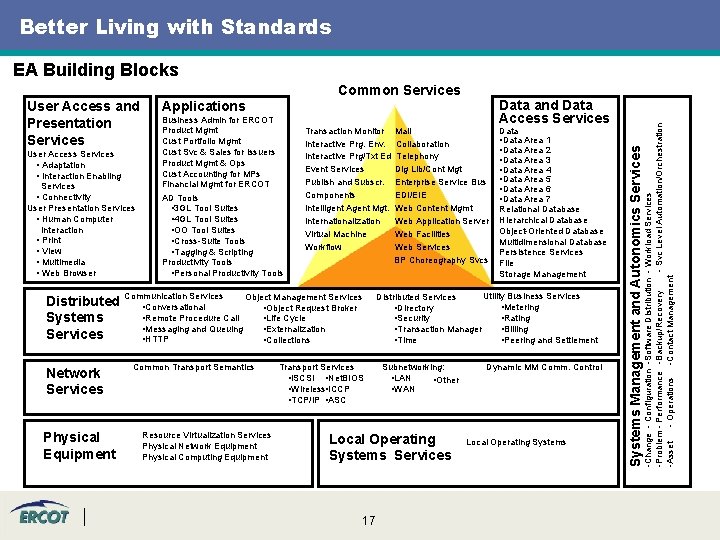
Better Living with Standards User Access Services • Adaptation • Interaction Enabling Services • Connectivity User Presentation Services • Human Computer Interaction • Print • View • Multimedia • Web Browser Applications Business Admin for ERCOT Product Mgmt Cust Portfolio Mgmt Cust Svc & Sales for issuers Product Mgmt & Ops Cust Accounting for MPs Financial Mgmt for ERCOT AD Tools • 3 GL Tool Suites • 4 GL Tool Suites • OO Tool Suites • Cross-Suite Tools • Tagging & Scripting Productivity Tools • Personal Productivity Tools Transaction Monitor Mail Interactive Prg. Env. Collaboration Interactive Prg/Txt Ed Telephony Event Services Dig Lib/Cont Mgt Publish and Subscr. Enterprise Service Bus Components EDI/EIE Intelligent Agent Mgt. Web Content Mgmt Internationalization Web Application Server Virtual Machine Web Facilities Workflow Web Services BP Choreography Svcs Object Management Services Distributed Communication Services • Conversational • Object Request Broker • Remote Procedure Call • Life Cycle Systems • Messaging and Queuing • Externalization Services • HTTP • Collections Network Services Physical Equipment Common Transport Semantics Resource Virtualization Services Physical Network Equipment Physical Computing Equipment Transport Services • i. SCSI • Net. BIOS • Wireless • ICCP • TCP/IP • ASC Data • Data Area 1 • Data Area 2 • Data Area 3 • Data Area 4 • Data Area 5 • Data Area 6 • Data Area 7 Relational Database Hierarchical Database Object-Oriented Database Multidimensional Database Persistence Services File Storage Management Utility Business Services Distributed Services • Metering • Directory • Rating • Security • Billing • Transaction Manager • Peering and Settlement • Time Subnetworking: • LAN • Other • WAN Local Operating Systems Services 17 Data and Data Access Services Dynamic MM Comm. Control Local Operating Systems -Change - Configuration -Software Distribution - Workload Services User Access and Presentation Services Systems Management and Autonomics Services Common Services -Problem - Performance -Backup/Recovery - Svc Level Automation/Orchestration -Asset - Operations -Contact Management EA Building Blocks
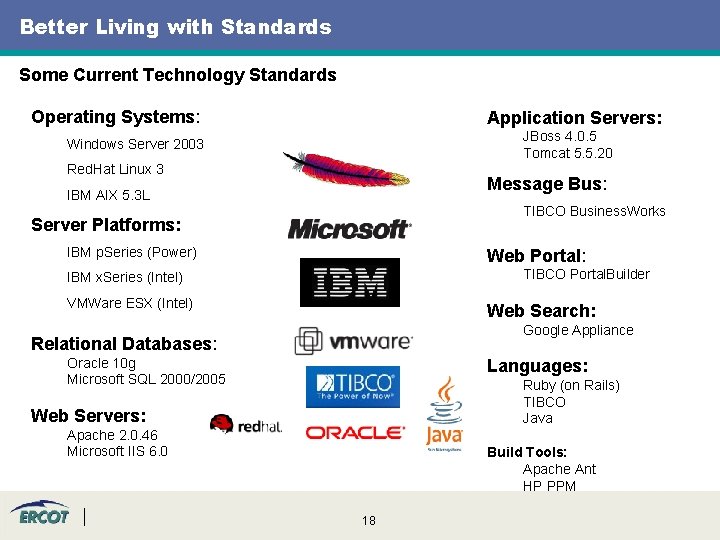
Better Living with Standards Some Current Technology Standards Operating Systems: Application Servers: JBoss 4. 0. 5 Tomcat 5. 5. 20 Windows Server 2003 Red. Hat Linux 3 Message Bus: IBM AIX 5. 3 L TIBCO Business. Works Server Platforms: IBM p. Series (Power) Web Portal: TIBCO Portal. Builder IBM x. Series (Intel) VMWare ESX (Intel) Web Search: Google Appliance Relational Databases: Oracle 10 g Microsoft SQL 2000/2005 Languages: Ruby (on Rails) TIBCO Java Web Servers: Apache 2. 0. 46 Microsoft IIS 6. 0 Build Tools: Apache Ant HP PPM 18
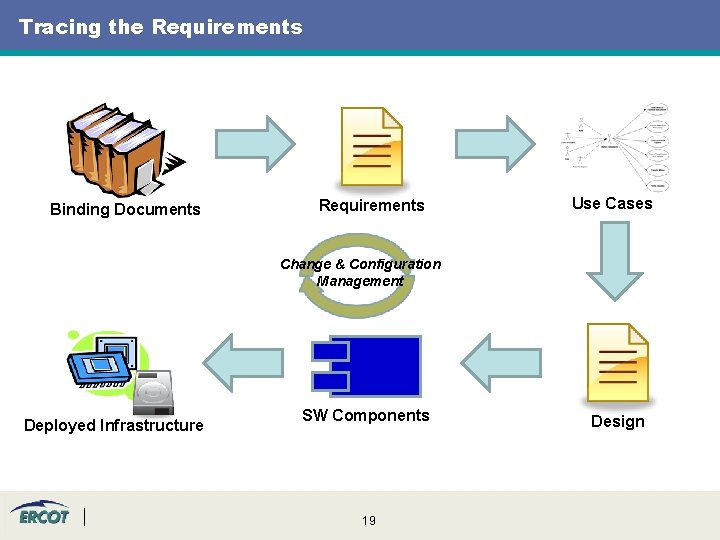
Tracing the Requirements Binding Documents Requirements Use Cases Change & Configuration Management Deployed Infrastructure SW Components 19 Design
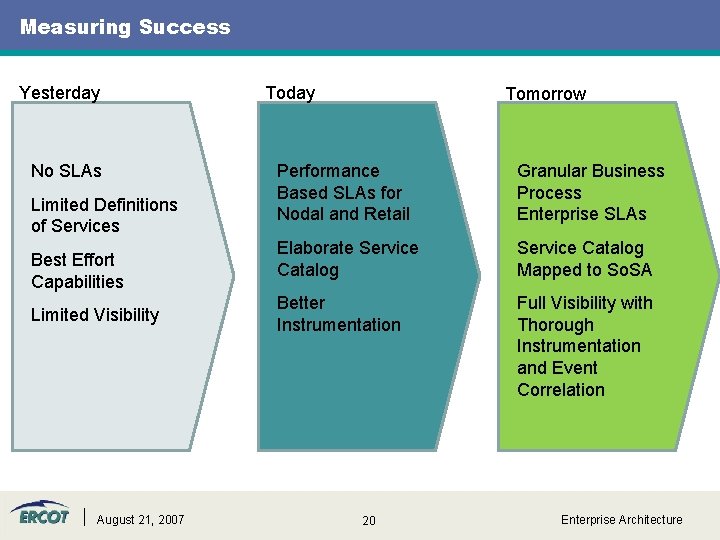
Measuring Success Yesterday No SLAs Limited Definitions of Services Best Effort Capabilities Limited Visibility August 21, 2007 Today Tomorrow Performance Based SLAs for Nodal and Retail Granular Business Process Enterprise SLAs Elaborate Service Catalog Mapped to So. SA Better Instrumentation Full Visibility with Thorough Instrumentation and Event Correlation 20 Enterprise Architecture
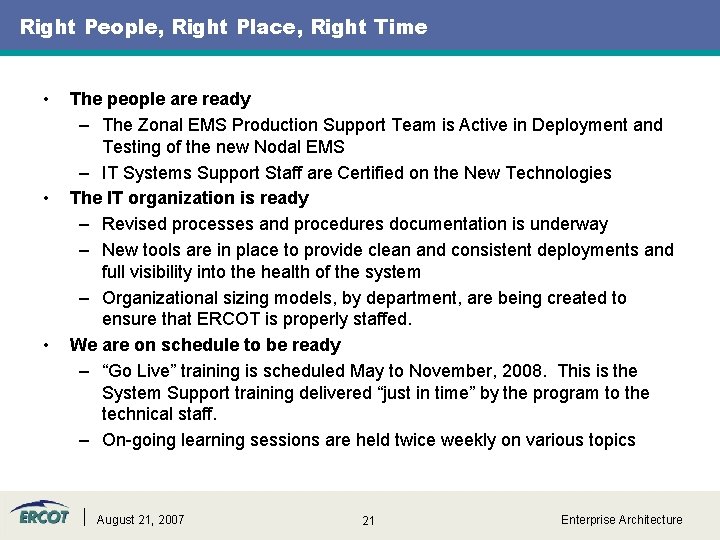
Right People, Right Place, Right Time • • • The people are ready – The Zonal EMS Production Support Team is Active in Deployment and Testing of the new Nodal EMS – IT Systems Support Staff are Certified on the New Technologies The IT organization is ready – Revised processes and procedures documentation is underway – New tools are in place to provide clean and consistent deployments and full visibility into the health of the system – Organizational sizing models, by department, are being created to ensure that ERCOT is properly staffed. We are on schedule to be ready – “Go Live” training is scheduled May to November, 2008. This is the System Support training delivered “just in time” by the program to the technical staff. – On-going learning sessions are held twice weekly on various topics August 21, 2007 21 Enterprise Architecture
Questions and Answers Handy Links: http: //nodal. ercot. com http: //uml. org August 21, 2007 All about Nodal OMG’s Official UML Site 22 Enterprise Architecture