
NOAAs National Environmental Satellite Data and Information Service
- Slides: 2
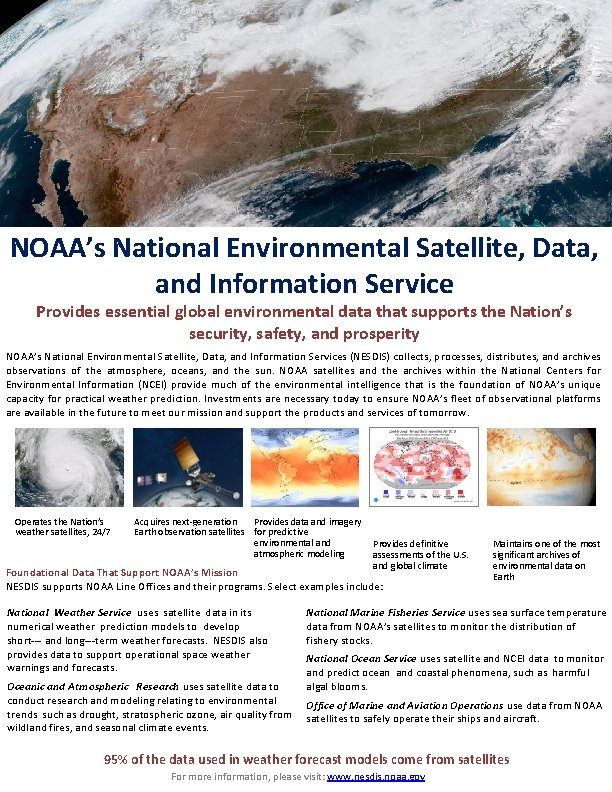
NOAA’s National Environmental Satellite, Data, and Information Service Provides essential global environmental data that supports the Nation’s security, safety, and prosperity NOAA’s National Environmental Satellite, Data, and Information Services (NESDIS) collects, processes, distributes, and archives observations of the atmosphere, oceans, and the sun. NOAA satellites and the archives within the National Centers for Environmental Information (NCEI) provide much of the environmental intelligence that is the foundation of NOAA’s unique capacity for practical weather prediction. Investments are necessary today to ensure NOAA’s fleet of observational platforms are available in the future to meet our mission and support the products and services of tomorrow. Operates the Nation’s weather satellites, 24/7 Acquires next‐generation Provides data and imagery Earth observation satellites for predictive environmental and atmospheric modeling Provides definitive assessments of the U. S. and global climate Foundational Data That Support NOAA’s Mission NESDIS supports NOAA Line Offices and their programs. Select examples include: National Weather Service uses satellite data in its numerical weather prediction models to develop short‐‐‐ and long‐‐‐term weather forecasts. NESDIS also provides data to support operational space weather warnings and forecasts. Oceanic and Atmospheric Research uses satellite data to conduct research and modeling relating to environmental trends such as drought, stratospheric ozone, air quality from wildland fires, and seasonal climate events. Maintains one of the most significant archives of environmental data on Earth National Marine Fisheries Service uses sea surface temperature data from NOAA’s satellites to monitor the distribution of fishery stocks. National Ocean Service uses satellite and NCEI data to monitor and predict ocean and coastal phenomena, such as harmful algal blooms. Office of Marine and Aviation Operations use data from NOAA satellites to safely operate their ships and aircraft. 95% of the data used in weather forecast models come from satellites For more information, please visit: www. nesdis. noaa. gov
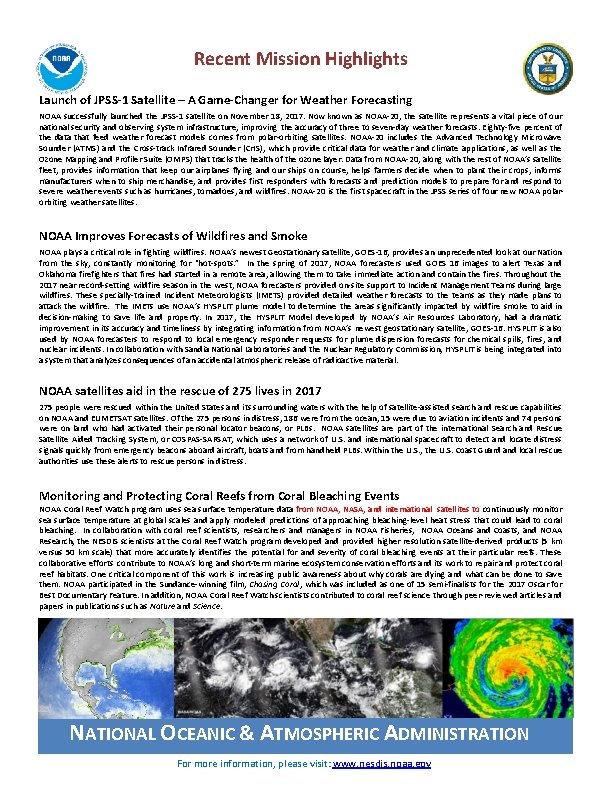
Recent Mission Highlights Launch of JPSS-1 Satellite – A Game-Changer for Weather Forecasting NOAA successfully launched the JPSS‐ 1 satellite on November 18, 2017. Now known as NOAA‐ 20, the satellite represents a vital piece of our national security and observing system infrastructure, improving the accuracy of three to seven‐day weather forecasts. Eighty‐five percent of the data that feed weather forecast models comes from polar‐orbiting satellites. NOAA‐ 20 includes the Advanced Technology Microwave Sounder (ATMS) and the Cross‐track Infrared Sounder (Cr. IS), which provide critical data for weather and climate applications, as well as the Ozone Mapping and Profiler Suite (OMPS) that tracks the health of the ozone layer. Data from NOAA‐ 20, along with the rest of NOAA’s satellite fleet, provides information that keep our airplanes flying and our ships on course, helps farmers decide when to plant their crops, informs manufacturers when to ship merchandise, and provides first responders with forecasts and prediction models to prepare for and respond to severe weather events such as hurricanes, tornadoes, and wildfires. NOAA‐ 20 is the first spacecraft in the JPSS series of four new NOAA polar‐ orbiting weather satellites. NOAA Improves Forecasts of Wildfires and Smoke NOAA plays a critical role in fighting wildfires. NOAA’s newest Geostationary satellite, GOES‐ 16, provides an unprecedented look at our Nation from the sky, constantly monitoring for “hot‐spots. ” In the spring of 2017, NOAA forecasters used GOES 16 images to alert Texas and Oklahoma firefighters that fires had started in a remote area, allowing them to take immediate action and contain the fires. Throughout the 2017 near record‐setting wildfire season in the west, NOAA forecasters provided on‐site support to Incident Management Teams during large wildfires. These specially‐trained Incident Meteorologists (IMETS) provided detailed weather forecasts to the teams as they made plans to attack the wildfire. The IMETs use NOAA’s HYSPLIT plume model to determine the areas significantly impacted by wildfire smoke to aid in decision‐making to save life and property. In 2017, the HYSPLIT Model developed by NOAA’s Air Resources Laboratory, had a dramatic improvement in its accuracy and timeliness by integrating information from NOAA’s newest geostationary satellite, GOES‐ 16. HYSPLIT is also used by NOAA forecasters to respond to local emergency responder requests for plume dispersion forecasts for chemical spills, fires, and nuclear incidents. In collaboration with Sandia National Laboratories and the Nuclear Regulatory Commission, HYSPLIT is being integrated into a system that analyzes consequences of an accidental atmospheric release of radioactive material. NOAA satellites aid in the rescue of 275 lives in 2017 275 people were rescued within the United States and its surrounding waters with the help of satellite‐assisted search and rescue capabilities on NOAA and EUMETSAT satellites. Of the 275 persons in distress, 186 were from the ocean, 15 were due to aviation incidents and 74 persons were on land who had activated their personal locator beacons, or PLBs. NOAA satellites are part of the international Search and Rescue Satellite Aided Tracking System, or COSPAS‐SARSAT, which uses a network of U. S. and international spacecraft to detect and locate distress signals quickly from emergency beacons aboard aircraft, boats and from handheld PLBs. Within the U. S. , the U. S. Coast Guard and local rescue authorities use these alerts to rescue persons in distress. Monitoring and Protecting Coral Reefs from Coral Bleaching Events NOAA Coral Reef Watch program uses sea surface temperature data from NOAA, NASA, and international satellites to continuously monitor sea surface temperature at global scales and apply modeled predictions of approaching bleaching‐level heat stress that could lead to coral bleaching. In collaboration with coral reef scientists, researchers and managers in NOAA Fisheries, NOAA Oceans and Coasts, and NOAA Research, the NESDIS scientists at the Coral Reef Watch program developed and provided higher resolution satellite‐derived products (5 km versus 50 km scale) that more accurately identifies the potential for and severity of coral bleaching events at their particular reefs. These collaborative efforts contribute to NOAA’s long and short‐term marine ecosystem conservation efforts and its work to repair and protect coral reef habitats. One critical component of this work is increasing public awareness about why corals are dying and what can be done to save them. NOAA participated in the Sundance‐winning film, Chasing Coral, which was included as one of 15 semi‐finalists for the 2017 Oscar for Best Documentary Feature. In addition, NOAA Coral Reef Watch scientists contributed to coral reef science through peer‐reviewed articles and papers in publications such as Nature and Science. NATIONAL OCEANIC & ATMOSPHERIC ADMINISTRATION For more information, please visit: www. nesdis. noaa. gov