
NOAAS Future Data Activities Petabyte Archives Metadata and
NOAA’S Future Data Activities: Petabyte Archives, Metadata and Systems Integration David Clark NOAA/NESDIS/ National Geophysical Data Center 20 th International CODATA Conference Beijing, P. R. China
What is the future? • Petabyte Archives – Comprehensive Large Array-data Stewardship System (CLASS) • Metadata – Systems interoperability • Integrated NOAA Observing systems – Global Earth Observation Integrated Data Environment (GEO IDE)
“More information has been produced in the last 30 years than in the last 5000” Pritchett, 1999 “Data is everyone’s second highest priority” Bretherton, circa 1988
A Petabyte Equals • • 1, 000 Terabytes 1 million Gigabytes 500 billion ASCII pages 32, 000 mile-high stack of paper 5 Billion pounds of paper 42. 5 million pulp trees 12, 000 football fields of file cabinets 5, 500 years to download at 56 kbps
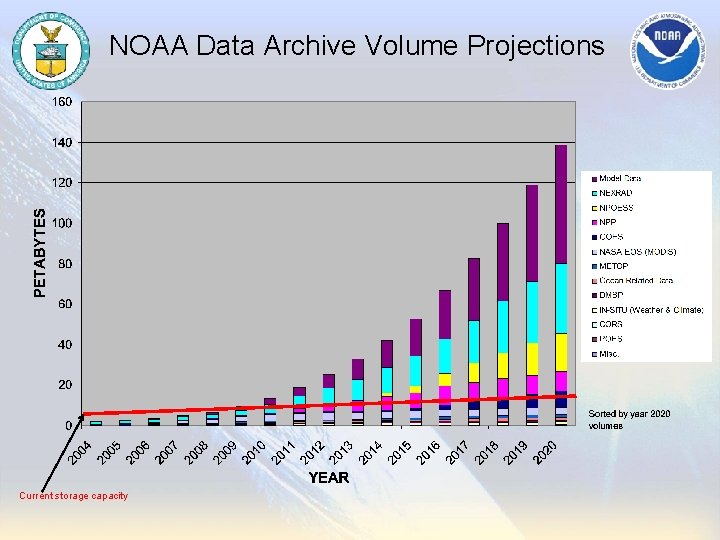
NOAA Data Archive Volume Projections Current storage capacity
Comprehensive Large Array-data Stewardship System (CLASS) Mission Statement “NOAA's National Data Centers and their world-wide clientele of customers look to CLASS as the sole NOAA IT infrastructure project in which all NOAA’s current and future environmental data sets will reside. CLASS provides permanent, secure storage, and safe, efficient data discovery and access between the Data Centers and the customers. ”
CLASS Goals • Provide one-stop shopping and access capability for NOAA environmental data and products • Provide a common look and feel for accessing NOAA environmental data and products • Provide an efficient architecture for archiving and distribution of NOAA environmental data and products • Reduce implementation costs by using reengineering, evolutionary effort • Allow NOAA to fulfill its requirements regarding archive, access, and distribution of data from NOAA and other observing systems
CLASS Performance Requirements – Core Requirements • ingest, secure storage, and access to baseline large-array data • information pertaining to processing data, including documentation, processing algorithms and procedures • provide human and machine-to-machine interfaces to store, maintain, and provide access to data, information, and metadata • initiate pilot programs with the GEO IDE to support risk reducing development and phased integration of standards for metadata, machine-to-machine interfaces, and archive
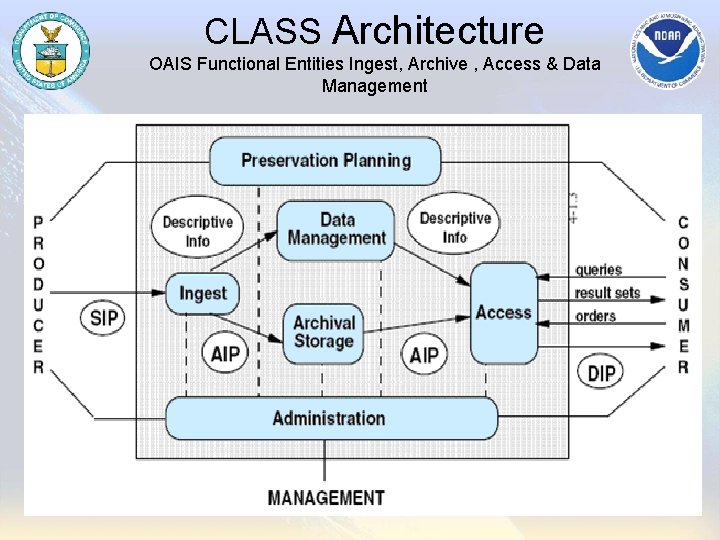
CLASS Architecture OAIS Functional Entities Ingest, Archive , Access & Data Management
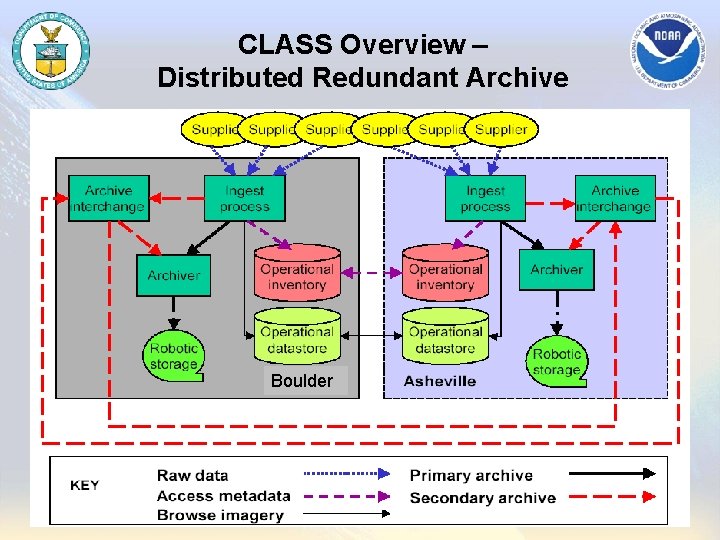
CLASS Overview – Distributed Redundant Archive Boulder
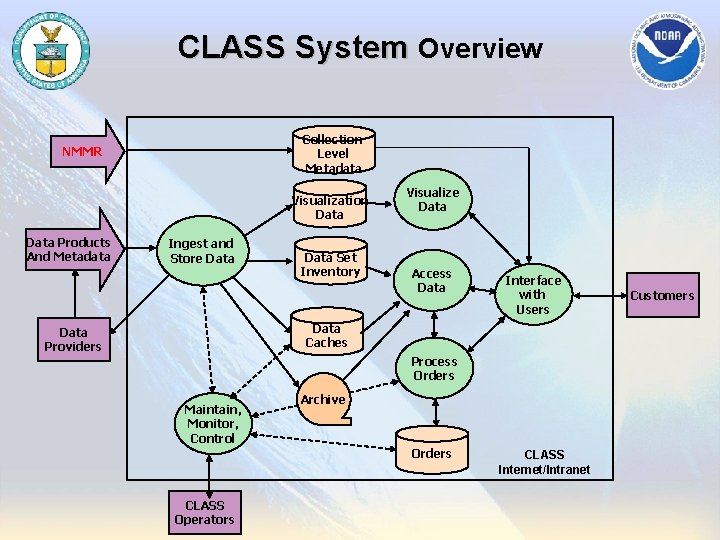
CLASS System Overview Collection Level Metadata NMMR Visualization Data Products And Metadata Ingest and Store Data Set Inventory Visualize Data Access Data Interface with Users Data Caches Data Providers Process Orders Maintain, Monitor, Control Archive Orders CLASS Operators CLASS Internet/Intranet Customers
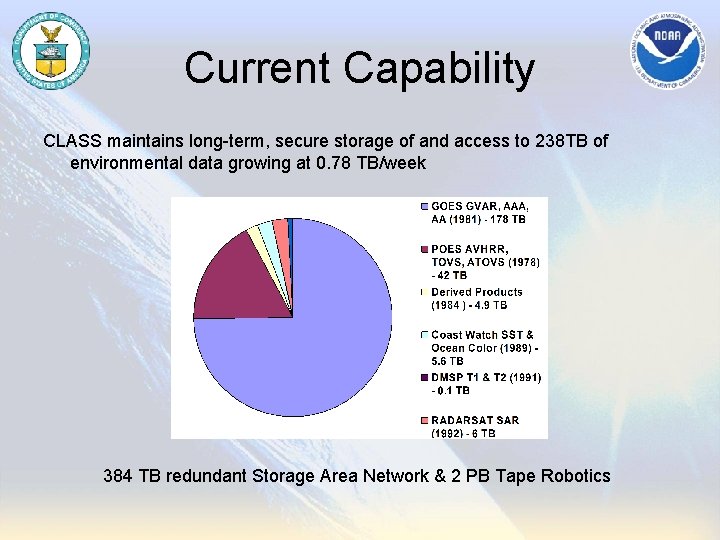
Current Capability CLASS maintains long-term, secure storage of and access to 238 TB of environmental data growing at 0. 78 TB/week 384 TB redundant Storage Area Network & 2 PB Tape Robotics
Metadata (Greek meta "after" and Latin data "information") are data that describe other data. Generally, a set of metadata describes a single set of data, called a resource. from Wikipedia
NOAA Metadata Manager and Repository (NMMR) • Supports multiple metadata standards • Web, SOAP, and search interfaces • Creation of metadata, with minimal understanding of FGDC standards • Supports workflow with multiple states • Collection/granule (parent/child) record sets • Direct path to conforming to ISO 19115/19139
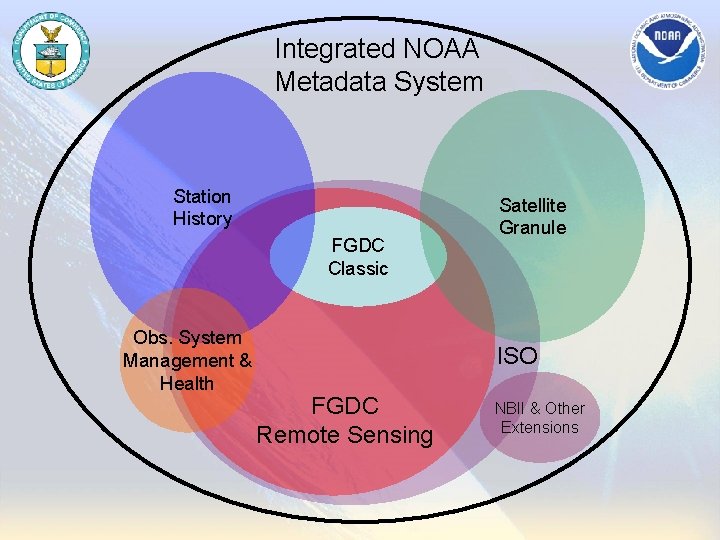
Integrated NOAA Metadata System Station History FGDC Classic Obs. System Management & Health Satellite Granule ISO FGDC Remote Sensing NBII & Other Extensions
Why Metadata? • Adherence to metadata standards – Leads to easier integration of data – More resources can be spent on development of data relationships than reformatting and manipulation of the data – Much more efficient archival and access to retrospective data – Leads to the integration of operational (real/near real-time data systems) and archive data systems.
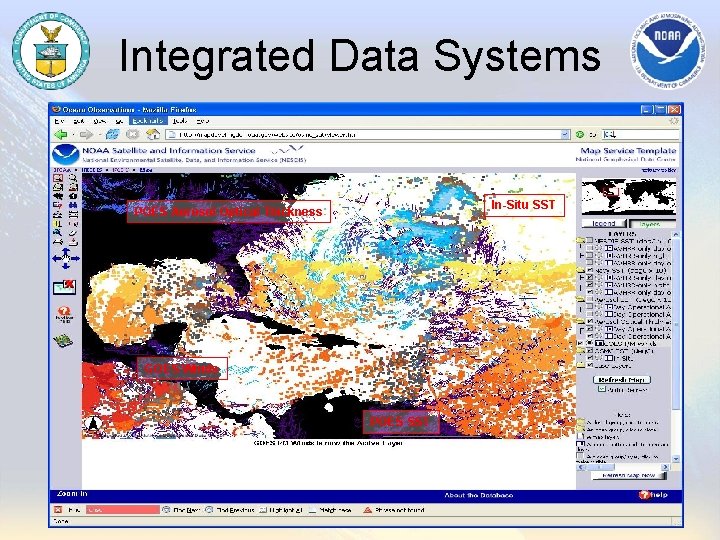
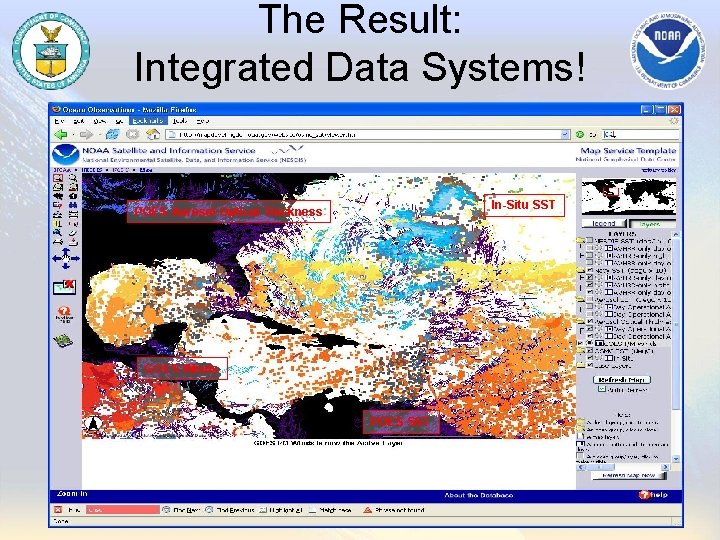
Integrated Data Systems In-Situ SST POES Aerosol Optical Thickness GOES Winds POES SST
NOAA Encompasses a Challenging Diversity • NOAA currently manages >90 environmental observing systems, some with hundreds of stations: including land-, sea-, air, and space -based observing platforms • These systems gather >300 diverse environmental parameters (e. g. marine biological health, economic fisheries data, physical and chemical state of the atmosphere and ocean, paleoclimate proxy data, geodetic survey points, etc. ) • NOAA also requires other national, international and commercial data in its operations (some in real-time) • NOAA data management systems include more than 50 significant stovepipe systems • Future observing systems will produce vastly increased data volumes that will need to be archived and efficiently accessed by an expanding number of users • NOAA is migrating from this current stovepipe environment to an information enterprise
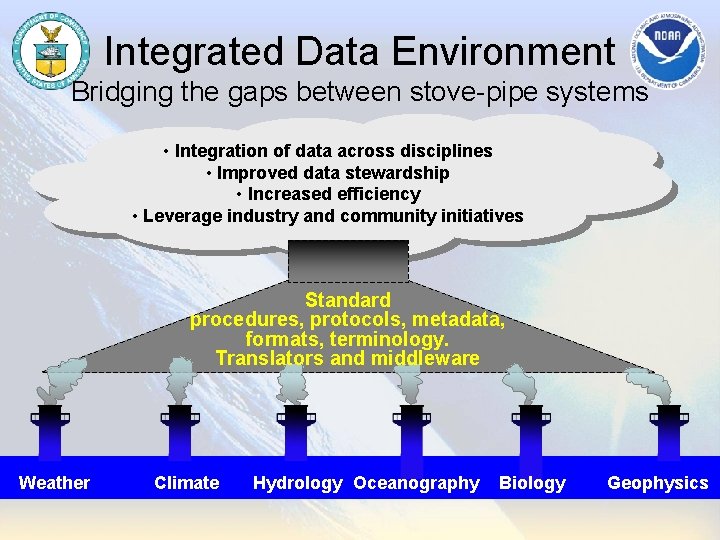
Integrated Data Environment Bridging the gaps between stove-pipe systems • Integration of data across disciplines • Improved data stewardship • Increased efficiency • Leverage industry and community initiatives Standard procedures, protocols, metadata, formats, terminology. Translators and middleware Weather Climate Hydrology Oceanography Biology Geophysics
Response - NOAA’s GEO-IDE • Scope – NOAA-wide architecture development to integrate legacy systems and guide development of future NOAA environmental data management systems • Vision – NOAA’s GEO-IDE is envisioned as a “system of systems” – a framework that provides effective and efficient integration of NOAA’s many quasi-independent systems • Foundation – built upon agreed standards, principles and guidelines • Approach – evolution of existing systems into a service-oriented architecture • Result – a single system of systems (user perspective) to access the data sets needed to address significant societal questions
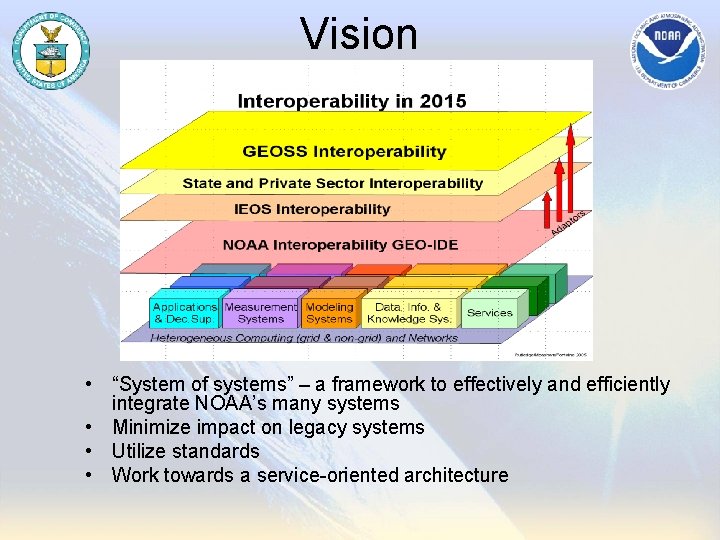
Vision • “System of systems” – a framework to effectively and efficiently integrate NOAA’s many systems • Minimize impact on legacy systems • Utilize standards • Work towards a service-oriented architecture
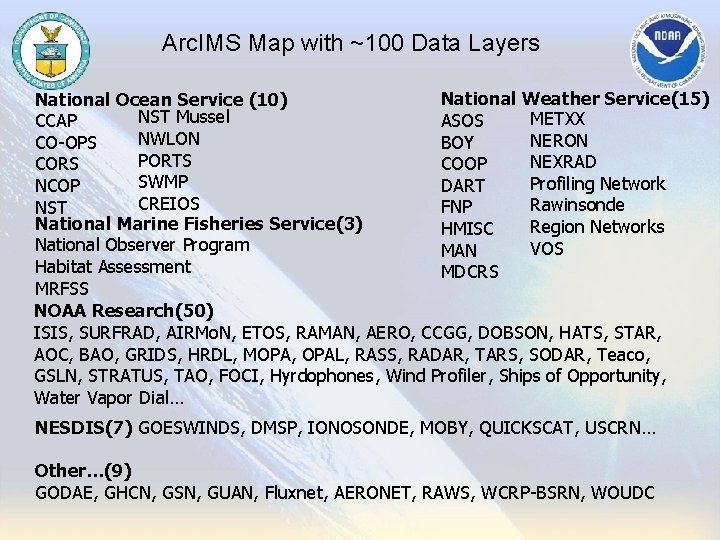
Arc. IMS Map with ~100 Data Layers National Weather Service(15) National Ocean Service (10) NST Mussel METXX ASOS CCAP NWLON NERON BOY CO-OPS PORTS NEXRAD COOP CORS SWMP Profiling Network DART NCOP CREIOS Rawinsonde FNP NST National Marine Fisheries Service(3) Region Networks HMISC National Observer Program VOS MAN Habitat Assessment MDCRS MRFSS NOAA Research(50) ISIS, SURFRAD, AIRMo. N, ETOS, RAMAN, AERO, CCGG, DOBSON, HATS, STAR, AOC, BAO, GRIDS, HRDL, MOPA, OPAL, RASS, RADAR, TARS, SODAR, Teaco, GSLN, STRATUS, TAO, FOCI, Hyrdophones, Wind Profiler, Ships of Opportunity, Water Vapor Dial… NESDIS(7) GOESWINDS, DMSP, IONOSONDE, MOBY, QUICKSCAT, USCRN… Other…(9) GODAE, GHCN, GSN, GUAN, Fluxnet, AERONET, RAWS, WCRP-BSRN, WOUDC
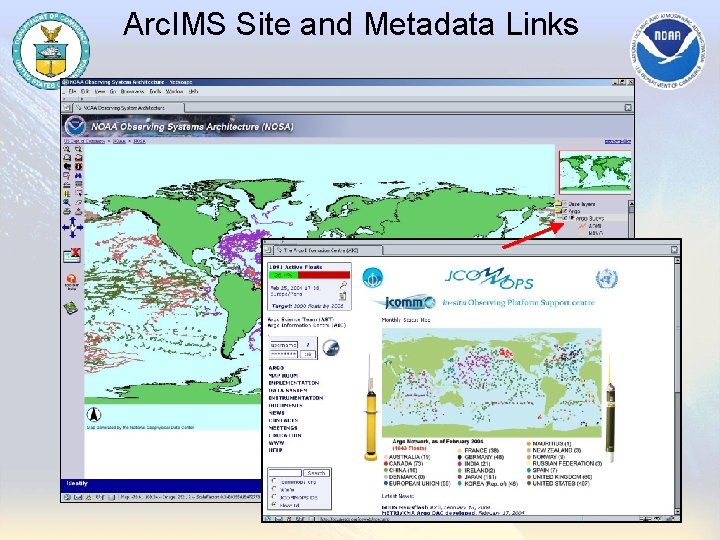
Arc. IMS Site and Metadata Links
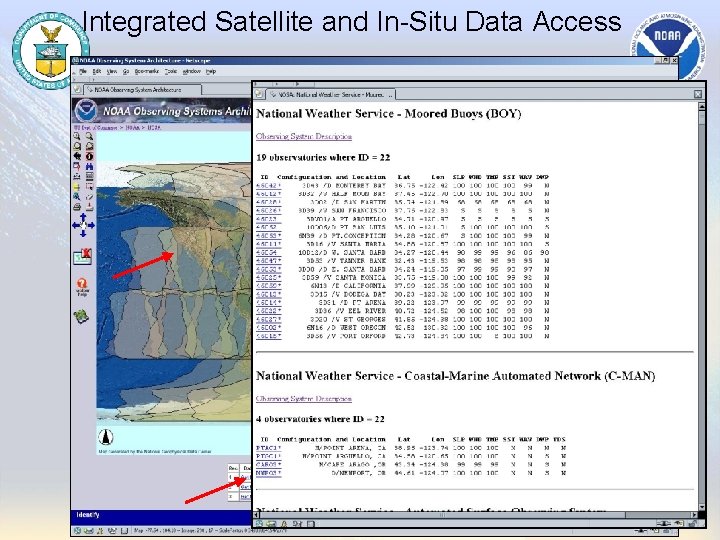
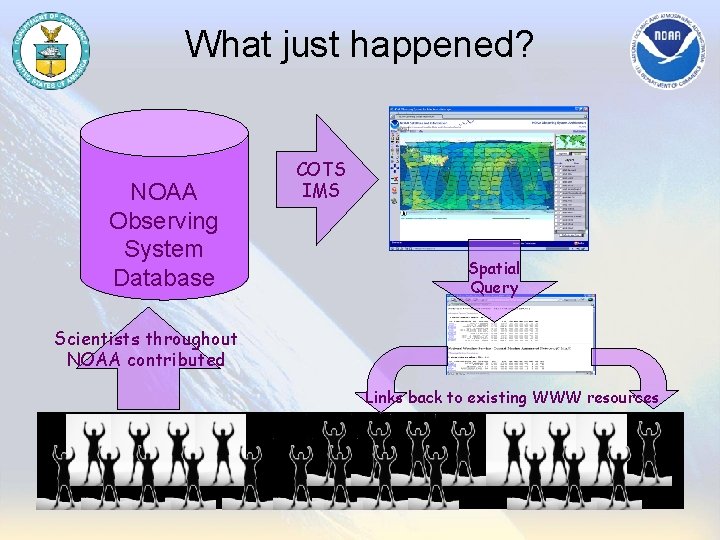
Integrated Satellite and In-Situ Data Access
What just happened? NOAA Observing System Database COTS IMS Spatial Query Scientists throughout NOAA contributed Links back to existing WWW resources
The Result: Integrated Data Systems! In-Situ SST POES Aerosol Optical Thickness GOES Winds POES SST
WWW Browser I D B WIST G. Earth LAS Desktop DBMS GIS WMS Arc. IMS Extract Points Lines Polygons Rasters w/ attrib. SQL Queries SDIF Time Series WFS MN Map Server WSDL Desktop Science WCS OPe. NDAP Net. CDF BI Office Geospatial Database Common Data Model GRIB Other HDF 5 Multi-Dimensional Grids
Multiple Standard Access Paths Common Data Model Simple “and” Foundation Geospatial Database GRIB Other HDF 5 Multi-Dimensional Grids
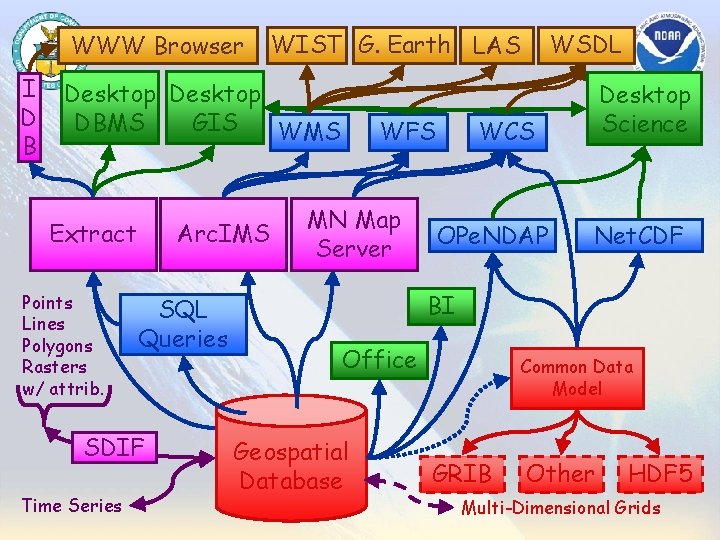
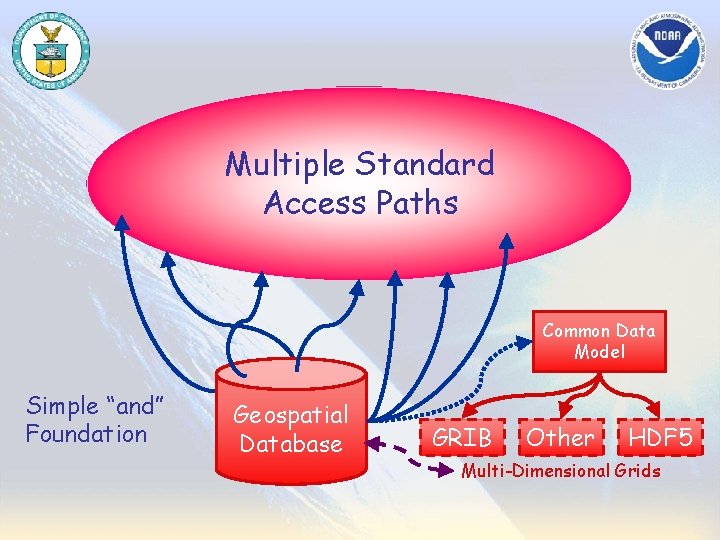
Standards • Standard names and terminology • Metadata standards – e. g. FGDC and ISO 19115 w/ remote sensing extensions • Standard formats for delivery of data/products – WMO, Net. CDF, HDF, Geo. TIF, JPEG, etc. • Web Services Standards – World Wide Web Consortium – OGC (Features, Coverage, GML) – Community Standards: OPe. NDAP (a REST service), Unidata’s Common Data Model (CDM) – SOAP / UDDI / WSDL where appropriate
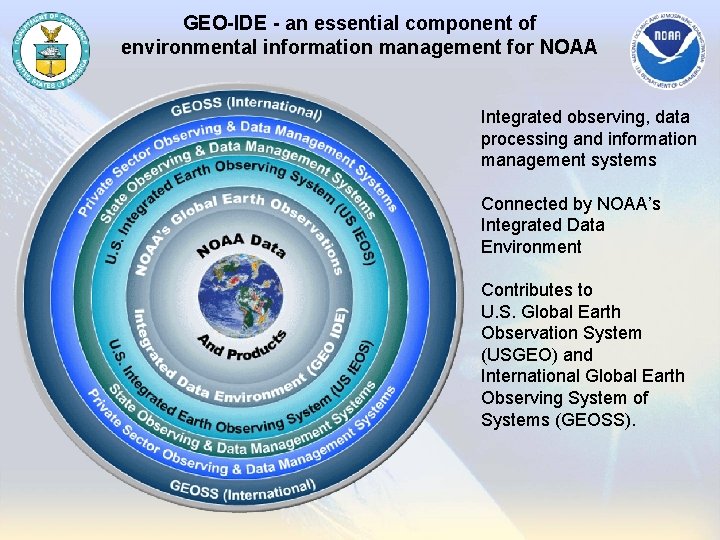
GEO-IDE - an essential component of environmental information management for NOAA Integrated observing, data processing and information management systems Connected by NOAA’s Integrated Data Environment Contributes to U. S. Global Earth Observation System (USGEO) and International Global Earth Observing System of Systems (GEOSS).
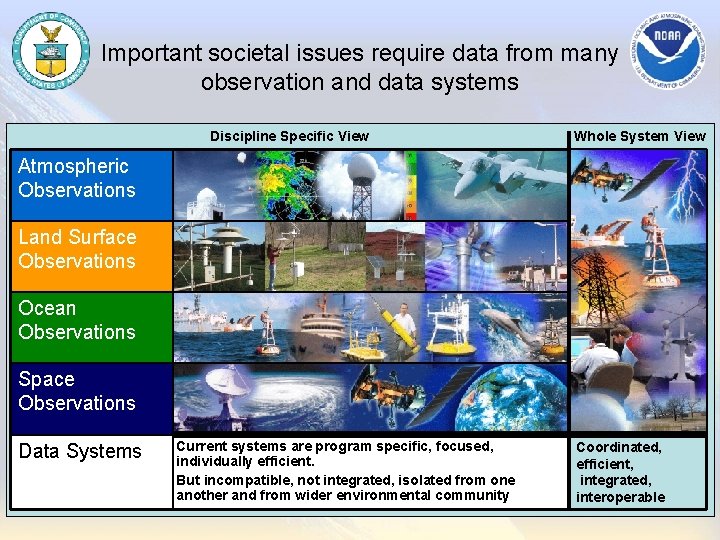
Important societal issues require data from many observation and data systems Discipline Specific View Whole System View Atmospheric Observations Land Surface Observations Ocean Observations Space Observations Data Systems Current systems are program specific, focused, individually efficient. But incompatible, not integrated, isolated from one another and from wider environmental community Coordinated, efficient, integrated, interoperable
- Slides: 31