
NOAANWS Satellite Training Plan Brian Motta Meteorologist NOAANational
NOAA/NWS Satellite Training Plan Brian Motta Meteorologist NOAA/National Weather Service Office of Chief Learning Officer (OCLO) Forecast Decision Training Division (FDTD) Contributors: John Ogren, Acting CLO/NWS HQ Le. Roy Spayd, OCLO/NWS HQ Anthony Mostek, OCLO/FDTD Chief Ed Mahoney, OCLO/WDTD Chief 1

Satellite Training Timeline FY 15 Pre. Req • Basic Remote Sensing • Characteristics of Satellites • Pull together from COMET, VISIT, CIMSS, CIRA, SPo. RT, WMO Vlab, etc. FY 16 Launch Found ation • NWS-Specific development • GOES vs GOES-R • Use Himawari. MSG & SNPP as examples • Geo vs Polar • Strengths & Weaknesses FY 17 and Beyond Application Exercise • Forecast/ warning process • Phenomena based • Baseline products • Service areas (severe, winter, hydro, tropical, fire, aviation, etc. ) • 10 -15 minute modules • Techniques • Quick. Guides • Simulations • Local training initiatives • “As it occurs” training • Evolve initial satellite concept of operations Make it Stick Cont. Learn • Reference materials in AWIPS • Repeat…practice • Blogs • Seasonal readiness • Peer-to-peer sharing • Storm-of-the month webinars • Demonstrated performance • Continuous Learning • Operations to Research • Optimize implementations for operations • Update for evolving science • Put in IDSS and WRN context 2
Proving Ground Mission Statement NOAA Satellite Proving Ground engages NWS in pre-operational demonstrations of selected capabilities of next generation instruments. The Proving Ground accomplishes its mission through: Ø Sustained interaction between developers & users Ø Training Ø Product evaluation Ø Solicitation of user feedback Ø Product Improvement Ø New Science and Technology Infusion
NOAA Satellite Proving Ground 4
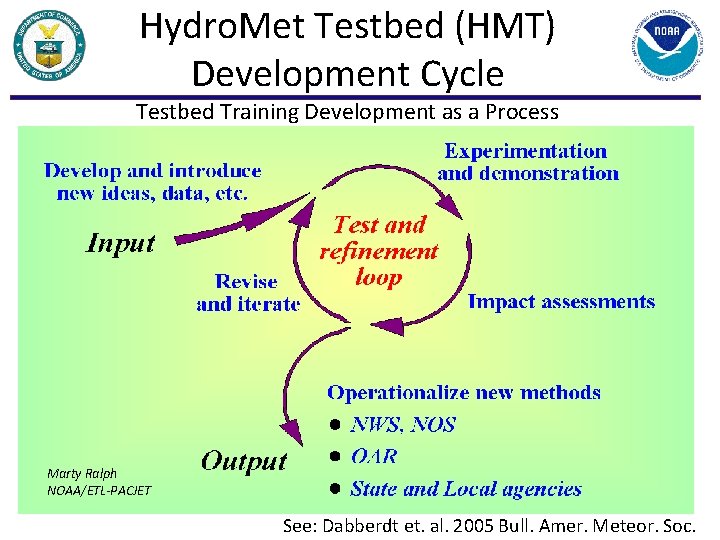
Hydro. Met Testbed (HMT) Development Cycle Testbed Training Development as a Process Marty Ralph NOAA/ETL-PACJET See: Dabberdt et. al. 2005 Bull. Amer. Meteor. Soc.
NOAA/NWS Satellite Training Plan Learning Objectives 1. Understand differences between legacy GOES & GOES-R and SNPP/JPSS baseline satellite data 2. Use GOES-R Advanced Baseline Imager (ABI) imagery and derived products for NWS forecasts and warnings 3. Utilize GOES-R Geostationary Lightning Mapper (GLM) data in forecast & warning operations 4. Understand fundamental RGB satellite techniques & applications for identification of meteorological phenomena 6
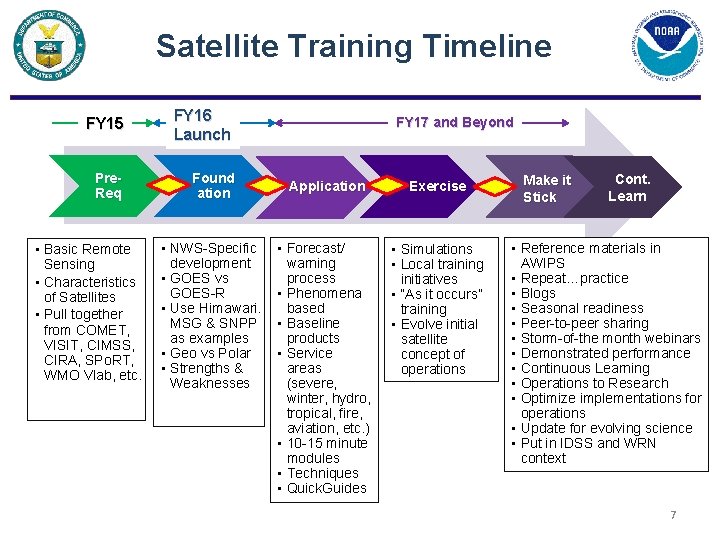
Satellite Training Timeline FY 15 Pre. Req • Basic Remote Sensing • Characteristics of Satellites • Pull together from COMET, VISIT, CIMSS, CIRA, SPo. RT, WMO Vlab, etc. FY 16 Launch Found ation • NWS-Specific development • GOES vs GOES-R • Use Himawari. MSG & SNPP as examples • Geo vs Polar • Strengths & Weaknesses FY 17 and Beyond Application Exercise • Forecast/ warning process • Phenomena based • Baseline products • Service areas (severe, winter, hydro, tropical, fire, aviation, etc. ) • 10 -15 minute modules • Techniques • Quick. Guides • Simulations • Local training initiatives • “As it occurs” training • Evolve initial satellite concept of operations Make it Stick Cont. Learn • Reference materials in AWIPS • Repeat…practice • Blogs • Seasonal readiness • Peer-to-peer sharing • Storm-of-the month webinars • Demonstrated performance • Continuous Learning • Operations to Research • Optimize implementations for operations • Update for evolving science • Put in IDSS and WRN context 7
NOAA/NWS Satellite Training Plan Education/Training on Fundamentals: #1 • 1 -2 minute “Infomercials” series to raise awareness • Get ready for GOES-R satellite launch • Awareness of new data, products, and training • Include PAO information and media “ 5 things you should know about GOES-R” • GOES-R Fact Sheets 8
NOAA/NWS Satellite Training Plan Training on Fundamentals: #2 GOES-R basic science: • new imager channels addressed in “Introduction to GOES-R” • introduce new GOES-R capabilities • GOES-R satellite science basics • GOES-R remote sensing fundamentals • differences between current geostationary satellites & GOES-R • fundamental operation and data from ABI and GLM • data assimilated into operational NWP, anticipated benefits/impacts • focus on NWS forecasters and AWIPS 9
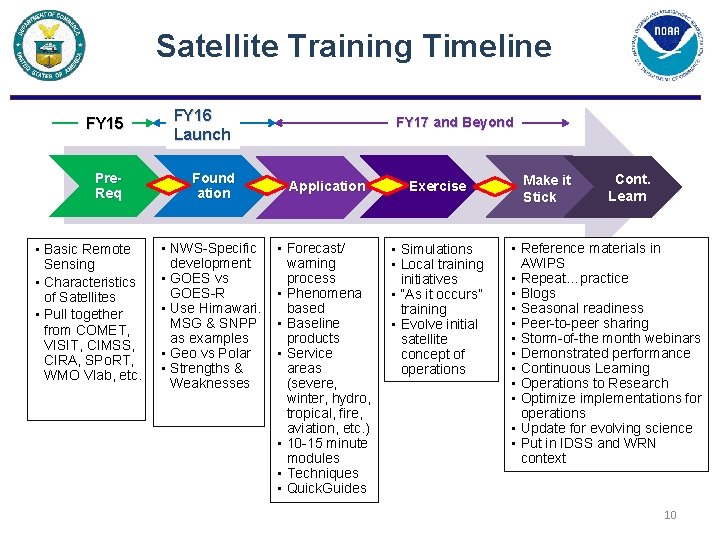
Satellite Training Timeline FY 15 Pre. Req • Basic Remote Sensing • Characteristics of Satellites • Pull together from COMET, VISIT, CIMSS, CIRA, SPo. RT, WMO Vlab, etc. FY 16 Launch Found ation • NWS-Specific development • GOES vs GOES-R • Use Himawari. MSG & SNPP as examples • Geo vs Polar • Strengths & Weaknesses FY 17 and Beyond Application Exercise • Forecast/ warning process • Phenomena based • Baseline products • Service areas (severe, winter, hydro, tropical, fire, aviation, etc. ) • 10 -15 minute modules • Techniques • Quick. Guides • Simulations • Local training initiatives • “As it occurs” training • Evolve initial satellite concept of operations Make it Stick Cont. Learn • Reference materials in AWIPS • Repeat…practice • Blogs • Seasonal readiness • Peer-to-peer sharing • Storm-of-the month webinars • Demonstrated performance • Continuous Learning • Operations to Research • Optimize implementations for operations • Update for evolving science • Put in IDSS and WRN context 10
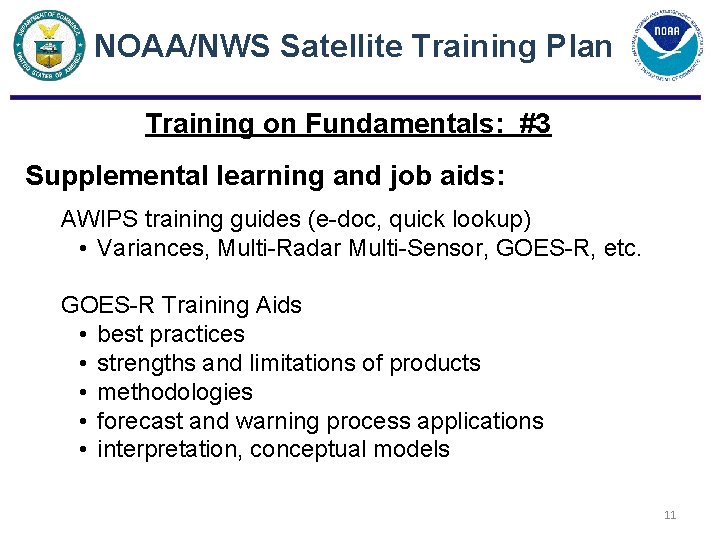
NOAA/NWS Satellite Training Plan Training on Fundamentals: #3 Supplemental learning and job aids: AWIPS training guides (e-doc, quick lookup) • Variances, Multi-Radar Multi-Sensor, GOES-R, etc. GOES-R Training Aids • best practices • strengths and limitations of products • methodologies • forecast and warning process applications • interpretation, conceptual models 11
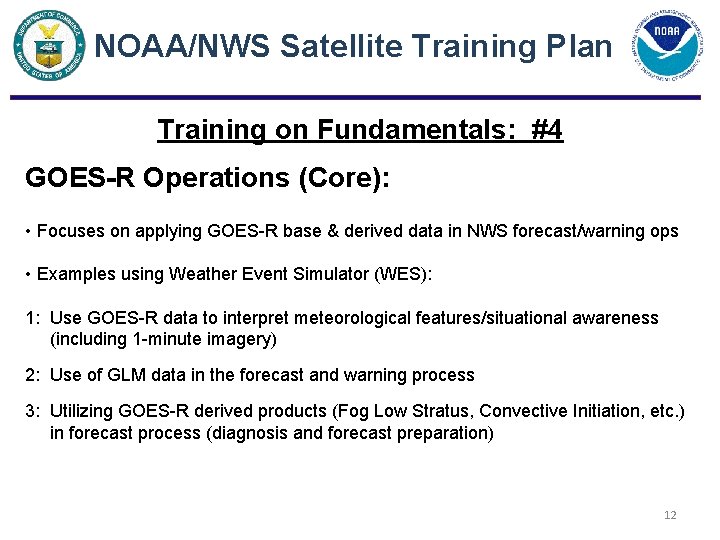
NOAA/NWS Satellite Training Plan Training on Fundamentals: #4 GOES-R Operations (Core): • Focuses on applying GOES-R base & derived data in NWS forecast/warning ops • Examples using Weather Event Simulator (WES): 1: Use GOES-R data to interpret meteorological features/situational awareness (including 1 -minute imagery) 2: Use of GLM data in the forecast and warning process 3: Utilizing GOES-R derived products (Fog Low Stratus, Convective Initiation, etc. ) in forecast process (diagnosis and forecast preparation) 12
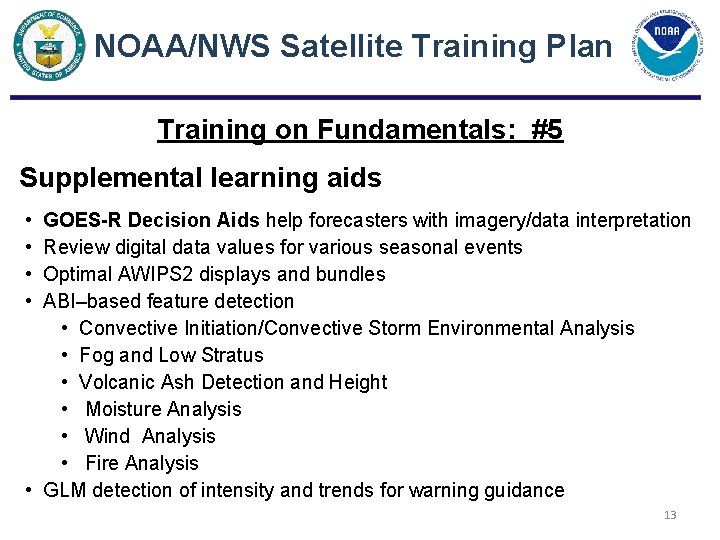
NOAA/NWS Satellite Training Plan Training on Fundamentals: #5 Supplemental learning aids • • GOES-R Decision Aids help forecasters with imagery/data interpretation Review digital data values for various seasonal events Optimal AWIPS 2 displays and bundles ABI–based feature detection • Convective Initiation/Convective Storm Environmental Analysis • Fog and Low Stratus • Volcanic Ash Detection and Height • Moisture Analysis • Wind Analysis • Fire Analysis • GLM detection of intensity and trends for warning guidance 13
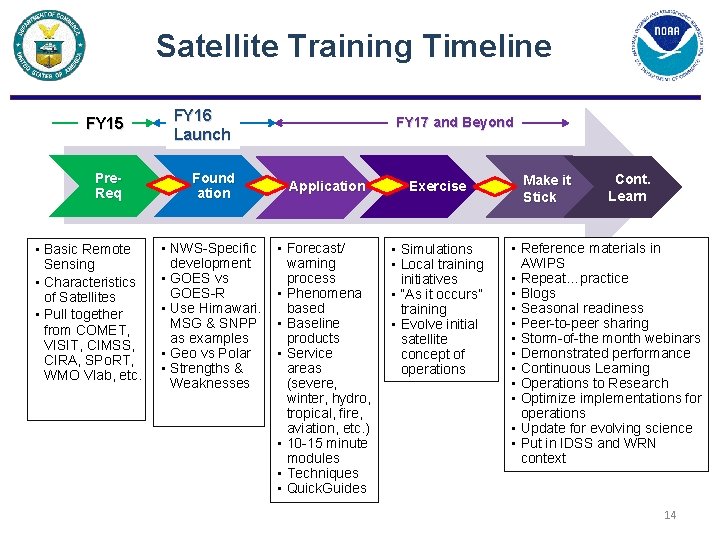
Satellite Training Timeline FY 15 Pre. Req • Basic Remote Sensing • Characteristics of Satellites • Pull together from COMET, VISIT, CIMSS, CIRA, SPo. RT, WMO Vlab, etc. FY 16 Launch Found ation • NWS-Specific development • GOES vs GOES-R • Use Himawari. MSG & SNPP as examples • Geo vs Polar • Strengths & Weaknesses FY 17 and Beyond Application Exercise • Forecast/ warning process • Phenomena based • Baseline products • Service areas (severe, winter, hydro, tropical, fire, aviation, etc. ) • 10 -15 minute modules • Techniques • Quick. Guides • Simulations • Local training initiatives • “As it occurs” training • Evolve initial satellite concept of operations Make it Stick Cont. Learn • Reference materials in AWIPS • Repeat…practice • Blogs • Seasonal readiness • Peer-to-peer sharing • Storm-of-the month webinars • Demonstrated performance • Continuous Learning • Operations to Research • Optimize implementations for operations • Update for evolving science • Put in IDSS and WRN context 14
NOAA/NWS Satellite Training Plan Advanced/Supplemental GOES-R Training: #6 Event of the Week (30 minutes): • • Webinar promotes sharing of events/best practices Cases presented by field personnel Participation and feedback from experts (O 2 R) Focus on use/interpretation of satellite data utilizing real events Purpose: builds credibility and understanding among forecasters Collaboration and direct interactions with SMEs Accomplished by leveraging expertise, Satellite Liaisons Note: Modeled after highly successful radar training called Dual-pol “Storm of the Month”. 15
NOAA/NWS Satellite Training Plan Advanced/Supplemental GOES-R Training: #7 Online Library: • Shift work prevents forecasters from attending all live “Event of the Week” webinars • Recorded webinars, placed in searchable online library • WES cases • Satellite interpretation blogs 16
NOAA/NWS Satellite Training Plan Advanced/Supplemental GOES-R Training: #8 Science Infusion Week (Residence): • Goal: emphasize emerging science & satellite meteorology • Graduate-level Science Infusion Workshop • Target audience: SOOs/DOHs/Local Satellite Experts • Improves scientific quality of NWS WRN message • Integrate GOES-R data and products in operations • NCEP numerical models with new satellite data assimilation • After GOES-R data available at NWS offices/centers 17
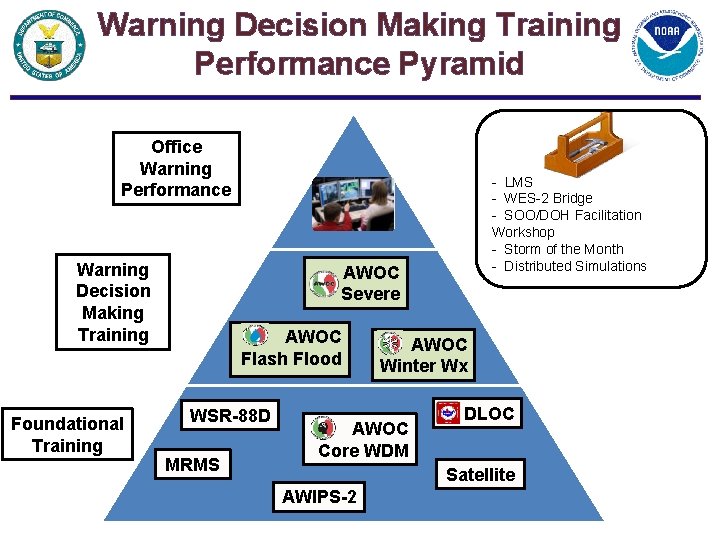
Warning Decision Making Training Performance Pyramid Office Warning Performance Warning Decision Making Training Foundational Training - LMS - WES-2 Bridge - SOO/DOH Facilitation Workshop - Storm of the Month - Distributed Simulations AWOC Severe AWOC Flash Flood WSR-88 D MRMS AWOC Winter Wx AWOC Core WDM DLOC Satellite AWIPS-2
Summary • NOAA’s Satellite education & training is continuous • Integrates GOES-R & JPSS in NOAA’s Environmental Intelligence Operations (NWS WRN) • 6 years ago: NOAA Satellite Proving Ground • NOAA Target Audience: 3000 + staff • Blended learning courses • Requires individual, office, & organizational commitments • Provides multiple modes to access training: on-line, in-person, just-in-time, and on-the-job 19
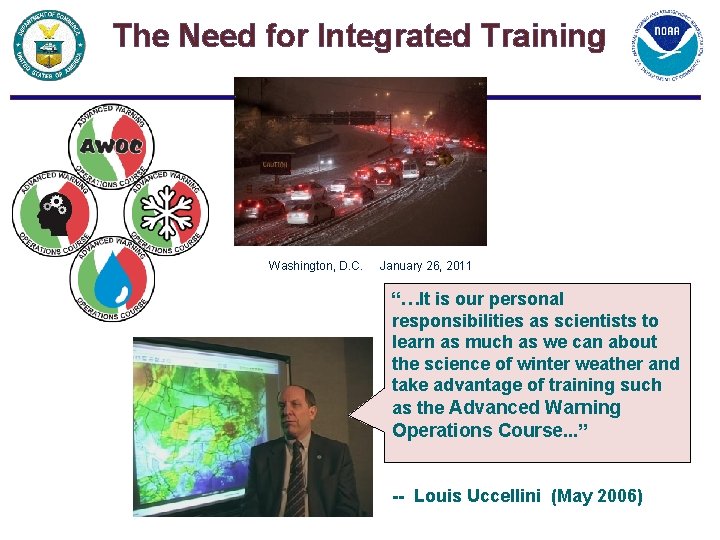
The Need for Integrated Training Washington, D. C. January 26, 2011 “…It is our personal responsibilities as scientists to learn as much as we can about the science of winter weather and take advantage of training such as the Advanced Warning Operations Course. . . ” -- Louis Uccellini (May 2006)
- Slides: 20