
NOAA SPECTRUM UPDATE Fred Mistichelli alfredo mistichellinoaa gov
- Slides: 30
NOAA SPECTRUM UPDATE Fred Mistichelli (alfredo. mistichelli@noaa. gov) 19 May 2016 1
OUTLINE Ø GOES-R Launch & Spectrum Use Ø NOAA’s L-Band Spectrum Ø Passive Bands Ø NOAA View on WRC-19 Agenda Items 2
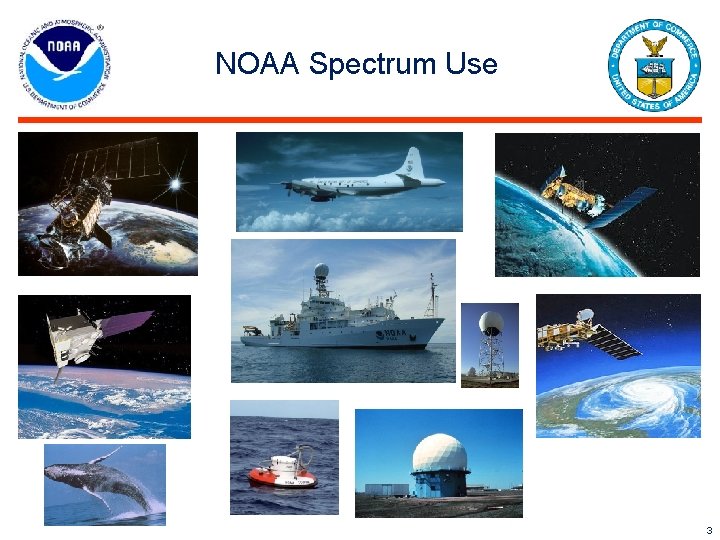
NOAA Spectrum Use 3
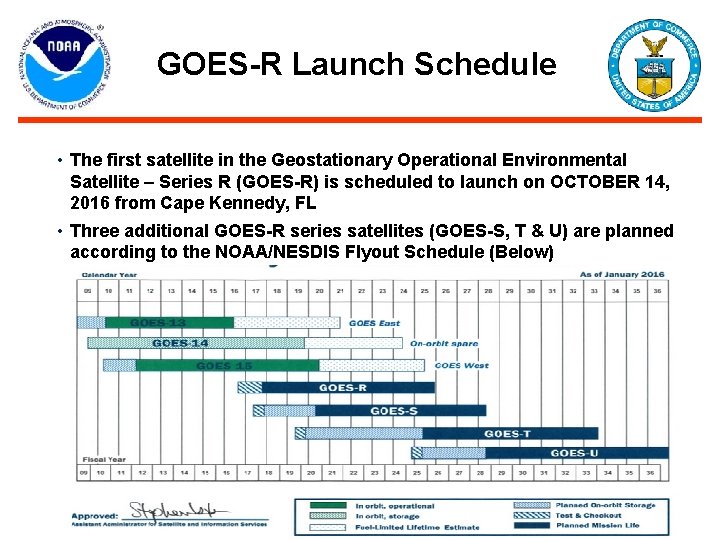
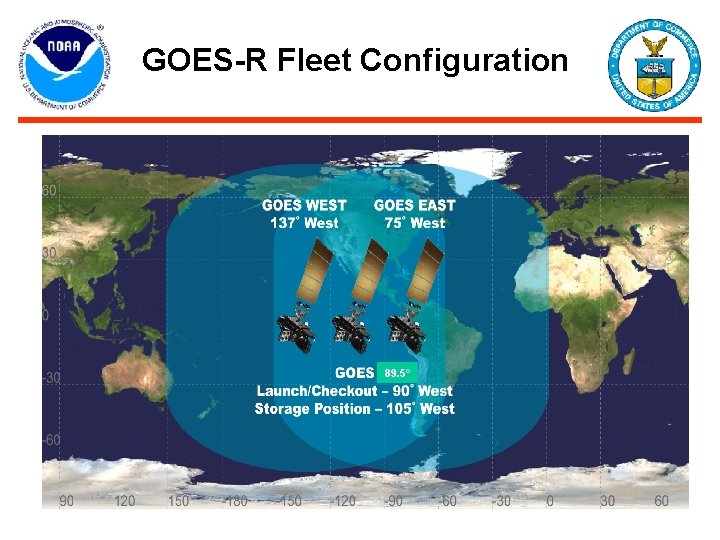
GOES-R Launch Schedule • The first satellite in the Geostationary Operational Environmental Satellite – Series R (GOES-R) is scheduled to launch on OCTOBER 14, 2016 from Cape Kennedy, FL • Three additional GOES-R series satellites (GOES-S, T & U) are planned according to the NOAA/NESDIS Flyout Schedule (Below)
GOES-R Fleet Configuration 89. 5°
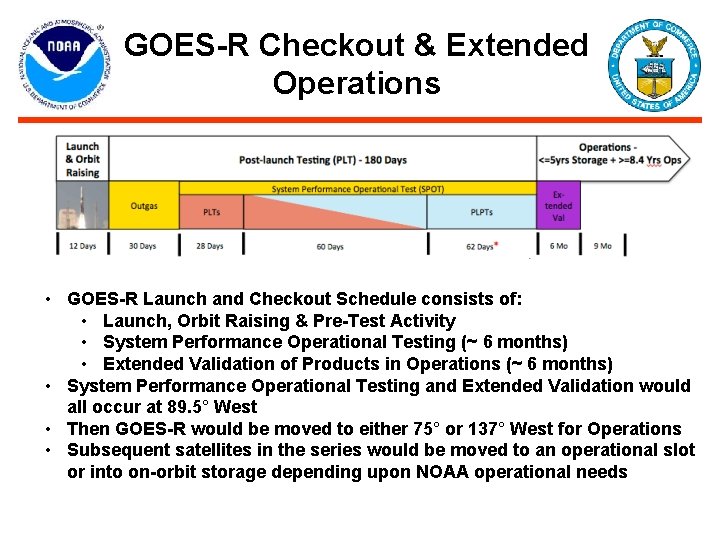
GOES-R Checkout & Extended Operations • GOES-R Launch and Checkout Schedule consists of: • Launch, Orbit Raising & Pre-Test Activity • System Performance Operational Testing (~ 6 months) • Extended Validation of Products in Operations (~ 6 months) • System Performance Operational Testing and Extended Validation would all occur at 89. 5° West • Then GOES-R would be moved to either 75° or 137° West for Operations • Subsequent satellites in the series would be moved to an operational slot or into on-orbit storage depending upon NOAA operational needs
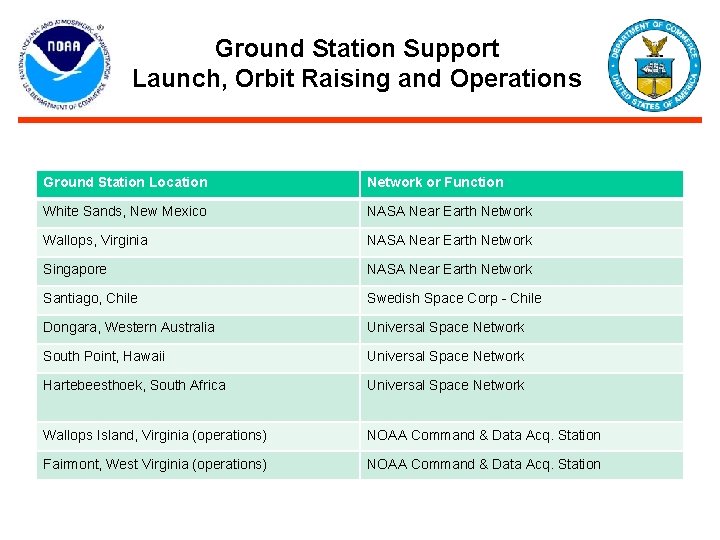
Ground Station Support Launch, Orbit Raising and Operations Ground Station Location Network or Function White Sands, New Mexico NASA Near Earth Network Wallops, Virginia NASA Near Earth Network Singapore NASA Near Earth Network Santiago, Chile Swedish Space Corp - Chile Dongara, Western Australia Universal Space Network South Point, Hawaii Universal Space Network Hartebeesthoek, South Africa Universal Space Network Wallops Island, Virginia (operations) NOAA Command & Data Acq. Station Fairmont, West Virginia (operations) NOAA Command & Data Acq. Station
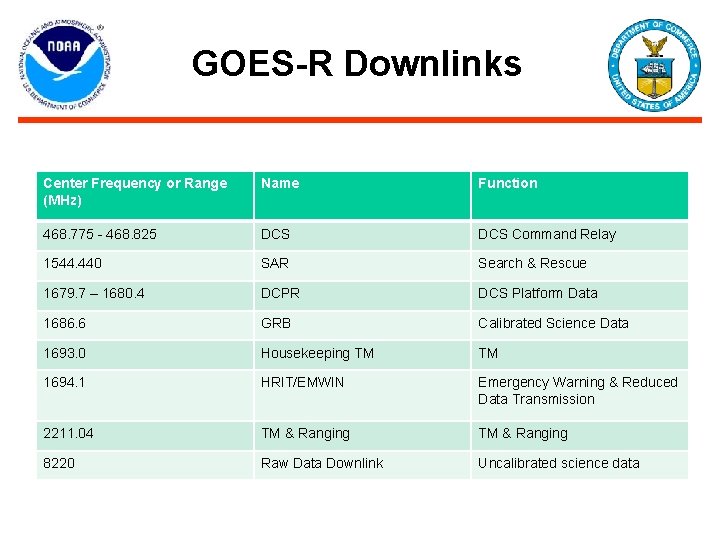
GOES-R Downlinks Center Frequency or Range (MHz) Name Function 468. 775 - 468. 825 DCS Command Relay 1544. 440 SAR Search & Rescue 1679. 7 – 1680. 4 DCPR DCS Platform Data 1686. 6 GRB Calibrated Science Data 1693. 0 Housekeeping TM TM 1694. 1 HRIT/EMWIN Emergency Warning & Reduced Data Transmission 2211. 04 TM & Ranging 8220 Raw Data Downlink Uncalibrated science data
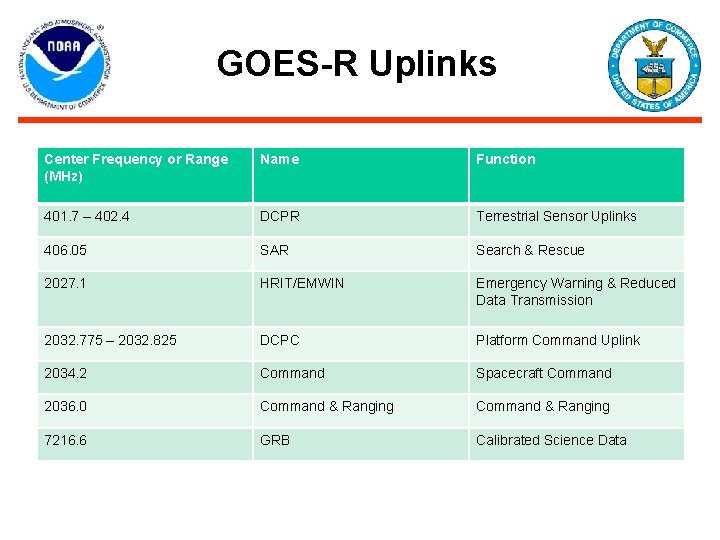
GOES-R Uplinks Center Frequency or Range (MHz) Name Function 401. 7 – 402. 4 DCPR Terrestrial Sensor Uplinks 406. 05 SAR Search & Rescue 2027. 1 HRIT/EMWIN Emergency Warning & Reduced Data Transmission 2032. 775 – 2032. 825 DCPC Platform Command Uplink 2034. 2 Command Spacecraft Command 2036. 0 Command & Ranging 7216. 6 GRB Calibrated Science Data
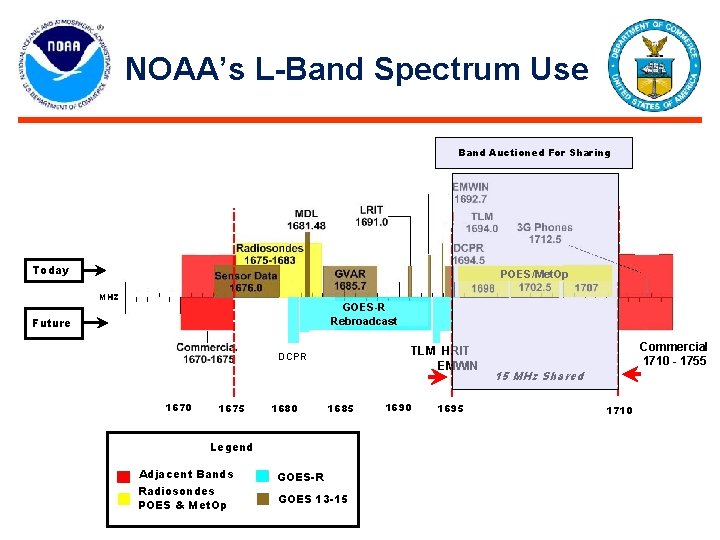
NOAA’s L-Band Spectrum Use Band Auctioned For Sharing Today POES/Met. Op MHZ GOES-R Rebroadcast Future TLM HRIT EMWIN DCPR 1670 1675 1680 1690 1685 Legend Adjacent Bands Radiosondes POES & Met. Op GOES-R GOES 13 -15 5 1695 Commercial 1710 - 1755 15 MHz Shared 1710
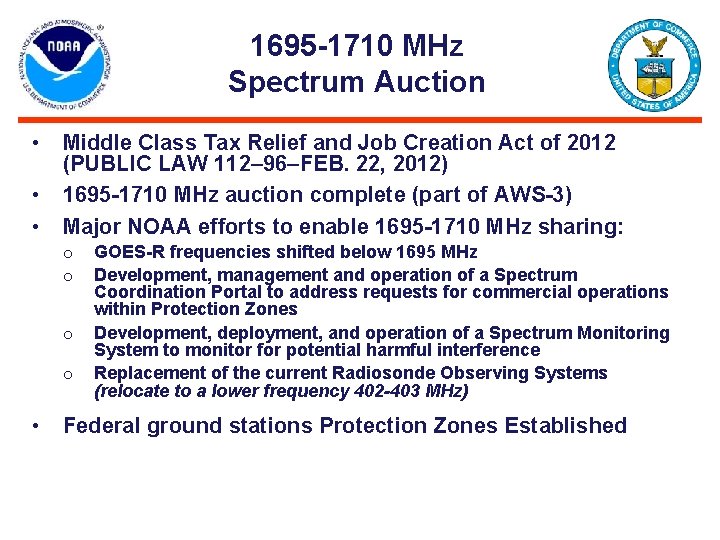
1695 -1710 MHz Spectrum Auction • • • Middle Class Tax Relief and Job Creation Act of 2012 (PUBLIC LAW 112– 96–FEB. 22, 2012) 1695 -1710 MHz auction complete (part of AWS-3) Major NOAA efforts to enable 1695 -1710 MHz sharing: o o • GOES-R frequencies shifted below 1695 MHz Development, management and operation of a Spectrum Coordination Portal to address requests for commercial operations within Protection Zones Development, deployment, and operation of a Spectrum Monitoring System to monitor for potential harmful interference Replacement of the current Radiosonde Observing Systems (relocate to a lower frequency 402 -403 MHz) Federal ground stations Protection Zones Established
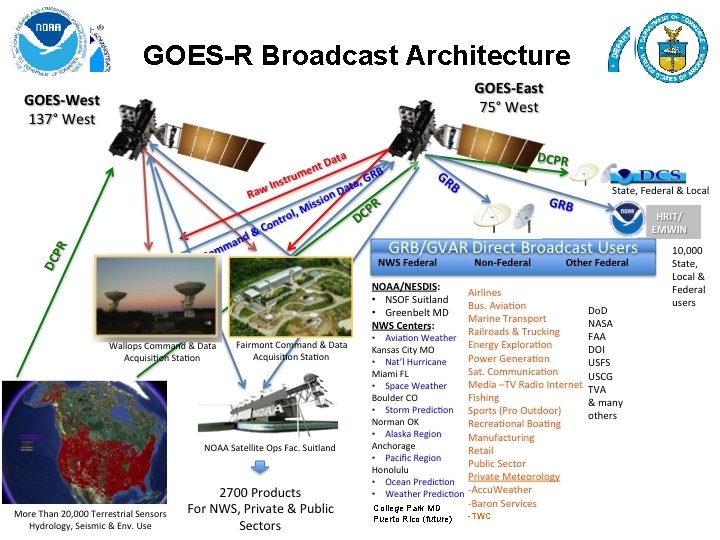
GOES-R Broadcast Architecture College Park MD Puerto Rico (future) -TWC
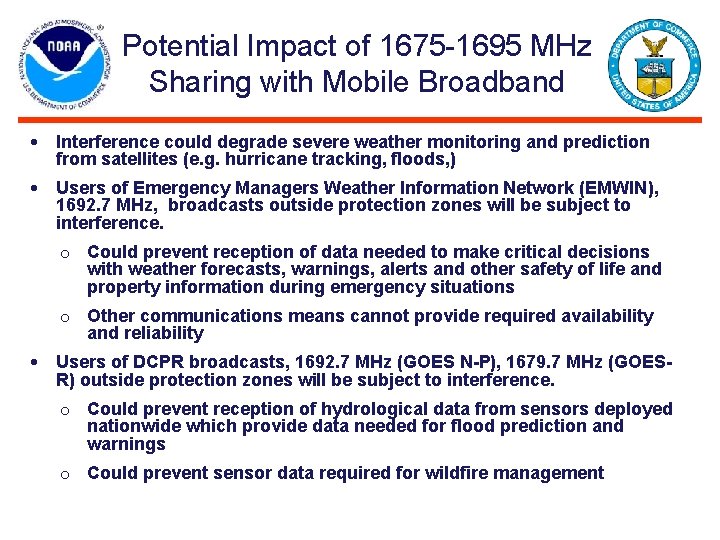
Potential Impact of 1675 -1695 MHz Sharing with Mobile Broadband • Interference could degrade severe weather monitoring and prediction from satellites (e. g. hurricane tracking, floods, ) • Users of Emergency Managers Weather Information Network (EMWIN), 1692. 7 MHz, broadcasts outside protection zones will be subject to interference. o Could prevent reception of data needed to make critical decisions with weather forecasts, warnings, alerts and other safety of life and property information during emergency situations o Other communications means cannot provide required availability and reliability • Users of DCPR broadcasts, 1692. 7 MHz (GOES N-P), 1679. 7 MHz (GOESR) outside protection zones will be subject to interference. o Could prevent reception of hydrological data from sensors deployed nationwide which provide data needed for flood prediction and warnings o Could prevent sensor data required for wildfire management
Potential Impact of 1675 -1695 MHz Sharing with Mobile Broadband • Possible reduction of quality in the regional and global data sets required for climate monitoring and prediction • Band is part of globally coordinated meteorological operations o Sharing could have a negative impact on global harmonization and interoperability
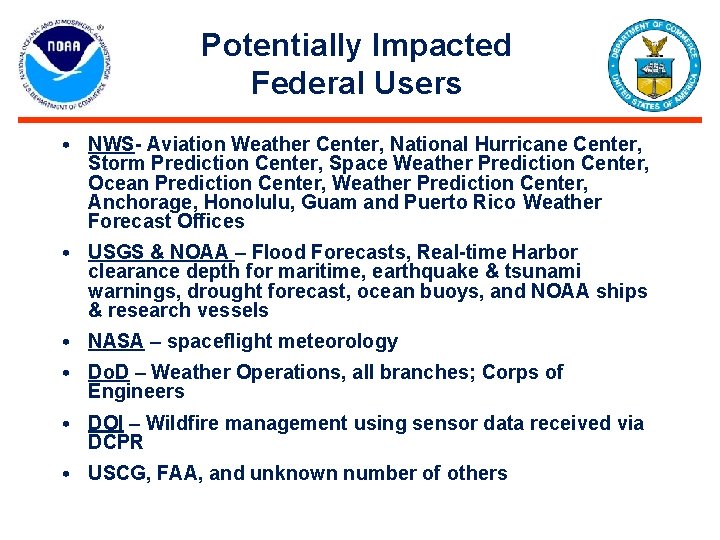
Potentially Impacted Federal Users • NWS- Aviation Weather Center, National Hurricane Center, Storm Prediction Center, Space Weather Prediction Center, Ocean Prediction Center, Weather Prediction Center, Anchorage, Honolulu, Guam and Puerto Rico Weather Forecast Offices • USGS & NOAA – Flood Forecasts, Real-time Harbor clearance depth for maritime, earthquake & tsunami warnings, drought forecast, ocean buoys, and NOAA ships & research vessels • NASA – spaceflight meteorology • Do. D – Weather Operations, all branches; Corps of Engineers • DOI – Wildfire management using sensor data received via DCPR • USCG, FAA, and unknown number of others
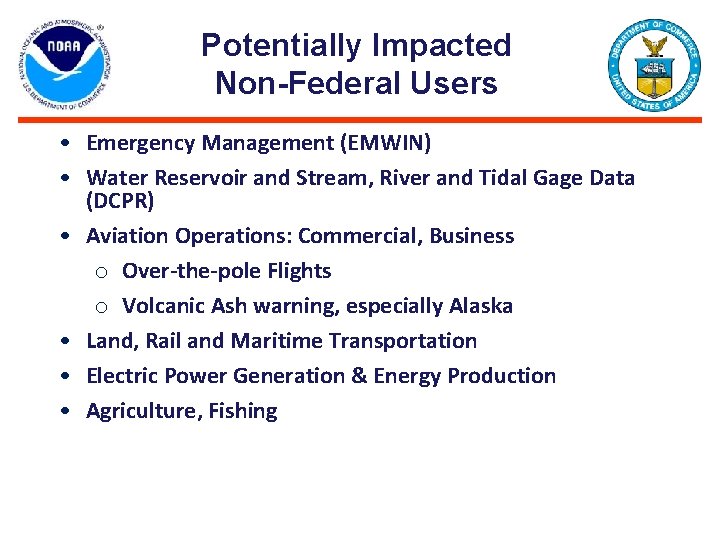
Potentially Impacted Non-Federal Users • Emergency Management (EMWIN) • Water Reservoir and Stream, River and Tidal Gage Data (DCPR) • Aviation Operations: Commercial, Business o Over-the-pole Flights o Volcanic Ash warning, especially Alaska • Land, Rail and Maritime Transportation • Electric Power Generation & Energy Production • Agriculture, Fishing
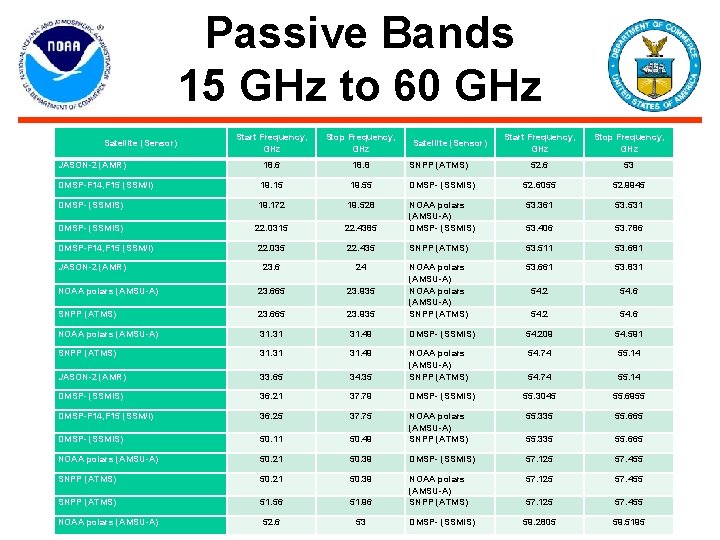
Passive Bands 15 GHz to 60 GHz Start Frequency, GHz Stop Frequency, GHz JASON-2 (AMR) 18. 6 18. 8 SNPP (ATMS) 52. 6 53 DMSP-F 14, F 15 (SSM/I) 19. 15 19. 55 DMSP- (SSMIS) 52. 6055 52. 9945 DMSP- (SSMIS) 19. 172 19. 528 53. 361 53. 531 22. 4385 NOAA polars (AMSU-A) DMSP- (SSMIS) 22. 0315 53. 406 53. 786 DMSP-F 14, F 15 (SSM/I) 22. 035 22. 435 SNPP (ATMS) 53. 511 53. 681 23. 6 24 53. 661 53. 831 NOAA polars (AMSU-A) 23. 665 23. 935 54. 2 54. 6 SNPP (ATMS) 23. 665 23. 935 NOAA polars (AMSU-A) SNPP (ATMS) 54. 2 54. 6 NOAA polars (AMSU-A) 31. 31 31. 49 DMSP- (SSMIS) 54. 209 54. 591 SNPP (ATMS) 31. 31 31. 49 54. 74 55. 14 JASON-2 (AMR) 33. 65 34. 35 NOAA polars (AMSU-A) SNPP (ATMS) 54. 74 55. 14 DMSP- (SSMIS) 36. 21 37. 79 DMSP- (SSMIS) 55. 3045 55. 6955 DMSP-F 14, F 15 (SSM/I) 36. 25 37. 75 55. 335 55. 665 DMSP- (SSMIS) 50. 11 50. 49 NOAA polars (AMSU-A) SNPP (ATMS) 55. 335 55. 665 NOAA polars (AMSU-A) 50. 21 50. 39 DMSP- (SSMIS) 57. 125 57. 455 SNPP (ATMS) 50. 21 50. 39 57. 125 57. 455 SNPP (ATMS) 51. 56 51. 96 NOAA polars (AMSU-A) SNPP (ATMS) 57. 125 57. 455 NOAA polars (AMSU-A) 52. 6 53 DMSP- (SSMIS) 59. 2805 59. 5195 Satellite (Sensor) JASON-2 (AMR) Satellite (Sensor)
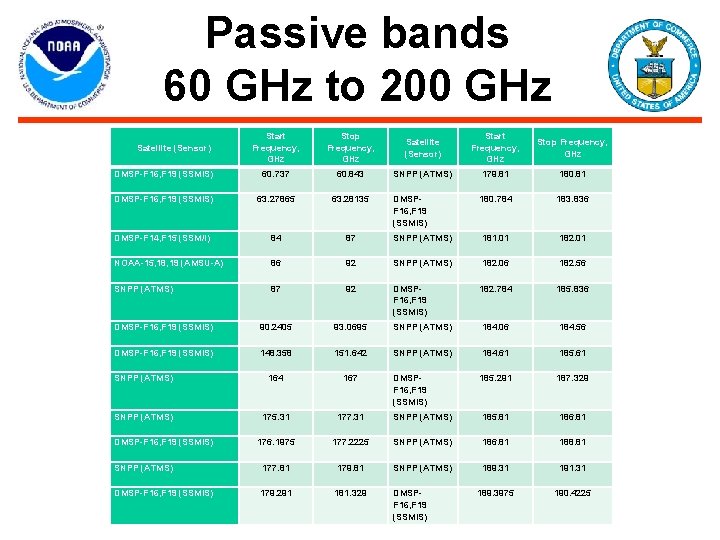
Passive bands 60 GHz to 200 GHz Start Frequency, GHz Stop Frequency, GHz Satellite (Sensor) Start Frequency, GHz Stop Frequency, GHz DMSP-F 16, F 19 (SSMIS) 60. 737 60. 843 SNPP (ATMS) 179. 81 180. 81 DMSP-F 16, F 19 (SSMIS) 63. 27865 63. 28135 DMSPF 16, F 19 (SSMIS) 180. 784 183. 836 DMSP-F 14, F 15 (SSM/I) 84 87 SNPP (ATMS) 181. 01 182. 01 NOAA-15, 18, 19 (AMSU-A) 86 92 SNPP (ATMS) 182. 06 182. 56 SNPP (ATMS) 87 92 DMSPF 16, F 19 (SSMIS) 182. 784 185. 836 DMSP-F 16, F 19 (SSMIS) 90. 2405 93. 0695 SNPP (ATMS) 184. 06 184. 56 DMSP-F 16, F 19 (SSMIS) 148. 358 151. 642 SNPP (ATMS) 184. 61 185. 61 SNPP (ATMS) 164 167 DMSPF 16, F 19 (SSMIS) 185. 291 187. 329 SNPP (ATMS) 175. 31 177. 31 SNPP (ATMS) 185. 81 186. 81 176. 1975 177. 2225 SNPP (ATMS) 186. 81 188. 81 SNPP (ATMS) 177. 81 179. 81 SNPP (ATMS) 189. 31 191. 31 DMSP-F 16, F 19 (SSMIS) 179. 291 181. 329 DMSPF 16, F 19 (SSMIS) 189. 3975 190. 4225 Satellite (Sensor) DMSP-F 16, F 19 (SSMIS)
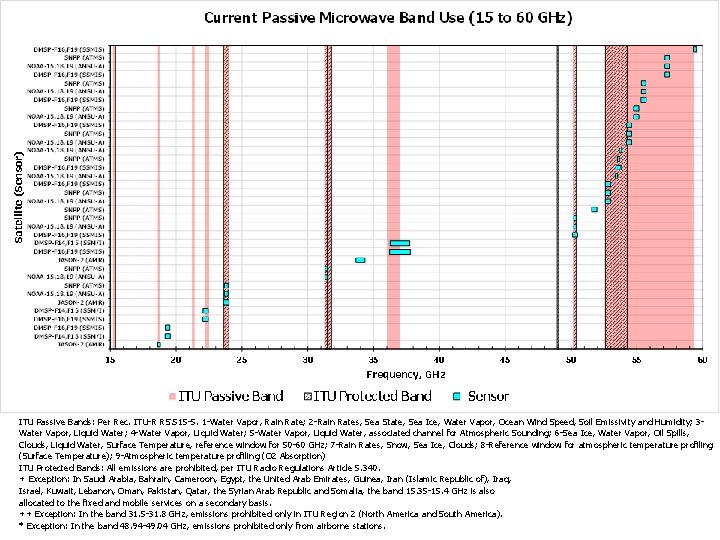
ITU Passive Bands: Per Rec. ITU-R RS. 515 -5. 1 -Water Vapor, Rain Rate; 2 -Rain Rates, Sea State, Sea Ice, Water Vapor, Ocean Wind Speed, Soil Emissivity and Humidity; 3 Water Vapor, Liquid Water; 4 -Water Vapor, Liquid Water; 5 -Water Vapor, Liquid Water, associated channel for Atmospheric Sounding; 6 -Sea Ice, Water Vapor, Oil Spills, Clouds, Liquid Water, Surface Temperature, reference window for 50 -60 GHz; 7 -Rain Rates, Snow, Sea Ice, Clouds; 8 -Reference window for atmospheric temperature profiling (Surface Temperature); 9 -Atmospheric temperature profiling (O 2 Absorption) ITU Protected Bands: All emissions are prohibited, per ITU Radio Regulations Article 5. 340. + Exception: In Saudi Arabia, Bahrain, Cameroon, Egypt, the United Arab Emirates, Guinea, Iran (Islamic Republic of), Iraq, Israel, Kuwait, Lebanon, Oman, Pakistan, Qatar, the Syrian Arab Republic and Somalia, the band 15. 35 -15. 4 GHz is also allocated to the fixed and mobile services on a secondary basis. ++ Exception: In the band 31. 5 -31. 8 GHz, emissions prohibited only in ITU Region 2 (North America and South America). * Exception: In the band 48. 94 -49. 04 GHz, emissions prohibited only from airborne stations.
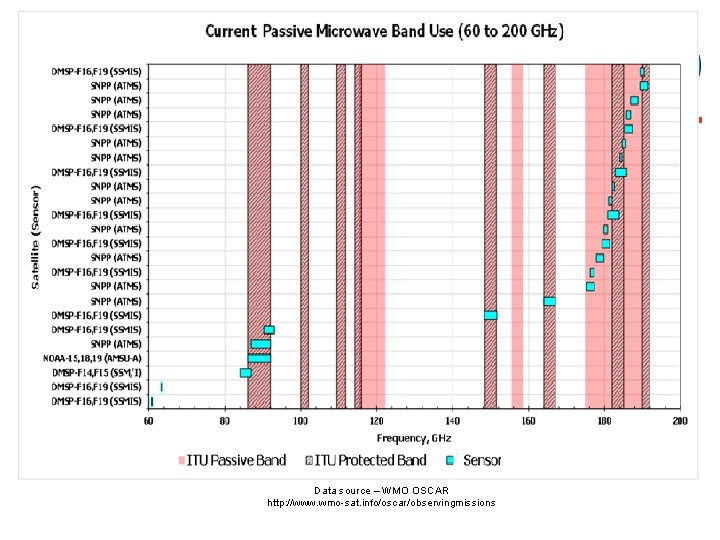
Data source – WMO OSCAR http: //www. wmo-sat. info/oscar/observingmissions
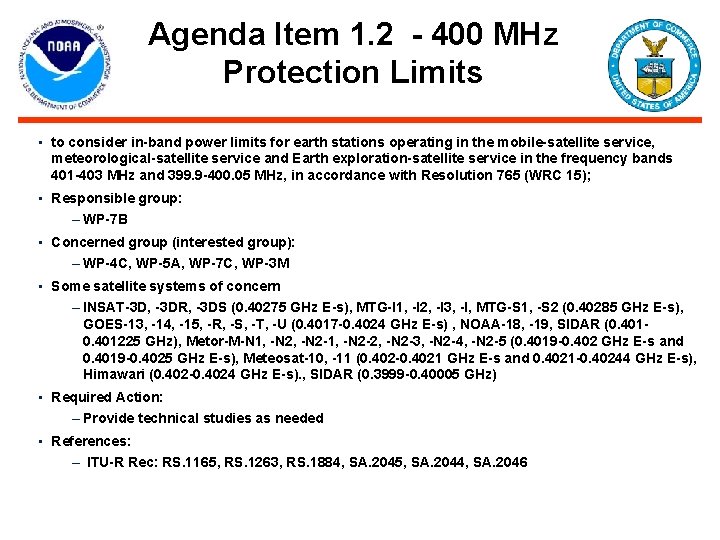
Agenda Item 1. 2 - 400 MHz Protection Limits • to consider in-band power limits for earth stations operating in the mobile-satellite service, meteorological-satellite service and Earth exploration-satellite service in the frequency bands 401 -403 MHz and 399. 9 -400. 05 MHz, in accordance with Resolution 765 (WRC 15); • Responsible group: – WP-7 B • Concerned group (interested group): – WP-4 C, WP-5 A, WP-7 C, WP-3 M • Some satellite systems of concern – INSAT-3 D, -3 DR, -3 DS (0. 40275 GHz E-s), MTG-I 1, -I 2, -I 3, -I, MTG-S 1, -S 2 (0. 40285 GHz E-s), GOES-13, -14, -15, -R, -S, -T, -U (0. 4017 -0. 4024 GHz E-s) , NOAA-18, -19, SIDAR (0. 401225 GHz), Metor-M-N 1, -N 2 -1, -N 2 -2, -N 2 -3, -N 2 -4, -N 2 -5 (0. 4019 -0. 402 GHz E-s and 0. 4019 -0. 4025 GHz E-s), Meteosat-10, -11 (0. 402 -0. 4021 GHz E-s and 0. 4021 -0. 40244 GHz E-s), Himawari (0. 402 -0. 4024 GHz E-s). , SIDAR (0. 3999 -0. 40005 GHz) • Required Action: – Provide technical studies as needed • References: – ITU-R Rec: RS. 1165, RS. 1263, RS. 1884, SA. 2045, SA. 2044, SA. 2046
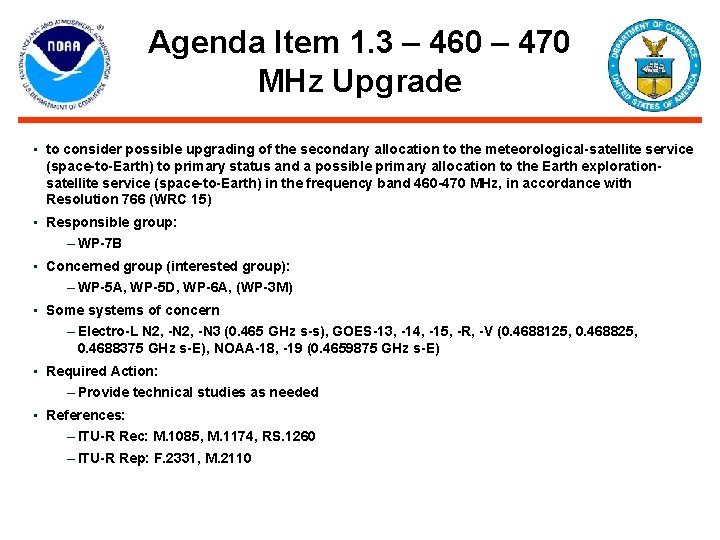
Agenda Item 1. 3 – 460 – 470 MHz Upgrade • to consider possible upgrading of the secondary allocation to the meteorological-satellite service (space-to-Earth) to primary status and a possible primary allocation to the Earth explorationsatellite service (space-to-Earth) in the frequency band 460 -470 MHz, in accordance with Resolution 766 (WRC 15) • Responsible group: – WP-7 B • Concerned group (interested group): – WP-5 A, WP-5 D, WP-6 A, (WP-3 M) • Some systems of concern – Electro-L N 2, -N 3 (0. 465 GHz s-s), GOES-13, -14, -15, -R, -V (0. 4688125, 0. 4688375 GHz s-E), NOAA-18, -19 (0. 4659875 GHz s-E) • Required Action: – Provide technical studies as needed • References: – ITU-R Rec: M. 1085, M. 1174, RS. 1260 – ITU-R Rep: F. 2331, M. 2110
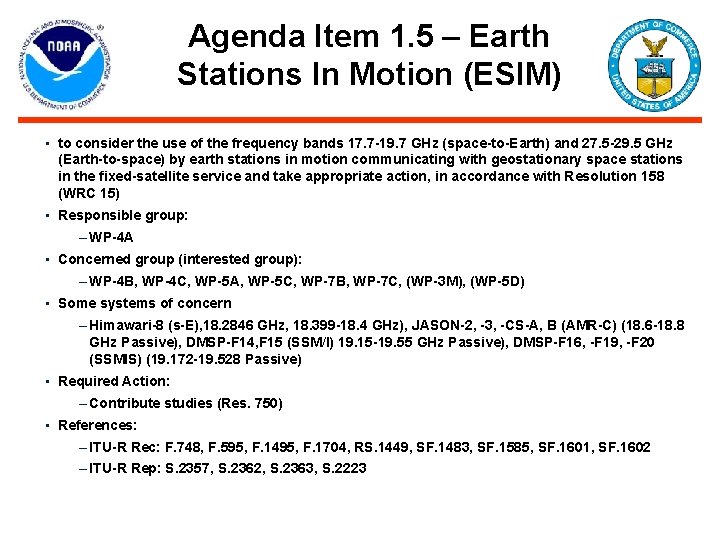
Agenda Item 1. 5 – Earth Stations In Motion (ESIM) • to consider the use of the frequency bands 17. 7 -19. 7 GHz (space-to-Earth) and 27. 5 -29. 5 GHz (Earth-to-space) by earth stations in motion communicating with geostationary space stations in the fixed-satellite service and take appropriate action, in accordance with Resolution 158 (WRC 15) • Responsible group: – WP-4 A • Concerned group (interested group): – WP-4 B, WP-4 C, WP-5 A, WP-5 C, WP-7 B, WP-7 C, (WP-3 M), (WP-5 D) • Some systems of concern – Himawari-8 (s-E), 18. 2846 GHz, 18. 399 -18. 4 GHz), JASON-2, -3, -CS-A, B (AMR-C) (18. 6 -18. 8 GHz Passive), DMSP-F 14, F 15 (SSM/I) 19. 15 -19. 55 GHz Passive), DMSP-F 16, -F 19, -F 20 (SSMIS) (19. 172 -19. 528 Passive) • Required Action: – Contribute studies (Res. 750) • References: – ITU-R Rec: F. 748, F. 595, F. 1495, F. 1704, RS. 1449, SF. 1483, SF. 1585, SF. 1601, SF. 1602 – ITU-R Rep: S. 2357, S. 2362, S. 2363, S. 2223
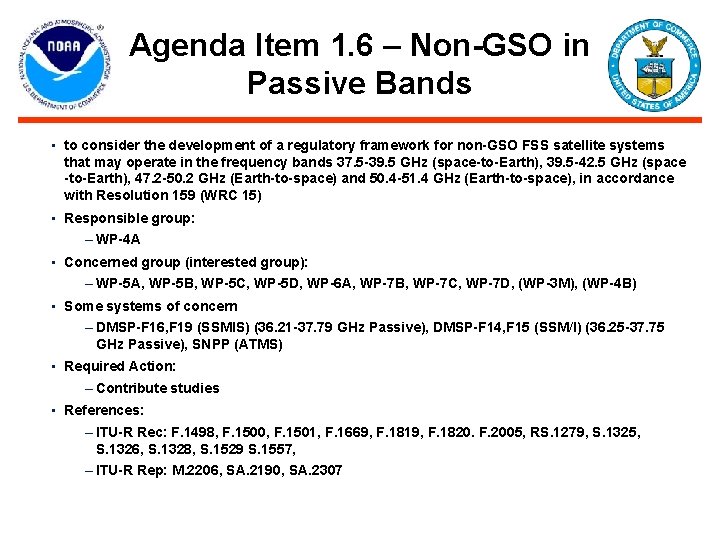
Agenda Item 1. 6 – Non-GSO in Passive Bands • to consider the development of a regulatory framework for non-GSO FSS satellite systems that may operate in the frequency bands 37. 5 -39. 5 GHz (space-to-Earth), 39. 5 -42. 5 GHz (space -to-Earth), 47. 2 -50. 2 GHz (Earth-to-space) and 50. 4 -51. 4 GHz (Earth-to-space), in accordance with Resolution 159 (WRC 15) • Responsible group: – WP-4 A • Concerned group (interested group): – WP-5 A, WP-5 B, WP-5 C, WP-5 D, WP-6 A, WP-7 B, WP-7 C, WP-7 D, (WP-3 M), (WP-4 B) • Some systems of concern – DMSP-F 16, F 19 (SSMIS) (36. 21 -37. 79 GHz Passive), DMSP-F 14, F 15 (SSM/I) (36. 25 -37. 75 GHz Passive), SNPP (ATMS) • Required Action: – Contribute studies • References: – ITU-R Rec: F. 1498, F. 1500, F. 1501, F. 1669, F. 1819, F. 1820. F. 2005, RS. 1279, S. 1325, S. 1326, S. 1328, S. 1529 S. 1557, – ITU-R Rep: M. 2206, SA. 2190, SA. 2307
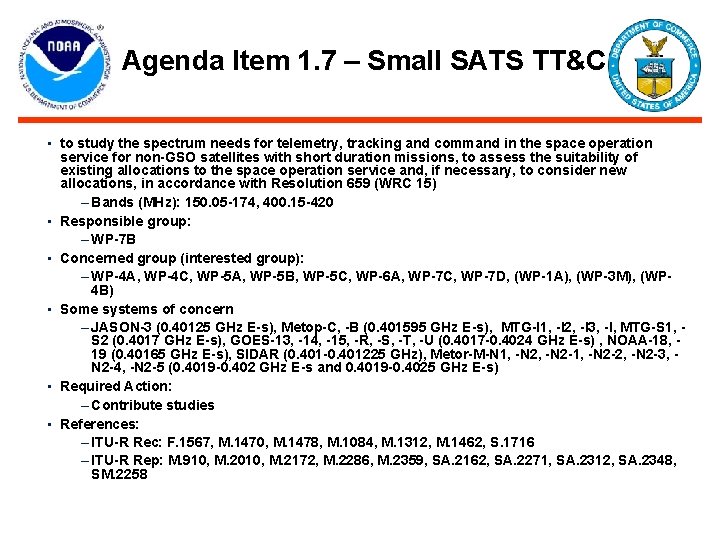
Agenda Item 1. 7 – Small SATS TT&C • to study the spectrum needs for telemetry, tracking and command in the space operation service for non-GSO satellites with short duration missions, to assess the suitability of existing allocations to the space operation service and, if necessary, to consider new allocations, in accordance with Resolution 659 (WRC 15) – Bands (MHz): 150. 05 -174, 400. 15 -420 • Responsible group: – WP-7 B • Concerned group (interested group): – WP-4 A, WP-4 C, WP-5 A, WP-5 B, WP-5 C, WP-6 A, WP-7 C, WP-7 D, (WP-1 A), (WP-3 M), (WP 4 B) • Some systems of concern – JASON-3 (0. 40125 GHz E-s), Metop-C, -B (0. 401595 GHz E-s), MTG-I 1, -I 2, -I 3, -I, MTG-S 1, S 2 (0. 4017 GHz E-s), GOES-13, -14, -15, -R, -S, -T, -U (0. 4017 -0. 4024 GHz E-s) , NOAA-18, 19 (0. 40165 GHz E-s), SIDAR (0. 401 -0. 401225 GHz), Metor-M-N 1, -N 2 -1, -N 2 -2, -N 2 -3, N 2 -4, -N 2 -5 (0. 4019 -0. 402 GHz E-s and 0. 4019 -0. 4025 GHz E-s) • Required Action: – Contribute studies • References: – ITU-R Rec: F. 1567, M. 1470, M. 1478, M. 1084, M. 1312, M. 1462, S. 1716 – ITU-R Rep: M. 910, M. 2010, M. 2172, M. 2286, M. 2359, SA. 2162, SA. 2271, SA. 2312, SA. 2348, SM. 2258
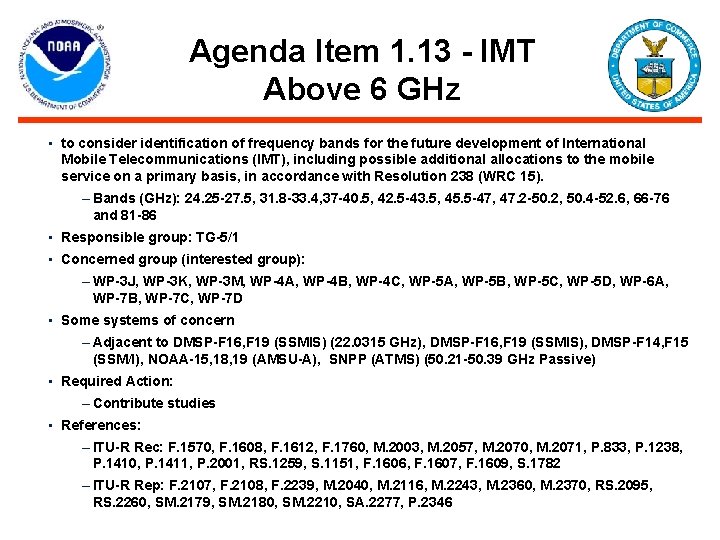
Agenda Item 1. 13 - IMT Above 6 GHz • to consider identification of frequency bands for the future development of International Mobile Telecommunications (IMT), including possible additional allocations to the mobile service on a primary basis, in accordance with Resolution 238 (WRC 15). – Bands (GHz): 24. 25 -27. 5, 31. 8 -33. 4, 37 -40. 5, 42. 5 -43. 5, 45. 5 -47, 47. 2 -50. 2, 50. 4 -52. 6, 66 -76 and 81 -86 • Responsible group: TG-5/1 • Concerned group (interested group): – WP-3 J, WP-3 K, WP-3 M, WP-4 A, WP-4 B, WP-4 C, WP-5 A, WP-5 B, WP-5 C, WP-5 D, WP-6 A, WP-7 B, WP-7 C, WP-7 D • Some systems of concern – Adjacent to DMSP-F 16, F 19 (SSMIS) (22. 0315 GHz), DMSP-F 16, F 19 (SSMIS), DMSP-F 14, F 15 (SSM/I), NOAA-15, 18, 19 (AMSU-A), SNPP (ATMS) (50. 21 -50. 39 GHz Passive) • Required Action: – Contribute studies • References: – ITU-R Rec: F. 1570, F. 1608, F. 1612, F. 1760, M. 2003, M. 2057, M. 2070, M. 2071, P. 833, P. 1238, P. 1410, P. 1411, P. 2001, RS. 1259, S. 1151, F. 1606, F. 1607, F. 1609, S. 1782 – ITU-R Rep: F. 2107, F. 2108, F. 2239, M. 2040, M. 2116, M. 2243, M. 2360, M. 2370, RS. 2095, RS. 2260, SM. 2179, SM. 2180, SM. 2210, SA. 2277, P. 2346
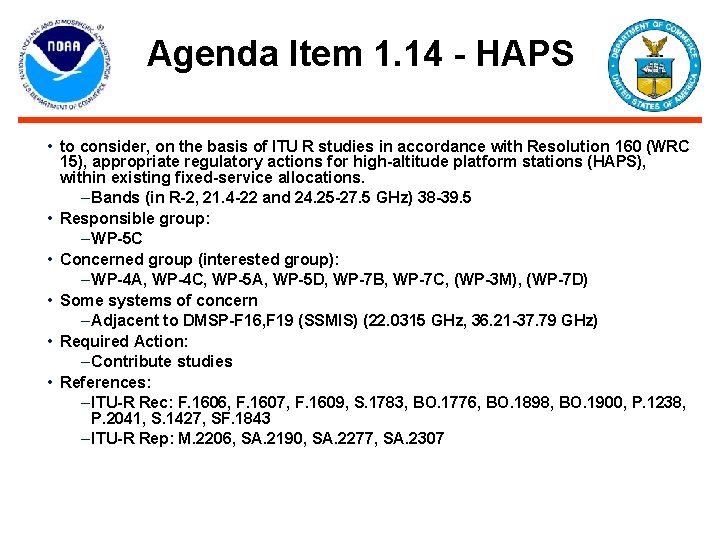
Agenda Item 1. 14 - HAPS • to consider, on the basis of ITU R studies in accordance with Resolution 160 (WRC 15), appropriate regulatory actions for high-altitude platform stations (HAPS), within existing fixed-service allocations. – Bands (in R-2, 21. 4 -22 and 24. 25 -27. 5 GHz) 38 -39. 5 • Responsible group: – WP-5 C • Concerned group (interested group): – WP-4 A, WP-4 C, WP-5 A, WP-5 D, WP-7 B, WP-7 C, (WP-3 M), (WP-7 D) • Some systems of concern – Adjacent to DMSP-F 16, F 19 (SSMIS) (22. 0315 GHz, 36. 21 -37. 79 GHz) • Required Action: – Contribute studies • References: – ITU-R Rec: F. 1606, F. 1607, F. 1609, S. 1783, BO. 1776, BO. 1898, BO. 1900, P. 1238, P. 2041, S. 1427, SF. 1843 – ITU-R Rep: M. 2206, SA. 2190, SA. 2277, SA. 2307
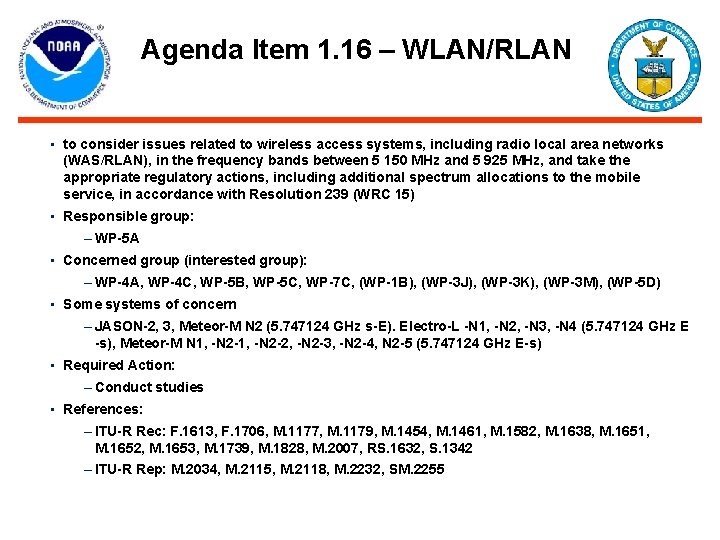
Agenda Item 1. 16 – WLAN/RLAN • to consider issues related to wireless access systems, including radio local area networks (WAS/RLAN), in the frequency bands between 5 150 MHz and 5 925 MHz, and take the appropriate regulatory actions, including additional spectrum allocations to the mobile service, in accordance with Resolution 239 (WRC 15) • Responsible group: – WP-5 A • Concerned group (interested group): – WP-4 A, WP-4 C, WP-5 B, WP-5 C, WP-7 C, (WP-1 B), (WP-3 J), (WP-3 K), (WP-3 M), (WP-5 D) • Some systems of concern – JASON-2, 3, Meteor-M N 2 (5. 747124 GHz s-E). Electro-L -N 1, -N 2, -N 3, -N 4 (5. 747124 GHz E -s), Meteor-M N 1, -N 2 -2, -N 2 -3, -N 2 -4, N 2 -5 (5. 747124 GHz E-s) • Required Action: – Conduct studies • References: – ITU-R Rec: F. 1613, F. 1706, M. 1177, M. 1179, M. 1454, M. 1461, M. 1582, M. 1638, M. 1651, M. 1652, M. 1653, M. 1739, M. 1828, M. 2007, RS. 1632, S. 1342 – ITU-R Rep: M. 2034, M. 2115, M. 2118, M. 2232, SM. 2255
Agenda Item 9. 1. 9 – FSS Passive 51/52 GHz • Resolution 162 (WRC 15). Studies relating to spectrum needs and possible allocation of the frequency band 51. 4 -52. 4 GHz to the fixed-satellite service (Earthto-space) • Responsible group: – WP-4 A • Concerned group (interested group): – WP-4 B, WP-5 A, WP-5 C, WP-5 D, WP-7 C, WP-7 D, (WP-3 M) • Some systems of concern – AMSU-EUMETSAT-METOP-B Instrument, Instrument DMSP-SSMIS-F 19, , SNPP (ATMS) (51. 56 -51. 96 GHz Passive) • Required Action: – Contribute Studies • References: – ITU-R Rec: F. 1494, RS. 515, RS. 1259, RS. 1279, RS. 1861, RS. 2017, RS. 2064, S. 1339 – ITU-R Rep: M. 1049, RS. 2165, SM. 2092
Questions? 30