
NOAA National Weather Service Robert Bunge Office of
NOAA National Weather Service Robert Bunge Office of the Chief Information Officer Robert. Bunge@noaa. gov 1
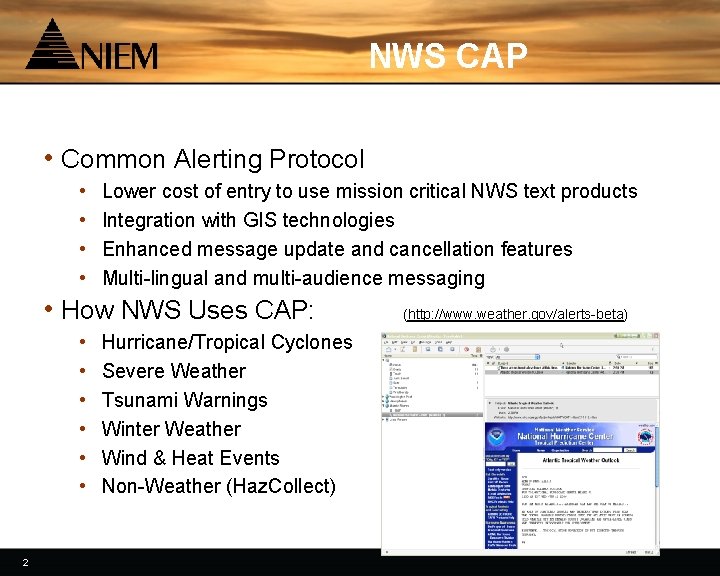
NWS CAP • Common Alerting Protocol • • Lower cost of entry to use mission critical NWS text products Integration with GIS technologies Enhanced message update and cancellation features Multi-lingual and multi-audience messaging • How NWS Uses CAP: • • • 2 Hurricane/Tropical Cyclones Severe Weather Tsunami Warnings Winter Weather Wind & Heat Events Non-Weather (Haz. Collect) (http: //www. weather. gov/alerts-beta)
Brief History • Built and deployed CAP 1. 0 feeds in 2004 • http: //www. weather. gov/alerts/ • Built by parsing WMO/text messages • With parallel HTML and RSS feeds • State and county (2006) feeds • Single CAP message contains all alerts • Well accepted, widely used, but calls for more fine grained parsing • Started CAP 1. 1 effort in 2007 • http: //www. weather. gov/alerts-beta/ • Created a cross Weather Enterprise working group • Held regular meetings to review prototypes • Each CAP message is a unique URI • State/County ATOM indexes, HTML replaced by style sheets • Plan to replace CAP 1. 0 in December and go operational • Will serve as a template for future AWIPS produced messages 3
Approach • Past and on-going tasks • Enhance the current experimental web-based CAP beta feeds • Started in Spring 2009 populating Instruction element • Populate additional CAP elements • Better quality control Engage Partners • Future tasks (2010 -2012) • CAP “Push” streams • XMPP • Centrally generate CAP messages in WMO "envelope" and disseminate via traditional NWS “push” dissemination systems • Generate native CAP using Next Generation Warning Tool with mixed case, expanded character set, and fully populated CAP elements • Generate WMO-formatted product and CAP message • Continue to disseminate both versions 4
• Haz. Collect Mission • Haz. Collect Description Haz. Collect 5

Haz. Collect All-Hazards Emergency Message Collection System • Mission – NOAA/NWS is assigned responsibility by the National Response Framework to “provide public dissemination of critical preand post-event information” on NOAA Weather Radio All Hazards (NWR) and other dissemination systems. • Provides tools to emergency responders and government officials for efficient distribution of alert and warning information to affected population in the event of an emergency. • Message Examples: Hazardous Materials Warning, Fire Warning, Evacuation Warning, Shelter-in-Place Warning, Amber Alert, Nuclear Power Plant Warning, Civil Emergency Message • Enables wider distribution of Non-Weather Emergency Messages to: • NWS dissemination systems including NOAA Weather Radio and NOAA Weather Wire Service, Emergency Managers Weather Information Network (EMWIN) • Emergency Alert System (EAS) • Weather enterprise, news media, and others that monitor and distribute NWS data streams 6
Haz. Collect Description • Haz. Collect is a nationwide capability developed by NWS in coordination with Department of Homeland Security’s (DHS) Federal Emergency Management Agency (FEMA). • Warning authorities create messages on a FEMAmanaged application or a third-party CAP-compliant NWEM authoring tool • FEMA Disaster Management interoperability platform authenticates users and provides message interoperability amongst parties • Distribution of Non-Weather Emergency Messages (NWEMs) through NWS dissemination systems 7
- Slides: 7