
No SQL What is No SQL No SQL
- Slides: 20
No. SQL
What is No. SQL? No. SQL is a set of concepts that allows the rapid and efficient processing of data sets with a focus on performance, reliability, and agility.
What is No. SQL? �It’s more than rows in tables—No. SQL systems store and retrieve data from many formats: key-value stores, graph databases, column-family (Bigtable) stores, document stores, and even rows in tables. �It’s free of joins—No. SQL systems allow you to extract your data using simple interfaces without joins. �It’s schema-free—No. SQL systems allow you to drag-and-drop your data into a folder and then query it without creating an entity-relational model. �It works on many processors—No. SQL systems allow you to store your database on multiple processors and maintain high-speed performance.
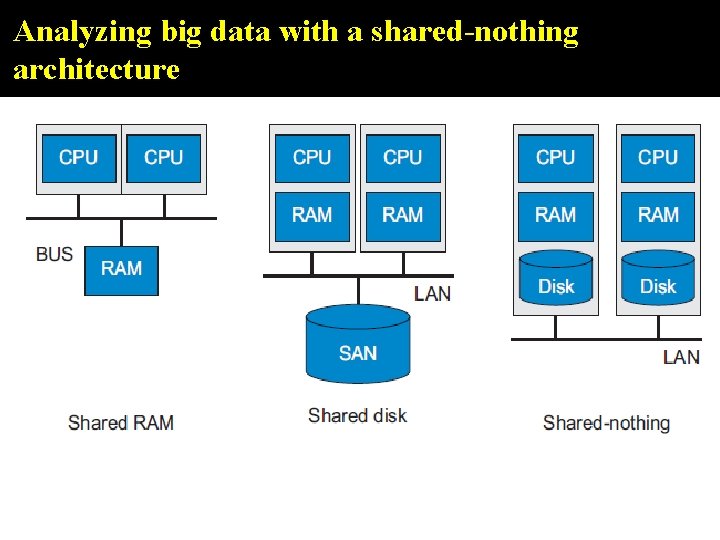
What is No. SQL? �It uses shared-nothing commodity computers—Most (but not all) No. SQL systems leverage low-cost commodity processors that have separate RAM and disk. �It supports linear scalability—When you add more processors, you get a consistent increase in performance. �It’s innovative—No. SQL offers options to a single way of storing, retrieving, and manipulating data. No. SQL supporters (also known as No. SQLers) have an inclusive attitude about No. SQL and recognize SQL solutions as viable options. To the No. SQL community, No. SQL means “Not only SQL. ”
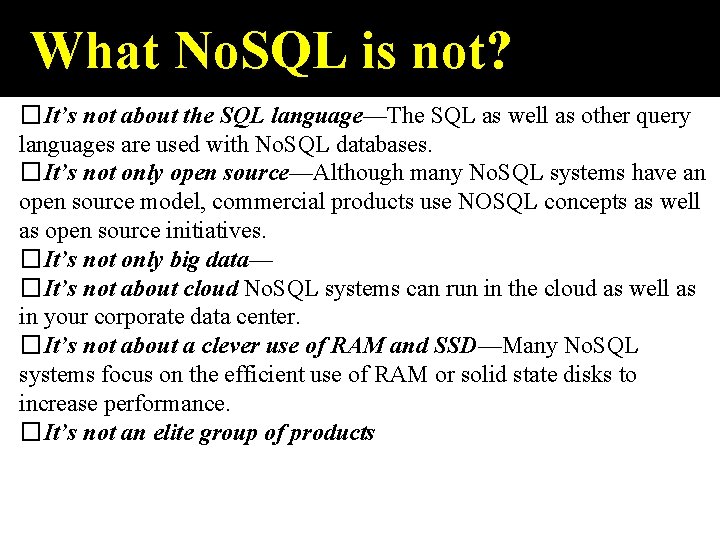
What No. SQL is not? �It’s not about the SQL language—The SQL as well as other query languages are used with No. SQL databases. �It’s not only open source—Although many No. SQL systems have an open source model, commercial products use NOSQL concepts as well as open source initiatives. �It’s not only big data— �It’s not about cloud No. SQL systems can run in the cloud as well as in your corporate data center. �It’s not about a clever use of RAM and SSD—Many No. SQL systems focus on the efficient use of RAM or solid state disks to increase performance. �It’s not an elite group of products
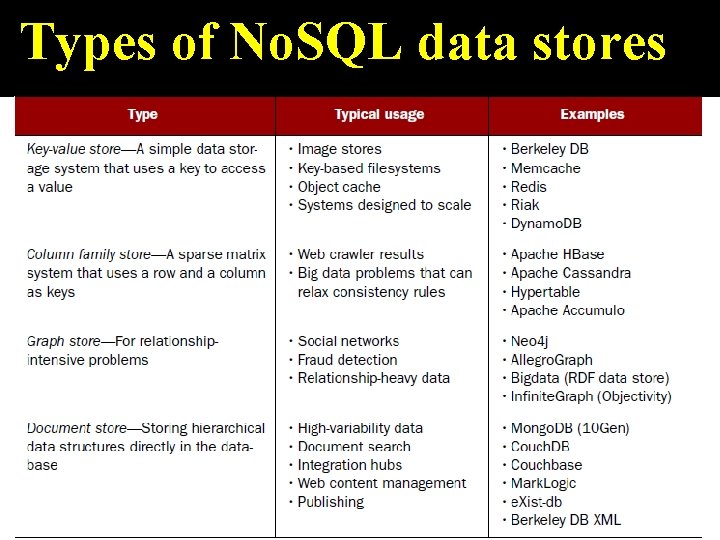
Types of No. SQL data stores
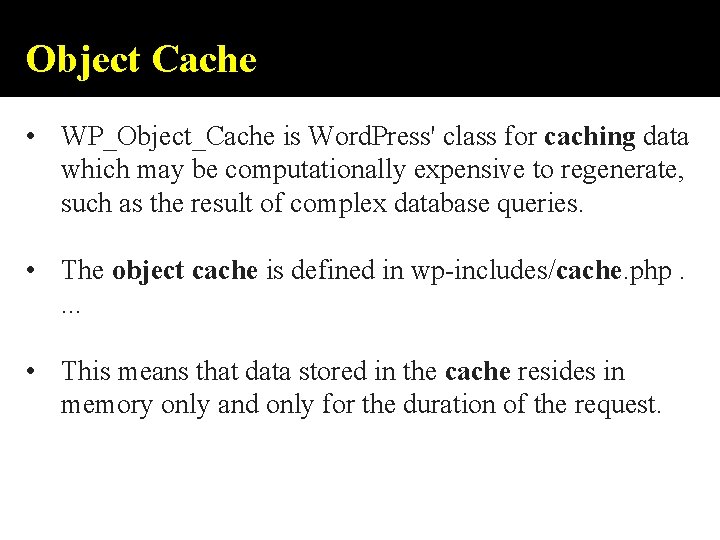
Object Cache • WP_Object_Cache is Word. Press' class for caching data which may be computationally expensive to regenerate, such as the result of complex database queries. • The object cache is defined in wp-includes/cache. php. . • This means that data stored in the cache resides in memory only and only for the duration of the request.
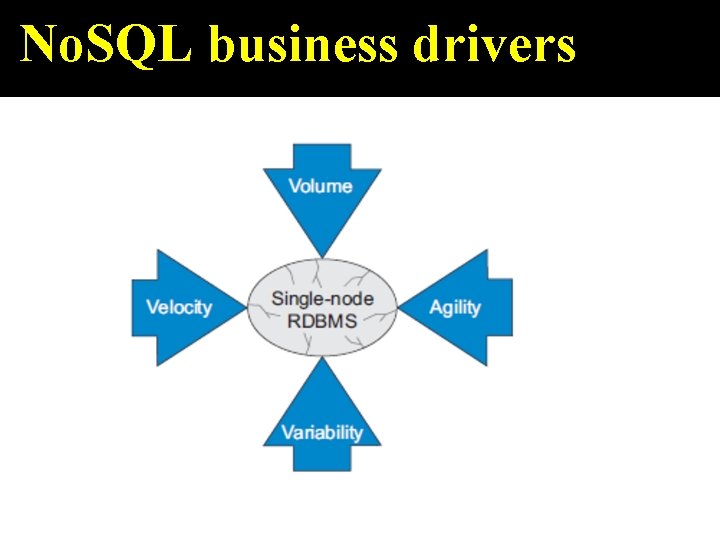
No. SQL business drivers
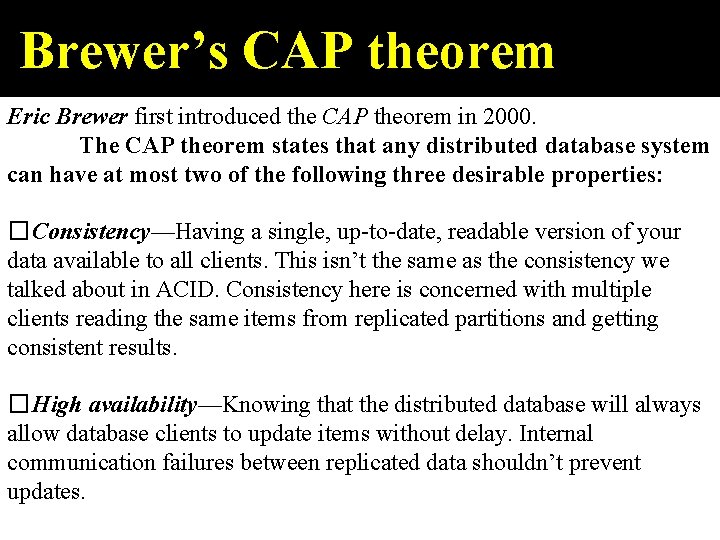
Brewer’s CAP theorem Eric Brewer first introduced the CAP theorem in 2000. The CAP theorem states that any distributed database system can have at most two of the following three desirable properties: �Consistency—Having a single, up-to-date, readable version of your data available to all clients. This isn’t the same as the consistency we talked about in ACID. Consistency here is concerned with multiple clients reading the same items from replicated partitions and getting consistent results. �High availability—Knowing that the distributed database will always allow database clients to update items without delay. Internal communication failures between replicated data shouldn’t prevent updates.
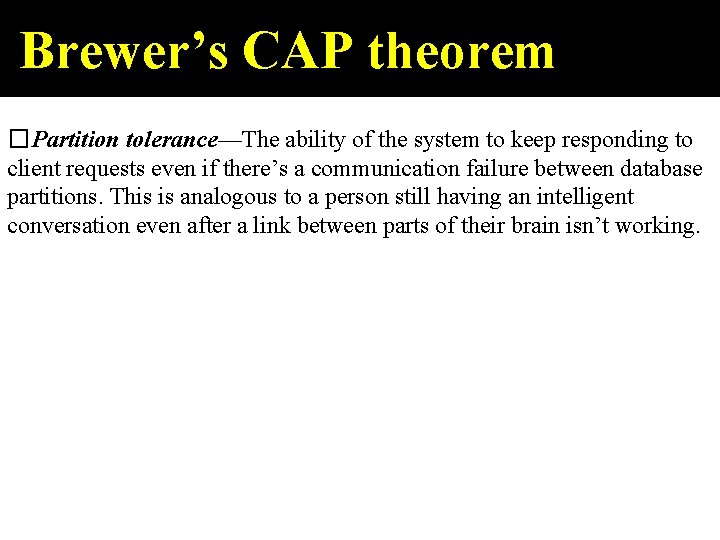
Brewer’s CAP theorem �Partition tolerance—The ability of the system to keep responding to client requests even if there’s a communication failure between database partitions. This is analogous to a person still having an intelligent conversation even after a link between parts of their brain isn’t working.
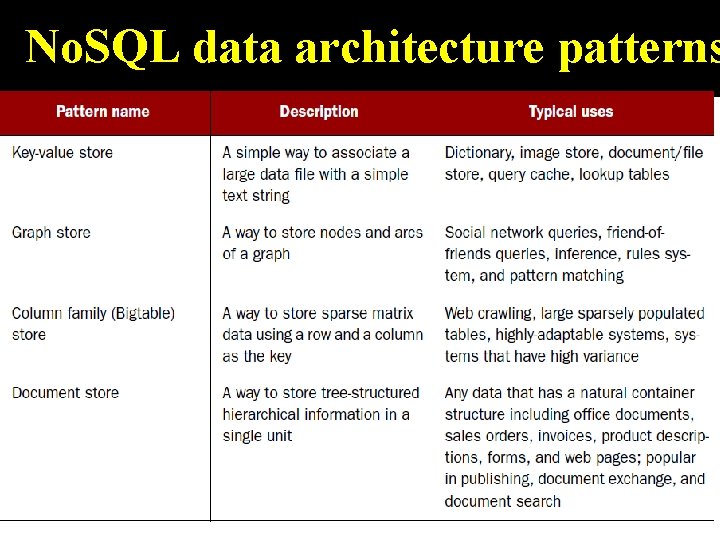
What is a data architecture pattern? We define a data architecture pattern as ; a consistent way of representing data in a regular structure that will be stored in memory. One of the challenges for users of No. SQL systems is there are many different architectural patterns from which to choose.
No. SQL data architecture patterns
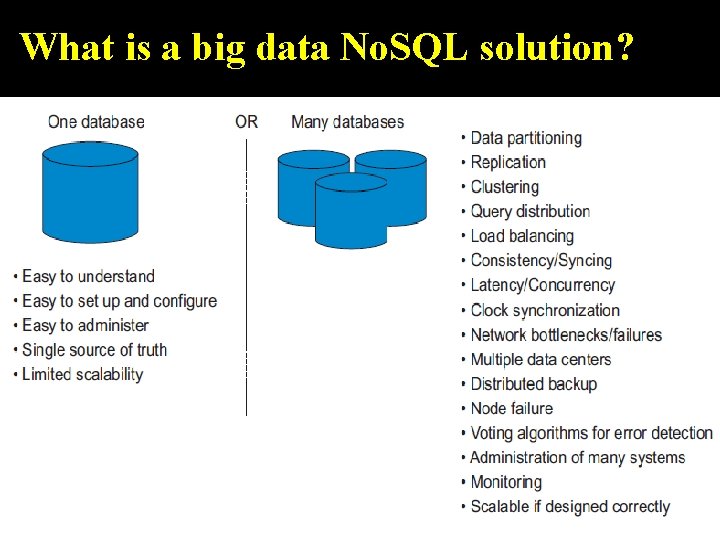
What is a big data No. SQL solution?
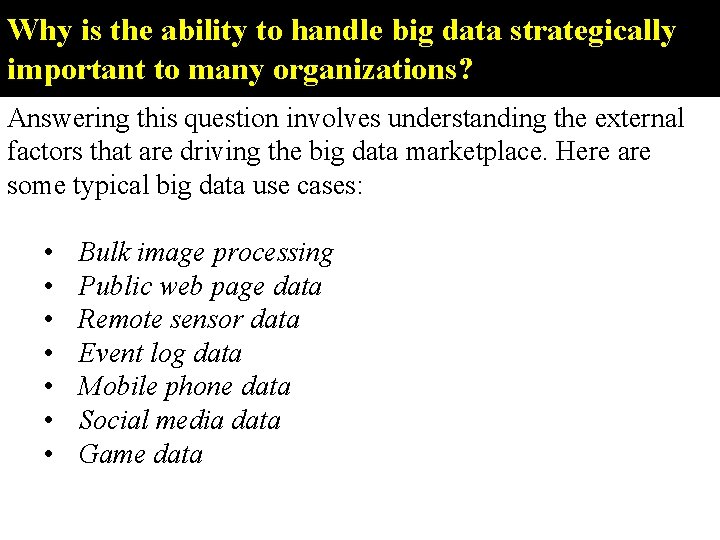
Why is the ability to handle big data strategically important to many organizations? Answering this question involves understanding the external factors that are driving the big data marketplace. Here are some typical big data use cases: • • Bulk image processing Public web page data Remote sensor data Event log data Mobile phone data Social media data Game data
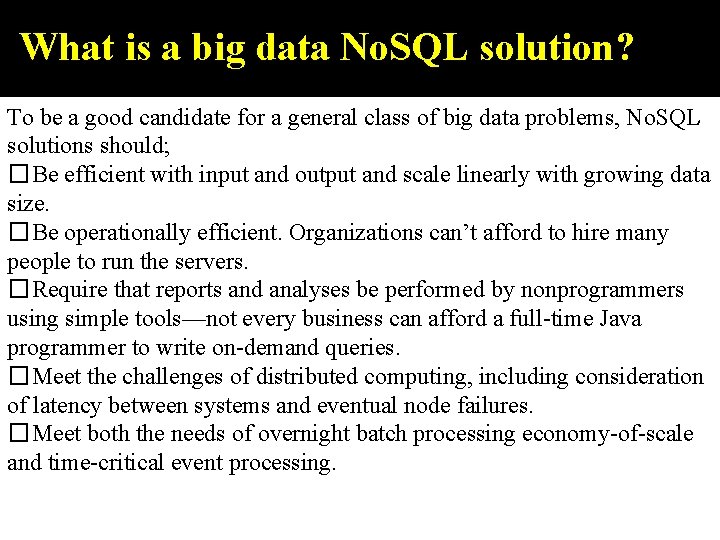
What is a big data No. SQL solution? To be a good candidate for a general class of big data problems, No. SQL solutions should; �Be efficient with input and output and scale linearly with growing data size. �Be operationally efficient. Organizations can’t afford to hire many people to run the servers. �Require that reports and analyses be performed by nonprogrammers using simple tools—not every business can afford a full-time Java programmer to write on-demand queries. �Meet the challenges of distributed computing, including consideration of latency between systems and eventual node failures. �Meet both the needs of overnight batch processing economy-of-scale and time-critical event processing.
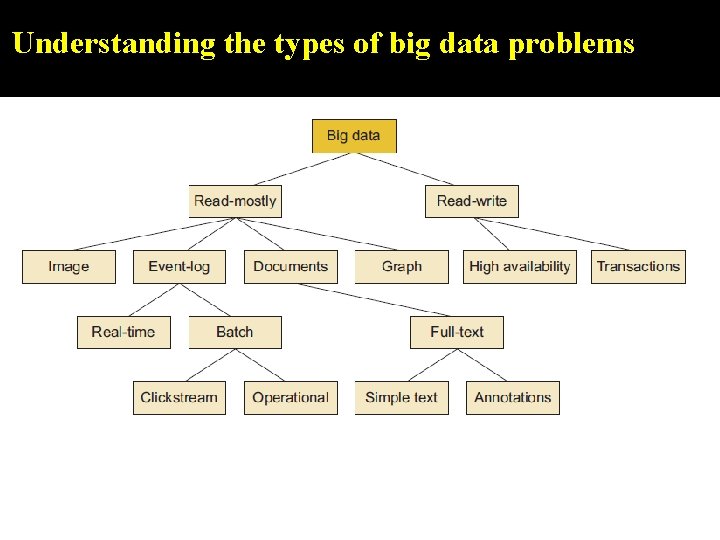
Understanding the types of big data problems
Analyzing big data with a shared-nothing architecture
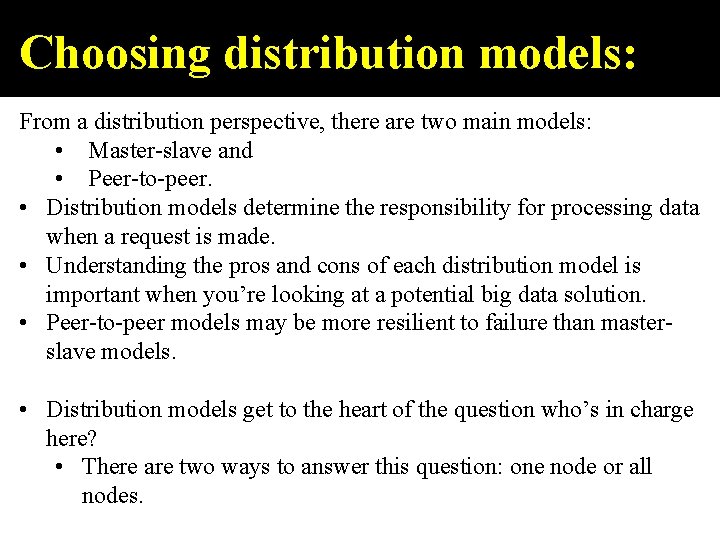
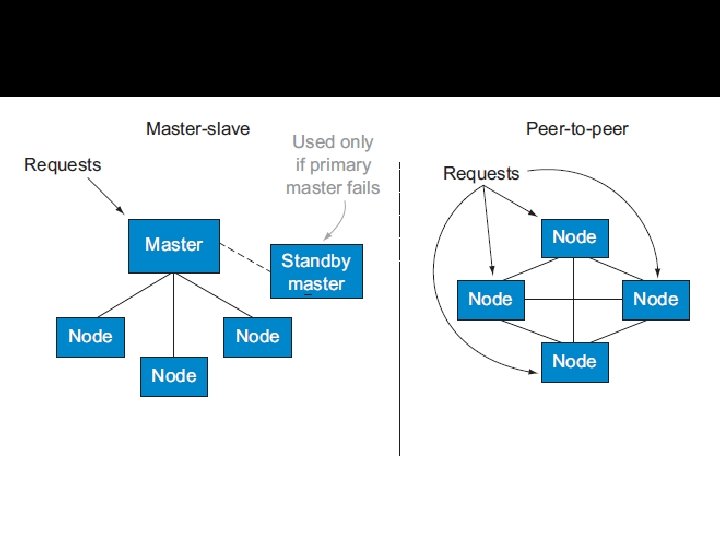
Choosing distribution models: From a distribution perspective, there are two main models: • Master-slave and • Peer-to-peer. • Distribution models determine the responsibility for processing data when a request is made. • Understanding the pros and cons of each distribution model is important when you’re looking at a potential big data solution. • Peer-to-peer models may be more resilient to failure than masterslave models. • Distribution models get to the heart of the question who’s in charge here? • There are two ways to answer this question: one node or all nodes.
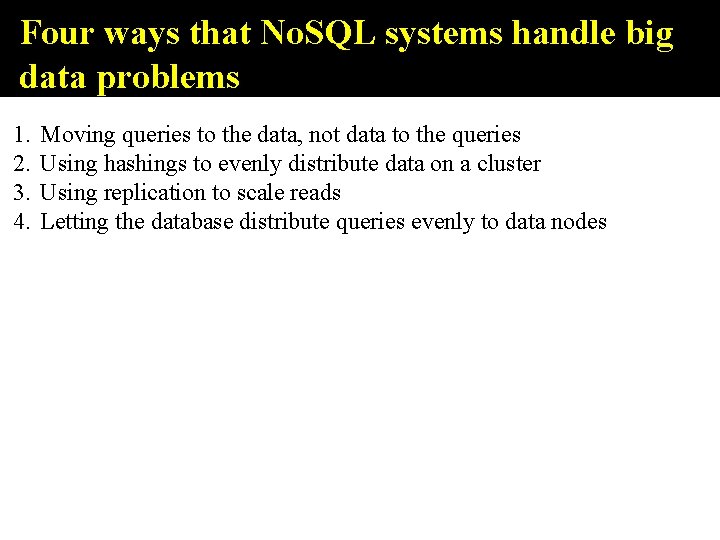
Four ways that No. SQL systems handle big data problems 1. 2. 3. 4. Moving queries to the data, not data to the queries Using hashings to evenly distribute data on a cluster Using replication to scale reads Letting the database distribute queries evenly to data nodes