
No Proof System for Number Theory Reduction to
No Proof System for Number Theory Reduction to Halting Problem • History • Gödel's Incompleteness • Halting ≤ Math Truth Lecture 6. 3 Jeff Edmonds York University COSC 2001
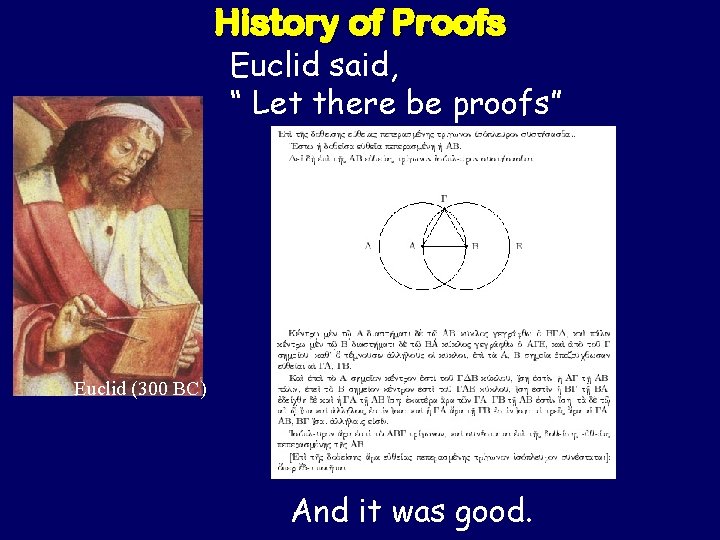
History of Proofs Euclid said, “ Let there be proofs” Euclid (300 BC) And it was good.

History of Proofs Euclid said, “ Let there be proofs” Clearly everything is either true or false. Goal: Design a proof system that proves everything. Result: “Prove that God exists” Euclid (300 BC)
History of Proofs Euclid said, “ Let there be proofs” A proof system consists of 1. A finite set of axioms (Statements assumed to be true) Eg. 1) Any two points can be joined by a straight line …. 5) Parallel lines never meet. Euclid (300 BC)
History of Proofs Euclid said, “ Let there be proofs” A proof system consists of 1. A finite set of axioms (Statements assumed to be true) 2. A finite set of rules for proving one statement from previously proved theorems. Euclid (300 BC) Eg: If statements A and A B have been proved, then statement B follows.
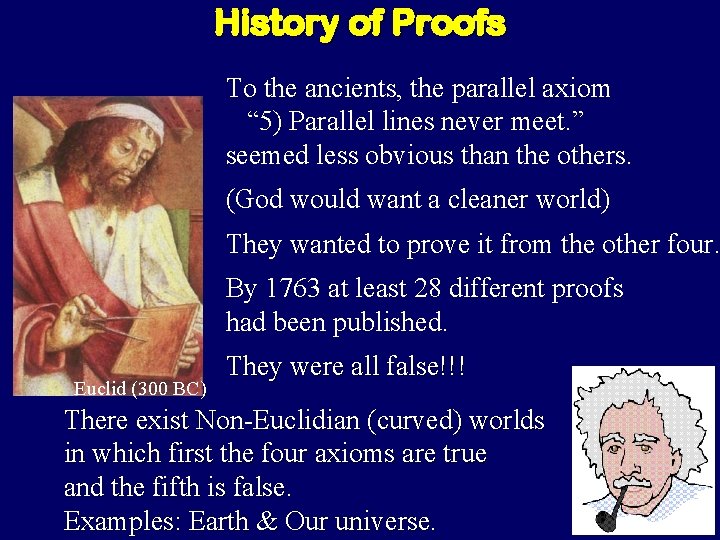
History of Proofs To the ancients, the parallel axiom “ 5) Parallel lines never meet. ” seemed less obvious than the others. (God would want a cleaner world) They wanted to prove it from the other four. By 1763 at least 28 different proofs had been published. Euclid (300 BC) They were all false!!! There exist Non-Euclidian (curved) worlds in which first the four axioms are true and the fifth is false. Examples: Earth & Our universe.
History of Proofs Euclid said, “ Let there be proofs” Clearly everything is either true or false. Oops Euclid (300 BC) Some things have no proof and whether true or false depends on your world view. Choose which world you want to live in and build that into your axioms. Eg Axiom: Homosexuals are bad. good
History of Proofs Euclid said, “ Let there be proofs” Clearly everything is either true or false. Consider only statements in Number Theory i. e. statements about the integers. eg: Φ = [ a, b, c, r 3 ar+br cr] Euclid (300 BC) Clearly each such statement is either true or false. Goal: Design a proof system that proves/disproves all of these.

Gödel’s Incompleteness Theorem Some things have no proof and whether true or false depends on your world view. For every proof system S, there are math statements Φ which are either not proved or proved incorrectly! Gödel 1931
Gödel’s Incompleteness Theorem Gödel 1931 Proof System: If S is a valid proof system, then Φ is true Φ has a valid proof P in S Number Theory: eg: Φ = [ a, b, c, r 3 ar+br cr] Is powerful enough to say Φtrue = “P is a valid proof of math statement I in proof system S. ” And hence can a say Φdiagonal = P “P is a valid proof of math statement Φdiagonal in proof system S. ”
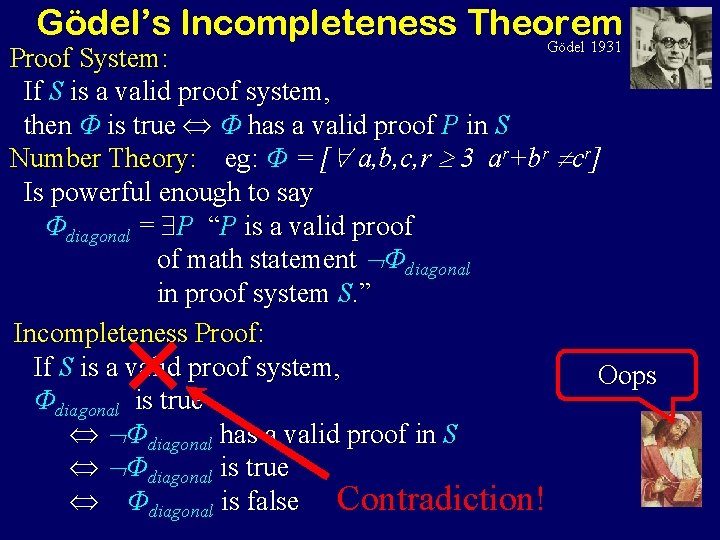
Gödel’s Incompleteness Theorem Gödel 1931 Proof System: If S is a valid proof system, then Φ is true Φ has a valid proof P in S Number Theory: eg: Φ = [ a, b, c, r 3 ar+br cr] Is powerful enough to say Φdiagonal = P “P is a valid proof of math statement Φdiagonal in proof system S. ” Incompleteness Proof: If S is a valid proof system, Oops Φdiagonal is true Φdiagonal has a valid proof in S Φdiagonal is true Φdiagonal is false Contradiction!
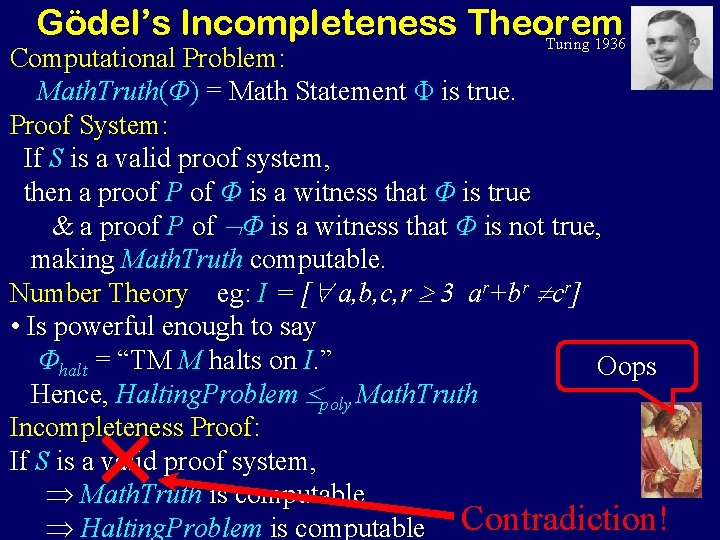
Gödel’s Incompleteness Theorem Turing 1936 Computational Problem: Math. Truth(Φ) = Math Statement Φ is true. Proof System: If S is a valid proof system, then a proof P of Φ is a witness that Φ is true & a proof P of Φ is a witness that Φ is not true, making Math. Truth computable. Number Theory eg: I = [ a, b, c, r 3 ar+br cr] • Is powerful enough to say Φhalt = “TM M halts on I. ” Oops Hence, Halting. Problem poly Math. Truth Incompleteness Proof: If S is a valid proof system, Math. Truth is computable Halting. Problem is computable Contradiction!
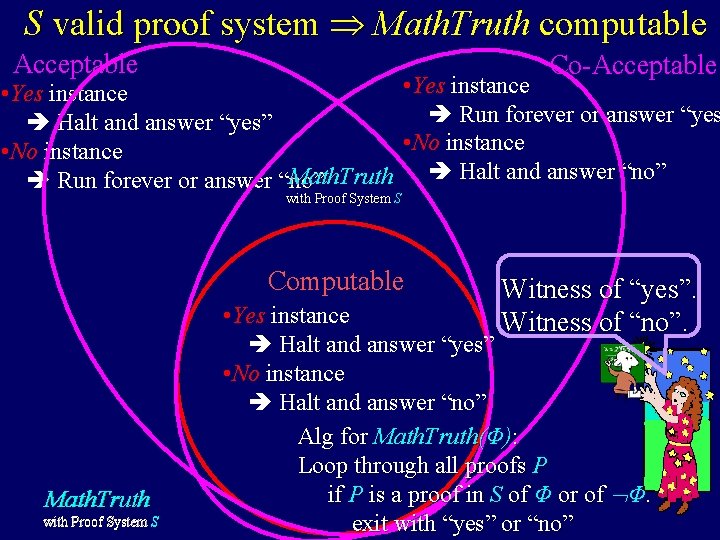
S valid proof system Math. Truth computable Acceptable Co-Acceptable • Yes instance Run forever or answer “yes Halt and answer “yes” • No instance Math. Truth Halt and answer “no” Run forever or answer “no” with Proof System S Computable Math. Truth with Proof System S Witness of “yes”. Witness of “no”. • Yes instance Halt and answer “yes” • No instance Halt and answer “no” Alg for Math. Truth(Φ Math. Truth( ): Loop through all proofs P if P is a proof in S of Φ or of Φ. exit with “yes” or “no”
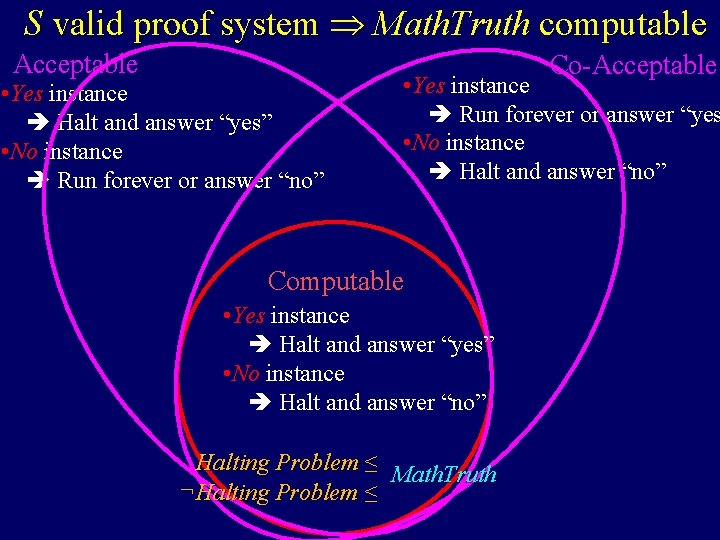
S valid proof system Math. Truth computable Acceptable • Yes instance Halt and answer “yes” • No instance Run forever or answer “no” Co-Acceptable • Yes instance Run forever or answer “yes • No instance Halt and answer “no” Computable • Yes instance Halt and answer “yes” • No instance Halt and answer “no” Halting Problem ≤ Math. Truth ¬Halting Problem ≤
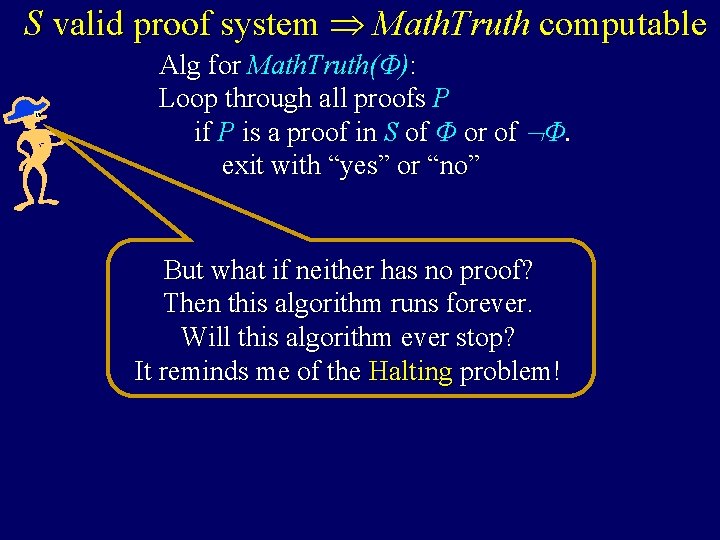
S valid proof system Math. Truth computable Alg for Math. Truth(Φ Math. Truth( ): Loop through all proofs P if P is a proof in S of Φ or of Φ. exit with “yes” or “no” But what if neither has no proof? Then this algorithm runs forever. Will this algorithm ever stop? It reminds me of the Halting problem!
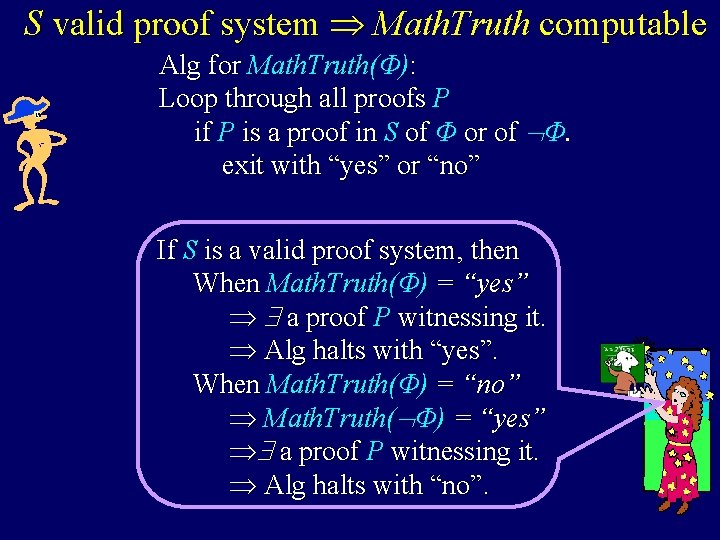
S valid proof system Math. Truth computable Alg for Math. Truth(Φ Math. Truth( ): Loop through all proofs P if P is a proof in S of Φ or of Φ. exit with “yes” or “no” If S is a valid proof system, then When Math. Truth(Φ Math. Truth( ) = “yes” a proof P witnessing it. Alg halts with “yes”. When Math. Truth(Φ Math. Truth( ) = “no” Math. Truth( Φ) = “yes” a proof P witnessing it. Alg halts with “no”.
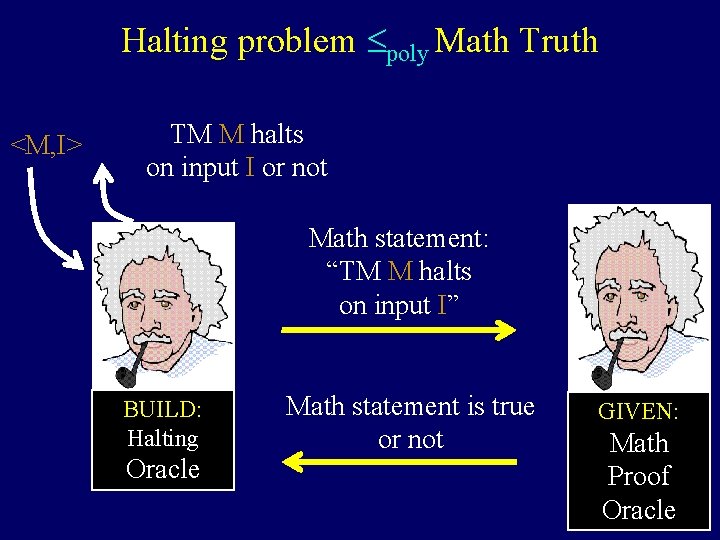
Halting problem poly Math Truth <M, I> TM M halts on input I or not Math statement: “TM M halts on input I” BUILD: Halting Oracle Math statement is true or not GIVEN: Math Proof Oracle
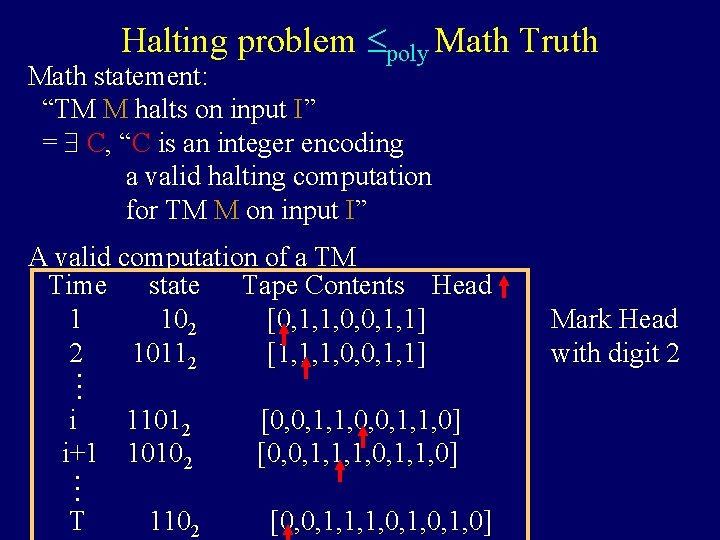
Halting problem poly Math Truth Math statement: “TM M halts on input I” “ = C, “C is an integer encoding a valid halting computation for TM M on input I” … A valid computation of a TM Time state Tape Contents Head 1 102 [0, 1, 1, 0, 0, 1, 1] 2 10112 [1, 1, 1, 0, 0, 1, 1] … i 11012 i+1 10102 T 1102 [0, 0, 1, 1, 0] [0, 0, 1, 1, 1, 0, 1, 0] Mark Head with digit 2
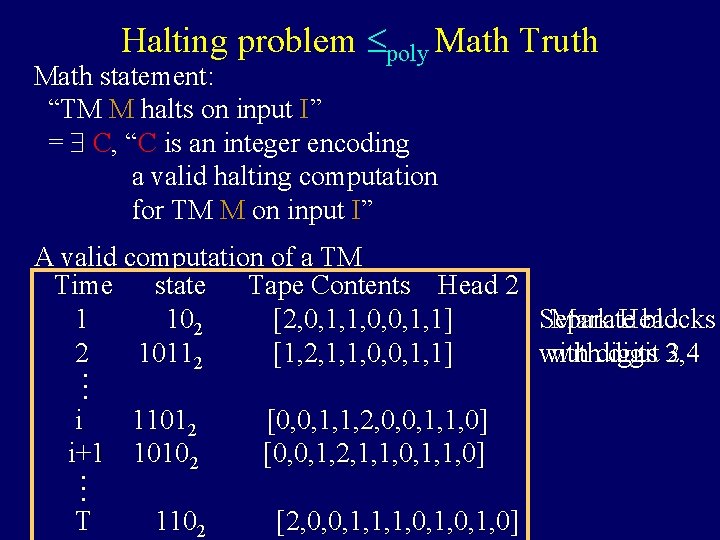
Halting problem poly Math Truth Math statement: “TM M halts on input I” “ = C, “C is an integer encoding a valid halting computation for TM M on input I” … A valid computation of a TM Time state Tape Contents Head 2 1 102 [2, 0, 1, 1, 0, 0, 1, 1] Separate Mark Head blocks 2 10112 [1, 2, 1, 1, 0, 0, 1, 1] withdigits digit 3, 4 2 … i 11012 i+1 10102 T 1102 [0, 0, 1, 1, 2, 0, 0, 1, 1, 0] [0, 0, 1, 2, 1, 1, 0] [2, 0, 0, 1, 1, 1, 0, 1, 0]
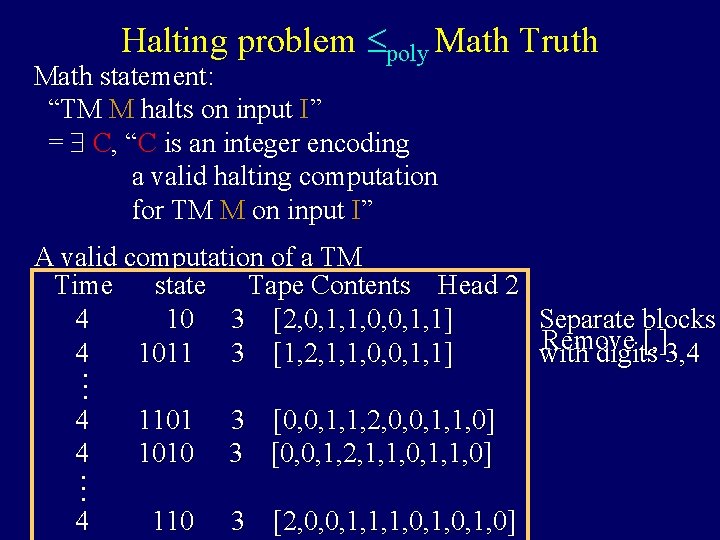
Halting problem poly Math Truth Math statement: “TM M halts on input I” “ = C, “C is an integer encoding a valid halting computation for TM M on input I” A valid computation of a TM Time state Tape Contents Head 2 4 10 3 [2, 0, 1, 1, 0, 0, 1, 1] Separate blocks Remove [, ]3, 4 4 1011 3 [1, 2, 1, 1, 0, 0, 1, 1] with digits … 4 4 … 4 1101 1010 110 3 [0, 0, 1, 1, 2, 0, 0, 1, 1, 0] 3 [0, 0, 1, 2, 1, 1, 0] 3 [2, 0, 0, 1, 1, 1, 0, 1, 0]
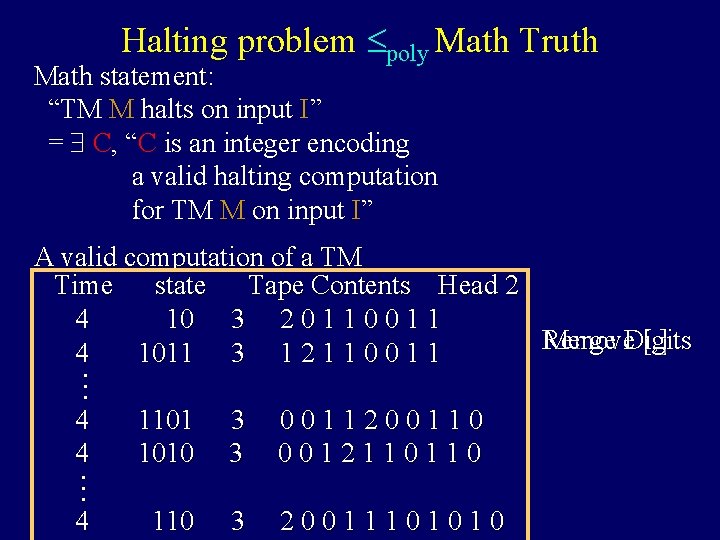
Halting problem poly Math Truth Math statement: “TM M halts on input I” “ = C, “C is an integer encoding a valid halting computation for TM M on input I” A valid computation of a TM Time state Tape Contents Head 2 4 10 3 2 0 1 1 0 0 1 1 Remove Merge Digits [, ] 4 1011 3 1 2 1 1 0 0 1 1 … 4 4 … 4 1101 1010 3 3 0011200110 0012110110 3 20011101010
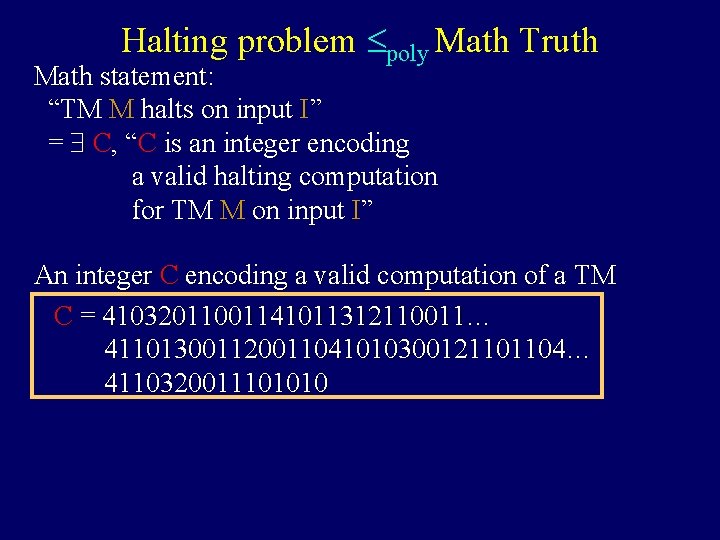
Halting problem poly Math Truth Math statement: “TM M halts on input I” “ = C, “C is an integer encoding a valid halting computation for TM M on input I” An integer C encoding a valid computation of a TM C = 41032011001141011312110011… 411013001120011041010300121101104… 4110320011101010
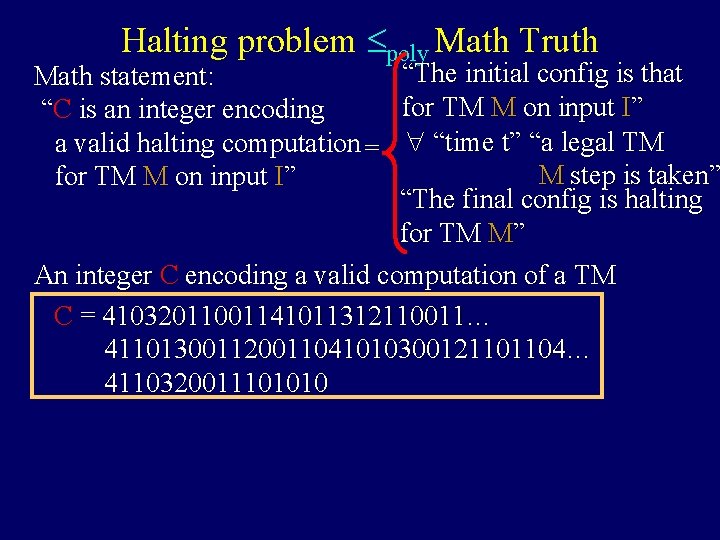
Halting problem poly Math Truth “The initial config is that for TM M on input I” “time t” “a legal TM M step is taken” “The final config is halting for TM M” An integer C encoding a valid computation of a TM C = 41032011001141011312110011… 411013001120011041010300121101104… 4110320011101010 Math statement: “C is an integer encoding a valid halting computation = for TM M on input I”
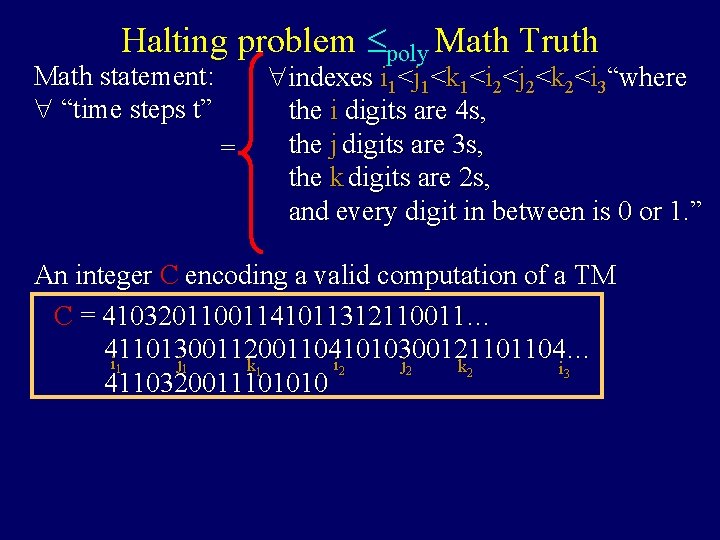
Halting problem poly Math Truth Math statement: “time steps t” = indexes i 1<j 1<k 1<i 2<j 2<k 2<i 3“where the i digits are 4 s, the j digits are 3 s, the k digits are 2 s, and every digit in between is 0 or 1. ” An integer C encoding a valid computation of a TM C = 41032011001141011312110011… 411013001120011041010300121101104… i 1 j 1 i 2 j 2 k 1 k 2 i 3 4110320011101010
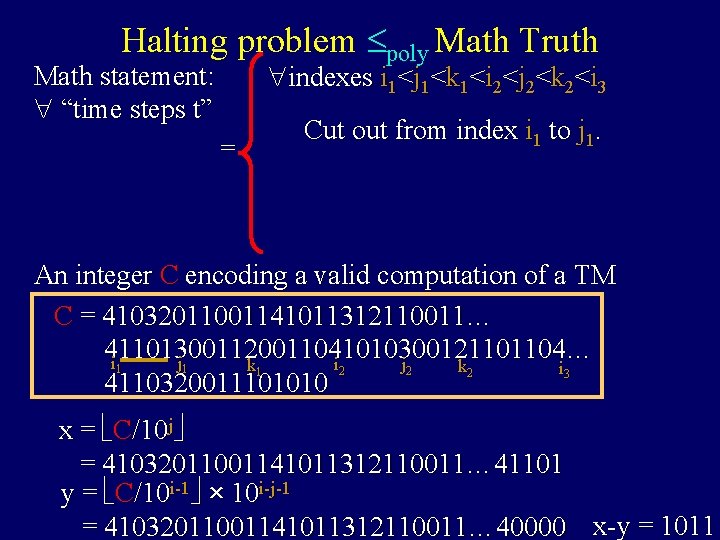
Halting problem poly Math Truth indexes i 1<j 1<k 1<i 2<j 2<k 2<i 3 Math statement: “time steps t” = Cut out from index i 1 to j 1. An integer C encoding a valid computation of a TM C = 41032011001141011312110011… 411013001120011041010300121101104… i 1 j 1 i 2 j 2 k 1 k 2 i 3 4110320011101010 x = C/10 j = 41032011001141011312110011… 41101 y = C/10 i-1 × 10 i-j-1 = 41032011001141011312110011… 40000 x-y = 1011
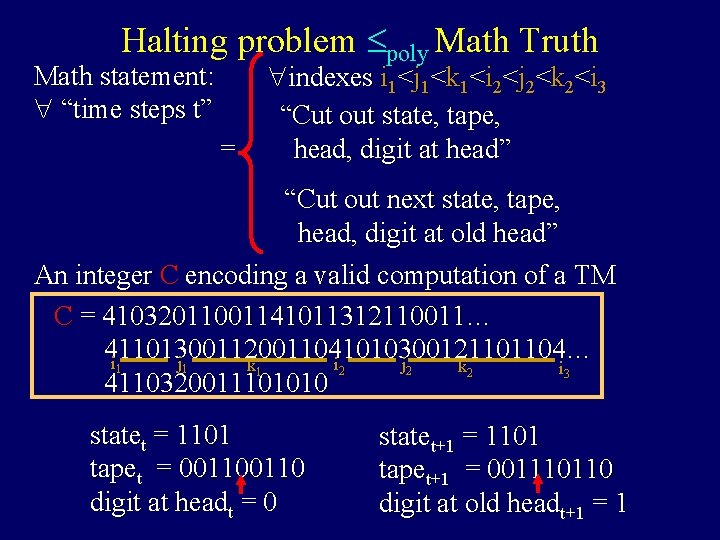
Halting problem poly Math Truth Math statement: “time steps t” = indexes i 1<j 1<k 1<i 2<j 2<k 2<i 3 “Cut out state, tape, head, digit at head” “Cut out next state, tape, head, digit at old head” An integer C encoding a valid computation of a TM C = 41032011001141011312110011… 411013001120011041010300121101104… i 1 j 1 i 2 j 2 k 1 k 2 i 3 4110320011101010 statet = 1101 tapet = 00110 digit at headt = 0 statet+1 = 1101 tapet+1 = 001110110 digit at old headt+1 = 1
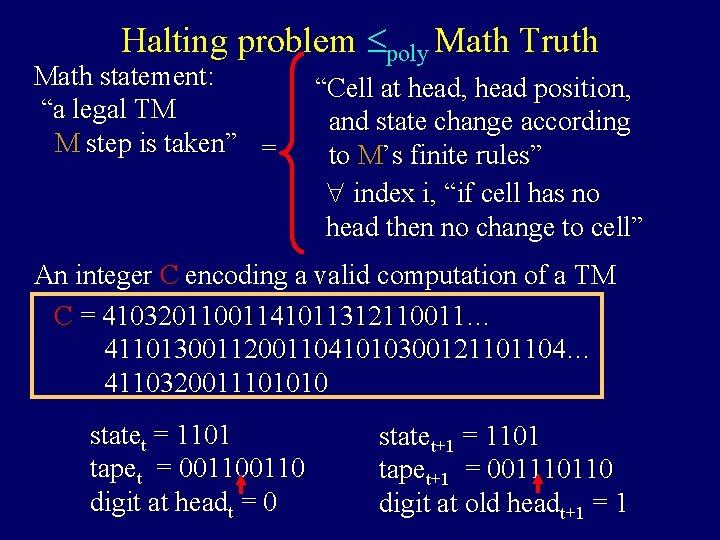
Halting problem poly Math Truth Math statement: “a legal TM M step is taken” = “Cell at head, head position, and state change according to M’s finite rules” index i, “if cell has no head then no change to cell” An integer C encoding a valid computation of a TM C = 41032011001141011312110011… 411013001120011041010300121101104… 4110320011101010 statet = 1101 tapet = 00110 digit at headt = 0 statet+1 = 1101 tapet+1 = 001110110 digit at old headt+1 = 1
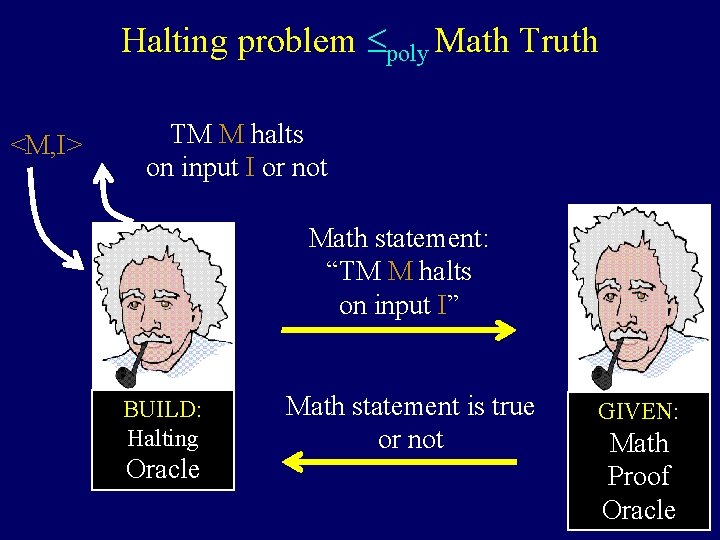
Halting problem poly Math Truth <M, I> TM M halts on input I or not Math statement: “TM M halts on input I” BUILD: Halting Oracle Math statement is true or not GIVEN: Math Proof Oracle
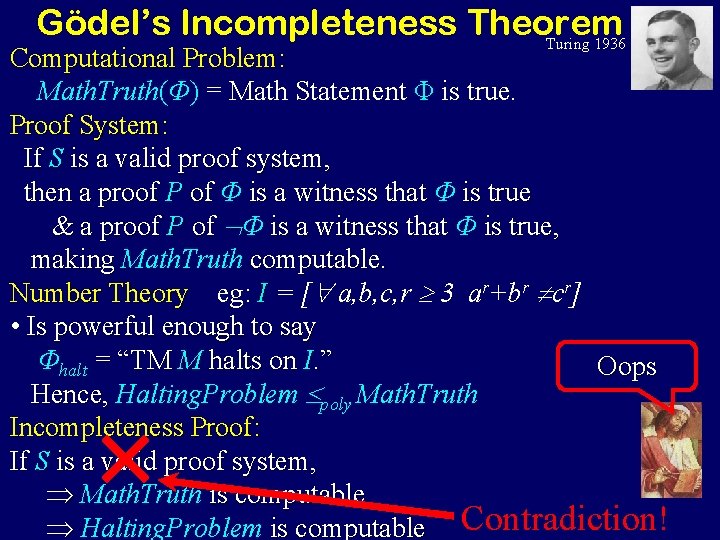
Gödel’s Incompleteness Theorem Turing 1936 Computational Problem: Math. Truth(Φ) = Math Statement Φ is true. Proof System: If S is a valid proof system, then a proof P of Φ is a witness that Φ is true & a proof P of Φ is a witness that Φ is true, making Math. Truth computable. Number Theory eg: I = [ a, b, c, r 3 ar+br cr] • Is powerful enough to say Φhalt = “TM M halts on I. ” Oops Hence, Halting. Problem poly Math. Truth Incompleteness Proof: If S is a valid proof system, Math. Truth is computable Halting. Problem is computable Contradiction!
The End
- Slides: 30