
No Fine theorem for macroscopic realism Johannes Kofler
![No signaling (in time) [LR] No-signaling (NS): “A measurement on one side does not](https://slidetodoc.com/presentation_image/f5571781d6666db7fba2e4df30fe698e/image-14.jpg "No signaling (in time) [LR] No-signaling (NS): “A measurement on one side does not")
- Slides: 22
No Fine theorem for macroscopic realism Johannes Kofler Max Planck Institute of Quantum Optics (MPQ) Garching/Munich, Germany 2 nd International Conference on Quantum Foundations Patna, India 17 Oct. 2016
Acknowledgments Časlav Brukner Lucas Clemente J. K. and Č. Brukner, PRA 87, 052115 (2013) L. Clemente and J. K. , PRA 91, 062103 (2015) L. Clemente and J. K. , PRL 116, 150401 (2016)
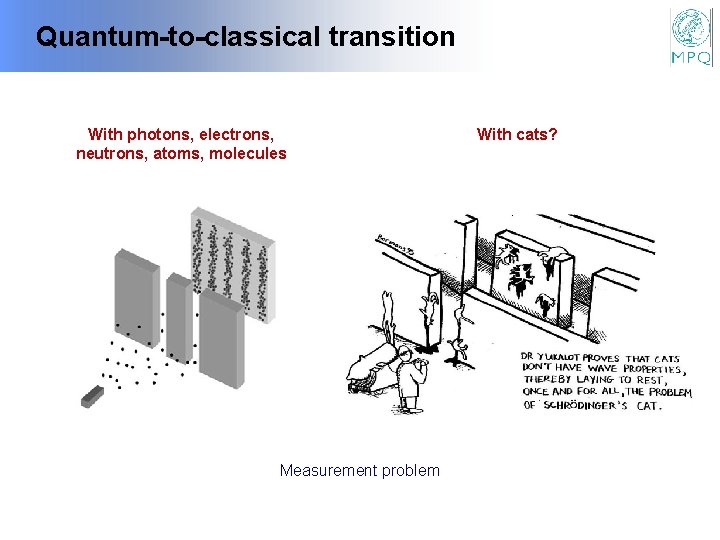
Quantum-to-classical transition With photons, electrons, neutrons, atoms, molecules Measurement problem With cats?
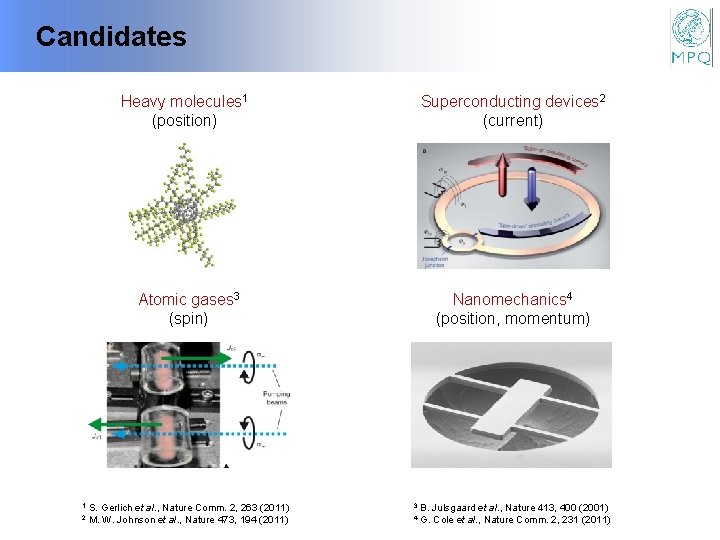
Candidates 1 2 Heavy molecules 1 (position) Superconducting devices 2 (current) Atomic gases 3 (spin) Nanomechanics 4 (position, momentum) S. Gerlich et al. , Nature Comm. 2, 263 (2011) M. W. Johnson et al. , Nature 473, 194 (2011) 3 4 B. Julsgaard et al. , Nature 413, 400 (2001) G. Cole et al. , Nature Comm. 2, 231 (2011)
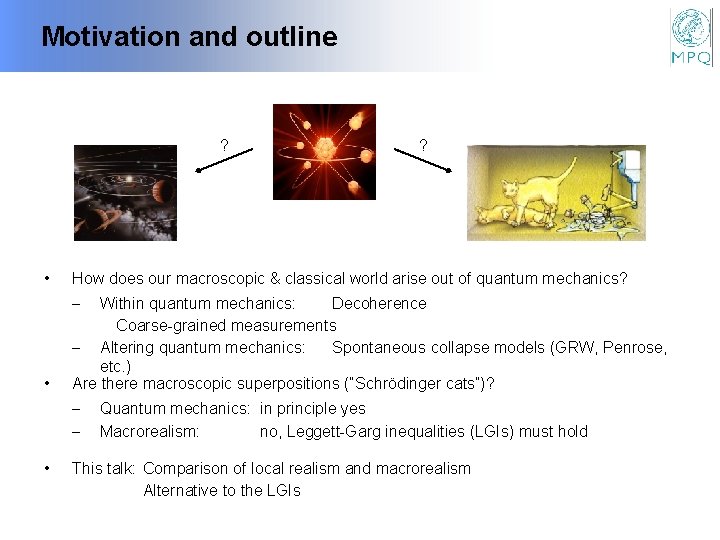
Motivation and outline ? • ? How does our macroscopic & classical world arise out of quantum mechanics? - • Within quantum mechanics: Decoherence Coarse-grained measurements - Altering quantum mechanics: Spontaneous collapse models (GRW, Penrose, etc. ) Are there macroscopic superpositions (“Schrödinger cats”)? • Quantum mechanics: in principle yes Macrorealism: no, Leggett-Garg inequalities (LGIs) must hold This talk: Comparison of local realism and macrorealism Alternative to the LGIs
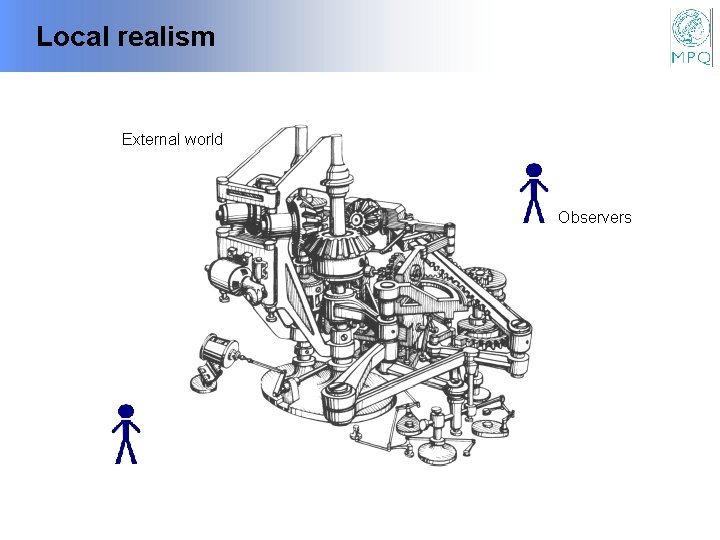
Local realism External world Observers
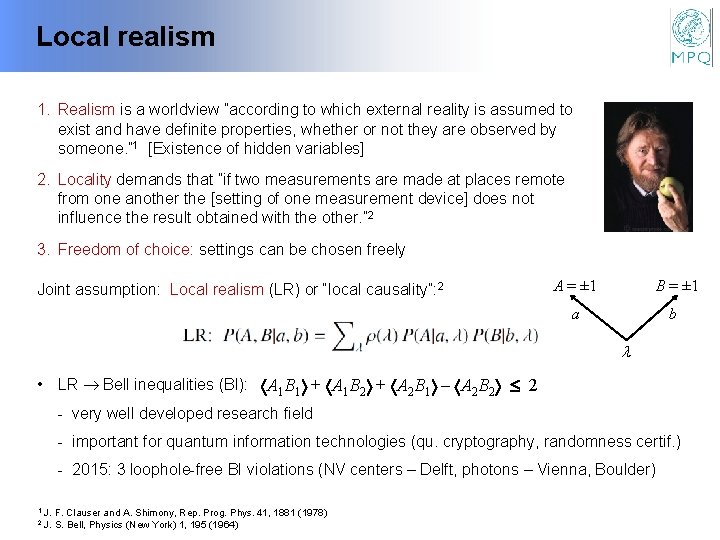
Local realism 1. Realism is a worldview ”according to which external reality is assumed to exist and have definite properties, whether or not they are observed by someone. ” 1 [Existence of hidden variables] 2. Locality demands that ”if two measurements are made at places remote from one another the [setting of one measurement device] does not influence the result obtained with the other. ” 2 3. Freedom of choice: settings can be chosen freely Joint assumption: Local realism (LR) or “local causality”: 2 A = ± 1 B = ± 1 a b • LR Bell inequalities (BI): A 1 B 1 + A 1 B 2 + A 2 B 1 – A 2 B 2 2 - very well developed research field - important for quantum information technologies (qu. cryptography, randomness certif. ) - 2015: 3 loophole-free BI violations (NV centers – Delft, photons – Vienna, Boulder) 1 2 J. F. Clauser and A. Shimony, Rep. Prog. Phys. 41, 1881 (1978) J. S. Bell, Physics (New York) 1, 195 (1964)
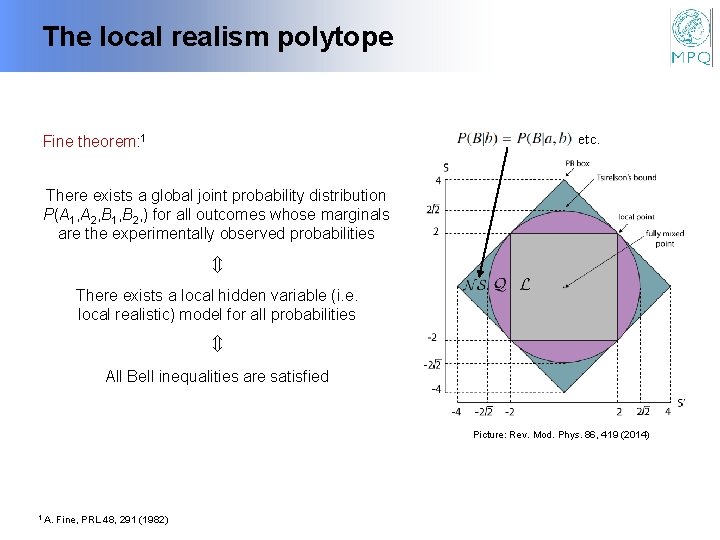
The local realism polytope etc. Fine theorem: 1 There exists a global joint probability distribution P(A 1, A 2, B 1, B 2, ) for all outcomes whose marginals are the experimentally observed probabilities There exists a local hidden variable (i. e. local realistic) model for all probabilities All Bell inequalities are satisfied Picture: Rev. Mod. Phys. 86, 419 (2014) 1 A. Fine, PRL 48, 291 (1982)
Macrorealism
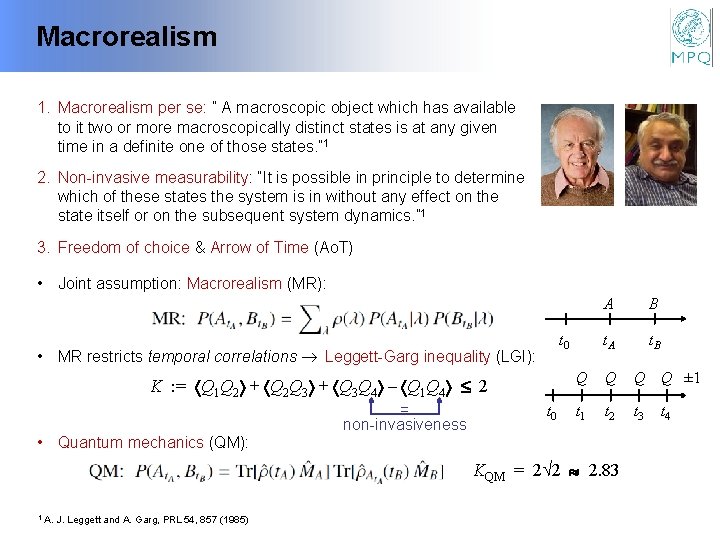
Macrorealism 1. Macrorealism per se: ” A macroscopic object which has available to it two or more macroscopically distinct states is at any given time in a definite one of those states. ” 1 2. Non-invasive measurability: “It is possible in principle to determine which of these states the system is in without any effect on the state itself or on the subsequent system dynamics. ” 1 3. Freedom of choice & Arrow of Time (Ao. T) • Joint assumption: Macrorealism (MR): t 0 • MR restricts temporal correlations Leggett-Garg inequality (LGI): K : = Q 1 Q 2 + Q 2 Q 3 + Q 3 Q 4 – Q 1 Q 4 2 • Quantum mechanics (QM): = non-invasiveness t 0 A B t. A t. B Q Q ± 1 t 2 t 3 KQM = 2 2 2. 83 1 A. J. Leggett and A. Garg, PRL 54, 857 (1985) t 4
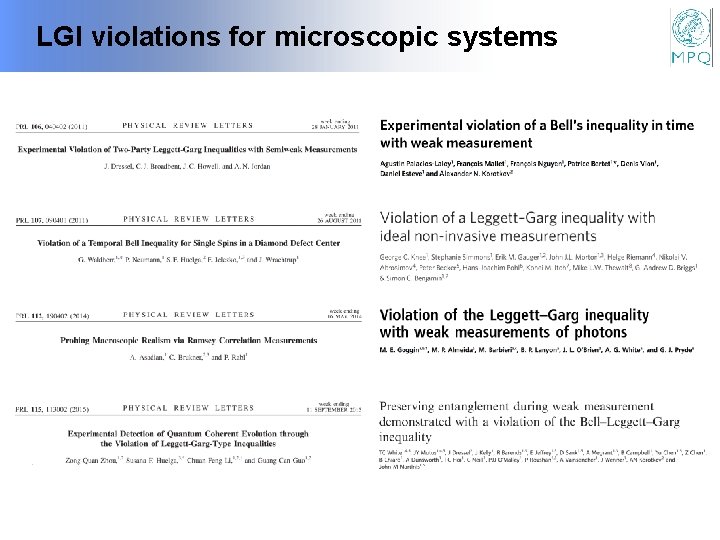
LGI violations for microscopic systems
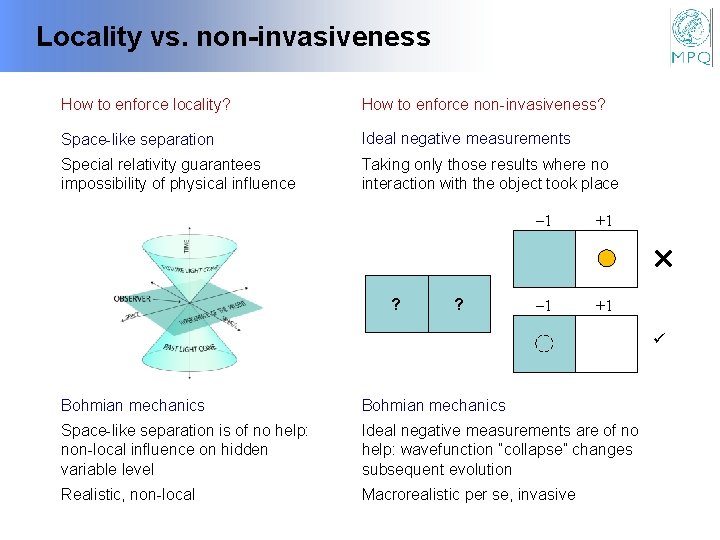
Locality vs. non-invasiveness How to enforce locality? How to enforce non-invasiveness? Space-like separation Ideal negative measurements Special relativity guarantees impossibility of physical influence Taking only those results where no interaction with the object took place ? ? – 1 +1 ü Bohmian mechanics Space-like separation is of no help: non-local influence on hidden variable level Ideal negative measurements are of no help: wavefunction “collapse” changes subsequent evolution Realistic, non-local Macrorealistic per se, invasive
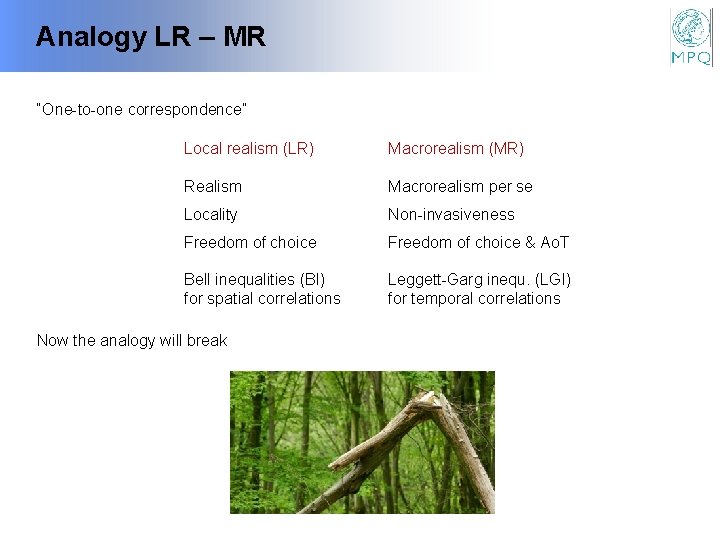
Analogy LR – MR “One-to-one correspondence” Local realism (LR) Macrorealism (MR) Realism Macrorealism per se Locality Non-invasiveness Freedom of choice & Ao. T Bell inequalities (BI) for spatial correlations Leggett-Garg inequ. (LGI) for temporal correlations Now the analogy will break
No signaling (in time) [LR] No-signaling (NS): “A measurement on one side does not change the outcome statistics on the other side. ” A B a b [MR] No-signaling in time (NSIT): “A measurement does not change the outcome statistics of a later measurement. ” 1 A t 0 t. A B t. B LR BI NS BI necessary for LR tests NS “useless” QM MR LGI NSIT QM 1 J. K. and Č. Brukner, PRA 87, 052115 (2013) LGI not essential for MR tests alternative: NSIT (interference) more physical, simpler, stronger, more robust to noise
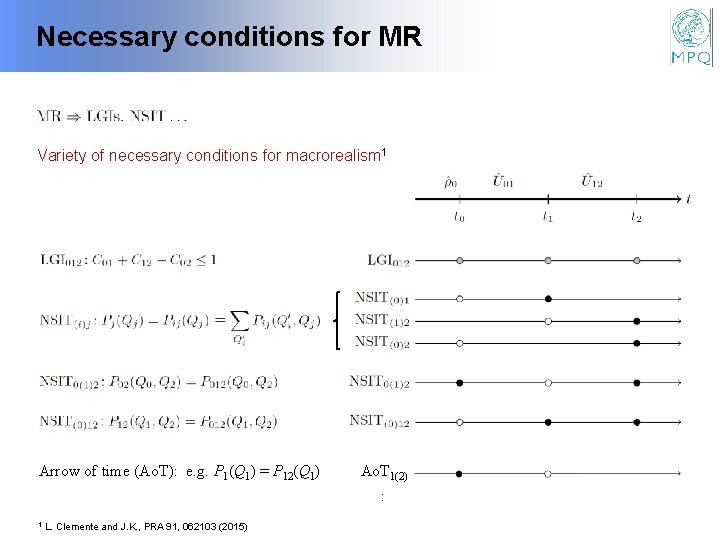
Necessary conditions for MR Variety of necessary conditions for macrorealism 1 Arrow of time (Ao. T): e. g. P 1(Q 1) = P 12(Q 1) Ao. T 1(2) : 1 L. Clemente and J. K. , PRA 91, 062103 (2015)
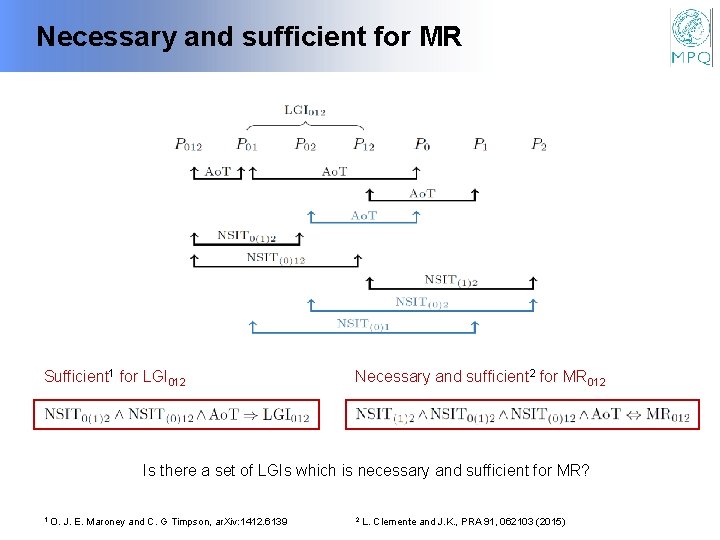
Necessary and sufficient for MR Sufficient 1 for LGI 012 Necessary and sufficient 2 for MR 012 Is there a set of LGIs which is necessary and sufficient for MR? 1 O. J. E. Maroney and C. G Timpson, ar. Xiv: 1412. 6139 2 L. Clemente and J. K. , PRA 91, 062103 (2015)
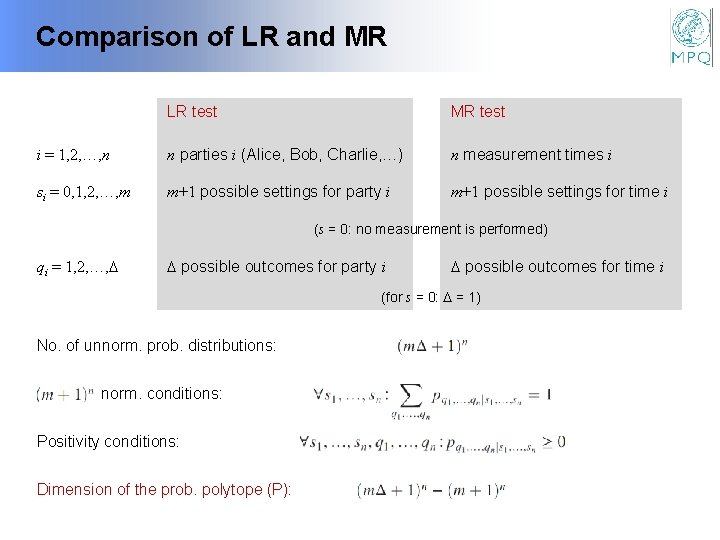
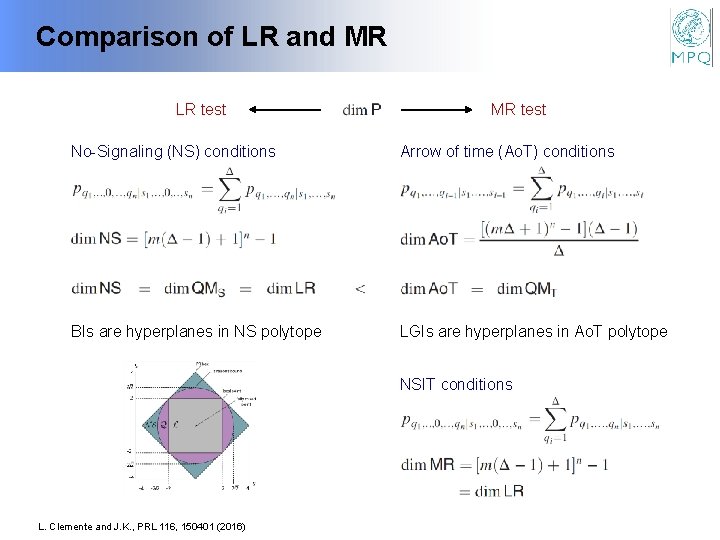
Comparison of LR and MR LR test MR test i = 1, 2, …, n n parties i (Alice, Bob, Charlie, …) n measurement times i si = 0, 1, 2, …, m m+1 possible settings for party i m+1 possible settings for time i (s = 0: no measurement is performed) qi = 1, 2, …, possible outcomes for party i possible outcomes for time i (for s = 0: = 1) No. of unnorm. prob. distributions: norm. conditions: Positivity conditions: Dimension of the prob. polytope (P):
Comparison of LR and MR LR test MR test No-Signaling (NS) conditions Arrow of time (Ao. T) conditions BIs are hyperplanes in NS polytope LGIs are hyperplanes in Ao. T polytope NSIT conditions L. Clemente and J. K. , PRL 116, 150401 (2016)
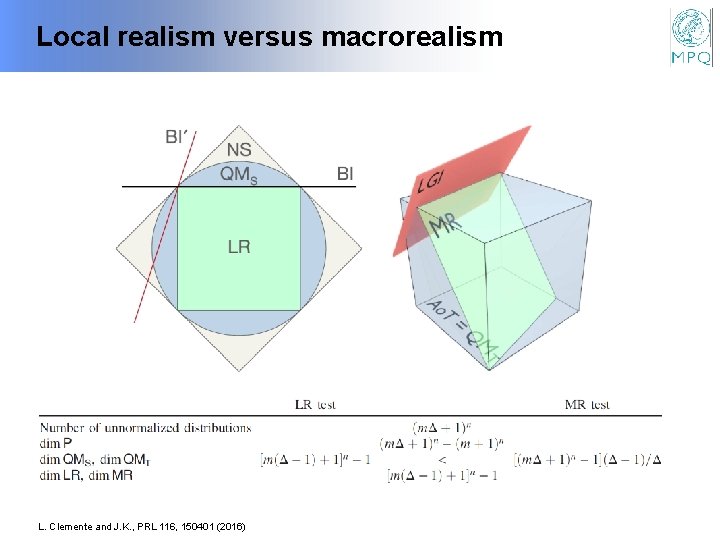
Local realism versus macrorealism L. Clemente and J. K. , PRL 116, 150401 (2016)
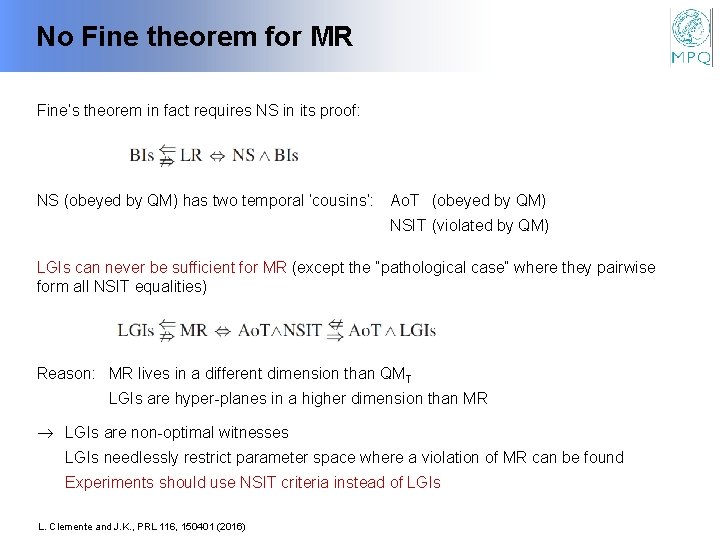
No Fine theorem for MR Fine’s theorem in fact requires NS in its proof: NS (obeyed by QM) has two temporal ‘cousins’: Ao. T (obeyed by QM) NSIT (violated by QM) LGIs can never be sufficient for MR (except the “pathological case” where they pairwise form all NSIT equalities) Reason: MR lives in a different dimension than QMT LGIs are hyper-planes in a higher dimension than MR LGIs are non-optimal witnesses LGIs needlessly restrict parameter space where a violation of MR can be found Experiments should use NSIT criteria instead of LGIs L. Clemente and J. K. , PRL 116, 150401 (2016)
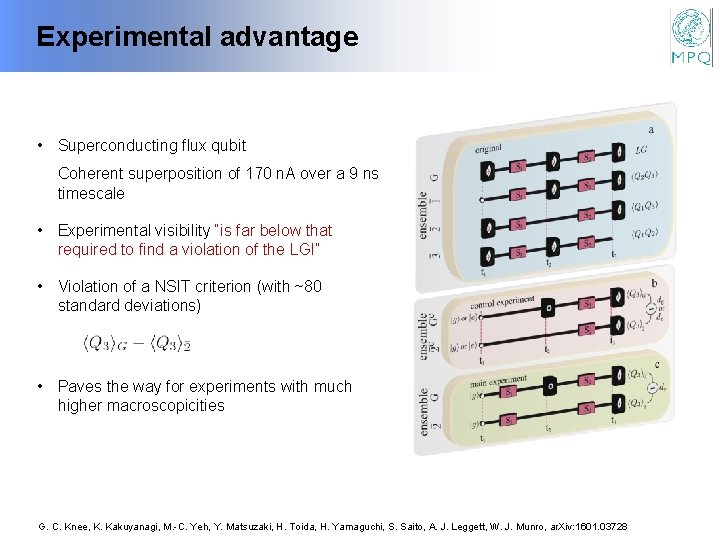
Experimental advantage • Superconducting flux qubit Coherent superposition of 170 n. A over a 9 ns timescale • Experimental visibility “is far below that required to find a violation of the LGI” • Violation of a NSIT criterion (with ~80 standard deviations) • Paves the way for experiments with much higher macroscopicities G. C. Knee, K. Kakuyanagi, M. -C. Yeh, Y. Matsuzaki, H. Toida, H. Yamaguchi, S. Saito, A. J. Leggett, W. J. Munro, ar. Xiv: 1601. 03728
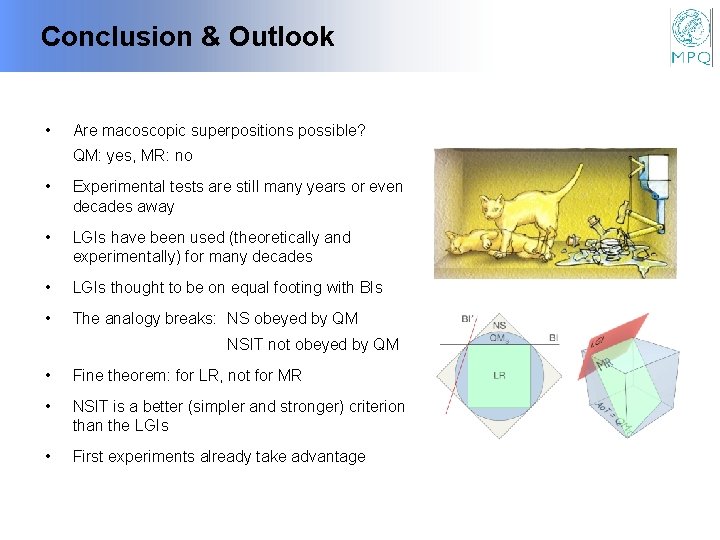
Conclusion & Outlook • Are macoscopic superpositions possible? QM: yes, MR: no • Experimental tests are still many years or even decades away • LGIs have been used (theoretically and experimentally) for many decades • LGIs thought to be on equal footing with BIs • The analogy breaks: NS obeyed by QM NSIT not obeyed by QM • Fine theorem: for LR, not for MR • NSIT is a better (simpler and stronger) criterion than the LGIs • First experiments already take advantage