
No DB Efficient Query Execution on Raw Data
No. DB: Efficient Query Execution on Raw Data Files loannis Alagiannis, Renata Borovica-Gajic, Miguel Branco, Stratos Idreos, and Anastasia Ailamaki Marios Michael Christos Hadjistyllis Computer Science Department University of Cyprus
Introduction ● ● ● DBMS: Complexity (Significant initialization cost in loading data and preparing database system for queries) Goal of No. DB: ○ Make a database system which is more accessible to the user by eliminating major bottleneck of data-to-query time Main Idea: ○ Eliminating data loading by: ■ Querying over raw data in original place as the way to manage data in a database ■ Redesign query processing layer to incrementally and adaptively query raw data in situ state (original place) while automatically creating and refining auxiliary structures to speed-up future queries 2
Introduction - Traditional DBMS ● Organizes data as a row store system, in the form of tuples, which are stored sequentially one tuple after the other in the form of slotted pages + additional metadata information to help inpage navigation ● Creation of DB objects during loading process ● During query processing the system brings pages into memory and process the tuples ● Optimizer: ○ Creation of proper query plans, which exploit previously collected statistics about the data 3
Query over raw data files ● Two straightforward ways: ● Run the loading procedure whenever a query arrives ○ When a query referring to table R arrives, only then load table R, and immediately evaluate the query over the loaded data ○ The above approaches penalize the first query since creating the complete table before evaluating the query implies that the same data needs to be accessed twice ■ Once for loading ■ Once for query evaluation 4
Query over raw data files ● Tightly integrate the raw file accesses with the query execution ○ It can be accomplished by enriching the leaf operators of the query plans with the ability to access raw data files ○ The scan operator tokenizes and parses a raw file on-the-fly, which allows it to create and pass tuples to the remaining query plan ○ Data parsing and processing occur in a pipeline ● Limitations ○ Not viable for extensive and repeated query processing ○ E. g: If data is not kept in persistent tables, then every future query needs to perform loading from scratch ○ Materializing loaded data into persistent tables, forces a single query to adapt all loading costs 5
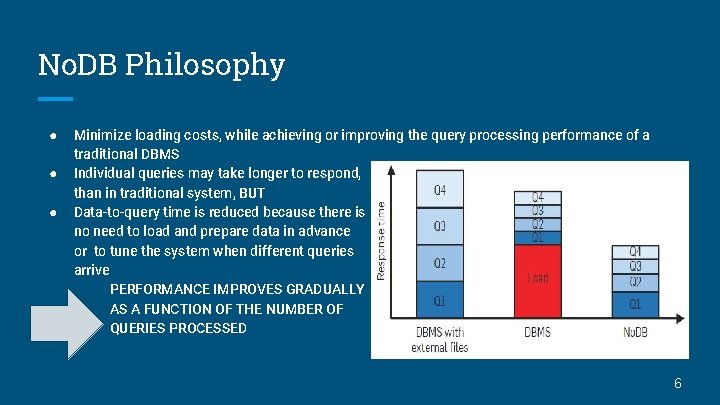
No. DB Philosophy ● ● ● Minimize loading costs, while achieving or improving the query processing performance of a traditional DBMS Individual queries may take longer to respond, than in traditional system, BUT Data-to-query time is reduced because there is no need to load and prepare data in advance or to tune the system when different queries arrive PERFORMANCE IMPROVES GRADUALLY AS A FUNCTION OF THE NUMBER OF QUERIES PROCESSED 6
Challenges ● Main Bottleneck of in situ query processing is the access of the raw data ○ Degrades significantly the query performance ● No. DB: Integrating raw data access in an abstract way into the query processing layer ○ Main challenge: Minimize the cost of accessing raw data. Two ways: ■ Design data structures which can help up speed-up the access ■ Selectively eliminating the need of raw data access by caching and scheduling raw data accesses 7
Postgresraw: Building No. DB in Postgresql ● Assuming the raw data is stored in comma separated values (CSV files) ○ High conversion cost to binary format (challenge for situ states) ● On the fly parsing: ○ When a query submitted to postgresraw reference relational tables that are not yet loaded, postgresraw needs to access the respective raw files ○ It overrides the scan operator with the ability to access raw data files directly ○ Parsing and Tokenizing every time a query need to access raw data ● CSV File: ○ File = Relational Table ○ Row = A Tuple of a Table ○ Entry = Attributed value of a Tuple 8
Postgresraw: Building No. DB in Postgresql ● ● ● During parsing: ○ Identify each tuple or row in the raw file ○ Once they are identified, search for a delimiter separating values and transform those characters into proper binary values Selective Tokenizing: ○ Reduce the tokenizing cost by opportunistically abort tokenizing tuples as soon as the required attributes for a query have been found ○ CSV is row-row so we can reduce CPU processing costs Selective Parsing: ○ Reduce raw access cost ○ Transform to binary format only the values that are required to answer the query 9
Postgresraw: Building No. DB in Postgresql ● Selective Tuple Formation: ○ Tuples contain only the attributes required for a given query ○ They are created only after select operator ● RESULT: ○ SIGNIFICANTLY MINIMIZE ON THE FLY PROCESSING COST 10
Postgresraw: Building No. DB in Postgresql ● Indexing ○ Adaptive Positional Map ■ Reduces parsing and tokenizing costs ■ Maintains low level metadata information on the structure of the flat file ■ Metadata refers to position of attributes in a raw file ■ Use metadata to navigate and retrieve raw data faster ■ Info of positional map can be used to jump to the exact position of the file or as close as possible ● E. g: if a query is looking for the 9 th attribute of a file, while the map contains info for the 4 th and 8 th attribute it will parse it until it will find it 11
Postgresraw: Building No. DB in Postgresql ● Map Population ○ Created on the fly, during query processing ○ Depending on where the requested attributes are located on the current map ○ Continuously adapting to queries ○ Is populated during the tokenizing phase, while tokenizing the raw file for the current query ○ Information also added to the map, so that Postgresraw can learn as much information as possible during each query 12
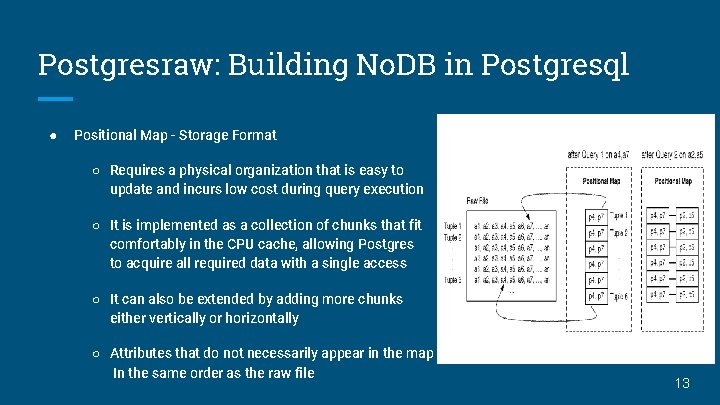
Postgresraw: Building No. DB in Postgresql ● Positional Map - Storage Format ○ Requires a physical organization that is easy to update and incurs low cost during query execution ○ It is implemented as a collection of chunks that fit comfortably in the CPU cache, allowing Postgres to acquire all required data with a single access ○ It can also be extended by adding more chunks either vertically or horizontally ○ Attributes that do not necessarily appear in the map In the same order as the raw file 13
Postgresraw: Building No. DB in Postgresql ● Positional Map - Maintenance ○ Auxiliary structure and may be dropped fully or partly without any loss of critical information ○ Every next query starts rebuilding the map from scratch ○ Postgres assign a storage threshold for the size of positional map such that the map fits comfortably in memory ● Positional Map - Adaptive Behavior ○ Continuously indexes positions based on the most recent queries ○ Least recently used policy - Dropping attributes which may no longer be relevant ○ Combinations of attributes used in the same query, which are stored together may be dropped to give space to new combinations 14
Postgresraw: Building No. DB in Postgresql ● Cache ○ Caching ■ Avoid raw file access together ■ If the attribute is requested by future queries, then it will be read directly from cache ○ Holds binary data - no need for additional parsing ○ Populated on-the-fly during query processing ○ Follows format of positional map to allowing queries to seamlessly exploit both the cache and the positional map in the same query plan 15
Postgresraw: Building No. DB in Postgresql ● Optimizer ○ Extension of Postgres scan operator in order to create statistics on-the-fly ○ Invoke native statistics routines of DBMS, providing it with a sample of the data ○ Statistics stored and exploited in the same way as in conventional DBMS ○ Postgresraw creates statistics only on requested attributes in order to minimize the overhead of creating statistics query processing 16
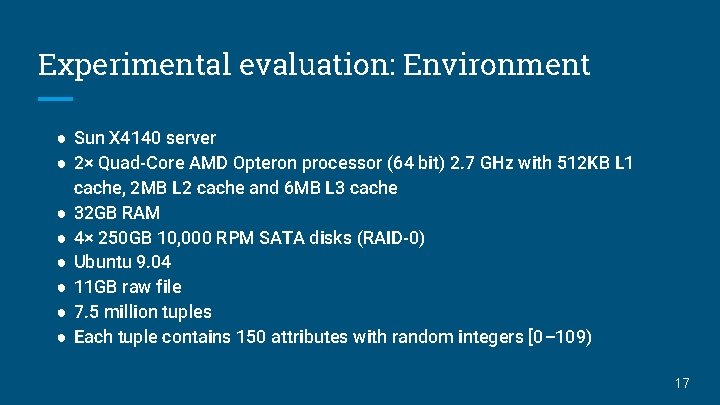
Experimental evaluation: Environment ● Sun X 4140 server ● 2× Quad-Core AMD Opteron processor (64 bit) 2. 7 GHz with 512 KB L 1 cache, 2 MB L 2 cache and 6 MB L 3 cache ● 32 GB RAM ● 4× 250 GB 10, 000 RPM SATA disks (RAID-0) ● Ubuntu 9. 04 ● 11 GB raw file ● 7. 5 million tuples ● Each tuple contains 150 attributes with random integers [0– 109) 17
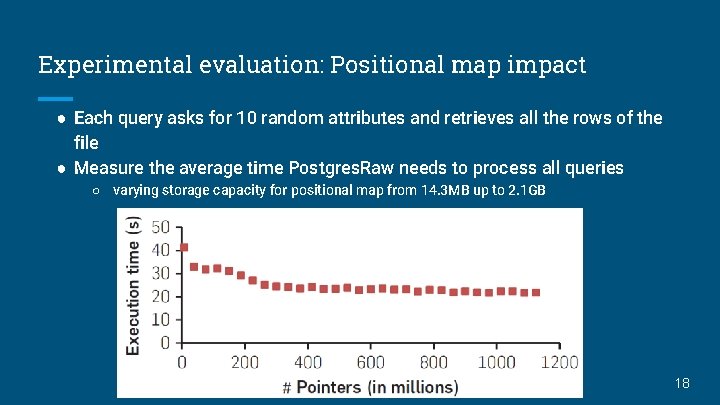
Experimental evaluation: Positional map impact ● Each query asks for 10 random attributes and retrieves all the rows of the file ● Measure the average time Postgres. Raw needs to process all queries ○ varying storage capacity for positional map from 14. 3 MB up to 2. 1 GB 18
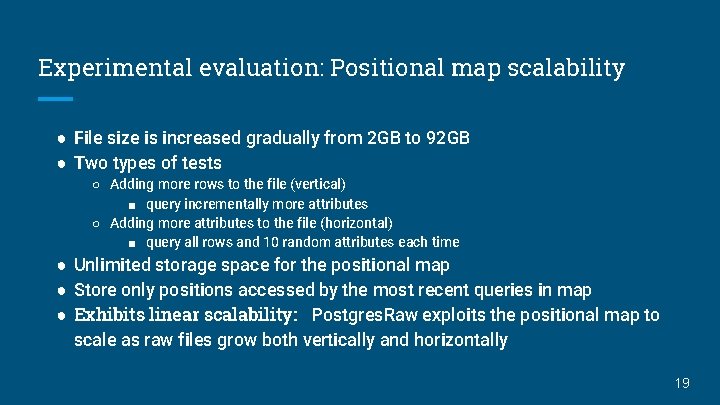
Experimental evaluation: Positional map scalability ● File size is increased gradually from 2 GB to 92 GB ● Two types of tests ○ Adding more rows to the file (vertical) ■ query incrementally more attributes ○ Adding more attributes to the file (horizontal) ■ query all rows and 10 random attributes each time ● Unlimited storage space for the positional map ● Store only positions accessed by the most recent queries in map ● Exhibits linear scalability: Postgres. Raw exploits the positional map to scale as raw files grow both vertically and horizontally 19
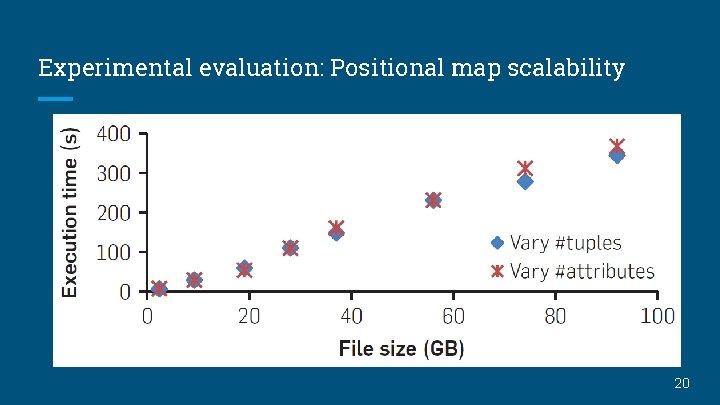
Experimental evaluation: Positional map scalability 20
Experimental evaluation: Positional map + Caching ● 50 queries, each query randomly accesses five columns and all rows ● Four variations of test ○ Baseline - no positional maps or caching used ○ PM - only positional map is used ○ C - only caching used ○ PM+C - Both PS and caching used 21
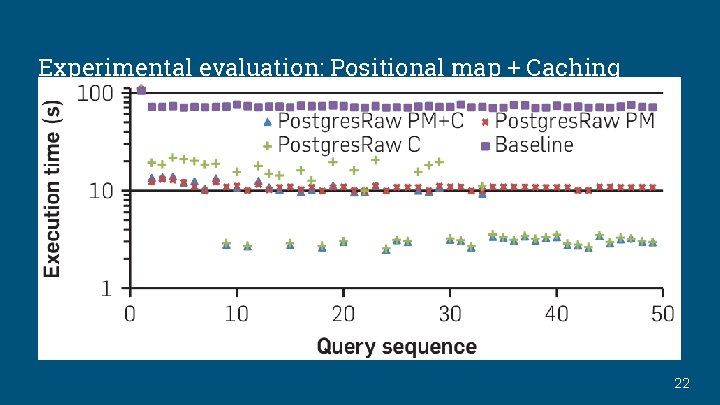
Experimental evaluation: Positional map + Caching 22
Experimental evaluation: Adapting to workload changes ● Demonstrate that Postgres. Raw progressively and transparently adapts to changes in the workload ● 250 queries - 50 different queries x 5 epochs (time instances) ● Each epoch focuses on a given part of the raw file ● 5 random attributes in each query ● Cache is limited to 2. 8 GB, positional map to 715 MB 23
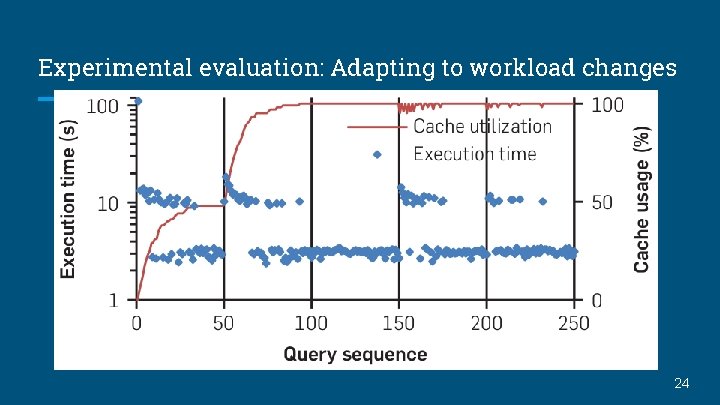
Experimental evaluation: Adapting to workload changes 24
Experimental evaluation: Postgres. Raw vs DBMS ● My. SQL (5. 5. 13), DBMS X (a commercial system) and Postgre. SQL ● Postgres. Raw with positional maps and caching enabled ● My. SQL and DBMS X offer “external files” functionality ○ Test with pre-loaded data in DBMS’s (without “external files” functionality) ○ Test with “external files” functionality ● Q 1: all attributes and all rows ● Q 2, Q 3, Q 4, Q 5: access 20%, 40%, 60%, 80% less rows respectively ● Q 6, Q 7, Q 8, Q 9: access 20%, 40%, 60%, 80% less columns (attributes) respectively 25
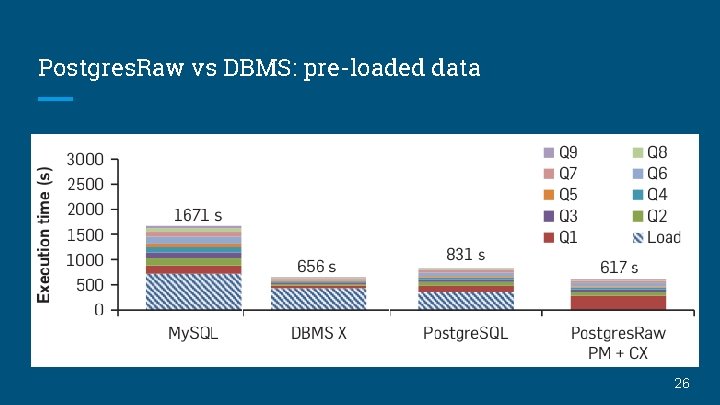
Postgres. Raw vs DBMS: pre-loaded data 26
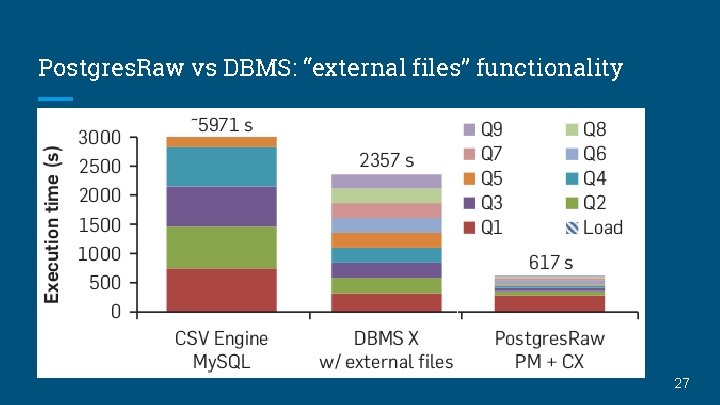
Postgres. Raw vs DBMS: “external files” functionality 27
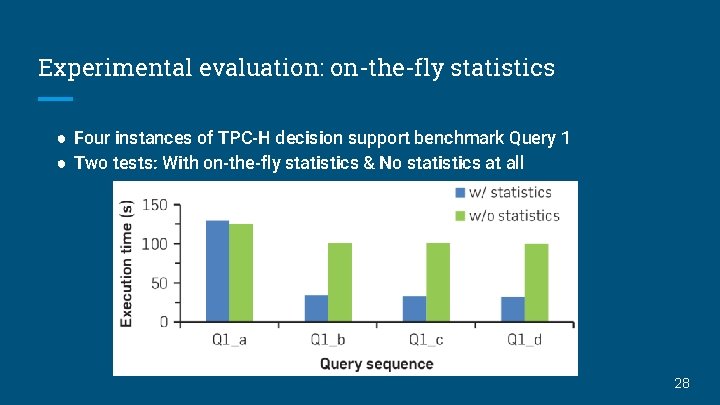
Experimental evaluation: on-the-fly statistics ● Four instances of TPC-H decision support benchmark Query 1 ● Two tests: With on-the-fly statistics & No statistics at all 28
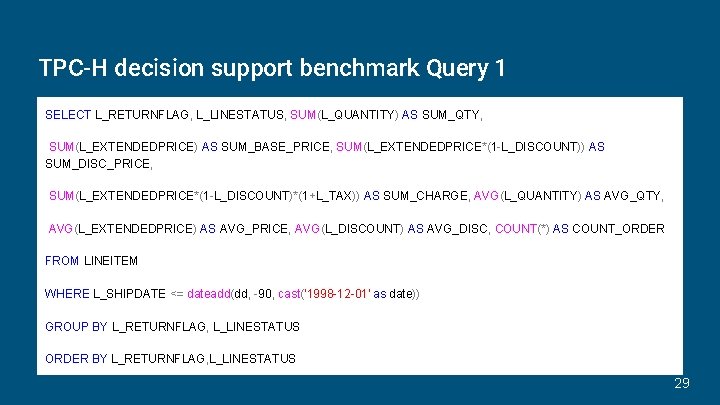
TPC-H decision support benchmark Query 1 SELECT L_RETURNFLAG, L_LINESTATUS, SUM(L_QUANTITY) AS SUM_QTY, SUM(L_EXTENDEDPRICE) AS SUM_BASE_PRICE, SUM(L_EXTENDEDPRICE*(1 -L_DISCOUNT)) AS SUM_DISC_PRICE, SUM(L_EXTENDEDPRICE*(1 -L_DISCOUNT)*(1+L_TAX)) AS SUM_CHARGE, AVG(L_QUANTITY) AS AVG_QTY, AVG(L_EXTENDEDPRICE) AS AVG_PRICE, AVG(L_DISCOUNT) AS AVG_DISC, COUNT(*) AS COUNT_ORDER FROM LINEITEM WHERE L_SHIPDATE <= dateadd(dd, -90, cast('1998 -12 -01' as date)) GROUP BY L_RETURNFLAG, L_LINESTATUS ORDER BY L_RETURNFLAG, L_LINESTATUS 29
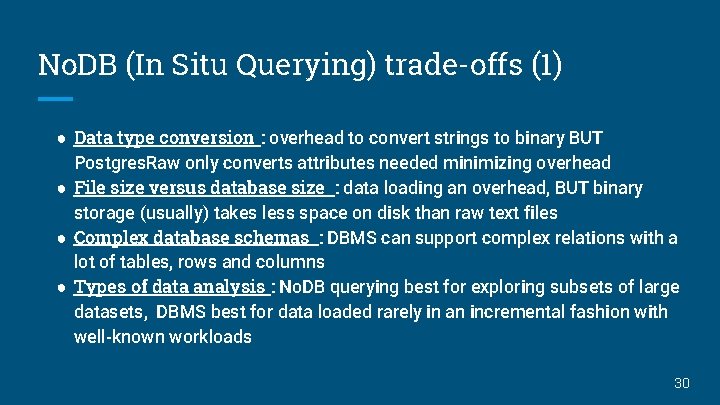
No. DB (In Situ Querying) trade-offs (1) ● Data type conversion : overhead to convert strings to binary BUT Postgres. Raw only converts attributes needed minimizing overhead ● File size versus database size : data loading an overhead, BUT binary storage (usually) takes less space on disk than raw text files ● Complex database schemas : DBMS can support complex relations with a lot of tables, rows and columns ● Types of data analysis : No. DB querying best for exploring subsets of large datasets, DBMS best for data loaded rarely in an incremental fashion with well-known workloads 30
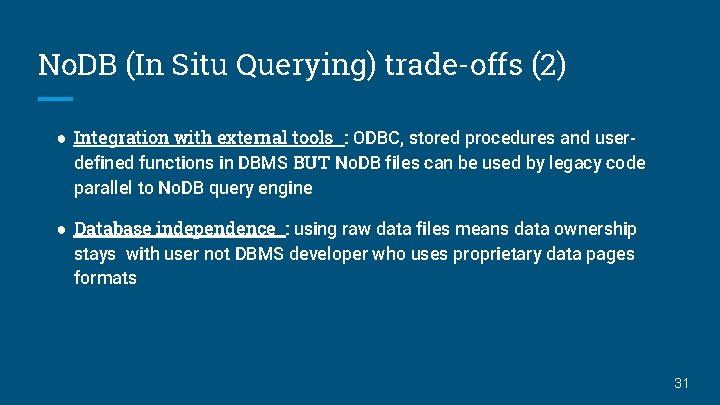
No. DB (In Situ Querying) trade-offs (2) ● Integration with external tools : ODBC, stored procedures and userdefined functions in DBMS BUT No. DB files can be used by legacy code parallel to No. DB query engine ● Database independence : using raw data files means data ownership stays with user not DBMS developer who uses proprietary data pages formats 31
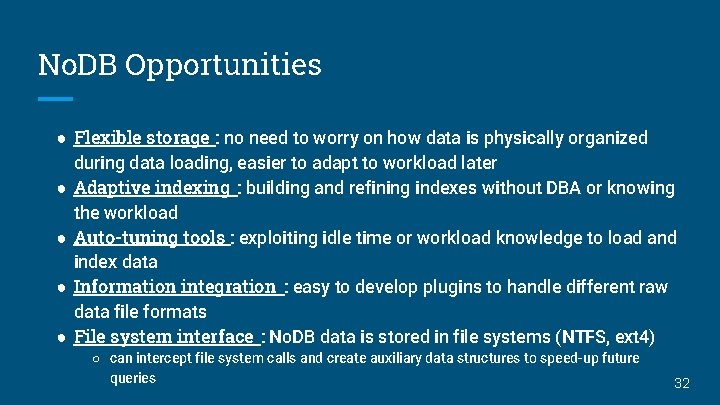
No. DB Opportunities ● Flexible storage : no need to worry on how data is physically organized during data loading, easier to adapt to workload later ● Adaptive indexing : building and refining indexes without DBA or knowing the workload ● Auto-tuning tools : exploiting idle time or workload knowledge to load and index data ● Information integration : easy to develop plugins to handle different raw data file formats ● File system interface : No. DB data is stored in file systems (NTFS, ext 4) ○ can intercept file system calls and create auxiliary data structures to speed-up future queries 32
Conclusions ● For state-of-the-art database systems, the incoming data flood is a problem ● Drastic changes to existing query processing technology eliminates data loading overhead/bottleneck ● No. DB prototype system, Postgres. Raw, demonstrates competitive performance with DBMS ○ Does not require any previous assumptions about data to load or how to load it before querying ○ Allows users to explore new data quickly ● Challenges exist but more research is underway 33

Thank you for your attention! 34
- Slides: 34