
NMR Spectroscopy Presented by Asst Prof Magar V
NMR Spectroscopy Presented by Asst. Prof. Magar V. R. New Arts, commerce & science Collage , Parner.
Objectives…. . • Student must gain principle of NMR • Understood instrumentation • How quantum mechanics he in understanding NMR
INTRODUCTION: The Nobel Prize has been awarded twice for work related to. NMR. F. Bloch and E. M. Purcell received the Nobel Prize in Physics, in 1952, for the first experimental verifications of the phenomenon, and Prof. R. R. Ernst received the Nobel Prize in Chemistry, in 1991, for the development of the NMR techniques.
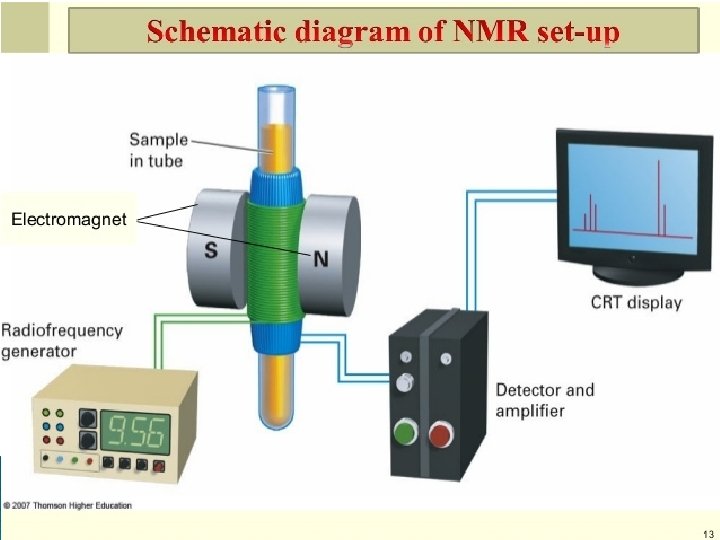
Principle Nuclear magnetic resonance, or NMR as it is abbreviated by scientists, is a phenomenon which occurs when the nuclei of certain atoms are immersed in a static strong magnetic field and exposed to a second oscillating magnetic field in the form of radiofrequency pulses, it is possible to transfer energy into the spin system and change the state of the system. After the pulse, the system relaxes back to its state of equilibrium, sending a weak signal that can be recorded.
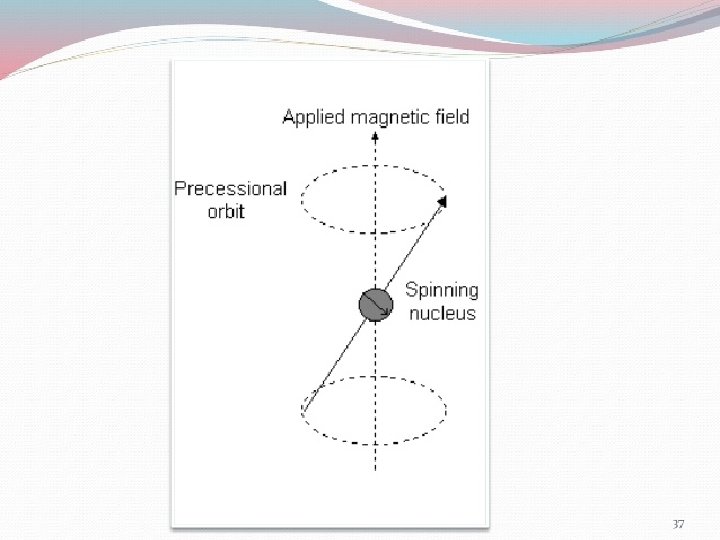
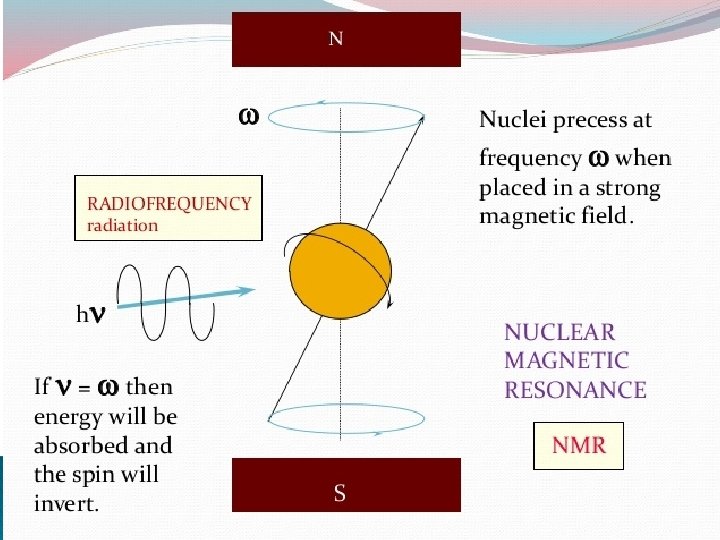
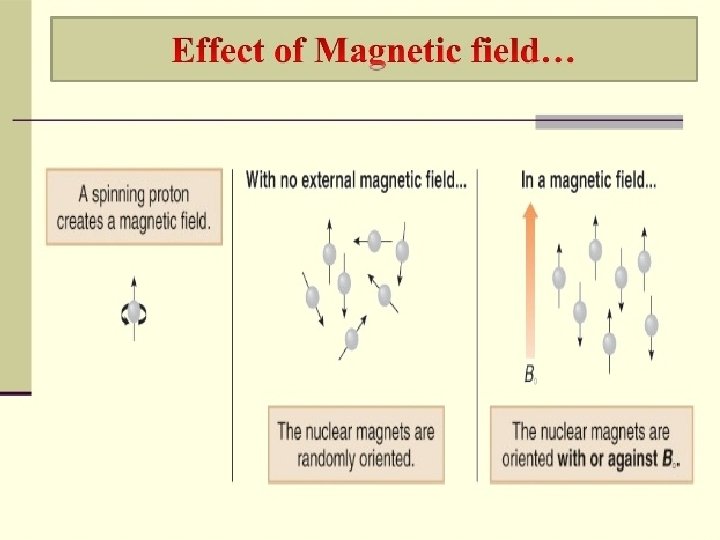
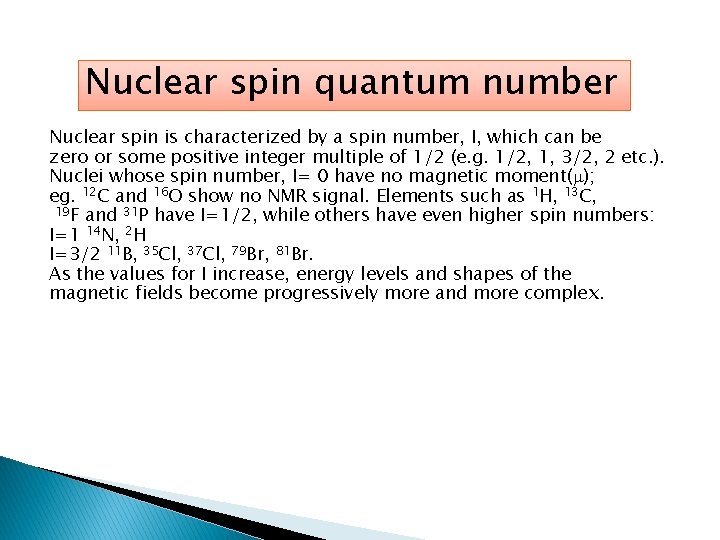
Nuclear spin quantum number Nuclear spin is characterized by a spin number, I, which can be zero or some positive integer multiple of 1/2 (e. g. 1/2, 1, 3/2, 2 etc. ). Nuclei whose spin number, I= 0 have no magnetic moment(m); eg. 12 C and 16 O show no NMR signal. Elements such as 1 H, 13 C, 19 F and 31 P have I=1/2, while others have even higher spin numbers: I=1 14 N, 2 H I=3/2 11 B, 35 Cl, 37 Cl, 79 Br, 81 Br. As the values for I increase, energy levels and shapes of the magnetic fields become progressively more and more complex.
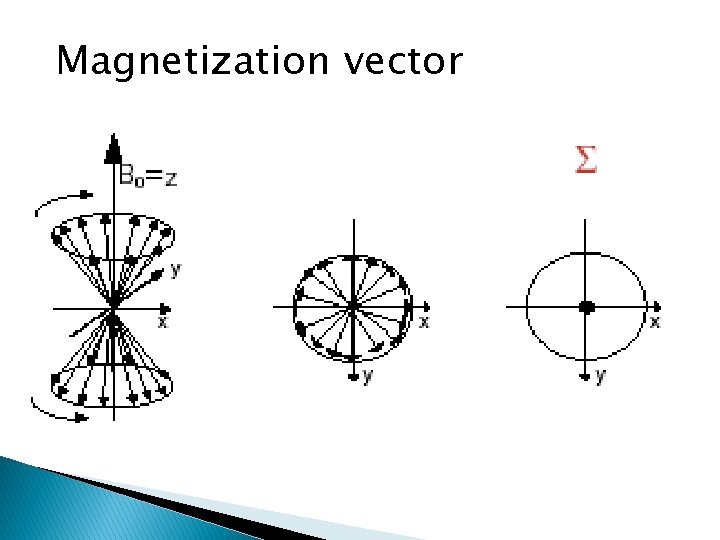
Magnetization vector
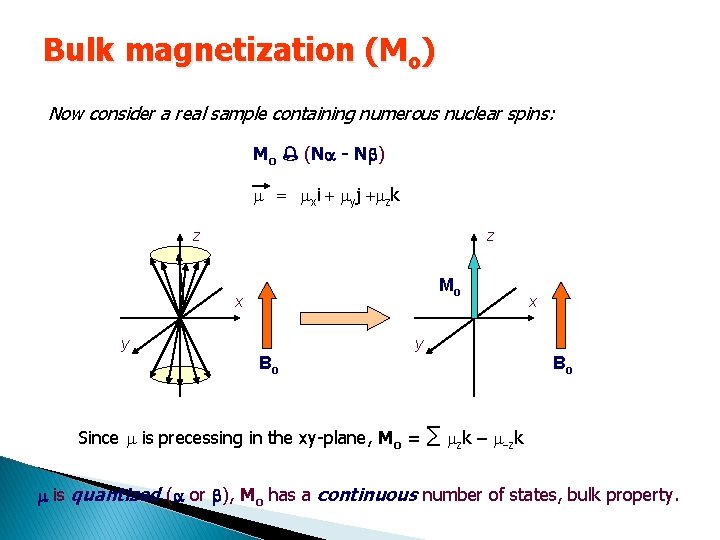
Bulk magnetization (Mo) Now consider a real sample containing numerous nuclear spins: Mo % (Na - Nb) m = mxi + myj +mzk z z Mo x y Bo Since m is precessing in the xy-plane, Mo = Bo ∑ mzk – m-zk m is quantized (a or b), Mo has a continuous number of states, bulk property.
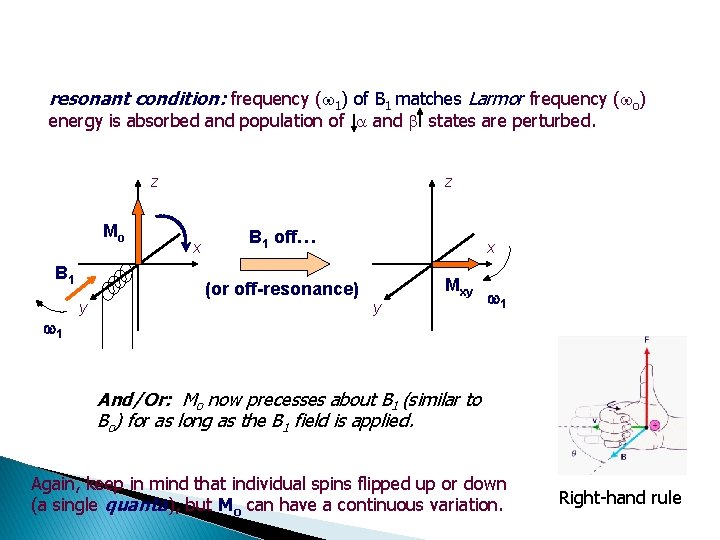
resonant condition: frequency (w 1) of B 1 matches Larmor frequency (wo) energy is absorbed and population of a and b states are perturbed. z Mo B 1 w 1 y z x B 1 off… (or off-resonance) x Mxy y w 1 And/Or: Mo now precesses about B 1 (similar to Bo) for as long as the B 1 field is applied. Again, keep in mind that individual spins flipped up or down (a single quanta), but Mo can have a continuous variation. Right-hand rule
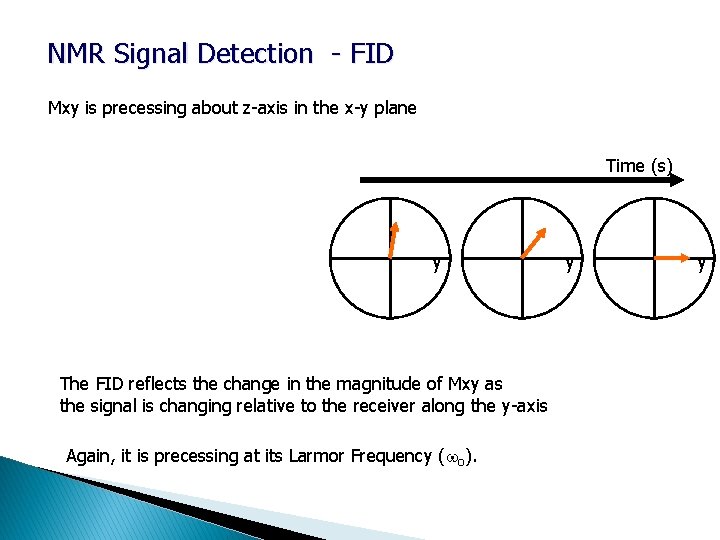
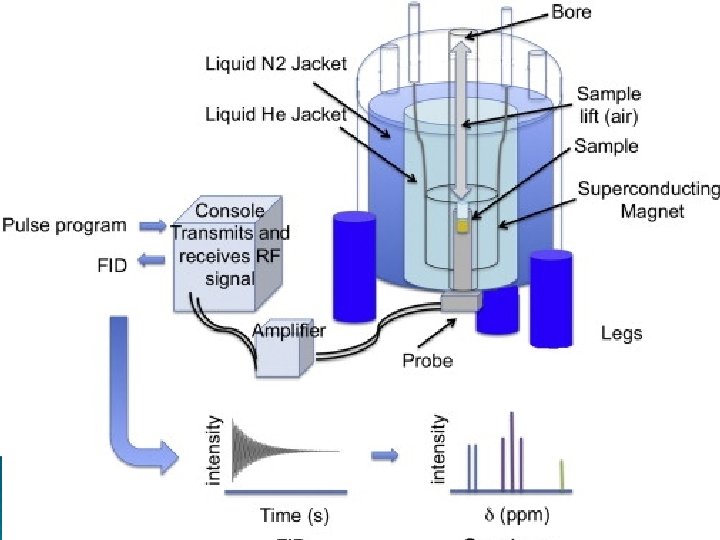
NMR Signal Detection - FID Mxy is precessing about z-axis in the x-y plane Time (s) y The FID reflects the change in the magnitude of Mxy as the signal is changing relative to the receiver along the y-axis Again, it is precessing at its Larmor Frequency (wo). y y
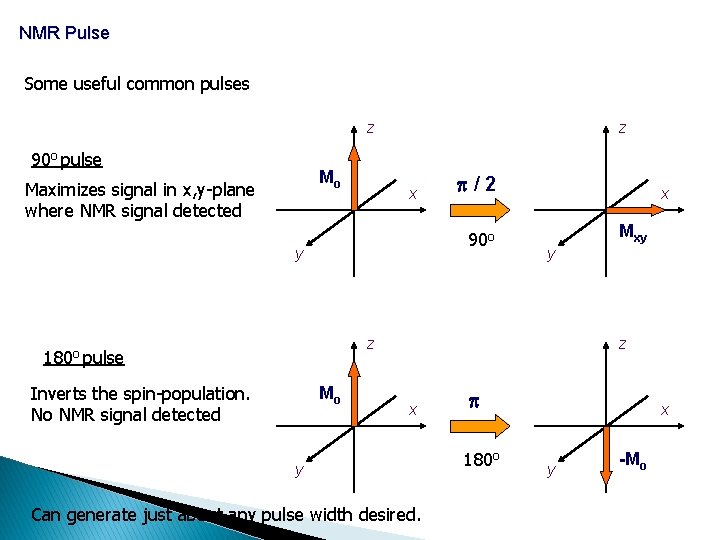
NMR Pulse Some useful common pulses z 90 o pulse Mo Maximizes signal in x, y-plane where NMR signal detected z x p/2 90 o y x Mxy y z 180 o pulse Inverts the spin-population. No NMR signal detected Mo z x y Can generate just about any pulse width desired. p 180 o x y -Mo
Application: § Determining structure of unknown compound § Medical field –MRI(magnetic resonance imagine)
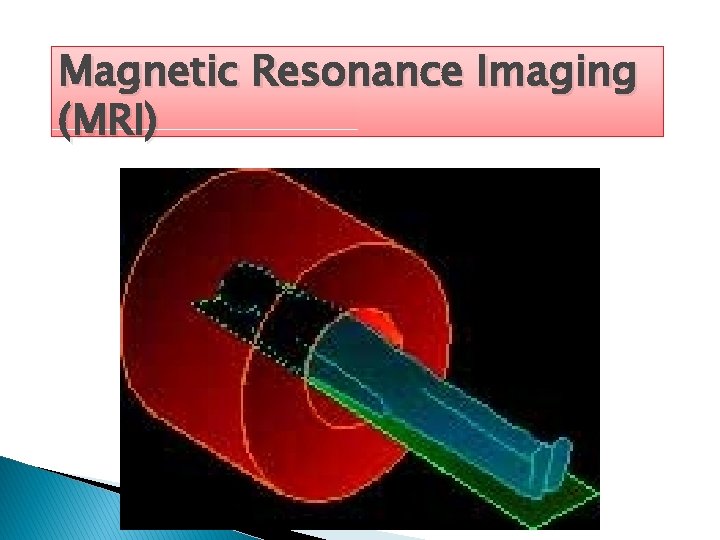
Magnetic Resonance Imaging (MRI)
Functional MRI patient is placed in a tube with magnetic fields The way the 1 H in body responds to those fields is noted and sent to a computer along with information about where the interactions occurred. Myriads of these points are sampled and fed into a computer that processes the information and creates an image. Thoughts Image Mapping by Functional Nuclear magnetic resonance FMRI

- Slides: 19