
NMR Spectroscop y 17 0 2 l Fal

- Slides: 94
NMR Spectroscop y 17 0 2 l Fal CHEM 430
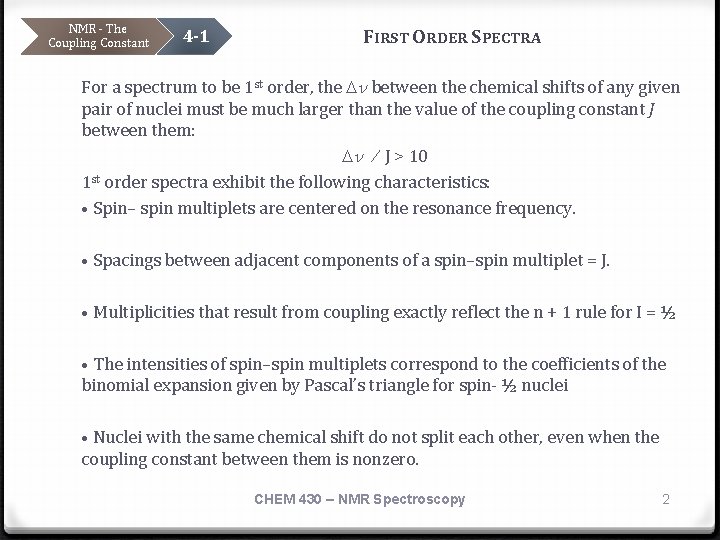
NMR - The Coupling Constant 4 -1 FIRST ORDER SPECTRA For a spectrum to be 1 st order, the Dn between the chemical shifts of any given pair of nuclei must be much larger than the value of the coupling constant J between them: Dn / J > 10 1 st order spectra exhibit the following characteristics: • Spin– spin multiplets are centered on the resonance frequency. • Spacings between adjacent components of a spin–spin multiplet = J. • Multiplicities that result from coupling exactly reflect the n + 1 rule for I = ½ • The intensities of spin–spin multiplets correspond to the coefficients of the binomial expansion given by Pascal’s triangle for spin- ½ nuclei • Nuclei with the same chemical shift do not split each other, even when the coupling constant between them is nonzero. CHEM 430 – NMR Spectroscopy 2
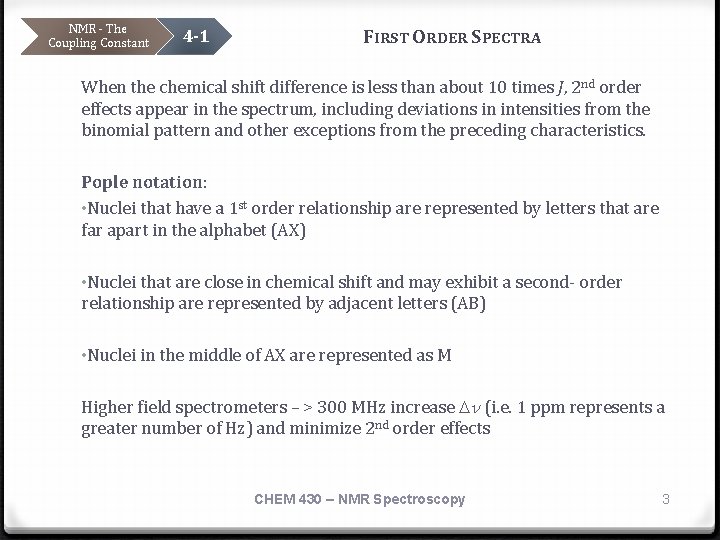
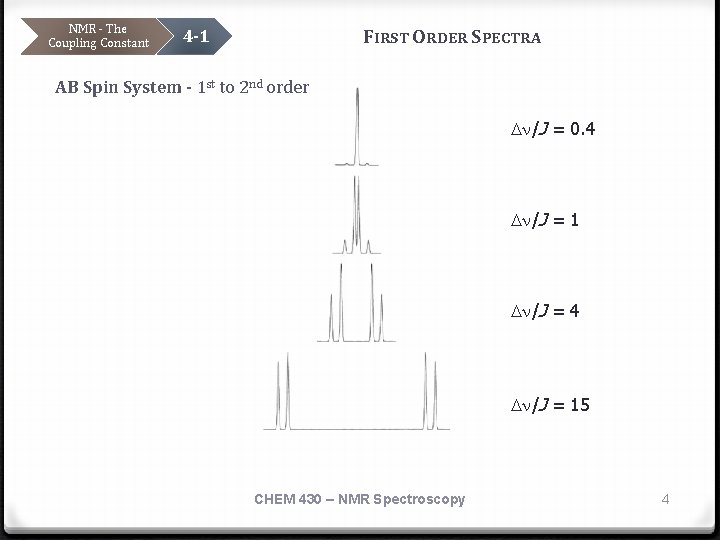
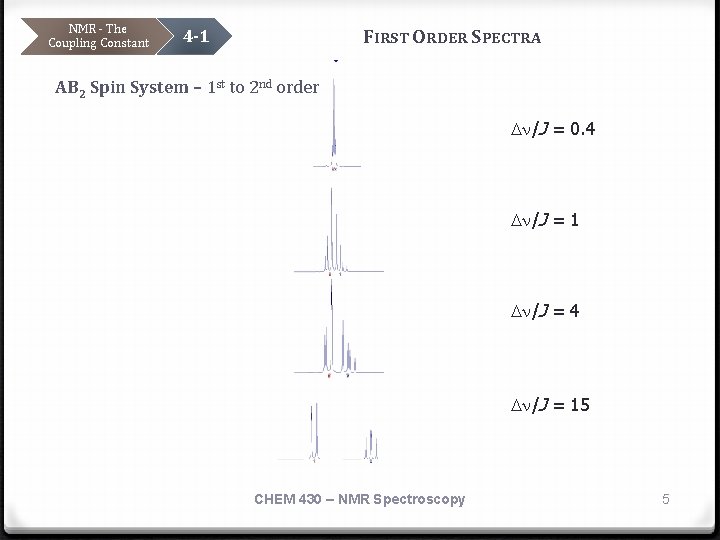
NMR - The Coupling Constant 4 -1 FIRST ORDER SPECTRA When the chemical shift difference is less than about 10 times J, 2 nd order effects appear in the spectrum, including deviations in intensities from the binomial pattern and other exceptions from the preceding characteristics. Pople notation: • Nuclei that have a 1 st order relationship are represented by letters that are far apart in the alphabet (AX) • Nuclei that are close in chemical shift and may exhibit a second- order relationship are represented by adjacent letters (AB) • Nuclei in the middle of AX are represented as M Higher field spectrometers – > 300 MHz increase Dn (i. e. 1 ppm represents a greater number of Hz) and minimize 2 nd order effects CHEM 430 – NMR Spectroscopy 3
NMR - The Coupling Constant FIRST ORDER SPECTRA 4 -1 AB Spin System - 1 st to 2 nd order Dn/J = 0. 4 Dn/J = 1 Dn/J = 4 Dn/J = 15 CHEM 430 – NMR Spectroscopy 4
NMR - The Coupling Constant FIRST ORDER SPECTRA 4 -1 AB 2 Spin System – 1 st to 2 nd order Dn/J = 0. 4 Dn/J = 1 Dn/J = 4 Dn/J = 15 CHEM 430 – NMR Spectroscopy 5
NMR - The Coupling Constant 4 -2 CHEMICAL AND MAGNETIC EQUIVALENCE • In addition to meeting the requirement that Dn / J > 10 , 1 st order spectra must pass a symmetry test. • Any two chemically equivalent nuclei must have the same coupling constant to every other nucleus. • Nuclear pairs that fail this test are said to be magnetically nonequivalent, and their spectral appearance is 2 nd order CHEM 430 – NMR Spectroscopy 6
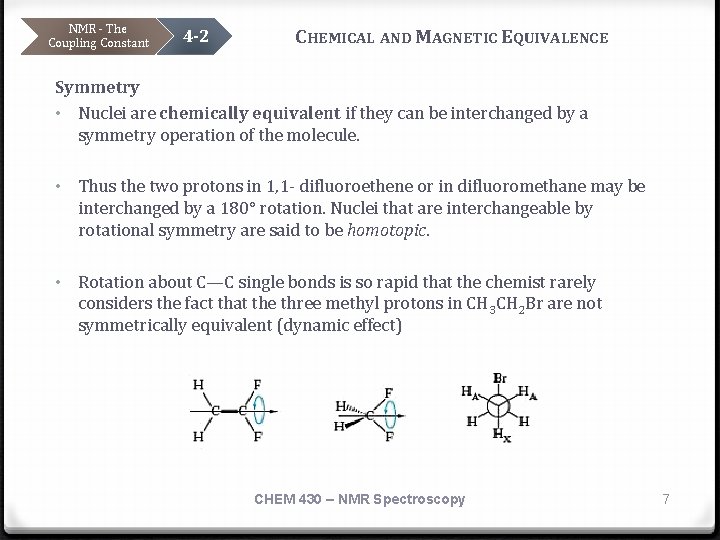
NMR - The Coupling Constant 4 -2 CHEMICAL AND MAGNETIC EQUIVALENCE Symmetry • Nuclei are chemically equivalent if they can be interchanged by a symmetry operation of the molecule. • Thus the two protons in 1, 1 - difluoroethene or in difluoromethane may be interchanged by a 180° rotation. Nuclei that are interchangeable by rotational symmetry are said to be homotopic. • Rotation about C—C single bonds is so rapid that the chemist rarely considers the fact that the three methyl protons in CH 3 CH 2 Br are not symmetrically equivalent (dynamic effect) CHEM 430 – NMR Spectroscopy 7
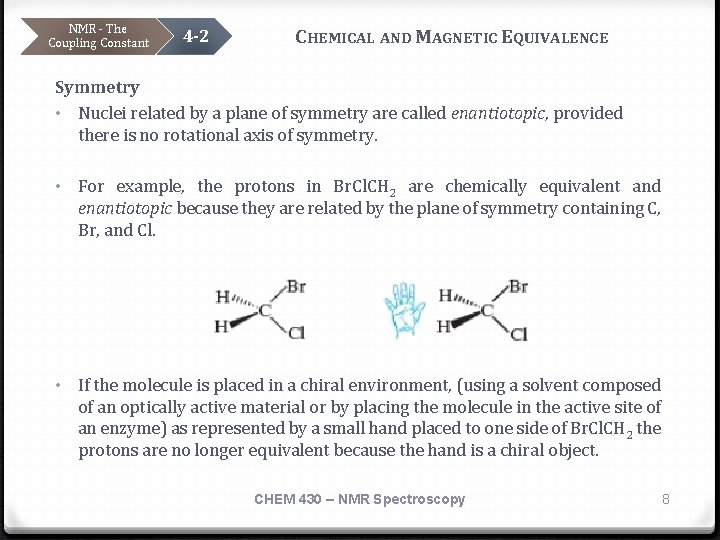
NMR - The Coupling Constant 4 -2 CHEMICAL AND MAGNETIC EQUIVALENCE Symmetry • Nuclei related by a plane of symmetry are called enantiotopic, provided there is no rotational axis of symmetry. • For example, the protons in Br. Cl. CH 2 are chemically equivalent and enantiotopic because they are related by the plane of symmetry containing C, Br, and Cl. • If the molecule is placed in a chiral environment, (using a solvent composed of an optically active material or by placing the molecule in the active site of an enzyme) as represented by a small hand placed to one side of Br. Cl. CH 2 the protons are no longer equivalent because the hand is a chiral object. CHEM 430 – NMR Spectroscopy 8
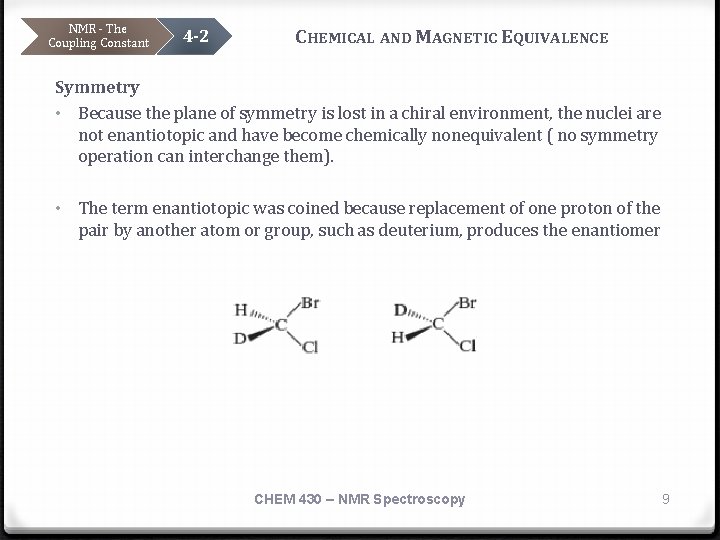
NMR - The Coupling Constant 4 -2 CHEMICAL AND MAGNETIC EQUIVALENCE Symmetry • Because the plane of symmetry is lost in a chiral environment, the nuclei are not enantiotopic and have become chemically nonequivalent ( no symmetry operation can interchange them). • The term enantiotopic was coined because replacement of one proton of the pair by another atom or group, such as deuterium, produces the enantiomer CHEM 430 – NMR Spectroscopy 9
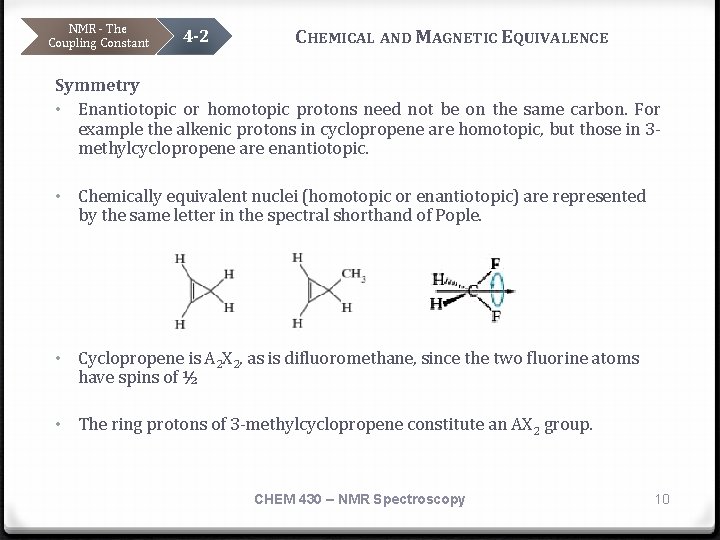
NMR - The Coupling Constant 4 -2 CHEMICAL AND MAGNETIC EQUIVALENCE Symmetry • Enantiotopic or homotopic protons need not be on the same carbon. For example the alkenic protons in cyclopropene are homotopic, but those in 3 - methylcyclopropene are enantiotopic. • Chemically equivalent nuclei (homotopic or enantiotopic) are represented by the same letter in the spectral shorthand of Pople. • Cyclopropene is A 2 X 2, as is difluoromethane, since the two fluorine atoms have spins of ½ • The ring protons of 3 -methylcyclopropene constitute an AX 2 group. CHEM 430 – NMR Spectroscopy 10
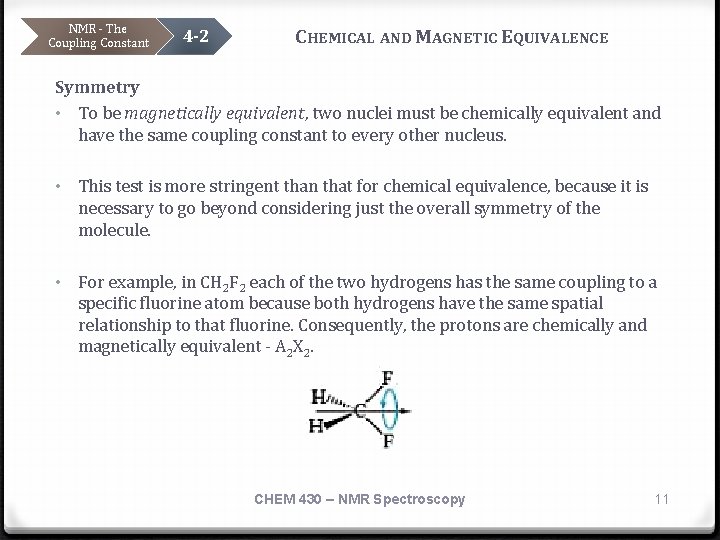
NMR - The Coupling Constant 4 -2 CHEMICAL AND MAGNETIC EQUIVALENCE Symmetry • To be magnetically equivalent, two nuclei must be chemically equivalent and have the same coupling constant to every other nucleus. • This test is more stringent than that for chemical equivalence, because it is necessary to go beyond considering just the overall symmetry of the molecule. • For example, in CH 2 F 2 each of the two hydrogens has the same coupling to a specific fluorine atom because both hydrogens have the same spatial relationship to that fluorine. Consequently, the protons are chemically and magnetically equivalent - A 2 X 2. CHEM 430 – NMR Spectroscopy 11
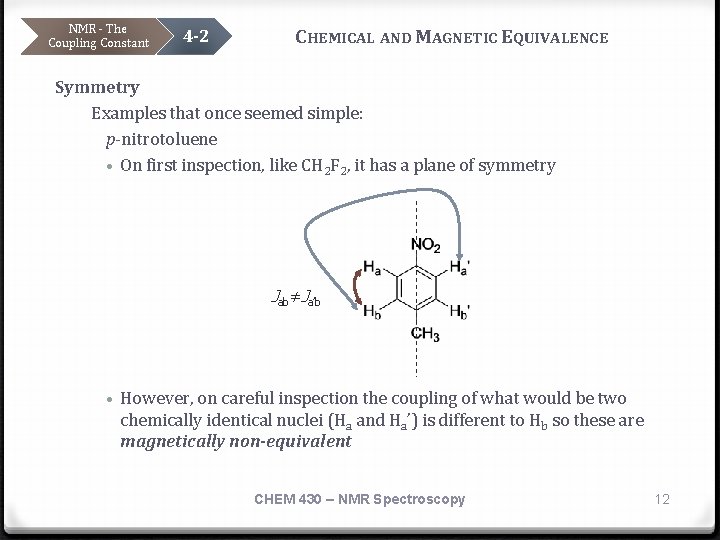
NMR - The Coupling Constant 4 -2 CHEMICAL AND MAGNETIC EQUIVALENCE Symmetry Examples that once seemed simple: p-nitrotoluene • On first inspection, like CH 2 F 2, it has a plane of symmetry Jab≠Ja’b • However, on careful inspection the coupling of what would be two chemically identical nuclei (Ha and Ha’) is different to Hb so these are magnetically non-equivalent CHEM 430 – NMR Spectroscopy 12
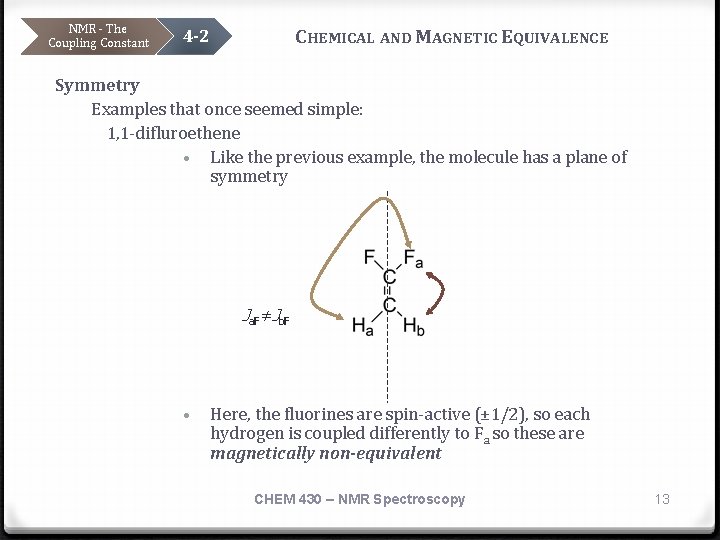
NMR - The Coupling Constant CHEMICAL AND MAGNETIC EQUIVALENCE 4 -2 Symmetry Examples that once seemed simple: 1, 1 -difluroethene • Like the previous example, the molecule has a plane of symmetry Ja. F≠Jb. F • Here, the fluorines are spin-active (± 1/2), so each hydrogen is coupled differently to Fa so these are magnetically non-equivalent CHEM 430 – NMR Spectroscopy 13
NMR - The Coupling Constant 4 -2 CHEMICAL AND MAGNETIC EQUIVALENCE Symmetry Why is this important? • Any spin system that contains nuclei that are chemically equivalent but magnetically nonequivalent is, by definition, 2 nd order. • Moreover, raising the magnetic field cannot alter basic structural relationships between nuclei, so that the spectrum remains second order at the highest accessible fields. • Nuclei that do not have the same chemical shift (anisochronous) also are magnetically nonequivalent because they resonate at different resonance frequencies (chemical shift criterion). CHEM 430 – NMR Spectroscopy 14
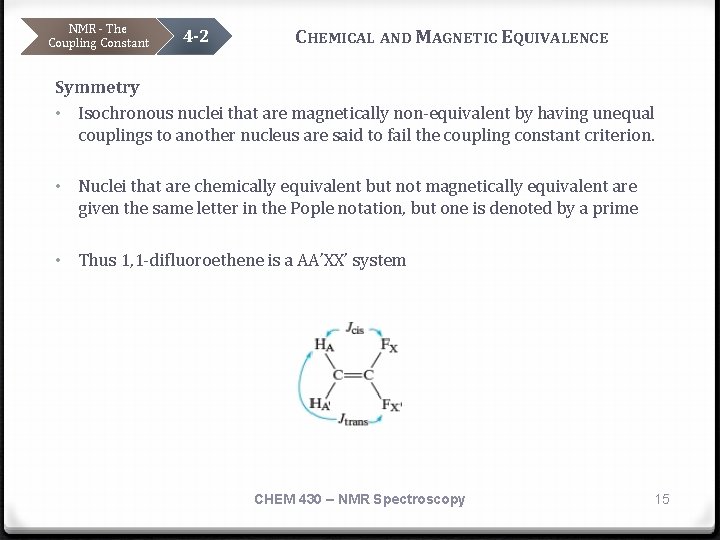
NMR - The Coupling Constant 4 -2 CHEMICAL AND MAGNETIC EQUIVALENCE Symmetry • Isochronous nuclei that are magnetically non-equivalent by having unequal couplings to another nucleus are said to fail the coupling constant criterion. • Nuclei that are chemically equivalent but not magnetically equivalent are given the same letter in the Pople notation, but one is denoted by a prime • Thus 1, 1 -difluoroethene is a AA’XX’ system CHEM 430 – NMR Spectroscopy 15
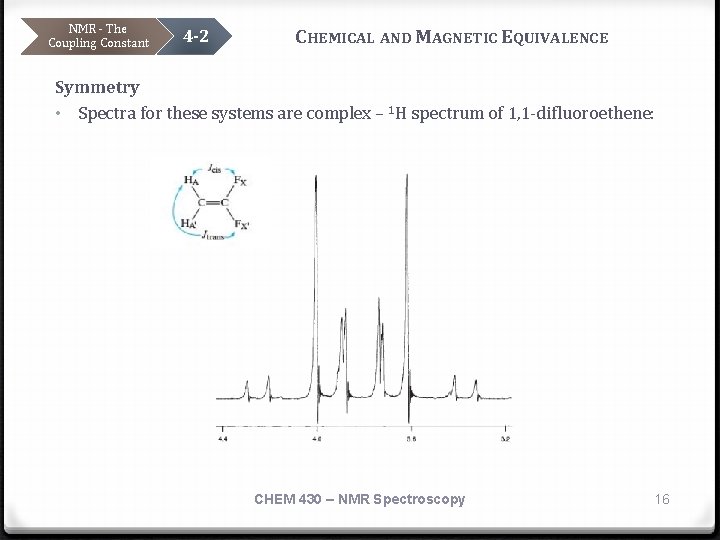
NMR - The Coupling Constant 4 -2 CHEMICAL AND MAGNETIC EQUIVALENCE Symmetry • Spectra for these systems are complex – 1 H spectrum of 1, 1 -difluoroethene: CHEM 430 – NMR Spectroscopy 16
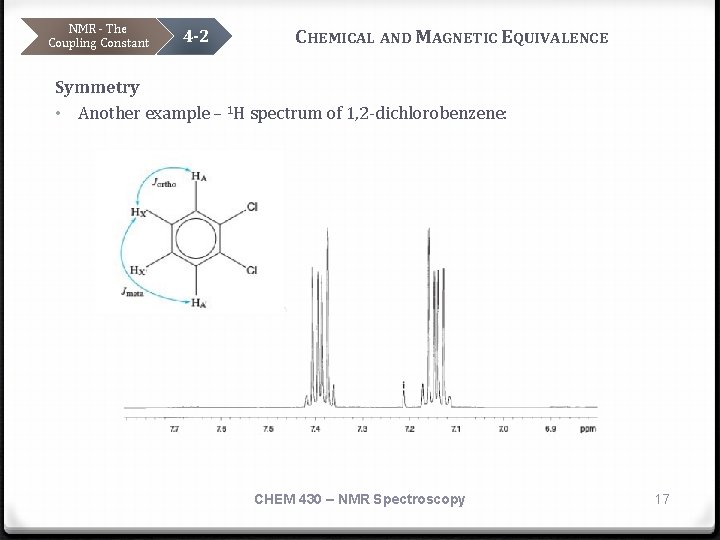
NMR - The Coupling Constant 4 -2 CHEMICAL AND MAGNETIC EQUIVALENCE Symmetry • Another example – 1 H spectrum of 1, 2 -dichlorobenzene: CHEM 430 – NMR Spectroscopy 17
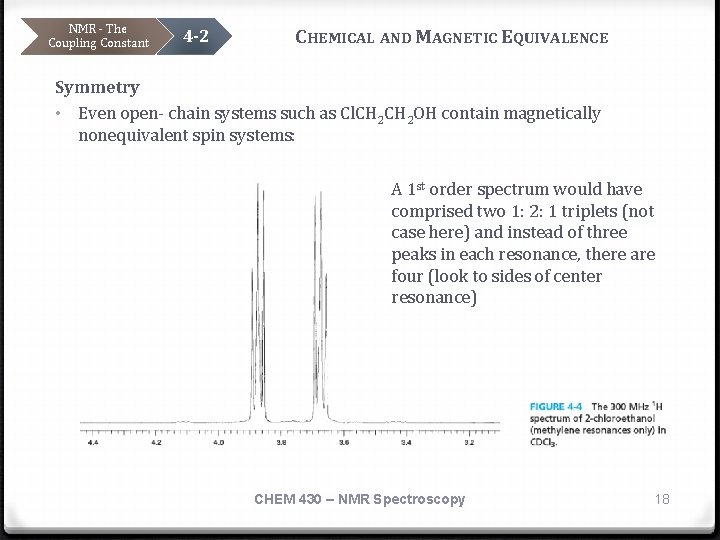
NMR - The Coupling Constant 4 -2 CHEMICAL AND MAGNETIC EQUIVALENCE Symmetry • Even open- chain systems such as Cl. CH 2 OH contain magnetically nonequivalent spin systems: A 1 st order spectrum would have comprised two 1: 2: 1 triplets (not case here) and instead of three peaks in each resonance, there are four (look to sides of center resonance) CHEM 430 – NMR Spectroscopy 18
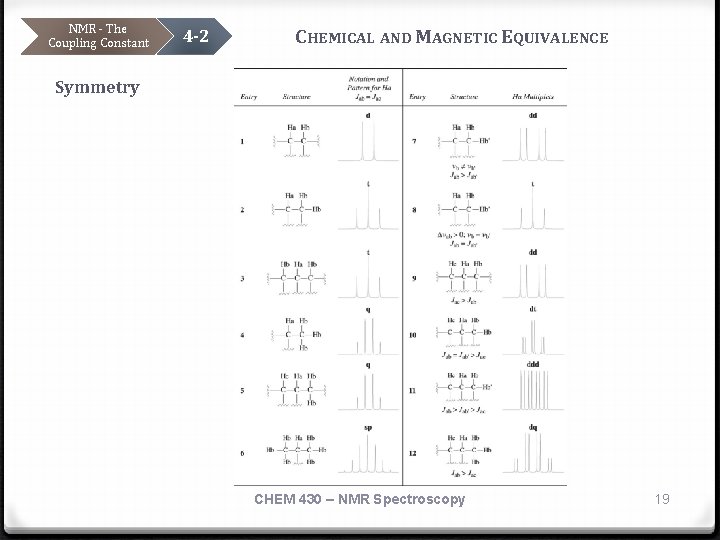
NMR - The Coupling Constant 4 -2 CHEMICAL AND MAGNETIC EQUIVALENCE Symmetry CHEM 430 – NMR Spectroscopy 19
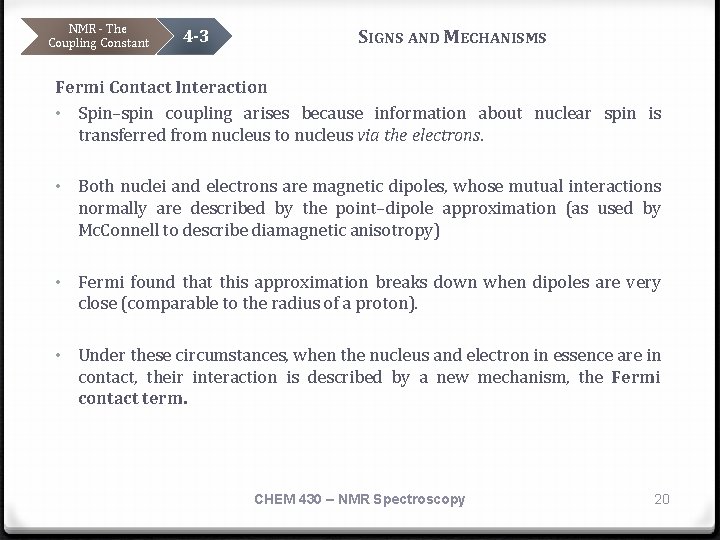
NMR - The Coupling Constant 4 -3 SIGNS AND MECHANISMS Fermi Contact Interaction • Spin–spin coupling arises because information about nuclear spin is transferred from nucleus to nucleus via the electrons. • Both nuclei and electrons are magnetic dipoles, whose mutual interactions normally are described by the point–dipole approximation (as used by Mc. Connell to describe diamagnetic anisotropy) • Fermi found that this approximation breaks down when dipoles are very close (comparable to the radius of a proton). • Under these circumstances, when the nucleus and electron in essence are in contact, their interaction is described by a new mechanism, the Fermi contact term. CHEM 430 – NMR Spectroscopy 20
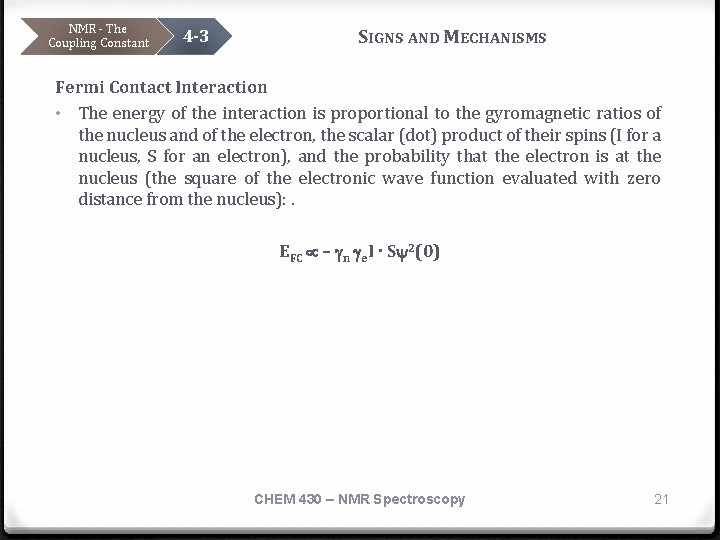
NMR - The Coupling Constant 4 -3 SIGNS AND MECHANISMS Fermi Contact Interaction • The energy of the interaction is proportional to the gyromagnetic ratios of the nucleus and of the electron, the scalar (dot) product of their spins (I for a nucleus, S for an electron), and the probability that the electron is at the nucleus (the square of the electronic wave function evaluated with zero distance from the nucleus): . EFC – gn ge. I · Sy 2(0) CHEM 430 – NMR Spectroscopy 21
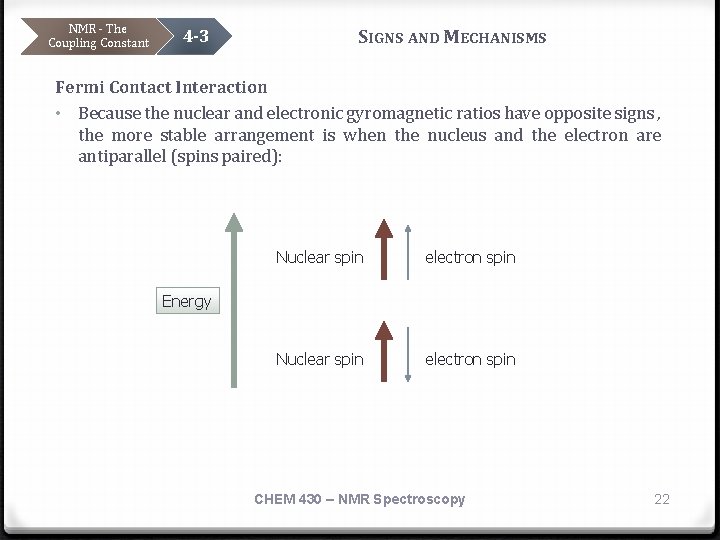
NMR - The Coupling Constant 4 -3 SIGNS AND MECHANISMS Fermi Contact Interaction • Because the nuclear and electronic gyromagnetic ratios have opposite signs , the more stable arrangement is when the nucleus and the electron are antiparallel (spins paired): Nuclear spin electron spin Energy CHEM 430 – NMR Spectroscopy 22
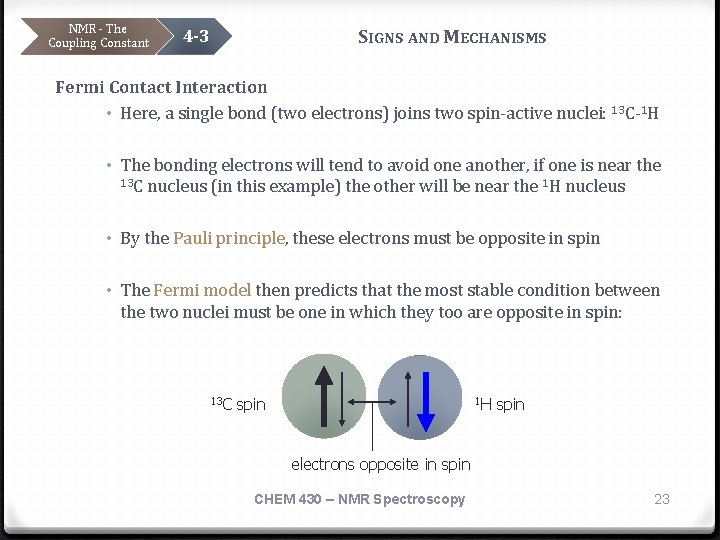
NMR - The Coupling Constant SIGNS AND MECHANISMS 4 -3 Fermi Contact Interaction • Here, a single bond (two electrons) joins two spin-active nuclei: 13 C-1 H • The bonding electrons will tend to avoid one another, if one is near the 13 C nucleus (in this example) the other will be near the 1 H nucleus • By the Pauli principle, these electrons must be opposite in spin • The Fermi model then predicts that the most stable condition between the two nuclei must be one in which they too are opposite in spin: 13 C spin 1 H spin electrons opposite in spin CHEM 430 – NMR Spectroscopy 23
NMR - The Coupling Constant 4 -3 SIGNS AND MECHANISMS Fermi Contact Interaction • When one spin slightly polarizes another spin oppositely the coupling constant J between the spins has a positive sign by convention. • A negative coupling occurs when spins polarize each other in the same (parallel) direction. • Qualitative models indicate that coupling over two bonds, as in H—C—H, is negative, while coupling over three bonds, as in H—C—C—H is positive. • There are numerous exceptions to this qualitative model, but it is useful in understanding that J has sign as well as magnitude. CHEM 430 – NMR Spectroscopy 24
NMR - The Coupling Constant 4 -3 SIGNS AND MECHANISMS Fermi Contact Interaction • There are many variations of the subscripts and superscripts associated with J constants • In general, the superscript numeral to the left of J is the number of intervening bonds through which the coupling is taking place • 2 J is a coupling constant operating through two bonds - geminal • 3 J is a coupling constant operating through three bonds – vicinal • ⩾ 4 J is a coupling constant operating through ⩾ four bonds – long range • Subscripts to the right of J can be used to show the type of coupling, such as HH for homonuclear between protons or HC for heteronuclear between a carbon and proton • Often, this subscript will be used to “order” the various J-constants within a complex multiplet: J 1, J 2, J 3, etc. or JAB, JBC, JAC CHEM 430 – NMR Spectroscopy 25
NMR - The Coupling Constant 4 -3 SIGNS AND MECHANISMS Fermi Contact Interaction • High resolution NMR spectra normally are not dependent on the absolute sign of coupling constants. • Simultaneous reversal of the sign of every coupling constant in a spin system results in an identical spectrum. • Many spectra, however, depend on the relative signs of component couplings. • For example, the general ABX spectrum is determined in part by three couplings, JAB, JAX, and JBX • Different spectra can be obtained when JAX and JBX have the same sign from when they have opposite signs even when the magnitudes are the same. CHEM 430 – NMR Spectroscopy 26
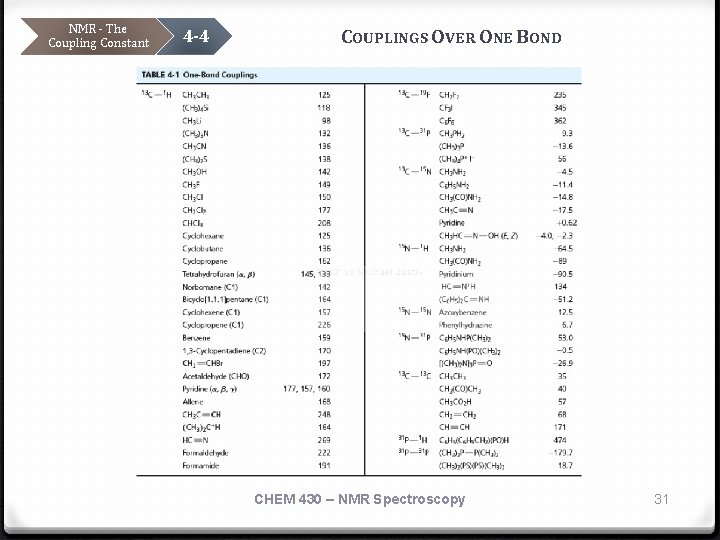
NMR - The Coupling Constant 4 -4 COUPLINGS OVER ONE BOND • The one- bond coupling between 13 C and 1 H is readily measured from the 13 C spectrum when the decoupler is turned off • Although it complicates routine 13 C interpretation, this coupling can provide useful information and illustrates several important principles. • Because a p orbital has a node at the nucleus, only electrons in s orbitals can contribute to the Fermi coupling mechanism (s orbitals have a maximum in electron density at the nucleus). • For protons, all electrons reside in the 1 s orbital, but, for other nuclei, only that proportion of the orbital that has s character can contribute to coupling. CHEM 430 – NMR Spectroscopy 27
NMR - The Coupling Constant COUPLINGS OVER ONE BOND 4 -4 • When a proton is attached to an sp 3 carbon atom (25% s character), 1 JHC is about half as large as that for a proton attached to an sp carbon atom ( 50% s character). • These numbers define a linear relationship between the %-s character of the carbon orbital and the one- bond coupling: %-s(C—H) = 0. 2 J(13 C—H) 1 J HC ethane = 125 Hz (sp 1 J 3) HC ethene = 156 Hz (sp 1 J 2 ) HC ethyne = 249 Hz (sp) • The zero intercept of this equation indicates that there is no coupling when the s character is zero, in agreement with the Fermi contact model. CHEM 430 – NMR Spectroscopy 28
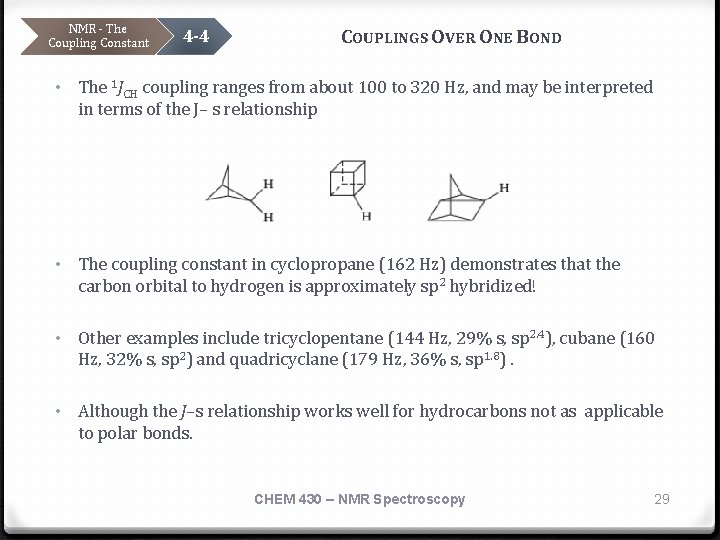
NMR - The Coupling Constant 4 -4 COUPLINGS OVER ONE BOND • The 1 JCH coupling ranges from about 100 to 320 Hz, and may be interpreted in terms of the J– s relationship • The coupling constant in cyclopropane (162 Hz) demonstrates that the carbon orbital to hydrogen is approximately sp 2 hybridized! • Other examples include tricyclopentane (144 Hz, 29% s, sp 2. 4), cubane (160 Hz, 32% s, sp 2) and quadricyclane (179 Hz, 36% s, sp 1. 8). • Although the J–s relationship works well for hydrocarbons not as applicable to polar bonds. CHEM 430 – NMR Spectroscopy 29
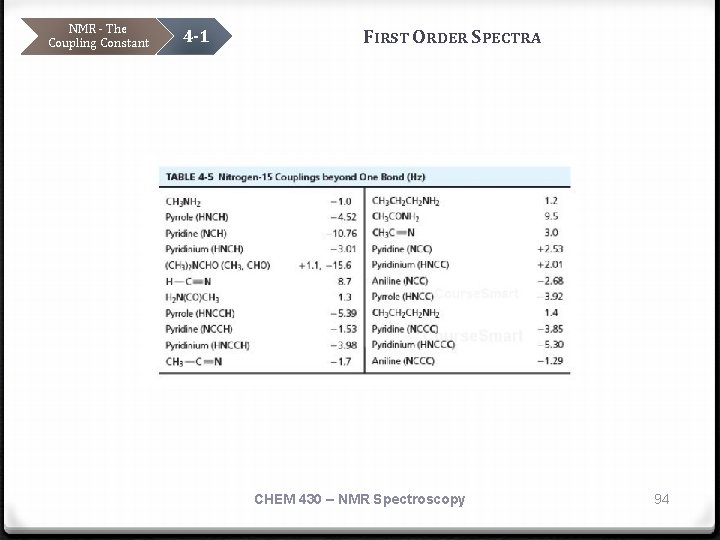
NMR - The Coupling Constant 4 -4 COUPLINGS OVER ONE BOND • For other nuclei variations in the effective nuclear charge and hybridization effects, may alter the coupling constants. • Just as the resonance frequency of a nucleus is proportional to its gyromagnetic ratio , the coupling constant between two nuclei, as noted above, is proportional to the product of both gyromagnetic ratios. • Nuclei with very small gyromagnetic ratios, such as correspondingly small couplings. 15 N, tend to have • For 15 N g has a negative sign, whereas 1 H and 13 C are positive. Therefore 1 JNH between 15 N and hydrogen have a negative sign • One bond couplings have been studied for other nuclei but are more complex CHEM 430 – NMR Spectroscopy 30
NMR - The Coupling Constant 4 -4 COUPLINGS OVER ONE BOND CHEM 430 – NMR Spectroscopy 31
NMR - The Coupling Constant 4 -5 GEMINAL COUPLINGS • By the Fermi model for geminal coupling (H—C—H) 2 J is usually negative • Geminal coupling (H–C–H) cay be measured directly from the spectrum when the coupled nuclei are chemically nonequivalent, (the AB or AM part of an ABX, AMX, ABX 3… spectrum). • If the relationship is 1 st order (AM), the coupling may be measured by inspection. In 2 nd order cases (AB), the spectrum must be simulated computationally, unless the two spins are isolated (a two- spin system) • When nuclei are chemically equivalent but magnetically nonequivalent (as in the AA' part of an AA'XX' spectrum) their coupling constant is accessible by computational methods CHEM 430 – NMR Spectroscopy 32
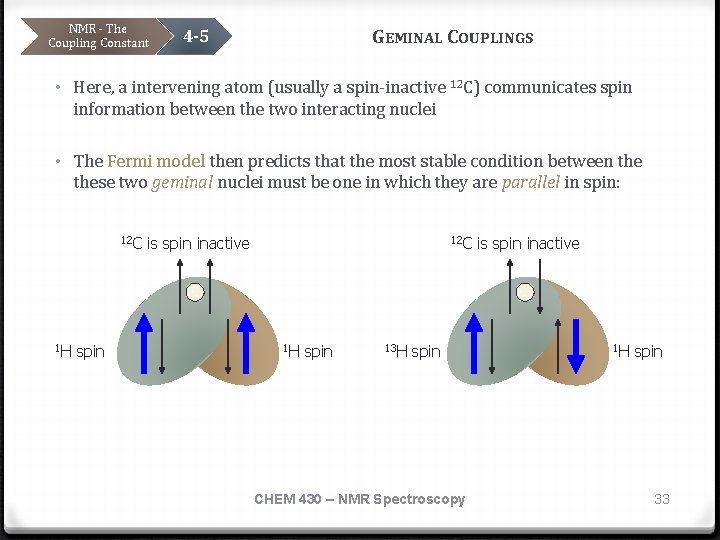
NMR - The Coupling Constant GEMINAL COUPLINGS 4 -5 • Here, a intervening atom (usually a spin-inactive 12 C) communicates spin information between the two interacting nuclei • The Fermi model then predicts that the most stable condition between these two geminal nuclei must be one in which they are parallel in spin: 12 C 1 H spin is spin inactive 12 C 1 H spin 13 H spin CHEM 430 – NMR Spectroscopy is spin inactive 1 H spin 33
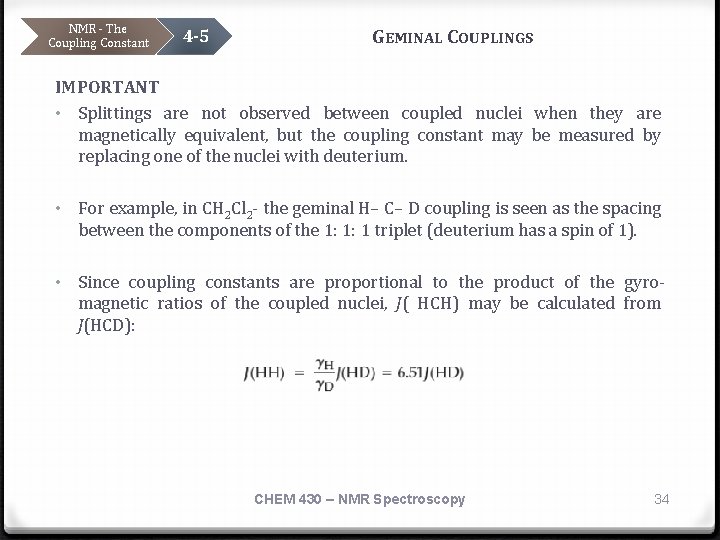
NMR - The Coupling Constant 4 -5 GEMINAL COUPLINGS IMPORTANT • Splittings are not observed between coupled nuclei when they are magnetically equivalent, but the coupling constant may be measured by replacing one of the nuclei with deuterium. • For example, in CH 2 Cl 2 - the geminal H– C– D coupling is seen as the spacing between the components of the 1: 1: 1 triplet (deuterium has a spin of 1). • Since coupling constants are proportional to the product of the gyromagnetic ratios of the coupled nuclei, J( HCH) may be calculated from J(HCD): CHEM 430 – NMR Spectroscopy 34
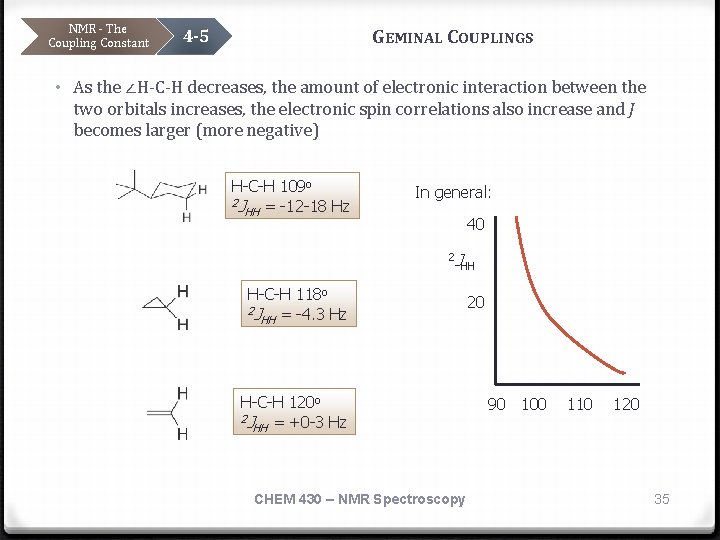
NMR - The Coupling Constant GEMINAL COUPLINGS 4 -5 • As the ∠H-C-H decreases, the amount of electronic interaction between the two orbitals increases, the electronic spin correlations also increase and J becomes larger (more negative) H-C-H 109 o 2 J HH = -12 -18 Hz In general: 40 JHH 2 H-C-H 118 o 2 J HH = -4. 3 Hz H-C-H 120 o 2 J HH = +0 -3 Hz CHEM 430 – NMR Spectroscopy 20 90 100 110 120 35
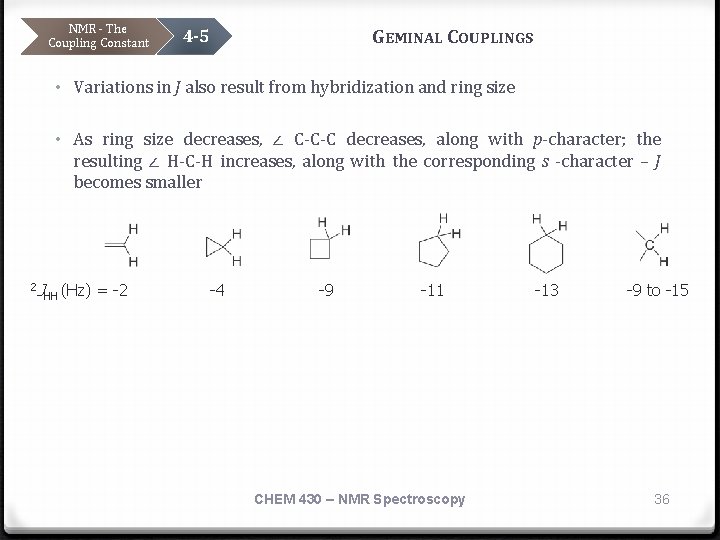
NMR - The Coupling Constant GEMINAL COUPLINGS 4 -5 • Variations in J also result from hybridization and ring size • As ring size decreases, ∠ C-C-C decreases, along with p-character; the resulting ∠ H-C-H increases, along with the corresponding s -character – J becomes smaller JHH (Hz) = -2 2 -4 -9 -11 CHEM 430 – NMR Spectroscopy -13 -9 to -15 36
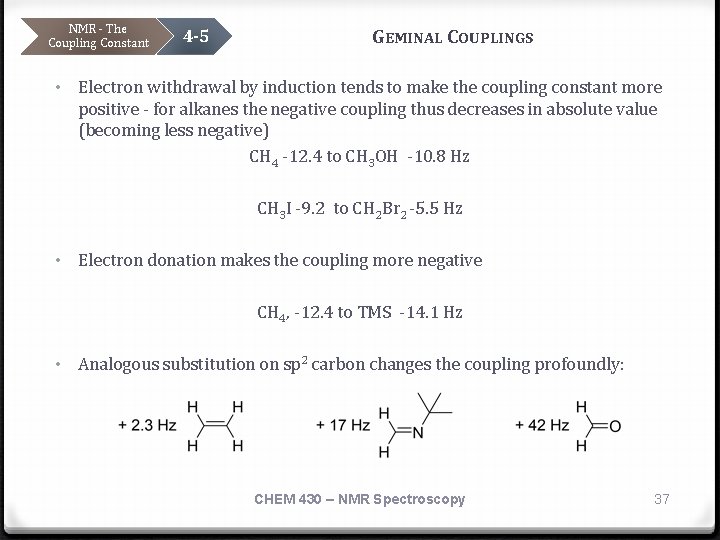
NMR - The Coupling Constant 4 -5 GEMINAL COUPLINGS • Electron withdrawal by induction tends to make the coupling constant more positive - for alkanes the negative coupling thus decreases in absolute value (becoming less negative) CH 4 -12. 4 to CH 3 OH -10. 8 Hz CH 3 I -9. 2 to CH 2 Br 2 -5. 5 Hz • Electron donation makes the coupling more negative CH 4, -12. 4 to TMS -14. 1 Hz • Analogous substitution on sp 2 carbon changes the coupling profoundly: CHEM 430 – NMR Spectroscopy 37
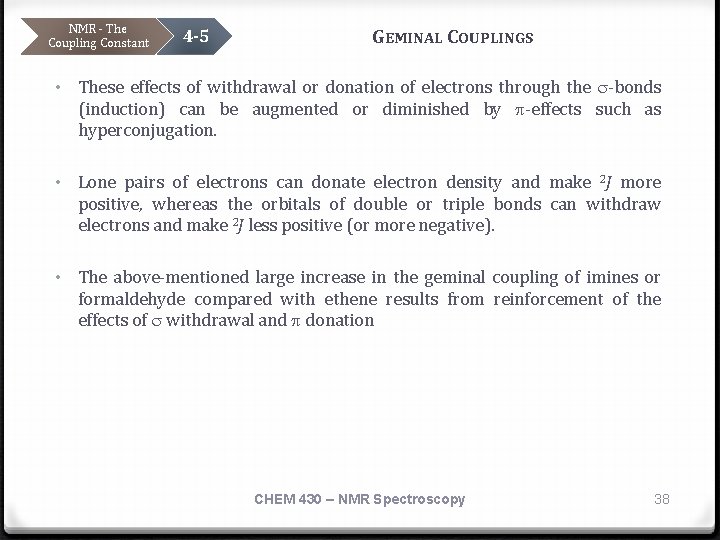
NMR - The Coupling Constant 4 -5 GEMINAL COUPLINGS • These effects of withdrawal or donation of electrons through the s-bonds (induction) can be augmented or diminished by p-effects such as hyperconjugation. • Lone pairs of electrons can donate electron density and make 2 J more positive, whereas the orbitals of double or triple bonds can withdraw electrons and make 2 J less positive (or more negative). • The above-mentioned large increase in the geminal coupling of imines or formaldehyde compared with ethene results from reinforcement of the effects of s withdrawal and p donation CHEM 430 – NMR Spectroscopy 38
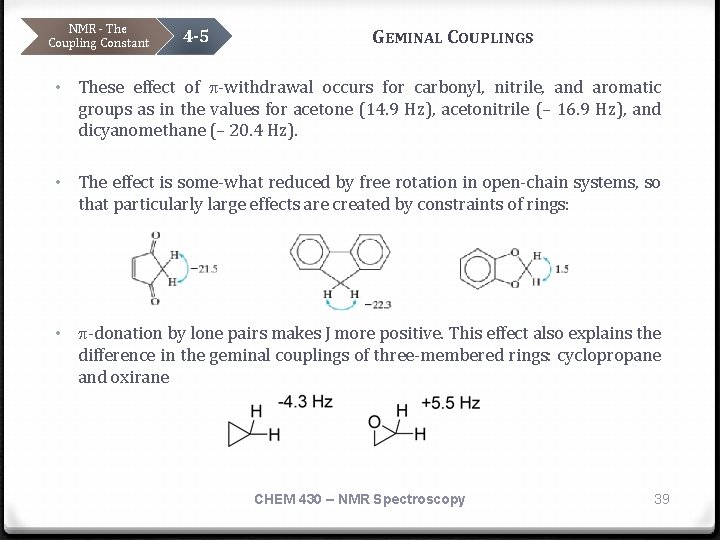
NMR - The Coupling Constant 4 -5 GEMINAL COUPLINGS • These effect of p-withdrawal occurs for carbonyl, nitrile, and aromatic groups as in the values for acetone (14. 9 Hz), acetonitrile (– 16. 9 Hz), and dicyanomethane (– 20. 4 Hz). • The effect is some-what reduced by free rotation in open-chain systems, so that particularly large effects are created by constraints of rings: • p-donation by lone pairs makes J more positive. This effect also explains the difference in the geminal couplings of three-membered rings: cyclopropane and oxirane CHEM 430 – NMR Spectroscopy 39
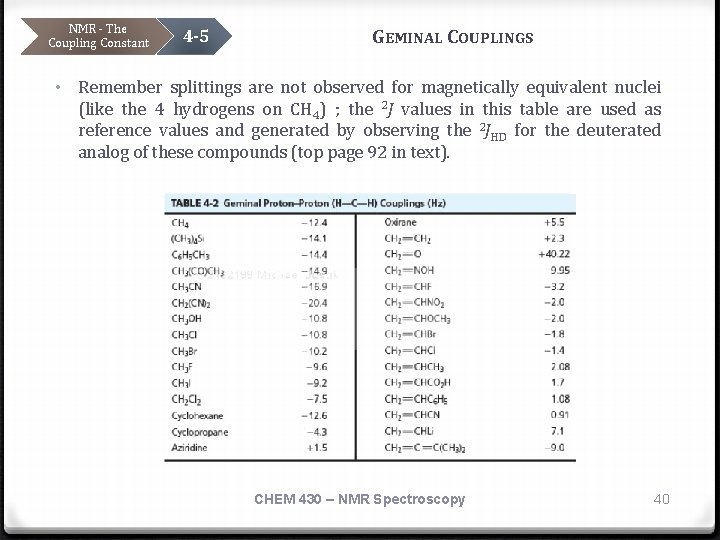
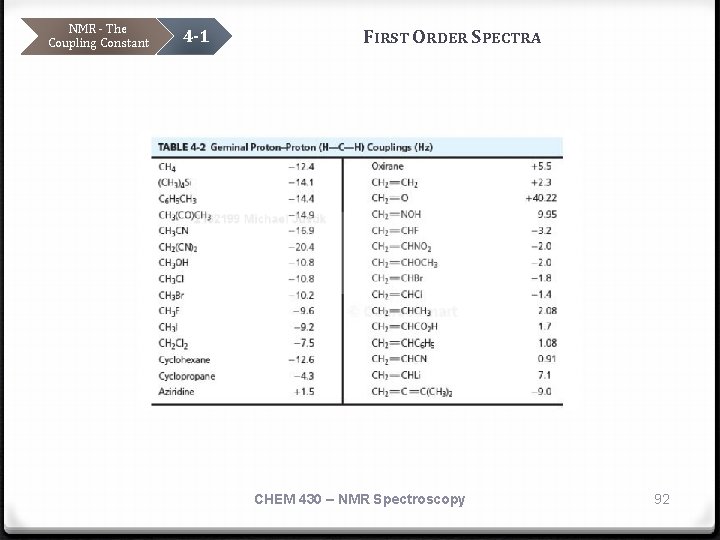
NMR - The Coupling Constant 4 -5 GEMINAL COUPLINGS • Remember splittings are not observed for magnetically equivalent nuclei (like the 4 hydrogens on CH 4) ; the 2 J values in this table are used as reference values and generated by observing the 2 JHD for the deuterated analog of these compounds (top page 92 in text). CHEM 430 – NMR Spectroscopy 40
NMR - The Coupling Constant 4 -5 GEMINAL COUPLINGS • Geminal couplings between protons and other nuclei also have been studied. • The H–C– 13 C coupling responds to substituents in much the same way as does the H–C–H coupling; values are smaller, due to the smaller g of 13 C. • Unlike the H–C–H case, the H–C– 13 C geminal coupling pathway can include a double or triple bond; such couplings can be useful to determine stereochemistry: CHEM 430 – NMR Spectroscopy 41
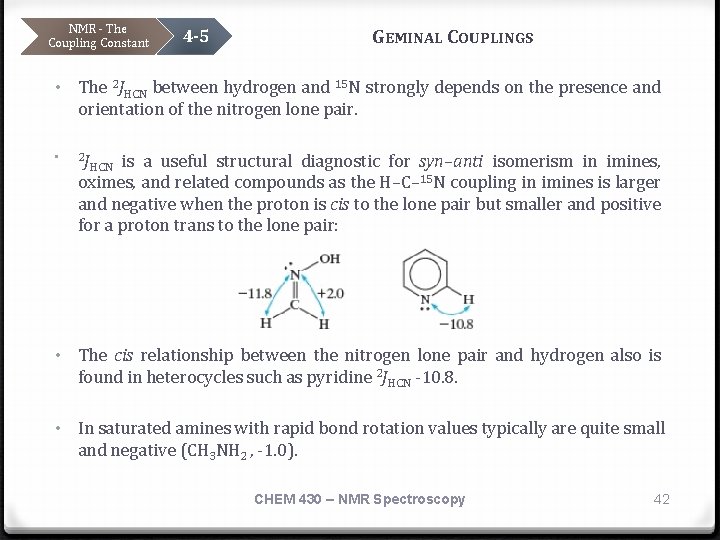
NMR - The Coupling Constant 4 -5 GEMINAL COUPLINGS • The 2 JHCN between hydrogen and 15 N strongly depends on the presence and orientation of the nitrogen lone pair. • 2 J HCN is a useful structural diagnostic for syn–anti isomerism in imines, oximes, and related compounds as the H–C– 15 N coupling in imines is larger and negative when the proton is cis to the lone pair but smaller and positive for a proton trans to the lone pair: • The cis relationship between the nitrogen lone pair and hydrogen also is found in heterocycles such as pyridine 2 JHCN -10. 8. • In saturated amines with rapid bond rotation values typically are quite small and negative (CH 3 NH 2 , -1. 0). CHEM 430 – NMR Spectroscopy 42
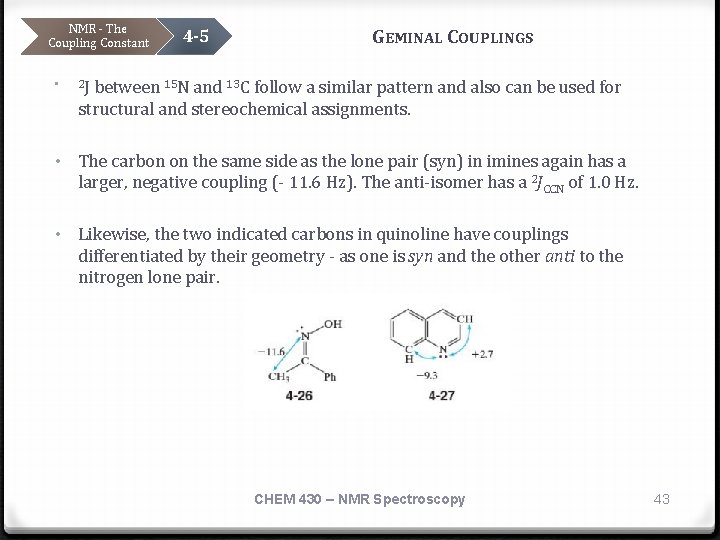
NMR - The Coupling Constant • 4 -5 GEMINAL COUPLINGS 2 J between 15 N and 13 C follow a similar pattern and also can be used for structural and stereochemical assignments. • The carbon on the same side as the lone pair (syn) in imines again has a larger, negative coupling (- 11. 6 Hz). The anti-isomer has a 2 JCCN of 1. 0 Hz. • Likewise, the two indicated carbons in quinoline have couplings differentiated by their geometry - as one is syn and the other anti to the nitrogen lone pair. CHEM 430 – NMR Spectroscopy 43
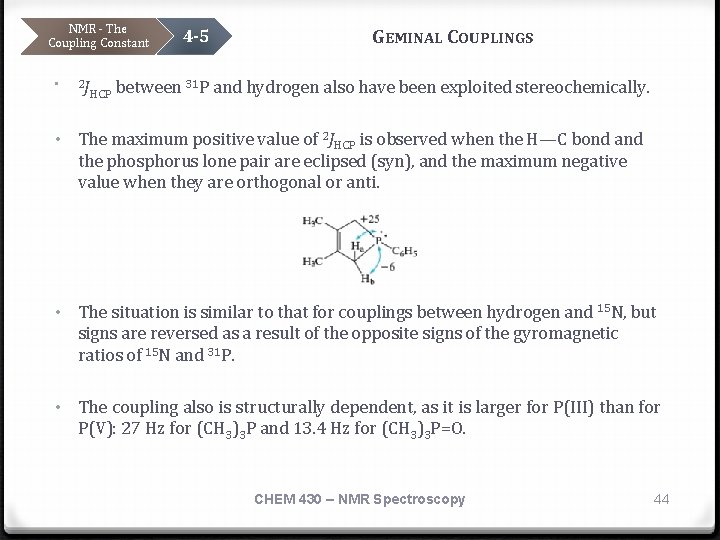
NMR - The Coupling Constant • 2 J 4 -5 HCP between GEMINAL COUPLINGS 31 P and hydrogen also have been exploited stereochemically. • The maximum positive value of 2 JHCP is observed when the H—C bond and the phosphorus lone pair are eclipsed (syn), and the maximum negative value when they are orthogonal or anti. • The situation is similar to that for couplings between hydrogen and 15 N, but signs are reversed as a result of the opposite signs of the gyromagnetic ratios of 15 N and 31 P. • The coupling also is structurally dependent, as it is larger for P(III) than for P(V): 27 Hz for (CH 3)3 P and 13. 4 Hz for (CH 3)3 P=O. CHEM 430 – NMR Spectroscopy 44
NMR - The Coupling Constant 4 -5 GEMINAL COUPLINGS • Geminal H– C– F couplings are usually close to for an sp 3 carbon (47. 5 Hz for CH 3 CH 2 F) and for an sp 2 carbon (84. 7 Hz for CH 2=CHF). • Geminal F–C–F couplings are quite large for saturated carbons (240 Hz for 1, 1 -difluorocyclohexane), but less than 100 Hz for unsaturated carbons (35. 6 Hz for CH 2=CF 2). CHEM 430 – NMR Spectroscopy 45
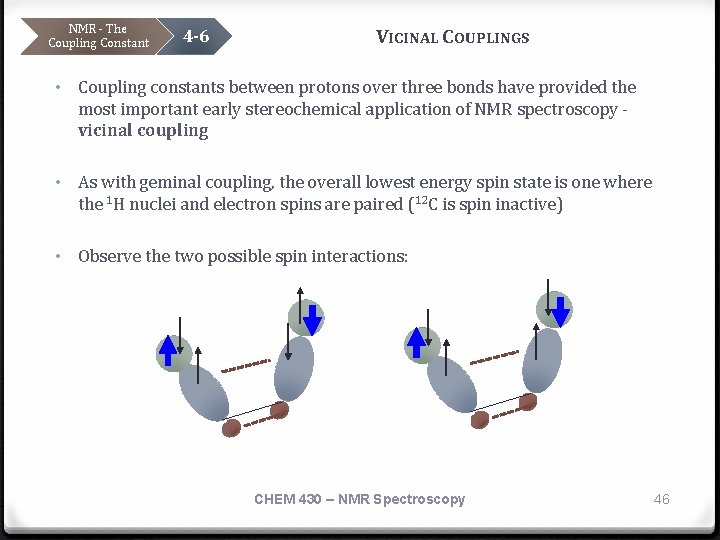
NMR - The Coupling Constant 4 -6 VICINAL COUPLINGS • Coupling constants between protons over three bonds have provided the most important early stereochemical application of NMR spectroscopy - vicinal coupling • As with geminal coupling, the overall lowest energy spin state is one where the 1 H nuclei and electron spins are paired (12 C is spin inactive) • Observe the two possible spin interactions: CHEM 430 – NMR Spectroscopy 46
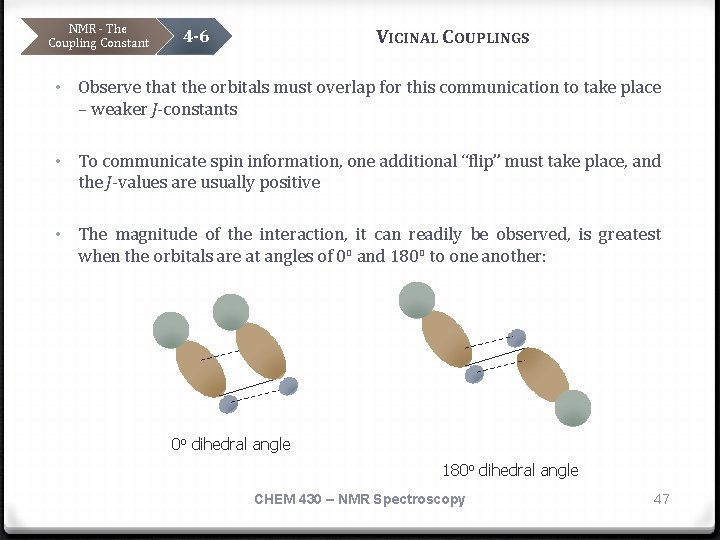
NMR - The Coupling Constant VICINAL COUPLINGS 4 -6 • Observe that the orbitals must overlap for this communication to take place – weaker J-constants • To communicate spin information, one additional “flip” must take place, and the J-values are usually positive • The magnitude of the interaction, it can readily be observed, is greatest when the orbitals are at angles of 0 o and 180 o to one another: 0 o dihedral angle 180 o dihedral angle CHEM 430 – NMR Spectroscopy 47
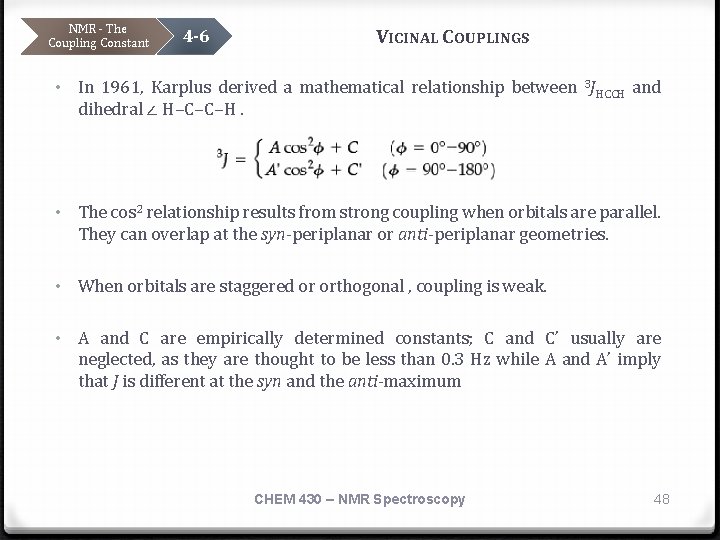
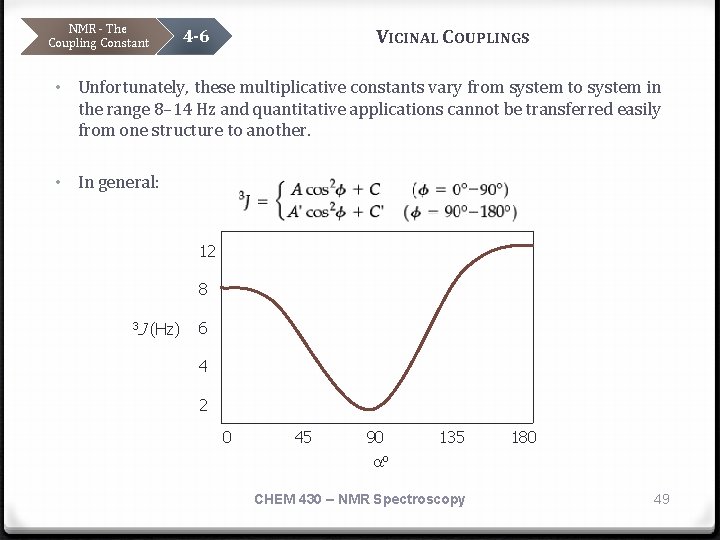
NMR - The Coupling Constant 4 -6 VICINAL COUPLINGS • In 1961, Karplus derived a mathematical relationship between 3 JHCCH and dihedral ∠ H‒C‒C‒H. • The cos 2 relationship results from strong coupling when orbitals are parallel. They can overlap at the syn-periplanar or anti-periplanar geometries. • When orbitals are staggered or orthogonal , coupling is weak. • A and C are empirically determined constants; C and C’ usually are neglected, as they are thought to be less than 0. 3 Hz while A and A’ imply that J is different at the syn and the anti-maximum CHEM 430 – NMR Spectroscopy 48
NMR - The Coupling Constant VICINAL COUPLINGS 4 -6 • Unfortunately, these multiplicative constants vary from system to system in the range 8– 14 Hz and quantitative applications cannot be transferred easily from one structure to another. • In general: 12 8 J (Hz) 3 6 4 2 0 45 90 ao 135 CHEM 430 – NMR Spectroscopy 180 49
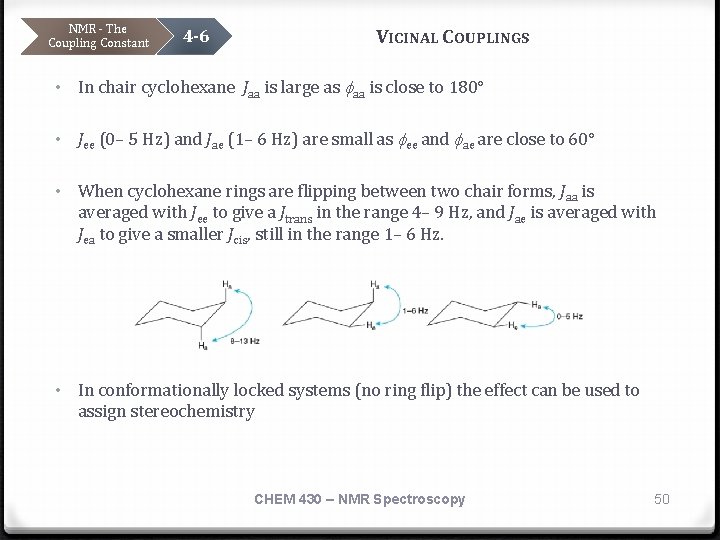
NMR - The Coupling Constant 4 -6 VICINAL COUPLINGS • In chair cyclohexane Jaa is large as faa is close to 180° • Jee (0– 5 Hz) and Jae (1– 6 Hz) are small as fee and fae are close to 60° • When cyclohexane rings are flipping between two chair forms, Jaa is averaged with Jee to give a Jtrans in the range 4– 9 Hz, and Jae is averaged with Jea to give a smaller Jcis, still in the range 1– 6 Hz. • In conformationally locked systems (no ring flip) the effect can be used to assign stereochemistry CHEM 430 – NMR Spectroscopy 50
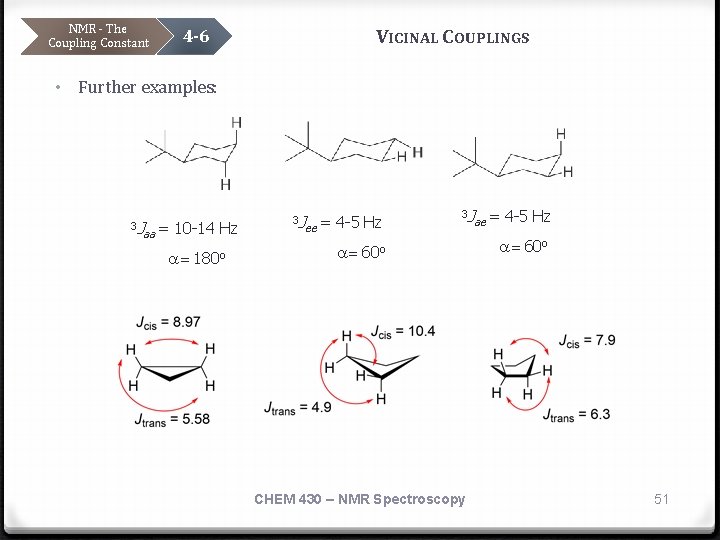
NMR - The Coupling Constant VICINAL COUPLINGS 4 -6 • Further examples: Jaa = 10 -14 Hz 3 a= 180 o Jee = 4 -5 Hz 3 Jae = 4 -5 Hz 3 a = 60 o CHEM 430 – NMR Spectroscopy a = 60 o 51
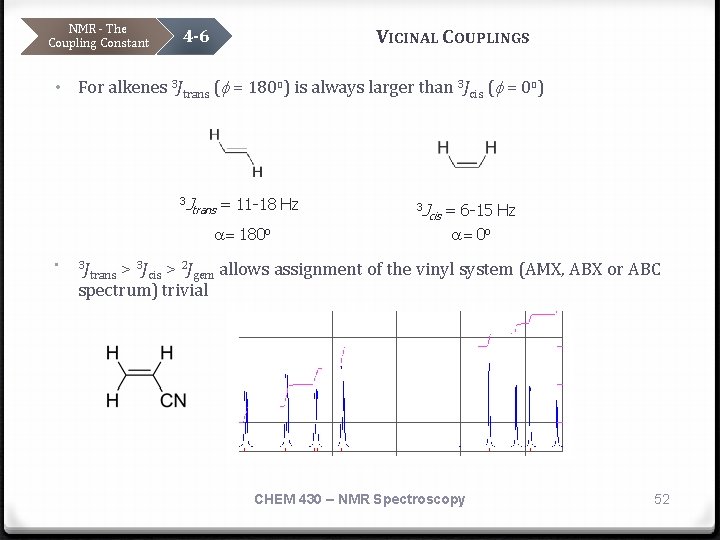
NMR - The Coupling Constant VICINAL COUPLINGS 4 -6 • For alkenes 3 Jtrans (f = 180 o) is always larger than 3 Jcis (f = 0 o) Jtrans = 11 -18 Hz 3 a = 180 o • 3 J trans > 3 J cis > 2 J Jcis = 6 -15 Hz 3 a = 0 o gem allows assignment of the vinyl system (AMX, ABX or ABC spectrum) trivial CHEM 430 – NMR Spectroscopy 52
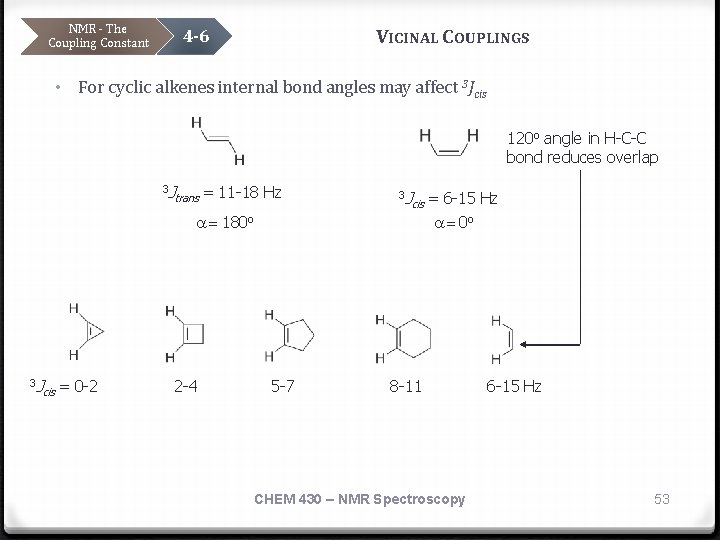
NMR - The Coupling Constant VICINAL COUPLINGS 4 -6 • For cyclic alkenes internal bond angles may affect 3 Jcis 120 o angle in H-C-C bond reduces overlap Jtrans = 11 -18 Hz 3 Jcis = 6 -15 Hz 3 a = 180 o Jcis = 0 -2 3 2 -4 a = 0 o 5 -7 8 -11 CHEM 430 – NMR Spectroscopy 6 -15 Hz 53
NMR - The Coupling Constant 4 -6 VICINAL COUPLINGS • Despite the potentially general application of the Karplus equation to dihedral angle problems, there are quantitative limitations. • The 3 J H–C–C–H depends on the C–C bond length or bond order, the H–C–C valence angle, the electronegativity and orientation of substituents on the carbon atoms in addition to the H–C–C–H dihedral angles. • A properly controlled calibration series of molecules must be rigid (monoconformational) and have unvarying bond lengths and valence angles. Three approaches have been developed to take the only remaining factor, substituent electronegativity, into account: 1. Derive the mathematical dependence of 3 J on electronegativity. 2. Empirical allowance by the use of chemical shifts that depend on electronegativity in a similar fashion as 3 J. 3. Eliminate the problem through the use of the ratio (the R value) of two 3 J coupling constants that respond to the same or related dihedral angles and that have the same multiplicative dependence on substituent electronegativity, which divides out in R. CHEM 430 – NMR Spectroscopy 54
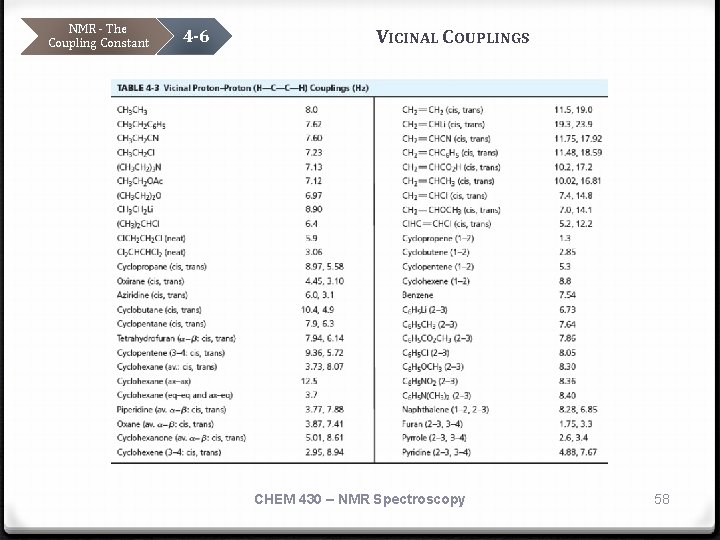
NMR - The Coupling Constant 4 -6 VICINAL COUPLINGS • These more sophisticated versions of the Karplus method have been used quite successfully to obtain reliable quantitative results. • The existence of factors other than the dihedral angle results in ranges of vicinal coupling constants at constant even in structurally analogous systems. • Saturated hydro-carbon chains (H–C–C H) exhibit vicinal couplings in the range 3– 9 Hz, depending on substituent electronegativity and rotamer mixes and 8. 90 Hz for. Higher substituent electronegativity always lowers the vicinal coupling constant. In small rings, the variation is almost entirely the result of substituent electronegativity, with cis ranges of 7– 13 Hz and trans ranges of 4– 10 Hz in cyclopropanes. CHEM 430 – NMR Spectroscopy 55
NMR - The Coupling Constant 4 -6 VICINAL COUPLINGS • These more sophisticated versions of the Karplus method have been used quite successfully to obtain reliable quantitative results. • The existence of factors other than the dihedral angle results in ranges of vicinal coupling constants at constant even in structurally analogous systems. • Saturated hydro-carbon chains (H–C–C–H) exhibit vicinal couplings in the range 3– 9 Hz, depending on substituent electronegativity and rotamer mixes. • Higher substituent electronegativity always lowers the vicinal coupling constant. In small rings, the variation is almost entirely the result of substituent electronegativity, with cis ranges of 7– 13 Hz and trans ranges of 4– 10 Hz in cyclopropanes. CHEM 430 – NMR Spectroscopy 56
NMR - The Coupling Constant 4 -6 VICINAL COUPLINGS • In small rings, the variation is almost entirely the result of substituent electronegativity, with cis ranges of 7– 13 Hz and trans ranges of 4– 10 Hz in cyclopropanes. • Coupling constants in oxiranes ( epoxides) are smaller because of the effect of the electronegative oxygen atom. • 3 J is proportional to the overall bond order, as in benzene and in naphthalene. The ortho-coupling in benzene derivatives varies over the relatively small range of 6. 7– 8. 5 Hz, depending on the resonance and polar effects of the substituents. • The presence of heteroatoms in the ring expands the range at the lower end down to 2 Hz, because of the effects of electronegativity ( pyridines) and of smaller rings (furans, pyrroles). CHEM 430 – NMR Spectroscopy 57
NMR - The Coupling Constant 4 -6 VICINAL COUPLINGS CHEM 430 – NMR Spectroscopy 58
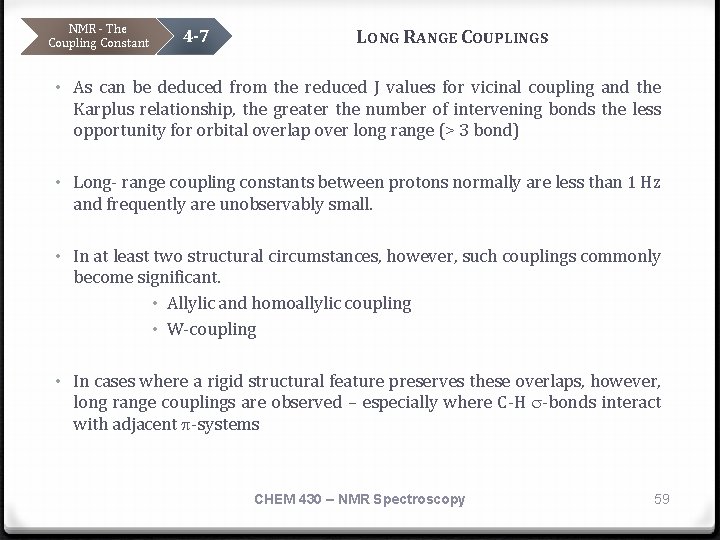
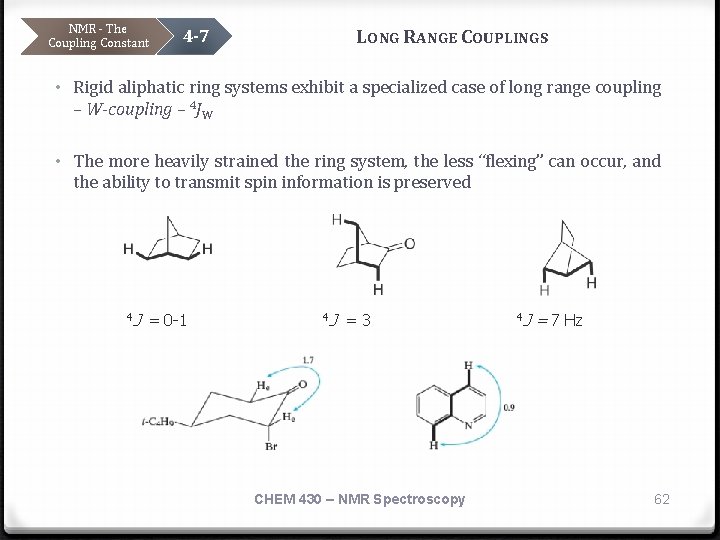
NMR - The Coupling Constant 4 -7 LONG RANGE COUPLINGS • As can be deduced from the reduced J values for vicinal coupling and the Karplus relationship, the greater the number of intervening bonds the less opportunity for orbital overlap over long range (> 3 bond) • Long- range coupling constants between protons normally are less than 1 Hz and frequently are unobservably small. • In at least two structural circumstances, however, such couplings commonly become significant. • Allylic and homoallylic coupling • W-coupling • In cases where a rigid structural feature preserves these overlaps, however, long range couplings are observed – especially where C-H s-bonds interact with adjacent p-systems CHEM 430 – NMR Spectroscopy 59
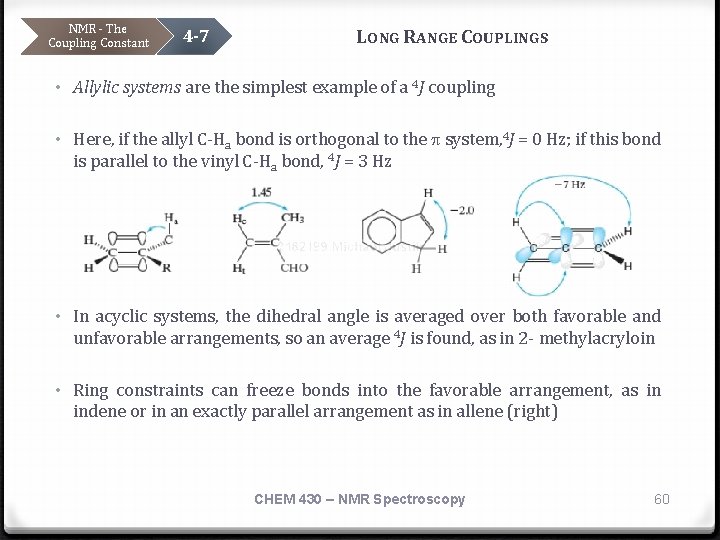
NMR - The Coupling Constant 4 -7 LONG RANGE COUPLINGS • Allylic systems are the simplest example of a 4 J coupling • Here, if the allyl C-Ha bond is orthogonal to the p system, 4 J = 0 Hz; if this bond is parallel to the vinyl C-Ha bond, 4 J = 3 Hz • In acyclic systems, the dihedral angle is averaged over both favorable and unfavorable arrangements, so an average 4 J is found, as in 2 - methylacryloin • Ring constraints can freeze bonds into the favorable arrangement, as in indene or in an exactly parallel arrangement as in allene (right) CHEM 430 – NMR Spectroscopy 60
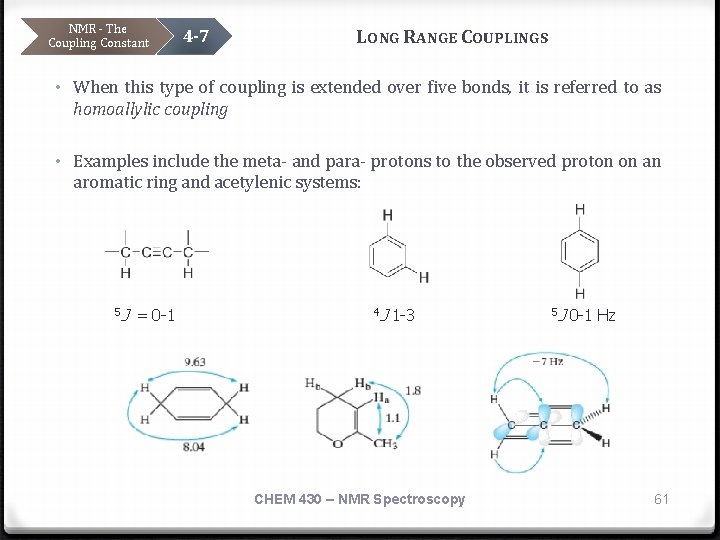
NMR - The Coupling Constant 4 -7 LONG RANGE COUPLINGS • When this type of coupling is extended over five bonds, it is referred to as homoallylic coupling • Examples include the meta- and para- protons to the observed proton on an aromatic ring and acetylenic systems: J = 0 -1 5 J 1 -3 4 CHEM 430 – NMR Spectroscopy J 0 -1 Hz 5 61
NMR - The Coupling Constant LONG RANGE COUPLINGS 4 -7 • Rigid aliphatic ring systems exhibit a specialized case of long range coupling – W-coupling – 4 JW • The more heavily strained the ring system, the less “flexing” can occur, and the ability to transmit spin information is preserved J = 0 -1 4 J =3 4 CHEM 430 – NMR Spectroscopy J = 7 Hz 4 62
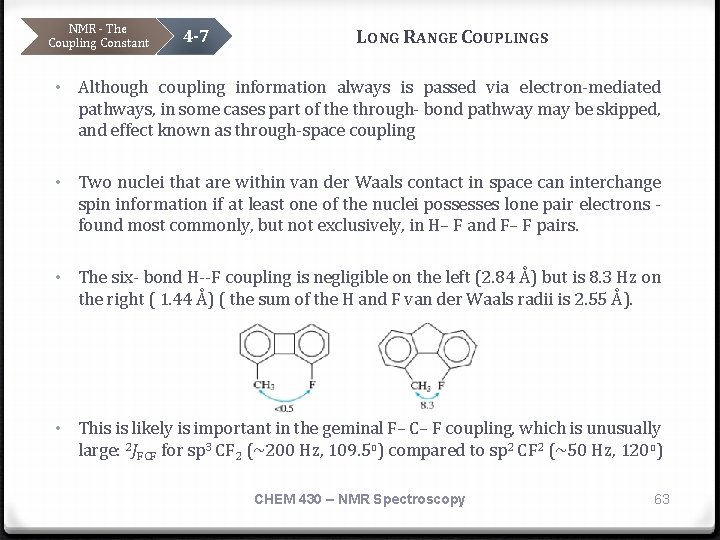
NMR - The Coupling Constant 4 -7 LONG RANGE COUPLINGS • Although coupling information always is passed via electron-mediated pathways, in some cases part of the through- bond pathway may be skipped, and effect known as through-space coupling • Two nuclei that are within van der Waals contact in space can interchange spin information if at least one of the nuclei possesses lone pair electrons - found most commonly, but not exclusively, in H– F and F– F pairs. • The six- bond H--F coupling is negligible on the left (2. 84 Å) but is 8. 3 Hz on the right ( 1. 44 Å) ( the sum of the H and F van der Waals radii is 2. 55 Å). • This is likely is important in the geminal F– C– F coupling, which is unusually large: 2 JFCF for sp 3 CF 2 (~200 Hz, 109. 5 o) compared to sp 2 CF 2 (~50 Hz, 120 o) CHEM 430 – NMR Spectroscopy 63
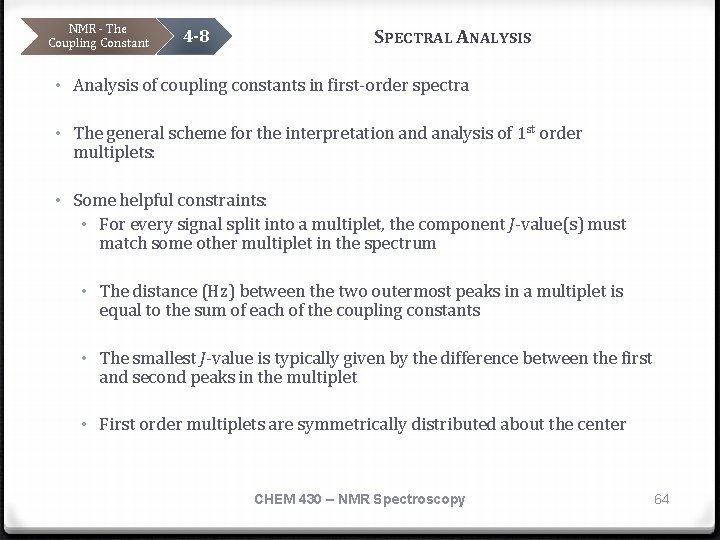
NMR - The Coupling Constant 4 -8 SPECTRAL ANALYSIS • Analysis of coupling constants in first-order spectra • The general scheme for the interpretation and analysis of 1 st order multiplets: • Some helpful constraints: • For every signal split into a multiplet, the component J-value(s) must match some other multiplet in the spectrum • The distance (Hz) between the two outermost peaks in a multiplet is equal to the sum of each of the coupling constants • The smallest J-value is typically given by the difference between the first and second peaks in the multiplet • First order multiplets are symmetrically distributed about the center CHEM 430 – NMR Spectroscopy 64
NMR - The Coupling Constant SPECTRAL ANALYSIS 4 -8 Analysis of coupling constants in first-order spectra Method: 1. Your book suggests letting the spectrometer do the work, however this method still requires ‘spectral common sense’ 2. Our method is adapted from: Hoye, T. R. ; Hanson, P. R. Vyvyan, J. R. J. Org. Chem. 1994, 59, 4096 -4103 and basically builds the same tree analysis from the branches on in 3. This paper is a well loved and regarded classic by 17 years of grateful graduate students CHEM 430 – NMR Spectroscopy 65
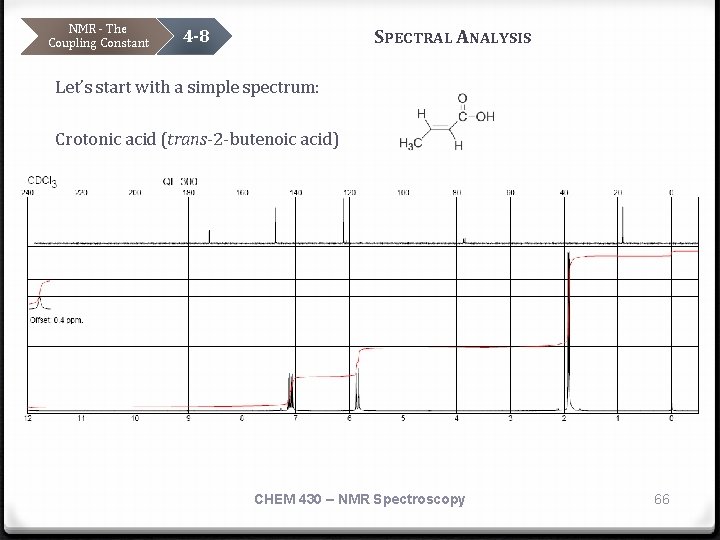
NMR - The Coupling Constant SPECTRAL ANALYSIS 4 -8 Let’s start with a simple spectrum: Crotonic acid (trans-2 -butenoic acid) CHEM 430 – NMR Spectroscopy 66
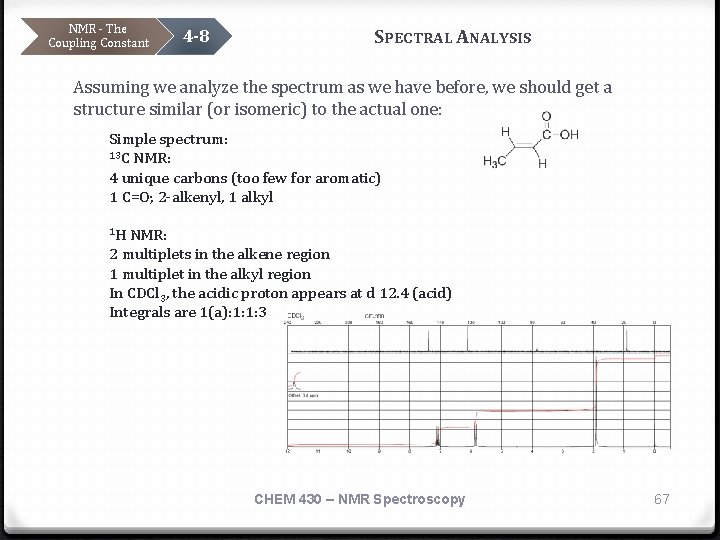
NMR - The Coupling Constant 4 -8 SPECTRAL ANALYSIS Assuming we analyze the spectrum as we have before, we should get a structure similar (or isomeric) to the actual one: Simple spectrum: 13 C NMR: 4 unique carbons (too few for aromatic) 1 C=O; 2 -alkenyl, 1 alkyl 1 H NMR: 2 multiplets in the alkene region 1 multiplet in the alkyl region In CDCl 3, the acidic proton appears at d 12. 4 (acid) Integrals are 1(a): 1: 1: 3 CHEM 430 – NMR Spectroscopy 67
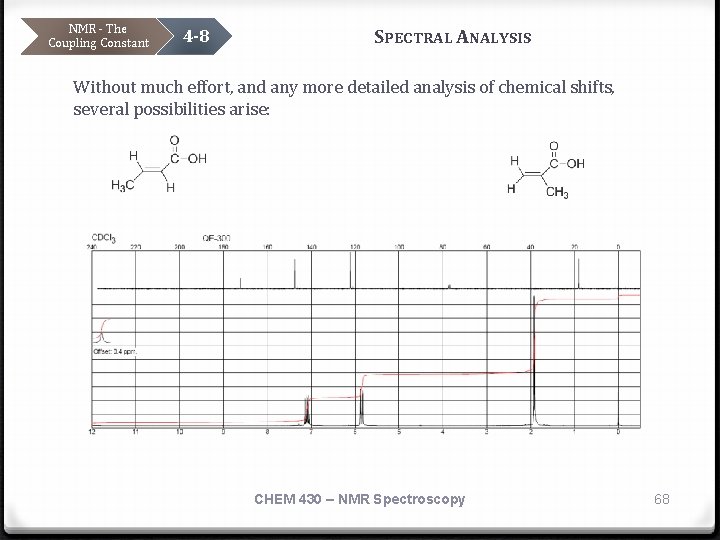
NMR - The Coupling Constant 4 -8 SPECTRAL ANALYSIS Without much effort, and any more detailed analysis of chemical shifts, several possibilities arise: CHEM 430 – NMR Spectroscopy 68
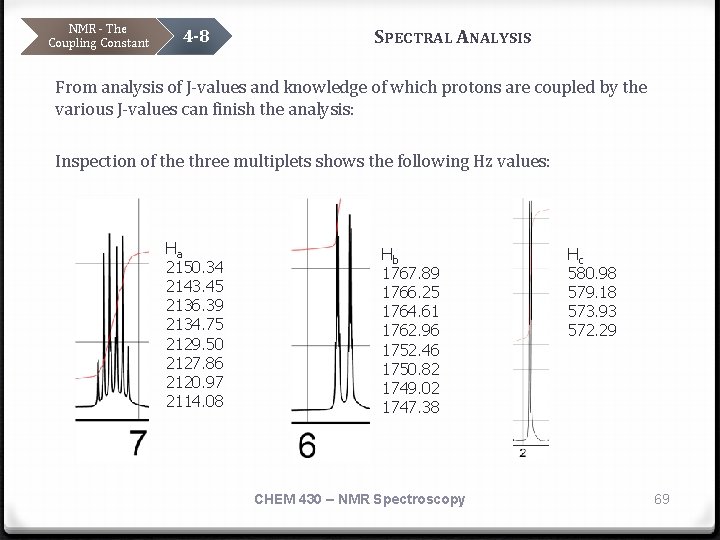
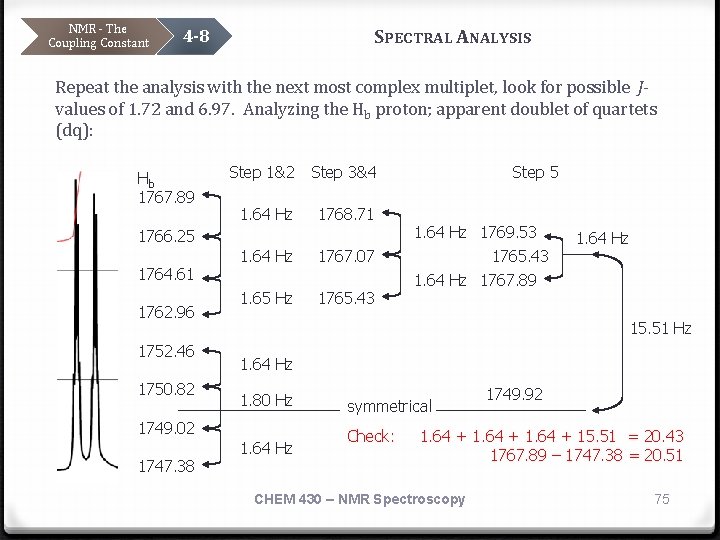
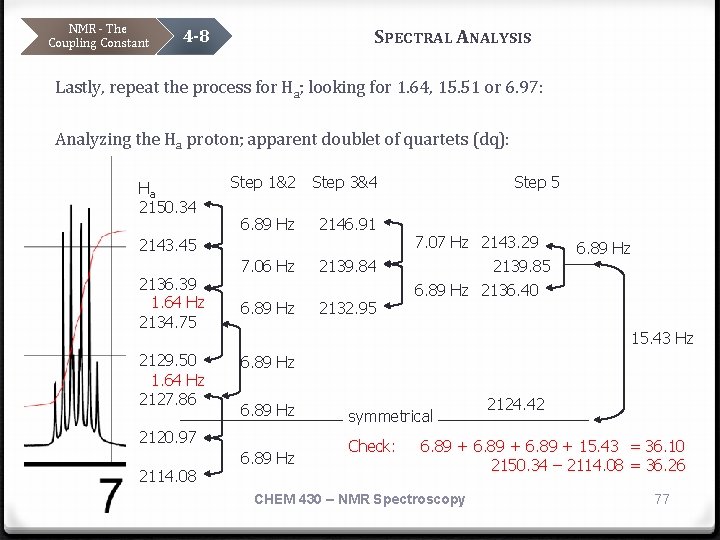
NMR - The Coupling Constant 4 -8 SPECTRAL ANALYSIS From analysis of J-values and knowledge of which protons are coupled by the various J-values can finish the analysis: Inspection of the three multiplets shows the following Hz values: Ha 2150. 34 2143. 45 2136. 39 2134. 75 2129. 50 2127. 86 2120. 97 2114. 08 Hb 1767. 89 1766. 25 1764. 61 1762. 96 1752. 46 1750. 82 1749. 02 1747. 38 CHEM 430 – NMR Spectroscopy Hc 580. 98 579. 18 573. 93 572. 29 69
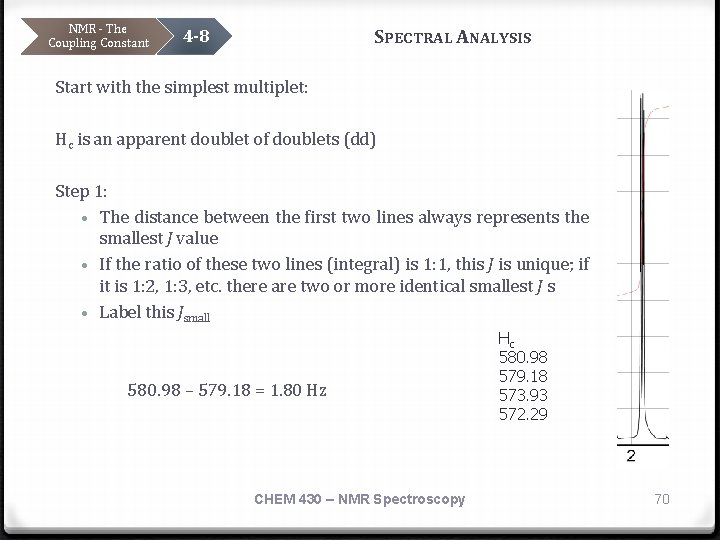
NMR - The Coupling Constant SPECTRAL ANALYSIS 4 -8 Start with the simplest multiplet: Hc is an apparent doublet of doublets (dd) Step 1: • The distance between the first two lines always represents the smallest J value • If the ratio of these two lines (integral) is 1: 1, this J is unique; if it is 1: 2, 1: 3, etc. there are two or more identical smallest J s • Label this Jsmall 580. 98 – 579. 18 = 1. 80 Hz CHEM 430 – NMR Spectroscopy Hc 580. 98 579. 18 573. 93 572. 29 70
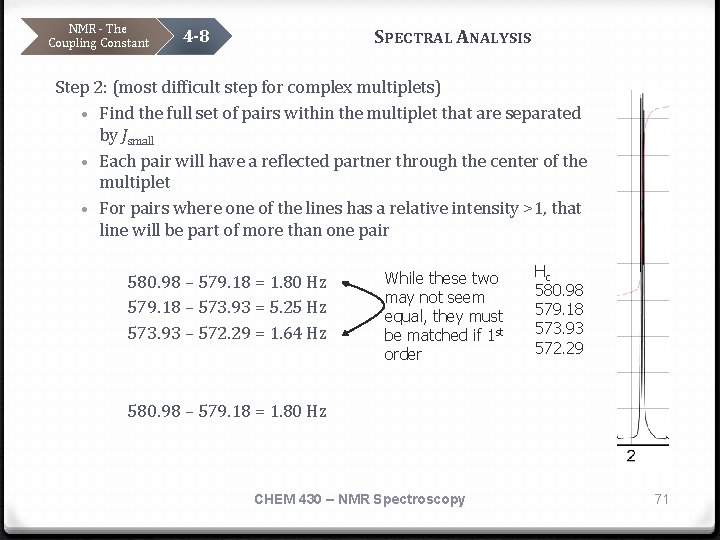
NMR - The Coupling Constant SPECTRAL ANALYSIS 4 -8 Step 2: (most difficult step for complex multiplets) • Find the full set of pairs within the multiplet that are separated by Jsmall • Each pair will have a reflected partner through the center of the multiplet • For pairs where one of the lines has a relative intensity >1, that line will be part of more than one pair 580. 98 – 579. 18 = 1. 80 Hz 579. 18 – 573. 93 = 5. 25 Hz 573. 93 – 572. 29 = 1. 64 Hz While these two may not seem equal, they must be matched if 1 st order Hc 580. 98 579. 18 573. 93 572. 29 580. 98 – 579. 18 = 1. 80 Hz CHEM 430 – NMR Spectroscopy 71
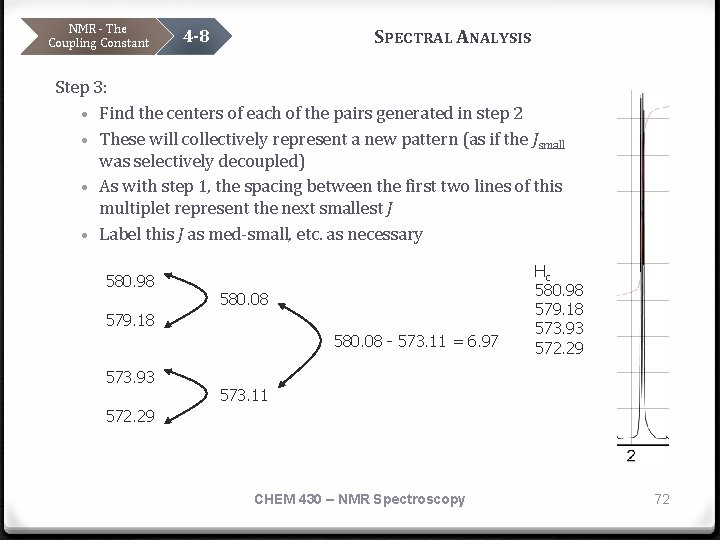
NMR - The Coupling Constant SPECTRAL ANALYSIS 4 -8 Step 3: • Find the centers of each of the pairs generated in step 2 • These will collectively represent a new pattern (as if the Jsmall was selectively decoupled) • As with step 1, the spacing between the first two lines of this multiplet represent the next smallest J • Label this J as med-small, etc. as necessary 580. 98 580. 08 579. 18 580. 08 - 573. 11 = 6. 97 573. 93 Hc 580. 98 579. 18 573. 93 572. 29 573. 11 572. 29 CHEM 430 – NMR Spectroscopy 72
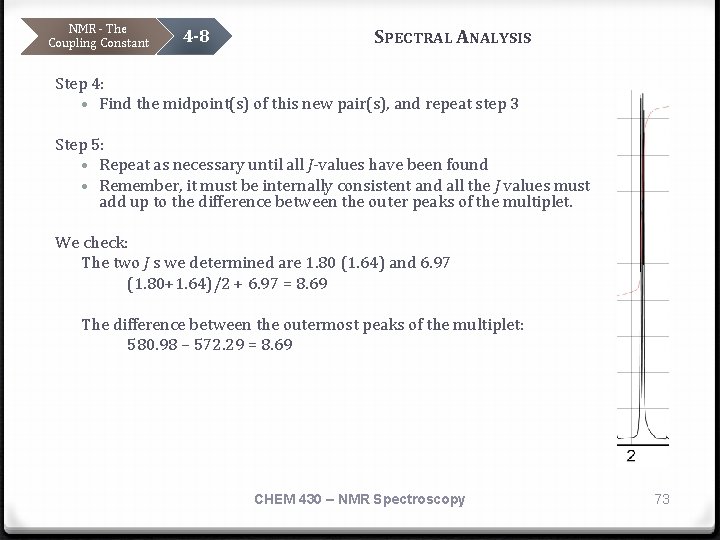
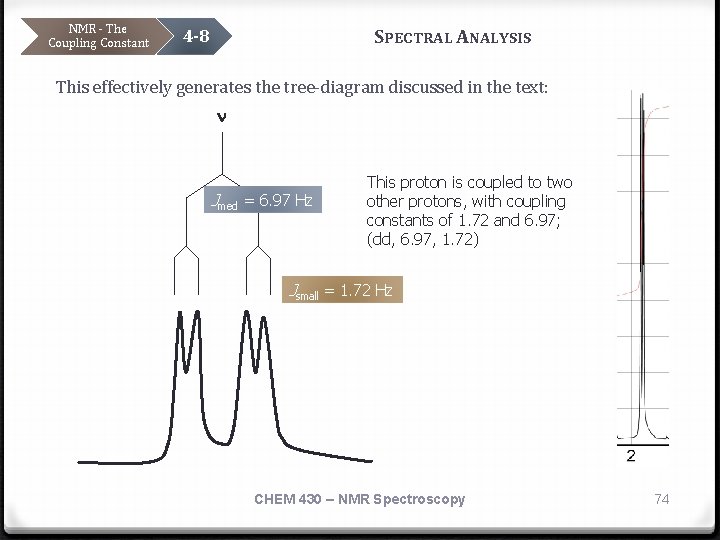
NMR - The Coupling Constant 4 -8 SPECTRAL ANALYSIS Step 4: • Find the midpoint(s) of this new pair(s), and repeat step 3 Step 5: • Repeat as necessary until all J-values have been found • Remember, it must be internally consistent and all the J values must add up to the difference between the outer peaks of the multiplet. We check: The two J s we determined are 1. 80 (1. 64) and 6. 97 (1. 80+1. 64)/2 + 6. 97 = 8. 69 The difference between the outermost peaks of the multiplet: 580. 98 – 572. 29 = 8. 69 CHEM 430 – NMR Spectroscopy 73
NMR - The Coupling Constant SPECTRAL ANALYSIS 4 -8 This effectively generates the tree-diagram discussed in the text: n Jmed = 6. 97 Hz This proton is coupled to two other protons, with coupling constants of 1. 72 and 6. 97; (dd, 6. 97, 1. 72) Jsmall = 1. 72 Hz CHEM 430 – NMR Spectroscopy 74
NMR - The Coupling Constant SPECTRAL ANALYSIS 4 -8 Repeat the analysis with the next most complex multiplet, look for possible Jvalues of 1. 72 and 6. 97. Analyzing the Hb proton; apparent doublet of quartets (dq): Hb 1767. 89 Step 1&2 Step 3&4 1. 64 Hz 1768. 71 1766. 25 1764. 61 1762. 96 1752. 46 1750. 82 1. 64 Hz 1767. 07 1. 65 Hz 1765. 43 1. 64 Hz 1769. 53 1765. 43 1. 64 Hz 1767. 89 1. 64 Hz 15. 51 Hz 1. 64 Hz 1. 80 Hz 1749. 02 1747. 38 Step 5 1. 64 Hz symmetrical Check: 1749. 92 1. 64 + 15. 51 = 20. 43 1767. 89 – 1747. 38 = 20. 51 CHEM 430 – NMR Spectroscopy 75
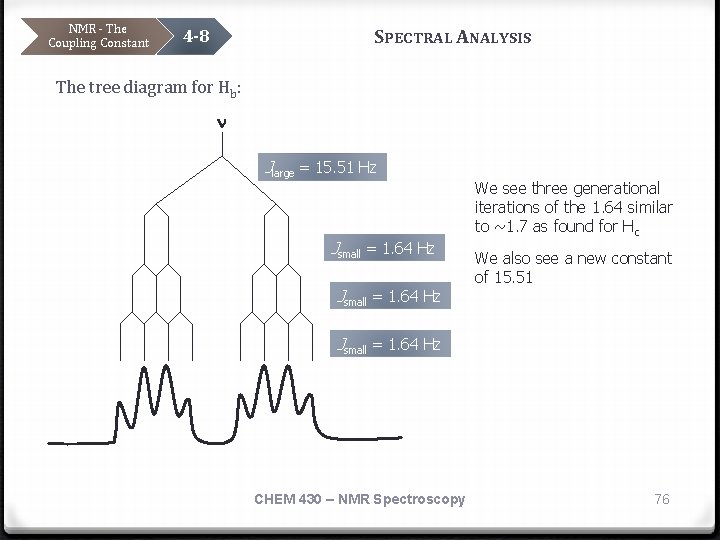
NMR - The Coupling Constant SPECTRAL ANALYSIS 4 -8 The tree diagram for Hb: n Jlarge = 15. 51 Hz Jsmall = 1. 64 Hz We see three generational iterations of the 1. 64 similar to ~1. 7 as found for Hc We also see a new constant of 15. 51 Jsmall = 1. 64 Hz CHEM 430 – NMR Spectroscopy 76
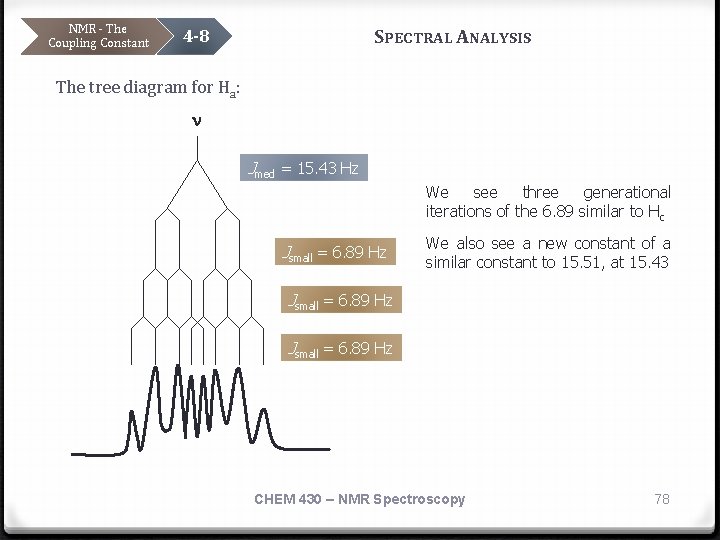
NMR - The Coupling Constant SPECTRAL ANALYSIS 4 -8 Lastly, repeat the process for Ha; looking for 1. 64, 15. 51 or 6. 97: Analyzing the Ha proton; apparent doublet of quartets (dq): Ha 2150. 34 Step 1&2 Step 3&4 6. 89 Hz 2146. 91 2143. 45 2136. 39 1. 64 Hz 2134. 75 2129. 50 1. 64 Hz 2127. 86 7. 06 Hz 2139. 84 6. 89 Hz 2132. 95 7. 07 Hz 2143. 29 2139. 85 6. 89 Hz 2136. 40 6. 89 Hz 15. 43 Hz 6. 89 Hz 2120. 97 2114. 08 Step 5 6. 89 Hz symmetrical Check: 2124. 42 6. 89 + 15. 43 = 36. 10 2150. 34 – 2114. 08 = 36. 26 CHEM 430 – NMR Spectroscopy 77
NMR - The Coupling Constant SPECTRAL ANALYSIS 4 -8 The tree diagram for Ha: n Jmed = 15. 43 Hz We see three generational iterations of the 6. 89 similar to Hc Jsmall = 6. 89 Hz We also see a new constant of a similar constant to 15. 51, at 15. 43 Jsmall = 6. 89 Hz CHEM 430 – NMR Spectroscopy 78
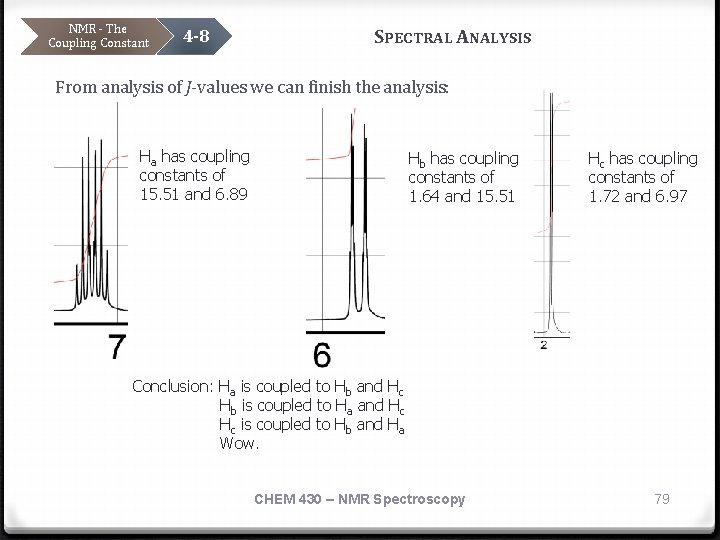
NMR - The Coupling Constant 4 -8 SPECTRAL ANALYSIS From analysis of J-values we can finish the analysis: Ha has coupling constants of 15. 51 and 6. 89 Hb has coupling constants of 1. 64 and 15. 51 Hc has coupling constants of 1. 72 and 6. 97 Conclusion: Ha is coupled to Hb and Hc Hb is coupled to Ha and Hc Hc is coupled to Hb and Ha Wow. CHEM 430 – NMR Spectroscopy 79
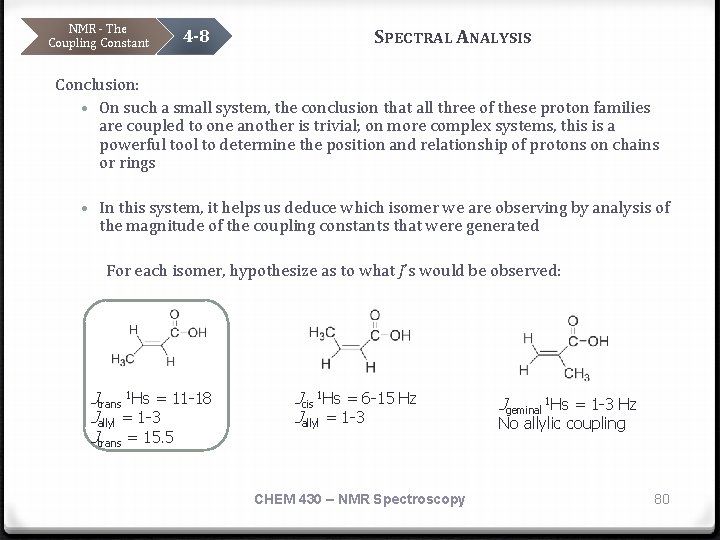
NMR - The Coupling Constant 4 -8 SPECTRAL ANALYSIS Conclusion: • On such a small system, the conclusion that all three of these proton families are coupled to one another is trivial; on more complex systems, this is a powerful tool to determine the position and relationship of protons on chains or rings • In this system, it helps us deduce which isomer we are observing by analysis of the magnitude of the coupling constants that were generated For each isomer, hypothesize as to what J’s would be observed: Jtrans 1 Hs = 11 -18 Jallyl = 1 -3 Jtrans = 15. 5 Jcis 1 Hs = 6 -15 Hz Jallyl = 1 -3 CHEM 430 – NMR Spectroscopy Jgeminal 1 Hs = 1 -3 Hz No allylic coupling 80
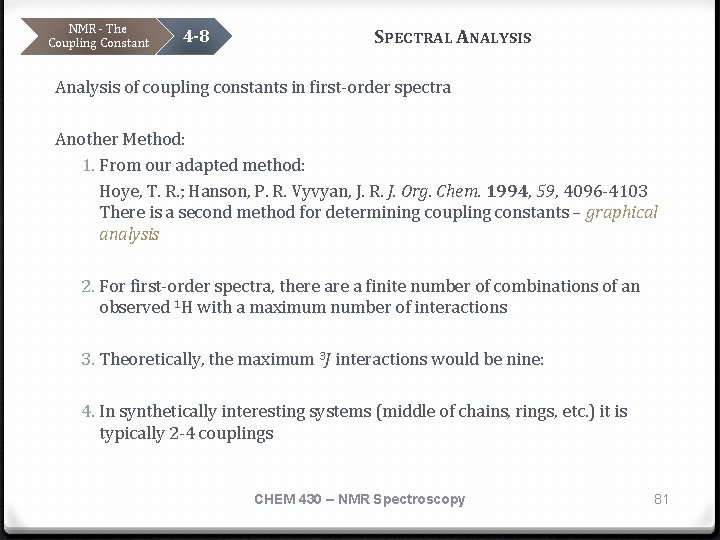
NMR - The Coupling Constant 4 -8 SPECTRAL ANALYSIS Analysis of coupling constants in first-order spectra Another Method: 1. From our adapted method: Hoye, T. R. ; Hanson, P. R. Vyvyan, J. R. J. Org. Chem. 1994, 59, 4096 -4103 There is a second method for determining coupling constants – graphical analysis 2. For first-order spectra, there a finite number of combinations of an observed 1 H with a maximum number of interactions 3. Theoretically, the maximum 3 J interactions would be nine: 4. In synthetically interesting systems (middle of chains, rings, etc. ) it is typically 2 -4 couplings CHEM 430 – NMR Spectroscopy 81
NMR - The Coupling Constant 4 -8 SPECTRAL ANALYSIS Another Method: 5. The authors of the article suggest the method of visual pattern recognition to save some of the tedium of the more analytical analysis we just covered 6. In the paper, they generated a series of tables that systematically cover the most commonly encountered spin systems 7. For each table, an example compound is used to show where such a spin pattern would be observed 8. It is suggested that you go through the paper, in conjunction with your text (as a reference for representative J-values) to see how each of the tables apply to the example the authors used CHEM 430 – NMR Spectroscopy 82
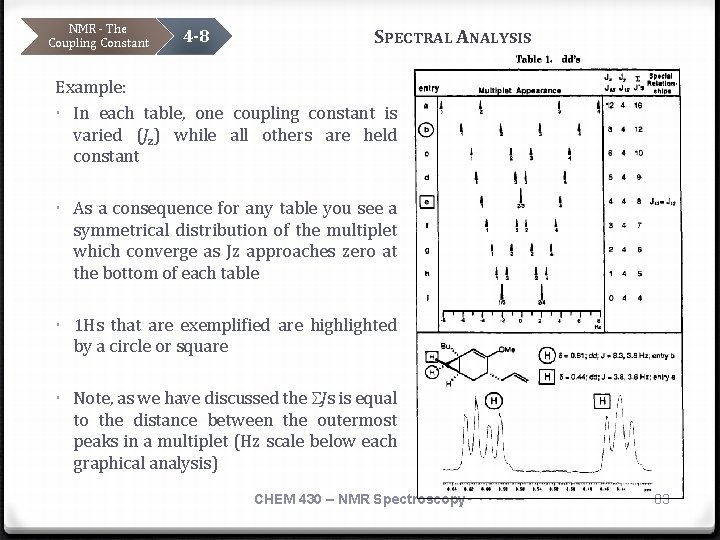
NMR - The Coupling Constant 4 -8 SPECTRAL ANALYSIS Example: ∙ In each table, one coupling constant is varied (Jz) while all others are held constant ∙ As a consequence for any table you see a symmetrical distribution of the multiplet which converge as Jz approaches zero at the bottom of each table ∙ 1 Hs that are exemplified are highlighted by a circle or square ∙ Note, as we have discussed the SJs is equal to the distance between the outermost peaks in a multiplet (Hz scale below each graphical analysis) CHEM 430 – NMR Spectroscopy 83
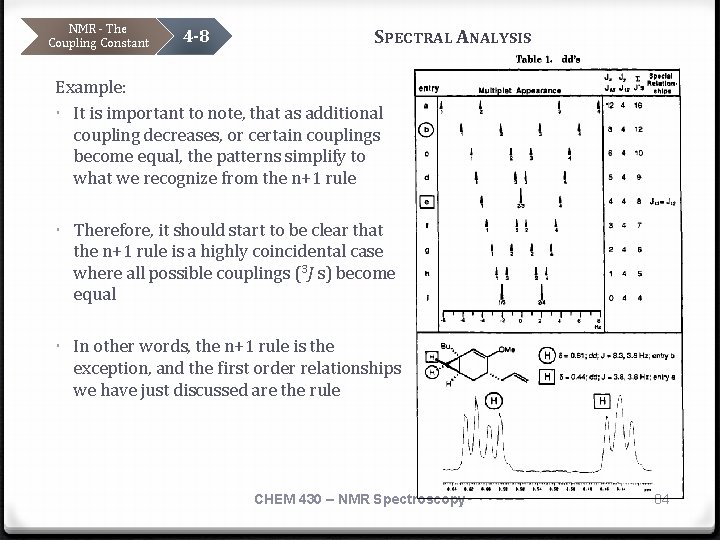
NMR - The Coupling Constant 4 -8 SPECTRAL ANALYSIS Example: ∙ It is important to note, that as additional coupling decreases, or certain couplings become equal, the patterns simplify to what we recognize from the n+1 rule ∙ Therefore, it should start to be clear that the n+1 rule is a highly coincidental case where all possible couplings (3 J s) become equal ∙ In other words, the n+1 rule is the exception, and the first order relationships we have just discussed are the rule CHEM 430 – NMR Spectroscopy 84
NMR - The Coupling Constant 4 -9 SECOND ORDER SPECTRA • Second- order spectra are characterized by peak spacings that do not correspond to coupling constants, by nonbinomial intensities, by chemical shifts that are not at resonance midpoints, or by resonance multiplicities that do not follow the n + 1 rule • Even when the spectrum has the appearance of being first order, it may not be. • Lines can coincide in such a way that the spectrum assumes a simpler appearance than seems consistent with the actual spectral parameters ( a situation termed deceptive simplicity). CHEM 430 – NMR Spectroscopy 85
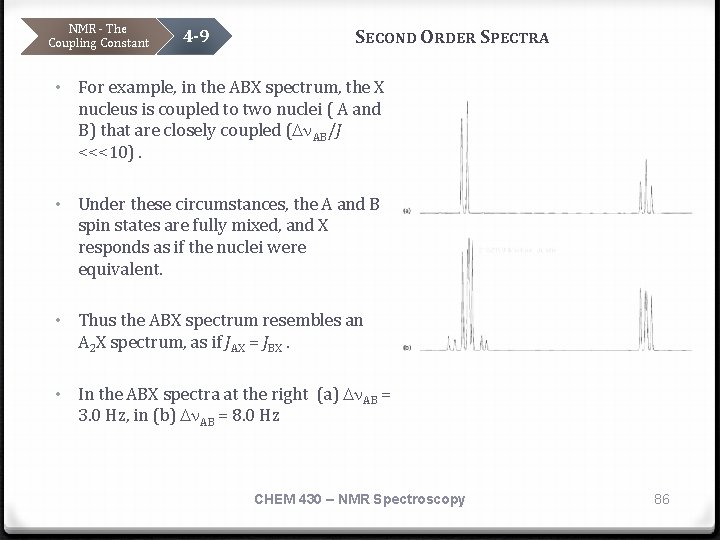
NMR - The Coupling Constant 4 -9 SECOND ORDER SPECTRA • For example, in the ABX spectrum, the X nucleus is coupled to two nuclei ( A and B) that are closely coupled (Dn. AB/J <<<10). • Under these circumstances, the A and B spin states are fully mixed, and X responds as if the nuclei were equivalent. • Thus the ABX spectrum resembles an A 2 X spectrum, as if JAX = JBX. • In the ABX spectra at the right (a) Dn. AB = 3. 0 Hz, in (b) Dn. AB = 8. 0 Hz CHEM 430 – NMR Spectroscopy 86
NMR - The Coupling Constant 4 -9 SECOND ORDER SPECTRA • The AA'XX' spectrum often is observed as a deceptively simple pair of triplets, resembling A 2 X 2. • In this case, it is the A and A' nuclei that are closely coupled ( and JAA' is large). • Such deceptive simplicity is not eliminated by raising the field because A and A' are chemically equivalent. • The chemist should beware of the pair of triplets that falsely suggests magnetic equivalence ( A 2 X 2) and equal couplings , when the molecular structure suggests AA'XX'. • Sometimes the couplings between A and X may be observed by lowering the field to turn the AA'XX' spectrum into AA'BB' with a larger number of peaks that may permit a complete analysis. CHEM 430 – NMR Spectroscopy 87
NMR - The Coupling Constant 4 -9 SECOND ORDER SPECTRA • Another example of second-order complexity occurs in the ABX spectrum (or, more generally, Ax. By. Xz) when A and B are very closely coupled, JAX is large, and JBX is zero. • With no coupling to B, the X spectrum should be a simple doublet from coupling to A. • Since A and B are closely coupled, however, the spin states of A and B are mixed, and the X spectrum is perturbed by the B spins (the phenomenon has been termed virtual coupling, which is something of a misnomer, since B is not coupled to X). CHEM 430 – NMR Spectroscopy 88
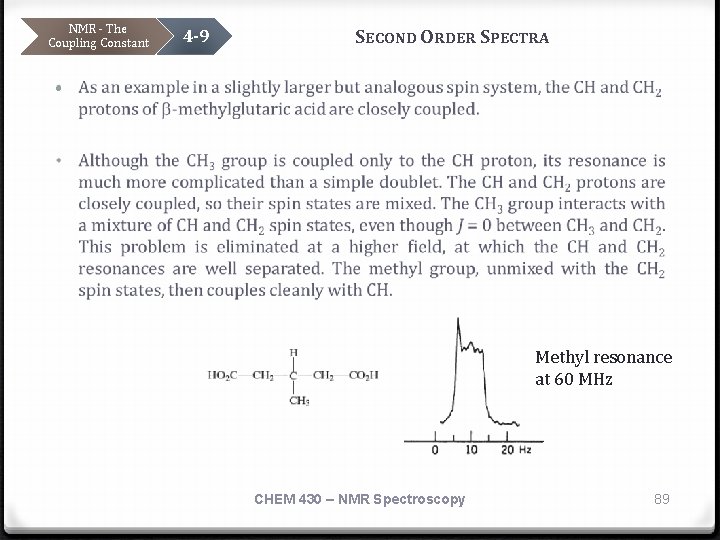
NMR - The Coupling Constant 4 -9 SECOND ORDER SPECTRA • Methyl resonance at 60 MHz CHEM 430 – NMR Spectroscopy 89
NMR - The Coupling Constant 4 -9 SECOND ORDER SPECTRA • Sometimes proton spectra are second order even at 500 MHz or higher ( aside from the AA' case). • Some institutions still have access only to iron core, 60 MHz spectrometers, which produce largely second- order proton spectra. • In each case, these spectra may be clarified somewhat by the use of paramagnetic shift reagents. These molecules contain unpaired spins and form Lewis acid– base complexes with dissolved substrates. • The unpaired spin exerts a strong paramagnetic shielding effect (downfield) on nuclei close to it. The effect drops off rapidly with distance, so that those nuclei in the substrate that are closest to the site of acid–base binding are affected more. • Consequently, the shift to higher frequency varies through the substrate and hence leads to greater separation of peaks. CHEM 430 – NMR Spectroscopy 90
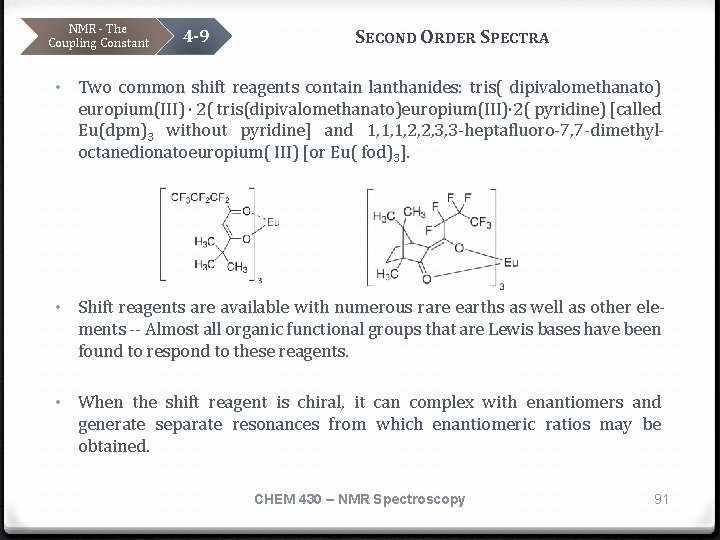
NMR - The Coupling Constant 4 -9 SECOND ORDER SPECTRA • Two common shift reagents contain lanthanides: tris( dipivalomethanato) europium(III) · 2( tris(dipivalomethanato)europium(III)· 2( pyridine) [called Eu(dpm)3 without pyridine] and 1, 1, 1, 2, 2, 3, 3 -heptafluoro-7, 7 -dimethyloctanedionatoeuropium( III) [or Eu( fod)3]. • Shift reagents are available with numerous rare earths as well as other elements -- Almost all organic functional groups that are Lewis bases have been found to respond to these reagents. • When the shift reagent is chiral, it can complex with enantiomers and generate separate resonances from which enantiomeric ratios may be obtained. CHEM 430 – NMR Spectroscopy 91
NMR - The Coupling Constant 4 -1 FIRST ORDER SPECTRA CHEM 430 – NMR Spectroscopy 92
NMR - The Coupling Constant 4 -1 FIRST ORDER SPECTRA CHEM 430 – NMR Spectroscopy 93
NMR - The Coupling Constant 4 -1 FIRST ORDER SPECTRA CHEM 430 – NMR Spectroscopy 94