
NMR Core Facility Training Course HighField Biomacromolecular Solution
NMR Core Facility Training Course High-Field Biomacromolecular Solution NMR Core Facility National Research Program for Genomic Medicine Topics: Protein Solution NMR Spectroscopy. Instructor: Tai-huang Huang, (Chi-Fon Chang and Winston Wu) Time: Every Saturday 10: 00 AM - 1: 00 PM for ~ 15 sessions (First session: Oct 2, 2004) Place: B 1 A room, IBMS, Academia Sinica Pre-requisite: Some prior experience with protein NMR spectroscopy. Textbooks: 1. Lecture by James Keeler on “Understanding NMR spectroscopy” (http: //www-keeler. ch. cam. ac. uk/lectures/) 2. Cavanagh, Fairbrother, Palmer, and Skelton: “Protein NMR spectroscopy – Principles and practice” Academic press, 1996. 3. Selected review articles.
Curse Content This will be a comprehensive lecture course, focusing on modern high field NMR spectroscopy in solution, with applications to protein structure, dynamics and functional studies. Topics to be covered include: 1. Basic NMR theory, including quantum mechanical and vectorial descriptions 2. of NMR spectroscopy. 2. Basic experimental aspects of NMR: NMR data acquisition and processing. 3. Product operator formalism analysis of pulse programs. 3. Spin dynamics: Coherent selection, phase cycling, gradient enhanced spectroscopy. 4. Heteronuclear multidimensional NMR spectroscopy. 5. Relaxation and protein dynamics. 6. Special topics: TROSY, RDC and reduced dimensionality etc. 7. Applications in protein NMR in solution.
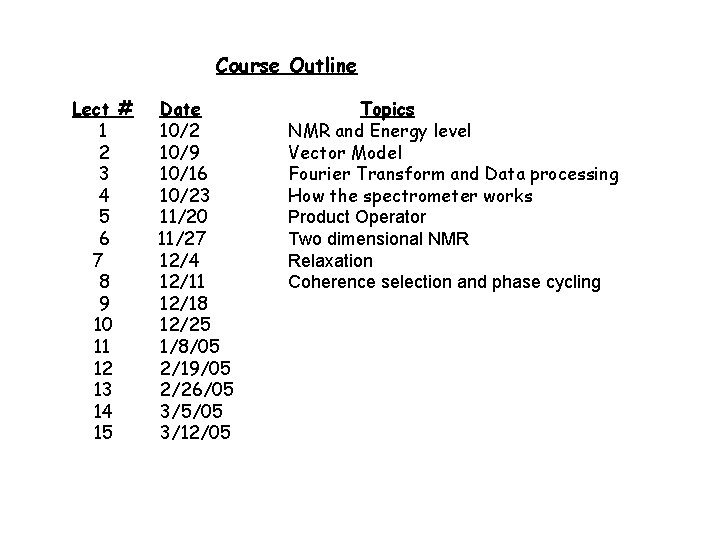
Course Outline Lect # 1 2 3 4 5 6 7 8 9 10 11 12 13 14 15 Date 10/2 10/9 10/16 10/23 11/20 11/27 12/4 12/11 12/18 12/25 1/8/05 2/19/05 2/26/05 3/5/05 3/12/05 Topics NMR and Energy level Vector Model Fourier Transform and Data processing How the spectrometer works Product Operator Two dimensional NMR Relaxation Coherence selection and phase cycling
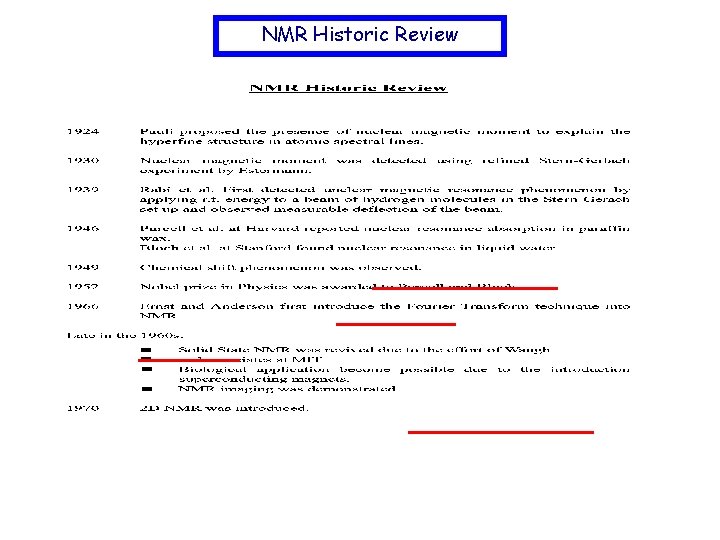
NMR Historic Review

2002 Nobel prize in Chemistry was awarded to Kurt Wuthrich NMR is a versatile tool and it has applications in wide varieties of subjects in addition to its chemical and biomedical applications, including material and quantum computing.
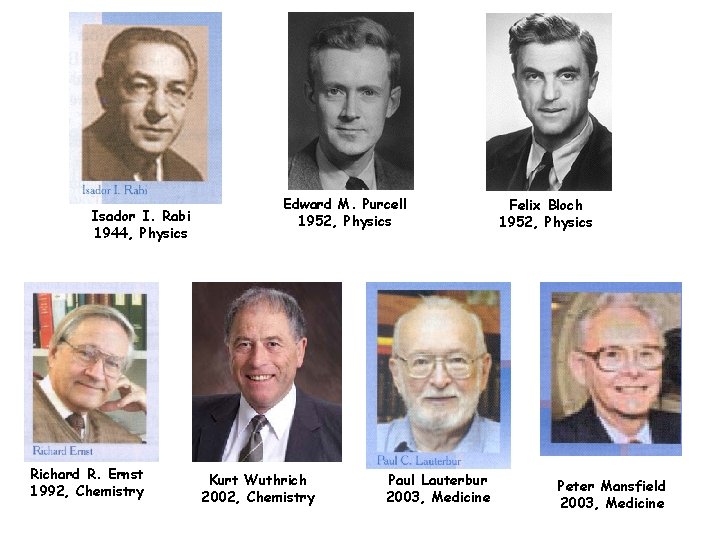
Isador I. Rabi 1944, Physics Richard R. Ernst 1992, Chemistry Edward M. Purcell 1952, Physics Kurt Wuthrich 2002, Chemistry Paul Lauterbur 2003, Medicine Felix Bloch 1952, Physics Peter Mansfield 2003, Medicine
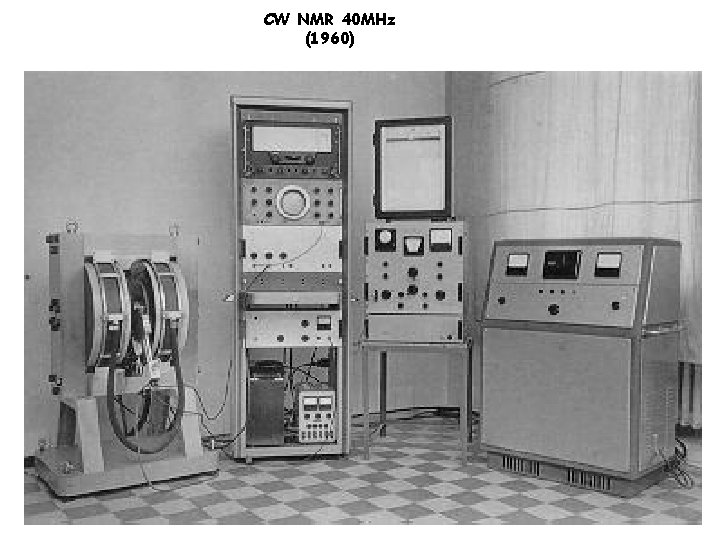
CW NMR 40 MHz (1960)
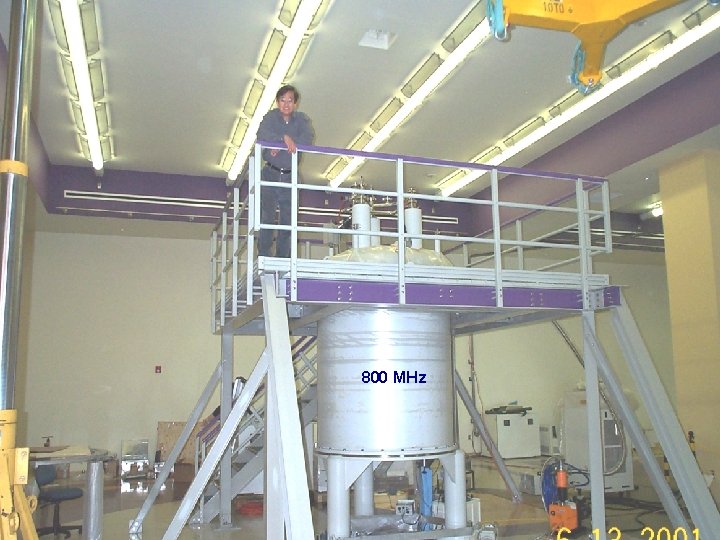
800 MHz
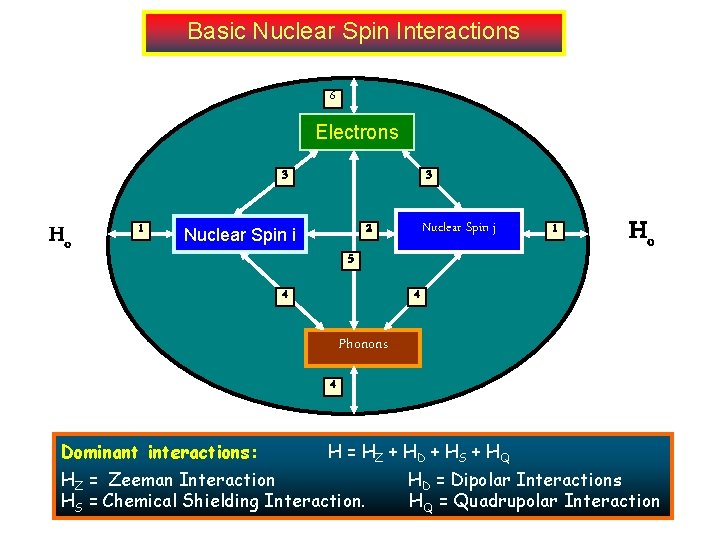
Basic Nuclear Spin Interactions 6 Electrons 3 Ho 1 3 Nuclear Spin j 2 Nuclear Spin i 5 4 1 Ho 4 Phonons 4 Dominant interactions: . H = HZ + HD + HS + HQ HZ = Zeeman Interaction HS = Chemical Shielding Interaction. HD = Dipolar Interactions HQ = Quadrupolar Interaction
- Slides: 9