
NMR Analysis of Protein Dynamics Despite the Typical
- Slides: 27
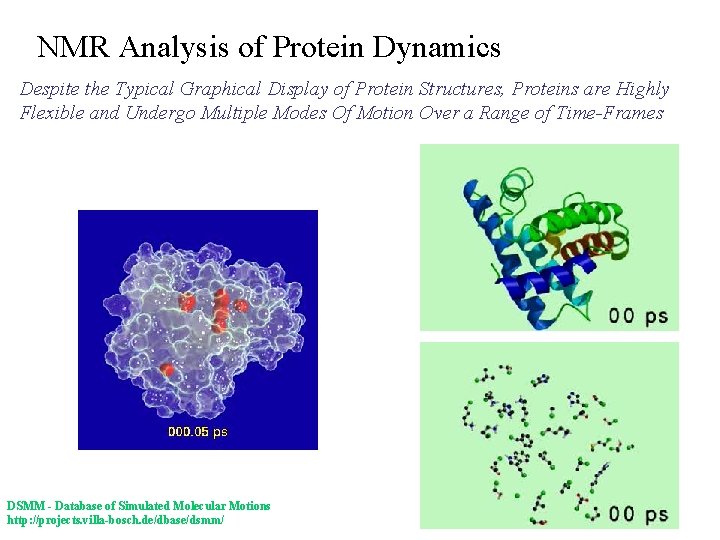
NMR Analysis of Protein Dynamics Despite the Typical Graphical Display of Protein Structures, Proteins are Highly Flexible and Undergo Multiple Modes Of Motion Over a Range of Time-Frames DSMM - Database of Simulated Molecular Motions http: //projects. villa-bosch. de/dbase/dsmm/
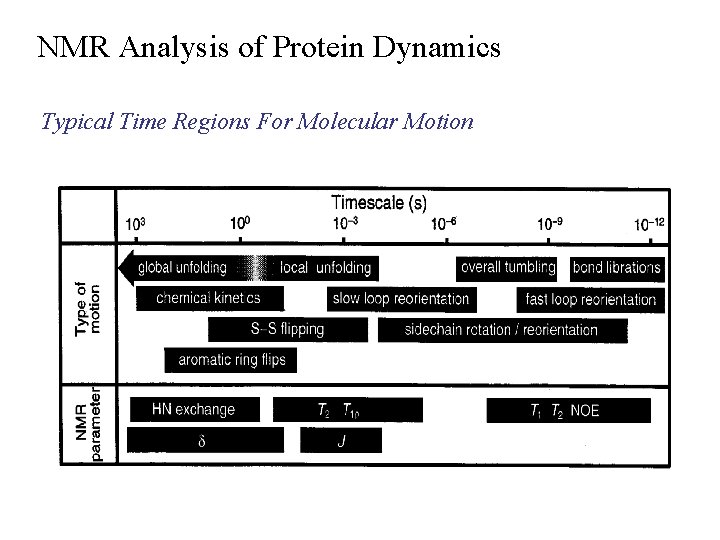
NMR Analysis of Protein Dynamics Typical Time Regions For Molecular Motion
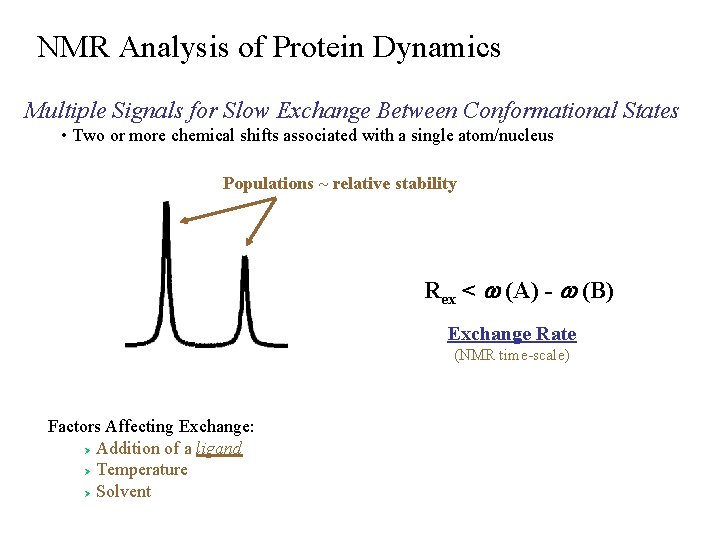
NMR Analysis of Protein Dynamics Multiple Signals for Slow Exchange Between Conformational States • Two or more chemical shifts associated with a single atom/nucleus Populations ~ relative stability Rex < w (A) - w (B) Exchange Rate (NMR time-scale) Factors Affecting Exchange: Ø Addition of a ligand Ø Temperature Ø Solvent
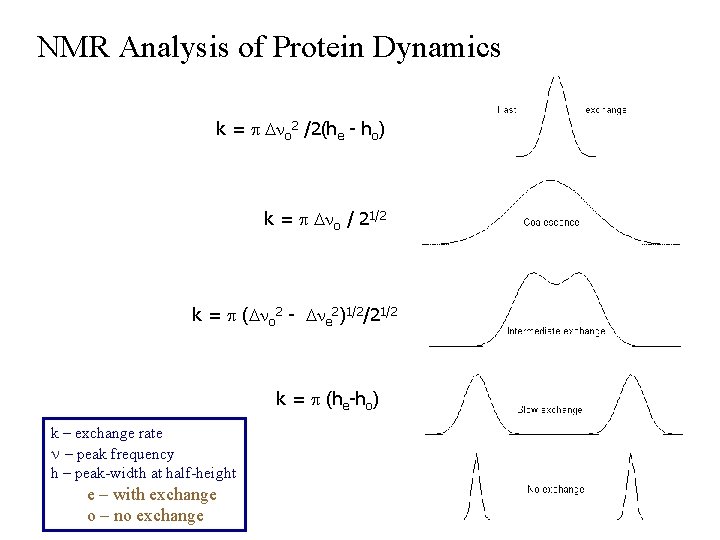
NMR Analysis of Protein Dynamics k = p Dno 2 /2(he - ho) k = p Dno / 21/2 k = p (Dno 2 - Dne 2)1/2/21/2 k = p (he-ho) k – exchange rate n – peak frequency h – peak-width at half-height e – with exchange o – no exchange
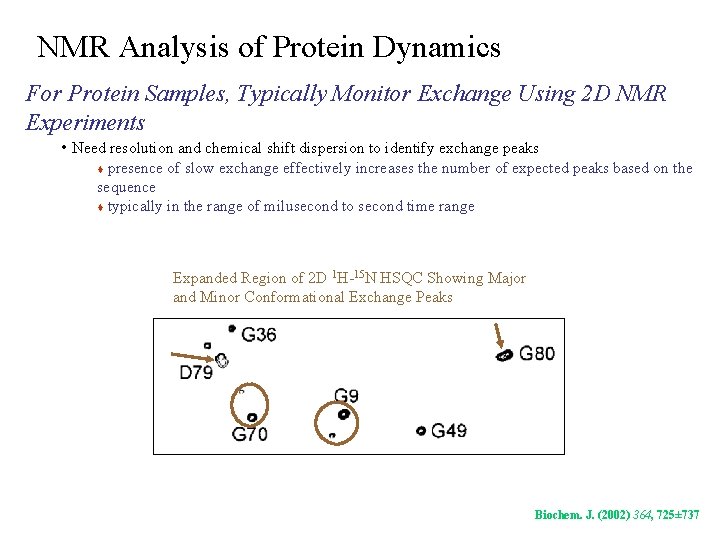
NMR Analysis of Protein Dynamics For Protein Samples, Typically Monitor Exchange Using 2 D NMR Experiments • Need resolution and chemical shift dispersion to identify exchange peaks presence of slow exchange effectively increases the number of expected peaks based on the sequence t typically in the range of milusecond to second time range t Expanded Region of 2 D 1 H-15 N HSQC Showing Major and Minor Conformational Exchange Peaks Biochem. J. (2002) 364, 725± 737
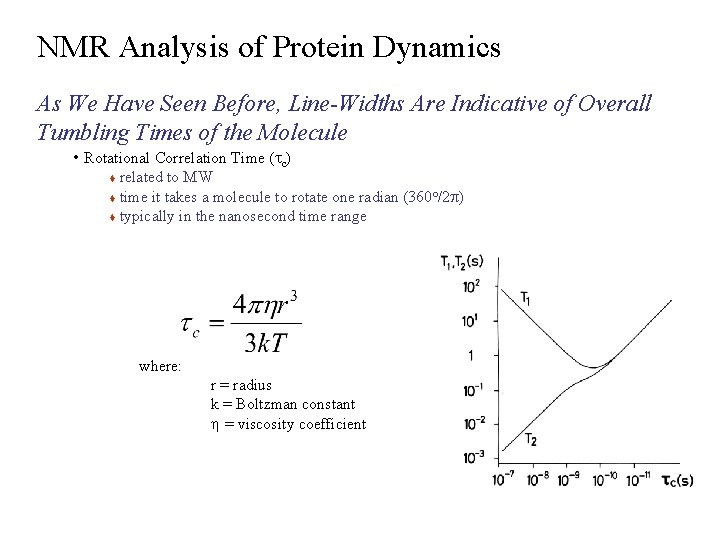
NMR Analysis of Protein Dynamics As We Have Seen Before, Line-Widths Are Indicative of Overall Tumbling Times of the Molecule • Rotational Correlation Time (tc) related to MW o t time it takes a molecule to rotate one radian (360 /2 p) t typically in the nanosecond time range t where: r = radius k = Boltzman constant h = viscosity coefficient
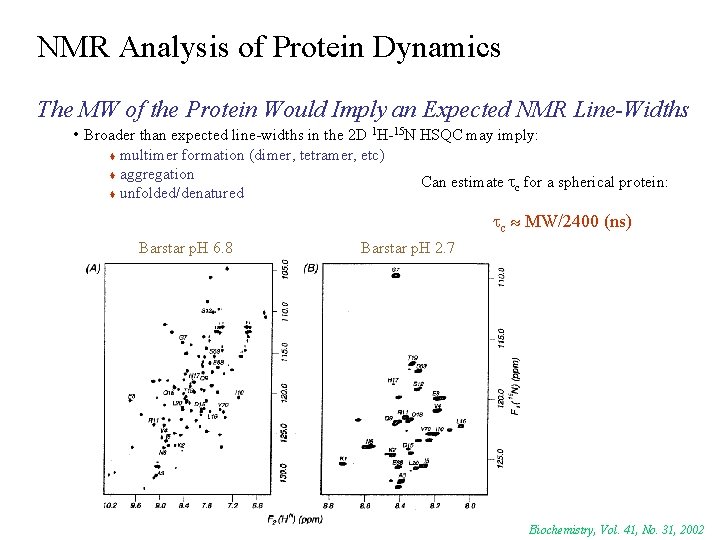
NMR Analysis of Protein Dynamics The MW of the Protein Would Imply an Expected NMR Line-Widths • Broader than expected line-widths in the 2 D 1 H-15 N HSQC may imply: multimer formation (dimer, tetramer, etc) t aggregation t unfolded/denatured t Can estimate tc for a spherical protein: tc » MW/2400 (ns) Barstar p. H 6. 8 Barstar p. H 2. 7 Biochemistry, Vol. 41, No. 31, 2002
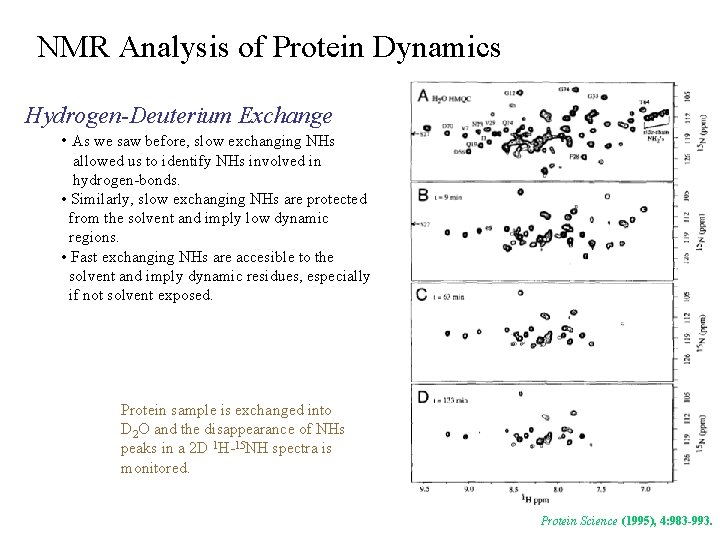
NMR Analysis of Protein Dynamics Hydrogen-Deuterium Exchange • As we saw before, slow exchanging NHs allowed us to identify NHs involved in hydrogen-bonds. • Similarly, slow exchanging NHs are protected from the solvent and imply low dynamic regions. • Fast exchanging NHs are accesible to the solvent and imply dynamic residues, especially if not solvent exposed. Protein sample is exchanged into D 2 O and the disappearance of NHs peaks in a 2 D 1 H-15 NH spectra is monitored. Protein Science (1995), 4: 983 -993.
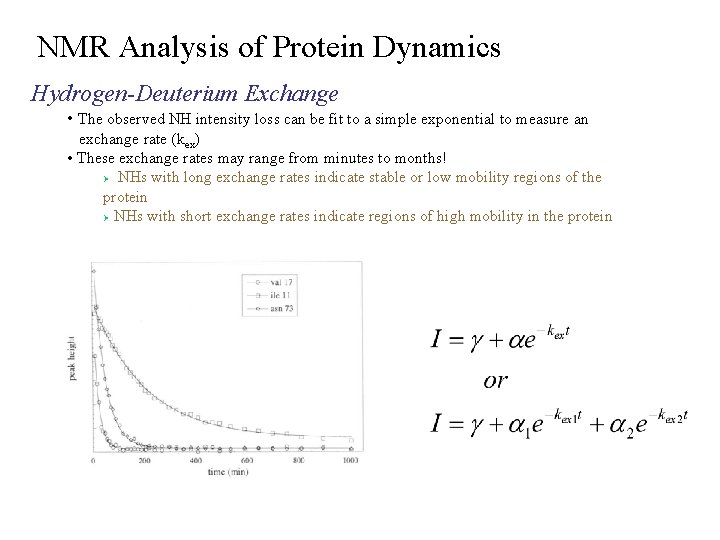
NMR Analysis of Protein Dynamics Hydrogen-Deuterium Exchange • The observed NH intensity loss can be fit to a simple exponential to measure an exchange rate (kex) • These exchange rates may range from minutes to months! Ø NHs with long exchange rates indicate stable or low mobility regions of the protein Ø NHs with short exchange rates indicate regions of high mobility in the protein
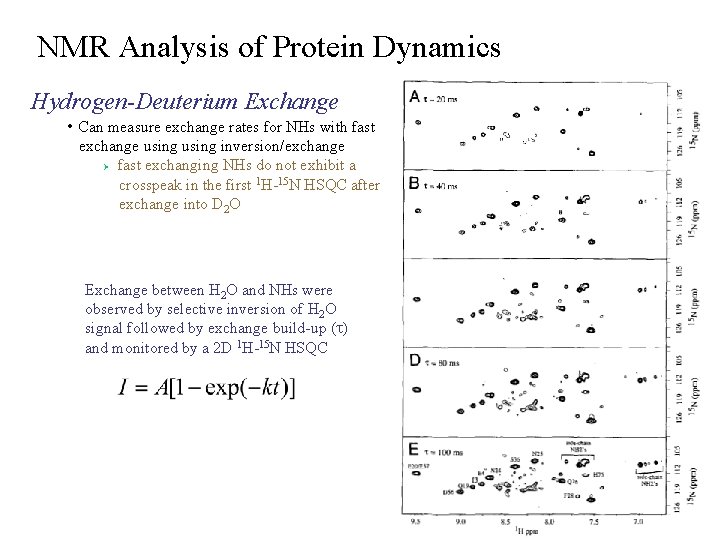
NMR Analysis of Protein Dynamics Hydrogen-Deuterium Exchange • Can measure exchange rates for NHs with fast exchange using inversion/exchange Ø fast exchanging NHs do not exhibit a crosspeak in the first 1 H-15 N HSQC after exchange into D 2 O Exchange between H 2 O and NHs were observed by selective inversion of H 2 O signal followed by exchange build-up (t) and monitored by a 2 D 1 H-15 N HSQC
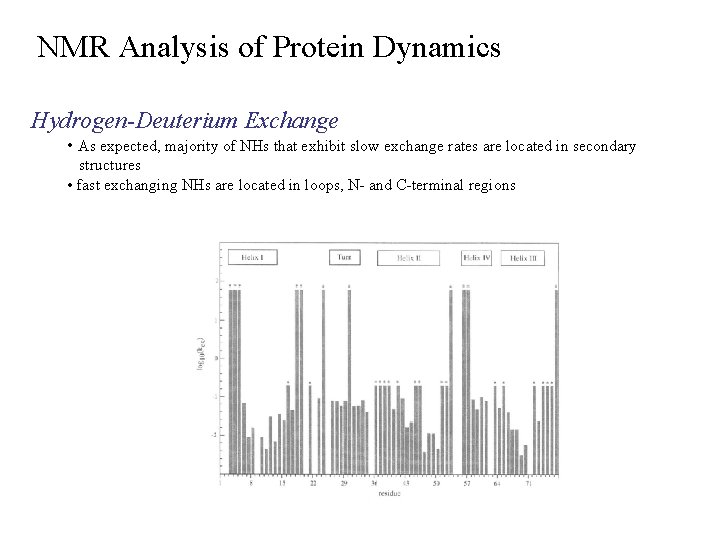
NMR Analysis of Protein Dynamics Hydrogen-Deuterium Exchange • As expected, majority of NHs that exhibit slow exchange rates are located in secondary structures • fast exchanging NHs are located in loops, N- and C-terminal regions
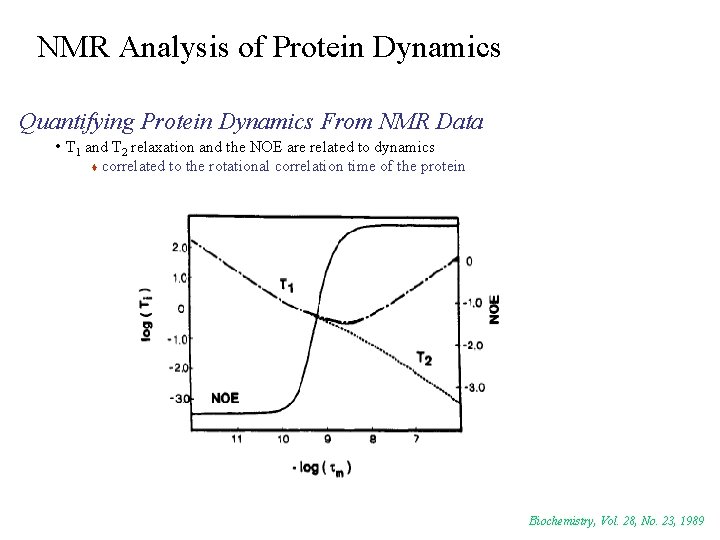
NMR Analysis of Protein Dynamics Quantifying Protein Dynamics From NMR Data • T 1 and T 2 relaxation and the NOE are related to dynamics t correlated to the rotational correlation time of the protein Biochemistry, Vol. 28, No. 23, 1989
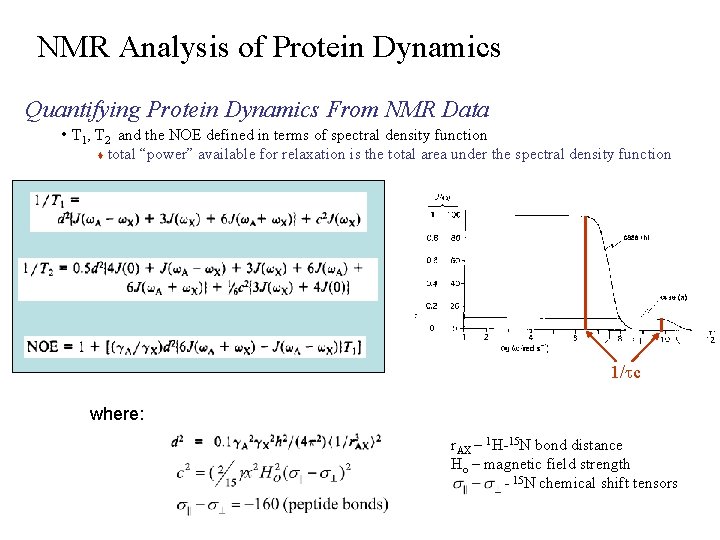
NMR Analysis of Protein Dynamics Quantifying Protein Dynamics From NMR Data • T 1, T 2 and the NOE defined in terms of spectral density function t total “power” available for relaxation is the total area under the spectral density function 1/tc where: r. AX – 1 H-15 N bond distance Ho – magnetic field strength - 15 N chemical shift tensors
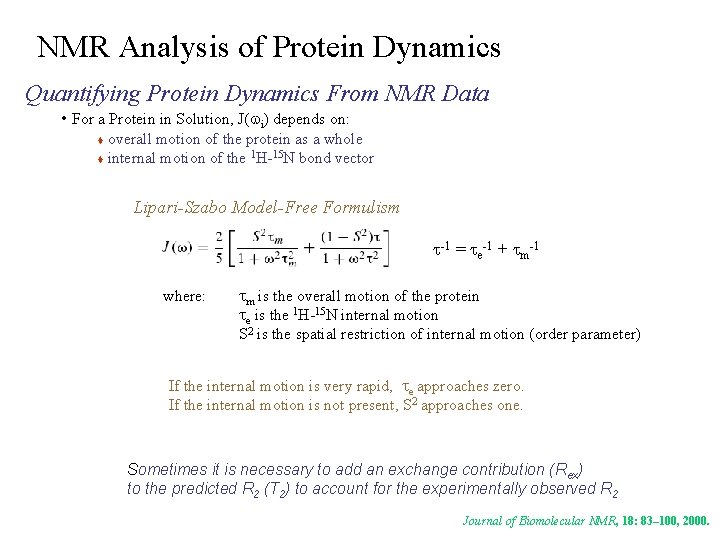
NMR Analysis of Protein Dynamics Quantifying Protein Dynamics From NMR Data • For a Protein in Solution, J(wi) depends on: overall motion of the protein as a whole 1 15 t internal motion of the H- N bond vector t Lipari-Szabo Model-Free Formulism t-1 = te-1 + tm-1 where: tm is the overall motion of the protein te is the 1 H-15 N internal motion S 2 is the spatial restriction of internal motion (order parameter) If the internal motion is very rapid, te approaches zero. If the internal motion is not present, S 2 approaches one. Sometimes it is necessary to add an exchange contribution (Rex) to the predicted R 2 (T 2) to account for the experimentally observed R 2 Journal of Biomolecular NMR, 18: 83– 100, 2000.
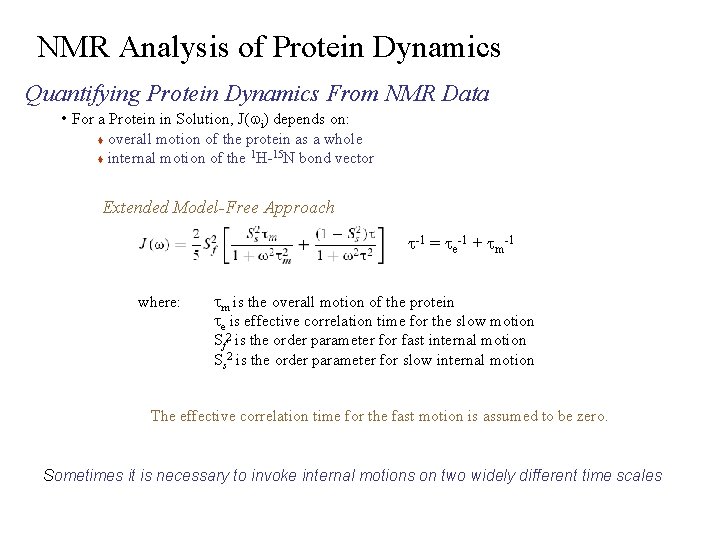
NMR Analysis of Protein Dynamics Quantifying Protein Dynamics From NMR Data • For a Protein in Solution, J(wi) depends on: overall motion of the protein as a whole 1 15 t internal motion of the H- N bond vector t Extended Model-Free Approach t-1 = te-1 + tm-1 where: tm is the overall motion of the protein te is effective correlation time for the slow motion Sf 2 is the order parameter for fast internal motion Ss 2 is the order parameter for slow internal motion The effective correlation time for the fast motion is assumed to be zero. Sometimes it is necessary to invoke internal motions on two widely different time scales
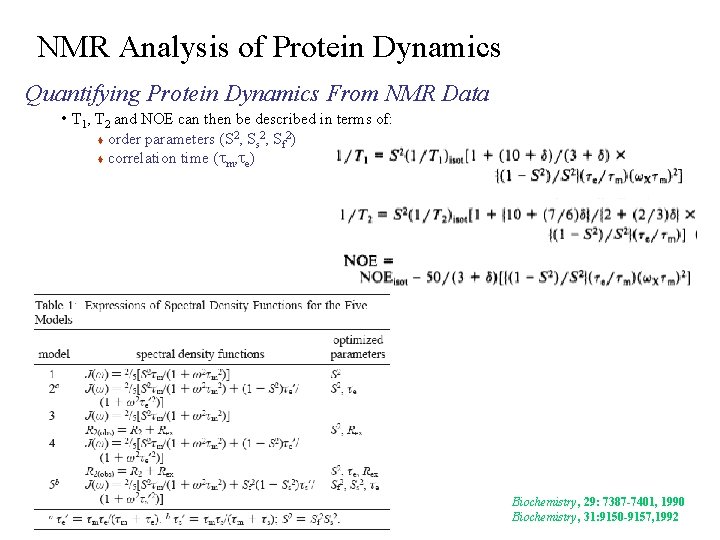
NMR Analysis of Protein Dynamics Quantifying Protein Dynamics From NMR Data • T 1, T 2 and NOE can then be described in terms of: order parameters (S 2, Ss 2, Sf 2) t correlation time (tm, te) t Biochemistry, 29: 7387 -7401, 1990 Biochemistry, 31: 9150 -9157, 1992
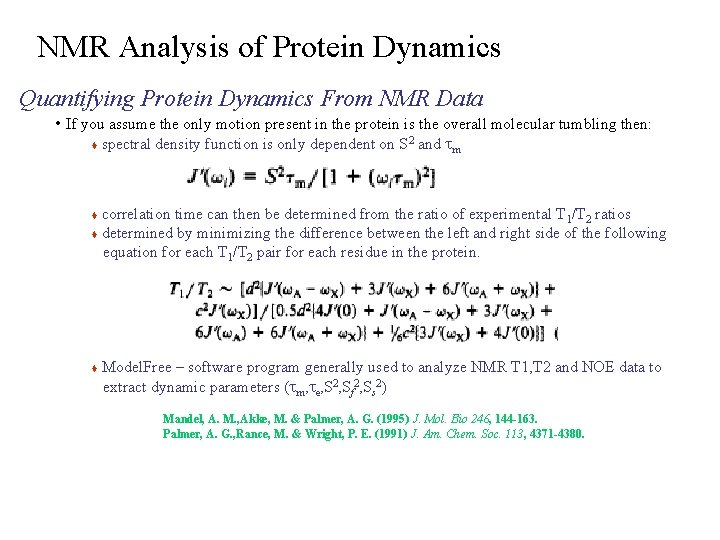
NMR Analysis of Protein Dynamics Quantifying Protein Dynamics From NMR Data • If you assume the only motion present in the protein is the overall molecular tumbling then: t spectral density function is only dependent on S 2 and tm correlation time can then be determined from the ratio of experimental T 1/T 2 ratios t determined by minimizing the difference between the left and right side of the following equation for each T 1/T 2 pair for each residue in the protein. t t Model. Free – software program generally used to analyze NMR T 1, T 2 and NOE data to extract dynamic parameters (tm, te, S 2, Sf 2, Ss 2) Mandel, A. M. , Akke, M. & Palmer, A. G. (1995) J. Mol. Bio 246, 144 -163. Palmer, A. G. , Rance, M. & Wright, P. E. (1991) J. Am. Chem. Soc. 113, 4371 -4380.
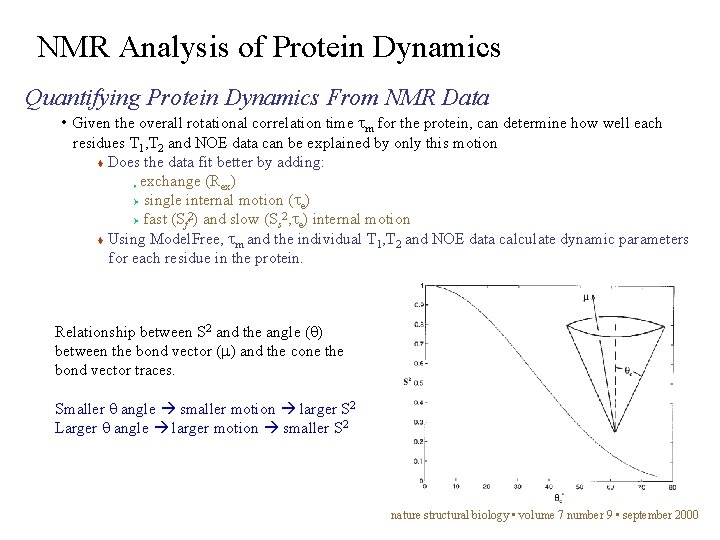
NMR Analysis of Protein Dynamics Quantifying Protein Dynamics From NMR Data • Given the overall rotational correlation time tm for the protein, can determine how well each residues T 1, T 2 and NOE data can be explained by only this motion t Does the data fit better by adding: exchange (Rex) Ø single internal motion (te) 2 2 Ø fast (Sf ) and slow (Ss , te) internal motion t Using Model. Free, tm and the individual T 1, T 2 and NOE data calculate dynamic parameters for each residue in the protein. Ø Relationship between S 2 and the angle (q) between the bond vector (m) and the cone the bond vector traces. Smaller q angle smaller motion larger S 2 Larger q angle larger motion smaller S 2 nature structural biology • volume 7 number 9 • september 2000
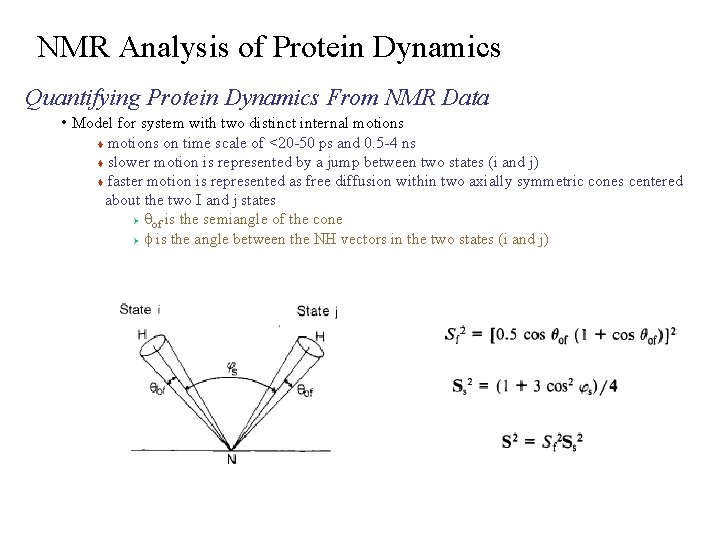
NMR Analysis of Protein Dynamics Quantifying Protein Dynamics From NMR Data • Model for system with two distinct internal motions on time scale of <20 -50 ps and 0. 5 -4 ns t slower motion is represented by a jump between two states (i and j) t faster motion is represented as free diffusion within two axially symmetric cones centered about the two I and j states Ø qof is the semiangle of the cone Ø f is the angle between the NH vectors in the two states (i and j) t
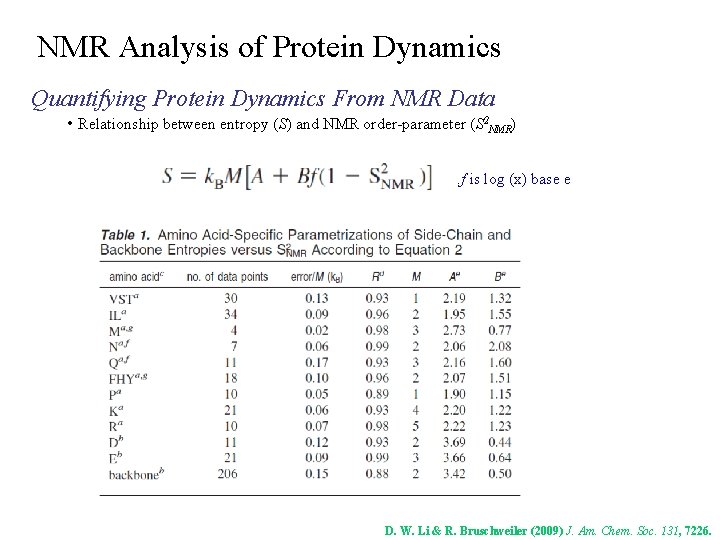
NMR Analysis of Protein Dynamics Quantifying Protein Dynamics From NMR Data • Relationship between entropy (S) and NMR order-parameter (S 2 NMR). f is log (x) base e D. W. Li & R. Bruschweiler (2009) J. Am. Chem. Soc. 131, 7226.
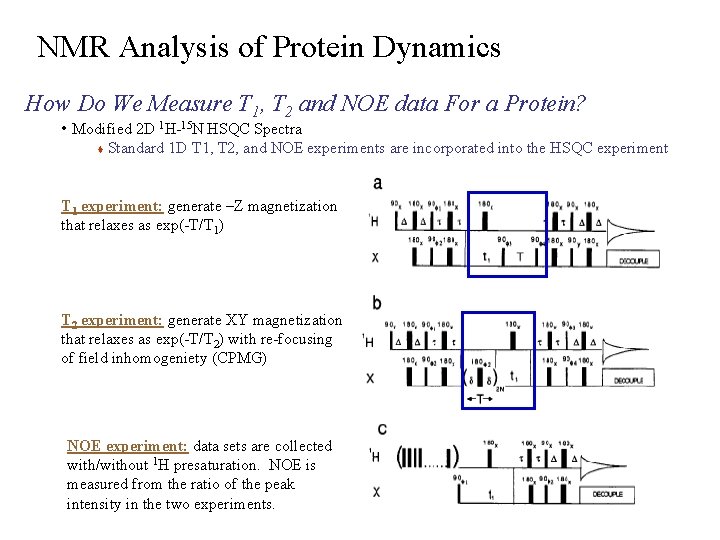
NMR Analysis of Protein Dynamics How Do We Measure T 1, T 2 and NOE data For a Protein? • Modified 2 D 1 H-15 N HSQC Spectra t Standard 1 D T 1, T 2, and NOE experiments are incorporated into the HSQC experiment T 1 experiment: generate –Z magnetization that relaxes as exp(-T/T 1) T 2 experiment: generate XY magnetization that relaxes as exp(-T/T 2) with re-focusing of field inhomogeniety (CPMG) NOE experiment: data sets are collected with/without 1 H presaturation. NOE is measured from the ratio of the peak intensity in the two experiments.
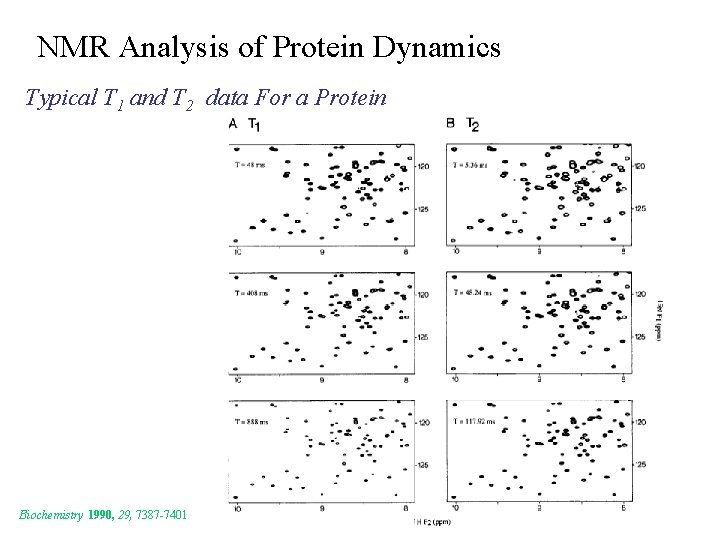
NMR Analysis of Protein Dynamics Typical T 1 and T 2 data For a Protein Biochemistry 1990, 29, 7387 -7401
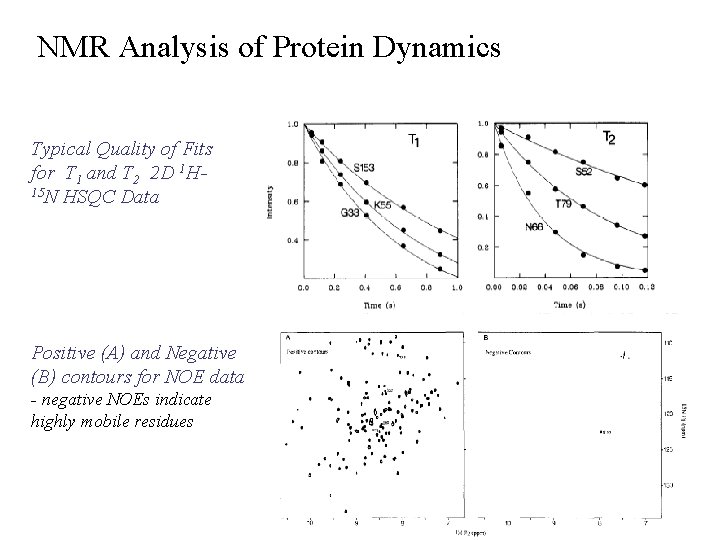
NMR Analysis of Protein Dynamics Typical Quality of Fits for T 1 and T 2 2 D 1 H 15 N HSQC Data Positive (A) and Negative (B) contours for NOE data - negative NOEs indicate highly mobile residues
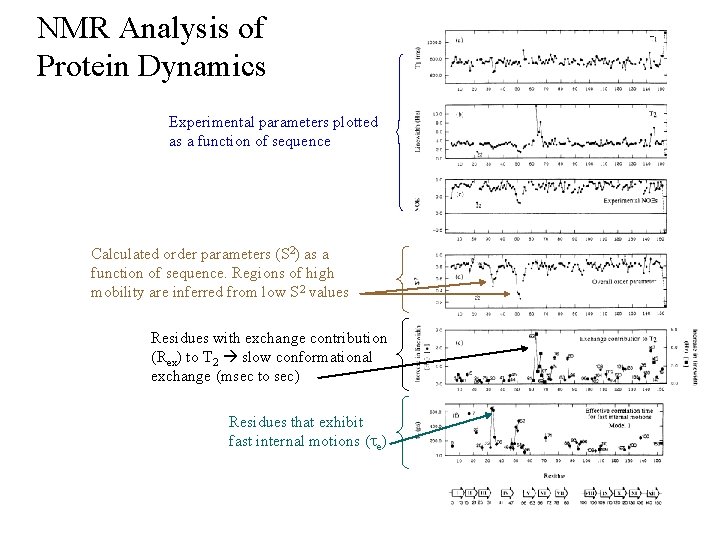
NMR Analysis of Protein Dynamics Experimental parameters plotted as a function of sequence Calculated order parameters (S 2) as a function of sequence. Regions of high mobility are inferred from low S 2 values Residues with exchange contribution (Rex) to T 2 slow conformational exchange (msec to sec) Residues that exhibit fast internal motions (te)
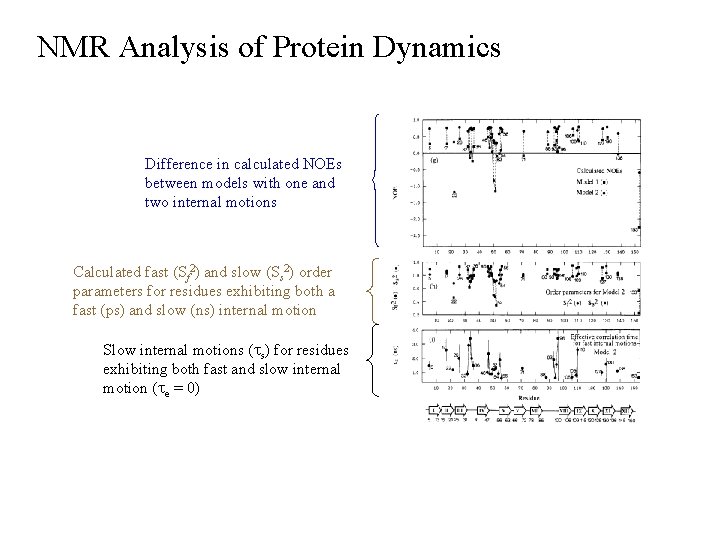
NMR Analysis of Protein Dynamics Difference in calculated NOEs between models with one and two internal motions Calculated fast (Sf 2) and slow (Ss 2) order parameters for residues exhibiting both a fast (ps) and slow (ns) internal motion Slow internal motions (ts) for residues exhibiting both fast and slow internal motion (te = 0)
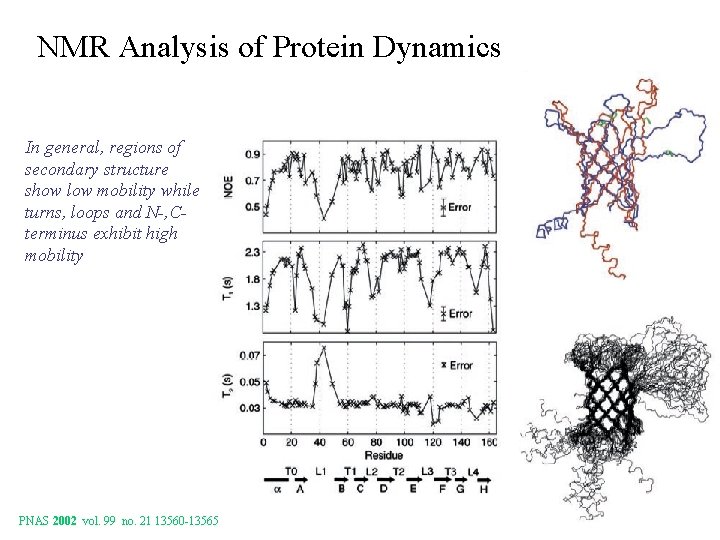
NMR Analysis of Protein Dynamics In general, regions of secondary structure show low mobility while turns, loops and N-, Cterminus exhibit high mobility PNAS 2002 vol. 99 no. 21 13560 -13565
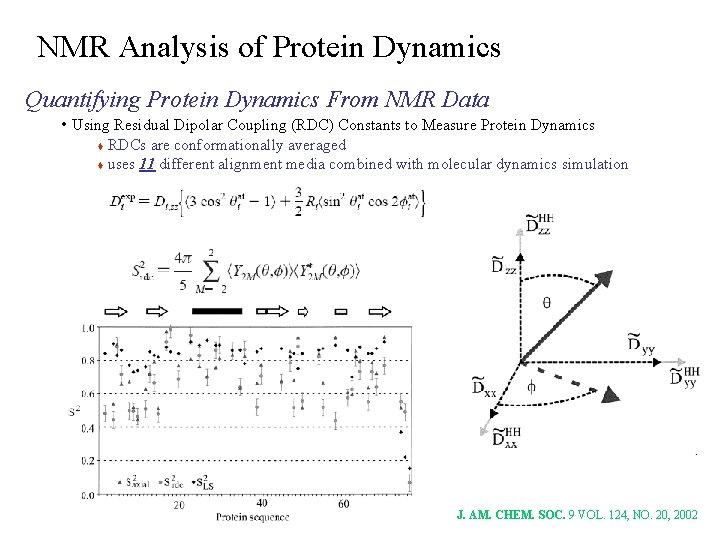
NMR Analysis of Protein Dynamics Quantifying Protein Dynamics From NMR Data • Using Residual Dipolar Coupling (RDC) Constants to Measure Protein Dynamics RDCs are conformationally averaged t uses 11 different alignment media combined with molecular dynamics simulation t J. AM. CHEM. SOC. 9 VOL. 124, NO. 20, 2002