
NMN Biology Refinement Workgroup Biological Parameters Priority 1
NMN: Biology Refinement Workgroup • Biological Parameters • Priority 1, 2 and “Special” • Need further work in terms of temporal scales (how often to sample) and what might be thresholds (in instances where they may be appropriate) Jawed Hameedi, NOAA NWQMC Meeting, Philadelphia, PA July 2007 1
Biology Refinement Workgroup • • • Ian Hartwell, NOAA (Chair) Marty Gurtz, USGS Hal Walker, EPA John Kraeuter, Rutgers University Barbara Scudder, USGS Danielle Kreeger, PDE Gabrielle Canonico, USGS Ellen Tarquinio, EPA John Hummer, Great Lakes Ed Santoro, DRBC Mike Connors, SFEI Jawed Hameedi, NOAA (ghost chair; mostly auditing) 2
Desired Criteria for Parameter Selection 1. They are measurable with a low margin of error, such that a “change” can be detected after a reasonable sampling effort and decision-making time-frame. 2. They are not costly to obtain; at least the cost should be relatable to the value of information being provided. 3. They are based on consensus and “expert counsel. ” 4. They are responsive to environmental conditions (or stressors), preferably in a monotonic way; variables that respond oppositely to different stressors are probably no good. 3
First Challenge • Biologists’ menagerie of measurements to describe environmental status is extensive – the toolbox is overloaded! – Over 200 indicators of ecosystem status (Rice 2000) – Over 20 biomarkers just relating to NOAA’s NS&T (Hameedi, 2005) – Nearly 25 in integrative assessment approaches used by NOAA/NCCOS (Hameedi, 2007) – Over 30 recommended at the National Core Coastal Indicators (2007) workshop 4
Second Challenge • Integrative biological measures such as biological diversity and ecosystem health – Difficult to interpret by managers and communicate to the public • What is ascendancy? Or resiliency (one of three parameters that • • define “ecosystem health” What does diversity of order 2 mean to a decision-maker (or what does Hill’s N 2 value of 2. 42 suggest? ) What is alpha, beta or gamma diversity? • Numeric values of most indices are not comparable (derived differently – number of spp. , biomass, probability, bits per species, etc. ) “Any index of diversity can be misleading” (Rice, 2003); the concept of diversity is “meaningless” (Hurlbert, 1971) You are better off by simply describing species richness or status of biota (particular species or groups of species) 5
Examples of Measures of Diversity (Jost, 2006) -some with reasonable application to biological communities, some not. • • Species Richness Shannon-Wiener Index (entropy) Simpson’s Reciprocal Index Gini-Simpson Index Renyi entropies HCDT (Havrda-Charvat-Daroczy-Tsallis) or Tsallis entropy Patil and Taillee average rarity index Varma entropy 6
Indices of Biotic Integrity • They are not based on any ecosystem theory or • unifying principles in ecology They are based on field observations – An ecosystem’s health is bad because the index is low, and a low index value indicates bad health because the index is low for unhealthy ecosystems (Suter, 1993) • This is a case of tautology: It is like saying, either it will rain tomorrow or its will not rain tomorrow. You can’t be wrong! 7
Still, we have a list of biological parameters (see handout) • The selected parameters are • • integrators or integrative of coastal conditions The have wide “appeal” and appreciation They can be measured effectively with current technologies 8
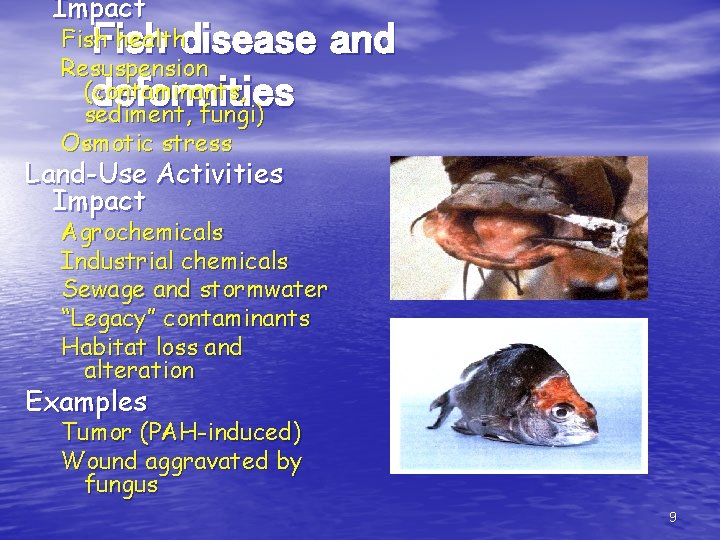
Impact Fish disease and deformities Fish health Resuspension (contaminants, sediment, fungi) Osmotic stress Land-Use Activities Impact Agrochemicals Industrial chemicals Sewage and stormwater “Legacy” contaminants Habitat loss and alteration Examples Tumor (PAH-induced) Wound aggravated by fungus 9
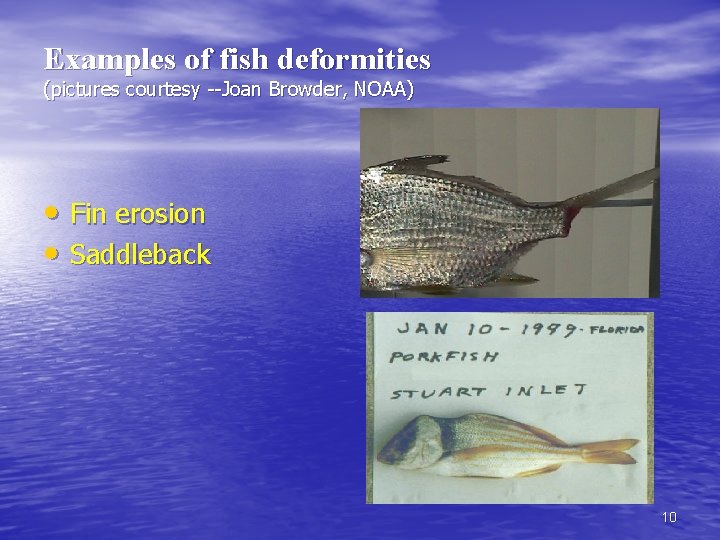
Examples of fish deformities (pictures courtesy --Joan Browder, NOAA) • Fin erosion • Saddleback 10
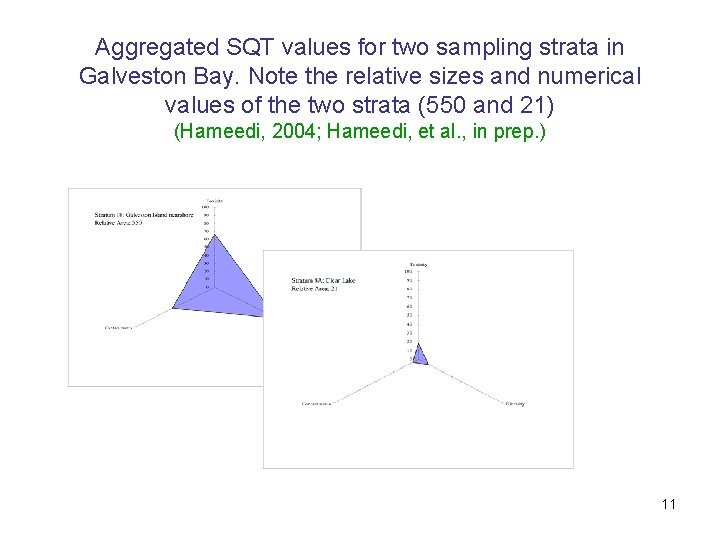
Aggregated SQT values for two sampling strata in Galveston Bay. Note the relative sizes and numerical values of the two strata (550 and 21) (Hameedi, 2004; Hameedi, et al. , in prep. ) 11
Thank You! It is the mark of an educated man to look for precision in each class of things just so far as the nature of the subject admits … Our discussion will be adequate if it has as much clearness as the subject matter admits of; for precision is not to be sought for alike in all discussions. Aristotle (384 -322 B. C. ) 12
- Slides: 12