
NMBAQC Scheme PSA for Supporting Biological Analysis Questionnaire
NMBAQC Scheme PSA for Supporting Biological Analysis Questionnaire Results Prue Addison, Environment Agency
Sample Collection Methodological Differences Highlighted in Questionnaire: • Source of PSA sub-sample (biology, chemistry or separate grab) • Method of sub-sample collection from grab (depth integrated core/mixed sample/surface sample) • Sample volume
Sample Collection Green Book states: Green Book Tables V 12: ‘The PSA sample used to support benthic community analysis should be a representative collected from a separate grab. . A separate sample should be collected for particle size analysis to support the contaminants data. The fraction less than 63 um should be determined on this sample. ’ Appendix 3. Procedural Guidelines for subtidal sediment sampling: ‘Take the sample from the surface to a minimum depth of 5 cm (a core previously used for redox analysis is acceptable). Transfer samples to containers that can withstand freezing, such as plastic bags or pots. ’
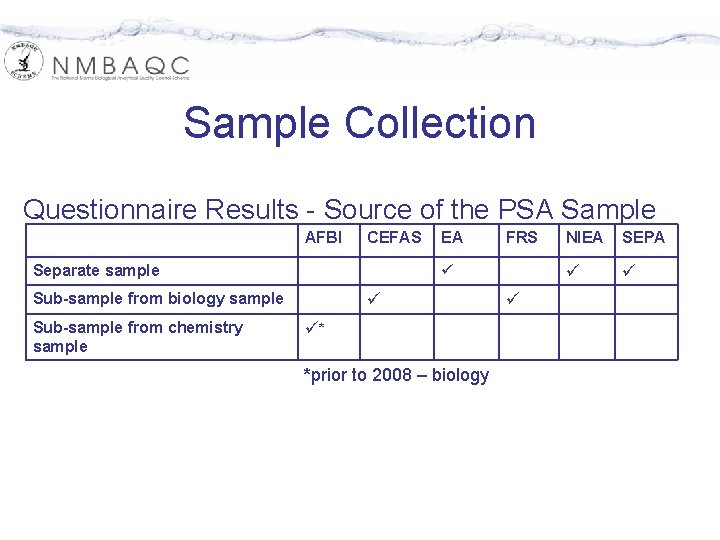
Sample Collection Questionnaire Results - Source of the PSA Sample AFBI CEFAS Separate sample FRS Sub-sample from biology sample Sub-sample from chemistry sample EA * *prior to 2008 – biology NIEA SEPA
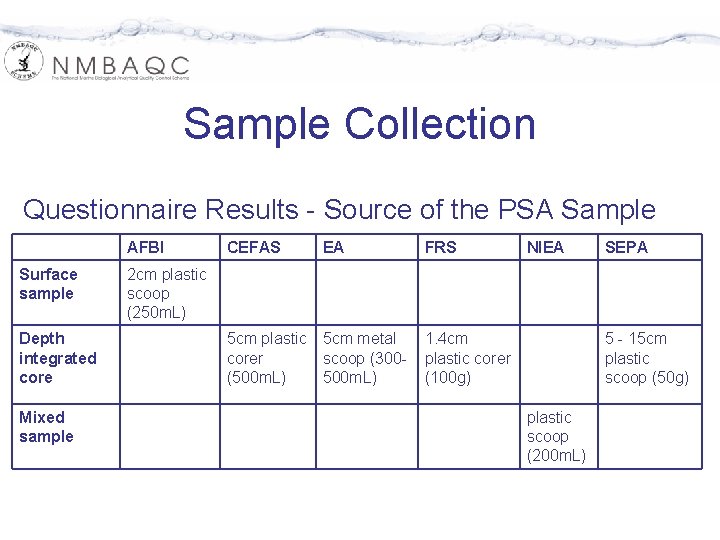
Sample Collection Questionnaire Results - Source of the PSA Sample AFBI Surface sample Depth integrated core Mixed sample CEFAS EA FRS 5 cm plastic corer (500 m. L) 5 cm metal scoop (300500 m. L) 1. 4 cm plastic corer (100 g) NIEA SEPA 2 cm plastic scoop (250 m. L) 5 - 15 cm plastic scoop (50 g) plastic scoop (200 m. L)

Sample Collection Questionnaire Results - Minimum Size of PSA Sample Taken AFBI CEFAS EA FRS NIEA SEPA Gravel 250 g 500 m. L 300 -500 m. L 100 g 50 g Sand 250 g 500 m. L 300 -500 m. L 100 g 50 g Mud 50 g 500 m. L 300 -500 m. L 100 g 25 g 50 g
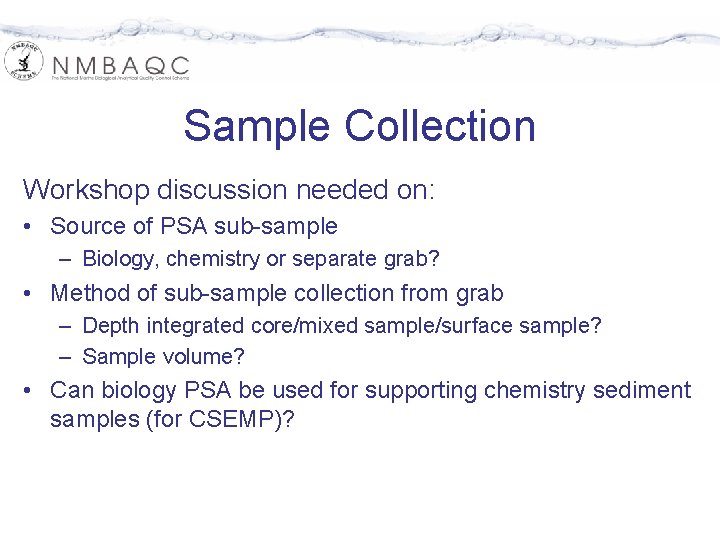
Sample Collection Workshop discussion needed on: • Source of PSA sub-sample – Biology, chemistry or separate grab? • Method of sub-sample collection from grab – Depth integrated core/mixed sample/surface sample? – Sample volume? • Can biology PSA be used for supporting chemistry sediment samples (for CSEMP)?
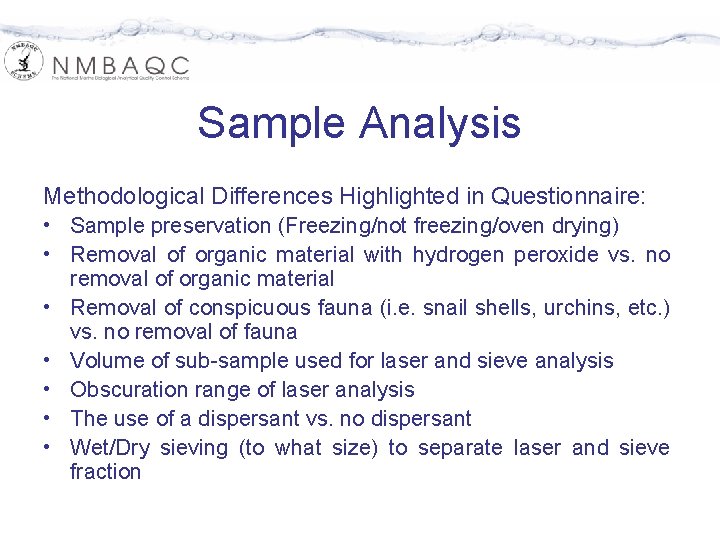
Sample Analysis Methodological Differences Highlighted in Questionnaire: • Sample preservation (Freezing/not freezing/oven drying) • Removal of organic material with hydrogen peroxide vs. no removal of organic material • Removal of conspicuous fauna (i. e. snail shells, urchins, etc. ) vs. no removal of fauna • Volume of sub-sample used for laser and sieve analysis • Obscuration range of laser analysis • The use of a dispersant vs. no dispersant • Wet/Dry sieving (to what size) to separate laser and sieve fraction

Sample Analysis Green Book states: Appendix 3. Procedural Guidelines for subtidal sediment sampling: ‘Keep samples cool and freeze them as soon as possible. This prevents decomposition from affecting grain size. Record the method of preservation. ’ Appendix 9. Procedural Guidelines for analysis of sediment supporting determinands: ‘PSA for analysis of sediment supporting determinands to be added by NMBAQC group’!
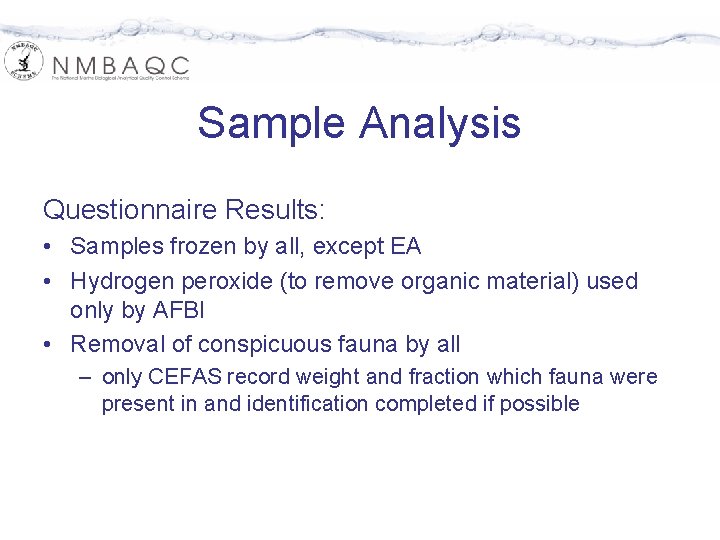
Sample Analysis Questionnaire Results: • Samples frozen by all, except EA • Hydrogen peroxide (to remove organic material) used only by AFBI • Removal of conspicuous fauna by all – only CEFAS record weight and fraction which fauna were present in and identification completed if possible
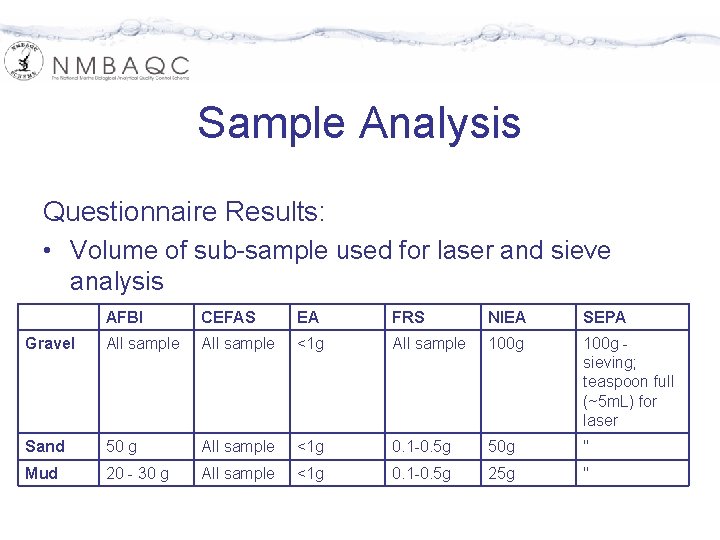
Sample Analysis Questionnaire Results: • Volume of sub-sample used for laser and sieve analysis AFBI CEFAS EA FRS NIEA SEPA Gravel All sample <1 g All sample 100 g sieving; teaspoon full (~5 m. L) for laser Sand 50 g All sample <1 g 0. 1 -0. 5 g 50 g " Mud 20 - 30 g All sample <1 g 0. 1 -0. 5 g 25 g "
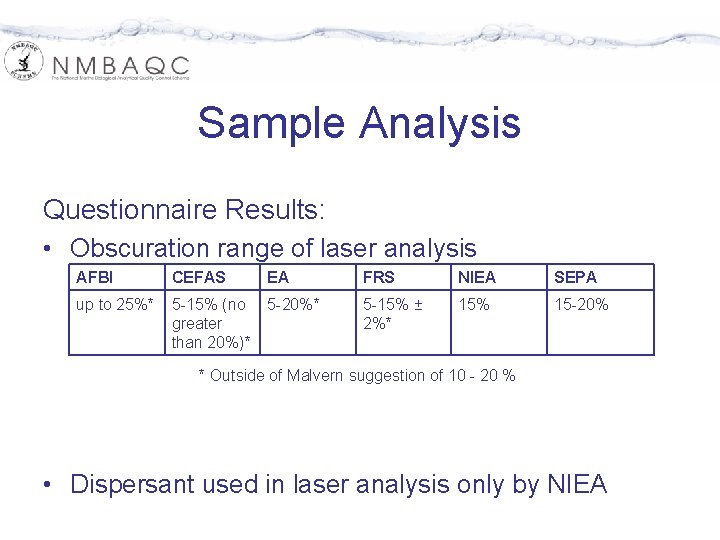
Sample Analysis Questionnaire Results: • Obscuration range of laser analysis AFBI CEFAS EA FRS NIEA SEPA up to 25%* 5 -15% (no greater than 20%)* 5 -20%* 5 -15% ± 2%* 15% 15 -20% * Outside of Malvern suggestion of 10 - 20 % • Dispersant used in laser analysis only by NIEA
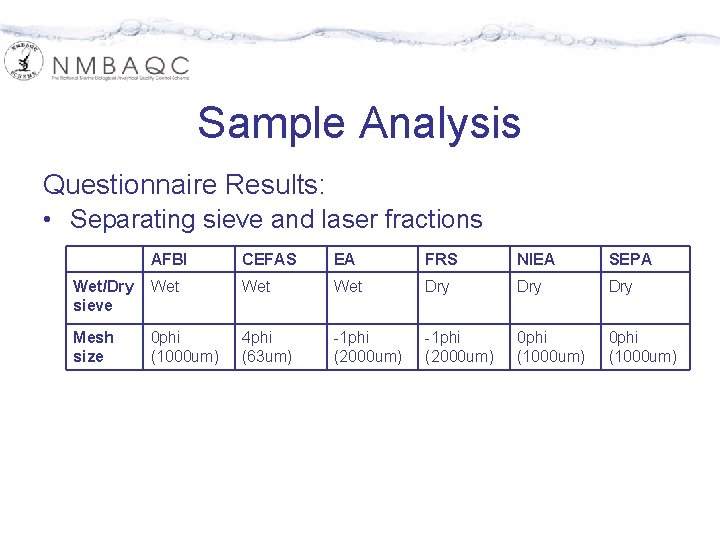
Sample Analysis Questionnaire Results: • Separating sieve and laser fractions AFBI CEFAS EA FRS NIEA SEPA Wet/Dry sieve Wet Wet Dry Dry Mesh size 0 phi (1000 um) 4 phi (63 um) -1 phi (2000 um) 0 phi (1000 um)
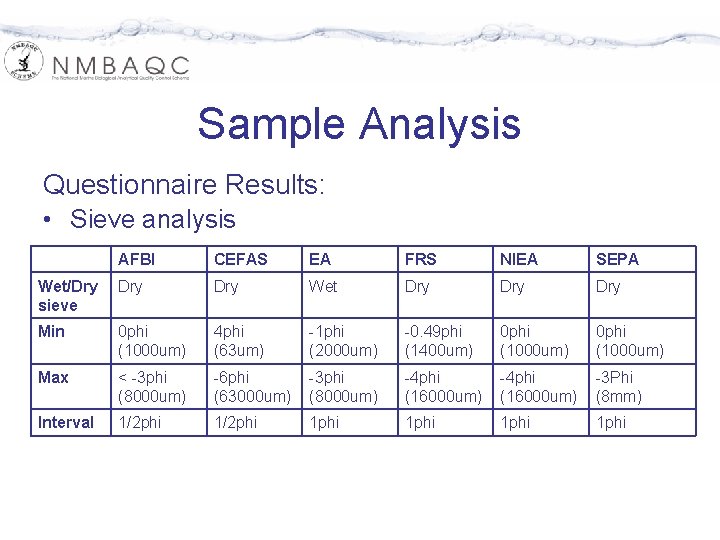
Sample Analysis Questionnaire Results: • Sieve analysis AFBI CEFAS EA FRS NIEA SEPA Wet/Dry sieve Dry Wet Dry Dry Min 0 phi (1000 um) 4 phi (63 um) -1 phi (2000 um) -0. 49 phi (1400 um) 0 phi (1000 um) Max < -3 phi (8000 um) -6 phi (63000 um) -3 phi (8000 um) -4 phi (16000 um) -3 Phi (8 mm) Interval 1/2 phi 1 phi
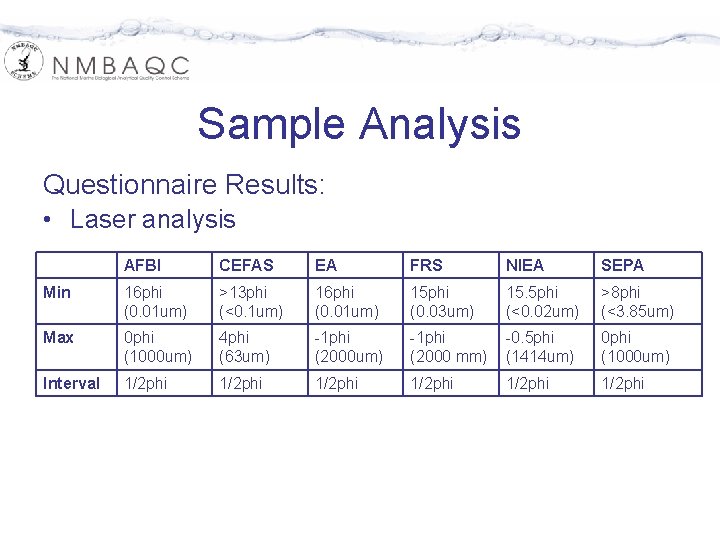
Sample Analysis Questionnaire Results: • Laser analysis AFBI CEFAS EA FRS NIEA SEPA Min 16 phi (0. 01 um) >13 phi (<0. 1 um) 16 phi (0. 01 um) 15 phi (0. 03 um) 15. 5 phi (<0. 02 um) >8 phi (<3. 85 um) Max 0 phi (1000 um) 4 phi (63 um) -1 phi (2000 mm) -0. 5 phi (1414 um) 0 phi (1000 um) Interval 1/2 phi 1/2 phi
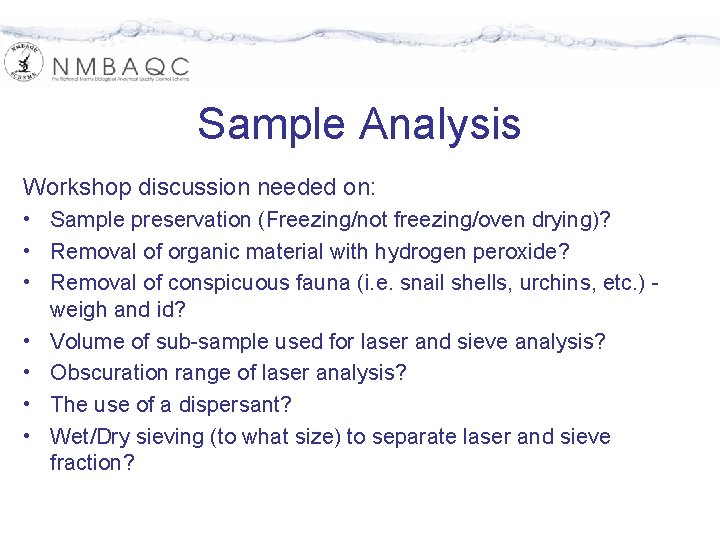
Sample Analysis Workshop discussion needed on: • Sample preservation (Freezing/not freezing/oven drying)? • Removal of organic material with hydrogen peroxide? • Removal of conspicuous fauna (i. e. snail shells, urchins, etc. ) weigh and id? • Volume of sub-sample used for laser and sieve analysis? • Obscuration range of laser analysis? • The use of a dispersant? • Wet/Dry sieving (to what size) to separate laser and sieve fraction?
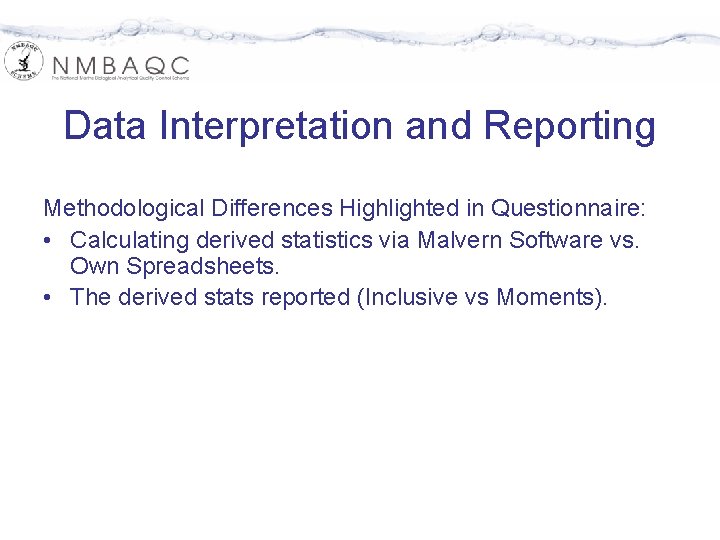
Data Interpretation and Reporting Methodological Differences Highlighted in Questionnaire: • Calculating derived statistics via Malvern Software vs. Own Spreadsheets. • The derived stats reported (Inclusive vs Moments).
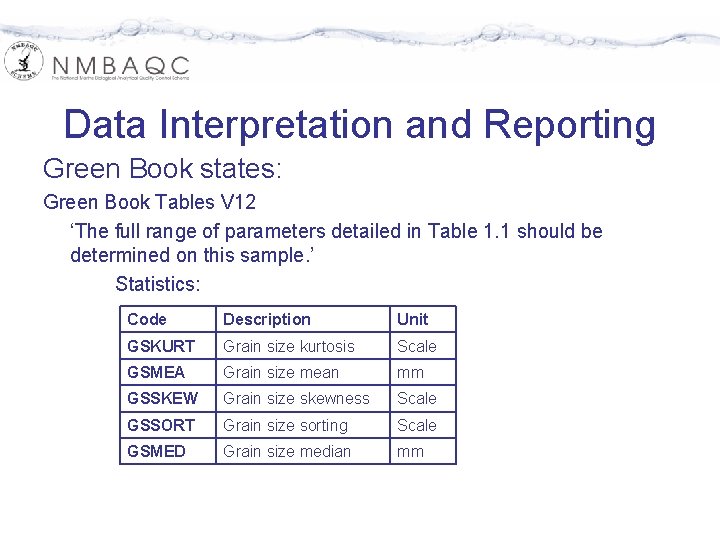
Data Interpretation and Reporting Green Book states: Green Book Tables V 12 ‘The full range of parameters detailed in Table 1. 1 should be determined on this sample. ’ Statistics: Code Description Unit GSKURT Grain size kurtosis Scale GSMEA Grain size mean mm GSSKEW Grain size skewness Scale GSSORT Grain size sorting Scale GSMED Grain size median mm
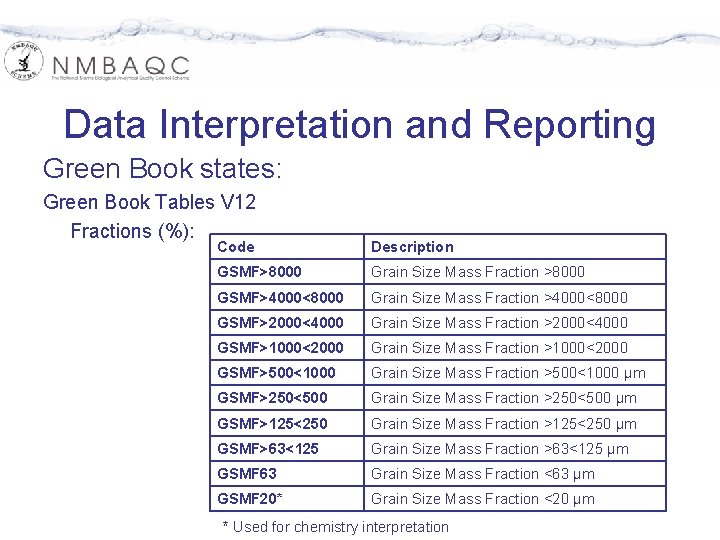
Data Interpretation and Reporting Green Book states: Green Book Tables V 12 Fractions (%): Code Description GSMF>8000 Grain Size Mass Fraction >8000 GSMF>4000<8000 Grain Size Mass Fraction >4000<8000 GSMF>2000<4000 Grain Size Mass Fraction >2000<4000 GSMF>1000<2000 Grain Size Mass Fraction >1000<2000 GSMF>500<1000 Grain Size Mass Fraction >500<1000 µm GSMF>250<500 Grain Size Mass Fraction >250<500 µm GSMF>125<250 Grain Size Mass Fraction >125<250 µm GSMF>63<125 Grain Size Mass Fraction >63<125 µm GSMF 63 Grain Size Mass Fraction <63 µm GSMF 20* Grain Size Mass Fraction <20 µm * Used for chemistry interpretation
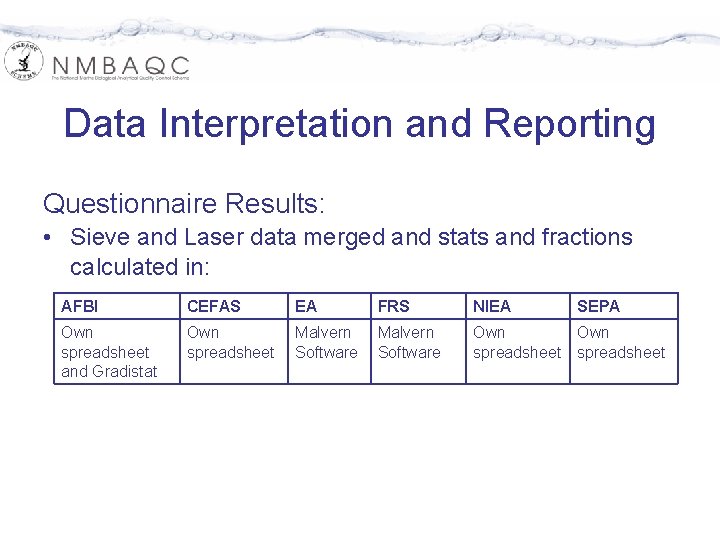
Data Interpretation and Reporting Questionnaire Results: • Sieve and Laser data merged and stats and fractions calculated in: AFBI CEFAS EA FRS NIEA SEPA Own spreadsheet and Gradistat Own spreadsheet Malvern Software Own spreadsheet
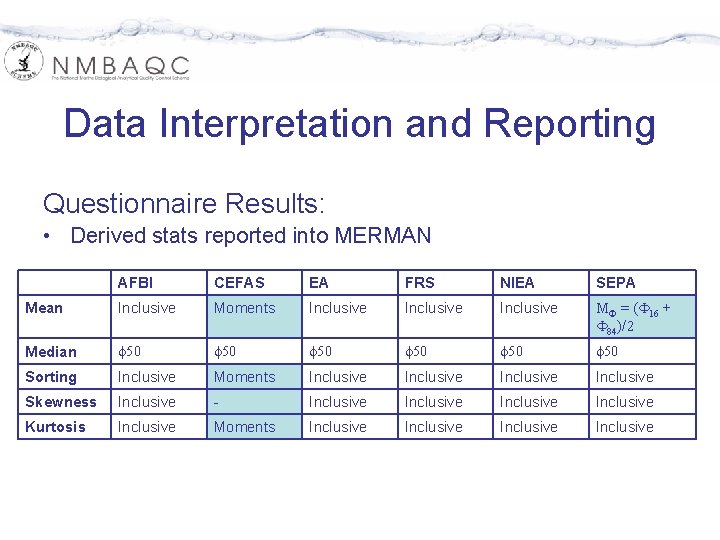
Data Interpretation and Reporting Questionnaire Results: • Derived stats reported into MERMAN AFBI CEFAS EA FRS NIEA SEPA Mean Inclusive Moments Inclusive MF = (F 16 + F 84)/2 Median f 50 f 50 Sorting Inclusive Moments Inclusive Skewness Inclusive - Inclusive Kurtosis Inclusive Moments Inclusive
Data Interpretation and Reporting Workshop discussion needed on: • Calculating fractions and statistics via Malvern Software vs. Own Spreadsheets? • Derived stats reported (Inclusive vs Moments)? • Should statistics be reported at all into national databases?
QA/QC Methodological Differences Highlighted in Questionnaire: • External QA - All CMA PSA labs signed up to NMBAQC PS component (plus 6 private labs) • Internal QC - Varying levels of internal QA/QC done by laboratories.
QA/QC Green Book States: Nothing!
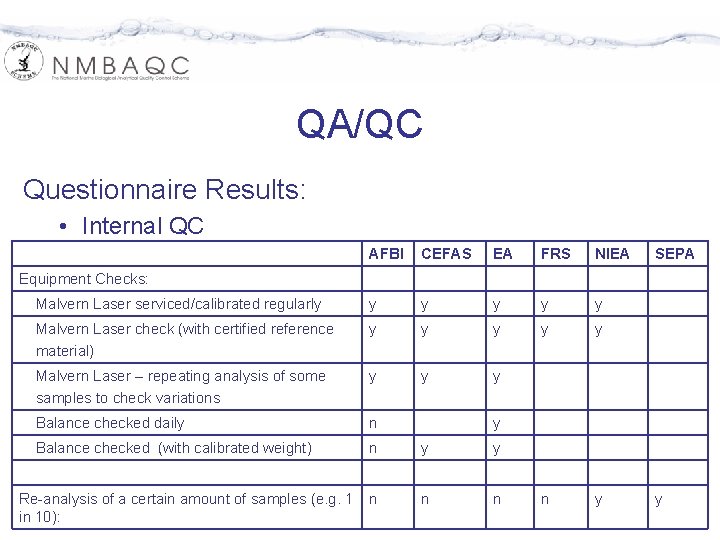
QA/QC Questionnaire Results: • Internal QC AFBI CEFAS EA FRS NIEA Malvern Laser serviced/calibrated regularly y y Malvern Laser check (with certified reference material) y y y Malvern Laser – repeating analysis of some samples to check variations y y y Balance checked daily n Balance checked (with calibrated weight) n y y n n y SEPA Equipment Checks: Re-analysis of a certain amount of samples (e. g. 1 in 10): y y
QA/QC Workshop discussion needed on: • Internal QC?
- Slides: 26