
NLP Introduction to NLP Inference Modus Ponens Modus




- Slides: 9
NLP
Introduction to NLP Inference
Modus Ponens • Modus ponens: ⇒ • Example: Cat(Martin) x: Cat(x) ⇒ Eats. Fish(x) Eats. Fish(Martin)
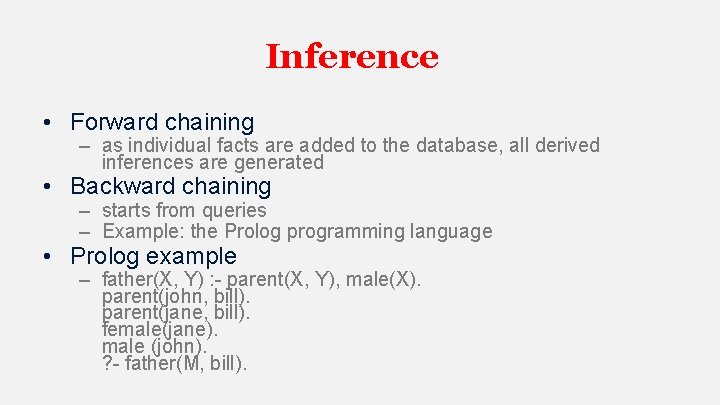
Inference • Forward chaining – as individual facts are added to the database, all derived inferences are generated • Backward chaining – starts from queries – Example: the Prolog programming language • Prolog example – father(X, Y) : - parent(X, Y), male(X). parent(john, bill). parent(jane, bill). female(jane). male (john). ? - father(M, bill).
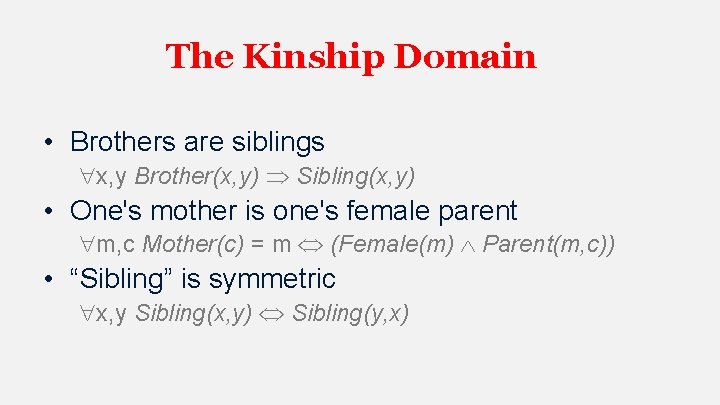
The Kinship Domain • Brothers are siblings x, y Brother(x, y) Sibling(x, y) • One's mother is one's female parent m, c Mother(c) = m (Female(m) Parent(m, c)) • “Sibling” is symmetric x, y Sibling(x, y) Sibling(y, x)
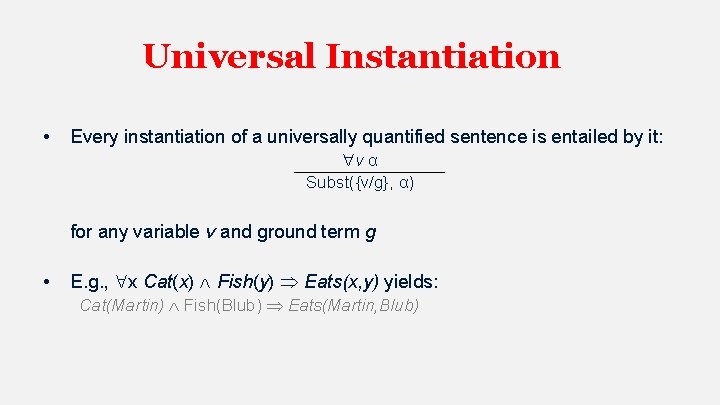
Universal Instantiation • Every instantiation of a universally quantified sentence is entailed by it: v α Subst({v/g}, α) for any variable v and ground term g • E. g. , x Cat(x) Fish(y) Eats(x, y) yields: Cat(Martin) Fish(Blub) Eats(Martin, Blub)
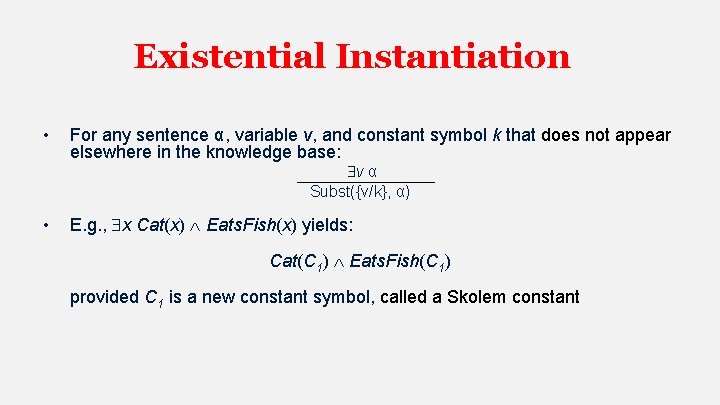
Existential Instantiation • For any sentence α, variable v, and constant symbol k that does not appear elsewhere in the knowledge base: v α Subst({v/k}, α) • E. g. , x Cat(x) Eats. Fish(x) yields: Cat(C 1) Eats. Fish(C 1) provided C 1 is a new constant symbol, called a Skolem constant
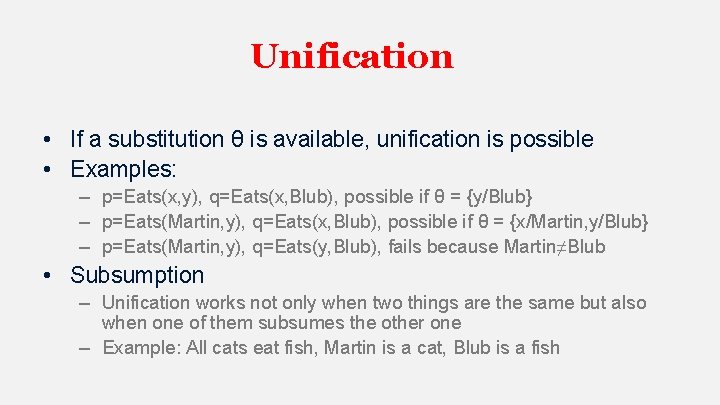
Unification • If a substitution θ is available, unification is possible • Examples: – p=Eats(x, y), q=Eats(x, Blub), possible if θ = {y/Blub} – p=Eats(Martin, y), q=Eats(x, Blub), possible if θ = {x/Martin, y/Blub} – p=Eats(Martin, y), q=Eats(y, Blub), fails because Martin≠Blub • Subsumption – Unification works not only when two things are the same but also when one of them subsumes the other one – Example: All cats eat fish, Martin is a cat, Blub is a fish
NLP