
NLP Introduction to NLP Brief History of NLP

NLP
Introduction to NLP Brief History of NLP
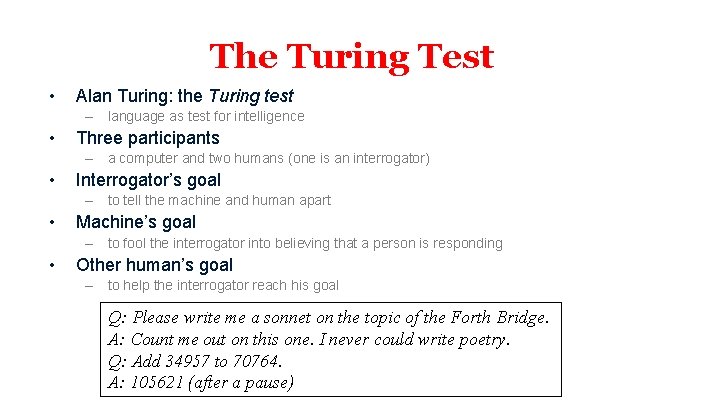
The Turing Test • Alan Turing: the Turing test – language as test for intelligence • Three participants – a computer and two humans (one is an interrogator) • Interrogator’s goal – to tell the machine and human apart • Machine’s goal – to fool the interrogator into believing that a person is responding • Other human’s goal – to help the interrogator reach his goal Q: Please write me a sonnet on the topic of the Forth Bridge. A: Count me out on this one. I never could write poetry. Q: Add 34957 to 70764. A: 105621 (after a pause)
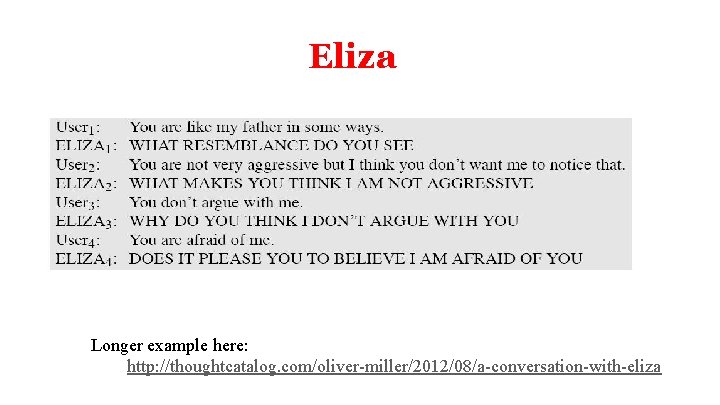
Eliza Longer example here: http: //thoughtcatalog. com/oliver-miller/2012/08/a-conversation-with-eliza
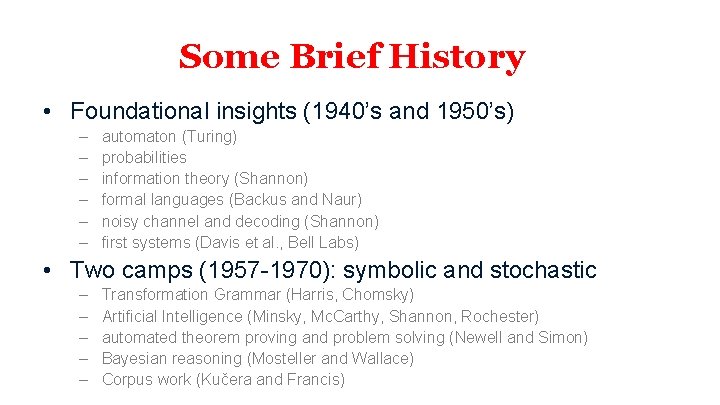
Some Brief History • Foundational insights (1940’s and 1950’s) – – – automaton (Turing) probabilities information theory (Shannon) formal languages (Backus and Naur) noisy channel and decoding (Shannon) first systems (Davis et al. , Bell Labs) • Two camps (1957 -1970): symbolic and stochastic – – – Transformation Grammar (Harris, Chomsky) Artificial Intelligence (Minsky, Mc. Carthy, Shannon, Rochester) automated theorem proving and problem solving (Newell and Simon) Bayesian reasoning (Mosteller and Wallace) Corpus work (Kučera and Francis)

Some Brief History • Four paradigms (1970 -1983) – – stochastic (IBM) logic-based (Colmerauer, Pereira and Warren, Kay, Bresnan) nlu (Winograd, Schank, Fillmore) discourse modelling (Grosz and Sidner) • Empiricism and finite-state models redux (83 -93) – Kaplan and Kay (phonology and morphology) – Church (syntax) • Late years (1994 -2010) – – – integration of different techniques different areas (including speech and IR) probabilistic models machine learning structured prediction topic models
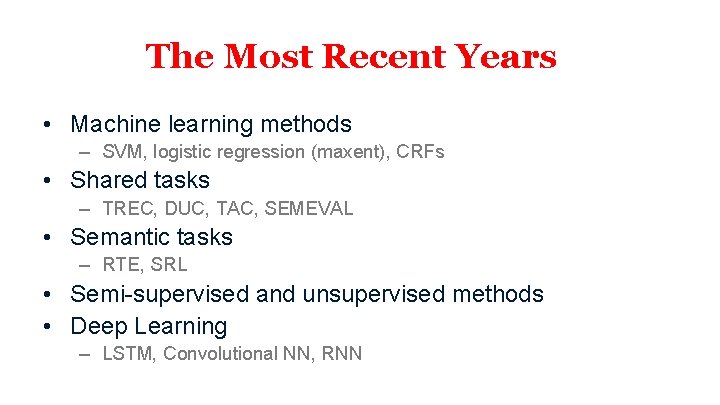
The Most Recent Years • Machine learning methods – SVM, logistic regression (maxent), CRFs • Shared tasks – TREC, DUC, TAC, SEMEVAL • Semantic tasks – RTE, SRL • Semi-supervised and unsupervised methods • Deep Learning – LSTM, Convolutional NN, RNN
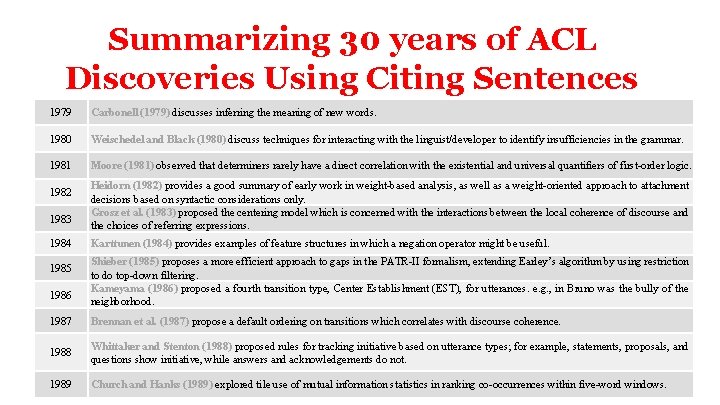
Summarizing 30 years of ACL Discoveries Using Citing Sentences 1979 Carbonell (1979) discusses inferring the meaning of new words. 1980 Weischedel and Black (1980) discuss techniques for interacting with the linguist/developer to identify insufficiencies in the grammar. 1981 Moore (1981) observed that determiners rarely have a direct correlation with the existential and universal quantifiers of first-order logic. 1982 1983 1984 1985 1986 Heidorn (1982) provides a good summary of early work in weight-based analysis, as well as a weight-oriented approach to attachment decisions based on syntactic considerations only. Grosz et al. (1983) proposed the centering model which is concerned with the interactions between the local coherence of discourse and the choices of referring expressions. Karttunen (1984) provides examples of feature structures in which a negation operator might be useful. Shieber (1985) proposes a more efficient approach to gaps in the PATR-II formalism, extending Earley’s algorithm by using restriction to do top-down filtering. Kameyama (1986) proposed a fourth transition type, Center Establishment (EST), for utterances. e. g. , in Bruno was the bully of the neighborhood. 1987 Brennan et al. (1987) propose a default ordering on transitions which correlates with discourse coherence. 1988 Whittaker and Stenton (1988) proposed rules for tracking initiative based on utterance types; for example, statements, proposals, and questions show initiative, while answers and acknowledgements do not. 1989 Church and Hanks (1989) explored tile use of mutual information statistics in ranking co-occurrences within five-word windows.
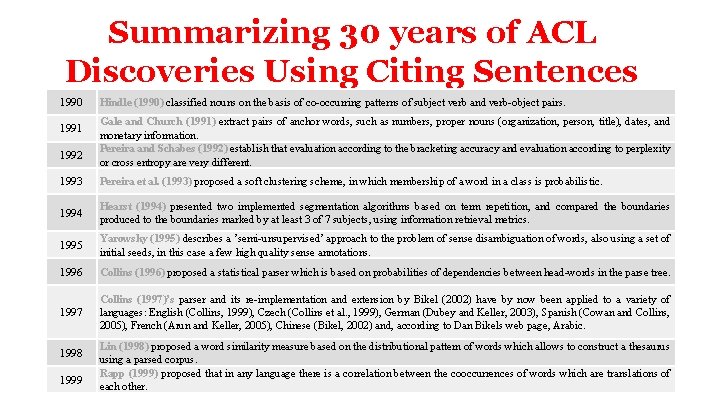
Summarizing 30 years of ACL Discoveries Using Citing Sentences 1990 1991 1992 Hindle (1990) classified nouns on the basis of co-occurring patterns of subject verb and verb-object pairs. Gale and Church (1991) extract pairs of anchor words, such as numbers, proper nouns (organization, person, title), dates, and monetary information. Pereira and Schabes (1992) establish that evaluation according to the bracketing accuracy and evaluation according to perplexity or cross entropy are very different. 1993 Pereira et al. (1993) proposed a soft clustering scheme, in which membership of a word in a class is probabilistic. 1994 Hearst (1994) presented two implemented segmentation algorithms based on term repetition, and compared the boundaries produced to the boundaries marked by at least 3 of 7 subjects, using information retrieval metrics. 1995 Yarowsky (1995) describes a ’semi-unsupervised’ approach to the problem of sense disambiguation of words, also using a set of initial seeds, in this case a few high quality sense annotations. 1996 Collins (1996) proposed a statistical parser which is based on probabilities of dependencies between head-words in the parse tree. 1997 Collins (1997)’s parser and its re-implementation and extension by Bikel (2002) have by now been applied to a variety of languages: English (Collins, 1999), Czech (Collins et al. , 1999), German (Dubey and Keller, 2003), Spanish (Cowan and Collins, 2005), French (Arun and Keller, 2005), Chinese (Bikel, 2002) and, according to Dan Bikels web page, Arabic. 1998 1999 Lin (1998) proposed a word similarity measure based on the distributional pattern of words which allows to construct a thesaurus using a parsed corpus. Rapp (1999) proposed that in any language there is a correlation between the cooccurrences of words which are translations of each other.
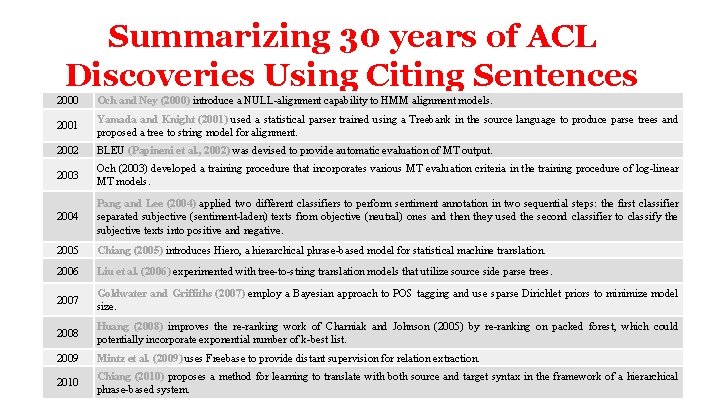
Summarizing 30 years of ACL Discoveries Using Citing Sentences 2000 Och and Ney (2000) introduce a NULL-alignment capability to HMM alignment models. 2001 Yamada and Knight (2001) used a statistical parser trained using a Treebank in the source language to produce parse trees and proposed a tree to string model for alignment. 2002 BLEU (Papineni et al. , 2002) was devised to provide automatic evaluation of MT output. 2003 Och (2003) developed a training procedure that incorporates various MT evaluation criteria in the training procedure of log-linear MT models. 2004 Pang and Lee (2004) applied two different classifiers to perform sentiment annotation in two sequential steps: the first classifier separated subjective (sentiment-laden) texts from objective (neutral) ones and then they used the second classifier to classify the subjective texts into positive and negative. 2005 Chiang (2005) introduces Hiero, a hierarchical phrase-based model for statistical machine translation. 2006 Liu et al. (2006) experimented with tree-to-string translation models that utilize source side parse trees. 2007 Goldwater and Griffiths (2007) employ a Bayesian approach to POS tagging and use sparse Dirichlet priors to minimize model size. 2008 Huang (2008) improves the re-ranking work of Charniak and Johnson (2005) by re-ranking on packed forest, which could potentially incorporate exponential number of k-best list. 2009 Mintz et al. (2009) uses Freebase to provide distant supervision for relation extraction. 2010 Chiang (2010) proposes a method for learning to translate with both source and target syntax in the framework of a hierarchical phrase-based system.
Introduction to NLP NACLO
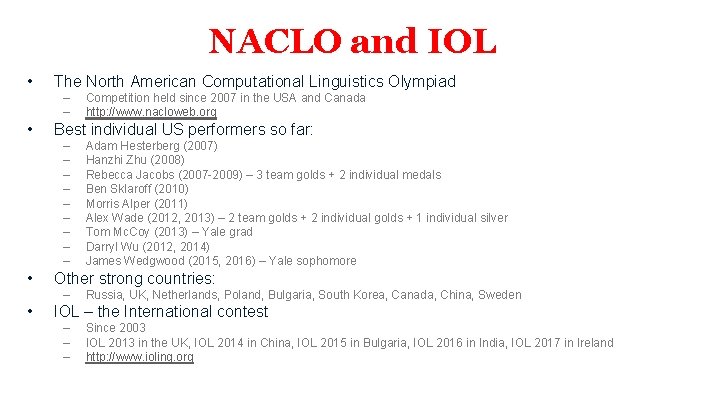
NACLO and IOL • The North American Computational Linguistics Olympiad – – • Best individual US performers so far: – – – – – • Adam Hesterberg (2007) Hanzhi Zhu (2008) Rebecca Jacobs (2007 -2009) – 3 team golds + 2 individual medals Ben Sklaroff (2010) Morris Alper (2011) Alex Wade (2012, 2013) – 2 team golds + 2 individual golds + 1 individual silver Tom Mc. Coy (2013) – Yale grad Darryl Wu (2012, 2014) James Wedgwood (2015, 2016) – Yale sophomore Other strong countries: – • Competition held since 2007 in the USA and Canada http: //www. nacloweb. org Russia, UK, Netherlands, Poland, Bulgaria, South Korea, Canada, China, Sweden IOL – the International contest – – – Since 2003 IOL 2013 in the UK, IOL 2014 in China, IOL 2015 in Bulgaria, IOL 2016 in India, IOL 2017 in Ireland http: //www. ioling. org
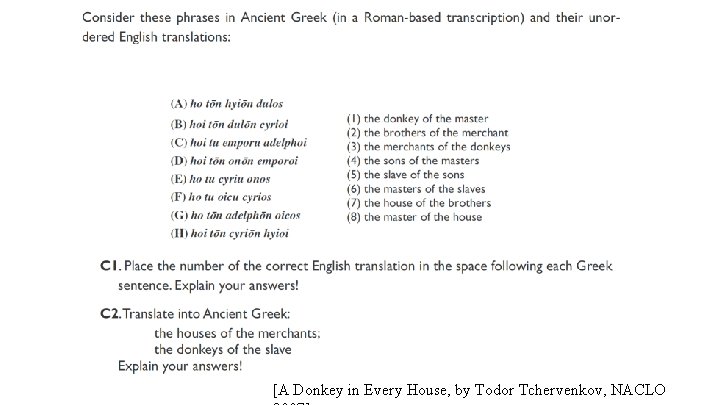
[A Donkey in Every House, by Todor Tchervenkov, NACLO
![[Spare the Rod, by Dragomir Radev, NACLO 2008]](http://slidetodoc.com/presentation_image_h2/b7e48e3a494be3fb00236eab80596894/image-14.jpg "[Spare the Rod, by Dragomir Radev, NACLO 2008]")
[Spare the Rod, by Dragomir Radev, NACLO 2008]
![[Tenji Karaoke, by Patrick Littell, NACLO 2009]](http://slidetodoc.com/presentation_image_h2/b7e48e3a494be3fb00236eab80596894/image-15.jpg "[Tenji Karaoke, by Patrick Littell, NACLO 2009]")
[Tenji Karaoke, by Patrick Littell, NACLO 2009]
![[aw-TOM-uh-tuh, by Patrick Littell, NACLO 2008]](http://slidetodoc.com/presentation_image_h2/b7e48e3a494be3fb00236eab80596894/image-16.jpg "[aw-TOM-uh-tuh, by Patrick Littell, NACLO 2008]")
[aw-TOM-uh-tuh, by Patrick Littell, NACLO 2008]
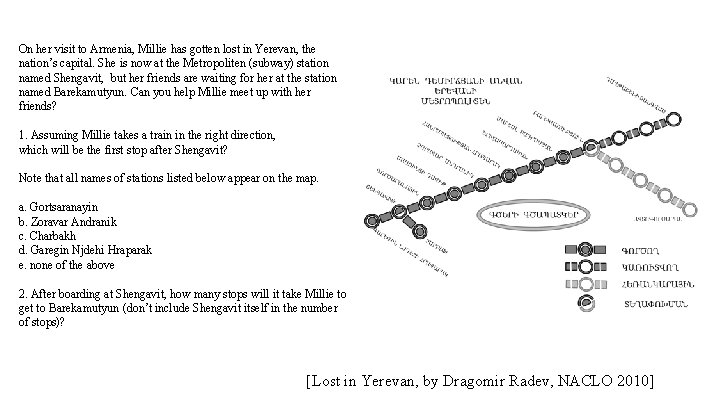
On her visit to Armenia, Millie has gotten lost in Yerevan, the nation’s capital. She is now at the Metropoliten (subway) station named Shengavit, but her friends are waiting for her at the station named Barekamutyun. Can you help Millie meet up with her friends? 1. Assuming Millie takes a train in the right direction, which will be the first stop after Shengavit? Note that all names of stations listed below appear on the map. a. Gortsaranayin b. Zoravar Andranik c. Charbakh d. Garegin Njdehi Hraparak e. none of the above 2. After boarding at Shengavit, how many stops will it take Millie to get to Barekamutyun (don’t include Shengavit itself in the number of stops)? [Lost in Yerevan, by Dragomir Radev, NACLO 2010]
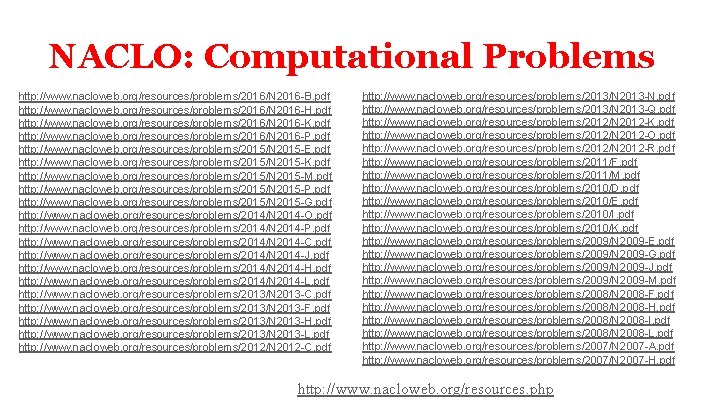
NACLO: Computational Problems http: //www. nacloweb. org/resources/problems/2016/N 2016 -B. pdf http: //www. nacloweb. org/resources/problems/2016/N 2016 -H. pdf http: //www. nacloweb. org/resources/problems/2016/N 2016 -K. pdf http: //www. nacloweb. org/resources/problems/2016/N 2016 -P. pdf http: //www. nacloweb. org/resources/problems/2015/N 2015 -E. pdf http: //www. nacloweb. org/resources/problems/2015/N 2015 -K. pdf http: //www. nacloweb. org/resources/problems/2015/N 2015 -M. pdf http: //www. nacloweb. org/resources/problems/2015/N 2015 -P. pdf http: //www. nacloweb. org/resources/problems/2015/N 2015 -G. pdf http: //www. nacloweb. org/resources/problems/2014/N 2014 -O. pdf http: //www. nacloweb. org/resources/problems/2014/N 2014 -P. pdf http: //www. nacloweb. org/resources/problems/2014/N 2014 -C. pdf http: //www. nacloweb. org/resources/problems/2014/N 2014 -J. pdf http: //www. nacloweb. org/resources/problems/2014/N 2014 -H. pdf http: //www. nacloweb. org/resources/problems/2014/N 2014 -L. pdf http: //www. nacloweb. org/resources/problems/2013/N 2013 -C. pdf http: //www. nacloweb. org/resources/problems/2013/N 2013 -F. pdf http: //www. nacloweb. org/resources/problems/2013/N 2013 -H. pdf http: //www. nacloweb. org/resources/problems/2013/N 2013 -L. pdf http: //www. nacloweb. org/resources/problems/2012/N 2012 -C. pdf http: //www. nacloweb. org/resources/problems/2013/N 2013 -N. pdf http: //www. nacloweb. org/resources/problems/2013/N 2013 -Q. pdf http: //www. nacloweb. org/resources/problems/2012/N 2012 -K. pdf http: //www. nacloweb. org/resources/problems/2012/N 2012 -O. pdf http: //www. nacloweb. org/resources/problems/2012/N 2012 -R. pdf http: //www. nacloweb. org/resources/problems/2011/F. pdf http: //www. nacloweb. org/resources/problems/2011/M. pdf http: //www. nacloweb. org/resources/problems/2010/D. pdf http: //www. nacloweb. org/resources/problems/2010/E. pdf http: //www. nacloweb. org/resources/problems/2010/I. pdf http: //www. nacloweb. org/resources/problems/2010/K. pdf http: //www. nacloweb. org/resources/problems/2009/N 2009 -E. pdf http: //www. nacloweb. org/resources/problems/2009/N 2009 -G. pdf http: //www. nacloweb. org/resources/problems/2009/N 2009 -J. pdf http: //www. nacloweb. org/resources/problems/2009/N 2009 -M. pdf http: //www. nacloweb. org/resources/problems/2008/N 2008 -F. pdf http: //www. nacloweb. org/resources/problems/2008/N 2008 -H. pdf http: //www. nacloweb. org/resources/problems/2008/N 2008 -I. pdf http: //www. nacloweb. org/resources/problems/2008/N 2008 -L. pdf http: //www. nacloweb. org/resources/problems/2007/N 2007 -A. pdf http: //www. nacloweb. org/resources/problems/2007/N 2007 -H. pdf http: //www. nacloweb. org/resources. php

NLP
- Slides: 19