
NJROTC MARKSMANSHIP AIR RIFLE SAFETY COURSE LESSON 1







- Slides: 59
NJROTC MARKSMANSHIP AIR RIFLE SAFETY COURSE
LESSON 1 THE HISTORY OF MARKSMANSHIP
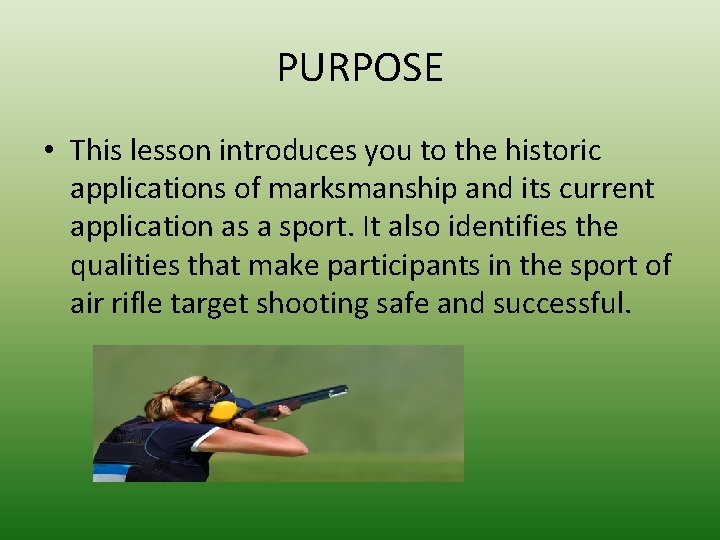
PURPOSE • This lesson introduces you to the historic applications of marksmanship and its current application as a sport. It also identifies the qualities that make participants in the sport of air rifle target shooting safe and successful.
MARKSMANSHIP INCORPORATES OR TEACHES: 1. ACCURACY 2. CONCENTRATION 3. CONTROL 4. DETERMINATION 5. PRACTICE 6. SKILL
Why participate in marksmanship?
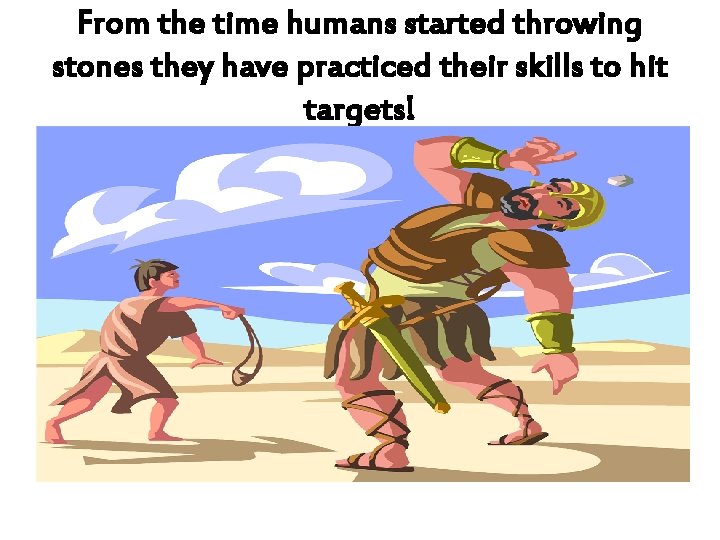
From the time humans started throwing stones they have practiced their skills to hit targets!
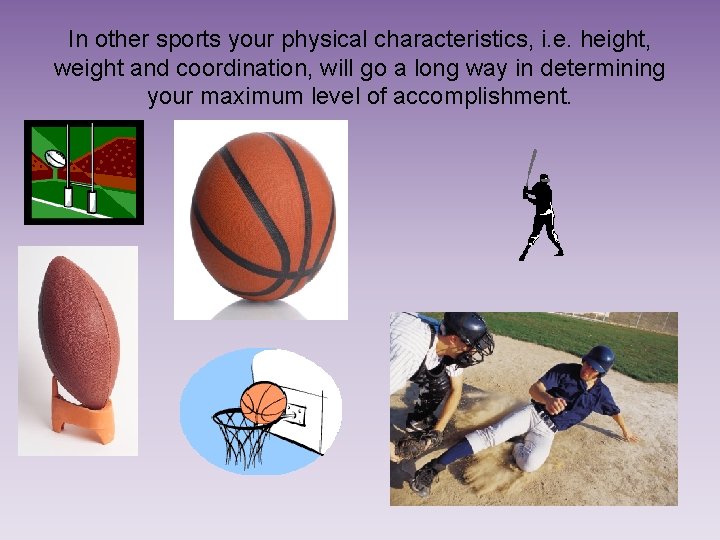
In other sports your physical characteristics, i. e. height, weight and coordination, will go a long way in determining your maximum level of accomplishment.
The translation of marksmanship skills to your schoolwork and lifework is obvious. • Not only will you develop self-discipline and confidence, but also when you shoot you will leave all your thoughts about school and day-to-day responsibilities behind. • When you participate in marksmanship you are not only learning a skill that helped found our great nation, but you are also participating in a highly competitive sport that will help you develop important life skills.
A HISTORIC OVERVIEW • In the past 150 years, people who demonstrated exceptional skills while shooting at targets, from Annie Oakley to the gold medalists of the most recent Olympic Games, were raised to positions of honor. • No matter when in human history great feats of marksmanship are performed, the skilled marksmanship is respected, honored and celebrated.
OLYMPIC COMPETITIORS
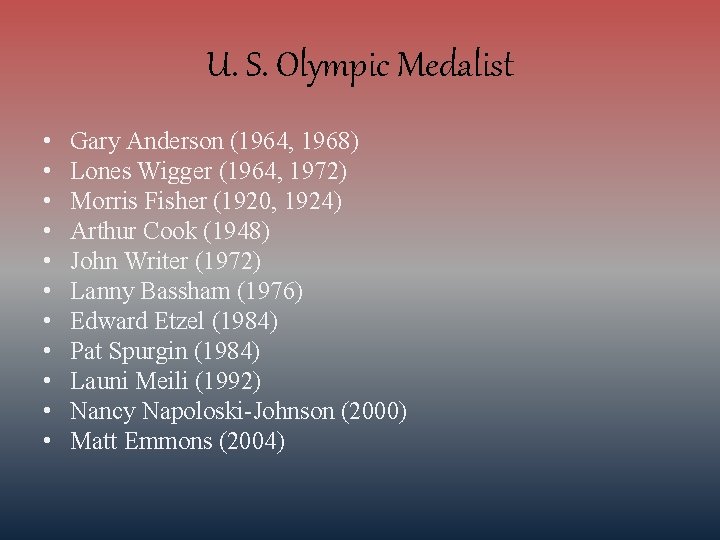
U. S. Olympic Medalist • • • Gary Anderson (1964, 1968) Lones Wigger (1964, 1972) Morris Fisher (1920, 1924) Arthur Cook (1948) John Writer (1972) Lanny Bassham (1976) Edward Etzel (1984) Pat Spurgin (1984) Launi Meili (1992) Nancy Napoloski-Johnson (2000) Matt Emmons (2004)
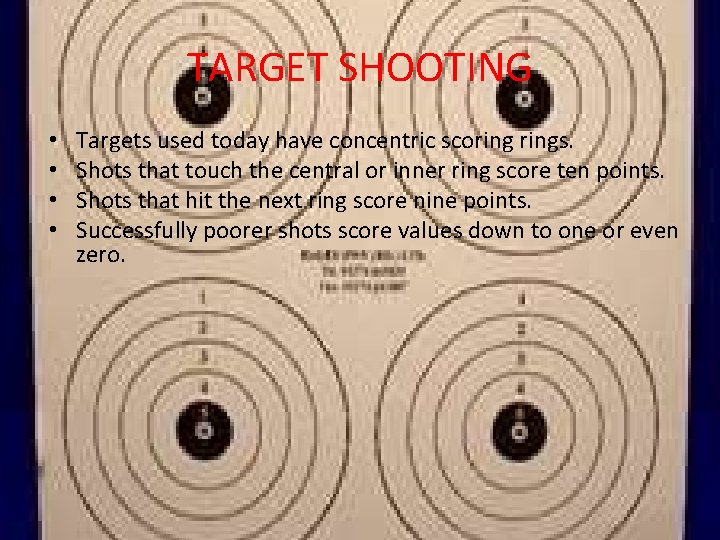
TARGET SHOOTING • • Targets used today have concentric scorings. Shots that touch the central or inner ring score ten points. Shots that hit the next ring score nine points. Successfully poorer shots score values down to one or even zero.
Target Shooting IS…
• A sport that can be practiced by everyone. • A sport where women and men compete equally. • Is a skilled sport. • Sport of control, discipline and concentration. • Enjoys worldwide popularity. • Exciting and fun.
CONCLUSION
The objectives of this marksmanship program are to teach you how to handle guns safely, how to perform the basic skills of the sport of targeting, and to give you the fundamental knowledge necessary to begin competing in three-position rifle competitions as a member of a JROTC or high school rifle team.
LESSON 2 FIREARM SAFETY AND SAFE RANGE OPERATION
PURPOSE • This lesson introduces you to the rules for safe air rifle handling and the range procedures that you must follow in air rifle firing activities.
RULES FOR SAFE GUN HANDLING • 3 Basic rules that are the foundation for the safe handling and shooting of all types of guns. • These rules fully apply to the air rifles that are used in JROTC marksmanship programs. • These fundamental safety rules focus on the 3 key parts of every gun that control when and where the gun can be fired.
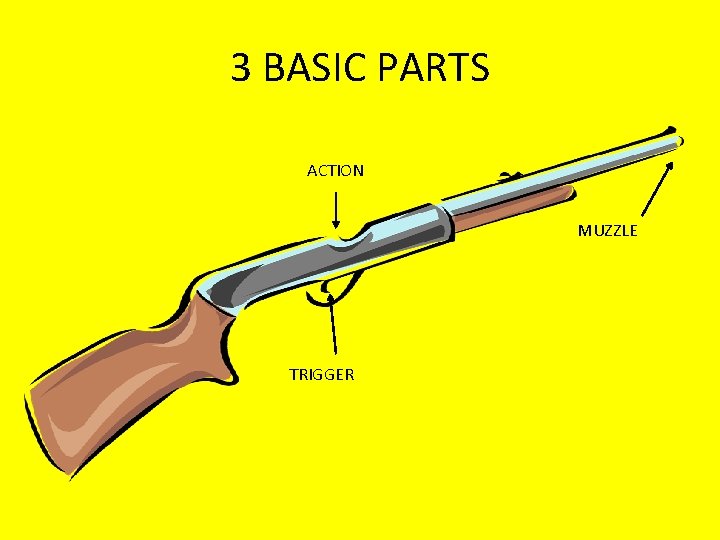
MUZZLE • The forward end of the barrel. The point where the pellet or projectile leaves the barrel when the gun is fired. A gun is aimed by pointing its muzzle at the target.
RULE 1 • Always keep gun muzzles pointed in a safe position. Gun muzzles should never be pointed at other persons under any circumstances. On a range, the safest directions to point a gun muzzle are usually upward and downrange toward the target.
ACTION • The working mechanism of the gun. Gun actions typically have a bolt or lever that is used to open and close the action so that the gun can be loaded and unloaded.
RULE 2 • When handling any rifle or firearm, the action should be open. Gun actions must remain open except when the gun is on the firing line and the command to LOAD has been given. When shooting is finished or the rifle is placed down to take a break, the action must be open and unloaded, even when the gun is on the firing line. The gun action may be closed and the CBI moved forward when it is placed in a gun case or storeroom, but must be opened and the CBI inserted as soon as it is picked up again.
TRIGGER • The trigger is part of the action or working mechanism of the gun. The trigger is a lever that projects out of the bottom of the gun. A trigger guard protects the trigger. After a gun is loaded and the action is closed, the gun is fired by pulling the trigger.
RULE 3 • Keep your finger off the trigger until after placing the gun in the shooting position and preparing to fire a shot. It is especially important to keep the finger outside of the trigger guard when loading the gun and placing it in the shooting position.
3 BASIC PARTS ACTION MUZZLE TRIGGER
3 SAFETY STEPS • 1 st – control the direction of the muzzle. • 2 nd – check the action of the gun and to open it if it is not already open. • 3 rd – hold or carry the rifle so that all fingers are held outside of the trigger guard and not on the trigger itself.
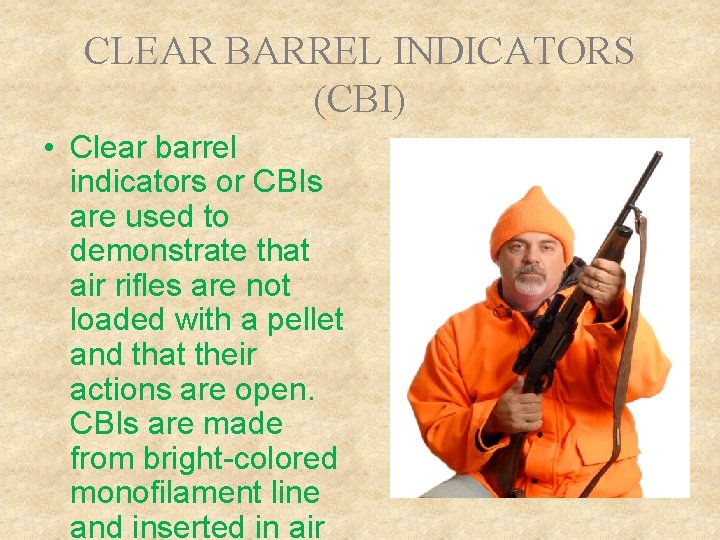
CLEAR BARREL INDICATORS (CBI) • Clear barrel indicators or CBIs are used to demonstrate that air rifles are not loaded with a pellet and that their actions are open. CBIs are made from bright-colored monofilament line and inserted in air
SHOOTING RANGES Safety Barrier • The outside wall or some means of preventing unauthorized persons from entering the range area while firing takes place.
SHOOTING RANGES Target Holders • Designed so that targets can be hung on them at heights appropriate for the 3 shooting positions.
SHOOTING RANGES Firing Line • A red or black line marked on the floor 10 meters from the targets.
SHOOTING RANGES Firing Points • Rectangular spaces behind the firing line for one shooter to occupy.
SHOOTING RANGES Range Officer • Is in charge of firing on the range and gives instructions to control shooting.
SHOOTING RANGES Ready Area • Area behind the firing line that is designated as a preparation area. Also, the area where spectators watch.
FIRING PROCEDURES AND COMMANDS • “LOAD” – No one may load any rifle until the Range Officer gives this command.
FIRING PROCEDURES AND COMMANDS • “START” – command telling the shooter they may begin to aim and fire at their targets.
FIRING PROCEDURES AND COMMANDS • “STOP” – shooting is finished. If the command is given during firing, open actions of rifle and wait for further instructions.
FIRING PROCEDURES AND COMMANDS • “UNLOAD” – Loaded air rifles are normally unloaded by firing into a Pellet Discharge Container (PDC).
FIRING PROCEDURES AND COMMANDS • As soon as you complete a firing exercise, you must 1) immediately open your air rifle action, 2) ground your rifle and 3) insert a CBI in the barrel.
ADDITIONAL RANGE SAFETY RULES 1. PROPER AIR RIFLES FOR THE RANGE. Only 4. 5 mm air rifles designated for target air rifle shooting can safely be used on JROTC air rifle ranges. 2. TARGET. Shoot only at the target designated for you. Shooting at any object on a range besides your target is strictly forbidden. 3. LOADING. Rifle muzzles must be pointed downrange or upwards whenever the rifle is charged and with air and loaded. 4. MALFUNCTIONS. If at any time during a firing exercise, your air rifle fails to fire properly, keep the muzzle pointed downrange and raise your hand so the Range Officer can see it. 5. FIRING COMPLETED. Immediately after you fire your last shot in a firing exercise or when the command STOP is given, you must open the action on your air rifle, place the rifle on the ground and insert a CBI. The Range Officer will then inspect the line to insure safety.
ADDITIONAL RANGE SAFETY RULES 6. LOADED RIFLE. A loaded rifle is a air rifle that has a pellet in the barrel. 7. GROUNDED RIFLE. To ground a rifle, open the action, place it on the ground with muzzle ahead of the firing line and insert CBI. 8. LINE IS HOT/LINE IS CLEAR. A firing line is “hot” all persons on the range are in proper locations behind the firing line and the line is prepared for live firing. A firing line is “clear” when all firing is completed and all rifles are grounded and CBI’s inserted. 9. GOING DOWNRANGE. No one may go forward of the firing line until authorized to do so by the Range Officer and no one may handle rifles while anyone is in front of the firing line. 10. PERSONAL HYGIENE. No food, drinks on the range. Wash hands with warm soapy water after handling pellets. 11. EYE AND EAR PROTECTION. Eye and ear protection is recommended because of a remote chance that a pellet could bounce back.
ADDITIONAL RANGE SAFETY RULES 12. GUN CASES. Before gun is removed, insure CBI is inserted and muzzle is pointing downrange. 13. AIR RIFLE STORAGE. Whenever you carry your rifle to the storage area, always keep muzzle pointed upward and in a safe direction. 14. AIR OR CO 2 CYLINDERS. When screwing filled cylinders into air rifles, do not overtighten the cylinders. At PHS NJROTC, ONLY authorized personnel will remove or screw in rifle cylinders.
BECOMING MARKSMANSHIP QUALIFIED • 1. Safety training course – A cadet must complete the safety training class from their instructor. • 2. Safety examination – Cadets must complete the Shooter Safety Examination with a score of 100%. • 3. Shooter pledge. Cadets must read and sign a copy of the Cadets Safety Pledge.
CONCLUSION • The most important lesson that cadets who participate in marksmanship learn is how to be safe while handling any type of air rifle or firearm. By learning and following the rules of safe gun handling and the range safety rules for your range and by practicing those rules during target rifle practice, anyone who participates in marksmanship will acquire the knowledge and skills to handle all guns safely.
CONCLUSION • This knowledge will not only assure safety during JROTC marksmanship activities, but it will insure that any encounter a person has with a firearm is a safe encounter.
LESSON 3 TARGET SHOOTING EQUIPMENT AND ITS OPERATION
PURPOSE • This lesson introduces you to the parts and components of the air rifle, how it functions and how to load and fire it. It also gives you details about the proper clothing and equipment needed for air rifle target shooting.
How Air Guns Work • Air rifles utilize energy that is stored in the form of compressed gas. If the air rifle has a pneumatic system, energy is stored when the rifle is cocked. If the air rifle has a CO 2 or compressed air system, a pre-charged cylinder that contains stored energy in the form of compressed air or CO 2 is attached to the rifle.
How Air Guns Work • Air rifles are fired when the trigger mechanism is activated to open a valve that releases compressed gas into the barrel. This gas expands rapidly into the rear or breech end of the rifle’s barrel and drives the projectile through the barrel to the target.
PARTS OF AN AIR RIFLE
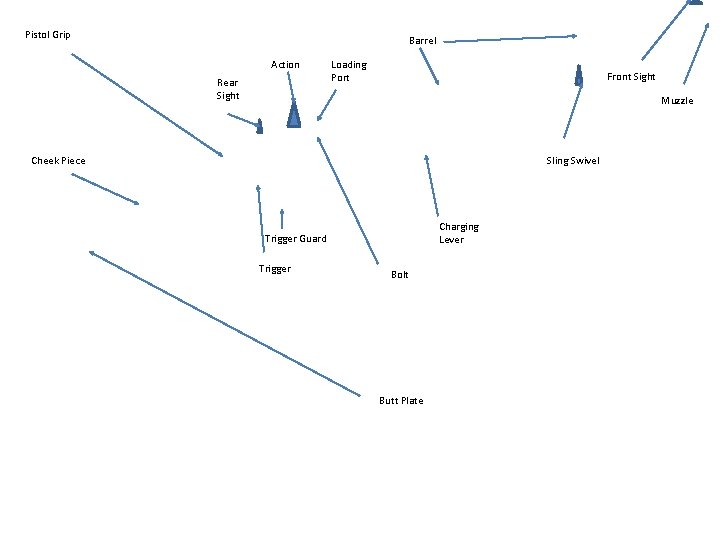
Pistol Grip Barrel Action Rear Sight Loading Port Front Sight Muzzle Cheek Piece Sling Swivel Charging Lever Trigger Guard Trigger Bolt Butt Plate
TARGET SHOOTING EQUIPMENT AND CLOTHING
SLING
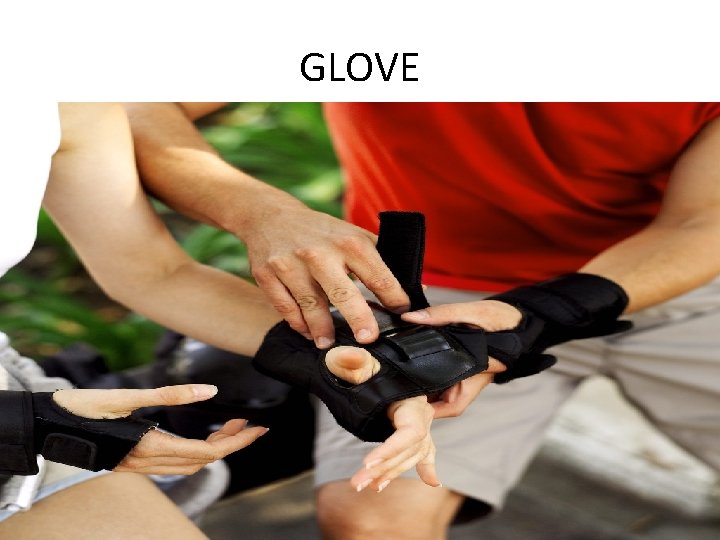
GLOVE
KNEELING ROLL
EYE GLASSES
LOADING AND FIRING AN AIR RIFLE Step 1 – Open the bolt. Step 2 – Charge the Air Chamber. Step 3 – Load Pellet. Step 4 – Release Trigger.
CONCLUSION After you learn the essential parts and components of the air rifle you will be using and how to load and fire it, you are ready to learn the first skills of target rifle marksmanship.
QUESTIONS