
Nixon Foreign Policy President Nixon redefined U S
- Slides: 23
Nixon Foreign Policy
President Nixon redefined U. S. foreign policy. • He did not divide the world into “us” (democratic countries) and “them” (communist countries). • He practiced realpolitik — foreign policy based on concrete national interests rather than ideology. • He concluded that there was no united worldwide communist movement.
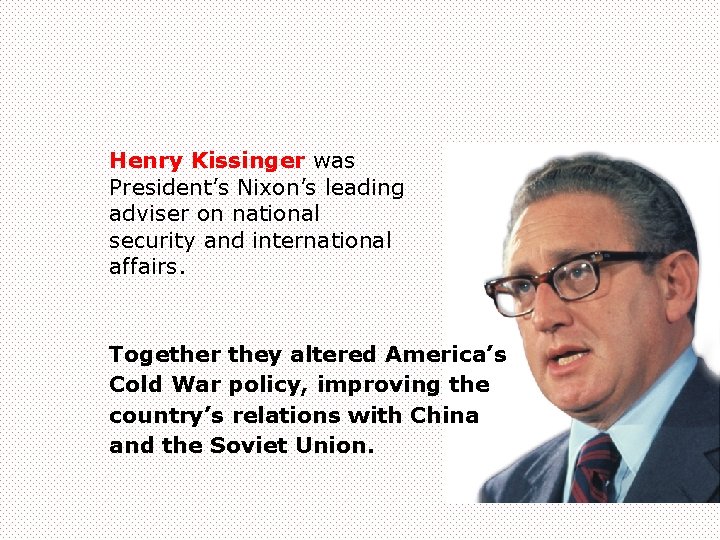
Henry Kissinger was President’s Nixon’s leading adviser on national security and international affairs. Together they altered America’s Cold War policy, improving the country’s relations with China and the Soviet Union.
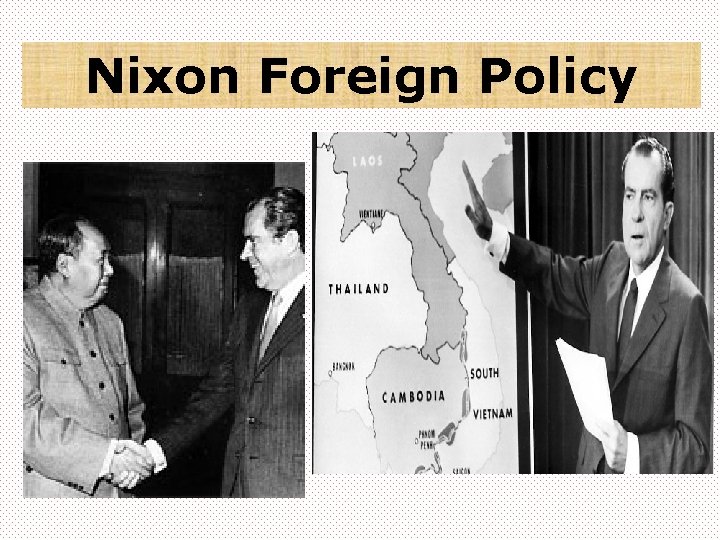
A political realist, Nixon wanted to establish diplomatic relations with China. • Diplomatic relations with China would bring economic opportunities to the United States. • An improved relationship with China would weaken China’s ties to the Soviet Union. The United States stood to gain much by recognizing China.
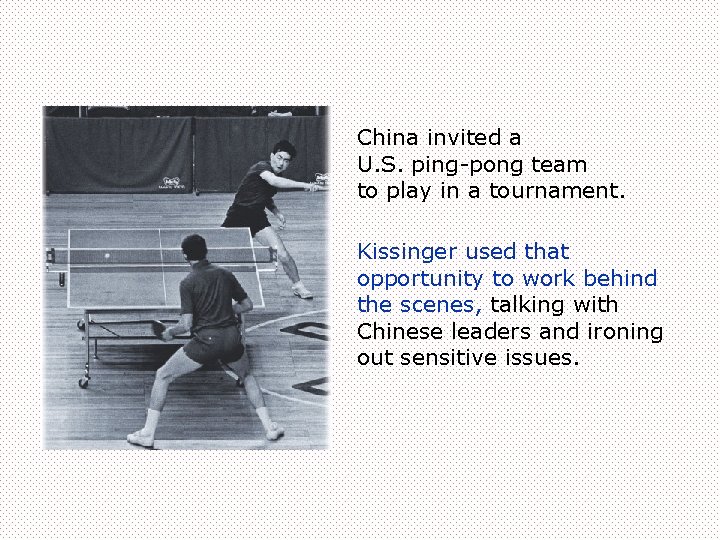
China invited a U. S. ping-pong team to play in a tournament. Kissinger used that opportunity to work behind the scenes, talking with Chinese leaders and ironing out sensitive issues.
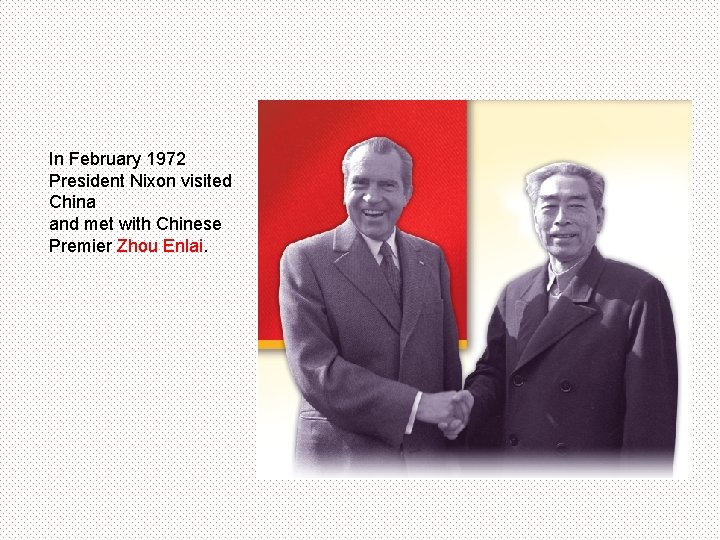
In February 1972 President Nixon visited China and met with Chinese Premier Zhou Enlai.
Nixon’s visit to China resulted in several benefits to the United States. • Trade thrived between the U. S. and China. • American tourists began to visit China. Soviet leader Leonid Brezhnev invited President Nixon to visit Moscow.
In May 1972 Nixon met with Brezhnev in Moscow. • They signed SALT 1, the Strategic Arms Limitation Treaty, a major step towards ending the nuclear arms race. • The two leaders agreed to reduce pollution and undertake a joint U. S. –Soviet space mission.
Nixon’s policy of détente, the easing of Cold War tensions, replaced the old policy based on suspicions and distrust. His foreign-policy breakthroughs moved the world closer to the end of the Cold War.
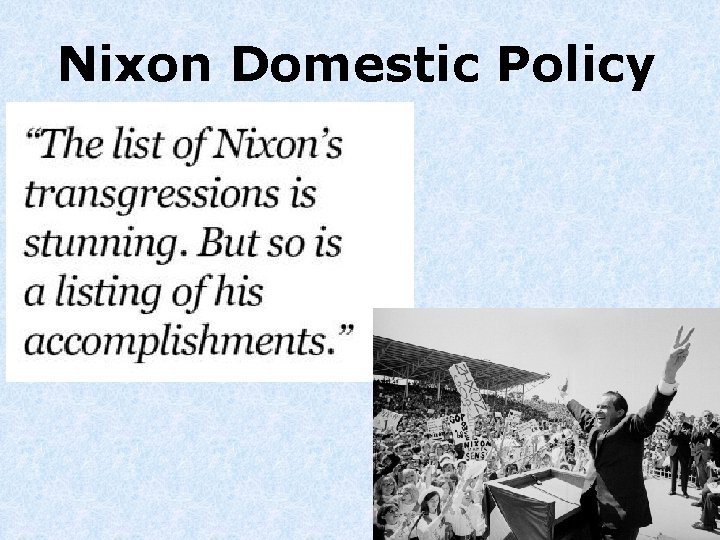
Nixon Domestic Policy
Nixon made a dramatic political comeback in 1968 when he won the presidency. He did it by working to appeal to the silent majority of those he called Middle Americans. ● The “silent majority” was composed of northern blue-collar workers and southern whites, to whom Nixon appealed for support in the 1968 presidential election
Nixon tried to give power back to the state governments but. . . Nixon actually expanded the federal government when he was in office.
Energy Crisis in the 1970’s Causes: ● The energy crisis of the 1970’s resulted from substantial shortages both real and perceived in the supply of petroleum on the world market. ● A 1973 embargo by oil-rich Arab nations on shipping petroleum to the United States ● Political crisis brought on by the Arab and Israeli Yom Kippur War and the Iranian revolution saw a disruption of the petroleum supply to the west Outcomes: ● Stagflation-persistent high inflation combined with high unemployment and stagnant demand in a country's economy. ● High prices ● Fuel shortages
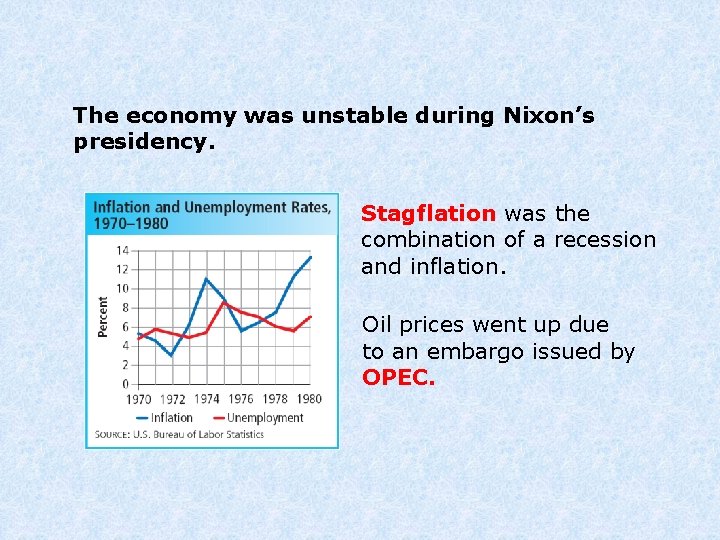
The economy was unstable during Nixon’s presidency. Stagflation was the combination of a recession and inflation. Oil prices went up due to an embargo issued by OPEC.
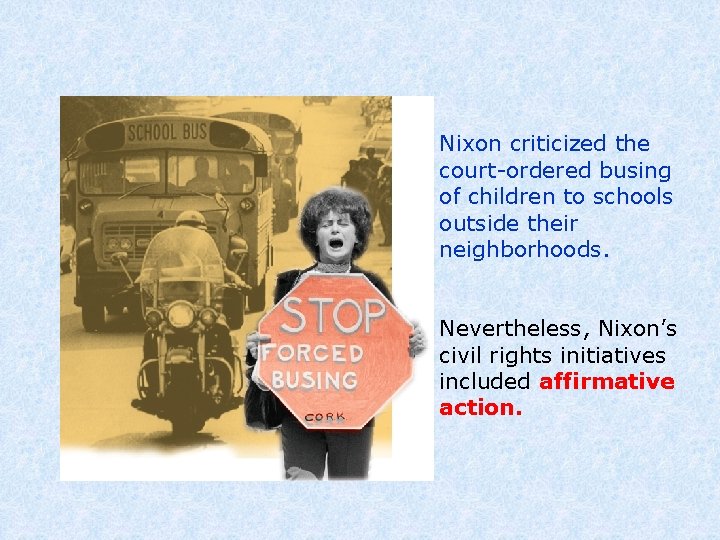
Nixon criticized the court-ordered busing of children to schools outside their neighborhoods. Nevertheless, Nixon’s civil rights initiatives included affirmative action.
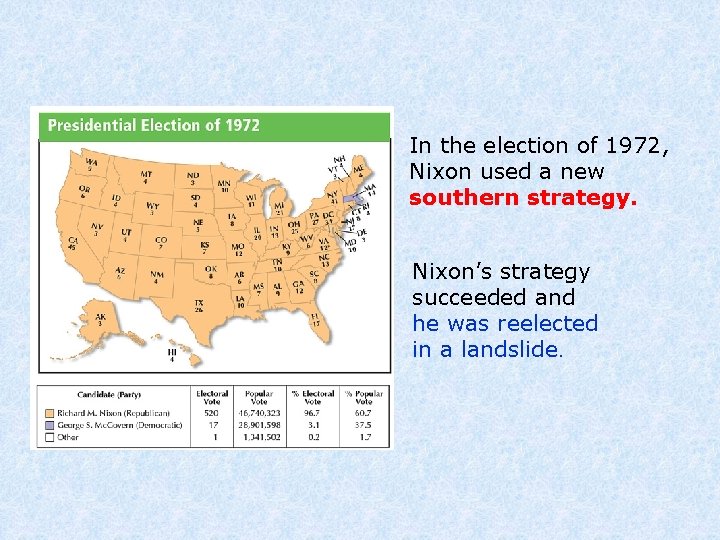
In the election of 1972, Nixon used a new southern strategy. Nixon’s strategy succeeded and he was reelected in a landslide.
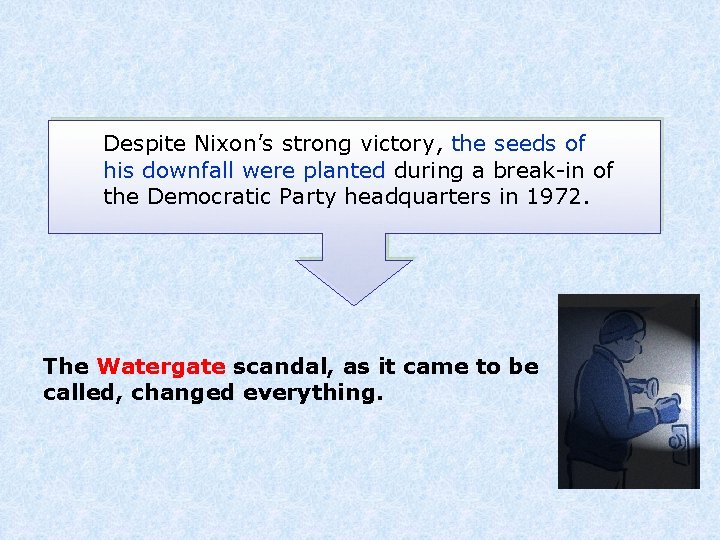
Despite Nixon’s strong victory, the seeds of his downfall were planted during a break-in of the Democratic Party headquarters in 1972. The Watergate scandal, as it came to be called, changed everything.
Nixon denied any wrongdoing. Two Washington Post reporters investigated. It was revealed that Nixon had been secretly taping conversations in the Oval Office.
Nixon refused to turn over the tapes, citing executive privilege. The Supreme Court ordered him to turn them over.
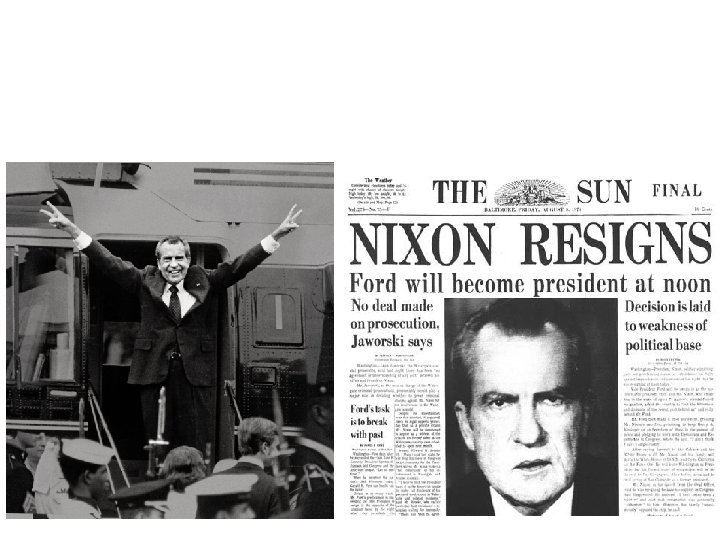
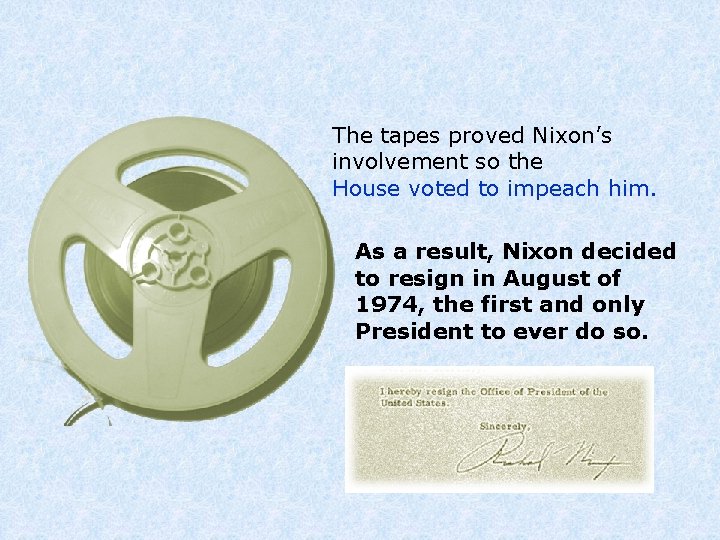
The tapes proved Nixon’s involvement so the House voted to impeach him. As a result, Nixon decided to resign in August of 1974, the first and only President to ever do so.
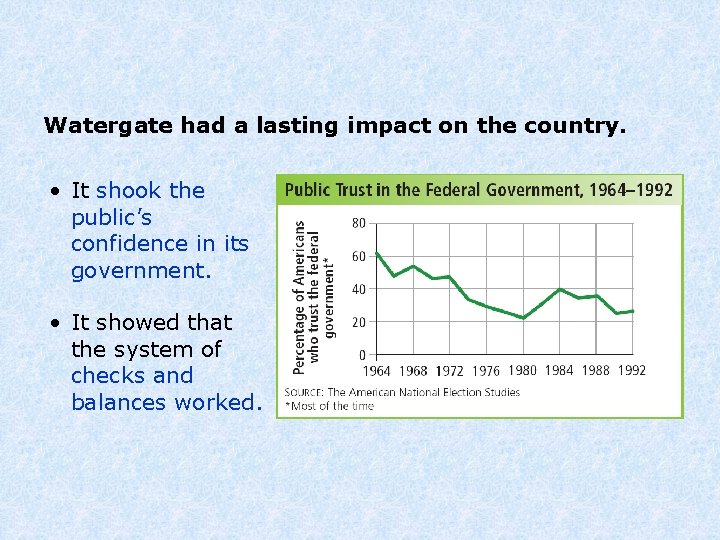
Watergate had a lasting impact on the country. • It shook the public’s confidence in its government. • It showed that the system of checks and balances worked.
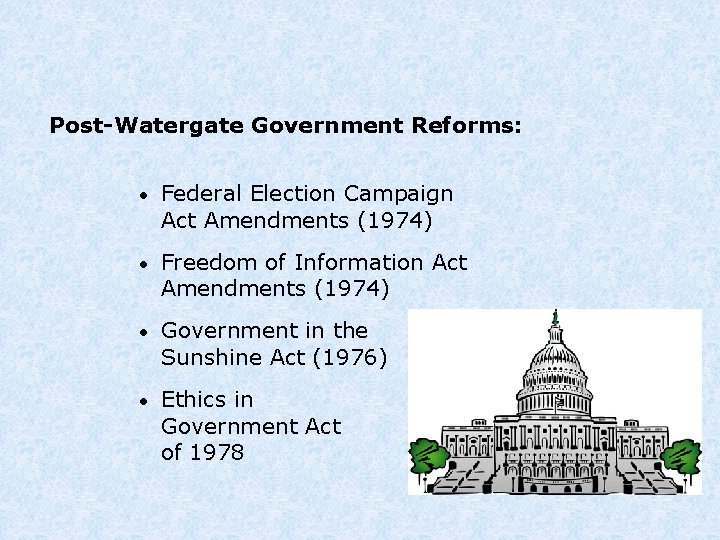
Post-Watergate Government Reforms: • Federal Election Campaign Act Amendments (1974) • Freedom of Information Act Amendments (1974) • Government in the Sunshine Act (1976) • Ethics in Government Act of 1978