
Nitrous Oxide Focus Group launch event Friday February
Nitrous Oxide Focus Group launch event Friday February 22 nd, 2008 The stratospheric sink of N 2 O – the impact upon climate change Dr Jan Kaiser Dr Parvadha Suntharalingam Nitrous Oxide Focus Group
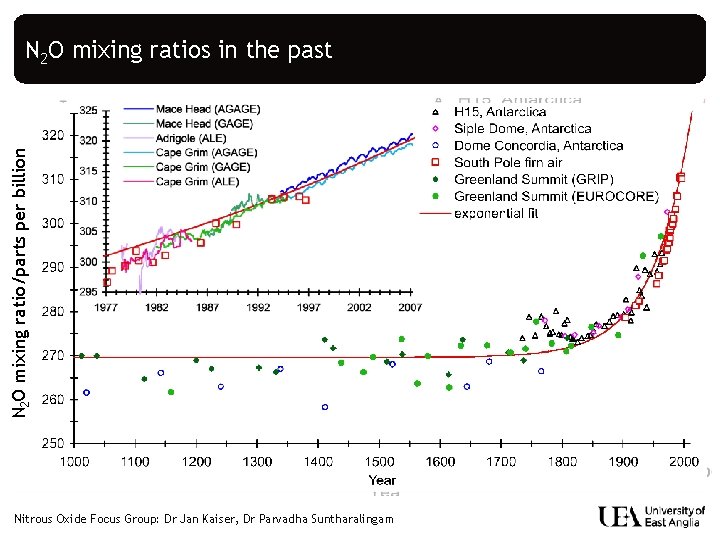
N 2 O mixing ratio/parts per billion N 2 O mixing ratios in the past Nitrous Oxide Focus Group: Dr Jan Kaiser, Dr Parvadha Suntharalingam
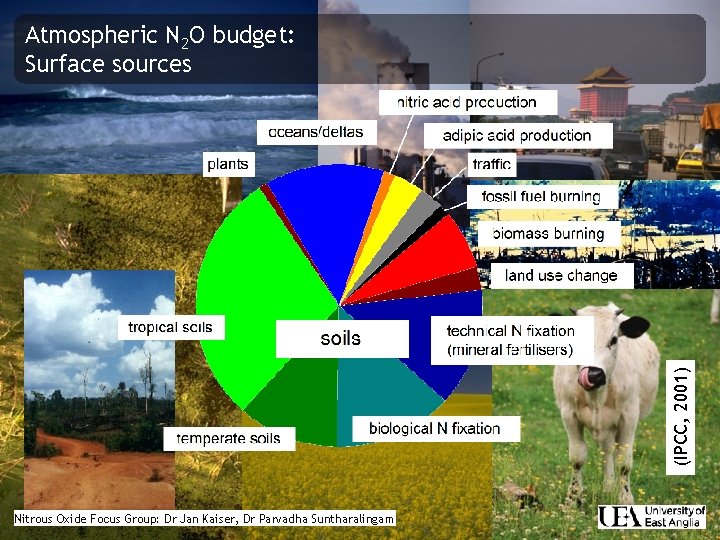
(IPCC, 2001) Atmospheric N 2 O budget: Surface sources Nitrous Oxide Focus Group: Dr Jan Kaiser, Dr Parvadha Suntharalingam
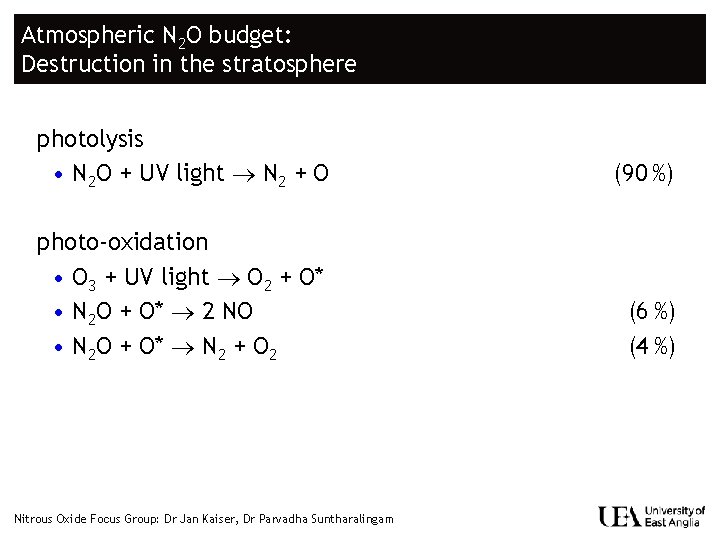
Atmospheric N 2 O budget: Destruction in the stratosphere photolysis • N 2 O + UV light N 2 + O (90 %) photo-oxidation • O 3 + UV light O 2 + O* • N 2 O + O* 2 NO • N 2 O + O* N 2 + O 2 (6 %) (4 %) Nitrous Oxide Focus Group: Dr Jan Kaiser, Dr Parvadha Suntharalingam
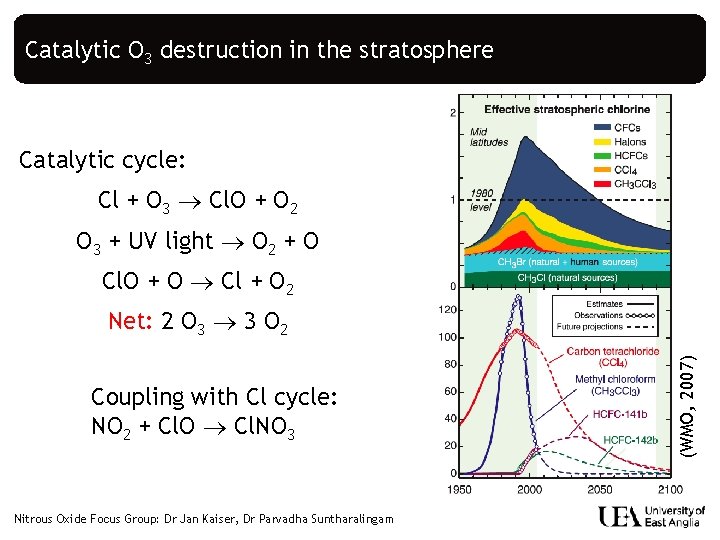
Catalytic O 3 destruction in the stratosphere Initiation: N 2 O + O* 2 NO Catalytic cycle: NO Cl ++ O O 33 Cl. O NO 2 ++ OO 22 O 3 + UV light O 2 + O NO Cl. O +O O NO Cl ++ OO 22 2 + + – Feedbacks: N 2 O Coupling with Cl cycle: UV Cl. NO 3 NO NO 2 + Cl. O – O 3 – Nitrous Oxide Focus Group: Dr Jan Kaiser, Dr Parvadha Suntharalingam (WMO, 2007) Net: 2 O 3 3 O 2
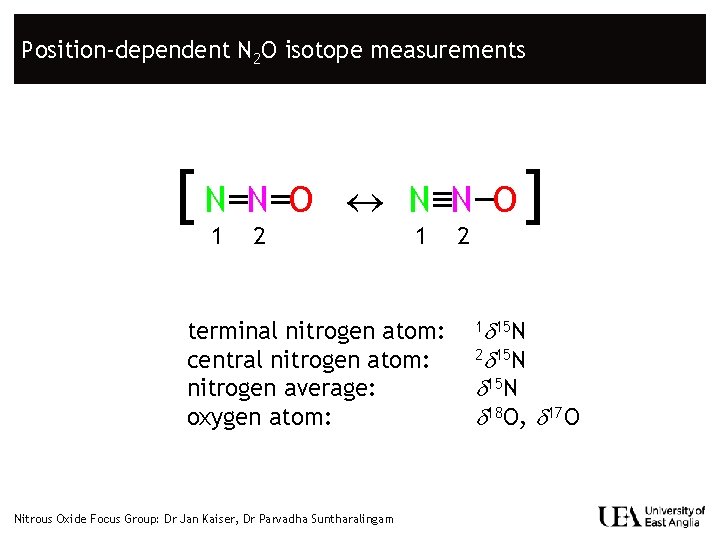
Position-dependent N 2 O isotope measurements [N 1 N O N N O 2 1 terminal nitrogen atom: central nitrogen atom: nitrogen average: oxygen atom: Nitrous Oxide Focus Group: Dr Jan Kaiser, Dr Parvadha Suntharalingam 2 ] 2 15 N 18 O, 17 O 1 15 N
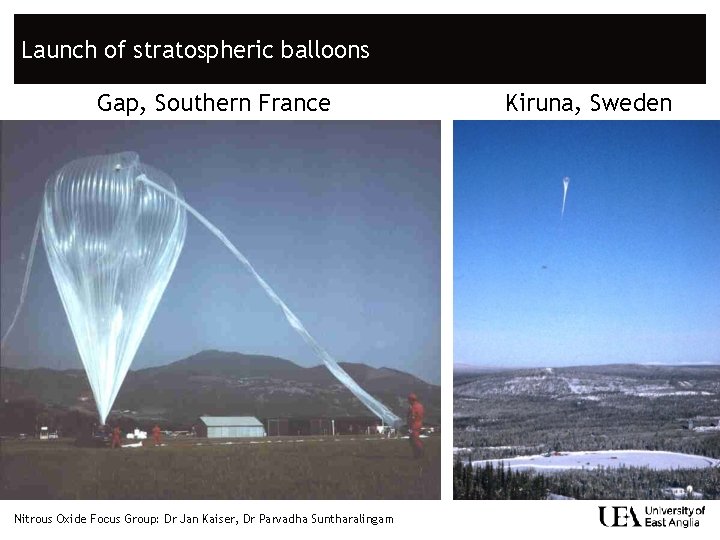
Launch of stratospheric balloons Gap, Southern France Nitrous Oxide Focus Group: Dr Jan Kaiser, Dr Parvadha Suntharalingam Kiruna, Sweden
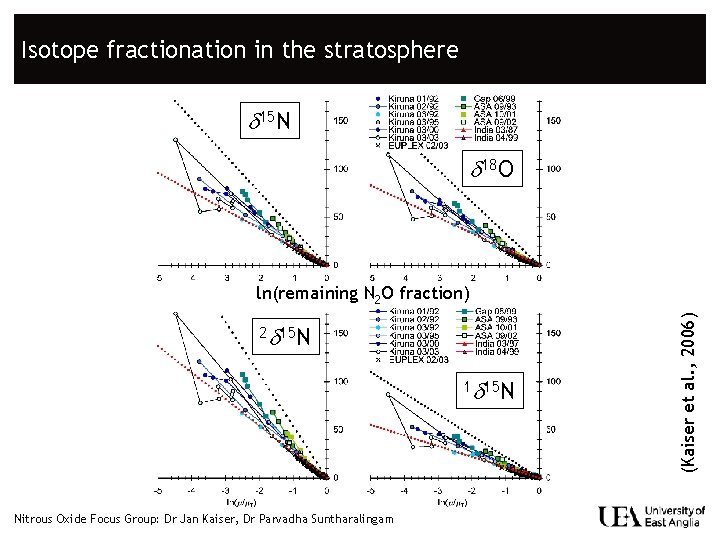
Isotope fractionation in the stratosphere 15 N 18 O 2 15 N 1 15 N Nitrous Oxide Focus Group: Dr Jan Kaiser, Dr Parvadha Suntharalingam (Kaiser et al. , 2006) ln(remaining N 2 O fraction)
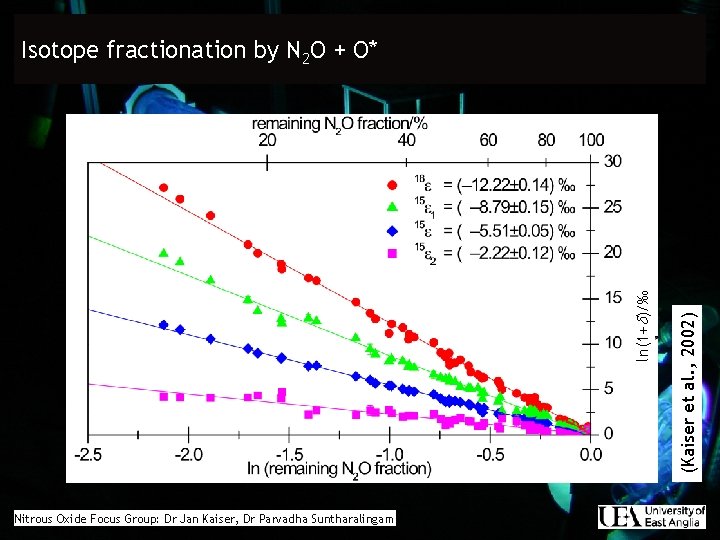
Nitrous Oxide Focus Group: Dr Jan Kaiser, Dr Parvadha Suntharalingam (Kaiser et al. , 2002) ln(1+ )/‰ Isotope fractionation by N 2 O + O*
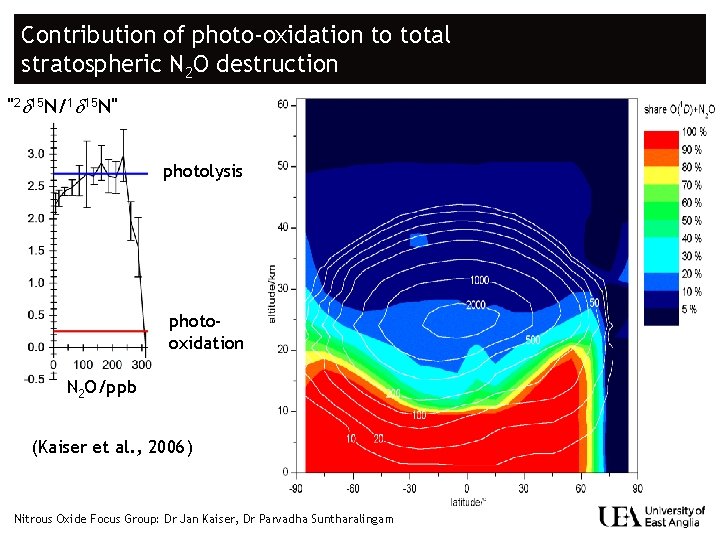
Contribution of photo-oxidation to total stratospheric N 2 O destruction "2 15 N/1 15 N" photolysis photooxidation N 2 O/ppb (Kaiser et al. , 2006) Nitrous Oxide Focus Group: Dr Jan Kaiser, Dr Parvadha Suntharalingam
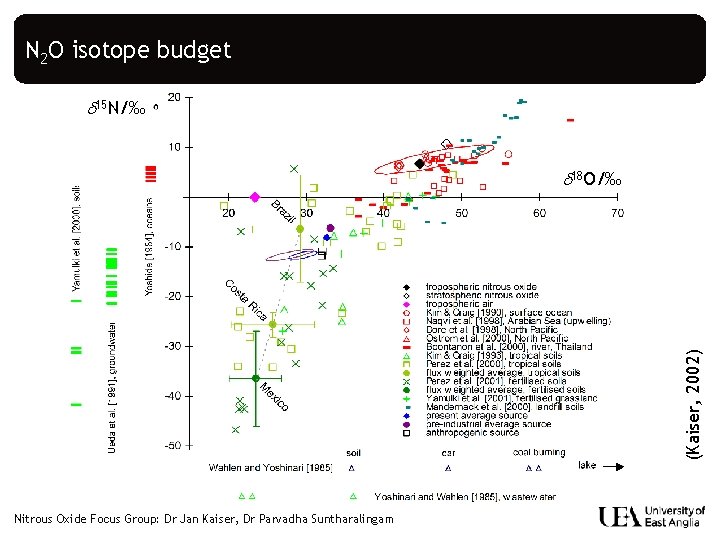
N 2 O isotope budget 15 N/‰ (Kaiser, 2002) 18 O/‰ Nitrous Oxide Focus Group: Dr Jan Kaiser, Dr Parvadha Suntharalingam
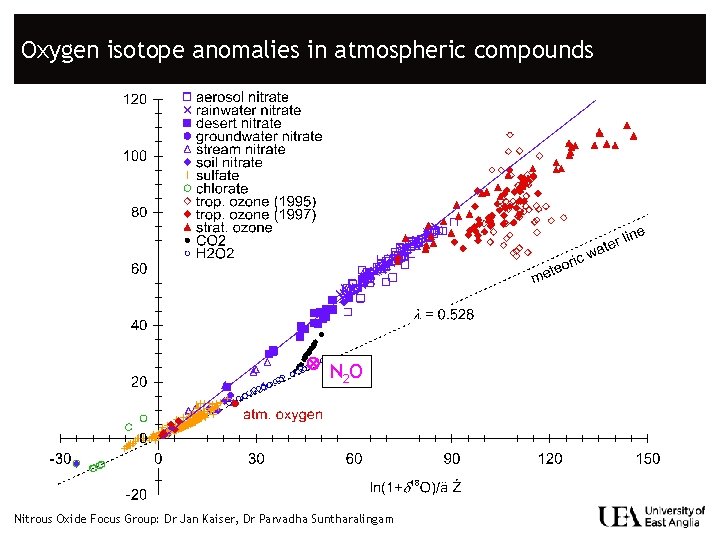
Oxygen isotope anomalies in atmospheric compounds NO 2 Nitrous Oxide Focus Group: Dr Jan Kaiser, Dr Parvadha Suntharalingam
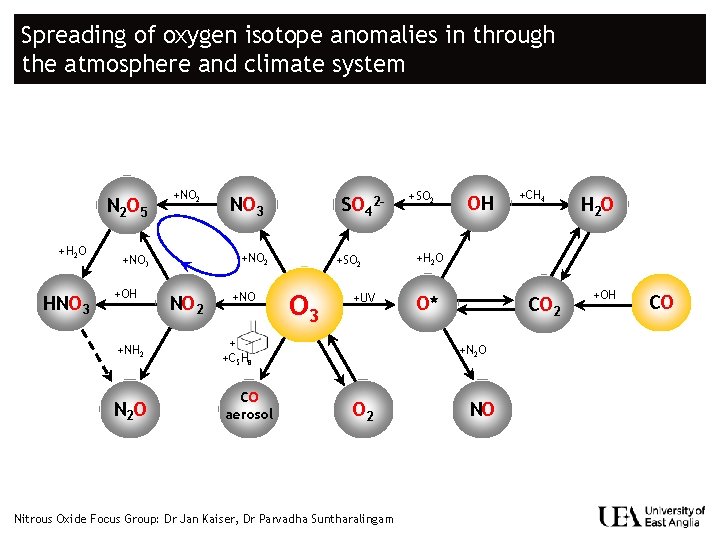
Spreading of oxygen isotope anomalies in through the atmosphere and climate system N 2 O 5 +H 2 O HNO 3 +NO 2 +NH 2 N 2 O SO 42– +NO 2 +NO 3 +OH NO 3 NO 2 +NO +SO 2 O 3 +UV + +C 5 H 8 CO aerosol +SO 2 OH Nitrous Oxide Focus Group: Dr Jan Kaiser, Dr Parvadha Suntharalingam H 2 O +H 2 O O* CO 2 +N 2 O O 2 +CH 4 NO +OH CO
Summary so far … • N 2 O is stable in the lower atmosphere. In the stratosphere, it breaks down to NO and contributes to O 3 destruction. • Position-dependent isotope measurements give unique insights into – stratospheric N 2 O loss reactions – N 2 O (isotope) budgets – contributions of different N 2 O sources – mechanisms of enzymatic reactions • Oxygen isotope anomalies leave fingerprints of atmospheric processes and indicate, for example, atmospheric nitrate inputs into aqueous and terrestrial ecosystems. Nitrous Oxide Focus Group: Dr Jan Kaiser, Dr Parvadha Suntharalingam
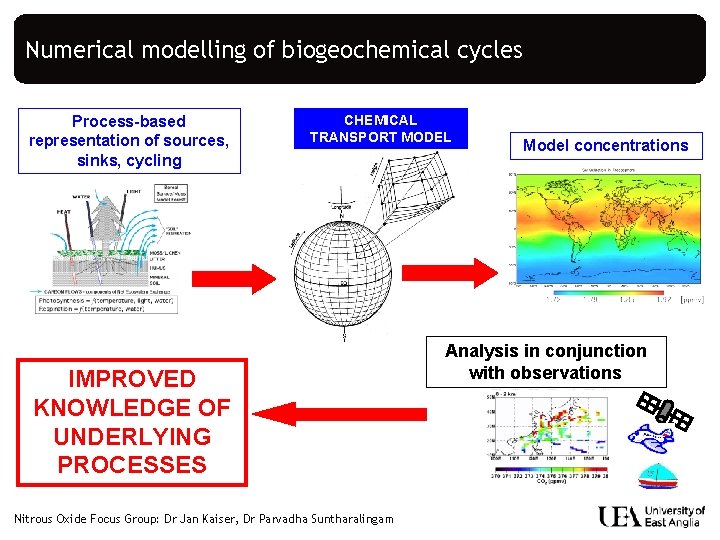
Numerical modelling of biogeochemical cycles Process-based representation of sources, sinks, cycling CHEMICAL TRANSPORT MODEL IMPROVED KNOWLEDGE OF UNDERLYING PROCESSES Nitrous Oxide Focus Group: Dr Jan Kaiser, Dr Parvadha Suntharalingam Model concentrations Analysis in conjunction with observations
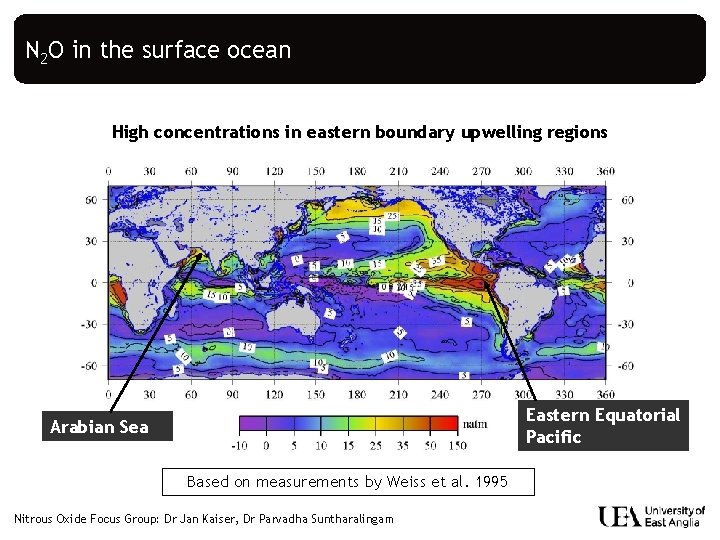
N 2 O in the surface ocean High concentrations in eastern boundary upwelling regions Eastern Equatorial Pacific Arabian Sea Based on measurements by Weiss et al. 1995 Nitrous Oxide Focus Group: Dr Jan Kaiser, Dr Parvadha Suntharalingam
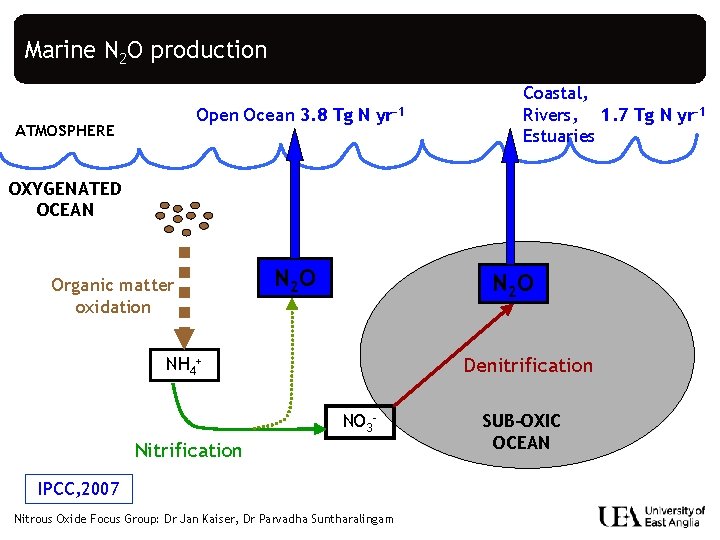
Marine N 2 O production Open Ocean 3. 8 Tg N yr– 1 ATMOSPHERE Coastal, Rivers, 1. 7 Tg N yr-1 Estuaries OXYGENATED OCEAN Organic matter oxidation N 2 O NH 4+ Denitrification NO 3 - Nitrification IPCC, 2007 Nitrous Oxide Focus Group: Dr Jan Kaiser, Dr Parvadha Suntharalingam SUB-OXIC OCEAN
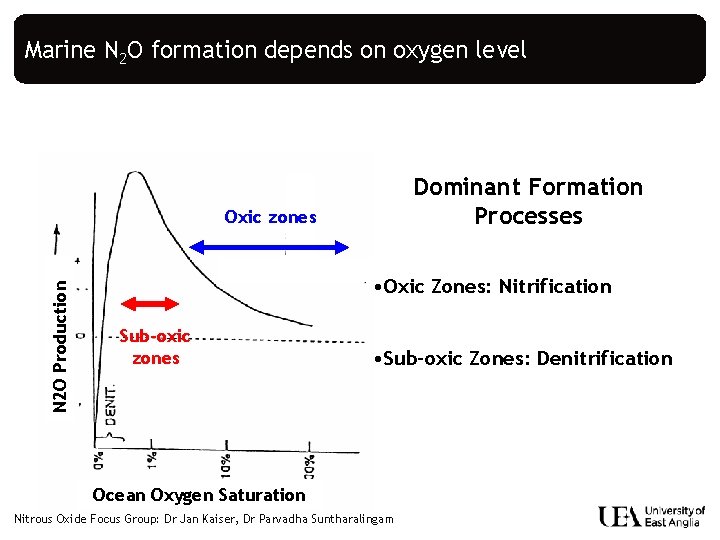
Marine N 2 O formation depends on oxygen level Dominant Formation Processes N 2 O Production Oxic zones • Oxic Zones: Nitrification Anoxic zones Sub-oxic zones • Sub-oxic Zones: Denitrification Ocean Oxygen Saturation Nitrous Oxide Focus Group: Dr Jan Kaiser, Dr Parvadha Suntharalingam
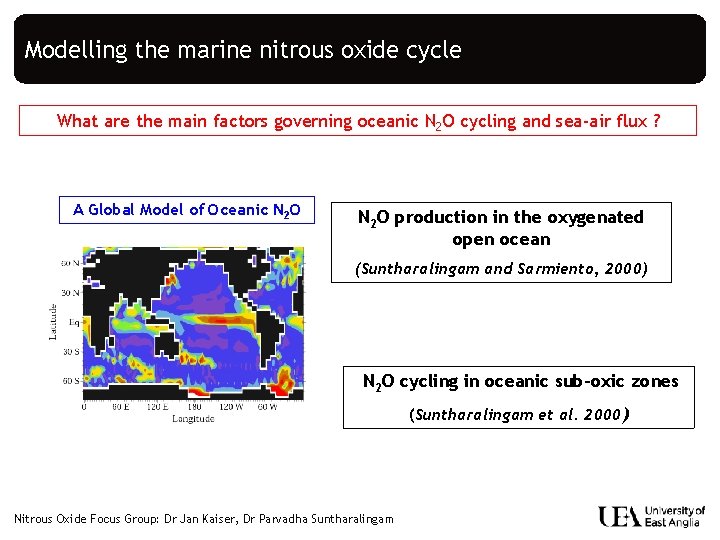
Modelling the marine nitrous oxide cycle What are the main factors governing oceanic N 2 O cycling and sea-air flux ? A Global Model of Oceanic N 2 O production in the oxygenated open ocean (Suntharalingam and Sarmiento, 2000) N 2 O cycling in oceanic sub-oxic zones (Suntharalingam et al. 2000) Nitrous Oxide Focus Group: Dr Jan Kaiser, Dr Parvadha Suntharalingam
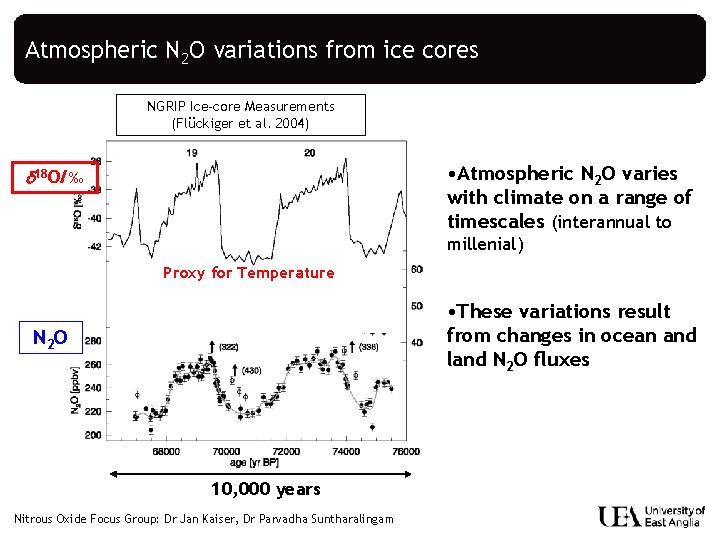
Atmospheric N 2 O variations from ice cores NGRIP Ice-core Measurements (Flückiger et al. 2004) • Atmospheric N 2 O varies with climate on a range of timescales (interannual to d 18 O/‰ millenial) Proxy for Temperature • These variations result from changes in ocean and land N 2 O fluxes N 2 O 10, 000 years Nitrous Oxide Focus Group: Dr Jan Kaiser, Dr Parvadha Suntharalingam
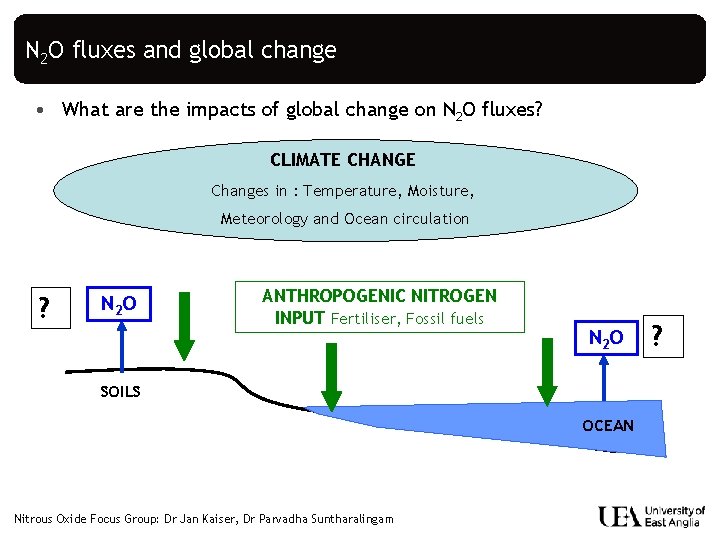
N 2 O fluxes and global change • What are the impacts of global change on N 2 O fluxes? CLIMATE CHANGE Changes in : Temperature, Moisture, Meteorology and Ocean circulation ? N 2 O ANTHROPOGENIC NITROGEN INPUT Fertiliser, Fossil fuels N 2 O SOILS OCEAN Nitrous Oxide Focus Group: Dr Jan Kaiser, Dr Parvadha Suntharalingam ?
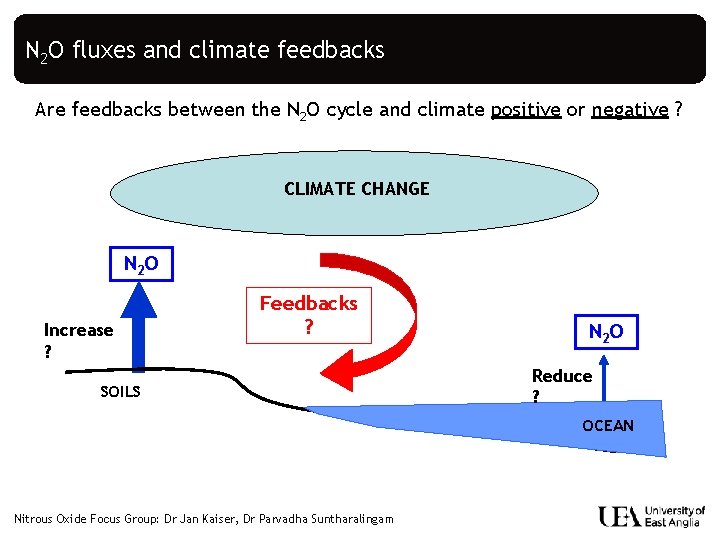
N 2 O fluxes and climate feedbacks Are feedbacks between the N 2 O cycle and climate positive or negative ? CLIMATE CHANGE N 2 O Increase ? Feedbacks ? SOILS N 2 O Reduce ? OCEAN Nitrous Oxide Focus Group: Dr Jan Kaiser, Dr Parvadha Suntharalingam
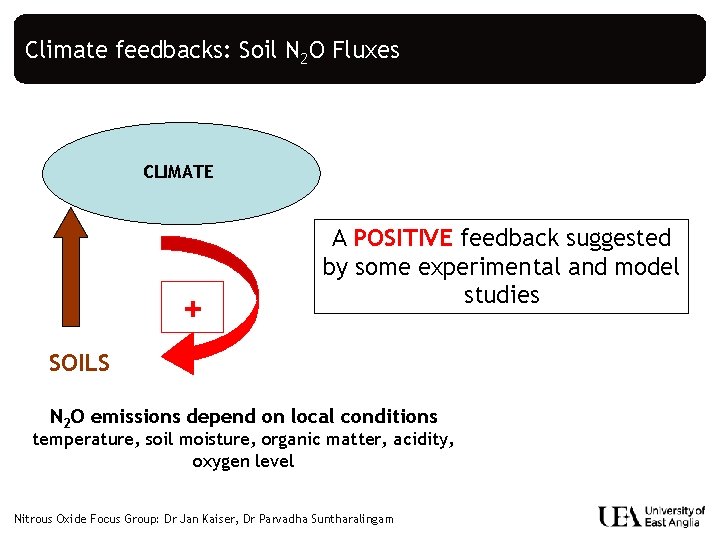
Climate feedbacks: Soil N 2 O Fluxes CLIMATE + A POSITIVE feedback suggested by some experimental and model studies SOILS N 2 O emissions depend on local conditions temperature, soil moisture, organic matter, acidity, oxygen level Nitrous Oxide Focus Group: Dr Jan Kaiser, Dr Parvadha Suntharalingam
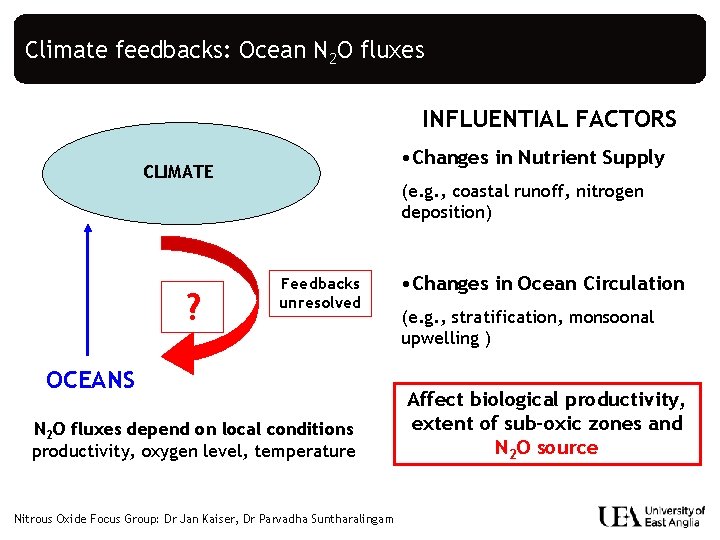
Climate feedbacks: Ocean N 2 O fluxes INFLUENTIAL FACTORS • Changes in Nutrient Supply CLIMATE ? (e. g. , coastal runoff, nitrogen deposition) Feedbacks unresolved OCEANS N 2 O fluxes depend on local conditions productivity, oxygen level, temperature Nitrous Oxide Focus Group: Dr Jan Kaiser, Dr Parvadha Suntharalingam • Changes in Ocean Circulation (e. g. , stratification, monsoonal upwelling ) Affect biological productivity, extent of sub-oxic zones and N 2 O source
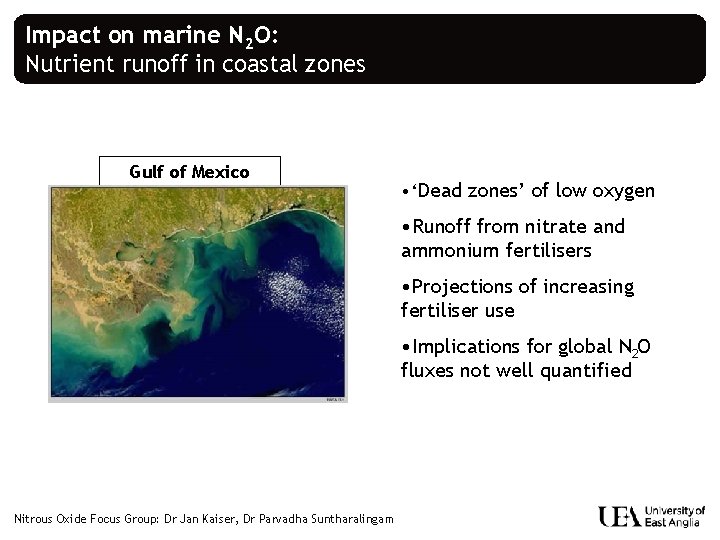
Impact on marine N 2 O: Nutrient runoff in coastal zones Gulf of Mexico • ‘Dead zones’ of low oxygen • Runoff from nitrate and ammonium fertilisers • Projections of increasing fertiliser use • Implications for global N 2 O fluxes not well quantified Nitrous Oxide Focus Group: Dr Jan Kaiser, Dr Parvadha Suntharalingam
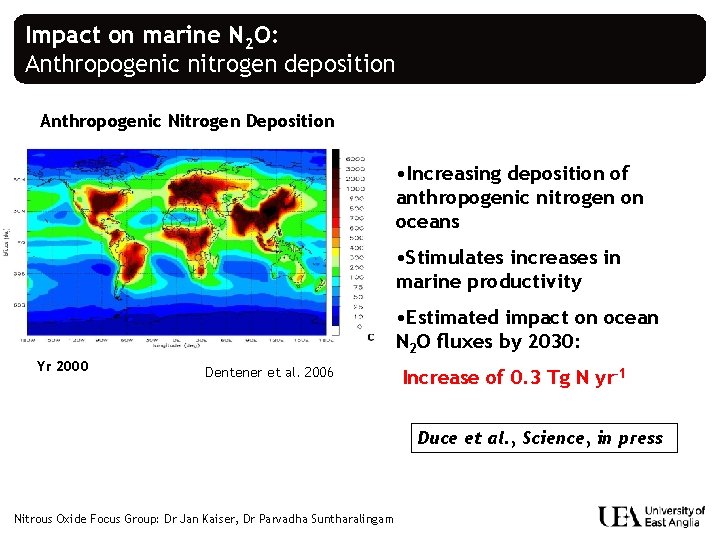
Impact on marine N 2 O: Anthropogenic nitrogen deposition Anthropogenic Nitrogen Deposition • Increasing deposition of anthropogenic nitrogen on oceans • Stimulates increases in marine productivity • Estimated impact on ocean N 2 O fluxes by 2030: Yr 2000 Dentener et al. 2006 Increase of 0. 3 Tg N yr– 1 Duce et al. , Science, in press Nitrous Oxide Focus Group: Dr Jan Kaiser, Dr Parvadha Suntharalingam
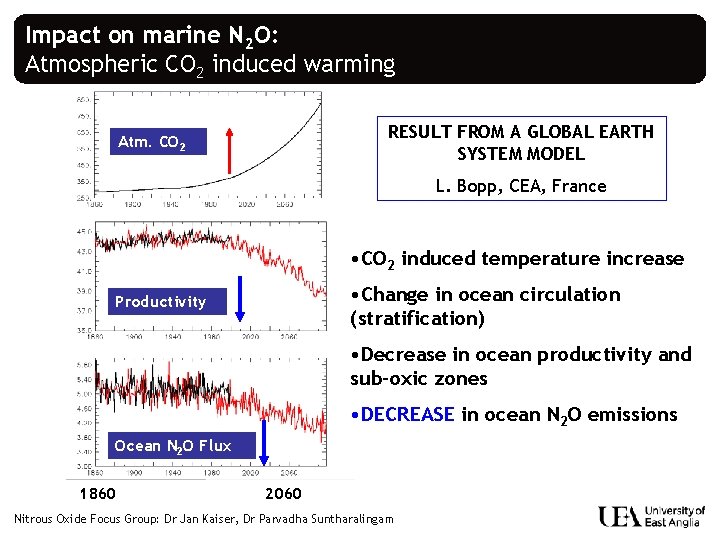
Impact on marine N 2 O: Atmospheric CO 2 induced warming RESULT FROM A GLOBAL EARTH SYSTEM MODEL Atm. CO 2 L. Bopp, CEA, France • CO 2 induced temperature increase • Change in ocean circulation (stratification) Productivity • Decrease in ocean productivity and sub-oxic zones • DECREASE in ocean N 2 O emissions Ocean N 2 O Flux 1860 2060 Nitrous Oxide Focus Group: Dr Jan Kaiser, Dr Parvadha Suntharalingam
Summary • Marine N 2 O formation is sensitive to local environmental conditions, in particular, oxygen concentration and biological productivity. • Anthropogenic nitrogen input to the open and coastal ocean is predicted to increase; the implications for the global marine N 2 O source are not well quantified. • The overall climate-oceanic N 2 O flux feedback depends on several competing factors. Our present understanding of the net feedback is low. Nitrous Oxide Focus Group: Dr Jan Kaiser, Dr Parvadha Suntharalingam
- Slides: 28