
Nitrification Nitrobacter Nitrosomonas Note There are other bacteria
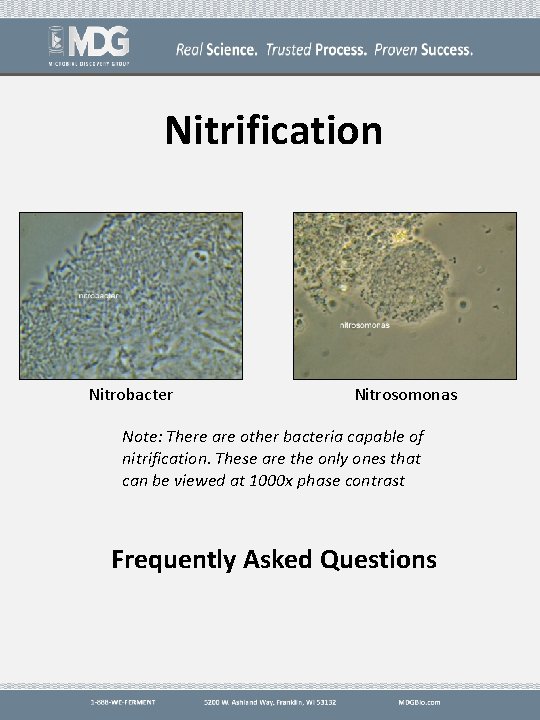
Nitrification Nitrobacter Nitrosomonas Note: There are other bacteria capable of nitrification. These are the only ones that can be viewed at 1000 x phase contrast Frequently Asked Questions
What are the Forms of Nitrogen? • Total Nitrogen= organic N + inorganic N • TKN (Total Kjeldahl Nitrogen)= ammonia and organic nitrogen (particulate and soluble) • Organic Nitrogen- Proteins, peptides, nucleic acids, urea, other synthetic organic compounds • Nitrate, Nitrite, Nitrogen Gas • Ammonia N- NH 3/ NH 4 • TIN (Total Inorganic Nitrogen)= nitrate + nitrite + ammonia
What is Nitrification? • Nitrification is an aerobic process that involves the conversion of ammonia to nitrite and then nitrate through nitrifying bacteria • Nitrosomonas, as well as other nitrifying bacteria convert ammonia to nitrite • Nitrobacter, as well as other nitrifying bacteria convert nitrite to nitrate • The bacteria in wastewater treatment will remove some nitrogen as a nutrient, and the remaining nitrogen may need to undergo this process if there is an ammonia limit for the plant
What’s the difference between ammonium and ammonia? • For scientific purposes, ammonia and ammonia are often grouped together and referred to as ammonia • Ammonium (NH 4+) is the ionized form of ammonia which is oxidized by nitrifying bacteria • The relationship between ammonium and ammonia (NH 3) depends on p. H and to a lesser extend, the temperature. • Un-ionized ammonia (NH 3) is the toxic form and will predominate at higher p. H. • In general, less than 10% of ammonia is in the toxic form at p. H <8 • Ammonium is relatively non-toxic and predominates at lower p. H values • At any p. H, more toxic ammonia is present in warmer water than in cooler water
What are the needed operating parameters for nitrification? • Dissolved Oxygen: Generally 2 mg/L or more is recommended to ensure aerobic conditions. • 4. 57 lbs of dissolved oxygen are consumed for every lb of ammonium converted to nitrate • p. H: 7 -8. 5 • Temperature: Nitrifying bacteria prefer temperatures between 15 -30 degrees C • nitrification rates will decrease at cooler temperatures • Alkalinity: Alkalinity is the food source for nitrifying bacteria. • For every part ammonium converted to nitrate, 7. 14 parts alkalinity are consumed. • Generally, it is good practice to maintain 60 mg/L or more alkalinity residual in the mixed liquor • Sludge Age: Due to slow growth rates of nitrifying bacteria, generally a 5 day sludge age or more is recommended for nitrification
What compounds can inhibit nitrification? • Heavy Metals • Phenol • Cyanide • Amines • Surfactants • Sulfide • Certain organic acids • Chlorinated hydrocarbons • Peracedic acid • Quaternary ammonium • Flourides
What should I do if the ammonia suddenly spikes in my effluent? • A microscopic evaluation is recommended to look for any signs of inhibition or stress to the other bacteria • It is generally accepted practice to increase the sludge age (decrease the wasting rate) to allow more time for nitrifying bacteria to grow • Ensure that the proper conditions for nitrification are present (see previous slide) • If, and only if the proper conditions are in place and there are no inhibitory compounds present, reseeding the plant with nitrifying bacteria via bio augmentation is a common practice • A nitrogen balance of the plant can be estimated to determine if the increase of ammonia in the effluent is simply due to more ammonia in the influent • Always document operational decisions, especially in the event of a potential non-compliance situation. • Your operational log book could serve as a legal document
- Slides: 7